APPROACH TO
PNEUMOTHORAX
Dr Navdeep Labana MD
Asst. Professor
Dept of Pulmonary Medicine
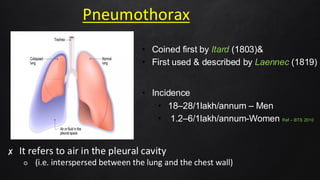
Pneumothorax
✘ It refers to air in the pleural cavity
○ (i.e. interspersed between the lung and the chest wall)
• Coined first by Itard (1803)&
• First used & described by Laennec (1819)
• Incidence
• 18–28/1lakh/annum – Men
• 1.2–6/1lakh/annum-Women Ref – BTS 2010
3
4
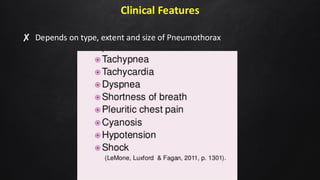
Clinical Features
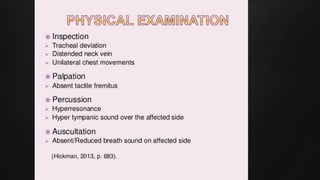
✘ Depends on type, extent and size of Pneumothorax
5
6
Radiology
7
“
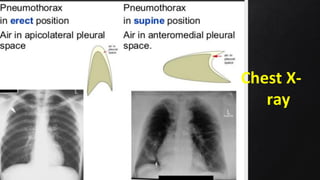
Chest X-
ray
9
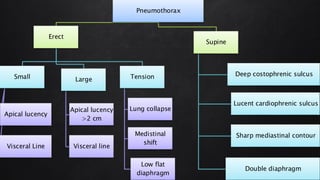
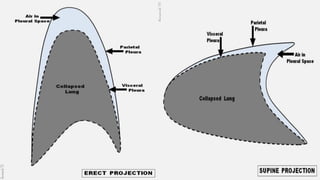
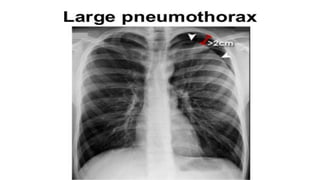
Pneumothorax
Erect
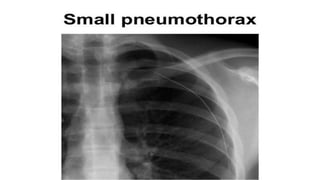
Small
Apical lucency
Visceral Line
Large
Apical lucency
>2 cm
Visceral line
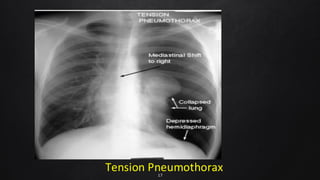
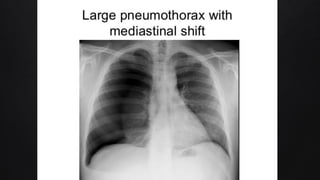
Tension
Lung collapse
Medistinal
shift
Low flat
diaphragm
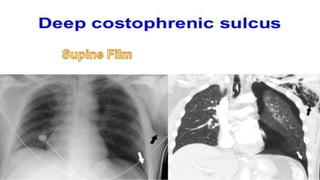
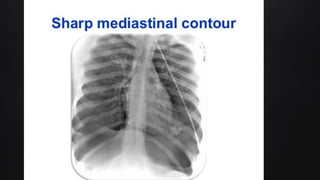
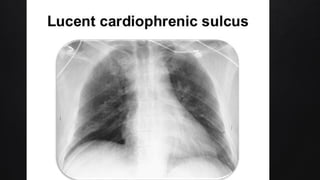
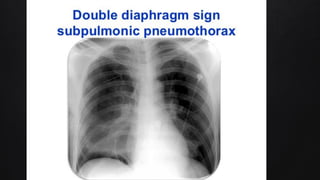
Supine
Deep costophrenic sulcus
Lucent cardiophrenic sulcus
Sharp mediastinal contour
Double diaphragm
10
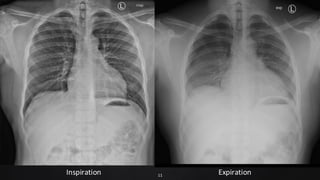
Inspiration Expiration
11
12
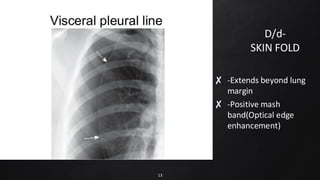
D/d-
SKIN FOLD
✘ -Extends beyond lung
margin
✘ -Positive mash
band(Optical edge
enhancement)
13
14
15
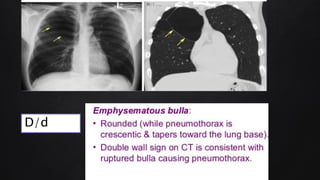
D/d
16
Tension Pneumothorax
17
18
Supine Film
19
20
21
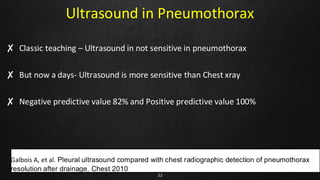
Ultrasound in Pneumothorax
✘ Classic teaching – Ultrasound in not sensitive in pneumothorax
✘ But now a days- Ultrasound is more sensitive than Chest xray
✘ Negative predictive value 82% and Positive predictive value 100%
22
Galbois A, et al. Pleural ultrasound compared with chest radiographic detection of pneumothorax
resolution after drainage. Chest 2010
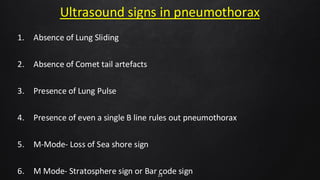
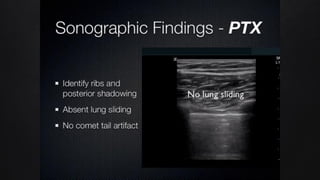
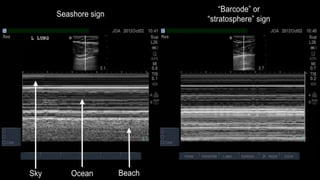
Ultrasound signs in pneumothorax
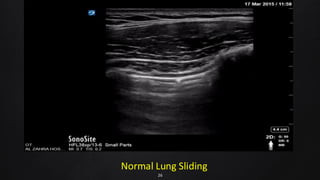
1. Absence of Lung Sliding
2. Absence of Comet tail artefacts
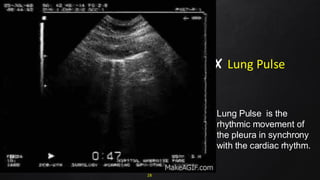
3. Presence of Lung Pulse
4. Presence of even a single B line rules out pneumothorax
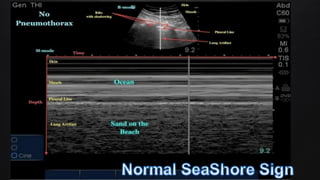
5. M-Mode- Loss of Sea shore sign
6. M Mode- Stratosphere sign or Bar code sign
23
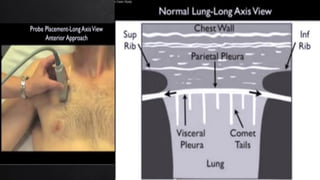
24
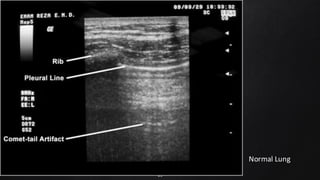
Normal Lung
25
Normal Lung Sliding
26
27
“ ✘ Lung Pulse
28
Lung Pulse is the
rhythmic movement of
the pleura in synchrony
with the cardiac rhythm.
29
Normal SeaShore Sign
30
31
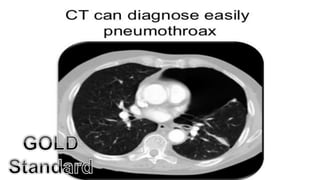
GOLD
Standard
Pneumothorax
Spontaneous
Primary Secondary
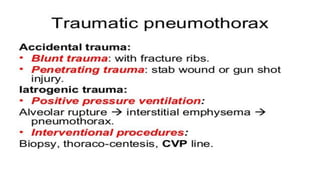
Traumatic
Iatrogenic
Procedure
related
Positive
pressure
ventilation
Others
Blunt trauma
Penetrating
Trauma
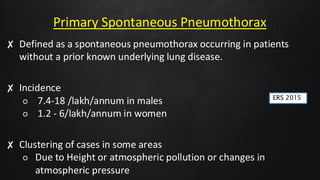
Primary Spontaneous Pneumothorax
✘ Defined as a spontaneous pneumothorax occurring in patients
without a prior known underlying lung disease.
✘ Incidence
○ 7.4-18 /lakh/annum in males
○ 1.2 - 6/lakh/annum in women
✘ Clustering of cases in some areas
○ Due to Height or atmospheric pollution or changes in
atmospheric pressure
ERS 2015
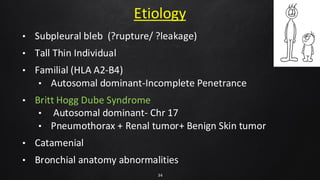
Etiology
• Subpleural bleb (?rupture/ ?leakage)
• Tall Thin Individual
• Familial (HLA A2-B4)
• Autosomal dominant-Incomplete Penetrance
• Britt Hogg Dube Syndrome
• Autosomal dominant- Chr 17
• Pneumothorax + Renal tumor+ Benign Skin tumor
• Catamenial
• Bronchial anatomy abnormalities
34
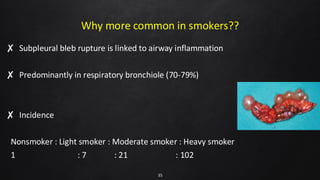
Why more common in smokers??
✘ Subpleural bleb rupture is linked to airway inflammation
✘ Predominantly in respiratory bronchiole (70-79%)
✘ Incidence
Nonsmoker : Light smoker : Moderate smoker : Heavy smoker
1 : 7 : 21 : 102
35
Catamenial Pmneumothorax
✘ Rare condition -women of reproductive age- in a temporal
relationship with menses.
✘ Recurrent episodes of pneumothorax - occur within 72 h
before or after the start of menstruation
✘ May try Gonadotrophin relasing human analogue for 6-12
months and create iatrogenic amenorrhea as treatment.
2.Jablonski C,
3.Kadiri H, et al.
Catamenial and noncatamenial, endometriosis-related or nonendometriosis-related pneumothorax referred for surgery. Am J Respir Crit Care Med 2007
ERS 2015
Curious Fact
✘ 30% of women with PSP referred for Surgery had catramenial pneumothorax
✘ Most common abnormality found in surgery was not thoracic endometriosis, but
were diaphragmatic defects
✘ Defects ranged fro 1 mm to 1cm – resected defects didn’t have endometrium
37
Alifano M et al.- Catamenial and noncatamenial, endometriosis-related or nonendometriosis-related
pneumothorax referred for surgery. Am J Respir Crit Care Med 2007
Plu-Bureau G, et al.Catamenial pneumothorax and endometriosis-related pneumothorax: clinical
features and risk factors. Hum Reprod 2011
Clinical Features- PSP
✘ Early 20s ( very rare after 40)
✘ Pleuritic pain (81%) + Dyspnea (39%)
✘ Rare symptom – Horners ( due to traction at sympathetic ganglia)
✘ Usually at rest (80%)
✘ O/E- Tachypnea + Tachycardia (Hemodynamic compromise is rare)
✘ Affected side- Decreased movements, Breath sounds, VF and VR with
Hyperresonance
Rarely may have shift of mediastinum to opposite side
Bense L,Et al. Onset of symptoms in spontaneous pneumothorax: correlations to physical activity. Eur J
Respir Dis 1987
Recurrence rate
✘ ERS 2018 (Stephen et al) systematic review
○ a 32% PSP recurrence rate,
○ with greatest risk in the first year.
○ Female sex -with higher risk
○ Widely accepted Lights Reference (Ipsilateral)
■ - Recurrence rate 52.5% ( 1st year) - 62% (second year) - 83% (third
year)
■ Contralateral -10%
39
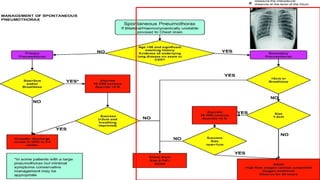
Management (ERS 2015, BTS 2010)
✘ More towards conservative side
✘ Because tension poneumothorax extremely rare
✘ Principle
○ intrapleural air does not necessarily require a therapeutic
intervention, and that management depends on the clinical
symptoms and not on the size of the pneumothorax
40
Henry M, et al BTS guidelines for the management of spontaneous pneumothorax. Thorax 2003; 58: Suppl. 2, ii39–ii52
41
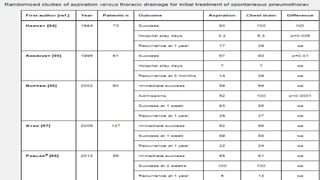
ERS 2015 conclusion
✘ Needle aspiration is effective for the initial management of spontaneous
pneumothorax.
✘ Following aspiration, patients may be discharged, avoiding hospital admission
✘ Failure with aspiration occurs at a frequency of 25–50% in PSP
✘ After a failed aspiration there is no evidence to support a second aspiration over
chest drain insertion.
✘ Smaller bore (11–13 French) tubes seemed to perform better than larger drains
(20–28 French)
42
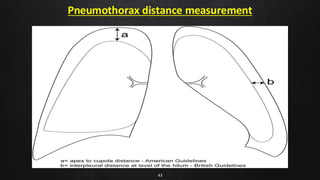
Pneumothorax distance measurement
43
Conservative Management
✘ Rate of absorption of air – 1.25% of total hemithoracic volume/day
✘ Average duration of hospital stay – 4 days
OXYGEN in Pneumothorax
3L/mt via nasal cannula ( higher if there is hypoxemnia)
Oxygen therapy reduces the partial pressure of nitrogen in the alveolus
compared with the pleural cavity, and a diffusion gradient for
nitrogen accelerates resolution
44
Suction or No Suction
✘ Initial Suction –No much role
✘ Lung re-expansion is achieved in up to 70% of patients with chest tube
drainage alone by day 3 without suction
✘ May be tried in a small proportion with air leak
45
1.Voisin F, et al. Ambulatory management of large spontaneous pneumothorax with pigtail catheters. Ann Emerg Med 2014; 64: 222–228.
Lai SM, et al. Outpatient treatment of primary spontaneous pneumothorax using a small-bore chest drain with a Heimlich valve: the experience of a Singapore emergency
department. Eur J Emerg Med 2012; 19: 400–404
Indications of Definitive Management of Primary
Spontaneous Pneumothorax
✘ Second episode of PSP
✘ Persisting airleak >3-5 days
✘ Hemopneumothorax
✘ Bilateral pneumothorax
✘ Professions at high risk 46
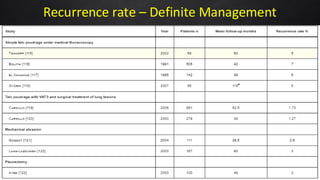
Recurrence rate – Definite Management
47
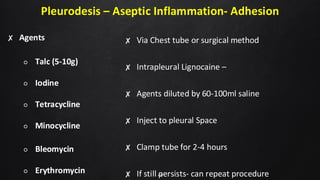
Pleurodesis – Aseptic Inflammation- Adhesion
✘ Agents
○ Talc (5-10g)
○ Iodine
○ Tetracycline
○ Minocycline
○ Bleomycin
○ Erythromycin
✘ Via Chest tube or surgical method
✘ Intrapleural Lignocaine –
✘ Agents diluted by 60-100ml saline
✘ Inject to pleural Space
✘ Clamp tube for 2-4 hours
✘ If still persists- can repeat procedure
48
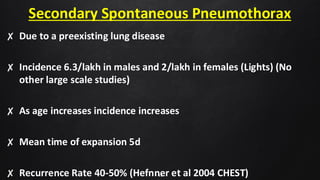
Secondary Spontaneous Pneumothorax
✘ Due to a preexisting lung disease
✘ Incidence 6.3/lakh in males and 2/lakh in females (Lights) (No
other large scale studies)
✘ As age increases incidence increases
✘ Mean time of expansion 5d
✘ Recurrence Rate 40-50% (Hefnner et al 2004 CHEST)
49
50
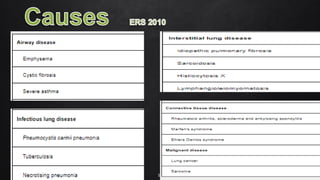
Causes ERS 2010
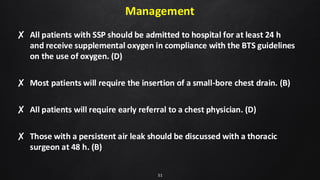
Management
✘ All patients with SSP should be admitted to hospital for at least 24 h
and receive supplemental oxygen in compliance with the BTS guidelines
on the use of oxygen. (D)
✘ Most patients will require the insertion of a small-bore chest drain. (B)
✘ All patients will require early referral to a chest physician. (D)
✘ Those with a persistent air leak should be discussed with a thoracic
surgeon at 48 h. (B)
51
52
53
✘ Pneumothorax ex vaco – Due to acute bronchial obstruction
✘ Pneumothorax with maximum duration of airleak – PCP in AIDS
55
thanks!
Any questions?
56

Respiratory System - Approach to Pneumothorax

  • 1.
    APPROACH TO PNEUMOTHORAX Dr NavdeepLabana MD Asst. Professor Dept of Pulmonary Medicine
  • 2.
    Pneumothorax ✘ It refersto air in the pleural cavity ○ (i.e. interspersed between the lung and the chest wall) • Coined first by Itard (1803)& • First used & described by Laennec (1819) • Incidence • 18–28/1lakh/annum – Men • 1.2–6/1lakh/annum-Women Ref – BTS 2010
  • 3.
  • 4.
  • 5.
    Clinical Features ✘ Dependson type, extent and size of Pneumothorax 5
  • 6.
  • 7.
  • 8.
  • 9.
    9 Pneumothorax Erect Small Apical lucency Visceral Line Large Apicallucency >2 cm Visceral line Tension Lung collapse Medistinal shift Low flat diaphragm Supine Deep costophrenic sulcus Lucent cardiophrenic sulcus Sharp mediastinal contour Double diaphragm
  • 10.
  • 11.
  • 12.
  • 13.
    D/d- SKIN FOLD ✘ -Extendsbeyond lung margin ✘ -Positive mash band(Optical edge enhancement) 13
  • 14.
  • 15.
  • 16.
  • 17.
  • 18.
  • 19.
  • 20.
  • 21.
  • 22.
    Ultrasound in Pneumothorax ✘Classic teaching – Ultrasound in not sensitive in pneumothorax ✘ But now a days- Ultrasound is more sensitive than Chest xray ✘ Negative predictive value 82% and Positive predictive value 100% 22 Galbois A, et al. Pleural ultrasound compared with chest radiographic detection of pneumothorax resolution after drainage. Chest 2010
  • 23.
    Ultrasound signs inpneumothorax 1. Absence of Lung Sliding 2. Absence of Comet tail artefacts 3. Presence of Lung Pulse 4. Presence of even a single B line rules out pneumothorax 5. M-Mode- Loss of Sea shore sign 6. M Mode- Stratosphere sign or Bar code sign 23
  • 24.
  • 25.
  • 26.
  • 27.
  • 28.
    “ ✘ LungPulse 28 Lung Pulse is the rhythmic movement of the pleura in synchrony with the cardiac rhythm.
  • 29.
  • 30.
  • 31.
  • 32.
  • 33.
    Primary Spontaneous Pneumothorax ✘Defined as a spontaneous pneumothorax occurring in patients without a prior known underlying lung disease. ✘ Incidence ○ 7.4-18 /lakh/annum in males ○ 1.2 - 6/lakh/annum in women ✘ Clustering of cases in some areas ○ Due to Height or atmospheric pollution or changes in atmospheric pressure ERS 2015
  • 34.
    Etiology • Subpleural bleb(?rupture/ ?leakage) • Tall Thin Individual • Familial (HLA A2-B4) • Autosomal dominant-Incomplete Penetrance • Britt Hogg Dube Syndrome • Autosomal dominant- Chr 17 • Pneumothorax + Renal tumor+ Benign Skin tumor • Catamenial • Bronchial anatomy abnormalities 34
  • 35.
    Why more commonin smokers?? ✘ Subpleural bleb rupture is linked to airway inflammation ✘ Predominantly in respiratory bronchiole (70-79%) ✘ Incidence Nonsmoker : Light smoker : Moderate smoker : Heavy smoker 1 : 7 : 21 : 102 35
  • 36.
    Catamenial Pmneumothorax ✘ Rarecondition -women of reproductive age- in a temporal relationship with menses. ✘ Recurrent episodes of pneumothorax - occur within 72 h before or after the start of menstruation ✘ May try Gonadotrophin relasing human analogue for 6-12 months and create iatrogenic amenorrhea as treatment. 2.Jablonski C, 3.Kadiri H, et al. Catamenial and noncatamenial, endometriosis-related or nonendometriosis-related pneumothorax referred for surgery. Am J Respir Crit Care Med 2007 ERS 2015
  • 37.
    Curious Fact ✘ 30%of women with PSP referred for Surgery had catramenial pneumothorax ✘ Most common abnormality found in surgery was not thoracic endometriosis, but were diaphragmatic defects ✘ Defects ranged fro 1 mm to 1cm – resected defects didn’t have endometrium 37 Alifano M et al.- Catamenial and noncatamenial, endometriosis-related or nonendometriosis-related pneumothorax referred for surgery. Am J Respir Crit Care Med 2007 Plu-Bureau G, et al.Catamenial pneumothorax and endometriosis-related pneumothorax: clinical features and risk factors. Hum Reprod 2011
  • 38.
    Clinical Features- PSP ✘Early 20s ( very rare after 40) ✘ Pleuritic pain (81%) + Dyspnea (39%) ✘ Rare symptom – Horners ( due to traction at sympathetic ganglia) ✘ Usually at rest (80%) ✘ O/E- Tachypnea + Tachycardia (Hemodynamic compromise is rare) ✘ Affected side- Decreased movements, Breath sounds, VF and VR with Hyperresonance Rarely may have shift of mediastinum to opposite side Bense L,Et al. Onset of symptoms in spontaneous pneumothorax: correlations to physical activity. Eur J Respir Dis 1987
  • 39.
    Recurrence rate ✘ ERS2018 (Stephen et al) systematic review ○ a 32% PSP recurrence rate, ○ with greatest risk in the first year. ○ Female sex -with higher risk ○ Widely accepted Lights Reference (Ipsilateral) ■ - Recurrence rate 52.5% ( 1st year) - 62% (second year) - 83% (third year) ■ Contralateral -10% 39
  • 40.
    Management (ERS 2015,BTS 2010) ✘ More towards conservative side ✘ Because tension poneumothorax extremely rare ✘ Principle ○ intrapleural air does not necessarily require a therapeutic intervention, and that management depends on the clinical symptoms and not on the size of the pneumothorax 40 Henry M, et al BTS guidelines for the management of spontaneous pneumothorax. Thorax 2003; 58: Suppl. 2, ii39–ii52
  • 41.
  • 42.
    ERS 2015 conclusion ✘Needle aspiration is effective for the initial management of spontaneous pneumothorax. ✘ Following aspiration, patients may be discharged, avoiding hospital admission ✘ Failure with aspiration occurs at a frequency of 25–50% in PSP ✘ After a failed aspiration there is no evidence to support a second aspiration over chest drain insertion. ✘ Smaller bore (11–13 French) tubes seemed to perform better than larger drains (20–28 French) 42
  • 43.
  • 44.
    Conservative Management ✘ Rateof absorption of air – 1.25% of total hemithoracic volume/day ✘ Average duration of hospital stay – 4 days OXYGEN in Pneumothorax 3L/mt via nasal cannula ( higher if there is hypoxemnia) Oxygen therapy reduces the partial pressure of nitrogen in the alveolus compared with the pleural cavity, and a diffusion gradient for nitrogen accelerates resolution 44
  • 45.
    Suction or NoSuction ✘ Initial Suction –No much role ✘ Lung re-expansion is achieved in up to 70% of patients with chest tube drainage alone by day 3 without suction ✘ May be tried in a small proportion with air leak 45 1.Voisin F, et al. Ambulatory management of large spontaneous pneumothorax with pigtail catheters. Ann Emerg Med 2014; 64: 222–228. Lai SM, et al. Outpatient treatment of primary spontaneous pneumothorax using a small-bore chest drain with a Heimlich valve: the experience of a Singapore emergency department. Eur J Emerg Med 2012; 19: 400–404
  • 46.
    Indications of DefinitiveManagement of Primary Spontaneous Pneumothorax ✘ Second episode of PSP ✘ Persisting airleak >3-5 days ✘ Hemopneumothorax ✘ Bilateral pneumothorax ✘ Professions at high risk 46
  • 47.
    Recurrence rate –Definite Management 47
  • 48.
    Pleurodesis – AsepticInflammation- Adhesion ✘ Agents ○ Talc (5-10g) ○ Iodine ○ Tetracycline ○ Minocycline ○ Bleomycin ○ Erythromycin ✘ Via Chest tube or surgical method ✘ Intrapleural Lignocaine – ✘ Agents diluted by 60-100ml saline ✘ Inject to pleural Space ✘ Clamp tube for 2-4 hours ✘ If still persists- can repeat procedure 48
  • 49.
    Secondary Spontaneous Pneumothorax ✘Due to a preexisting lung disease ✘ Incidence 6.3/lakh in males and 2/lakh in females (Lights) (No other large scale studies) ✘ As age increases incidence increases ✘ Mean time of expansion 5d ✘ Recurrence Rate 40-50% (Hefnner et al 2004 CHEST) 49
  • 50.
  • 51.
    Management ✘ All patientswith SSP should be admitted to hospital for at least 24 h and receive supplemental oxygen in compliance with the BTS guidelines on the use of oxygen. (D) ✘ Most patients will require the insertion of a small-bore chest drain. (B) ✘ All patients will require early referral to a chest physician. (D) ✘ Those with a persistent air leak should be discussed with a thoracic surgeon at 48 h. (B) 51
  • 52.
  • 53.
  • 55.
    ✘ Pneumothorax exvaco – Due to acute bronchial obstruction ✘ Pneumothorax with maximum duration of airleak – PCP in AIDS 55
  • 56.