Jeremy Mason
6th November 2015
 25% – 50% all traumatic injuries involve thorax
 Thoracotomy is an integral part of resuscitation
in selected patients
 Need to decide quickly if thoracotomy is
indicated to increase chance of survival
 Patients may deteriorate prehospital or in the ED
and this may be the only option to restore life
 Release cardiac tamponade
 Control haemorrhage
 Perform open cardiac massage
 Cross clamp the descending thoracic aorta
 Control air embolism
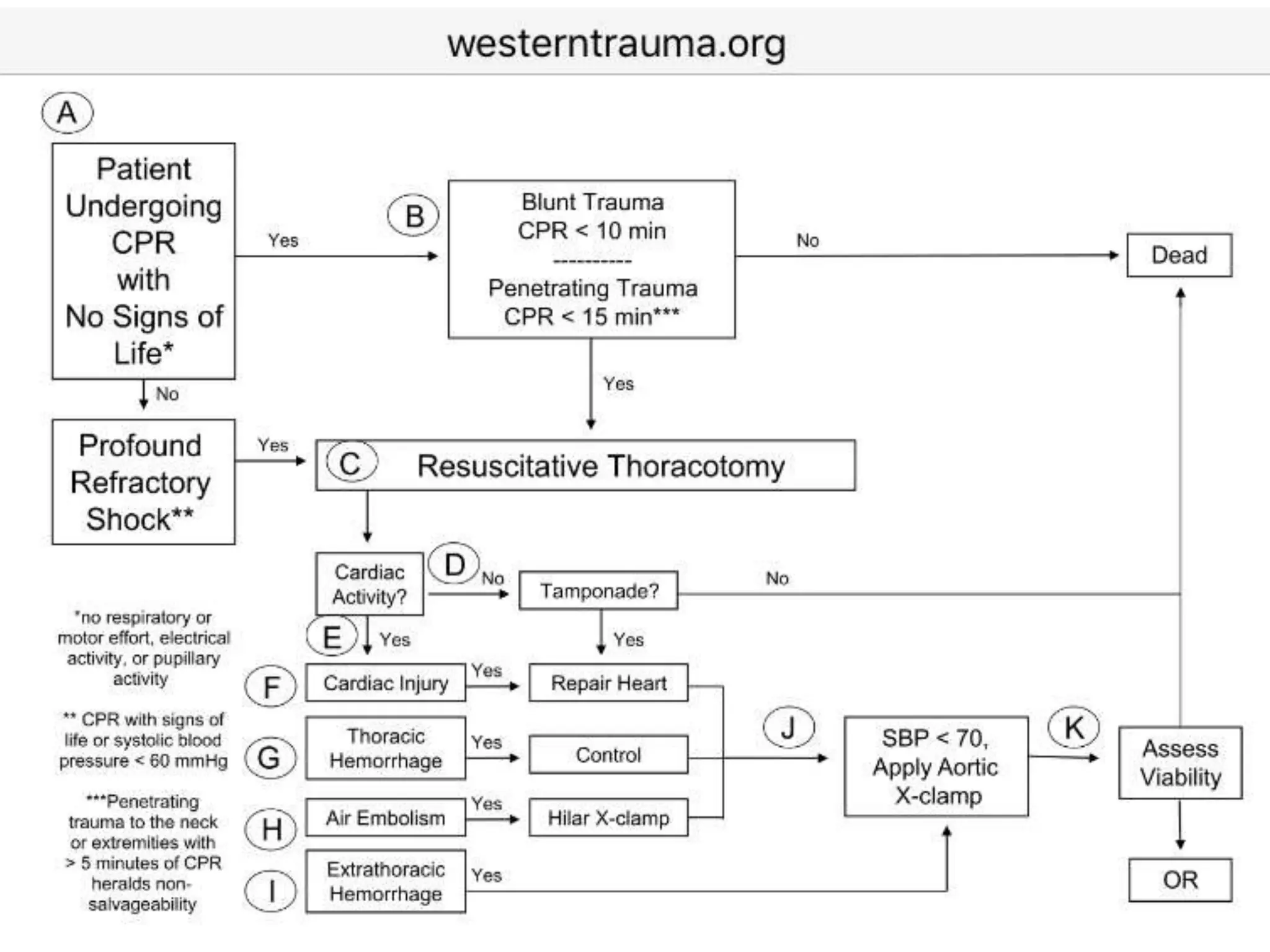
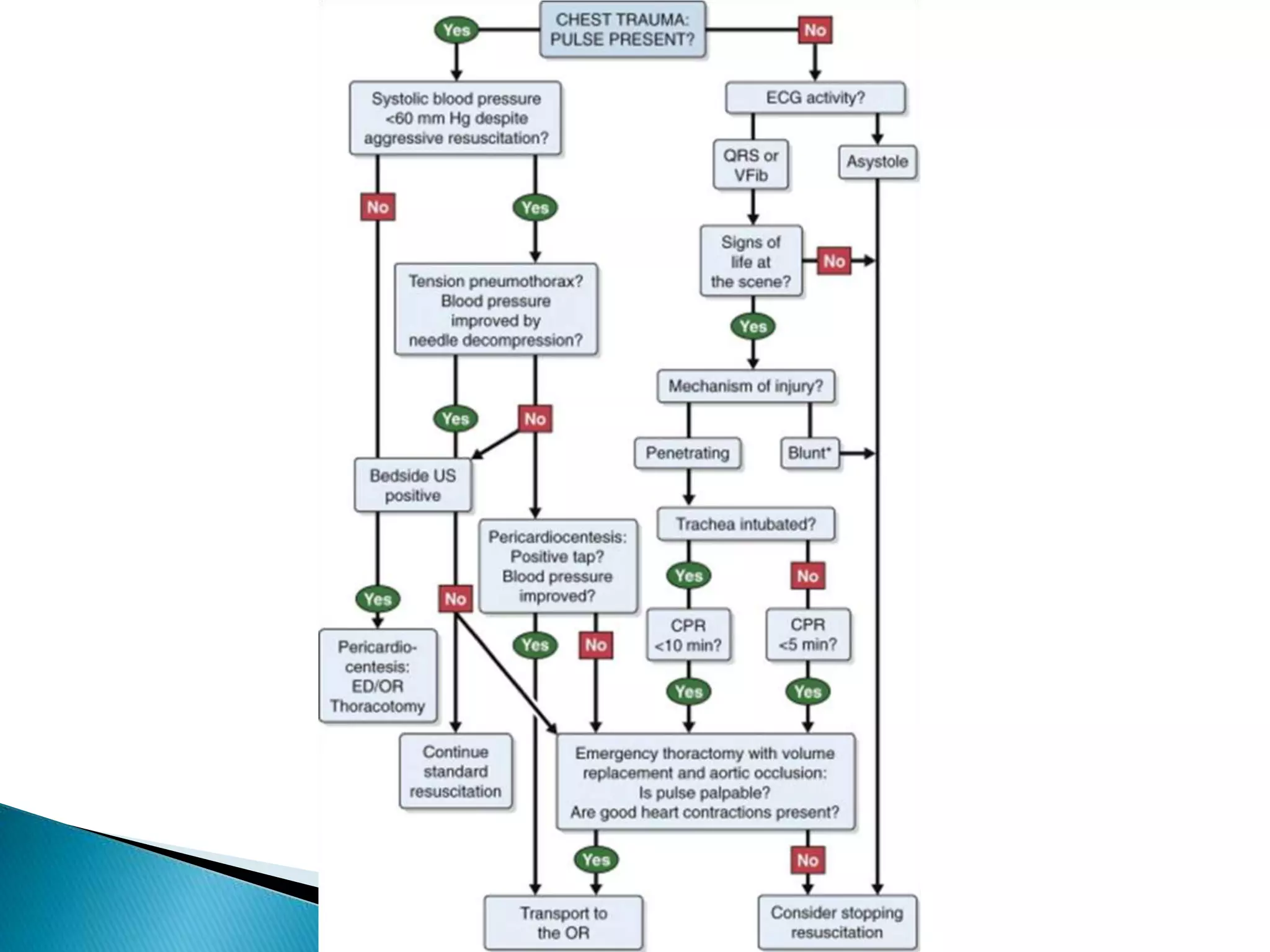
 Penetrating thoracic injury
◦ Haemodynamic instability (SPB <70mmHg despite
vigorous fluid resuscitation)
◦ Traumatic arrest with previously witnessed cardiac
activity (prehospital or ED)
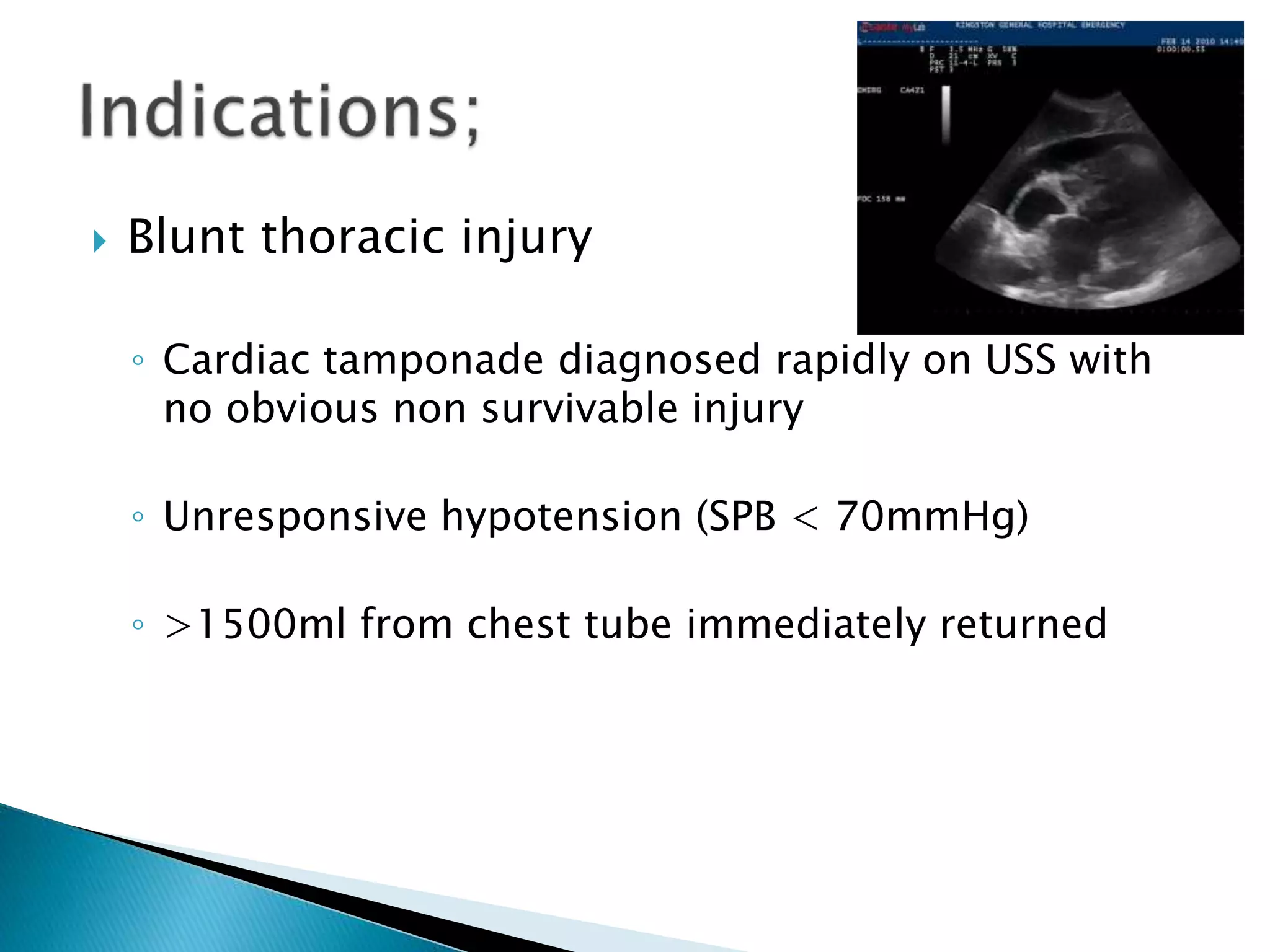
 Blunt thoracic injury
◦ Cardiac tamponade diagnosed rapidly on USS with
no obvious non survivable injury
◦ Unresponsive hypotension (SPB < 70mmHg)
◦ >1500ml from chest tube immediately returned
 Penetrating chest injury – traumatic arrest
without witnessed cardiac activity
 Penetrating non thoracic injury (abdominal or
peripheral) with previously witnessed cardiac
activity
 Blunt thoracic injuries with traumatic arrest
with previously witnessed cardiac activity
 Penetrating injuries
◦ Patient has no signs of life at injury scene
◦ Asystole with no pericardial tamponade
◦ Prolonged pulselessness (>15 mins)
◦ Other massive nonsurvivable injuries have occurred
 Blunt injury
◦ Patient requires >10 minutes prehospital CPR
◦ Patient has no signs of life at scene of injury
◦ Patient has other massive non survivable injuries
 Non traumatic cardiac arrest
 Severe head or multisystem injury
 Improperly trained team
 Insufficient equipment
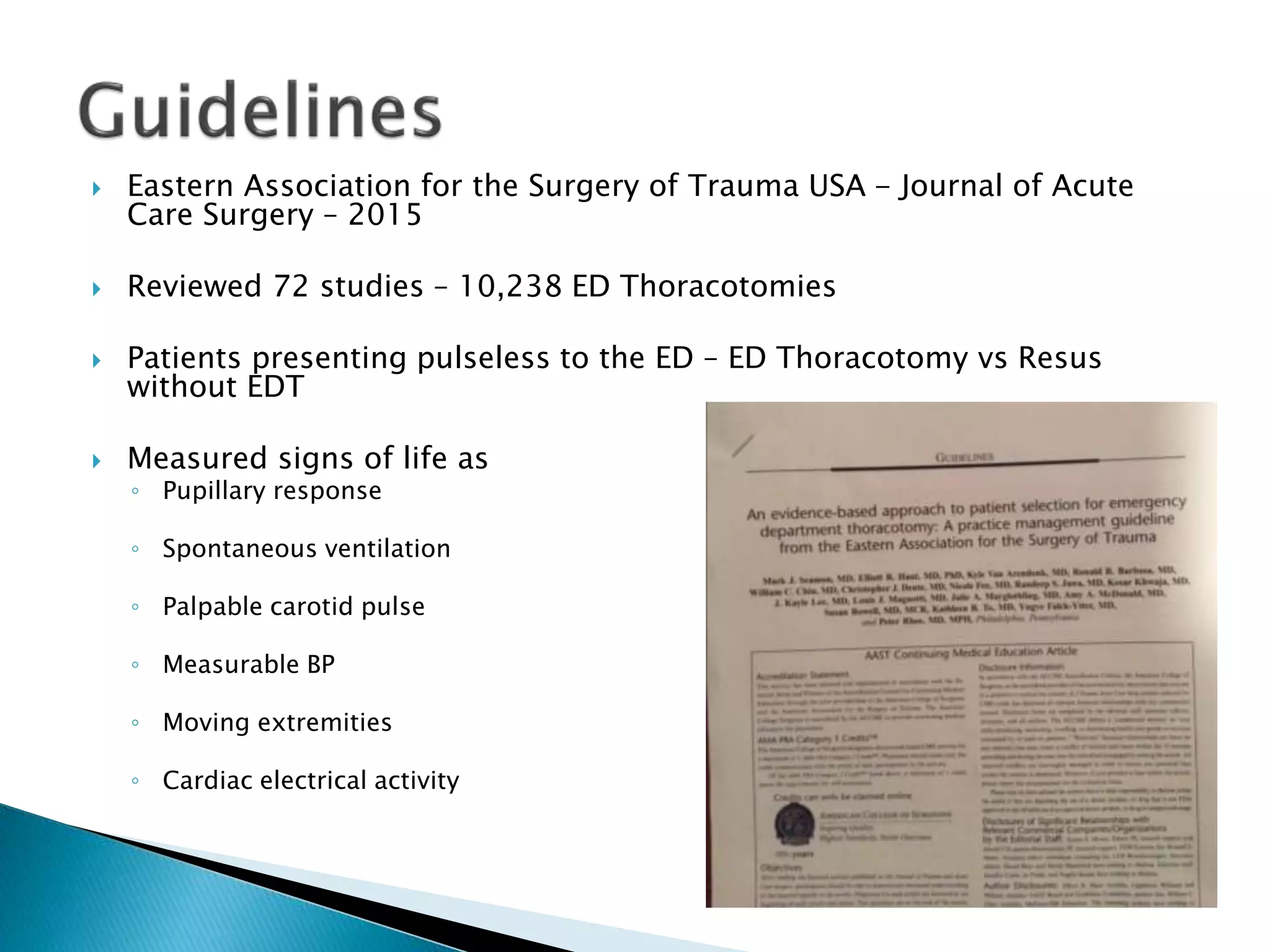
 Eastern Association for the Surgery of Trauma USA - Journal of Acute
Care Surgery – 2015
 Reviewed 72 studies – 10,238 ED Thoracotomies
 Patients presenting pulseless to the ED – ED Thoracotomy vs Resus
without EDT
 Measured signs of life as
◦ Pupillary response
◦ Spontaneous ventilation
◦ Palpable carotid pulse
◦ Measurable BP
◦ Moving extremities
◦ Cardiac electrical activity
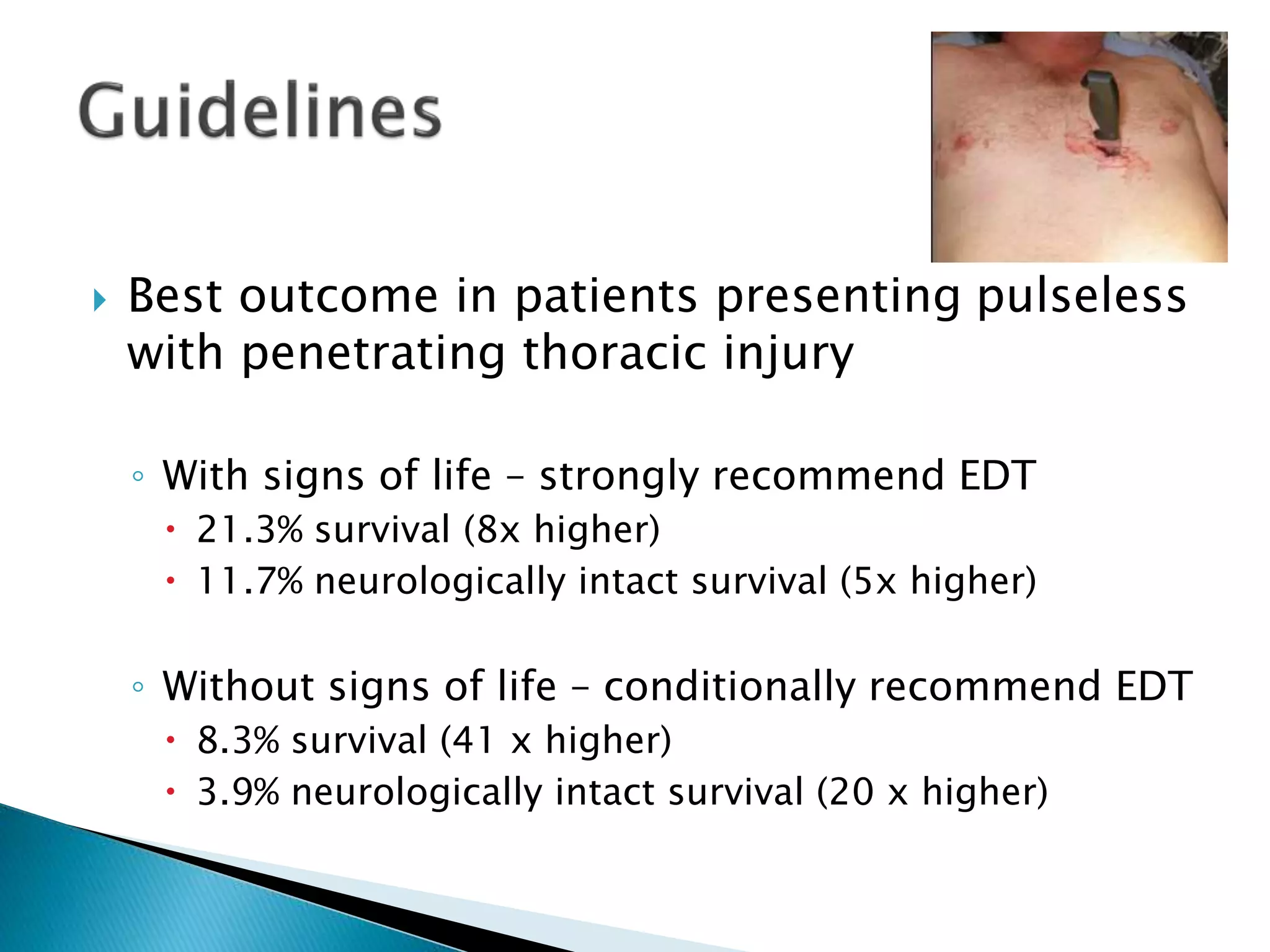
 Best outcome in patients presenting pulseless
with penetrating thoracic injury
◦ With signs of life – strongly recommend EDT
 21.3% survival (8x higher)
 11.7% neurologically intact survival (5x higher)
◦ Without signs of life – conditionally recommend EDT
 8.3% survival (41 x higher)
 3.9% neurologically intact survival (20 x higher)
 Penetrating extrathoracic injury
◦ Signs of life – Conditionally recommend EDT
 Survival 15.6% (9x higher)
 Neurologically intact survival 16.5% (11 x higher)
◦ No signs of life – Conditionally recommend EDT
 Survival 2.9% (29 x higher)
 Neurologically intact survival 5% (56 x higher)
 Pulseless Blunt Injury
◦ With signs of life – Conditionally recommend EDT
 Survival 4.6% (9x higher)
 Neurologically intact survival 2.4% (8x higher)
◦ Without signs of life – Recommend against EDT
 Survival 0.7%
 Neurologically intact survival 0.1%
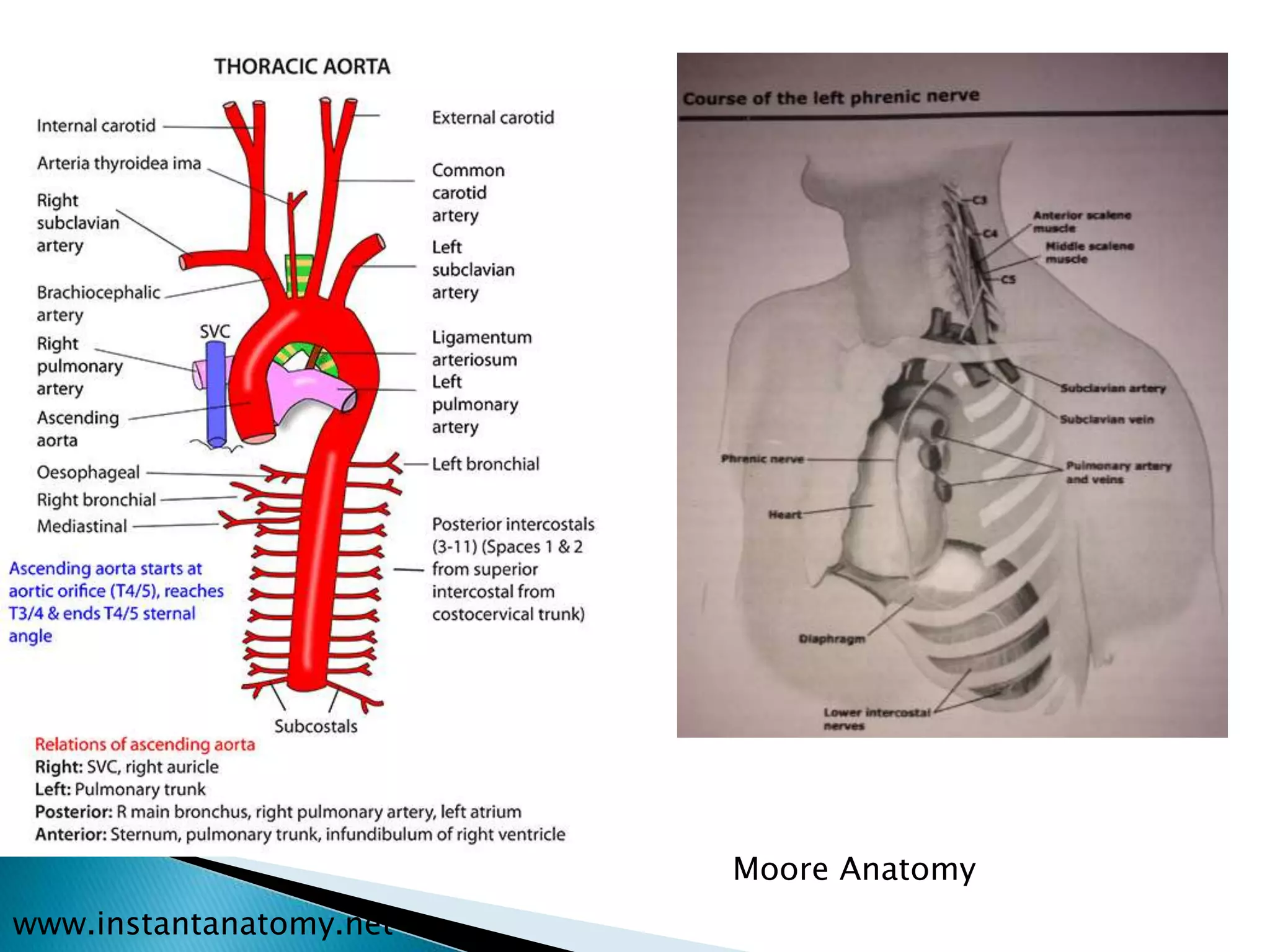
www.instantanatomy.net
Moore Anatomy
https://calsprogram.org/manual/volume2/Sec
tion7_Circulation%20Skills/05-
CirSk4EmergThoracotomy13.html
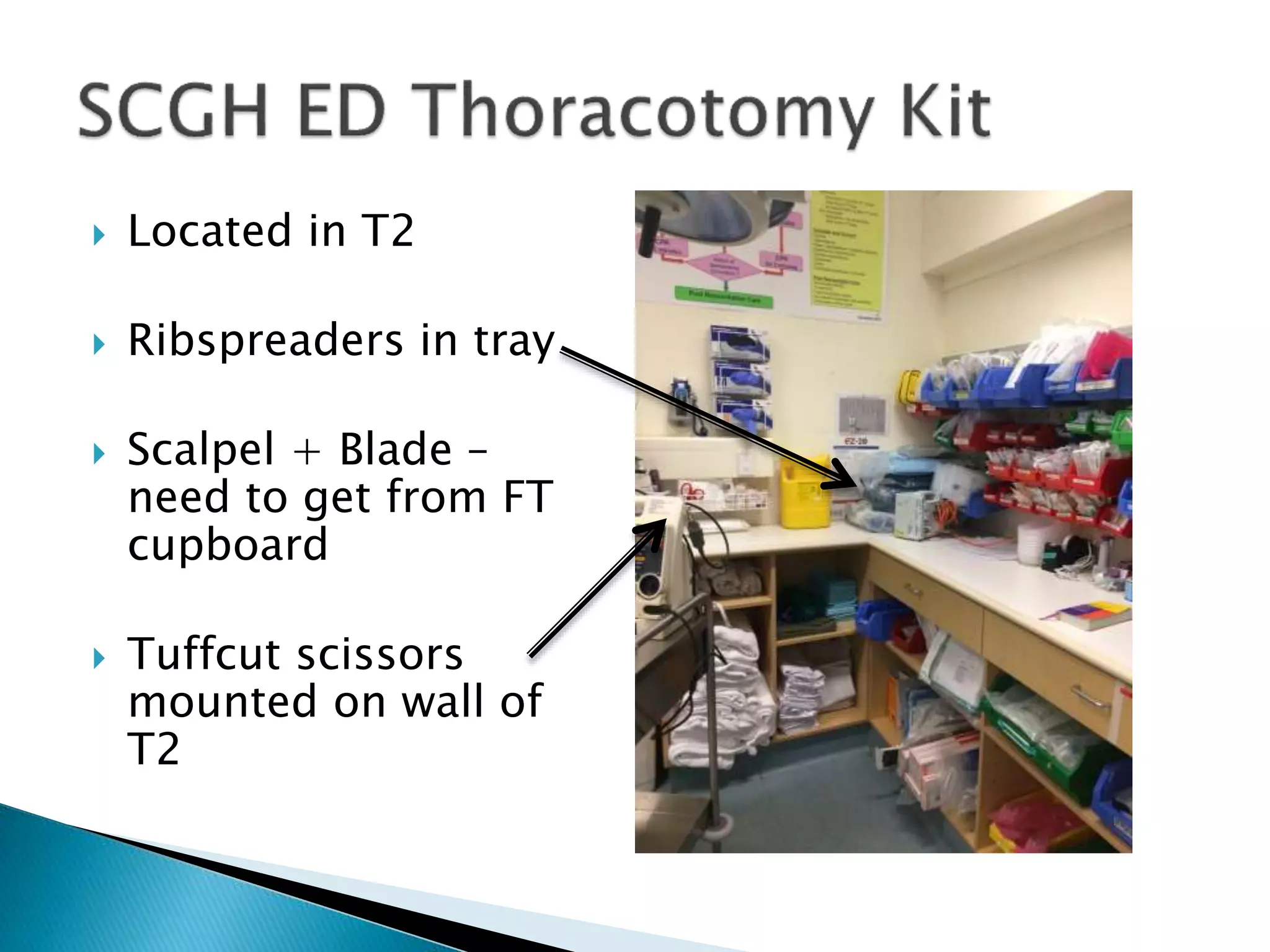
 Located in T2
 Ribspreaders in tray
 Scalpel + Blade –
need to get from FT
cupboard
 Tuffcut scissors
mounted on wall of
T2
 Scalpel + Blade
 Retractor – Finochietto’s rib spreader or Balfour
abdominal retractor
 Gigli Saw / Tuffcut Scissors
 Curved Mayos Scissors
 Toothed forceps
 DeBakey Aortic Clamp
 Mosquito artery forceps
 Foley catheter
 Satinsky large vascular clamps
 Needle holders
 Internal defibrillator clamps
 Sutures, sternal wires
 Trauma Call
 Universal precautions
 Intubate and ventilate patient
◦ Intubate right main bronchus to collapse left lung
 Fluid resucitation + Blood Products / Massive Transfusion
Protocol
 15 degree headup
 Surgically prep the area
 Antibiotic prophylaxis
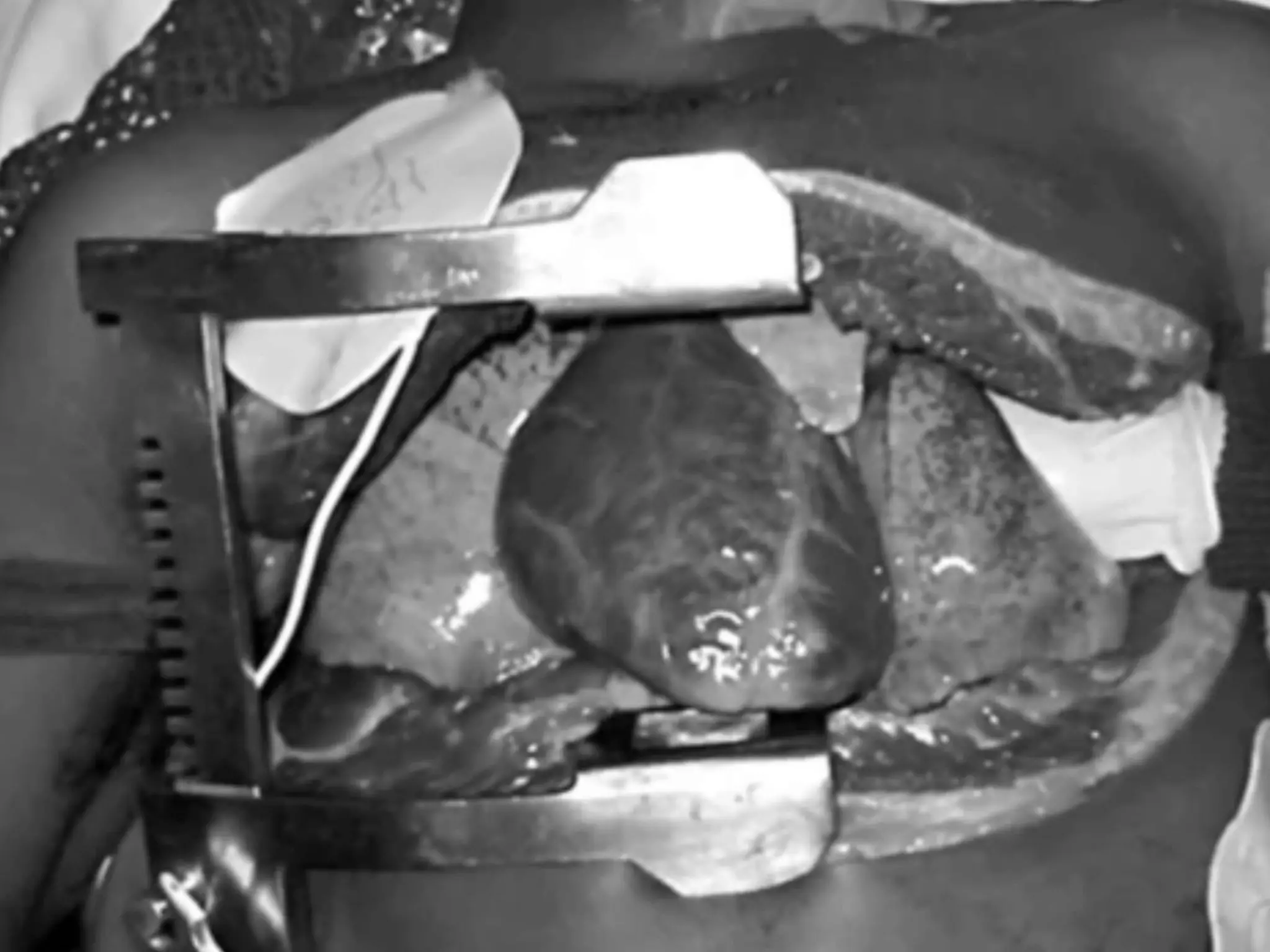
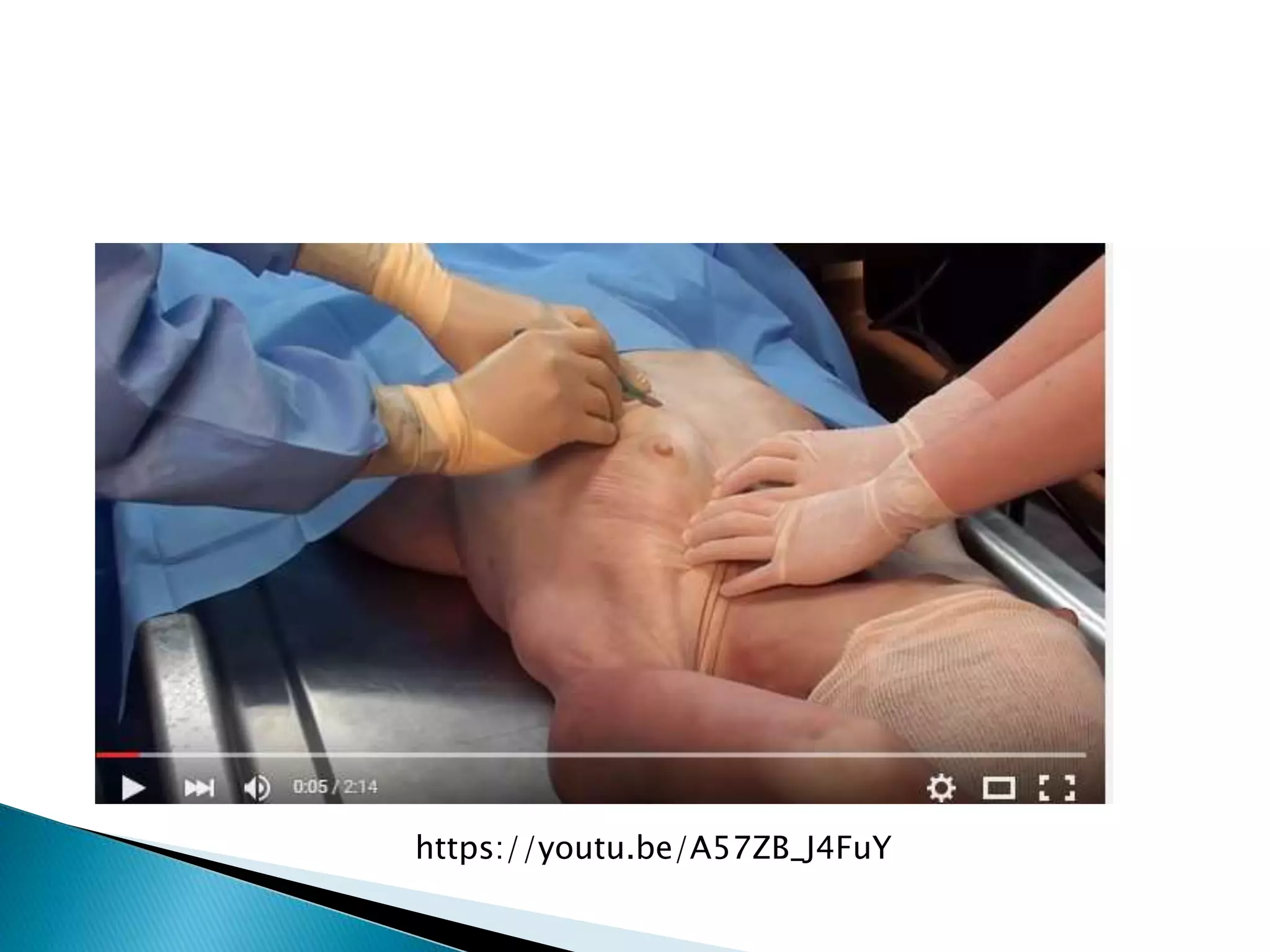
 Bilateral anterior thoracotomy (clamshell incision)
is the ideal emergency thoracotomy incision: an
anatomic study Simms ER, Flaris AN, Franchino X,
et al.. World J Surg 2013; 37:1277.
 Looked at 6 different thoracotomy incisions on
cadavers
 Left and Right Anterolateral, Left 2nd intercostal
incision, Left 3rd Intercostal incision, median
sternotomy & Clamshell
◦ Clamshell fastest for access and best for control of
thoracic structures in Emergency Thoracotomy
 “Clamshell Incision”
 A – 5th intercostal space
thoracostomy bilaterally
midaxillary line
 B – Incise skin and subcut
fat
 C & D – Extend to sternum
 E – Cut sternum
 F – Finochietto retractor
(Bar on right)
Simms et al 2013
 Penetrating cardiac injury
◦ Direct digital pressure
◦ Staple cardiac defect closed
◦ Suture closure of injury
◦ Pass Foley catheter through defect, inflate balloon, apply traction
 Abdominal Haemorrhage / Hypoperfusion
◦ Cross clamp thoracic aorta to redistribute blood to myocardium
and brain (Doubles MAP and Cardiac Output)
◦ Pass NG Tube to help identify Oesophagus vs Descending Aorta
◦ Ideally clamp just above diaphragm – maximize spinal cord
perfusion
 Haemorrhage from pulmonary parenchyma or major
pulmonary vasculature
◦ Clamp pulmonary Hilum / Injured tissue / Bleeding vessel
◦ Hilar twist
 Pericardiotomy
◦ If no other obvious injuries and cannot see myocardium
through pericardium
◦ Identify phrenic nerve anterolateral surface of
pericardium
◦ Grasp pericardium anterior to phrenic nerve with tooth
forceps – extend incision parallel to phrenic nerve
◦ Evacuate blood clots / Pericardial fluid
◦ Deliver heart from pericardial sac to inspect or fix
defects
 Air Embolism
◦ Air in coronary vessels, heart or aorta is diagnostic
◦ Clamp hilum of affected lung
◦ Ventilate unaffected lung only
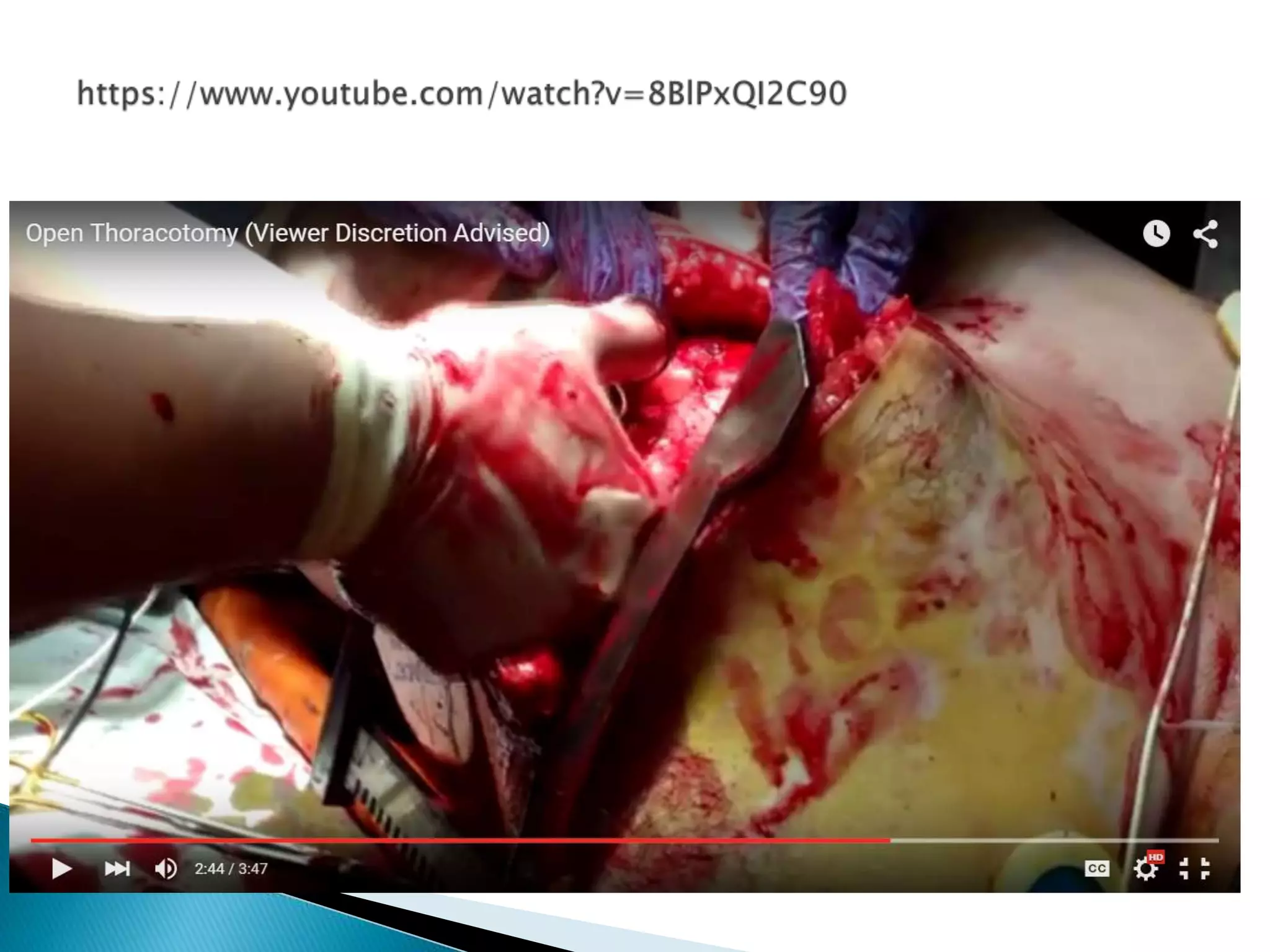
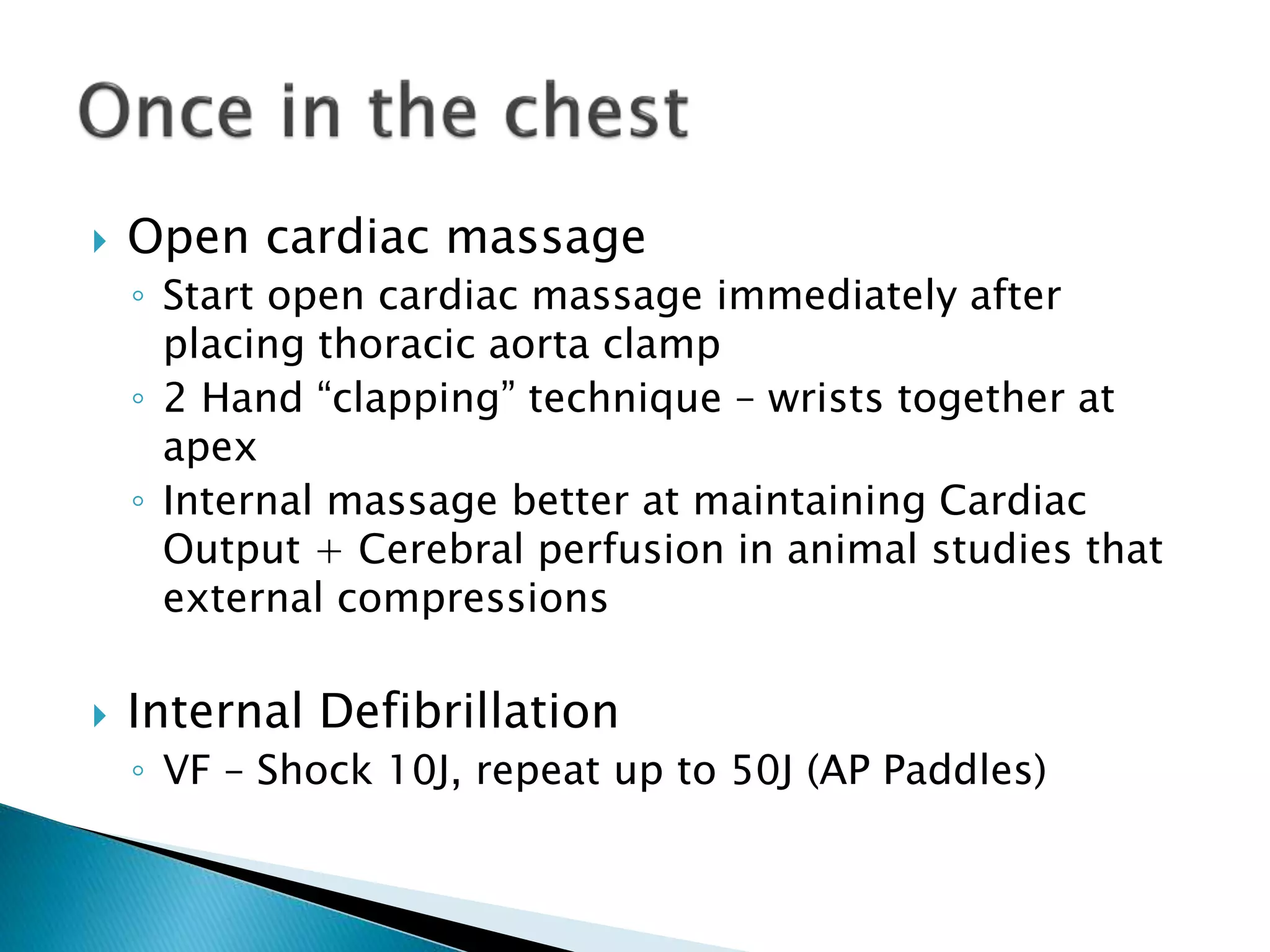
 Open cardiac massage
◦ Start open cardiac massage immediately after
placing thoracic aorta clamp
◦ 2 Hand “clapping” technique – wrists together at
apex
◦ Internal massage better at maintaining Cardiac
Output + Cerebral perfusion in animal studies that
external compressions
 Internal Defibrillation
◦ VF – Shock 10J, repeat up to 50J (AP Paddles)
https://youtu.be/A57ZB_J4FuY
https://www.youtube.com/watch?v=GFX_tocJShA
 Intention to perform procedure should be quick
 Give a lead in – state from the outset the plan so
everyone knows what is coming
 Rules in the sick obtunded trauma patient
◦ 1) Dont dick about with a duff anaesthetic
◦ 2) If they do arrest - dont dick about with a duff
resuscitation attempt
 Learn indications and evidence as you wont have
time to look these up when you need to perform
the procedure!
 Bilateral anterior thoracotomy (clamshell incision) is the ideal emergency
thoracotomy incision: an anatomic study Simms ER, Flaris AN, Franchino X, et al..
World J Surg 2013; 37:1277.
 An evidenced based approach to patient selection for emergency department
thoracotomy: A practice management guideline for the Eastern Association for the
Surgery of Trauma Seamon et al. Journal of Trauma Acute Care Surgery. 2015,
Volume 79, Number 1 159:173
 Emergency thoracotomy in thoracic trauma-a review. Hunt et al. Injury. 2006
Jan;37(1):1-19. Epub 2005 Apr 20
 Western Trauma Association Critical Decisions in Trauma: Resuscitative
thoracotomy, Cburlew et al, 2012 Guideline
 http://lifeinthefastlane.com/ed-thoracotomy-is-it-just-the-first-part-of-the-
autopsy/, Kane Guthrie
 http://www.uptodate.com/contents/resuscitative-thoracotomy-technique
 SMACC Chicago, June 2015, “Crack The Chest; Get Crucified”, John Hinds
Emergency Thoracotomy

Emergency Thoracotomy

  • 1.
  • 2.
     25% –50% all traumatic injuries involve thorax  Thoracotomy is an integral part of resuscitation in selected patients  Need to decide quickly if thoracotomy is indicated to increase chance of survival  Patients may deteriorate prehospital or in the ED and this may be the only option to restore life
  • 3.
     Release cardiactamponade  Control haemorrhage  Perform open cardiac massage  Cross clamp the descending thoracic aorta  Control air embolism
  • 4.
     Penetrating thoracicinjury ◦ Haemodynamic instability (SPB <70mmHg despite vigorous fluid resuscitation) ◦ Traumatic arrest with previously witnessed cardiac activity (prehospital or ED)
  • 5.
     Blunt thoracicinjury ◦ Cardiac tamponade diagnosed rapidly on USS with no obvious non survivable injury ◦ Unresponsive hypotension (SPB < 70mmHg) ◦ >1500ml from chest tube immediately returned
  • 6.
     Penetrating chestinjury – traumatic arrest without witnessed cardiac activity  Penetrating non thoracic injury (abdominal or peripheral) with previously witnessed cardiac activity  Blunt thoracic injuries with traumatic arrest with previously witnessed cardiac activity
  • 8.
     Penetrating injuries ◦Patient has no signs of life at injury scene ◦ Asystole with no pericardial tamponade ◦ Prolonged pulselessness (>15 mins) ◦ Other massive nonsurvivable injuries have occurred
  • 9.
     Blunt injury ◦Patient requires >10 minutes prehospital CPR ◦ Patient has no signs of life at scene of injury ◦ Patient has other massive non survivable injuries
  • 10.
     Non traumaticcardiac arrest  Severe head or multisystem injury  Improperly trained team  Insufficient equipment
  • 12.
     Eastern Associationfor the Surgery of Trauma USA - Journal of Acute Care Surgery – 2015  Reviewed 72 studies – 10,238 ED Thoracotomies  Patients presenting pulseless to the ED – ED Thoracotomy vs Resus without EDT  Measured signs of life as ◦ Pupillary response ◦ Spontaneous ventilation ◦ Palpable carotid pulse ◦ Measurable BP ◦ Moving extremities ◦ Cardiac electrical activity
  • 13.
     Best outcomein patients presenting pulseless with penetrating thoracic injury ◦ With signs of life – strongly recommend EDT  21.3% survival (8x higher)  11.7% neurologically intact survival (5x higher) ◦ Without signs of life – conditionally recommend EDT  8.3% survival (41 x higher)  3.9% neurologically intact survival (20 x higher)
  • 14.
     Penetrating extrathoracicinjury ◦ Signs of life – Conditionally recommend EDT  Survival 15.6% (9x higher)  Neurologically intact survival 16.5% (11 x higher) ◦ No signs of life – Conditionally recommend EDT  Survival 2.9% (29 x higher)  Neurologically intact survival 5% (56 x higher)
  • 15.
     Pulseless BluntInjury ◦ With signs of life – Conditionally recommend EDT  Survival 4.6% (9x higher)  Neurologically intact survival 2.4% (8x higher) ◦ Without signs of life – Recommend against EDT  Survival 0.7%  Neurologically intact survival 0.1%
  • 18.
  • 19.
  • 20.
     Located inT2  Ribspreaders in tray  Scalpel + Blade – need to get from FT cupboard  Tuffcut scissors mounted on wall of T2
  • 21.
     Scalpel +Blade  Retractor – Finochietto’s rib spreader or Balfour abdominal retractor  Gigli Saw / Tuffcut Scissors  Curved Mayos Scissors  Toothed forceps  DeBakey Aortic Clamp  Mosquito artery forceps  Foley catheter  Satinsky large vascular clamps  Needle holders  Internal defibrillator clamps  Sutures, sternal wires
  • 23.
     Trauma Call Universal precautions  Intubate and ventilate patient ◦ Intubate right main bronchus to collapse left lung  Fluid resucitation + Blood Products / Massive Transfusion Protocol  15 degree headup  Surgically prep the area  Antibiotic prophylaxis
  • 24.
     Bilateral anteriorthoracotomy (clamshell incision) is the ideal emergency thoracotomy incision: an anatomic study Simms ER, Flaris AN, Franchino X, et al.. World J Surg 2013; 37:1277.  Looked at 6 different thoracotomy incisions on cadavers  Left and Right Anterolateral, Left 2nd intercostal incision, Left 3rd Intercostal incision, median sternotomy & Clamshell ◦ Clamshell fastest for access and best for control of thoracic structures in Emergency Thoracotomy
  • 25.
     “Clamshell Incision” A – 5th intercostal space thoracostomy bilaterally midaxillary line  B – Incise skin and subcut fat  C & D – Extend to sternum  E – Cut sternum  F – Finochietto retractor (Bar on right) Simms et al 2013
  • 28.
     Penetrating cardiacinjury ◦ Direct digital pressure ◦ Staple cardiac defect closed ◦ Suture closure of injury ◦ Pass Foley catheter through defect, inflate balloon, apply traction  Abdominal Haemorrhage / Hypoperfusion ◦ Cross clamp thoracic aorta to redistribute blood to myocardium and brain (Doubles MAP and Cardiac Output) ◦ Pass NG Tube to help identify Oesophagus vs Descending Aorta ◦ Ideally clamp just above diaphragm – maximize spinal cord perfusion  Haemorrhage from pulmonary parenchyma or major pulmonary vasculature ◦ Clamp pulmonary Hilum / Injured tissue / Bleeding vessel ◦ Hilar twist
  • 29.
     Pericardiotomy ◦ Ifno other obvious injuries and cannot see myocardium through pericardium ◦ Identify phrenic nerve anterolateral surface of pericardium ◦ Grasp pericardium anterior to phrenic nerve with tooth forceps – extend incision parallel to phrenic nerve ◦ Evacuate blood clots / Pericardial fluid ◦ Deliver heart from pericardial sac to inspect or fix defects  Air Embolism ◦ Air in coronary vessels, heart or aorta is diagnostic ◦ Clamp hilum of affected lung ◦ Ventilate unaffected lung only
  • 30.
     Open cardiacmassage ◦ Start open cardiac massage immediately after placing thoracic aorta clamp ◦ 2 Hand “clapping” technique – wrists together at apex ◦ Internal massage better at maintaining Cardiac Output + Cerebral perfusion in animal studies that external compressions  Internal Defibrillation ◦ VF – Shock 10J, repeat up to 50J (AP Paddles)
  • 31.
  • 32.
  • 33.
     Intention toperform procedure should be quick  Give a lead in – state from the outset the plan so everyone knows what is coming  Rules in the sick obtunded trauma patient ◦ 1) Dont dick about with a duff anaesthetic ◦ 2) If they do arrest - dont dick about with a duff resuscitation attempt  Learn indications and evidence as you wont have time to look these up when you need to perform the procedure!
  • 34.
     Bilateral anteriorthoracotomy (clamshell incision) is the ideal emergency thoracotomy incision: an anatomic study Simms ER, Flaris AN, Franchino X, et al.. World J Surg 2013; 37:1277.  An evidenced based approach to patient selection for emergency department thoracotomy: A practice management guideline for the Eastern Association for the Surgery of Trauma Seamon et al. Journal of Trauma Acute Care Surgery. 2015, Volume 79, Number 1 159:173  Emergency thoracotomy in thoracic trauma-a review. Hunt et al. Injury. 2006 Jan;37(1):1-19. Epub 2005 Apr 20  Western Trauma Association Critical Decisions in Trauma: Resuscitative thoracotomy, Cburlew et al, 2012 Guideline  http://lifeinthefastlane.com/ed-thoracotomy-is-it-just-the-first-part-of-the- autopsy/, Kane Guthrie  http://www.uptodate.com/contents/resuscitative-thoracotomy-technique  SMACC Chicago, June 2015, “Crack The Chest; Get Crucified”, John Hinds

Editor's Notes

  • #34 Lead in - I will intubate the patient, perform bilateral finger thoracostomies, give blood and if the patient arrests at any stage I will open the chest. Is eveybody OK with this – allows people to voice concerns and leave ifthey want to Ie 200mg propofol causing an arrest - ? If obtunded use muscle relaxant only for intubation