Information Systems
UniversityofEducationOkara
Campus
1
Inam Ul-Haq
Lecturer (Computer Science)
MS Computer Science Sweden
Inam.bth@gmail.com
Information Systems
• Why Do People Need Information?
• Individuals - Entertainment and Enlightenment
• Businesses - Decision making, Problem Solving
and Control
UniversityofEducation
OkaraCampus
2
Information Systems
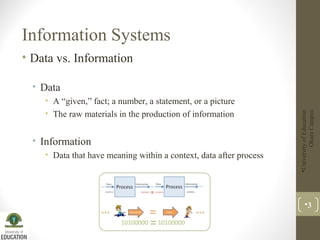
• Data vs. Information
• Data
• A “given,” fact; a number, a statement, or a picture
• The raw materials in the production of information
• Information
• Data that have meaning within a context, data after process
UniversityofEducation
OkaraCampus
3
Data, Information, and Systems
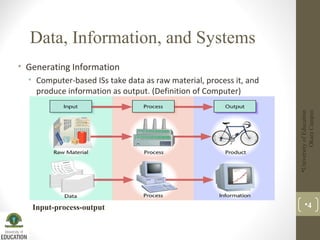
• Generating Information
• Computer-based ISs take data as raw material, process it, and
produce information as output. (Definition of Computer)
UniversityofEducation
OkaraCampus
4Input-process-output
Information Systems
• What Is a System?
• System: A set of Components that work together to achieve a
common Goal
• Subsystem: One part of a system where the products of more
than one system are combined to reach an ultimate goal
• Closed System: Stand-alone system that has no contact with
other systems
• Open System: System that interfaces with other systems
UniversityofEducation
OkaraCampus
5
Information Systems
• Definition
IS is combination of hardware, software, and telecommunications
networks that people build, collect, and distribute useful data,
typically in organizational settings
UniversityofEducation
OkaraCampus
6
A system composed of people and computers that processes or
interprets information (wikipedia)
A combination of hardware, software, infrastructure and trained
personnel organized to facilitate planning, control, coordination,
and decision making in an organization. (business ditionary)
Information Systems
UniversityofEducation
OkaraCampus
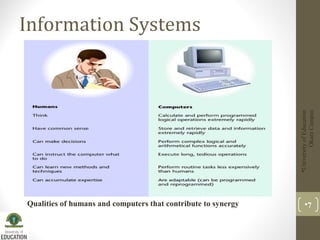
7Qualities of humans and computers that contribute to synergy
Why Study IS?
• Information Systems Careers
• Systems analyst, specialist in enterprise resource planning (ERP), database
administrator, telecommunications specialist, consulting, etc.
• Knowledge Workers
• Knowledge workers are typically professionals who are relatively well educated
and who create, modify, and/or synthesize knowledge as a fundamental part of
their jobs.
• Employers seek computer-literate professionals who know how to use
information technology.
UniversityofEducation
OkaraCampus
8
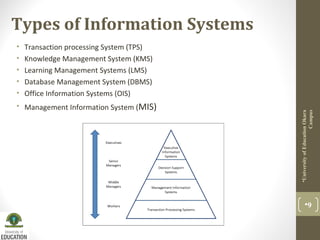
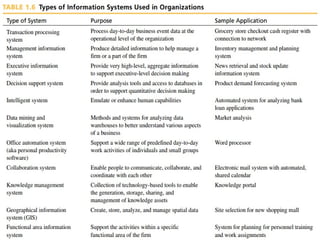
Types of Information Systems
• Transaction processing System (TPS)
• Knowledge Management System (KMS)
• Learning Management Systems (LMS)
• Database Management System (DBMS)
• Office Information Systems (OIS)
• Management Information System (MIS)
UniversityofEducationOkara
Campus
9
Information System
Basic Components (For computer-based IS)
An IS using computer technology to carry out some or all of its
planned tasks.
•Hardware- these are the devices like the monitor, processor,
printer and keyboard, all of which work together to accept,
process, show data and information.
•Software- are the programs that allow the hardware to process
the data.
•Databases- are the gathering of associated files or tables
containing related data.
•Networks- are a connecting system that allows diverse
computers to distribute resources.
•Procedures- are the commands for combining the components
above to process information and produce the preferred output.
UniversityofEducationOkara
Campus
10
Examples
•Examples
1- People in organizations use information systems to process sales
transactions, manage loan applications, or help financial analysts decide
where, when, and how to invest.
2-Product managers also use them to help decide where, when, and
how to market their products and related services, and production managers
use them to help decide when and how to manufacture products.
3-Information systems also enable us to get cash from ATMs,
communicate by live video with people in other parts of the world, and buy
concert or airline tickets.
11
UniversityofEducationOkara
Campus
12
UniversityofEducationOkara
Campus
13
UniversityofEducationOkara
Campus
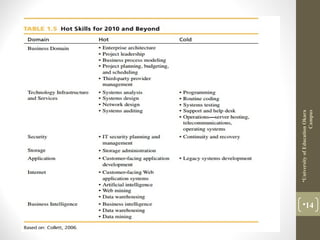
14
UniversityofEducationOkara
Campus
15
UniversityofEducationOkara
Campus
Learning Assignment (4 Marks)
• Case Study on FedEx to know its Information System.
• Study on
1. Transaction processing system
2. Library Information System
3. Decision Support System
4. Office Automation System
5. Online Ticketing System
6. GIS
7. Office Automation System
8. Expert System
16
UniversityofEducationOkara
Campus
Individually submit slides [10-15] till 15.03.2015 at 11:55pm
References
• Information Systems Today: Managing in the Digital World, Fourth Edition, by Joe
Valacich and Christoph Schneider. Published by Prentice Hall.
17
UniversityofEducationOkara
Campus

Lecture 1 Information System

  • 1.
    Information Systems UniversityofEducationOkara Campus 1 Inam Ul-Haq Lecturer(Computer Science) MS Computer Science Sweden Inam.bth@gmail.com
  • 2.
    Information Systems • WhyDo People Need Information? • Individuals - Entertainment and Enlightenment • Businesses - Decision making, Problem Solving and Control UniversityofEducation OkaraCampus 2
  • 3.
    Information Systems • Datavs. Information • Data • A “given,” fact; a number, a statement, or a picture • The raw materials in the production of information • Information • Data that have meaning within a context, data after process UniversityofEducation OkaraCampus 3
  • 4.
    Data, Information, andSystems • Generating Information • Computer-based ISs take data as raw material, process it, and produce information as output. (Definition of Computer) UniversityofEducation OkaraCampus 4Input-process-output
  • 5.
    Information Systems • WhatIs a System? • System: A set of Components that work together to achieve a common Goal • Subsystem: One part of a system where the products of more than one system are combined to reach an ultimate goal • Closed System: Stand-alone system that has no contact with other systems • Open System: System that interfaces with other systems UniversityofEducation OkaraCampus 5
  • 6.
    Information Systems • Definition ISis combination of hardware, software, and telecommunications networks that people build, collect, and distribute useful data, typically in organizational settings UniversityofEducation OkaraCampus 6 A system composed of people and computers that processes or interprets information (wikipedia) A combination of hardware, software, infrastructure and trained personnel organized to facilitate planning, control, coordination, and decision making in an organization. (business ditionary)
  • 7.
  • 8.
    Why Study IS? •Information Systems Careers • Systems analyst, specialist in enterprise resource planning (ERP), database administrator, telecommunications specialist, consulting, etc. • Knowledge Workers • Knowledge workers are typically professionals who are relatively well educated and who create, modify, and/or synthesize knowledge as a fundamental part of their jobs. • Employers seek computer-literate professionals who know how to use information technology. UniversityofEducation OkaraCampus 8
  • 9.
    Types of InformationSystems • Transaction processing System (TPS) • Knowledge Management System (KMS) • Learning Management Systems (LMS) • Database Management System (DBMS) • Office Information Systems (OIS) • Management Information System (MIS) UniversityofEducationOkara Campus 9
  • 10.
    Information System Basic Components(For computer-based IS) An IS using computer technology to carry out some or all of its planned tasks. •Hardware- these are the devices like the monitor, processor, printer and keyboard, all of which work together to accept, process, show data and information. •Software- are the programs that allow the hardware to process the data. •Databases- are the gathering of associated files or tables containing related data. •Networks- are a connecting system that allows diverse computers to distribute resources. •Procedures- are the commands for combining the components above to process information and produce the preferred output. UniversityofEducationOkara Campus 10
  • 11.
    Examples •Examples 1- People inorganizations use information systems to process sales transactions, manage loan applications, or help financial analysts decide where, when, and how to invest. 2-Product managers also use them to help decide where, when, and how to market their products and related services, and production managers use them to help decide when and how to manufacture products. 3-Information systems also enable us to get cash from ATMs, communicate by live video with people in other parts of the world, and buy concert or airline tickets. 11 UniversityofEducationOkara Campus
  • 12.
  • 13.
  • 14.
  • 15.
  • 16.
    Learning Assignment (4Marks) • Case Study on FedEx to know its Information System. • Study on 1. Transaction processing system 2. Library Information System 3. Decision Support System 4. Office Automation System 5. Online Ticketing System 6. GIS 7. Office Automation System 8. Expert System 16 UniversityofEducationOkara Campus Individually submit slides [10-15] till 15.03.2015 at 11:55pm
  • 17.
    References • Information SystemsToday: Managing in the Digital World, Fourth Edition, by Joe Valacich and Christoph Schneider. Published by Prentice Hall. 17 UniversityofEducationOkara Campus