Information Systems
UniversityofEducationOkara
Campus
1
Inam Ul-Haq
Lecturer Computer Science
MS Computer Science Sweden
organizer@dfd-charity.com, inam@ue.edu.pk
Information Systems
• Why Do People Need Information?
• Individuals - Entertainment and Enlightenment
• Businesses - Decision making, Problem Solving
and Control
UniversityofEducation
OkaraCampus
2
Information Systems
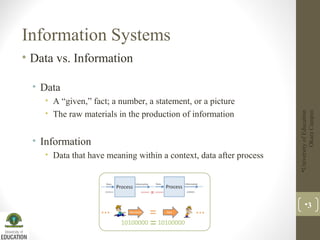
• Data vs. Information
• Data
• A “given,” fact; a number, a statement, or a picture
• The raw materials in the production of information
• Information
• Data that have meaning within a context, data after process
UniversityofEducation
OkaraCampus
3
Data, Information, and Systems
• Data Processing = Information
• Example: Customer Survey
• Reading through data collected from a customer survey with
questions in various categories would be time-consuming and
not very helpful.
• When processed, the surveys may provide useful information.
UniversityofEducation
OkaraCampus
4
Data, Information, and Systems
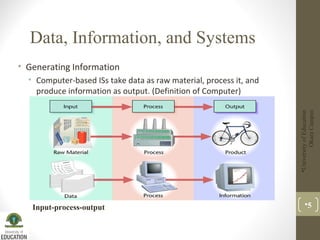
• Generating Information
• Computer-based ISs take data as raw material, process it, and
produce information as output. (Definition of Computer)
UniversityofEducation
OkaraCampus
5Input-process-output
Information Systems
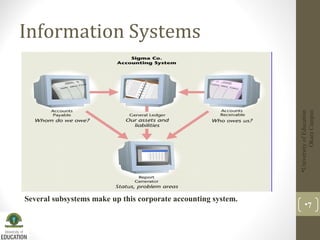
• What Is a System?
• System: A set of Components that work together to achieve a
common Goal
• Subsystem: One part of a system where the products of more
than one system are combined to reach an ultimate goal
• Closed System: Stand-alone system that has no contact with
other systems
• Open System: System that interfaces with other systems
UniversityofEducation
OkaraCampus
6
Information Systems
UniversityofEducation
OkaraCampus
7
Several subsystems make up this corporate accounting system.
Information Systems
• Information and Managers
• Systems thinking
• Creates a framework(software) for Problem Solving and
Decision Making.
• Keeps managers focused on overall goals and operations of
business.
• History: emerged in 20th
century
• Definition
Information system (IS) is the study of complementary networks
of hardware and software (IT) that people and organizations
use to collect, process, filter, create, and distribute data.
UniversityofEducation
OkaraCampus
8
Information Systems
UniversityofEducation
OkaraCampus
9Qualities of humans and computers that contribute to synergy
Why Study IS?
• Information Systems Careers
• Systems analyst, specialist in enterprise resource planning (ERP),
database administrator, telecommunications specialist, consulting, etc.
• Knowledge Workers
• Managers and non-managers
• Employers seek computer-literate professionals who know how to use
information technology.
• Computer Literacy Replacing Traditional Literacy
• Key to full participation in western society
UniversityofEducation
OkaraCampus
10
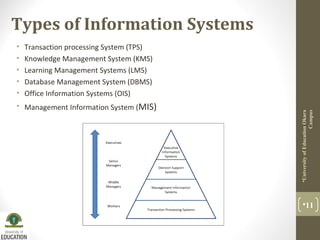
Types of Information Systems
• Transaction processing System (TPS)
• Knowledge Management System (KMS)
• Learning Management Systems (LMS)
• Database Management System (DBMS)
• Office Information Systems (OIS)
• Management Information System (MIS)
UniversityofEducationOkara
Campus
11
Information System
Basic Components (For computer-based IS)
An IS using computer technology to carry out some or all of its
planned tasks.
•Hardware- these are the devices like the monitor, processor,
printer and keyboard, all of which work together to accept,
process, show data and information.
•Software- are the programs that allow the hardware to process
the data.
•Databases- are the gathering of associated files or tables
containing related data.
•Networks- are a connecting system that allows diverse
computers to distribute resources.
•Procedures- are the commands for combining the components
above to process information and produce the preferred output.
UniversityofEducationOkara
Campus
12

Information system

  • 1.
    Information Systems UniversityofEducationOkara Campus 1 Inam Ul-Haq LecturerComputer Science MS Computer Science Sweden organizer@dfd-charity.com, inam@ue.edu.pk
  • 2.
    Information Systems • WhyDo People Need Information? • Individuals - Entertainment and Enlightenment • Businesses - Decision making, Problem Solving and Control UniversityofEducation OkaraCampus 2
  • 3.
    Information Systems • Datavs. Information • Data • A “given,” fact; a number, a statement, or a picture • The raw materials in the production of information • Information • Data that have meaning within a context, data after process UniversityofEducation OkaraCampus 3
  • 4.
    Data, Information, andSystems • Data Processing = Information • Example: Customer Survey • Reading through data collected from a customer survey with questions in various categories would be time-consuming and not very helpful. • When processed, the surveys may provide useful information. UniversityofEducation OkaraCampus 4
  • 5.
    Data, Information, andSystems • Generating Information • Computer-based ISs take data as raw material, process it, and produce information as output. (Definition of Computer) UniversityofEducation OkaraCampus 5Input-process-output
  • 6.
    Information Systems • WhatIs a System? • System: A set of Components that work together to achieve a common Goal • Subsystem: One part of a system where the products of more than one system are combined to reach an ultimate goal • Closed System: Stand-alone system that has no contact with other systems • Open System: System that interfaces with other systems UniversityofEducation OkaraCampus 6
  • 7.
  • 8.
    Information Systems • Informationand Managers • Systems thinking • Creates a framework(software) for Problem Solving and Decision Making. • Keeps managers focused on overall goals and operations of business. • History: emerged in 20th century • Definition Information system (IS) is the study of complementary networks of hardware and software (IT) that people and organizations use to collect, process, filter, create, and distribute data. UniversityofEducation OkaraCampus 8
  • 9.
  • 10.
    Why Study IS? •Information Systems Careers • Systems analyst, specialist in enterprise resource planning (ERP), database administrator, telecommunications specialist, consulting, etc. • Knowledge Workers • Managers and non-managers • Employers seek computer-literate professionals who know how to use information technology. • Computer Literacy Replacing Traditional Literacy • Key to full participation in western society UniversityofEducation OkaraCampus 10
  • 11.
    Types of InformationSystems • Transaction processing System (TPS) • Knowledge Management System (KMS) • Learning Management Systems (LMS) • Database Management System (DBMS) • Office Information Systems (OIS) • Management Information System (MIS) UniversityofEducationOkara Campus 11
  • 12.
    Information System Basic Components(For computer-based IS) An IS using computer technology to carry out some or all of its planned tasks. •Hardware- these are the devices like the monitor, processor, printer and keyboard, all of which work together to accept, process, show data and information. •Software- are the programs that allow the hardware to process the data. •Databases- are the gathering of associated files or tables containing related data. •Networks- are a connecting system that allows diverse computers to distribute resources. •Procedures- are the commands for combining the components above to process information and produce the preferred output. UniversityofEducationOkara Campus 12

Editor's Notes