Information Systems
Development
Prepared By Osama Rahman
About Content
 What is Information System?
 What is Information Systems Development?
 Information System Development Stages
1. System Survey
i. System Identification
ii. Selection
iii. System Planning
2. Needs Analysis
3. Design
4. Implementation
5. Testing
6. Change and Maintenance
What is Information
System?
 The system is a collection of various elements or entities that are used to process
input into an output. Inputs and outputs can be either raw or intact data into
information — depending on the processing designed to work in the system.
 Meanwhile, information is the result of data processing used for a particular
purpose. As for what data means is raw facts that have not been processed and can
not provide stimulus for users to take action.
 Thus, an information system can be interpreted as a set of interconnected elements
to process a given input into a particular output produced. The next stage of an
information system is a MIS (Management Information System) which has a
higher complexity with the final goal being used for the needs of analysis and
decision making.
What is Information
Systems Development?
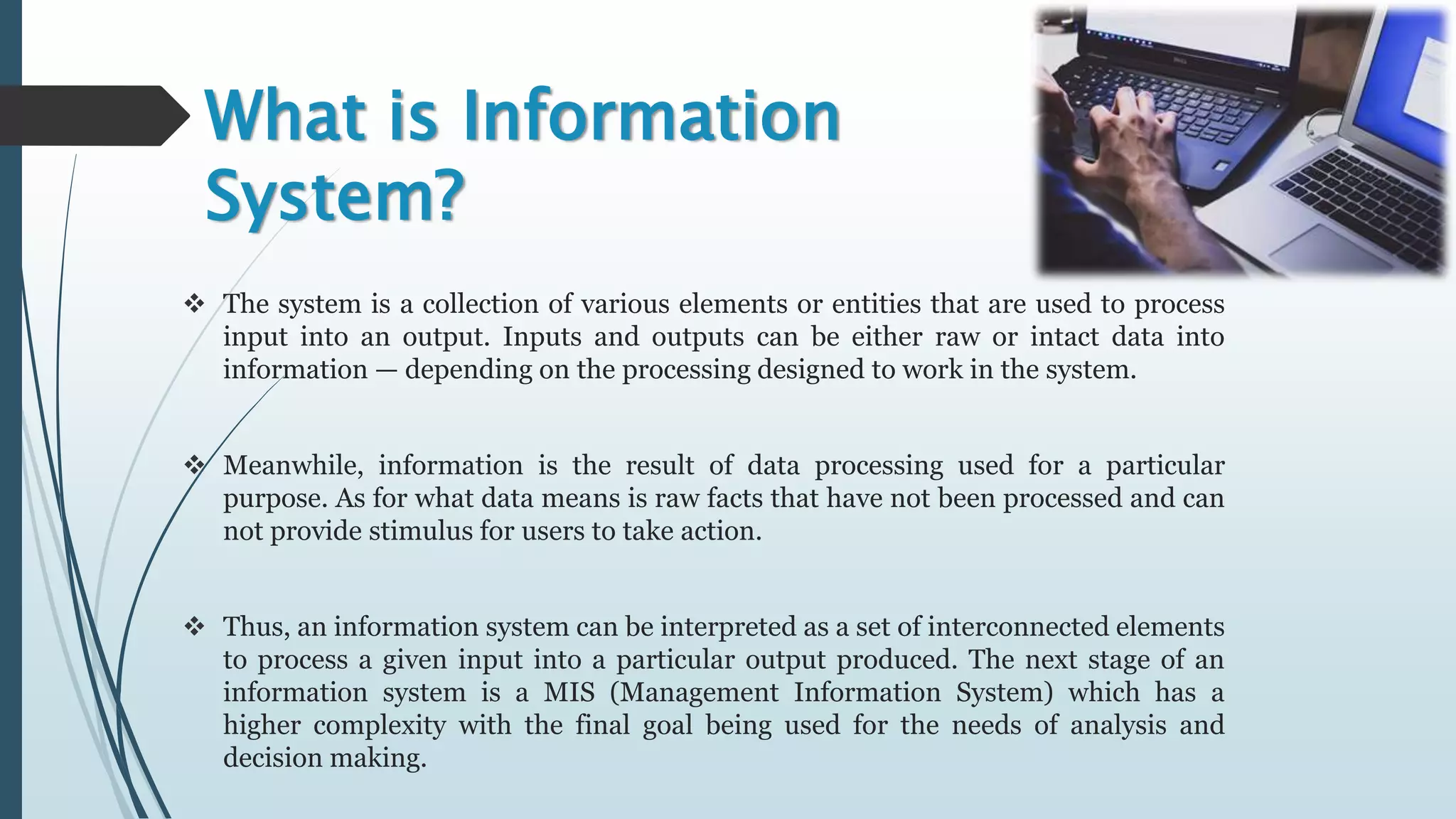
 As the name suggests, information system development or commonly known as SLC (Systems Life
Cycle) or SLDC (Software Development Life Cycle) is a process of making and changing the system
and the model and methodology used. In other words, an SDLC is the preparation of a new system
to replace the old system, both in whole and only partially.
 Development of information systems is generally done because of problems that cannot be
accommodated by the old system. For example, the hospital where you work make an overhaul
SIMRS (Sistem Informasi Manajemen Rumah Sakit/Hospital Management Information System)
because of applications that previously could not do bridging with BPJS. Considering the fact that
the government has required it, then inevitably the hospital must adjust the SIMRS it already has.
 As for carrying out an information system development, the related team will consist of several
personnel, namely the project coordinator, system analyst and design, network designer,
programmer, technician (hardware), administrator, software tester, graphic designer, and
documentary.
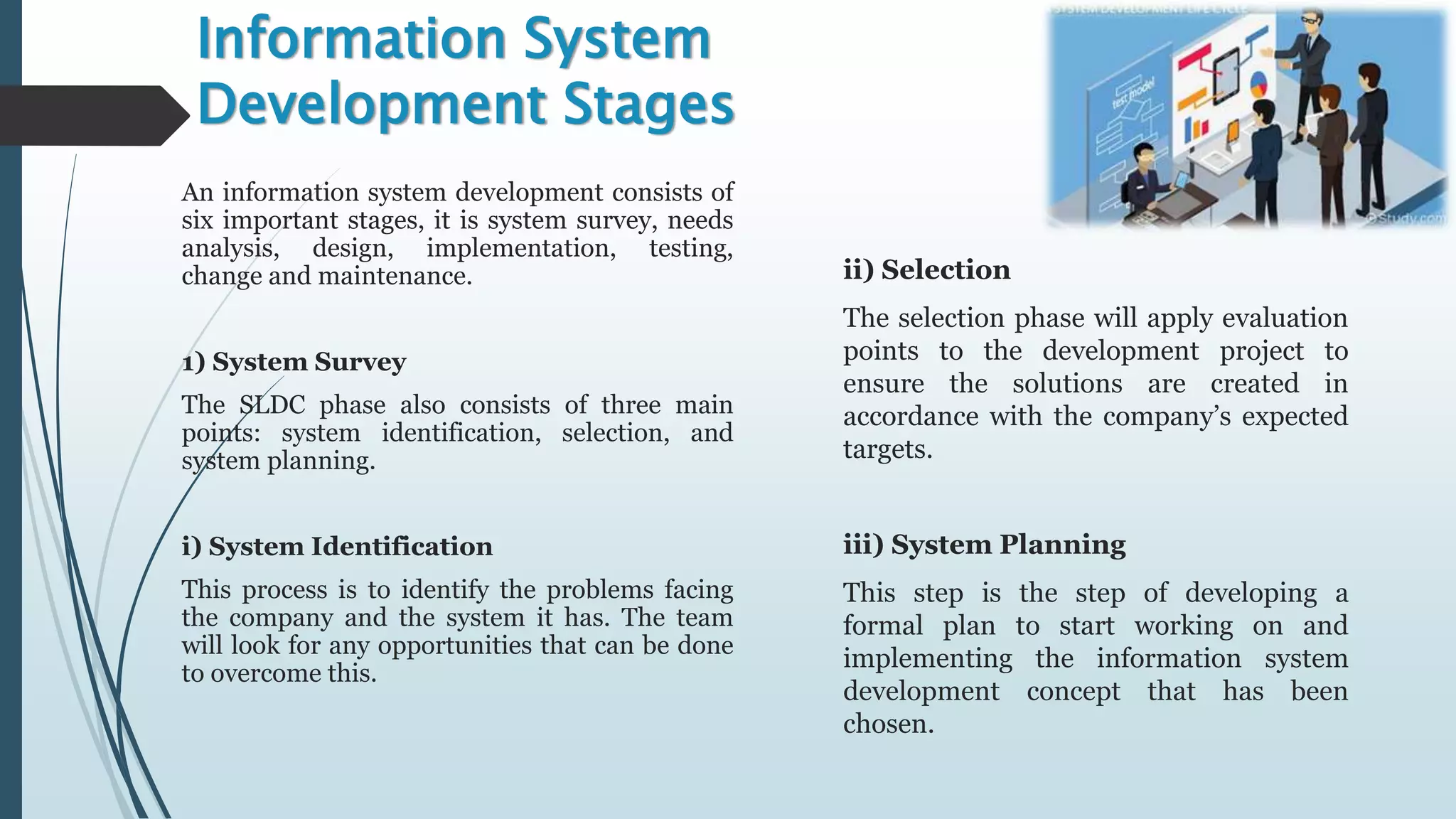
Information System
Development Stages
An information system development consists of
six important stages, it is system survey, needs
analysis, design, implementation, testing,
change and maintenance.
1) System Survey
The SLDC phase also consists of three main
points: system identification, selection, and
system planning.
i) System Identification
This process is to identify the problems facing
the company and the system it has. The team
will look for any opportunities that can be done
to overcome this.
ii) Selection
The selection phase will apply evaluation
points to the development project to
ensure the solutions are created in
accordance with the company’s expected
targets.
iii) System Planning
This step is the step of developing a
formal plan to start working on and
implementing the information system
development concept that has been
chosen.
2) Needs Analysis
 System requirements analysis is a technique for solving problems by decomposing
the components of the system. The aim is none other than to find out more about
how each component works and the interaction between one component with
other components.
 Some aspects that need to be targeted in the needs analysis in the development of
information systems include business users, job analysis, business processes,
agreed rules, problems and solutions, business tools, and business plans.
3) Design
 The design or design of system development is
intended to provide a complete blueprint as a
guideline for the IT team (especially programmers) in
making applications. Thus the IT team no longer makes
decisions or works in a sporadic way.
4) Implementation
 The stage of developing this information system is to
work on a previously designed development.
5) Testing
 A system needs to be tested to ensure that the
development carried out is appropriate or not
with the expected results. Tests that are applied
are various, such as performance, input
efficiency, syntax (program logic), output, and
so on.
 This information system development stage
requires preparation of various supporting
aspects. In addition to applications, hardware
readiness and several other related facilities also
need to be prepared. As for implementation,
several activities carried out include data
migration (conversion), training for users, and
trials.
6) Change and Maintenance
 This step covers the whole process in order to
ensure the continuity, smoothness and
improvement of the system. In addition to
monitoring the system at a certain time,
maintenance also includes activities to
anticipate minor bugs (bugs), system
improvements, and anticipation of some risks
from factors outside the system.
Any Question ?

Information Systems Development.pptx

  • 1.
  • 2.
    About Content  Whatis Information System?  What is Information Systems Development?  Information System Development Stages 1. System Survey i. System Identification ii. Selection iii. System Planning 2. Needs Analysis 3. Design 4. Implementation 5. Testing 6. Change and Maintenance
  • 3.
    What is Information System? The system is a collection of various elements or entities that are used to process input into an output. Inputs and outputs can be either raw or intact data into information — depending on the processing designed to work in the system.  Meanwhile, information is the result of data processing used for a particular purpose. As for what data means is raw facts that have not been processed and can not provide stimulus for users to take action.  Thus, an information system can be interpreted as a set of interconnected elements to process a given input into a particular output produced. The next stage of an information system is a MIS (Management Information System) which has a higher complexity with the final goal being used for the needs of analysis and decision making.
  • 4.
    What is Information SystemsDevelopment?  As the name suggests, information system development or commonly known as SLC (Systems Life Cycle) or SLDC (Software Development Life Cycle) is a process of making and changing the system and the model and methodology used. In other words, an SDLC is the preparation of a new system to replace the old system, both in whole and only partially.  Development of information systems is generally done because of problems that cannot be accommodated by the old system. For example, the hospital where you work make an overhaul SIMRS (Sistem Informasi Manajemen Rumah Sakit/Hospital Management Information System) because of applications that previously could not do bridging with BPJS. Considering the fact that the government has required it, then inevitably the hospital must adjust the SIMRS it already has.  As for carrying out an information system development, the related team will consist of several personnel, namely the project coordinator, system analyst and design, network designer, programmer, technician (hardware), administrator, software tester, graphic designer, and documentary.
  • 5.
    Information System Development Stages Aninformation system development consists of six important stages, it is system survey, needs analysis, design, implementation, testing, change and maintenance. 1) System Survey The SLDC phase also consists of three main points: system identification, selection, and system planning. i) System Identification This process is to identify the problems facing the company and the system it has. The team will look for any opportunities that can be done to overcome this. ii) Selection The selection phase will apply evaluation points to the development project to ensure the solutions are created in accordance with the company’s expected targets. iii) System Planning This step is the step of developing a formal plan to start working on and implementing the information system development concept that has been chosen.
  • 6.
    2) Needs Analysis System requirements analysis is a technique for solving problems by decomposing the components of the system. The aim is none other than to find out more about how each component works and the interaction between one component with other components.  Some aspects that need to be targeted in the needs analysis in the development of information systems include business users, job analysis, business processes, agreed rules, problems and solutions, business tools, and business plans.
  • 7.
    3) Design  Thedesign or design of system development is intended to provide a complete blueprint as a guideline for the IT team (especially programmers) in making applications. Thus the IT team no longer makes decisions or works in a sporadic way. 4) Implementation  The stage of developing this information system is to work on a previously designed development.
  • 8.
    5) Testing  Asystem needs to be tested to ensure that the development carried out is appropriate or not with the expected results. Tests that are applied are various, such as performance, input efficiency, syntax (program logic), output, and so on.  This information system development stage requires preparation of various supporting aspects. In addition to applications, hardware readiness and several other related facilities also need to be prepared. As for implementation, several activities carried out include data migration (conversion), training for users, and trials. 6) Change and Maintenance  This step covers the whole process in order to ensure the continuity, smoothness and improvement of the system. In addition to monitoring the system at a certain time, maintenance also includes activities to anticipate minor bugs (bugs), system improvements, and anticipation of some risks from factors outside the system.
  • 9.