SYSTEM
A system is a set of elements and relationships
which are different from relationships of the
set or its elements to other elements or sets.
CHARACTERISTICS OF SYSTEM
Most systems share common characteristics, including:
Systems have structure, defined by components and their composition;
Systems have behavior, which involves inputs, processing and outputs of
material, energy, information, or data;
Systems have interconnectivity: the various parts of a system have
functional as well as structural relationships to each other.
Systems may have some functions or groups of functions
SYSTEM CONCEPTS
Environment and boundaries :-
Systems theory views the world as a complex system of interconnected parts.
We scope a system by defining its boundary; this means choosing which
entities are inside the system and which are outside - part of the environment.
We then make simplified representations (models) of the system in order to
understand it and to predict or impact its future behavior. These models may
define the structure and/or the behavior of the system.
Natural and man-made systems :
There are natural and man-made (designed) systems. Natural systems may not
have an apparent objective but their outputs can be interpreted as purposes.
Man-made systems are made with purposes that are achieved by the delivery
of outputs. Their parts must be related; they must be “designed to work as a
coherent entity” - else they would be two or more distinct systems.
Theoretical Framework An open system exchanges matter and energy with its
surroundings. Most systems are open systems; like a car, coffeemaker, or computer. A
closed system exchanges energy, but not matter, with its environment; like Earth or
the project Biosphere2 or 3. An isolated system exchanges neither matter nor energy
with its environment. A theoretical example of such system is the Universe.
Process and transformation process A system can also be viewed as a bounded
transformation process, that is, a process or collection of processes that transforms
inputs into outputs. Inputs are consumed; outputs are produced. The concept of input
and output here is very broad. E.g., an output of a passenger ship is the movement
of people from departure to destination.
Subsystem A subsystem is a set of elements, which is a system
itself, and a component of a larger system.
System Model A system comprises multiple views. For the
man-made systems it may be such views as planning,
requirement (analysis), design, implementation, deployment,
structure, behavior, input data, and output data views. A
system model is required to describe and represent all these
multiple views.
System Architecture A system architecture, using one single
integrated model for the description of multiple views such as
planning, requirement (analysis), design, implementation,
deployment, structure, behavior, input data, and output data
views, is a kind of system model.
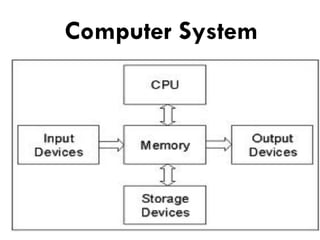
Computer System
Computer System & Subsystems
INFORMATION SYSTEM
An information system (IS) is any combination of
information technology and people's activities using that
technology to support operations, management In a very
broad sense, the term information system is frequently
used to refer to the interaction between people,
algorithmic processes, data and technology. In this sense,
the term is used to refer not only to the information and
communication technology (ICT) an organization uses, but
also to the way in which people interact with this
technology in support of business processes.
COMPONENTS OF INFORMATION
SYSTEM
The main components of information systems
are
• Computer hardware
• Software
• Databases
• Telecommunications systems
•  Human resources
•  Procedures
CATEGORIES OF IS
Management Information System (MIS).
Decision Support System (DSS).
Executive Information System (EIS).
Transaction Processing System (TPS).
Outline
• Definitions
• Types of Information Systems
• Information Systems Vs Information Technology
• Expanding Roles of IS
• Classification of IS
• Enterprise Resource Planning
• Information Systems Development
• IS as Discipline
• Information systems: Opportunities and Challenges
• Conclusion
INFORMATION SYSTEM
IMPLEMENTATION
Information systems are implemented within an organization for
the purpose of improving the effectiveness and efficiency of
that organization.
Capabilities of the information system and characteristics of
the organization, its work systems, its people, and its
development and implementation methodologies together
determine the extent to which that purpose is achieved.
TYPES OF INFORMATION
SYSTEMS
Some examples of such systems are:
• data warehouses
• enterprise resource planning
• enterprise systems
• expert systems
• geographic information system
• global information system
• office automation
INFORMATION SYSTEMS HAVE A
NUMBER OF DIFFERENT AREAS OF
WORK
• Information systems strategy
• Information systems management
• Information systems development
• Information systems security
• Information systems iteration
• Information system organization
INFORMATION SYSTEM
DEVELOPMENT
System development is done in stages which include:
• Problem recognition and specification
• Information gathering
• Requirements specification for the new system
• System design
• System construction
• System implementation
• Review and maintenance
Definitions
Data:-
Raw facts such as an employee’s name and number of hours
worked in a week, inventory part numbers or sales orders.
Information:-
A collection of facts organized in such a way that they have
additional value beyond the value of the facts themselves.
Data
Information
$35,000 12 Units $12,000
J. Jones Western Region
$100,000 100 Units
35 Units
Data Processing
Salesperson: J. Jones Sales
Territory: Western Region
Current Sales: 147 Units =
$147,000
Information Systems
An information system(IS) is typically considered to be a set of interrelated elements
or components that collect(input), manipulate(processes), and disseminate (output)
data and information and provide a feedback mechanism to meet an objective.
Definitions
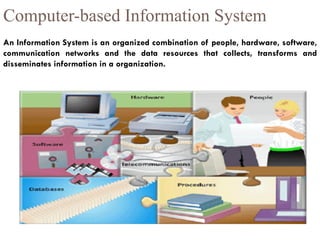
An Information System is an organized combination of people, hardware, software,
communication networks and the data resources that collects, transforms and
disseminates information in a organization.
Computer-based Information System
INFORMATION
TECHNOLOGY
Hardware
Software
Databases
Networks
Other related
components
are used to build
INFORMATION
SYSTEMS
Payroll
System
Inventory
System
Marketing
System
Customer
Service
System
IS Vs IT
Classification of IS
Information Systems
Operations Support
System
Management Support
System
Transaction
processing
systems
Process control
systems
Office
automation
systems
Management
information
systems
Decision
support
systems
Executive
information
systems
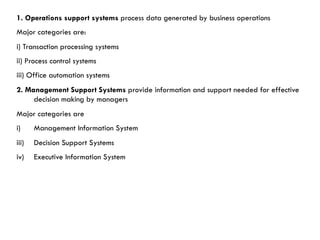
1. Operations support systems process data generated by business operations
Major categories are:
i) Transaction processing systems
ii) Process control systems
iii) Office automation systems
2. Management Support Systems provide information and support needed for effective
decision making by managers
Major categories are
i)  Management Information System
iii)  Decision Support Systems
iv)  Executive Information System
1.  Operations Support System
i) Transaction processing systems
•  Process business exchanges
•  Maintain records about the exchanges
•  Handle routine, yet critical, tasks
•  Perform simple calculations
ii) Process control systems monitor and control industrial processes.
iii) Office automation systems automate office procedures and enhance office
communications and productivity.
2. Management support systems provide information and support needed for effective
decision making by managers
Major categories are:
i)  Management information systems
v  Routine information for routine decisions
v  Operational efficiency
v  Use transaction data as main input
v  Databases integrate MIS in different functional areas
ii) Decision Support System
•  Interactive support for non-routine decisions or problems
•  End-users are more involved in creating a DSS than an MIS
iii) Executive information systems
provide critical information tailored to the information needs of executives
Other categories
a)  Expert systems
b)  End user computing systems
c)  Business information systems
d) Strategic information systems
a) Expert Systems are knowledge-based systems that provides expert advice and act as
expert consultants to the users
b) End user computing systems support the direct, hands on use of computers by end users
for operational and managerial applications
c) Business information systems support the operational and managerial applications of the
basic business functions of a firm
d) Strategic information systems provide a firm which strategic products, services, and
capabilities for competitive advantage
Information Systems Development
IS as Discipline
IS is an interdisciplinary field influenced by Computer Science, Political Science,
Psychology, Operations Research, Linguistics, Sociology, and Organizational Theory.
Challenges
1.  Workforce downsizing
2.  Information overload
3.  Employee mistrust
4.  Difficult to built
5.  Security breaches
Opportunities
1.  Enhanced global competitiveness
2.  Capture market opportunities
3.  Support corporate strategy
4.  Enhance worker productivity
5.  Improve quality of goods and services
Conclusion
Information Systems are indispensable to the business, industry, academia and any
organization to meet the future challenges
Asif Jamal
Lecturer
National University Of Modern Languages
&
Senior H R Manager
Indus Valley Development Society

Computer system

  • 1.
    SYSTEM A system isa set of elements and relationships which are different from relationships of the set or its elements to other elements or sets.
  • 2.
    CHARACTERISTICS OF SYSTEM Mostsystems share common characteristics, including: Systems have structure, defined by components and their composition; Systems have behavior, which involves inputs, processing and outputs of material, energy, information, or data; Systems have interconnectivity: the various parts of a system have functional as well as structural relationships to each other. Systems may have some functions or groups of functions
  • 3.
    SYSTEM CONCEPTS Environment andboundaries :- Systems theory views the world as a complex system of interconnected parts. We scope a system by defining its boundary; this means choosing which entities are inside the system and which are outside - part of the environment. We then make simplified representations (models) of the system in order to understand it and to predict or impact its future behavior. These models may define the structure and/or the behavior of the system. Natural and man-made systems : There are natural and man-made (designed) systems. Natural systems may not have an apparent objective but their outputs can be interpreted as purposes. Man-made systems are made with purposes that are achieved by the delivery of outputs. Their parts must be related; they must be “designed to work as a coherent entity” - else they would be two or more distinct systems.
  • 4.
    Theoretical Framework Anopen system exchanges matter and energy with its surroundings. Most systems are open systems; like a car, coffeemaker, or computer. A closed system exchanges energy, but not matter, with its environment; like Earth or the project Biosphere2 or 3. An isolated system exchanges neither matter nor energy with its environment. A theoretical example of such system is the Universe. Process and transformation process A system can also be viewed as a bounded transformation process, that is, a process or collection of processes that transforms inputs into outputs. Inputs are consumed; outputs are produced. The concept of input and output here is very broad. E.g., an output of a passenger ship is the movement of people from departure to destination.
  • 5.
    Subsystem A subsystemis a set of elements, which is a system itself, and a component of a larger system. System Model A system comprises multiple views. For the man-made systems it may be such views as planning, requirement (analysis), design, implementation, deployment, structure, behavior, input data, and output data views. A system model is required to describe and represent all these multiple views. System Architecture A system architecture, using one single integrated model for the description of multiple views such as planning, requirement (analysis), design, implementation, deployment, structure, behavior, input data, and output data views, is a kind of system model.
  • 6.
  • 7.
  • 8.
    INFORMATION SYSTEM An informationsystem (IS) is any combination of information technology and people's activities using that technology to support operations, management In a very broad sense, the term information system is frequently used to refer to the interaction between people, algorithmic processes, data and technology. In this sense, the term is used to refer not only to the information and communication technology (ICT) an organization uses, but also to the way in which people interact with this technology in support of business processes.
  • 9.
    COMPONENTS OF INFORMATION SYSTEM Themain components of information systems are • Computer hardware • Software • Databases • Telecommunications systems •  Human resources •  Procedures
  • 10.
    CATEGORIES OF IS ManagementInformation System (MIS). Decision Support System (DSS). Executive Information System (EIS). Transaction Processing System (TPS).
  • 11.
    Outline • Definitions • Types of InformationSystems • Information Systems Vs Information Technology • Expanding Roles of IS • Classification of IS • Enterprise Resource Planning • Information Systems Development • IS as Discipline • Information systems: Opportunities and Challenges • Conclusion
  • 12.
    INFORMATION SYSTEM IMPLEMENTATION Information systemsare implemented within an organization for the purpose of improving the effectiveness and efficiency of that organization. Capabilities of the information system and characteristics of the organization, its work systems, its people, and its development and implementation methodologies together determine the extent to which that purpose is achieved.
  • 14.
    TYPES OF INFORMATION SYSTEMS Someexamples of such systems are: • data warehouses • enterprise resource planning • enterprise systems • expert systems • geographic information system • global information system • office automation
  • 15.
    INFORMATION SYSTEMS HAVEA NUMBER OF DIFFERENT AREAS OF WORK • Information systems strategy • Information systems management • Information systems development • Information systems security • Information systems iteration • Information system organization
  • 16.
    INFORMATION SYSTEM DEVELOPMENT System developmentis done in stages which include: • Problem recognition and specification • Information gathering • Requirements specification for the new system • System design • System construction • System implementation • Review and maintenance
  • 17.
    Definitions Data:- Raw facts suchas an employee’s name and number of hours worked in a week, inventory part numbers or sales orders. Information:- A collection of facts organized in such a way that they have additional value beyond the value of the facts themselves. Data Information $35,000 12 Units $12,000 J. Jones Western Region $100,000 100 Units 35 Units Data Processing Salesperson: J. Jones Sales Territory: Western Region Current Sales: 147 Units = $147,000
  • 18.
    Information Systems An informationsystem(IS) is typically considered to be a set of interrelated elements or components that collect(input), manipulate(processes), and disseminate (output) data and information and provide a feedback mechanism to meet an objective. Definitions
  • 19.
    An Information Systemis an organized combination of people, hardware, software, communication networks and the data resources that collects, transforms and disseminates information in a organization. Computer-based Information System
  • 20.
    INFORMATION TECHNOLOGY Hardware Software Databases Networks Other related components are usedto build INFORMATION SYSTEMS Payroll System Inventory System Marketing System Customer Service System IS Vs IT
  • 21.
    Classification of IS InformationSystems Operations Support System Management Support System Transaction processing systems Process control systems Office automation systems Management information systems Decision support systems Executive information systems
  • 22.
    1. Operations supportsystems process data generated by business operations Major categories are: i) Transaction processing systems ii) Process control systems iii) Office automation systems 2. Management Support Systems provide information and support needed for effective decision making by managers Major categories are i)  Management Information System iii)  Decision Support Systems iv)  Executive Information System
  • 23.
    1.  Operations SupportSystem i) Transaction processing systems •  Process business exchanges •  Maintain records about the exchanges •  Handle routine, yet critical, tasks •  Perform simple calculations ii) Process control systems monitor and control industrial processes. iii) Office automation systems automate office procedures and enhance office communications and productivity.
  • 24.
    2. Management supportsystems provide information and support needed for effective decision making by managers Major categories are: i)  Management information systems v  Routine information for routine decisions v  Operational efficiency v  Use transaction data as main input v  Databases integrate MIS in different functional areas
  • 25.
    ii) Decision SupportSystem •  Interactive support for non-routine decisions or problems •  End-users are more involved in creating a DSS than an MIS iii) Executive information systems provide critical information tailored to the information needs of executives
  • 26.
    Other categories a)  Expertsystems b)  End user computing systems c)  Business information systems d) Strategic information systems a) Expert Systems are knowledge-based systems that provides expert advice and act as expert consultants to the users b) End user computing systems support the direct, hands on use of computers by end users for operational and managerial applications c) Business information systems support the operational and managerial applications of the basic business functions of a firm d) Strategic information systems provide a firm which strategic products, services, and capabilities for competitive advantage
  • 27.
  • 28.
    IS as Discipline ISis an interdisciplinary field influenced by Computer Science, Political Science, Psychology, Operations Research, Linguistics, Sociology, and Organizational Theory.
  • 30.
    Challenges 1.  Workforce downsizing 2. Information overload 3.  Employee mistrust 4.  Difficult to built 5.  Security breaches
  • 31.
    Opportunities 1.  Enhanced globalcompetitiveness 2.  Capture market opportunities 3.  Support corporate strategy 4.  Enhance worker productivity 5.  Improve quality of goods and services
  • 32.
    Conclusion Information Systems areindispensable to the business, industry, academia and any organization to meet the future challenges
  • 33.
    Asif Jamal Lecturer National UniversityOf Modern Languages & Senior H R Manager Indus Valley Development Society