
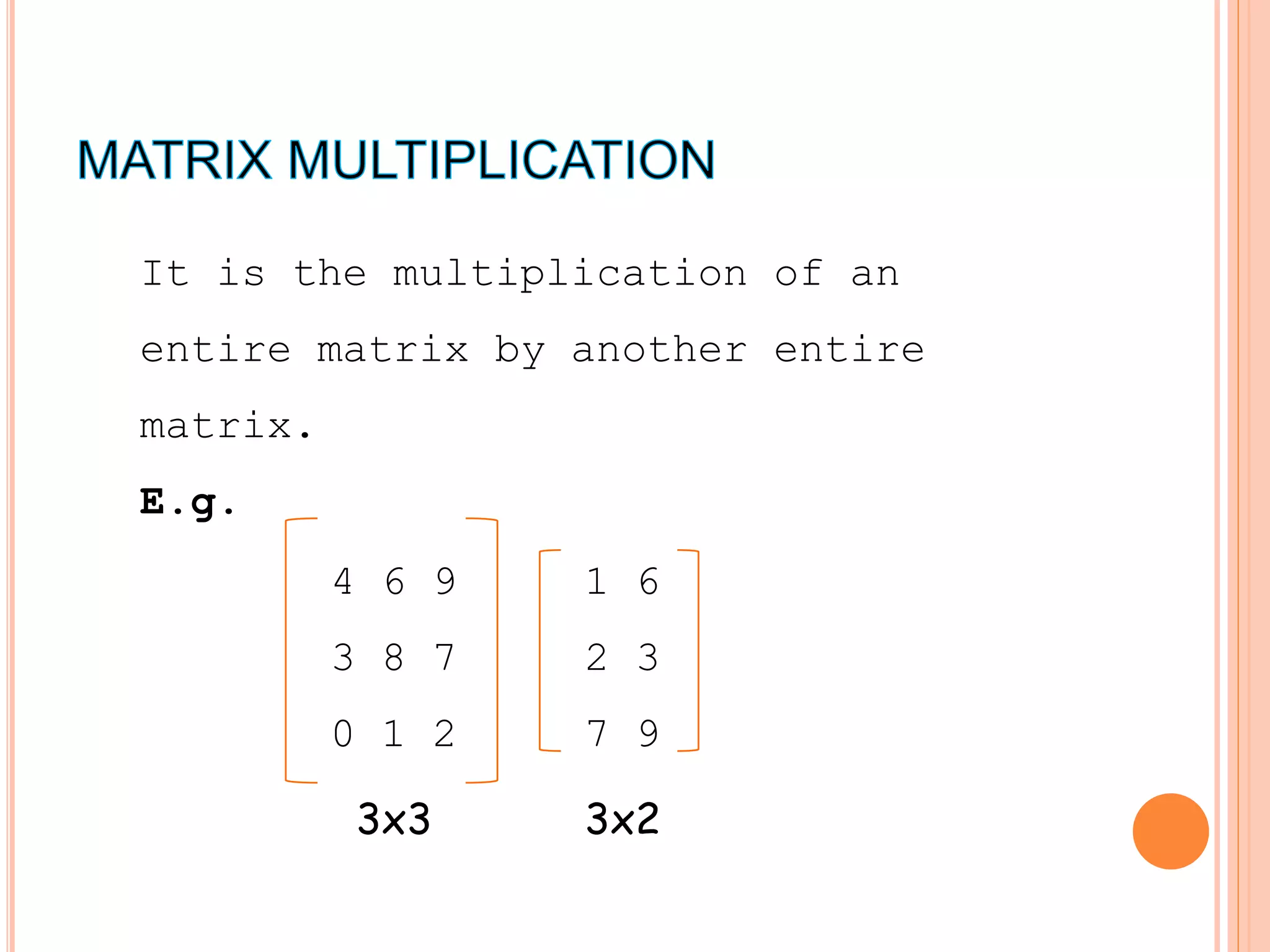
4 6 9 1 6
3 8 7 2 3
0 1 2 7 9
3x3 3x2
It is the multiplication of an
entire matrix by another entire
matrix.
E.g.
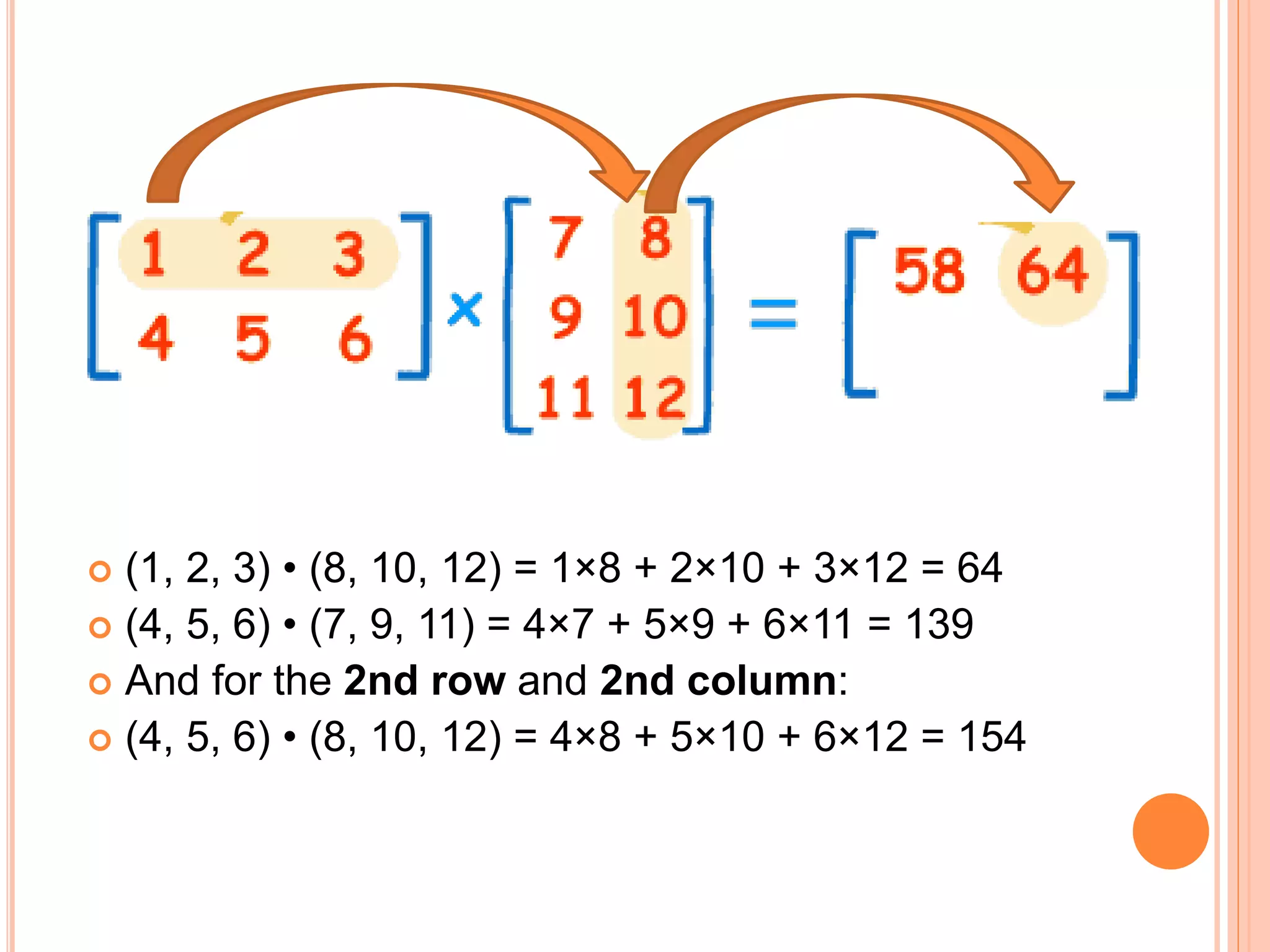
 (1, 2, 3) • (8, 10, 12) = 1×8 + 2×10 + 3×12 = 64
 (4, 5, 6) • (7, 9, 11) = 4×7 + 5×9 + 6×11 = 139
 And for the 2nd row and 2nd column:
 (4, 5, 6) • (8, 10, 12) = 4×8 + 5×10 + 6×12 = 154
In General:
To multiply an m×n matrix by
an n×p matrix, the ns must be the
same,
and the result is an m×p matrix.
 The number of columns of the 1st
matrix must equal the number of rows
of the 2nd matrix.
 And the result will have the same
number of rows as the 1st matrix, and
the same number of columns as the 2nd
matrix.
 In arithmetic we are used to:
 3 × 5 = 5 × 3
(The Commutative Law of
Multiplication)
 But this is not generally true for
matrices (matrix multiplication is not
commutative):
Example:
See how changing the order affects
this multiplication.
AB ≠ BA
When you change the order of
multiplication, the answer is
(usually) different.
 You can multiply two matrices if, and only if, the
number of columns in the first matrix equals the
number of rows in the second matrix.
 Otherwise, the product of two matrices is
undefined.
 Step 1: Make sure that the number of columns in
the 1st one equals the number of rows in the
2nd one. (The pre-requisite to be able to multiply)
 Step 2: Multiply the elements of each row of the
first matrix by the elements of each column in the
second matrix.
 Step 3: Add the products.
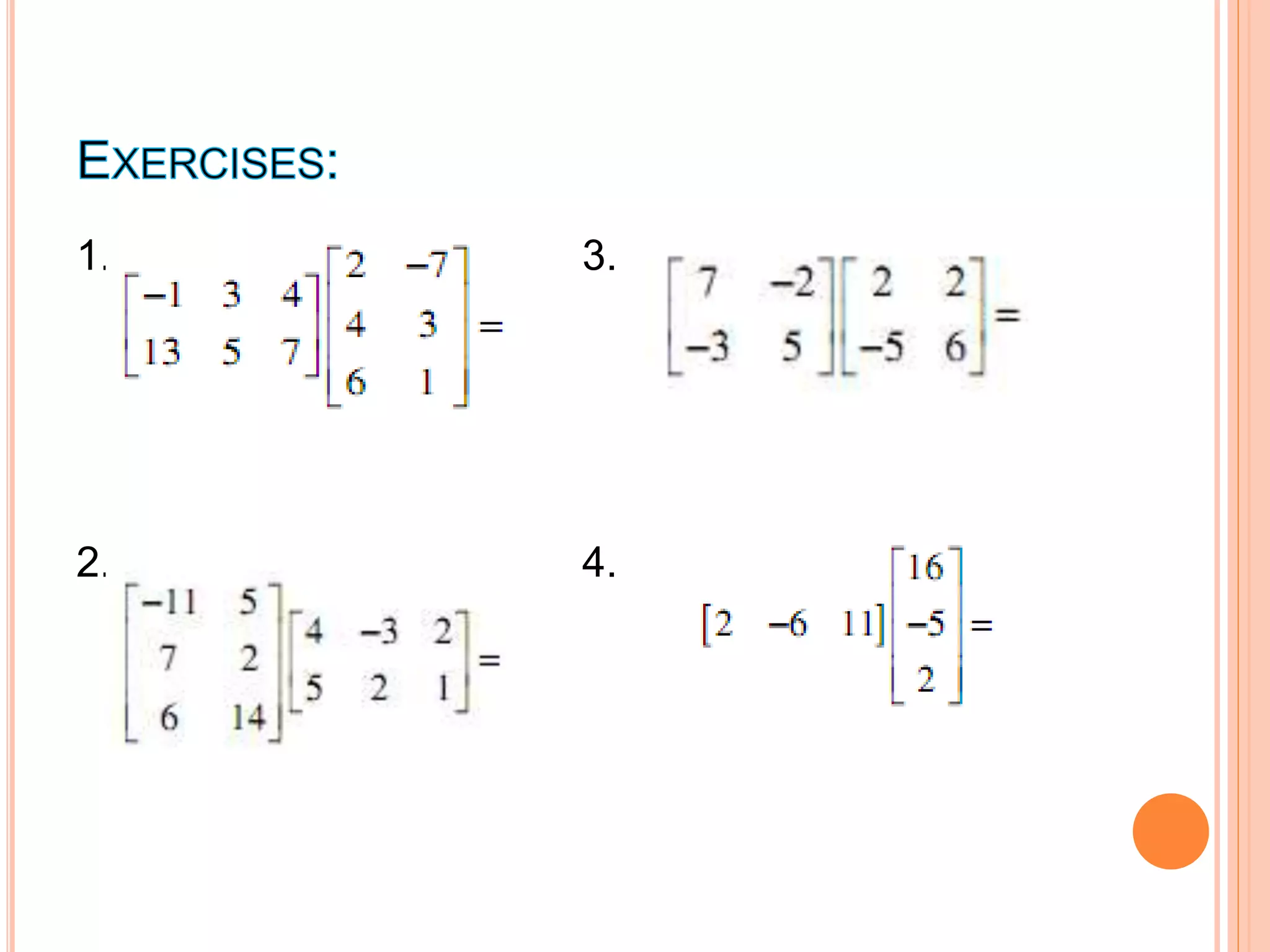
1. (6*-4)+(-2*8)+(5*3)
(1*-4)+(6*8)+(2*3)
(-3*-4)+(4*8)+(7*3)
-24 + -16 + 15
-4 + 48 + 6
12 21+32+
=
=
2.
=
(4*-3)+(2*2)+(0*-1) (4*5)+(2*3)+(0*8) (4*6)+(2*-2)+(0*9) (4*7)+(2*4)+(0*0)
=
(-4*-3)+(-2*2)+(-1*-1) (-4*5)+(-2*3)+(-1*8) (-4*6)+(-2*-2)+(-1*9) (-4*7)+(-2*4)+(-1*0)
-12+4+0 20+6+0 24+-4+0 28+8+0
12+-4+1 -20+-6+-8 -24+4+-9 -28+-8+0
=
-8
9
2026
-34 -36-29
36
1.
2.
3.
4.
5. Multiply
 http://www.mathopolis.com/questions/q.php?id=658
8

Matrices - Discrete Structures

  • 2.
    4 6 91 6 3 8 7 2 3 0 1 2 7 9 3x3 3x2 It is the multiplication of an entire matrix by another entire matrix. E.g.
  • 4.
     (1, 2,3) • (8, 10, 12) = 1×8 + 2×10 + 3×12 = 64  (4, 5, 6) • (7, 9, 11) = 4×7 + 5×9 + 6×11 = 139  And for the 2nd row and 2nd column:  (4, 5, 6) • (8, 10, 12) = 4×8 + 5×10 + 6×12 = 154
  • 5.
    In General: To multiplyan m×n matrix by an n×p matrix, the ns must be the same, and the result is an m×p matrix.
  • 6.
     The numberof columns of the 1st matrix must equal the number of rows of the 2nd matrix.  And the result will have the same number of rows as the 1st matrix, and the same number of columns as the 2nd matrix.
  • 7.
     In arithmeticwe are used to:  3 × 5 = 5 × 3 (The Commutative Law of Multiplication)  But this is not generally true for matrices (matrix multiplication is not commutative):
  • 8.
    Example: See how changingthe order affects this multiplication. AB ≠ BA When you change the order of multiplication, the answer is (usually) different.
  • 9.
     You canmultiply two matrices if, and only if, the number of columns in the first matrix equals the number of rows in the second matrix.  Otherwise, the product of two matrices is undefined.
  • 10.
     Step 1:Make sure that the number of columns in the 1st one equals the number of rows in the 2nd one. (The pre-requisite to be able to multiply)  Step 2: Multiply the elements of each row of the first matrix by the elements of each column in the second matrix.  Step 3: Add the products.
  • 11.
  • 12.
    2. = (4*-3)+(2*2)+(0*-1) (4*5)+(2*3)+(0*8) (4*6)+(2*-2)+(0*9)(4*7)+(2*4)+(0*0) = (-4*-3)+(-2*2)+(-1*-1) (-4*5)+(-2*3)+(-1*8) (-4*6)+(-2*-2)+(-1*9) (-4*7)+(-2*4)+(-1*0) -12+4+0 20+6+0 24+-4+0 28+8+0 12+-4+1 -20+-6+-8 -24+4+-9 -28+-8+0 = -8 9 2026 -34 -36-29 36
  • 13.
  • 14.
  • 15.