LESSON 1- MATRICES:
BASIC OPERATIONS
Math 2B (Contemporary Mathematics)
Barnett/Ziegler/Byleen Finite Mathematics 11e 1
2
Learning Objectives for Lesson 1-
Matrices: Basic Operations
 The student will be able to perform addition and subtraction
of matrices.
 The student will be able to find the scalar product of a
number k and a matrix M.
 The student will be able to calculate a matrix product.
3
Addition and Subtraction
of Matrices
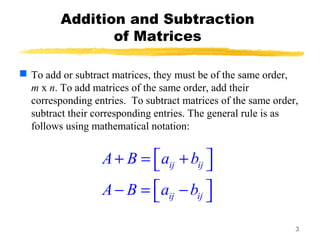
 To add or subtract matrices, they must be of the same order,
m x n. To add matrices of the same order, add their
corresponding entries. To subtract matrices of the same order,
subtract their corresponding entries. The general rule is as
follows using mathematical notation:
ij ij
ij ij
A B a b
A B a b
 + = + 
 − = − 
4
Example: Addition
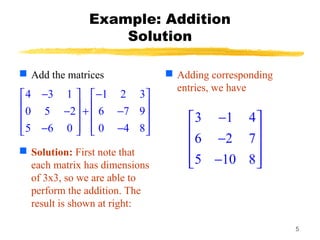
 Add the matrices
4 3 1 1 2 3
0 5 2 6 7 9
5 6 0 0 4 8
− −   
   − + −   
   − −   
5
Example: Addition
Solution
 Add the matrices
 Solution: First note that
each matrix has dimensions
of 3x3, so we are able to
perform the addition. The
result is shown at right:
 Adding corresponding
entries, we have
4 3 1 1 2 3
0 5 2 6 7 9
5 6 0 0 4 8
− −   
   − + −   
   − −   
3 1 4
6 2 7
5 10 8
− 
 − 
 − 
6
Example: Subtraction
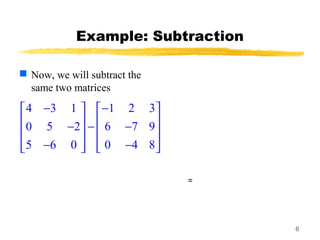
 Now, we will subtract the
same two matrices
4 3 1 1 2 3
0 5 2 6 7 9
5 6 0 0 4 8
− −   
   − − −   
   − −   
=
7
Example: Subtraction
Solution
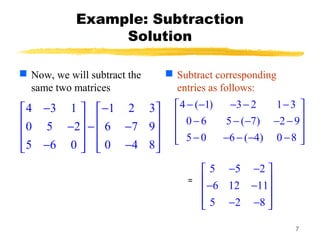
 Now, we will subtract the
same two matrices
 Subtract corresponding
entries as follows:
4 3 1 1 2 3
0 5 2 6 7 9
5 6 0 0 4 8
− −   
   − − −   
   − −   
4 ( 1) 3 2 1 3
0 6 5 ( 7) 2 9
5 0 6 ( 4) 0 8
− − − − − 
 − − − − − 
 − − − − − 
5 5 2
6 12 11
5 2 8
− − 
 − − 
 − − 
=
8
Scalar Multiplication
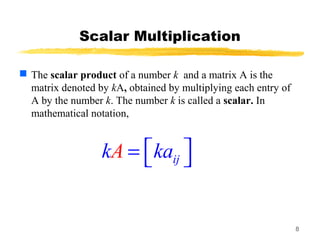
 The scalar product of a number k and a matrix A is the
matrix denoted by kA, obtained by multiplying each entry of
A by the number k. The number k is called a scalar. In
mathematical notation,
ijAk ka =  
9
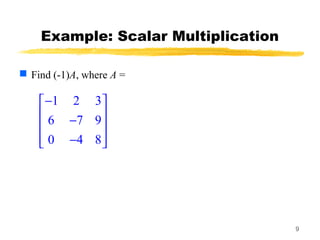
Example: Scalar Multiplication
 Find (-1)A, where A =
1 2 3
6 7 9
0 4 8
− 
 − 
 − 
10
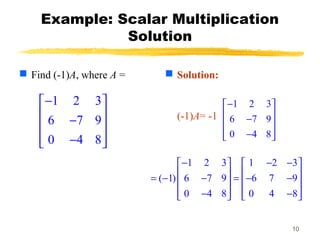
Example: Scalar Multiplication
Solution
 Find (-1)A, where A =  Solution:
(-1)A= -1
1 2 3
6 7 9
0 4 8
− 
 − 
 − 
1 2 3
6 7 9
0 4 8
− 
 − 
 − 
1 2 3 1 2 3
( 1) 6 7 9 6 7 9
0 4 8 0 4 8
− − −   
   = − − = − −   
   − −   
11
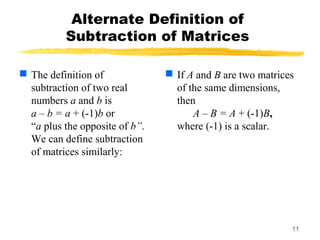
Alternate Definition of
Subtraction of Matrices
 The definition of
subtraction of two real
numbers a and b is
a – b = a + (-1)b or
“a plus the opposite of b”.
We can define subtraction
of matrices similarly:
 If A and B are two matrices
of the same dimensions,
then
A – B = A + (-1)B,
where (-1) is a scalar.
12
Example
 The example on the right
illustrates this procedure for
two 2x2 matrices.





−
=






−
−
+





=






−
−
−+





=






−
−
−





50
31
13
12
43
21
13
12
)1(
43
21
13
12
43
21
13
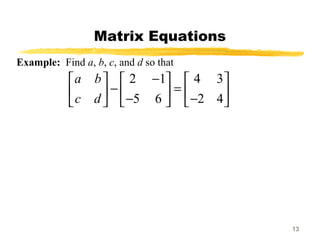
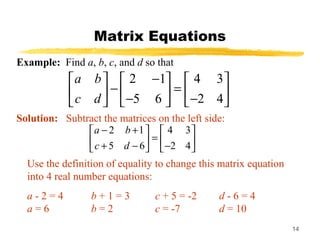
Matrix Equations
Example: Find a, b, c, and d so that
2 1 4 3
5 6 2 4
a b
c d
−     
− =     − −     
14
Matrix Equations
Example: Find a, b, c, and d so that
2 1 4 3
5 6 2 4
a b
c d
−     
− =     − −     
Solution: Subtract the matrices on the left side:
2 1 4 3
5 6 2 4
a b
c d
− +   
=   + − −   
Use the definition of equality to change this matrix equation
into 4 real number equations:
a - 2 = 4 b + 1 = 3 c + 5 = -2 d - 6 = 4
a = 6 b = 2 c = -7 d = 10
15
Matrix Products
 The method of
multiplication of matrices
is not as intuitive and may
seem strange, although
this method is extremely
useful in many
mathematical applications.
 Matrix multiplication was
introduced by an English
mathematician named
Arthur Cayley (1821-1895).
We will see shortly how
matrix multiplication can be
used to solve systems of
linear equations.
16
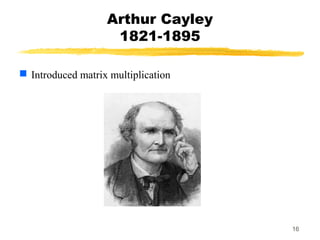
Arthur Cayley
1821-1895
 Introduced matrix multiplication
17
Product of a Row Matrix
and a Column Matrix
 In order to understand the general procedure of matrix
multiplication, we will introduce the concept of the product of
a row matrix by a column matrix.
 A row matrix consists of a single row of numbers, while a
column matrix consists of a single column of numbers. If the
number of columns of a row matrix equals the number of rows
of a column matrix, the product of a row matrix and column
matrix is defined. Otherwise, the product is not defined.
18
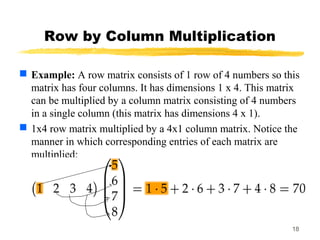
Row by Column Multiplication
 Example: A row matrix consists of 1 row of 4 numbers so this
matrix has four columns. It has dimensions 1 x 4. This matrix
can be multiplied by a column matrix consisting of 4 numbers
in a single column (this matrix has dimensions 4 x 1).
 1x4 row matrix multiplied by a 4x1 column matrix. Notice the
manner in which corresponding entries of each matrix are
multiplied:
19
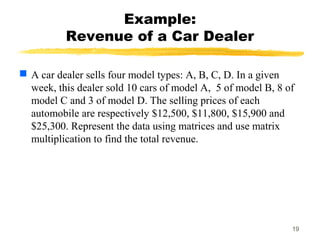
Example:
Revenue of a Car Dealer
 A car dealer sells four model types: A, B, C, D. In a given
week, this dealer sold 10 cars of model A, 5 of model B, 8 of
model C and 3 of model D. The selling prices of each
automobile are respectively $12,500, $11,800, $15,900 and
$25,300. Represent the data using matrices and use matrix
multiplication to find the total revenue.
20
Solution using Matrix Multiplication
 We represent the number of each model sold using a row
matrix (4x1), and we use a 1x4 column matrix to represent the
sales price of each model. When a 4x1 matrix is multiplied by
a 1x4 matrix, the result is a 1x1 matrix containing a single
number.
[ ] [ ] [ ]
12,500
11,800
10 5 8 3 10(12,500) 5(11,800) 8(15,900) 3(25,300) 387,100
15,900
25,300
 
 
  = + + + =
 
 
 
Barnett/Ziegler/Byleen Finite Mathematics 11e 21
Matrix Product
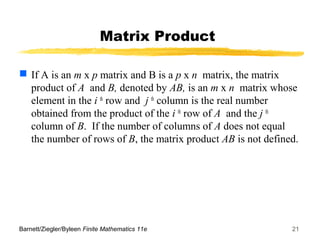
 If A is an m x p matrix and B is a p x n matrix, the matrix
product of A and B, denoted by AB, is an m x n matrix whose
element in the i th
row and j th
column is the real number
obtained from the product of the i th
row of A and the j th
column of B. If the number of columns of A does not equal
the number of rows of B, the matrix product AB is not defined.
Barnett/Ziegler/Byleen Finite Mathematics 11e 22
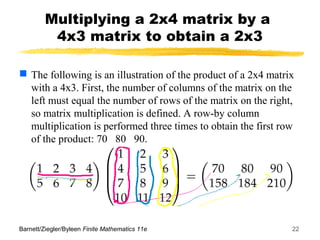
Multiplying a 2x4 matrix by a
4x3 matrix to obtain a 2x3
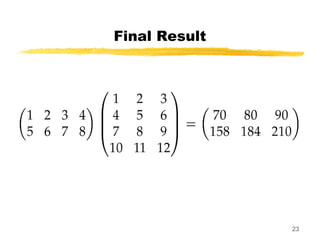
 The following is an illustration of the product of a 2x4 matrix
with a 4x3. First, the number of columns of the matrix on the
left must equal the number of rows of the matrix on the right,
so matrix multiplication is defined. A row-by column
multiplication is performed three times to obtain the first row
of the product: 70 80 90.
23
Final Result
24
Undefined Matrix Multiplication
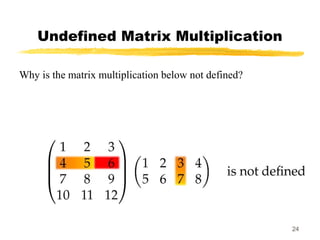
Why is the matrix multiplication below not defined?
25
Undefined Matrix Multiplication
Solution
Why is the matrix multiplication below not defined?
The answer is that the left matrix has three columns but the
matrix on the right has only two rows. To multiply the second
row [4 5 6] by the third column, 3 , there is no number to pair
with 6 to multiply. 7
26
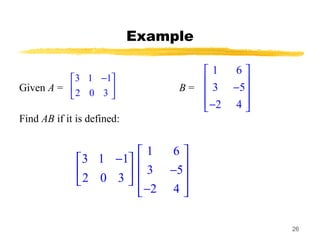
Example
Given A = B =
Find AB if it is defined:
3 1 1
2 0 3
− 
 
 
1 6
3 5
2 4
 
 − 
 − 
1 6
3 5
2 4
 
 − 
 − 
3 1 1
2 0 3
− 
 
 
27
Solution
2 0 3
3 1 1 
 
 
−
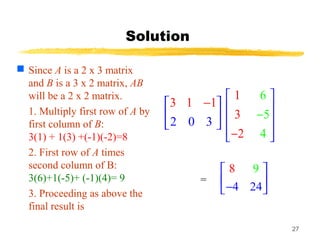
 Since A is a 2 x 3 matrix
and B is a 3 x 2 matrix, AB
will be a 2 x 2 matrix.
1. Multiply first row of A by
first column of B:
3(1) + 1(3) +(-1)(-2)=8
2. First row of A times
second column of B:
3(6)+1(-5)+ (-1)(4)= 9
3. Proceeding as above the
final result is
6
5
4
1
3
2
 
 
 
  
−
−
4
98
4 2
 
 − 
=
28
Is Matrix Multiplication
Commutative?
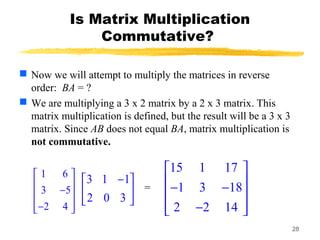
 Now we will attempt to multiply the matrices in reverse
order: BA = ?
 We are multiplying a 3 x 2 matrix by a 2 x 3 matrix. This
matrix multiplication is defined, but the result will be a 3 x 3
matrix. Since AB does not equal BA, matrix multiplication is
not commutative.
1 6
3 5
2 4
 
 − 
 − 
3 1 1
2 0 3
− 
 
 
15 1 17
1 3 18
2 2 14
 
 − − 
 − 
=
29
Practical Application
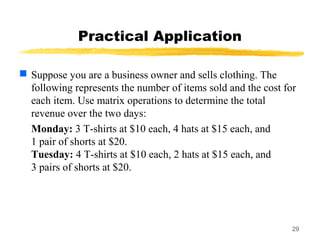
 Suppose you are a business owner and sells clothing. The
following represents the number of items sold and the cost for
each item. Use matrix operations to determine the total
revenue over the two days:
Monday: 3 T-shirts at $10 each, 4 hats at $15 each, and
1 pair of shorts at $20.
Tuesday: 4 T-shirts at $10 each, 2 hats at $15 each, and
3 pairs of shorts at $20.
30
Solution of Practical Application
 Represent the information using two matrices: The product of
the two matrices gives the total revenue:
 Then your total revenue for the two days is = [110 130]
Price times Quantity = Revenue
[ ]
3 4
10 15 20 4 2
1 3
 
 
 
  
Unit price of
each item:
Qty sold
of each
item on
Monday
Qty sold of
each item on
Tuesday
End of Lesson.
Reference:
Barnett/Ziegler/Byleen. Finite Mathematics 11e
31

Lesson 1 matrix

  • 1.
    LESSON 1- MATRICES: BASICOPERATIONS Math 2B (Contemporary Mathematics) Barnett/Ziegler/Byleen Finite Mathematics 11e 1
  • 2.
    2 Learning Objectives forLesson 1- Matrices: Basic Operations  The student will be able to perform addition and subtraction of matrices.  The student will be able to find the scalar product of a number k and a matrix M.  The student will be able to calculate a matrix product.
  • 3.
    3 Addition and Subtraction ofMatrices  To add or subtract matrices, they must be of the same order, m x n. To add matrices of the same order, add their corresponding entries. To subtract matrices of the same order, subtract their corresponding entries. The general rule is as follows using mathematical notation: ij ij ij ij A B a b A B a b  + = +   − = − 
  • 4.
    4 Example: Addition  Addthe matrices 4 3 1 1 2 3 0 5 2 6 7 9 5 6 0 0 4 8 − −       − + −       − −   
  • 5.
    5 Example: Addition Solution  Addthe matrices  Solution: First note that each matrix has dimensions of 3x3, so we are able to perform the addition. The result is shown at right:  Adding corresponding entries, we have 4 3 1 1 2 3 0 5 2 6 7 9 5 6 0 0 4 8 − −       − + −       − −    3 1 4 6 2 7 5 10 8 −   −   − 
  • 6.
    6 Example: Subtraction  Now,we will subtract the same two matrices 4 3 1 1 2 3 0 5 2 6 7 9 5 6 0 0 4 8 − −       − − −       − −    =
  • 7.
    7 Example: Subtraction Solution  Now,we will subtract the same two matrices  Subtract corresponding entries as follows: 4 3 1 1 2 3 0 5 2 6 7 9 5 6 0 0 4 8 − −       − − −       − −    4 ( 1) 3 2 1 3 0 6 5 ( 7) 2 9 5 0 6 ( 4) 0 8 − − − − −   − − − − −   − − − − −  5 5 2 6 12 11 5 2 8 − −   − −   − −  =
  • 8.
    8 Scalar Multiplication  Thescalar product of a number k and a matrix A is the matrix denoted by kA, obtained by multiplying each entry of A by the number k. The number k is called a scalar. In mathematical notation, ijAk ka =  
  • 9.
    9 Example: Scalar Multiplication Find (-1)A, where A = 1 2 3 6 7 9 0 4 8 −   −   − 
  • 10.
    10 Example: Scalar Multiplication Solution Find (-1)A, where A =  Solution: (-1)A= -1 1 2 3 6 7 9 0 4 8 −   −   −  1 2 3 6 7 9 0 4 8 −   −   −  1 2 3 1 2 3 ( 1) 6 7 9 6 7 9 0 4 8 0 4 8 − − −       = − − = − −       − −   
  • 11.
    11 Alternate Definition of Subtractionof Matrices  The definition of subtraction of two real numbers a and b is a – b = a + (-1)b or “a plus the opposite of b”. We can define subtraction of matrices similarly:  If A and B are two matrices of the same dimensions, then A – B = A + (-1)B, where (-1) is a scalar.
  • 12.
    12 Example  The exampleon the right illustrates this procedure for two 2x2 matrices.      − =       − − +      =       − − −+      =       − − −      50 31 13 12 43 21 13 12 )1( 43 21 13 12 43 21
  • 13.
    13 Matrix Equations Example: Finda, b, c, and d so that 2 1 4 3 5 6 2 4 a b c d −      − =     − −     
  • 14.
    14 Matrix Equations Example: Finda, b, c, and d so that 2 1 4 3 5 6 2 4 a b c d −      − =     − −      Solution: Subtract the matrices on the left side: 2 1 4 3 5 6 2 4 a b c d − +    =   + − −    Use the definition of equality to change this matrix equation into 4 real number equations: a - 2 = 4 b + 1 = 3 c + 5 = -2 d - 6 = 4 a = 6 b = 2 c = -7 d = 10
  • 15.
    15 Matrix Products  Themethod of multiplication of matrices is not as intuitive and may seem strange, although this method is extremely useful in many mathematical applications.  Matrix multiplication was introduced by an English mathematician named Arthur Cayley (1821-1895). We will see shortly how matrix multiplication can be used to solve systems of linear equations.
  • 16.
  • 17.
    17 Product of aRow Matrix and a Column Matrix  In order to understand the general procedure of matrix multiplication, we will introduce the concept of the product of a row matrix by a column matrix.  A row matrix consists of a single row of numbers, while a column matrix consists of a single column of numbers. If the number of columns of a row matrix equals the number of rows of a column matrix, the product of a row matrix and column matrix is defined. Otherwise, the product is not defined.
  • 18.
    18 Row by ColumnMultiplication  Example: A row matrix consists of 1 row of 4 numbers so this matrix has four columns. It has dimensions 1 x 4. This matrix can be multiplied by a column matrix consisting of 4 numbers in a single column (this matrix has dimensions 4 x 1).  1x4 row matrix multiplied by a 4x1 column matrix. Notice the manner in which corresponding entries of each matrix are multiplied:
  • 19.
    19 Example: Revenue of aCar Dealer  A car dealer sells four model types: A, B, C, D. In a given week, this dealer sold 10 cars of model A, 5 of model B, 8 of model C and 3 of model D. The selling prices of each automobile are respectively $12,500, $11,800, $15,900 and $25,300. Represent the data using matrices and use matrix multiplication to find the total revenue.
  • 20.
    20 Solution using MatrixMultiplication  We represent the number of each model sold using a row matrix (4x1), and we use a 1x4 column matrix to represent the sales price of each model. When a 4x1 matrix is multiplied by a 1x4 matrix, the result is a 1x1 matrix containing a single number. [ ] [ ] [ ] 12,500 11,800 10 5 8 3 10(12,500) 5(11,800) 8(15,900) 3(25,300) 387,100 15,900 25,300       = + + + =      
  • 21.
    Barnett/Ziegler/Byleen Finite Mathematics11e 21 Matrix Product  If A is an m x p matrix and B is a p x n matrix, the matrix product of A and B, denoted by AB, is an m x n matrix whose element in the i th row and j th column is the real number obtained from the product of the i th row of A and the j th column of B. If the number of columns of A does not equal the number of rows of B, the matrix product AB is not defined.
  • 22.
    Barnett/Ziegler/Byleen Finite Mathematics11e 22 Multiplying a 2x4 matrix by a 4x3 matrix to obtain a 2x3  The following is an illustration of the product of a 2x4 matrix with a 4x3. First, the number of columns of the matrix on the left must equal the number of rows of the matrix on the right, so matrix multiplication is defined. A row-by column multiplication is performed three times to obtain the first row of the product: 70 80 90.
  • 23.
  • 24.
    24 Undefined Matrix Multiplication Whyis the matrix multiplication below not defined?
  • 25.
    25 Undefined Matrix Multiplication Solution Whyis the matrix multiplication below not defined? The answer is that the left matrix has three columns but the matrix on the right has only two rows. To multiply the second row [4 5 6] by the third column, 3 , there is no number to pair with 6 to multiply. 7
  • 26.
    26 Example Given A =B = Find AB if it is defined: 3 1 1 2 0 3 −      1 6 3 5 2 4    −   −  1 6 3 5 2 4    −   −  3 1 1 2 0 3 −     
  • 27.
    27 Solution 2 0 3 31 1      −  Since A is a 2 x 3 matrix and B is a 3 x 2 matrix, AB will be a 2 x 2 matrix. 1. Multiply first row of A by first column of B: 3(1) + 1(3) +(-1)(-2)=8 2. First row of A times second column of B: 3(6)+1(-5)+ (-1)(4)= 9 3. Proceeding as above the final result is 6 5 4 1 3 2          − − 4 98 4 2    −  =
  • 28.
    28 Is Matrix Multiplication Commutative? Now we will attempt to multiply the matrices in reverse order: BA = ?  We are multiplying a 3 x 2 matrix by a 2 x 3 matrix. This matrix multiplication is defined, but the result will be a 3 x 3 matrix. Since AB does not equal BA, matrix multiplication is not commutative. 1 6 3 5 2 4    −   −  3 1 1 2 0 3 −      15 1 17 1 3 18 2 2 14    − −   −  =
  • 29.
    29 Practical Application  Supposeyou are a business owner and sells clothing. The following represents the number of items sold and the cost for each item. Use matrix operations to determine the total revenue over the two days: Monday: 3 T-shirts at $10 each, 4 hats at $15 each, and 1 pair of shorts at $20. Tuesday: 4 T-shirts at $10 each, 2 hats at $15 each, and 3 pairs of shorts at $20.
  • 30.
    30 Solution of PracticalApplication  Represent the information using two matrices: The product of the two matrices gives the total revenue:  Then your total revenue for the two days is = [110 130] Price times Quantity = Revenue [ ] 3 4 10 15 20 4 2 1 3          Unit price of each item: Qty sold of each item on Monday Qty sold of each item on Tuesday
  • 31.