
Referencing and Citing 2.1 References and Bibliographies
Bibliography Lists sources used for background reading as part of research. References Lists the particular sources used e.g. journal articles, books, websites, graphics
Bibliographies and References include Author Date of publication  Title of book or article Periodical title Place of publication Publisher Page numbers for journal articles
Bibliographic software  e.g. Endnote, Refworks etc. Construct and organise bibliographies for theses and papers Import citations Format citations
Referencing and Citing 2.2 Plagiarism
When you borrow another person’s words or ideas by quoting, paraphrasing or summarizing them, you must show where you got the ideas by putting certain information in  parenthesis immediately after the material you have borrowed. Source:Oshima & Hogue,1999 All work taken from another source must be acknowledged and documented
2 ways of giving acknowledgement: Direct method  i.e. quotation Indirect method  by summarizing and  paraphrasing
Quotation  is copying word-for-word from a published text, transcript etc. However, changing words or sentence structure from the original means it is no longer a direct quote. Statistics are good supporting details for opinions. Like quotations their source must also be cited.
Ways of quoting For a short quotation of less than 40 words, use a brief phrase as an introduction to the quotation e.g. Pennycook (1996) claims “All language learning is to some extent a process of borrowing others’ words”  Longer quotations stand alone in the text e.g.
In a seminal article on plagiarism, Pennycook cautioned All language learning is to some  extent a process of borrowing others’  words and we need to be flexible, not  dogmatic, about where we draw  boundaries between acceptable and  unacceptable textual borrowings. (1996:227)
Referencing and Citing 2.3 Documenting sources  within the text
What? The practice of citing original sources of information When? Direct quotations and paraphrased information from another source, except dictionaries and encyclopedias Why? Readers can find the original source Writer not responsible for all information Plagiarism is avoided
Although there are other methods for documenting sources, APA or American Psychological Association Number reference system  Are frequently used in natural science, social science and technical fields. The conventions of the APA system are:
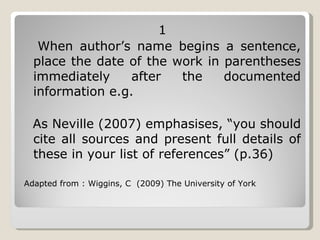
1 When author’s name begins a sentence, place the date of the work in parentheses immediately after the documented information e.g. As Neville (2007) emphasises, “you should cite all sources and present full details of these in your list of references” (p.36) Adapted from : Wiggins, C  (2009) The University of York
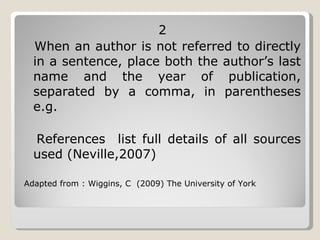
2 When an author is not referred to directly in a sentence, place both the author’s last name and the year of publication, separated by a comma, in parentheses e.g. References  list full details of all sources used (Neville,2007)  Adapted from : Wiggins, C  (2009) The University of York
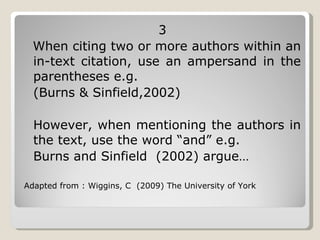
3 When citing two or more authors within an in-text citation, use an ampersand in the parentheses e.g. (Burns & Sinfield,2002) However, when mentioning the authors in the text, use the word “and” e.g. Burns and Sinfield  (2002) argue… Adapted from : Wiggins, C  (2009) The University of York
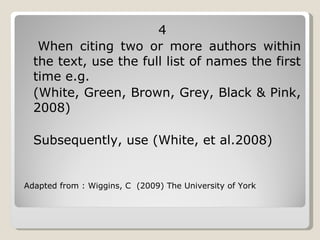
4 When citing two or more authors within the text, use the full list of names the first time e.g.  (White, Green, Brown, Grey, Black & Pink, 2008) Subsequently, use (White, et al.2008)  Adapted from : Wiggins, C  (2009) The University of York
5 When the same author and text is referred to more than once in a single paragraph, there is no need to give the date for the  second reference  6 When a direct quotation is used, give the year and page/s numbers immediately after the quotation
7 Two works by the same author published  in the same year are differentiated by  a,b,c and cross-referenced accordingly  e.g.  In-text  (Carroll, 2007a)  References: Carroll, J.(2007a)  A handbook for deterring plagiarism in higher education . Oxford Centre for Staff and Learning Development: Oxford Brookes University Adapted from : Wiggins, C  (2009) The University of York
8 Two works by the same author published  in different years require the year of publication for both works e.g.  Carroll (2005, 2007) maintains….
9 When pulling together several sources to support your argument, use one in-text citation. List the names alphabetically as they appear in the bibliography e.g.  As widely stated in the literature…. (Carroll,2002; Mallon, 1991;Neville,2007)  Adapted from : Wiggins, C  (2009) The University of York
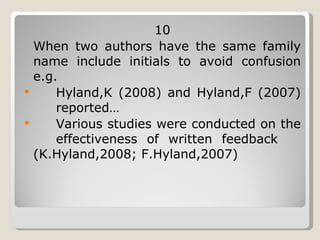
10 When two authors have the same family name include initials to avoid confusion e.g.  Hyland,K (2008) and Hyland,F (2007)  reported… Various studies were conducted on the  effectiveness of written feedback  (K.Hyland,2008; F.Hyland,2007)
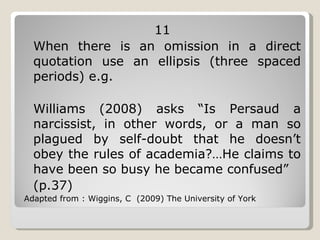
11 When there is an omission in a direct quotation use an ellipsis (three spaced periods) e.g. Williams (2008) asks “Is Persaud a narcissist, in other words, or a man so plagued by self-doubt that he doesn’t obey the rules of academia?…He claims to have been so busy he became confused” (p.37) Adapted from : Wiggins, C  (2009) The University of York
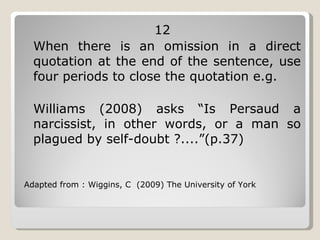
12 When there is an omission in a direct quotation at the end of the sentence, use four periods to close the quotation e.g. Williams (2008) asks “Is Persaud a narcissist, in other words, or a man so plagued by self-doubt ?....”(p.37) Adapted from : Wiggins, C  (2009) The University of York

Referencing and Citing

  • 1.
    Referencing and Citing2.1 References and Bibliographies
  • 2.
    Bibliography Lists sourcesused for background reading as part of research. References Lists the particular sources used e.g. journal articles, books, websites, graphics
  • 3.
    Bibliographies and Referencesinclude Author Date of publication Title of book or article Periodical title Place of publication Publisher Page numbers for journal articles
  • 4.
    Bibliographic software e.g. Endnote, Refworks etc. Construct and organise bibliographies for theses and papers Import citations Format citations
  • 5.
    Referencing and Citing2.2 Plagiarism
  • 6.
    When you borrowanother person’s words or ideas by quoting, paraphrasing or summarizing them, you must show where you got the ideas by putting certain information in parenthesis immediately after the material you have borrowed. Source:Oshima & Hogue,1999 All work taken from another source must be acknowledged and documented
  • 7.
    2 ways ofgiving acknowledgement: Direct method i.e. quotation Indirect method by summarizing and paraphrasing
  • 8.
    Quotation iscopying word-for-word from a published text, transcript etc. However, changing words or sentence structure from the original means it is no longer a direct quote. Statistics are good supporting details for opinions. Like quotations their source must also be cited.
  • 9.
    Ways of quotingFor a short quotation of less than 40 words, use a brief phrase as an introduction to the quotation e.g. Pennycook (1996) claims “All language learning is to some extent a process of borrowing others’ words” Longer quotations stand alone in the text e.g.
  • 10.
    In a seminalarticle on plagiarism, Pennycook cautioned All language learning is to some extent a process of borrowing others’ words and we need to be flexible, not dogmatic, about where we draw boundaries between acceptable and unacceptable textual borrowings. (1996:227)
  • 11.
    Referencing and Citing2.3 Documenting sources within the text
  • 12.
    What? The practiceof citing original sources of information When? Direct quotations and paraphrased information from another source, except dictionaries and encyclopedias Why? Readers can find the original source Writer not responsible for all information Plagiarism is avoided
  • 13.
    Although there areother methods for documenting sources, APA or American Psychological Association Number reference system Are frequently used in natural science, social science and technical fields. The conventions of the APA system are:
  • 14.
    1 When author’sname begins a sentence, place the date of the work in parentheses immediately after the documented information e.g. As Neville (2007) emphasises, “you should cite all sources and present full details of these in your list of references” (p.36) Adapted from : Wiggins, C (2009) The University of York
  • 15.
    2 When anauthor is not referred to directly in a sentence, place both the author’s last name and the year of publication, separated by a comma, in parentheses e.g. References list full details of all sources used (Neville,2007) Adapted from : Wiggins, C (2009) The University of York
  • 16.
    3 When citingtwo or more authors within an in-text citation, use an ampersand in the parentheses e.g. (Burns & Sinfield,2002) However, when mentioning the authors in the text, use the word “and” e.g. Burns and Sinfield (2002) argue… Adapted from : Wiggins, C (2009) The University of York
  • 17.
    4 When citingtwo or more authors within the text, use the full list of names the first time e.g. (White, Green, Brown, Grey, Black & Pink, 2008) Subsequently, use (White, et al.2008) Adapted from : Wiggins, C (2009) The University of York
  • 18.
    5 When thesame author and text is referred to more than once in a single paragraph, there is no need to give the date for the second reference 6 When a direct quotation is used, give the year and page/s numbers immediately after the quotation
  • 19.
    7 Two worksby the same author published in the same year are differentiated by a,b,c and cross-referenced accordingly e.g. In-text (Carroll, 2007a) References: Carroll, J.(2007a) A handbook for deterring plagiarism in higher education . Oxford Centre for Staff and Learning Development: Oxford Brookes University Adapted from : Wiggins, C (2009) The University of York
  • 20.
    8 Two worksby the same author published in different years require the year of publication for both works e.g. Carroll (2005, 2007) maintains….
  • 21.
    9 When pullingtogether several sources to support your argument, use one in-text citation. List the names alphabetically as they appear in the bibliography e.g. As widely stated in the literature…. (Carroll,2002; Mallon, 1991;Neville,2007) Adapted from : Wiggins, C (2009) The University of York
  • 22.
    10 When twoauthors have the same family name include initials to avoid confusion e.g. Hyland,K (2008) and Hyland,F (2007) reported… Various studies were conducted on the effectiveness of written feedback (K.Hyland,2008; F.Hyland,2007)
  • 23.
    11 When thereis an omission in a direct quotation use an ellipsis (three spaced periods) e.g. Williams (2008) asks “Is Persaud a narcissist, in other words, or a man so plagued by self-doubt that he doesn’t obey the rules of academia?…He claims to have been so busy he became confused” (p.37) Adapted from : Wiggins, C (2009) The University of York
  • 24.
    12 When thereis an omission in a direct quotation at the end of the sentence, use four periods to close the quotation e.g. Williams (2008) asks “Is Persaud a narcissist, in other words, or a man so plagued by self-doubt ?....”(p.37) Adapted from : Wiggins, C (2009) The University of York