1
APA Style Reference Citations
Library Resource Guide
WHAT IS A REFERENCE CITATION?
A reference citation is the documentation needed to make your
paper acceptable for academic purposes. It
gives authoritative sources for your statements, helps the reader
gain access to those sources, and acknowledges
the fact that the information used in a paper did not originate
with the writer.
WHAT IS APA'S STYLE OF REFERENCE CITATION?
APA style uses the author/date method of citation in which the
author's last name and the year of the
publication are inserted in the actual text of the paper. It is the
style recommended by the American
Psychological Association and used in many of the social
sciences. The American Psychological Association
addresses new electronic formats in a separate guide, which UT
students can access in book format or online
through the library. Several of the examples in this guide come
from one of these sources. The American
Psychological Association offers some guidance and examples
at http://www.apastyle.org/. The Writing
Center, on the first floor of Carlson, also offers help to students
who are writing papers. This guide only
summarizes a few main points regarding APA style. For full
information, please consult the two APA guides
below.
BF 76.7 .P83 2001 REF (available in Reference and Reserves at
Carlson Library)
Publication Manual of the American Psychological Association
(5th ed.) by The American
Psychological Association.
BF 76.7 .P833 2007 REF (available in Reference or at
http://utmost.cl.utoledo.edu/record=b2574984)
APA Style Guide to Electronic References by The American
Psychological Association.
WHEN USING APA STYLE, DO I NEED TO USE
FOOTNOTES AT THE BOTTOM OF THE PAGE?
No, by inserting reference citations in the text, you eliminate
the need to use footnotes at the bottom of the page
or at the end of your paper. The citations in your end-of-paper
references list should give readers enough
information to locate each source.
NOTE: It is suggested that you consult with your instructor or
advisor for the style preferred by your
department. Be consistent and do not mix styles! Inquire at the
Information/Reference Desk for style
manuals available at Carlson Library.
EXAMPLES OF REFERENCE CITATIONS IN TEXT--APA
STYLE
1. If author's name occurs in the text, follow it with year of
publication in parentheses.
Example: Piaget (1970) compared reaction times...
2. If author's name is not in the text, insert last name, comma,
year in parenthesis.
Example: In a recent study of reaction times (Piaget, 1978)…
2
3. If author's name and the date of publication have been
mentioned in the text of your paper, they
should not be repeated within parentheses.
Example: In 1978, Piaget compared reaction times...
4. Because material within a book or on a web page is often
difficult to locate, authors should,
whenever possible, give page numbers for books or paragraph
numbers for web pages in body to
assist readers. Page numbers (preceded by p. or pp.) or
paragraph numbers (preceded by ¶ or
para.) follow the year of publication, and are separated from it
by a comma. For websites with
neither page numbers nor paragraph numbers, cite the heading
and the number of the paragraph
following it.
Examples: Hunt (1974, pp. 25-69) confirms the hypothesis...
(Myers, 2000 ¶ 5)
(Beutler, 2000, Conclusion section, para. 1)
5. If a work has two authors, always cite both names every time
the reference occurs in the text.
Connect both names by using the word "and."
Examples: Piaget and Smith (1972) recognize...
Finberg and Skipp (1973, pp. 37-52) discuss...
6. If a work has two authors and they are not included in the
text, insert within parentheses, the last
names of the authors joined by an ampersand (&), and the year
separated from the authors by a
comma.
Examples: ...to organize accumulated knowledge and order
sequences of operations (Piaget &
Smith, 1973)
...to organize accumulated knowledge and order sequences of
operations (Piaget &
Smith,1973, p. 410)
7. If a work has more than two authors (but fewer than six), cite
all authors the first time the
reference occurs; include the last name followed by "et al." and
the year in subsequent citations
of the same reference.
Example: First occurrence:
Williams, French and Joseph (1962) found...
Subsequent citations:
Williams et al. (1962) recommended...
8. Quotations: Cite the source of direct quotations by enclosing
it in parentheses. Include author,
year, and page number. Punctuation differs according to where
the quotation falls.
1) If the quoted passage is in the middle of a sentence, end the
passage with quotation marks, cite
the source in parentheses immediately, and continue the
sentence.
Example: Many inexperienced writers are unsure about "the
actual boundaries of the grammatical
abstraction called a sentence" (Shaughnessy, 1977, p. 24) or
about which form of
punctuation they should use.
3
2) If the quotation falls at the end of a sentence, close the
quotation with quotation marks, and cite
the source in parentheses after the quotation marks. End with
the period outside the parentheses.
Example: Fifty percent "of spontaneous speech is estimated to
be non-speech"
(Shaughnessy, 1977, p. 24).
3) If the quotation is longer than forty words, it is set off
without quotations marks in an indented
block (double spaced). The source is cited in parentheses after
the final period.
Example: This is further explained by Shaughnessy's (1977)
following statements:
In speech, pauses mark rates of respiration, set off certain
words
for rhetorical emphasis, facilitate phonological maneuvers,
regulate the rhythms of thought and articulation and suggest
grammatical structure. Modern punctuation, however, does not
provide a score for such a complex orchestration. (p. 24)
4) If citing a work discussed in a secondary source, name the
original work and give a citation for
the secondary source. The reference list should contain the
secondary source, not the unread
primary source.
Example: Seidenberg and McClelland’s study (as cited in
Coltheart, Curtis, Atkins, &
Haller, 1993)
THE REFERENCE LIST
APA style suggests using a reference list for references cited in
the text of a paper rather than a bibliography. A
reference list includes only those references which were
actually cited in the text of one's paper. There must be
total agreement between the two. (See an example of a
reference list on the last page). A bibliography includes
all literature consulted which was "immediately relevant" to the
research process, even though the material was
not cited in the text of one's paper.
When compiling a reference list one needs to pay particular
attention to the following: 1) sequence; 2)
punctuation and spacing; 3) capitalization; and 4) underlining.
ORDER OF REFERENCES IN THE REFERENCE LIST
1) Arrange entries in alphabetical order by surname of the first
author.
2) Single-author entries precede multiple-author entries
beginning with the same surname:
Kaufman, J. R. (1981).
Kaufman, J. R., & Cochran, D. C. (1978).
3) References with the same first author and different second or
third authors are arranged
alphabetically by the surname of the second author, and so on:
Kaufman, J. R., Jones, K., & Cochran, D. F. (1982).
Kaufman, J. R., & Wong, D. F. (1978)
4
4) References with the same authors in the same order are
arranged by year of publication, the
earliest first:
Kaufman, J. R., Jones, K. (1977).
Kaufman, J. R., Jones, K. (1980).
5) The order of several works by different authors with the same
surname is arranged alphabetically
by the first initial:
Eliot, A. L. (1983).
Eliot, G. E. (1980).
EXAMPLES OF ITEMS IN A REFERENCE LIST
Although the format for books, journal articles, magazine
articles and other media is similar, there are some
slight differences. Items in a reference list should be double -
spaced. Also, use hanging indents: entries should
begin flush left with subsequent lines indented.
BOOKS:
One author:
Castle, E. B. (1970). The teacher. London: Oxford University
Press.
Two authors:
McCandless, B. R., & Evans, E. D. (1973). Children and youth:
Psychosocial development.
Hinsdale, IL: Dryden Press.
Three or more authors: (list each author)
Smith, V., Barr, R., & Burke, D. (1976). Alternatives in
education: Freedom to choose.
Bloomington, IN: Phi Delta Kappa, Educational Foundation.
Society, association, or institution as author and publisher:
American Psychiatric Association. (1980). Diagnostic and
statistical manual of mental disorders
(3rd ed.). Washington, D.C.: Author.
Editor or compiler as author:
Rich, J. M. (Ed.). (1972). Readings in the philosophy of
education (2nd ed.). Belmont, CA:
Wadsworth.
Chapter, essay, or article by one author in a book or
encyclopedia edited by another:
Medley, D. M. (1983). Teacher effectiveness. In H. E. Mitzel
(Ed.), Encyclopedia of educational
research (Vol. 4, pp. 1894-1903). New York: The Free Press.
JOURNAL ARTICLES:
One author:
Herrington, A. J. (1985). Classrooms as forums for reasoning
and writing. College Composition
and Communication, 36(4), 404-413.
Two authors:
5
Horowitz, L. M., & Post, D. L. (1981). The prototype as a
construct in abnormal psychology.
Journal of Abnormal Psychology, 90(6), 575-585.
Society, association, or institution as author:
Institute on Rehabilitation Issues. (1975). Critical issues in
rehabilitating the severely
handicapped. Rehabilitation Counseling Bulletin, 18(4), 205-
213.
NEWSPAPER ARTICLES:
No author:
More jobs waiting for college grads. (1986, June 17). Detroit
Free Press, pp. 1A, 3A.
MAGAZINES:
One author:
Powledge, T. M. (1983, July). The importance of being twins.
Psychology Today, 19, 20-27.
No author:
CBS invades Cuba, returns with Irakere: Havana jam. (1979,
May 3). Down Beat, 10.
MICROFORMS:
ERIC report:
Plantes, Mary Kay. (1979). The effect of work experience on
young men's earnings. (Report No.
IRP-DP-567-79). Madison: Wisconsin University. Madison
Institute for Research on
Poverty. (ERIC Document Reproduction Service No. ED183687)
ERIC paper presented at a meeting:
Whipple, W. S. (1977, January). Changing attitude through
behavior modification. Paper
presented at the annual meeting of the National Association of
Secondary School
Principals, New Orleans, LA. (ERIC Document Reproduction
Service No. ED146500)
AUDIOVISUAL MEDIA AND SPECIAL INSTRUCTIONAL
MATERIALS:
This category includes the following types of non-book
materials:
Audiorecord Flashcard Motion picture Videorecording Slide
Kit
Chart Game Picture Transparency Realia Filmstrip
A bibliographic/reference format for these non-print materials is
as follows:
Author's name (inverted.----Author's function, i.e., Producer,
Director, Speaker, etc. in parentheses.----Date of
publication in parentheses----Title.----Medium in brackets after
title, [Filmstrip]. HOWEVER, if it is necessary
to use a number after a medium for identification or retrieval
purposes, use parentheses instead of brackets, e.g.,
(Audiorecord No. 4321).----Place of publication: Publisher.
Maas, J. B. (Producer), & Gluck, D. H. (Director). (1979).
Deeper in hypnosis [Motion Picture]. Englewood
Cliffs, NJ: Prentice-Hall.
6
ELECTRONIC MEDIA:
Materials available via the Internet include journals,
newspapers, research papers, government reports, web
pages, etc. When citing an Internet source, one should:
1. Provide as much information as possible that will help
readers relocate the information. Also try to
reference specific documents rather than web pages when
possible.
2. Give accurate, working addresses (URLs) or Digital Object
Identifiers.
References to Internet sources should include at least the
following four items:
1. A title or description
2. A date (either date of publication or date of retrieval)
3. An address (URL) or Digital Object Identifier
4. An author's name, if available
In an effort to solve the problem of changed addresses and
broken links, publishers have begun to assign Digital
Object Identifiers (DOI) to documents, particularly to scholarly
journal articles. DOIs should be used in
reference lists when they are available. A DOI may be pasted
into the DOI Resolver at http://www.crossref.org/
to confirm a citation. For journal articles, if no DOI is
available, a database name or URL may be added for
particularly difficult to find publications. Since journal
articles, unlike many web pages, are unlikely to change,
a retrieval date is not necessary. Electronic book citations only
need source information when the book is
difficult to find or only available electronically.
Internet article based on a print source (exact duplicate) with
DOI assigned:
Stultz, J. (2006). Integrating exposure therapy and analytic
therapy in trauma treatment.
American Journal of Orthopsychiatry, 76(4), 482-488.
doi:10.1037/0002-9432.76.4.482
Article in an Internet only journal with no DOI assigned:
Sillick, T. J., & Schutte, N. S. (2006). Emotional intelligence
and self-esteem mediate between
perceived early parental love and adult happiness. E-Journal of
Applied Psychology, 2(2),
38-48. Retrieved from
http://ojs.lib.swin.edu.au/index.php/ejap/article/view/71/100
Daily newspaper article, electronic version available by search:
Botha, T. (1999, February 21). The Statue of Liberty, Central
Park and me. The New York Times.
Retrieved from http://www.nytimes.com
Webpage:
Raymon H. Mulford Library, The University of Toledo Health
Science Campus. (2008).
Instructions to authors in the health sciences. Retrieved June
17, 2008, from
http://mulford.mco.edu/instr/
Annual report:
Pearson PLC. (2005). Reading allowed: Annual review and
summary financial statements 2004.
Retrieved from
http://www.pearson.com/investor/ar2004/pdfs/summary_report_
2004.pdf
7
References
American Psychological Association. (2008). Electronic
resources. Retrieved June 17, 2008 from
http://www.apastyle.org/elecref.html.
American Psychological Association. (2008). Frequently asked
questions. Retrieved June 17, 2008 from
http://www.apastyle.org/faqs.html.
Bloom, B. S. (Ed.). (1956). Taxonomy of educational
objectives: The classification of educational goals, by a
committee of college and university examiners. New York: D.
McKay.
Botha, T. (1999, February 21). The Statue of Liberty, Central
Park and me. The New York Times. Retrieved
from http://www.nytimes.com
CBS invades Cuba, returns with Irakere: Havana jam. (1979,
May 3). Down Beat, 10.
Herrington, A. J. (1985). Classrooms as forums for reasoning
and writing. College Composition and
Communication, 36(4), 404-413.
Maas, J. B. (Producer), & Gluck, D. H. (Director). (1979).
Deeper in hypnosis [Motion Picture]. Englewood
Cliffs, NJ: Prentice-Hall.
Mandel, B. J. (1978). Losing one's mind: Learning to write and
edit. College Composition and Communication,
29, 263-268.
Medley, D. M. (1982). Teacher effectiveness. In H. E. Mitzel
(Ed.), Encyclopedia of educational research (Vol.
4, pp. 1894-1903). New York: The Free Press.
Raymon H. Mulford Library, The University of Toledo Health
Science Campus. (2008). Instructions to authors
in the health sciences. Retrieved June 17, 2008, from
http://mulford.mco.edu/instr/
Sillick, T. J., & Schutte, N. S. (2006). Emotional intelligence
and self-esteem mediate between perceived early
parental love and adult happiness. E-Journal of Applied
Psychology, 2(2), 38-48. Retrieved from
http://ojs.lib.swin.edu.au/index.php/ejap/article/view/71/100
Stultz, J. (2006). Integrating exposure therapy and analytic
therapy in trauma treatment. American Journal of
Orthopsychiatry, 76(4), 482-488. doi:10.1037/0002-
9432.76.4.482 revised 06/23/08 jam
FACING THE PERILS OF
PRESIDENTIALISM?
Francis Fukuyama, Björn Dressel, and Boo-Seung Chang
While several East Asian countries have been part of the “third
wave”
of democratization over the past generation, it is no secret that
many of
them have also been experiencing significant growing pains. In
just the
last five years, Indonesia, the Philippines, Taiwan, and most
recently
South Korea have all suffered serious—albeit not regime-
threatening—
political crises that featured at least the beginning of
impeachment
proceedings against an elected chief executive. Presidents
Joseph Estrada
of the Philippines and Abdurrahman Wahid of Indonesia (the
one indi-
rectly elected member of the group) actually lost their offices —
in
Estrada’s case through means that many deemed illegal.
Presidents Chen
Shui-bian of Taiwan and Roh Moo Hyun of South Korea
survived the
campaigns against them, the former because impeachment never
went
much beyond a preliminary motion in the legislature, and the
latter
because his country’s Constitutional Court decided that he
should keep
his job despite what the Court found were legal and
constitutional der-
elictions.
In each of these cases a president found himself facing a crisis
of
legitimacy, bereft of a legislative majority, and often without
power to
enact his agenda into law. The turmoil created by these crises
has led to
calls for constitutional reform in all four countries. In the
Philippines,
President Gloria Macapagal-Arroyo, Estrada’s successor, has
even agreed
to open formal deliberations on whether the country should
amend its
constitution and adopt a parliamentary form of government.
Is there a crisis in East Asian presidentialism comparable to the
prob-
Francis Fukuyama is Bernard Schwartz Professor of
International
Political Economy at the Johns Hopkins School of Advanced
Interna-
tional Studies. His most recent book is State-Building:
Governance and
World Order in the 21st Century (2004). Björn Dressel and Boo-
Seung
Chang are doctoral students at the Johns Hopkins School of
Advanced
International Studies.
Journal of Democracy Volume 16, Number 2 April 2005
Challenge and Change in East Asia
Francis Fukuyama, Björn Dressel, and Boo-Seung Chang 103
lems that presidential polities have experienced in Latin
America and
other parts of the world? Does what happened in Indonesia, the
Philip-
pines, South Korea, and Taiwan reveal defects inherent in
presidentialism,
or are the causes more particular, relating to poorly designed
institu-
tions in one country or another? If the latter, are such
institutions readily
fixable, or do they reflect deep-seated dynamics in each society
that are
likely to resist change?
It is true that presidential systems have created crisis and
instability
in all four of these East Asian lands, though none of the four
crises was
regime-threatening or led to democratic breakdown. In each
country,
presidentialism allowed a relative outsider to rise to power far
more
rapidly than would have been possible under parliamentarism.
In Tai-
wan and South Korea, these outsiders succeeded in dramatically
shifting
the policy agenda. Estrada might have as well, had the
Philippine estab-
lishment not ousted him. In many developing countries, the
tendency
toward consensus praised by proponents of parliamentarism is
often a
formula for political stasis. What one thinks of the ultimate
merits of
presidentialism thus depends on what one thinks about the
urgency of
political change in a given country.
Juan Linz, in his classic article in the Journal of Democracy,
laid out
four major “perils of presidentialism.”1 First, the inherently
winner-take-
all nature of presidential elections can too readily produce a
president
who enjoys the support of only a minority of the electorate and
hence
suffers from a legitimacy gap. Second, the rigidity of
presidential terms
and the difficulties in removing a sitting president make change
in the
executive excessively difficult, and term limits may turn even
popular
and effective incumbents into lame ducks. Third, the “dual
legitimacy”
of elected executives and legislatures often leads to policy
gridlock
when the two branches are captured by different parties or when
presi-
dents fail to muster solid legislative majorities to support their
agendas.
Finally, presidentialism can foster “personality politics” and
make it
possible for inexperienced outsiders to rise to the top.
L i n z ’ s o r i g i n a l a r t i c l e u n l e a s h e d a f l o o d
o f s c h o l a r s h i p o n
presidentialism, much of it published originally in the pages of
this jour-
nal.2 Very little of that literature, however, has taken account
of recent
developments in East Asia, where the majority of new
democracies have
presidential systems. In reviewing developments in the
Philippines, In-
donesia, South Korea, and Taiwan, we will explore to what
extent Linz’s
critique and predictions have been borne out in East Asia.
The Philippines: A President on Trial
Joseph Estrada won the presidency of the Philippines in May
1998
with the largest landslide in the country’s history. A former
movie star
with strong populist appeal, he drew the support of poorer
voters and
Journal of Democracy104
the skepticism or even dismay of political and economic elites.
By
January 2001 he was being hustled out the back door of
Malacanang
Palace under a cloud of impeachment charges and with a new
version of
the nonviolent 1986 “people power” uprising brewing in
Manila.
At first glance, it all seemed a stunning reversal of fortune.
When
Estrada had taken office in mid-1998, he had enjoyed not only
wide
voter support but also majorities in both houses of the
legislature. His
cabinet was well-balanced, and he wisely boosted his legitimacy
and
allayed establishment fears by asking his well-respected
predecessor
Fidel Ramos to sign on as a senior advisor.
Within a year, however, Estrada’s approval ratings were
dropping
and his political capital was running low. A sluggish economy
and
mounting fiscal constraints had made clear the limits to his bold
agenda
of balancing the demands of economic liberalization with his
goal of
enacting policies to help the poor. New agencies and projects
such as
the National Anti-Poverty Commission and the mass-housing
program
seemed sluggish or even corruption-riddled.
The president’s day-to-day operating style, meanwhile, was
causing
concern. Estrada met with his cabinet ministers irregularly and
spent
much time drinking and gambling with a “midnight cabinet” of
cronies
who even drafted orders for the president to sign during after -
hours ca-
rousing sessions. Scandals and evidence of special presidential
treatment
involving friends of Estrada in the air travel,
telecommunications, and
banking industries as well as the stock market gravely worried
the Fili-
pino business community. The president tried to address these
worries in
early 2000 with a cabinet reshuffle and some outreach efforts,
but to no
avail. On 9 October 2000, a state governor named Luis Chavit
Singson
alleged that he had funneled about US$3.5 million in illegal
gambling
money to Estrada and his family as protection payments. This
accusation
led to the first concrete evidence that the president had been
taking bribes
and condoning illicit activities.
Civil society groups rallied to protest Estrada’s misdeeds,
business
groups distanced themselves from him, and legislators
defected.3 In
December 2000, the Senate began impeachment proceedings on
charges
of bribery, corruption, betrayal of public trust, and culpable
violation
of the constitution. The impeachment trial produced additional
evi-
dence against the president, but came to a sudden end in
January 2001
when the prosecutors walked out, claiming that pro-Estrada
senators
were manipulating the trial.
At that point, the focus of anti-Estrada activity moved to the
streets.
Church, business, and political leaders demanded Estrada’s
resigna-
tion, and thousands of mostly middle-class protesters in the
Manila area
backed these calls. When the armed forces publicly withdrew
their sup-
port, Estrada was finished. Gloria Macapagal-Arroyo stepped up
from
the vice-presidency to the presidency in a process not covered
by the
Francis Fukuyama, Björn Dressel, and Boo-Seung Chang 105
constitution. A Supreme Court ruling later deemed it a case of
presiden-
tial resignation, but doubts as to the legality of the process
remain.4
Estrada himself, detained in April 2001 and still under house
arrest,
awaits trial on charges of corruption, bribery, and economic
plunder.
Estrada’s dubious habits and erratic leadership convinced many
that
he was unfit, yet he was no political neophyte. He had become
mayor of
San Juan Municipality in metropolitan Manila in the late 1960s,
a posi-
tion that he held until he won a Senate seat (a nationwide office,
since
all Philippine senators are “at-large”) in 1987 and the vice-
presidency
five years after that. He had even served on Ramos’s
Presidential Anti-
Crime Commission. While Estrada had experience, however, he
was
unlike his predecessors in being unable to reach out to critical
business,
religious, and civic groups to build consensus. Under the
influence of
friends and family, his policy style became increasingly
exclusionary,
skewed toward populist policies aimed at the poor and relatively
un-
mindful of the urban middle class.
Institutional dynamics mattered a great deal as well. The
Philippine
president is directly elected and limited to a single six-year
term. A
serious presidential campaign costs more than US$50 million—
a huge
sum in a country where GDP per capita is about US$1,080 a
year.5 Busi-
ness interests typically provide most of this money, and expect
rewards
for doing so. Meanwhile, the term limit might reinforce
tendencies to
push through with a political agenda without pausing to build
broad-
based support.
Besides cash, it is popular appeal—and not the backing of the
Phil-
ippines’ traditionally weak and fragmented political parties—
that is
the key to winning the presidency. Estrada ran and won as the
head of a
party that was formed barely a year before the election. Given
the feeble-
ness of parties and the strength of the president in matters such
as the
budget process, floor-crossing is common, especially in the
250-mem-
ber House of Representatives. This eases the problem of “dual
legitimacy” but also means that defections can swiftly cascade
should
the president’s popularity slip or a crisis loom. The 24 members
of the
Senate, with their limit of two six-year terms and their
nationwide voter
bases, often regard themselves as potential presidents-in-
waiting, which
only tends to increase the system’s brittleness once a president
runs
into trouble.
The foregoing explains why the real push for Estrada’s removal
came
from outside the formal political institutions. At least one
scholar has
praised the “People Power II” movement, which united political
and
economic elites with activists from the urban middle classes, as
a vic-
tory for popular will and a “middle-class consensus.”6 Yet is
not the
resolution of a constitutional crisis by an extra-institutional
popular
movement a worrisome sign of brittleness and vulnerability in
the Phil-
ippine polity?
Journal of Democracy106
The institutional dimension of the crisis becomes fully
comprehen-
sible only in light of the strong regional, political, and above all
social
cleavages that made a populist such as Estrada a likely choice
for the
Philippine poor. The massive and someti mes violent protests of
his
supporters after his resignation as well as his continuing high
popular-
ity among lower-income voters betoken the aspirations of
millions who
are disillusioned with elites and institutions that have delivered
neither
equity nor sustained growth. As long as the Philippine Republic
is run
by elites that are unable or unwilling seriously to accommodate
the
policy preferences of the poor within a formal institutional
framework
centered on a strong presidency, political crisis is almost
inevitable.7
After the 2004 presidential election, in which populist outsider
(and
famous Philippine actor) Fernando Poe unsuccessfully
challenged Presi-
dent Macapagal-Arroyo, the latter proposed to resume a
constitutional-
reform process that had stalled during Estrada’s truncated term.
The goals
of this reform, it would appear, are to redefine elite-mass
relations,
recalibrate low-quality institutions, and change a political
culture widely
perceived as dysfunctional. It remains to be seen whether these
delibera-
tions will provide the Philippine Republic with the answers it
badly
needs.
Indonesia: A President Befuddled
Abdurrahman Wahid came to power in October 1999 as, in
effect, the
first democratically chosen president after the fall of the long-
ruling dic-
tator Suharto. A charismatic Muslim cleric known for his open-
minded
and inclusive leadership style as head of the moderate, Islamic -
oriented
National Awakening Party (PKB), Wahid was the widely
respected com-
promise choice of the People’s Consultative Assembly (MPR),
Indonesia’s
highest deliberative body. On 23 July 2001, barely two years
after elect-
ing him, the MPR dismissed him from office in a process
tantamount to
impeachment.
The first signs of tension surrounding Wahid’s presidency
appeared
early. Wahid headed a government of national unity comprising
all
major parties represented in Indonesia’s parliament, the
People’s Rep-
resentative Assembly (DPR). After only a few months in office,
he
shocked and outraged his coalition partners by firing several
major
cabinet ministers—one from each of three major parties that
were far
larger than Wahid’s own PKB—on unspecified corruption
charges that
were never followed up through the legal process. To make
matters
worse, Wahid installed his own close allies as replacements,
thereby
threatening to upset the delicate party balance in his 36-member
cabi-
net. Tensions spiraled upward, and Wahid’s subsequent
behavior would
only make them worse.
News soon leaked that Wahid had possibly misused state funds
and
Francis Fukuyama, Björn Dressel, and Boo-Seung Chang 107
taken a large cash gift from the sultan of Brunei. The MPR
debated the
charges in August 2000, but party leaders, recognizing the
politically
charged climate in the country, decided to shelve the matter in
return
for Wahid’s agreement to enlarge the policy-making role of
Vice-Presi-
dent Megawati Sukarnoputri, who also headed the largest of the
parties
represented in parliament. Wahid made the promised power
transfer, but
kept it on a mostly procedural rather than substantive level.
Then, mis-
takenly thinking that he held the upper hand, he reshuffled his
cabinet
again. Wahid completely shut out Megawati’s party and another
major
party, while limiting the still-formidable old ruling party
(Golkar) plus
another major party to one ministerial post apiece.
The legislature’s response was swift. By January 2001, a special
com-
mittee had dismissed Wahid’s explanations and had officially
found it
“reasonable to believe” that Wahid had been involved in an
improper
state-funds transfer and had made contradictory statements
about the
Brunei money. In April 2001, parliament passed a motion of
censure.
Having now alienated all major parties, including the Muslim-
ori-
ented ones, and facing a series of cabinet resignations, Wahid
grew ever
more erratic. He offered more power-sharing proposals to
Megawati even
while lobbing corruption charges at senior figures in Golkar and
Megawati’s own party (including her husband)—all while
backing her
sister in an attempt to split the nationalist base. With Wahid’s
precari-
ous health failing further (he was nearly blind after a series of
strokes),
his last desperate flailings featured numerous additional cabinet
changes
and a shake-up of top military and police ranks as part of a plan
to
engineer a state of emergency that would allow him to dissolve
parlia-
ment. With the armed forces signaling no enthusiasm for this
scheme,
Wahid’s bid to declare a national emergency on 23 July 2001
was cut
short by an adverse Supreme Court decision, the refusal of the
army and
police to take part, and the MPR’s vote to oust Wahid and
replace him
with Megawati, who took the presidential oath of office the
same day.
Wahid, holed up in the presidential palace with supporters
gathering
outside, calmed his partisans and, to his credit, quietly left to
seek medi-
cal help in the United States. The way to a peaceful leadership
transition
was clear.
Clearly, President Wahid’s own rash behavior had fueled the
crisis.
Originally praised for his inclusive and tolerant leadership
style, he
became increasingly volatile as his term wore on. His
consultations
with his coalition partners and even his own advisors were often
impul-
sive and incoherent, while his relations with parliamentary
leaders grew
tense. He alienated the vast bulk of Indonesia’s political elite
even as
his frail health was driving him out of touch with day-to-day
political
affairs.
Blaming the crisis solely on Wahid, however, ignores the
context in
which his presidency operated. The 1945 constitution
establishes a presi-
Journal of Democracy108
dential system with twin legislatures, the DPR and the MPR.
The latter,
nominally the supreme sovereign body, was at the time in
charge of
electing the president. This practice has since been scrapped in
favor of
direct popular election with a provision for a runoff between the
top two
finishers if no candidate exceeds 50 percent in the first round.
The
constitution, a short document hastily drafted at independence
and lack-
ing any clear separation of powers, was reenacted by President
Sukarno
(Megawati’s father) in 1959 after a brief, volatile period of
parliamen-
tary democracy. Unamended for nearly four decades, it was the
cloudy
basis of an unclear constitutional framework that allowed rulers
like
Sukarno and Suharto to establish centralized authoritarian
structures
which they could then claim were somehow “constitutional.”
Coming to power amid the opening that followed Suharto’s
1998
resignation, Wahid was operating within an institutional
framework
that underlying political events had overtaken. Indonesia held
its first
truly democratic DPR elections in 1999. With more than 48
parties
competing in multimember districts on a closed-list system, the
predict-
able result was a “hung parliament” with no clear majority.
With most
parties both centralized and separated from each other by robust
ideo-
logical differences, stable coalitions were not in the cards.
Moreover,
the Muslim-minded parties, once virtually shut out of the
system, were
now competing under fairer conditions than ever before, and
doing
well.8 Under such circumstances, any president would have
found it
fairly hard to keep up broad support in the DPR and to a lesser
extent
the MPR, with its regional delegates and representatives named
directly
by the army (another practice since abandoned).
With no clear constitutional separation of powers, the
legislative
and the executive each tried to gain power at the other’s
expense. More-
over, Indonesia—unlike the other three countries—lacked an
exclusive
arbiter in constitutional matters such as a constitutional court to
help
settle conflicts between institutions. On top of this, the decision
to
switch to direct popular election of the president dated from
before
Wahid’s 1999 accession, meaning that party leaders had an
incentive to
jockey for position early, perhaps by facing down the
incumbent. In-
deed, Wahid’s cabinet firings and hirings may have been aimed
at
weeding out potential rivals while gaining access to
contributions for
his 2004 campaign chest.9
Perhaps a calmer if not more skillful politician than Wahid
would
have managed to stay in power despite these systemic flaws—
the more
placid Megawati did so for three years until the voters unseated
her in a
regular election. Indonesia is riven by ethnic, religious, and
regional
cleavages that press constantly on its political institutions and it
is
surprising how stable these institutions remained under Wahid’s
troubled
rule. While Wahid’s own blunders bear no small share of the
blame for
his fall, it is also true that the complicated and shifting
institutional
Francis Fukuyama, Björn Dressel, and Boo-Seung Chang 109
landscape which he inherited left him with little room for error.
Once
his poor decisions cut him off from the kind of major-party
support that
that he needed in Indonesia’s quasi-parliamentary system, the
drop was
very steep and he was effectively finished.
Triggered by Wahid’s impeachment, several substantial
constitu-
tional amendments have brought Indonesia a directly elected
president,
changes to the electoral process, more regional autonomy, and a
consti-
tutional court. The number of parties competing for
parliamentary seats
has decreased, and the electorate has—surprisingly for many
observ-
ers—tended to vote for centrist candidates. Though all this may
enhance
political stability and prevent major crisis in the future, given
the now
more pronounced dual-legitimacy problem in the modified
presidential
system, it remains to be seen whether presidential crises are
completely
an issue of the past.
South Korea: A Court Ascendant
Roh Moo Hyun’s December 2002 victory marked the second
time
since 1997 that a left-wing opposition leader had been elected
presi-
dent of South Korea (the first had been Kim Dae Jung). Roh at
first
lacked a legislative majority to carry out his program, and as
conflict
escalated with his main rivals in the Grand National Party
(GNP), his
approval ratings plummeted. Fifteen months after Roh’s
election, his
own Millennium Democratic Party (MDP) joined forces with the
GNP
and made him the first president that South Korea’s National
Assembly
had ever voted to impeach.
A little less than three months later, in mid-May 2004, South
Korea’s
Constitutional Court ruled that Roh could keep his office. In the
mean-
time, his foes had learned the hard way that they had overplayed
their
hand: The voters, having formed an unfavorable view of the
impeach-
ment push, had gone to the polls for prescheduled elections in
mid-April
and had given Roh’s new Uri Party (UP) a narrow legislative
majority.
The Korean system survived this turmoil and in the end
produced a
result that was both constitutionally and democratically
legitimate. But
there was substantial instability in the meantime, and it
amplified Korea’s
existing social cleavages in way that may encourage future
political
conflict.
Roh’s election had been unforeseen by pollsters and came as a
great
shock. Perhaps among those most surprised was the winner
himself, who
seemed unready for the burdens of national leadership. Roh was
a self-
made lawyer who had never gone to college because his parents
were too
poor. His opponent, Lee Hoi Chang of the GNP, was a former
high-court
justice and prime minister who had graduated from the best
university in
South Korea. Signs of tension surfaced immediately after the
election,
with GNP leader Choi Byong Ryol publicly rejecting Roh’s
legitimacy
Journal of Democracy110
and talking of ousting him. The GNP held a solid legislative
majority and
in September 2003 successfully pressed Roh to fire a cabinet
minister.
Roh’s popularity fell and the smell of a failed presidency was in
the air.
Under the Republic of Korea’s constitution, impeachment
requires
the vote of a two-thirds majority of the National Assembly. The
GNP
lacked that many votes, so the move became a live possibility
only in
early September 2003, when the MDP split into factions for and
against
Roh. The group loyal to Roh became the UP, but it had only 44
seats—
not enough to block an impeachment. In response, Roh
suggested
holding a referendum on his presidency, in effect trying to
engineer a
presidential version of the parliamentary practice of a
confidence vote.
The constitution carefully spells out the conditions under which
a refer-
endum may go forward, however, and as no such conditions
applied in
this case, Roh’s proposal went nowhere.
Two months later, more than two-thirds of the National
Assembly voted
to establish an independent-counsel’s office to probe corruption
charges
involving President Roh’s entourage. Roh vetoed this move, but
in De-
cember an even larger majority overrode him (after a nearly
ninety-day
investigation, little would come of these charges). On 24
February 2004,
Roh made a televised remark that opposition leaders said was in
violation
of the election law and the constitution. Roh refused to retract
or apolo-
gize, and said that he would let the people decide the matter via
the
legislative balloting already set for mid-April. Impeachment
came on
March 12 by a vote of 193 to 2, with nearly all Roh supporters
abstaining.
In presidential systems, impeachment is meant to be used
infrequently
to correct grave abuses by the executive, and not as a routine
means of
unseating presidents. There is evidence that Roh’s opponents
were using
it in the latter fashion. He had deeply upset conservatives by
saying that
he might adopt a policy of anti-Americanism, as if seeking to
ride the
wave of anti-Americanism and Korean nationalism among
younger vot-
ers.10 In the eyes of business interests and the old guard within
the existing
political parties, Roh’s remark about the United States in
conjunction
with his past as a labor-rights lawyer and dissident represented
a grave
danger to Korea’s international security and domestic political
order.
Enveloping these ideological splits was a climate of personal
antago-
nism between President Roh and opposition leaders. The anti -
Roh faction
in the MDP consisted of the former party mainstream, now
resentful of
the president’s recent rise. The GNP epitomized the
establishment that
had ruled for decades before Kim Dae Jung. Roh, in other
words, was the
consummate outsider. He had run and lost repeatedly in races
for the
National Assembly seat representing his far-southeastern
hometown of
Pusan, knowing that as long as he refused to pay court to
regional pa-
trons, his chances of winning were near zero. He thus
symbolized the
“underdog” mentality within the strongly regional politics of
South
Korea.
Francis Fukuyama, Björn Dressel, and Boo-Seung Chang 111
In many respects, the impeachment of Roh resembled the
impeachment
of U.S. president Andrew Johnson in 1868: The grounds for
impeachment
cited in the resolution seemed strained at best, if not simply
false.11 Ac-
cording to the resolution, Roh had neglected his obligation to be
neutral
on political matters when he publicly supported the Uri Party,12
and had
disregarded his obligation to protect law and order when he
publicly
rejected as unfair the National Election Commission’s
reprimand.13 The
Constitutional Court would later rule these charges “not
sufficient”—
even if true—to warrant the removal of a duly elected president.
In impeaching Roh, the opposition had miscalculated badly.
Citi-
zens weighed the charges and found them wanting. As voters in
April,
these same citizens stripped the GNP of its majority, reduced
the MDP
to fewer than a dozen seats, and tripled the size of the UP’s
National
Assembly delegation.
South Korea’s political system, instead of bridging political
con-
flicts arising from the country’s pronounced regional and class
divisions,
tends to widen them. For example, the first-past-the-post
electoral sys-
tem for the National Assembly overrepresents certain populous
provinces
in the central government, while underrepresenting social
interests such
as the labor and environmentalist movements. Strong party
discipline
exacerbates conflicts by making it hard for presidents to reach
across
party lines to individual lawmakers for the sake of gathering
“issue
coalitions” behind specific policies.14
As in some other countries, the single, five-year term of a
Korean presi-
dent removes the prospect of reelection as an accountability
mechanism
and puts a huge premium on constantly maintaining a
stratospheric level
of popular support. To hold the president accountable, voters
can only
punish his party in the next election, which of course increases
the likeli-
hood of divided government. More importantly, the one-term
limit tempts
presidents to excessive haste in their efforts to deliver on
election pledges.
In the end, the real winner may have been neither Roh nor his
Uri
Party, but rather the Constitutional Court. By resolving the
standoff
between the president and the legislature, the Court effectively
raised
its own stature above that of either the presidency or the
National As-
sembly. The Court’s nine justices took center stage and bestrode
the
political world as millions of their fellow citizens looked to
them to
decide a grave national issue. If nothing else, South Korea’s
voters
learned that institutions matter. This lesson from the school of
crisis
suggests that future debates on constitutional reform in South
Korea
will draw close and careful attention from her people.
Taiwan: A President Wounded
President Chen Shui-bian came to power in March 2000, ending
the
55-year rule of the Nationalist Party (Kuomintang or KMT) in
Taiwan.
Journal of Democracy112
Like Roh, Chen was a lawyer and former regime opponent. He
began his
political career in 1980 when he defended eight anti -KMT
demonstra-
tors in court. The son of poor tenant farmers, he worked his way
up
through Taiwanese society by entering prestigious National
Taiwan
University and succeeding at the law. He became a national
figure with
his 1994 election as mayor of Taipei.
Chen and his Democratic Progressive Party (DPP) have long
advo-
cated Taiwanese independence. This puts them at odds with
both Beijing
(which insists that Taiwan is a province of China) and the KMT
(which
maintains that the island is the seat of the legitimate national
govern-
ment of all China). Chen’s election therefore marked a great
change on
the island—the rise of a new Taiwanese national identity and
assertiveness. Yet Chen’s presidency has been afflicted by many
of the
weaknesses that Linz describes. These include legislative
deadlock,
weak legitimacy due to a minority mandate, and the attempted
use of
impeachment to oust a weak and unpopular president. Chen’s
legiti-
macy remains contested, as some opposition leaders have been
refusing
to concede defeat in the March 2004 presidential election.
Like Chile’s Salvador Allende (1970–73), Chen Shui-bian was
origi-
nally a minority president. He won in 2000 only because the
KMT vote
split between Lien Chan and James Soong as the result of a feud
be-
tween Lien and former president Lee Teng-hui. Chen lacked a
parliamentary majority, and found both the KMT and Soong’s
People
First Party (PFP) blocking his program in the Legislative Yuan
(LY). An
early dispute over the building of a fourth nuclear power plant
on the
island led the opposition to attempt Chen’s impeachment, but
that reso-
lution never passed. Chen’s standing as a leader suffered,
however, and
an ailing economy dragged down his popularity. Chen’s refusal
to reaf-
firm a “one China” policy and his increasingly confrontational
attitude
toward Beijing energized his base but polarized the island’s
politics.
The legitimacy of Chen’s presidency faced a more serious
challenge,
however, at the beginning of his second term. On 19 March
2004, the
day before the presidential election, Chen and his vice-
president, Annette
Lu, were shot and slightly wounded while leading a motorcade
in Tainan.
Chen won the election by a small margin of 29,518 votes, or
0.22 per-
cent of the total votes cast. Polls had predicted a sli ght
advantage for
the KMT’s Lien Chan. Lien immediately charged that the
shooting had
been an election-eve stunt, staged to gain sympathy votes from
unde-
cided voters who otherwise would have stayed home. The
presence of
337,297 invalidated ballots—representing 2.5 percent of all
ballots cast,
or more than enough to change the outcome —further
exacerbated op-
position suspicions.
On March 21, thousands gathered in Taipei and elsewhere on
the
island to protest the election result. The Central Electoral
Commission
nonetheless declared Chen the winner. The KMT-PFP “Pan-
Blue” alli-
Francis Fukuyama, Björn Dressel, and Boo-Seung Chang 113
ance then filed two lawsuits, one asking for the invalidation of
the
election, and the other asking for a recount of the votes. The
Taiwan
High Court dismissed the first suit in November as “lacking
evidence.”
In response to the second lawsuit, the judiciary began
recounting bal-
lots on May 10. Chen’s margin fell to 22,000 votes, but he
remained the
winner.
The opposition continued to contest the legitimacy of Chen’s
elec-
tion, however, and to use their LY majority in an effort to
reverse the
verdict. In August 2004, the LY adopted a bill to set up an
independent
body, the March 19 Shooting Truth Investigation Special
Committee,
to look into the election-eve shooting. The Truth Committee
was sup-
posed to be equipped with its own investigative and
prosecutorial
services loaned from the Executive Yuan and controlled by
KMT and
PFP lawmakers. President Chen signed the bill authorizing the
Truth
Committee in September, but refused to execute the legislation.
DPP
lawmakers asked the Court to judge the constitutionality of the
Truth
Committee. In December 2004, the Court ruled certain core
provisions
of the Truth Committee statute unconstitutional.
Each of Chen’s terms has borne the mark of a legitimacy crisis.
The
first stemmed from his minority-winner status, a problem
highlighted
by Linz. The second and odder crisis, stemming from the
shooting con-
troversy, could of course also have occurred in a parliamentary
system.
What could not have happened in a parliamentary system,
however, was
the attempt by the opposition parties to keep the legitimacy
challenge
alive through their control of a majority in the legislature. In
the LY
election of 11 December 2004, the Pan-Blue alliance retained
its major-
ity and therewith its ability to prolong the deadlock. The lack of
synchronization between the presidential and legislative
electoral cycles
makes matters worse.
Does Linz’s Critique Apply to the Asian Cases?
How do the four defects of presidentialism that Linz outlines
apply
to these East Asian cases?
Minority presidents. Korea, Taiwan, and Indonesia all elected
presi-
dents who received a minority of the popular vote and whose
legitimacy
the opposition thus questioned. The alleged legitimacy deficit
was the
direct motivation for impeachment efforts. This was not the
case in the
Philippines, where Joseph Estrada received a large popular
mandate.
Rigid terms and difficulty of removal. In each of the four cases,
po-
litical opponents tried to remove a president who had become
unpopular
before his term was over. The weapon in each case was
impeachment (or,
in the case of Indonesia, its equivalent). Impeachment barely
got off the
ground in Taiwan; was stopped in Korea by a court ruling;
failed in the
Philippines, yet not in a way that ultimately saved the president
(whose
Journal of Democracy114
removal may have been illegal); and succeeded only in
Indonesia, where
it arguably also fulfilled the function of removing a genuinely
incom-
petent (that is, severely ailing) president.
Policy gridlock. Dual legitimacy pro-
duced situations in which presidents failed
to achieve supportive legislative coalitions
in Indonesia, South Korea, and Taiwan. As
many of Linz’s critics have noted, this out-
c o m e i s o f t e n t h e r e s u l t n o t o f
presidentialism per se but of poorly de-
s i g n e d e l e c t o r a l s y s t e m s . T h i s w a s a
problem in all three cases, and particularly
in Indonesia, where a constitution left over
from authoritarian days left executive-leg-
islative relations severely clouded.
Election of inexperienced outsiders.
This was true in all four cases: It is highly
unlikely that figures such as Estrada, Wahid, Roh, and Chen
could have
risen to power in parliamentary systems. The personalization of
politics
is most evident in the Philippines, which has seen popular
actors run in
the last two elections.
The question remains as to whether the problems experienced in
these Asian cases constitute a “crisis” of presidentialism, and if
so,
whether they bolster the general indictment of presidentialism
made by
Linz. It is our view that they do not.
To begin with, all four systems endured and remained
democratic
even in the face of crisis. In these four stories, the military coup
or other
authoritarian backsliding is conspicuous by its absence. Not
only was
there no Pinochet-style military takeover, but democratic
institutions
worked as they were supposed to in Korea, Taiwan, and
Indonesia. In
the first two cases, constitutional courts played a particularly
important
role in diffusing conflict between the executive and legislative
branches.
Even in the Philippines, the Supreme Court defused conflict by
supply-
ing a degree of after-the-fact legitimation to Estrada’s removal.
Indeed, one can argue that the problems experienced by each
coun-
try reflect the immaturity of its democratic system rather than
some
defect of presidentialism as such. This was particularl y true in
Indone-
sia, where constitutional rules were in flux as the crisis
unfolded. In
South Korea, Roh’s ultimate vindication makes it unlikely that
the po-
litical opposition will try to use impeachment as a political
weapon any
time in the foreseeable future. A learning process has taken
place.
Finally, the conflicts between Roh, Chen, and Estrada and their
re-
spective opponents reflected real social conflicts in each
country. Each
president represented constituencies that were more left-leaning
or at
least populist than those of the existing establishment. The
winner-
Whether one regards
presidentialism as
good or bad depends
in part on what one
thinks about the need
of democratic politi-
cal systems to
accommodate rapid
political change.
Francis Fukuyama, Björn Dressel, and Boo-Seung Chang 115
take-all nature of presidential systems often amplifies rather
than mutes
structural dissonances, thereby making faster political change
possible.
The politics of South Korea and Taiwan are utterly differ ent
today than
they were a decade ago, and it is doubtful that this would have
hap-
pened had they possessed Japanese-style parliamentary systems,
where
delay and accommodation, rather than dispatch and tension, are
the
order of the day. The Philippines was ripe for a similar shift,
but estab-
lished elites blocked change by going outside the institutional
framework. Whether one regards presidentialism as good or bad
thus
depends in part on what one thinks about the need of democratic
politi-
cal systems to accommodate rapid political change.
Juan Linz wrote his critique of presidentialism at the end of a
period in
which militaries in many developing countries had come to
regard them-
selves as guardians of stability, and had intervened to prevent
the sort of
rapid political change that presidentialism facilitates. Today,
there are
much stronger norms against overt military intervention—
though it is
interesting to note that the refusal of the military to help the
sitting
president get his way was a major factor in both the Philippines
and
Indonesia. In these four Asian cases, one can make the argument
that
constitutional courts are doing in a gentler way something like
what
militaries used to do in a much rougher fashion when presidents
and
legislatures simply could not get along. Presidential systems
have not
two but three branches; whether judiciaries come to play critical
mediat-
ing roles on a consistent basis will bear careful watching.
NOTES
1. Juan J. Linz, “The Perils of Presidentialism,” Journal of
Democracy 1 (Win-
ter 1990): 51–69.
2. Donald L. Horowitz, “Comparing Democratic Systems,” Guy
Lardeyret,
“The Problem with PR,” and Arend Lijphart, “Constitutional
Choices for New
Democracies,” in Larry Diamond and Marc F. Plattner, eds.,
The Global Resur-
gence of Democracy 2 nd ed. (Baltimore: Johns Hopkins
University Press, 1996);
Matthew S. Shugart and John M. Carey, Presidents and
Assemblies: Constitutional
Design and Electoral Dynamics (Cambridge: Cambridge
University Press, 1992);
Scott Mainwaring and Matthew S. Shugart, Presidentialism and
Democracy in
Latin America (Cambridge: Cambridge University Press, 1997).
3. Carl H. Landé, “The Return of ‘People Power’ in the
Philippines,” Journal of
Democracy 12 (April 2001): 88–102.
4. The decision, while unanimous, reveals some of the legal
problems sur-
rounding Estrada’s fall from power. Three justices held it to be
a case of resignation,
three accepted Macapagal-Arroyo’s presidency as an
irreversible fact, two ruled
Estrada permanently disabled, and the largest group—five—
simply signed the
ruling without expressing any opinion.
5. Yvonne T. Chua and Sheila S. Coronel, eds., The PCIJ Guide
to Government
(Manila: Philippine Center for Investigative Journalism, 2003).
Journal of Democracy116
6. Alexander R. Magno, “Philippines: Trauma of a Failed
Presidency,” South-
east Asian Affairs (May 2001): 251–63.
7. Steven Rogers, “Philippine Politics and the Rule of Law,”
Journal of Democ-
racy 15 (October 2004): 111–25.
8. See Robert W. Hefner, Civil Islam: Muslims and
Democratization in Indone-
sia (Princeton: Princeton University Press, 2000); Greg Fealy,
“Islamic Politics: A
Rising or Declining Force?” revised version of a paper
presented at a conference
on “Rethinking Indonesia,” Melbourne, Australia, 4–5 March
2000; R. William
Liddle, “The Islamic Turn in Indonesia: A Political
Explanation,” Journal of Asian
Studies 55 (August 1996): 613–34; and Martin van Bruinessen,
“Genealogies of
Islamic Radicalism in Post-Suharto Indonesia,” Southeast Asia
Research 10 (July
2 0 0 2 ) : 1 1 7 – 5 4 .
9. R. William Liddle, “Indonesia in 2000: A Shaky Start for
Democracy,” Asian
Survey 41 (January–February 2001): 208–20.
10. Various survey results show that anti-Americanism is one of
the most im-
portant sources of the recent political polarization in South
Korea. See Sook Jong
Lee, The Transformation of South Korean Politics: Implications
for U.S.-Korea
Relations (Washington, D.C.: Brookings Institution, 2004).
11. For a brief review of Andrew Johnson’s impeachment, see
John Bowman,
History of the American Presidency (North Dighton, Mass.:
World Publications,
2002), 78.
12. Roh’s controversial 24 February 2004 remark, made during
a televised
discussion program, was as follows: “I expect that people will
overwhelmingly
support [the Uri Party] in the general election in April.”
13. On 3 March 2004, the NEC found that Roh’s 24 February
2004 remark
violated a provision of Korean electoral law which requires that
all public employ-
ees except national and local assemblymen remain neutral in
election campaigns.
The Commission sent Roh a letter urging him to abide by his
legal duty of neutral-
ity. Officials in the president’s office (not Roh himself)
objected, citing the open
and active electioneering typical of U.S. presidents.
14. Strong party discipline is of course not always a liability; in
many develop-
ing countries its absence makes it difficult for presidents to pass
unpopular agendas.
Ph.D. Program in Political Science of the City University of
New York is collaborating with JSTOR to digitize, preserve
and extend access to Comparative Politics.
http://www.jstor.org
Juan Linz, Presidentialism, and Democracy: A Critical
Appraisal
Author(s): Scott Mainwaring and Matthew S. Shugart
Source: Comparative Politics, Vol. 29, No. 4 (Jul., 1997), pp.
449-471
Published by: Ph.D. Program in Political Science of the City
University of New York
Stable URL: http://www.jstor.org/stable/422014
Accessed: 22-03-2015 17:27 UTC
Your use of the JSTOR archive indicates your acceptance of the
Terms & Conditions of Use, available at
http://www.jstor.org/page/info/about/policies/terms.jsp
JSTOR is a not-for-profit service that helps scholars,
researchers, and students discover, use, and build upon a wide
range of content
in a trusted digital archive. We use information technology and
tools to increase productivity and facilitate new forms of
scholarship.
For more information about JSTOR, please contact
[email protected]
This content downloaded from 128.235.251.160 on Sun, 22 Mar
2015 17:27:51 UTC
All use subject to JSTOR Terms and Conditions
http://www.jstor.org
http://www.jstor.org/action/showPublisher?publisherCode=phd
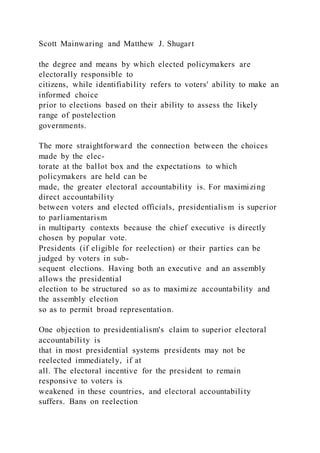
http://www.jstor.org/stable/422014
http://www.jstor.org/page/info/about/policies/terms.jsp
Juan Linz, Presidentialism, and Democracy
A Critical Appraisal
Scott Mainwaring and Matthew S. Shugart
Since the 1960s Juan J. Linz has been one of the world's
foremost contributors to
our understanding of democracy, authoritarianism, and
totalitarianism. Although
many of his contributions have had a significant impact, few
have been as far-
reaching as his essay "Presidential or Parliamentary Democracy:
Does It Make a
Difference?," originally written in 1985. The essay argued that
presidentialism is
less likely than parliamentarism to sustain stable democratic
regimes. It became a
classic even in unpublished form. Among both policymakers
and scholars it
spawned a broad debate about the merits and especially the
liabilities of presidential
government. Now that the definitive version of the essay has
appeared, we believe
that a critical appraisal is timely. This task is especially
important because Linz's
arguments against presidentialism have gained widespread
currency.
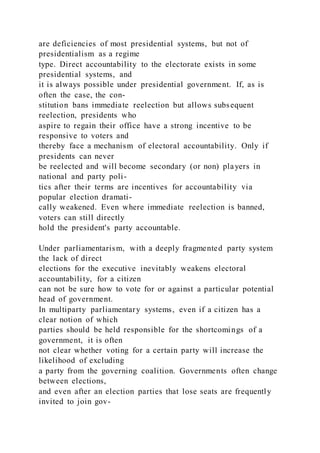
This article critically assesses Linz's arguments about the perils
of presidential-
ism. Although we agree with several of Linz's criticisms of
presidentialism, we dis-
agree that presidentialism is particularly oriented towards
winner-takes-all results.'
We argue that the superior record of parliamentary systems has
rested partly on
where parliamentary government has been implemented, and we
claim that presi-
dentialism has some advantages that partially offset its
drawbacks. These advantages
can be maximized by paying careful attention to differences
among presidential sys-
tems. Other things being equal, presidentialism tends to
function better where pres-
idencies have weak legislative powers, parties are at least
moderately disciplined,
and party systems are not highly fragmented. Finally, we argue
that switching from
presidentialism to parliamentarism could exacerbate problems
of governability in
countries with undisciplined parties. Even if parliamentary
government is more con-
ducive to stable democracy, much rests on what kind of
parliamentarism and presi-
dentialism is implemented.2
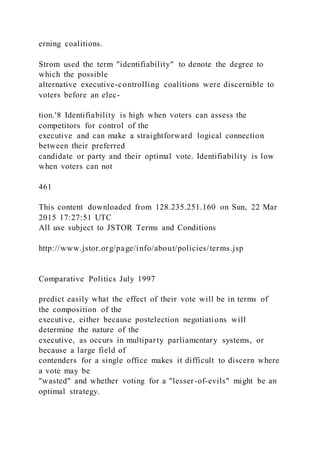
By presidentialism we mean a regime in which, first, the
president is always the
chief executive and is elected by popular vote or, as in the U.S.,
by an electoral col-
lege with essentially no autonomy with respect to popular
preferences and, second,
the terms of office for the president and the assembly are fixed.
Under pure presi-
dentialism the president has the right to retain ministers of his
or her choosing
regardless of the composition of the congress.
449
This content downloaded from 128.235.251.160 on Sun, 22 Mar
2015 17:27:51 UTC
All use subject to JSTOR Terms and Conditions
http://www.jstor.org/page/info/about/policies/terms.jsp
Comparative Politics July 1997
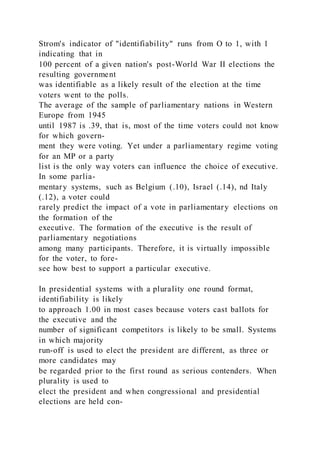
The Perils of Presidentialism: Linz's Argument
Linz bases his argument about the superiority of parliamentary
systems partially on
the observation that few long established democracies have
presidential systems. He
maintains that the superior historical performance of
parliamentary democracies
stems from intrinsic defects of presidentialism. He analyzes
several problems of
presidential systems. We briefly summarize the five most
important issues.
First, in presidential systems the president and assembly have
competing claims
to legitimacy. Both are popularly elected, and the origin and
survival of each are
independent from the other.3 Since both the president and
legislature "derive their
power from the vote of the people in a free competition among
well-defined alter-
natives, a conflict is always latent and sometimes likely to erupt
dramatically; there
is no democratic principle to resolve it."4 Linz argues that
parliamentarism obviates
this problem because the executive is not independent of the
assembly. If the major-
ity of the assembly favors a change in policy direction, it can
replace the government
by exercising its no confidence vote.
Second, the fixed term of the president's office introduces a
rigidity that is less
favorable to democracy than the flexibility offered by
parliamentary systems, where
governments depend on the ongoing confidence of the assembly.
Presidentialism
"entails a rigidity . .. that makes adjustment to changing
situations extremely diffi-
cult; a leader who has lost the confidence of his own party or
the parties that ac-
quiesced [in] his election cannot be replaced."' By virtue of
their greater ability to
promote changes in the cabinet and government, parliamentary
systems afford
greater opportunities to resolve disputes. Such a safety valve
may enhance regime
stability.
Third, presidentialism "introduces a strong element of zero-sum
game into demo-
cratic politics with rules that tend toward a 'winner-take-all'
outcome." In contrast,
in parliamentary systems "power-sharing and coalition-forming
are fairly common,
and incumbents are accordingly attentive to the demands and
interests of even the
smaller parties." In presidential systems direct popular election
is likely to imbue
presidents with a feeling that they need not undertake the
tedious process of con-
structing coalitions and making concessions to the opposition.6
Fourth, the style of presidential politics is less propitious for
democracy than the
style of parliamentary politics. The sense of being the
representative of the entire
nation may lead the president to be intolerant of the opposition.
"The feeling of hav-
ing independent power, a mandate from the people ... is likely
to give a president
a sense of power and mission that might be out of proportion to
the limited plurality
that elected him. This in turn might make resistances he
encounters ... more frus-
trating, demoralizing, or irritating than resistances usually are
for a prime minister.7
The absence in presidential systems of a monarch or a
"president of the republic"
deprives them of an authority who can exercise restraining
power.
450
This content downloaded from 128.235.251.160 on Sun, 22 Mar
2015 17:27:51 UTC
All use subject to JSTOR Terms and Conditions
http://www.jstor.org/page/info/about/policies/terms.jsp
Scott Mainwaring and Matthew J. Shugart
Finally, political outsiders are more likely to win the chief
executive office in
presidential systems, with potentially destabilizing effects.
Individuals elected by
direct popular vote are less dependent on and less beholden to
political parties. Such
individuals are more likely to govern in a populist,
antiinstitutionalist fashion.
A Critique of Linz's Argument
We agree with the main thrust of four of Linz's five basic
criticisms of presidential-
ism. We concur that the issue of dual legitimacy is nettlesome
in presidential sys-
tems, but we believe that his contrast between presidential and
parliamentary sys-
tems is too stark. To a lesser degree than in presidential
systems, conflicting claims
to legitimacy also exist in parliamentary systems. Conflicts
sometimes arise between
the lower and upper houses of a bicameral legislature, each
claiming to exercise
legitimate power. If both houses have the power of confidence
over the cabinet, the
most likely outcome when the houses are controlled by different
majorities is a com-
promise coalition cabinet. In this case dual legitimacy exists,
not between executive
and assembly, but between the two chambers of the assembly.
This arrangement
could be troublesome if the two chambers were controlled by
opposed parties or
blocs. In a few parliamentary systems, including Canada,
Germany, and Japan,
upper houses have significant powers over legislation but can
not exercise a vote of
no confidence against the government. In some the upper house
can not be dissolved
by the government. Then, there is a genuine dual legitimacy
between the executive
and part of the legislature. Thus, dual democratic legitimacy is
not exclusively a
problem of presidentialism, though it is more pronounced with
it. A unicameral par-
liament would avoid the potential of dual legitimacy under
parliamentarism, but it
sacrifices the advantages of bicameralism, especially for large,
federal, and plural
countries.8
Another overlooked potential source of conflicting legitimacy in
parliamentary
republics is the role of the head of state, who is usually called
"president" but tends
to be elected by parliament. The constitutions of parliamentary
republics usually
give the president several powers that are - or may be, subject
to constitutional
interpretation - more than ceremonial. Examples include the
president's exclusive
discretion to dissolve parliament (Italy), the requirement of
countersignatures of
cabinet decrees (Italy), suspensory veto over legislation (Czech
Republic, Slovakia),
the power to decree new laws (Greece for some time after
1975), and appointments
to high offices, sometimes (as in the Czech Republic and
Slovakia) including min-
istries. Linz argues that the president in such systems "can play
the role of adviser
or arbiter by bringing party leaders together and facilitating the
flow of information
among them." He also notes that "no one in a presidential
system is institutionally
entitled to such a role." He is quite right that political systems
often face moments
451
This content downloaded from 128.235.251.160 on Sun, 22 Mar
2015 17:27:51 UTC
All use subject to JSTOR Terms and Conditions
http://www.jstor.org/page/info/about/policies/terms.jsp
Comparative Politics July 1997
when they need a "neutral" arbiter. However, for the position of
head of state to be
more than feckless it is necessary to make it "institutionally
entitled" to other tasks
as well. Linz correctly notes that, "if presidents in pure
parliamentary republics were
irrelevant, it would not make sense for politicians to put so
much effort into electing
their preferred candidate to the office."'
Paradoxically, the more authority the head of state is given, the
greater is the
potential for conflict, especially in newer democracies where
roles have not yet been
clearly defined by precedent. Hungary and especially Slovakia
have had several con-
stitutional crises involving the head of state, and in some Third
World parliamentary
republics such crises have at times been regime-threatening, as
in Somalia
(1961-68) and Pakistan. Politicians indeed care who holds the
office, precisely
because it has potential for applying brakes to the parliamentary
majority. The office
of the presidency may not be democratically legitimated via
popular election, but it
typically has a fixed term of office and a longer term than the
parliament's By prais-
ing the potential of the office in serving as arbiter, Linz
implicitly acknowledges the
Madisonian point that placing unchecked power in the hands of
the assembly major-
ity is not necessarily good. Again, the key is careful attention to
the distribution of
powers among the different political players who are involved
in initiating or block-
ing policy.
We also agree that the rigidity of presidentialism, created by the
fixed term of
office, can be a liability, sometimes a serious one. With the
fixed term it is difficult
to get rid of unpopular or inept presidents without the system's
breaking down, and
it is constitutionally barred in many countries to reelect a good
president. However,
there is no reason why a presidential system must prohibit
reelection. Provisions
against reelection have been introduced primarily to reduce the
president's incen-
tives to abuse executive powers to secure reelection. Despite the
potential for abuse,
reelection can be permitted, and we believe it should be in
countries where reliable
institutions safeguard elections from egregious manipulation by
incumbents.
Even if reelection is permitted, we are still left with the rigidity
of fixed term
lengths. One way of mitigating this problem is to shorten the
presidential term so
that if presidents lose support dramatically, they will not be in
office for as long a
time. Therefore, we believe that a four year term is usually
preferable to the longer
mandates that are common in Latin America.
The argument about the flexibility of replacing cabinets in
parliamentary systems
is two-edged. In a parliamentary system the prime minister's
party can replace its
leader or a coalition partner can withdraw its support and usher
in a change of gov-
ernment short of the coup that might be the only way to remove
a president who
lacks support. We agree with Linz that cabinet instability need
not lead to regime
instability and can offer a safety valve. Yet crises in many
failed parliamentary sys-
tems, including Somalia and Thailand, have come about
precisely because of the dif-
ficulty of sustaining viable cabinets. Presidentialism raises the
threshold for remov-
452
This content downloaded from 128.235.251.160 on Sun, 22 Mar
2015 17:27:51 UTC
All use subject to JSTOR Terms and Conditions
http://www.jstor.org/page/info/about/policies/terms.jsp
Scott Mainwaring and Matthew J. Shugart
ing an executive; opponents must either wait out the term or
else countenance
undemocratic rule. There may be cases when this higher
threshold for government
change is desirable, as it could provide more predictability and
stability to the poli-
cymaking process than the frequent dismantling and
reconstructing of cabinets that
afflict some parliamentary systems.
Theoretically, the problem of fixed terms could be remedied
without adopting
parliamentarism by permitting under certain conditions the
calling of early elections.
One way is to allow either the head of government or the
assembly majority to
demand early elections for both branches, as is the case under
newly adopted Israeli
rules. Such provisions represent a deviation from
presidentialism, which is defined
by its fixed terms. Nevertheless, as long as one branch can not
dismiss the other
without standing for reelection itself, the principle of separation
of powers is still
retained to an extent not present in any variant of
parliamentarism.
We take issue with Linz's assertion that presidentialism induces
more of a winner-
takes-all approach to politics than does parliamentarism. As we
see it, parliamentary
systems do not afford an advantage on this point. The degree to
which democracies
promote winner-take-all rules depends mostly on the electoral
and party system and
on the federal or unitary nature of the system. Parliamentary
systems with disci-
plined parties and a majority party offer the fewest checks on
executive power, and
hence promote a winner-takes-all approach more than
presidential systems.'0 In
Great Britain, for example, in the last two decades a party has
often won a decisive
majority of parliamentary seats despite winning well under 50
percent of the votes.
Notwithstanding its lack of a decisive margin in popular votes,
the party can control
the entire executive and the legislature for a protracted period
of time. It can even
use its dissolution power strategically to renew its mandate for
another five years by
calling a new election before its current term ends.
Because of the combination of disciplined parties, single
member plurality elec-
toral districts, and the prime minister's ability to dissolve the
parliament,
Westminster systems provide a very weak legislative check on
the premier. In prin-
ciple, the MPs of the governing party control the cabinet, but in
practice they usual-
ly support their own party's legislative initiatives regardless of
the merits of partic-
ular proposals because their electoral fates are closely tied with
that of the party
leadership. As a norm, a disciplined majority party leaves the
executive virtually
unconstrained between elections." Here, more than in any
presidential system, the
winner takes all. Given the majority of a single party in
parliament, it is unlikely that
a no confidence vote would prevail, so there is little or no
opposition to check the
government. Early elections occur not as a flexible mechanism
to rid the country of
an ineffective government, but at the discretion of a ruling
majority using its disso-
lution power strategically to renew its mandate for another five
years by calling a
new election before its current term ends.12
Presidentialism is predicated upon a system of checks and
balances. Such checks
453
This content downloaded from 128.235.251.160 on Sun, 22 Mar
2015 17:27:51 UTC
All use subject to JSTOR Terms and Conditions
http://www.jstor.org/page/info/about/policies/terms.jsp
Comparative Politics July 1997
and balances usually inhibit winner-takes-all tendencies;
indeed, they are designed
precisely to limit the possibility that the winner would take all.
If it loses the presi-
dency, a party or coalition may still control congress, allowing
it to block some pres-
idential initiatives. If the president's own legislative powers are
reactive only (a
veto, but no decree powers), an opposition-controlled congress
can be the prime
mover in legislating, as it is in the United States and Costa
Rica, the two longest
standing presidential democracies. Controlling congress is not
the biggest prize, and
it usually does not enable a party or coalition to dictate policy,
but it allows the party
or coalition to establish parameters within which policy is
made. It can be a big prize
in its own right if the presidency has relatively weak legislative
powers.
Moreover, compared to Westminster parliamentary systems,
most presidential
democracies offer greater prospects of dividing the cabinet
among several parties.
This practice, which is essentially unknown among the
Westminster parliamentary
democracies, is common in multiparty presidential systems. To
get elected, presi-
dents need to assemble a broad interparty coalition, either for
the first round (if a
plurality format obtains) or for the second (if a two round,
absolute majority format
obtains). Generally, presidents allocate cabinet seats to parties
other than their own
in order to attract the support of these parties or, after elections,
to reward them for
such support. Dividing the cabinet in this manner allows losers
in the presidential
contest a piece of the pie. The norm in multiparty presidenti al
systems is similar to
that in multiparty parliamentary systems: a coalition governs,
cabinet positions are
divided among several parties, and the president typically must
retain the support of
these parties to govern effectively.
Thus, most parliamentary systems with single member district
electoral systems
have stronger winner-takes-all mechanisms than presidential
systems. The combi-
nation of parliamentarism and a majority party specifically
produces winner-takes-
all results. This situation of extreme majoritarianism under
parliamentarism is not
uncommon; it is found throughout the Caribbean and some parts
of the Third World.
In fact, outside western Europe all parliamentary systems that
have been continu-
ously democratic from 1972 to 1994 have been based on the
Westminster model (see
Table 1). Thus, Linz is not right when he states that an absolute
majority of seats for
one party does not occur often in parliamentary systems.'3 In
presidential systems
with single member plurality districts, the party that does not
win the presidency can
control congress, thereby providing an important check on
executive power.
Linz's fourth argument, that the style of presidential politics is
less favorable to
democracy than the style of parliamentar y politics, rests in part
on his view that pres-
identialism induces a winner-takes-all logic. We have already
expressed our skepti-
cism about this claim. We agree that the predominant style of
politics differs some-
what between presidential and parliamentary systems, but we
would place greater
emphasis on differences of style that stem from constitutional
design and the nature
of the party system.
454
This content downloaded from 128.235.251.160 on Sun, 22 Mar
2015 17:27:51 UTC
All use subject to JSTOR Terms and Conditions
http://www.jstor.org/page/info/about/policies/terms.jsp
Scott Mainwaring and Matthew J. Shugart
Table 1 Independent Countries That Were Continuously
Democratic, 1972-1994
Inc. level Pop. size Parliamentary Presidential Other
Low/lower- Micro
middle
Small Jamaica Costa Rica
Mauritius
Medium/ Colombia
Large Dominican Republic
Upper- Micro Nauru
middle Barbados
Malta
Small Botswana
Trinidad and Tobago
Medium/ Venezuela
Large
Upper Micro Luxembourg Iceland
Small Ireland Cyprus
New Zealand
Norway
Medium/ Australia United States Austria
Large Belgium Finland
Canada France
Denmark Switzerland
Germany
Israel
Italy
Japan
Netherlands
Sweden
United Kingdom
All regimes in the "other" column are premier-presidential,
except for Switzerland.
Countries that have become independent from Britain or a
British Commonwealth state since
1945: Jamaica, Mauritius, Nauru, Barbados, Malta, Botswana,
Trinidad and Tobago, Cyprus,
Israel
455
This content downloaded from 128.235.251.160 on Sun, 22 Mar
2015 17:27:51 UTC
All use subject to JSTOR Terms and Conditions
http://www.jstor.org/page/info/about/policies/terms.jsp
Comparative Politics July 1997
Finally, we agree with Linz that presidentialism is more
conducive than parlia-
mentarism to the election of a political outsider as head of
government and that this
process can entail serious problems. But in presidential
democracies that have more
institutionalized party systems the election of politi cal outsiders
is the exception.
Costa Rica, Uruguay, Colombia, and Venezuela have not elected
an outsider presi-
dent in recent decades, unless one counts Rafael Caldera of
Venezuela in his latest
incarnation (1993). Argentina last elected an outsider president
in 1945, when Per6n
had not yet built a party. In Chile political outsiders won the
presidential campaigns
of 1952 and 1958, but they were exceptions rather than the
norm. The most notable
recent cases of elections of political outsiders, Fernando Collor
de Mello in Brazil
(1989) and Alberto Fujimori in Peru (1990), owe much to the
unraveling of the party
systems in both countries and in Fujimori's case also to the
majority run-off system
that encouraged widespread party system fragmentation in the
first round.
Assessing the Record of Presidentialism
Linz correctly states that most long established democracies
have parliamentary sys-
tems. Presidentialism is poorly represented among long
established democracies.
This fact is apparent in Table 1, which lists countries that have
a long, continuous
democratic record according to the criteria of Freedom House.
Freedom House has been rating countries on a scale of 1 to 7
(with 1 being best)
on political rights and civil rights since 1972. Table 1 lists all
thirty-three countries
that were continuously democratic from 1972 to 1994. We
considered a country con-
tinuously democratic if it had an average score of 3 or better on
political rights
throughout this period.14 Additionally, the scores for both
political and civil rights
needed to be 4 or better in every annual Freedom House survey
for a country to be
considered continuously democratic.
Of the thirty-three long established democracies, only six are
presidential despite
the prevalence of presidentialism in many parts of the globe.
Twenty-two are par-
liamentary, and five fall into the "other" category. However, the
superior record of
parliamentarism is in part an artifact of where it has been
implemented.
Table 1 provides information on three other issues that may
play a role in a so-
ciety's likelihood of sustaining democracy: income level,
population size, and
British colonial heritage. It is widely recognized that a
relatively high income level
is an important background condition for democracy.'" In
classifying countries by
income levels, we followed the guidelines of the World Bank's
World Development
Report 1993: low is under $635 per capita GNP; lower middle is
$636 to $2,555;
upper middle is $2,556 to $7,,910; and upper is above $7,911.
We collapsed the
bottom two categories. Table 2 summarizes the income
categories of countries in
Table 1.
456
This content downloaded from 128.235.251.160 on Sun, 22 Mar
2015 17:27:51 UTC
All use subject to JSTOR Terms and Conditions
http://www.jstor.org/page/info/about/policies/terms.jsp
Scott Mainwaring and Matthew J. Shugart
Table 2 Income Levels of Continuous Democracies, 1972-1994
(number of countries in each
category)
Per Capita GNP in US $ Parliamentary Presidential Other
0-2555 2 3 0
2556-7910 5 1 0
over 7911 15 2 5
total 22 6 5
Most of these long established democracies (twenty-eight of
thirty-three) are in
upper middle or upper income countries. But among the low to
lower middle income
countries there are actually more presidential (three) than
parliamentary (two) sys-
tems. Fifteen of the parliamentary democracies are found in
Europe or other high
income countries such as Canada, Israel, and Japan. It is likely
that these countries
would have been democratic between 1972 and 1994 had they
had presidential con-
stitutions. So some of the success of parliamentary democracy
is accidental: in part
because of the evolution of constitutional monarchies into
democracies, the region
of the world that democratized and industrialized first is
overwhelmingly populated
with parliamentary systems.
Very small countries may have an advantage in democratic
stability because they
typically have relatively homogeneous populations in ethnic,
religious, and linguis-
tic terms, thereby attenuating potential sources of political
conflict. We classified
countries as micro (population under 500,000), small (500,000
to 5,000,000), and
medium to large (over 5,000,000), using 1994 population data.
Table 3 groups our
thirty-three long established democracies by population size.
Here, too, parliamen-
tary systems enjoy an advantage. None of the five micronations
with long estab-
lished democracies has a presidential system.
The strong correlation between British colonial heritage and
democracy has been
widely recognized. Reasons for this association need not
concern us here, but possi-
bilities mentioned in the literature include the tendency to train
civil servants, the gov-
ernmental practices and institutions (which include but can not
be reduced to parlia-
mentarism) created by the British, and the lack of control of
local landed elites over
Table 3 Population Size of Continuous Democracies, 1972-1994
(number of countries in
each category)
Population Parliamentary Presidential Other
Under 500,000 4 0 1
500,000 to 5,000,000 7 2 0
Over 5,000,000 11 4 5
total 22 6 5
457
This content downloaded from 128.235.251.160 on Sun, 22 Mar
2015 17:27:51 UTC
All use subject to JSTOR Terms and Conditions
http://www.jstor.org/page/info/about/policies/terms.jsp
Comparative Politics July 1997
the colonial state.16 Nine of the thirty-three long established
democracies had British
colonial experience. Among them, eight are parliamentary and
one is presidential.
Here, too, background conditions have been more favorable to
parliamentary systems.
It is not our purpose here to analyze the contributions of these
factors to democ-
racy; rather, we wanted to see if these factors correlated with
regime type. If a back-
Table 4 Independent Countries That Were Democratic for at
Least Ten Years (But Less Than
Twenty-three) as of 1994
Inc. level Pop. size Parliamentary Presidential Other
Low/lower- Micro Belize (1981)
middle Dominica (1978)
Kiribati (1979)
St. Lucia (1979)
St. Vincent (1979)
Solomons (1978)
Tuvalu (1978)
Vanuatu (1980)
Small Papua New Guinea
(1975)
Medium/ India (1979) Bolivia (1982)
Large Brazil (1985)
Ecuador (1979)
El Salvador (1985)
Honduras (1980)
Middle Micro Antigua and Barbuda
(1981)
Grenada (1985)
St. Kitts-Nevis
(1983)
Small
Medium/ Greece (1974) Argentina (1983) Portugal' (1976)
Large Uruguary (1985)
Upper Micro Bahamas (1973)
Small
Medium/ Spain (1977)
Large
Numbers in parentheses give the date when the transition to
democracy took place or the date
of independence for former colonies that were not independent
as of 1972.
Note: 1. Portugal has a premier-presidential system
Countries that have become independent from Britain or a
British Commonwealth state since
1945: Belize, Dominica, Kiribati, St. Lucia, St. Vincent,
Solomons, Tuvalu, Vanuatu, Papua
New Guinea, India, Antigua and Barbuda, Grenada, St. Kitts-
Nevis, Bahamas
458
This content downloaded from 128.235.251.160 on Sun, 22 Mar
2015 17:27:51 UTC
All use subject to JSTOR Terms and Conditions
http://www.jstor.org/page/info/about/policies/terms.jsp
Scott Mainwaring and Matthew J. Shugart
ground condition that is conducive to democracy is correlated
with parliamentarism,
then the superior record of parliamentarism may be more a
product of the back-
ground condition than the regime type.
Table 4 shows twenty-four additional countries that had been
continuously demo-
cratic by the same criteria used in Table 1, only for a shorter
time period (at least ten
years). Together, Tables 1 and 4 give us a complete look at
contemporary democra-
cies that have lasted at least ten years.
There are three striking facts about the additional countries in
Table 4. First, they
include a large number of microstates that became independent
from Britain in the
1970s and 1980s, and all of them are parliamentary. All seven
presidential democ-
racies but only three of the sixteen parliamentary democracies
are in medium to
large countries (see Table 5). All sixteen of the democracies
listed in Tables 1 and 4
with populations under one-half million (mostly island nations)
are parliamentary,
as are eight of ten democracies with populations between one-
half and five million.
In contrast, no presidential systems are in microstates, and
many are in exception-
ally large countries, such as Argentina, Brazil, and the United
States.
Second, with Table 4 the number of presidential democracies
increases substan-
tially. Most are in the lower and lower middle income
categories, and all are in Latin
America. Table 6 summarizes the income status of the newer
democracies listed in
Table 4. Clearly, not all of parliamentarism's advantage stems
from the advanced
industrial states. Even in the lower to upper middle income
categories, there are
more parliamentary systems (twenty-one if we combine Tables 1
and 4, compared
to eleven presidential systems). However, every one of the
parliamentary democra-
cies outside of the high income category is a former British
colony. The only other
democracies in these income categories are presidential, and all
but Cyprus are in
Latin America.
Thus, if the obstacles of lower income (or other factors not
considered here) in
Latin America continue to cause problems for the consolidation
of democracy, the
number of presidential breakdowns could be large once again in
the future. More
optimistically, if Latin American democracies achieve greater
success in consoli-
dating themselves this time around, the number of long
established presidential
democracies will grow substantially in the future.
Table 5 Population Size of Continuous Democracies, 1985-1994
(number of countries in
each category)
Population Parliamentary Presidential Other
Under 500,000 12 0 0
500,000 to 5,000,000 1 0 0
Over 5,000,000 3 7 1
total 16 7 1
459
This content downloaded from 128.235.251.160 on Sun, 22 Mar
2015 17:27:51 UTC
All use subject to JSTOR Terms and Conditions
http://www.jstor.org/page/info/about/policies/terms.jsp
Comparative Politics July 1997
Table 6 Income Levels of Continuous Democracies, 1985-1994
(number of countries in each
category)
Per Capita GNP in US$ Parliamentary Presidential Other
0-2555 10 0 0
2556-7910 4 5 1
Over 7911 2 2 0
total 16 7 1
Similarly, if British colonial heritage and small population size
are conducive to
democracy, parliamentarism has a built-in advantage simply
because Britain colon-
ized many small island territories. As a rule, British colonies
had local self-govern-
ment, always on the parliamentary model, before
independence." Further, if other
aspects of Latin American societies (such as extreme inequality
across classes or
regions) are inimical to stable democracy, then presidentialism
has a built-in disad-
vantage.
In sum, presidentialism is more likely to be adopted in Latin
America and in
Africa than in other parts of the world, and these parts of the
world have had more
formidable obstacles to democracy regardless of the form of
government. In con-
trast, parliamentarism has been the regime form of choice in
most of Europe and in
former British colonies (a large percentage of which are
microstates), where condi-
tions for democracy have generally been more favorable. Thus,
the correlation
between parliamentarism and democratic success is in part a
product of where it has
been implemented.
Advantages of Presidential Systems
Presidential systems afford some attractive features that can be
maximized through
careful attention to constitutional design. These advantages
partially offset the lia-
bilities of presidentialism.
Greater Choice for Voters Competing claims to legitimacy are
the flipside of one
advantage. The direct election of the chief executive gives the
voters two electoral
choices instead of one - assuming unicameralism, for the sake
of simplicity of
argument. Having both executive and legislative elections gives
voters a freer range
of choices. Voters can support one party or candidate at the
legislative level but
another for the head of government.
Electoral Accountability and Identification Presidentialism
affords some
advantages for accountability and identifiability. Electoral
accountability describes
460
This content downloaded from 128.235.251.160 on Sun, 22 Mar
2015 17:27:51 UTC
All use subject to JSTOR Terms and Conditions
http://www.jstor.org/page/info/about/policies/terms.jsp
Scott Mainwaring and Matthew J. Shugart
the degree and means by which elected policymakers are
electorally responsible to
citizens, while identifiability refers to voters' ability to make an
informed choice
prior to elections based on their ability to assess the likely
range of postelection
governments.
The more straightforward the connection between the choices
made by the elec-
torate at the ballot box and the expectations to which
policymakers are held can be
made, the greater electoral accountability is. For maximizing
direct accountability
between voters and elected officials, presidentialism is superior
to parliamentarism
in multiparty contexts because the chief executive is directly
chosen by popular vote.
Presidents (if eligible for reelection) or their parties can be
judged by voters in sub-
sequent elections. Having both an executive and an assembly
allows the presidential
election to be structured so as to maximize accountability and
the assembly election
so as to permit broad representation.
One objection to presidentialism's claim to superior electoral
accountability is
that in most presidential systems presidents may not be
reelected immediately, if at
all. The electoral incentive for the president to remain
responsive to voters is
weakened in these countries, and electoral accountability
suffers. Bans on reelection
are deficiencies of most presidential systems, but not of
presidentialism as a regime
type. Direct accountability to the electorate exists in some
presidential systems, and
it is always possible under presidential government. If, as is
often the case, the con-
stitution bans immediate reelection but allows subsequent
reelection, presidents who
aspire to regain their office have a strong incentive to be
responsive to voters and
thereby face a mechanism of electoral accountability. Only if
presidents can never
be reelected and will become secondary (or non) players in
national and party poli-
tics after their terms are incentives for accountability via
popular election dramati-
cally weakened. Even where immediate reelection is banned,
voters can still directly
hold the president's party accountable.
Under parliamentarism, with a deeply fragmented party system
the lack of direct
elections for the executive inevitably weakens electoral
accountability, for a citizen
can not be sure how to vote for or against a particular potential
head of government.
In multiparty parliamentary systems, even if a citizen has a
clear notion of which
parties should be held responsible for the shortcomings of a
government, it is often
not clear whether voting for a certain party will increase the
likelihood of excluding
a party from the governing coalition. Governments often change
between elections,
and even after an election parties that lose seats are frequently
invited to join gov-
erning coalitions.
Strom used the term "identifiability" to denote the degree to
which the possible
alternative executive-controlling coalitions were discernible to
voters before an elec-
tion.'8 Identifiability is high when voters can assess the
competitors for control of the
executive and can make a straightforward logical connection
between their preferred
candidate or party and their optimal vote. Identifiability is low
when voters can not
461
This content downloaded from 128.235.251.160 on Sun, 22 Mar
2015 17:27:51 UTC
All use subject to JSTOR Terms and Conditions
http://www.jstor.org/page/info/about/policies/terms.jsp
Comparative Politics July 1997
predict easily what the effect of their vote will be in terms of
the composition of the
executive, either because postelection negotiations will
determine the nature of the
executive, as occurs in multiparty parliamentary systems, or
because a large field of
contenders for a single office makes it difficult to discern where
a vote may be
"wasted" and whether voting for a "lesser-of-evils" might be an
optimal strategy.
Strom's indicator of "identifiability" runs from O to 1, with 1
indicating that in
100 percent of a given nation's post-World War II elections the
resulting government
was identifiable as a likely result of the election at the time
voters went to the polls.
The average of the sample of parliamentary nations in Western
Europe from 1945
until 1987 is .39, that is, most of the time voters could not know
for which govern-
ment they were voting. Yet under a parliamentary regime voting
for an MP or a party
list is the only way voters can influence the choice of executive.
In some parlia-
mentary systems, such as Belgium (.10), Israel (.14), nd Italy
(.12), a voter could
rarely predict the impact of a vote in parliamentary elections on
the formation of the
executive. The formation of the executive is the result of
parliamentary negotiations
among many participants. Therefore, it is virtually impossible
for the voter, to fore-
see how best to support a particular executive.
In presidential systems with a plurality one round format,
identifiability is likely
to approach 1.00 in most cases because voters cast ballots for
the executive and the
number of significant competitors is likely to be small. Systems
in which majority
run-off is used to elect the president are different, as three or
more candidates may
be regarded prior to the first round as serious contenders. When
plurality is used to
elect the president and when congressional and presidential
elections are held con-
currently, the norm is for "serious" competition to be restricted
to two candidates
even when there is multiparty competition in congressional
elections. Especially
when the electoral method is not majority run-off,
presidentialism tends to encour-
age coalition building before elections, thus clarifying the basic
policy options being
presented to voters in executive elections and simplifying the
voting calculus.
Linz has responded to the argument that presidentialism
engenders greater identi-
fiability by arguing that voters in most parliamentary systems
can indeed identify the
likely prime ministers and cabinet ministers."9 By the time
individuals approach
leadership status, they are well known to voters. While his
rejoinder is valid on its
face, Linz is using the term "identifiability" in a different
manner from Strom or us.
He is speaking of voters' ability to identify personnel rather
than government teams,
which, as we have noted, may not be at all identifiable.
Congressional Independence in Legislative Matters Because
representatives in
a presidential system can act on legislation without worrying
about immediate con-
sequences for the survival of the government, issues can be
considered on their
merits rather than as matters of "confidence" in the leadership
of the ruling party or
coalition. In this specific sense, assembly members exercise
independent judgment
462
This content downloaded from 128.235.251.160 on Sun, 22 Mar
2015 17:27:51 UTC
All use subject to JSTOR Terms and Conditions
http://www.jstor.org/page/info/about/policies/terms.jsp
Scott Mainwaring and Matthew J. Shugart
on legislative matters. Of course, this independence of the
assembly from the exec-
utive can generate the problem of immobilism. This legislative
independence is par-
ticularly problematic with highly fragmented multiparty
systems, where presidents'
parties typically are in the minority and legislative deadlock
more easily ensues.
However, where presidents enjoy substantial assembly support,
congressional oppo-
sition to executive initiatives can promote consensus building
and can avoid the pas-
sage of ill-considered legislation simply to prevent a crisis of
confidence. The immo-
bilism feared by presidentialism's detractors is the flip side of
the checks and bal-
ances desired by the United States' founding fathers.
Congressional independence can encourage broad coalition
building because even
a majority president is not guaranteed the unreserved support of
partisans in
congress. In contrast, when a prime minister's party enjoys a
majority, parliamen-
tary systems exhibit highly majoritarian characteristics. Even a
party with less than
a majority of votes can rule almost unchecked if the electoral
system "manufactures"
a majority of seats for the party. The incentive not to jeopardize
the survival of the
government pressures members of parliament whose parties
hold executive office
not to buck cabinet directives. Thus, presidentialism is arguably
better able than par-
liamentarism to combine the independence of legislators with an
accountable and
identifiable executive. If one desires the consensual and often
painstaking task of
coalition building to be undertaken on each major legislative
initiative, rather than
only on the formation of a government, then presidentialism has
an advantage.
Variations among Presidential Systems
Linz's critique is based mostly on a generic category of
presidential systems. He
does not sufficiently differentiate among kinds of
presidentialism. As Linz acknowl-
edges, the simple dichotomy, presidentialism versus
parliamentarism, while useful
as a starting point, is not sufficient to assess the relative merits
of different constitu-
tional designs.
Presidentialism encompasses a range of systems of government,
and variations
within presidentialism are important. Presidential systems vary
and their dynamics
change considerably according to the constitutional powers of
the president, the
degree of party discipline, and the fragmentation of the party
system.
Presidential Powers The dynamics of presidential systems vary
according to
presidents' formal powers. Some constitutions make it easier for
the president to
dominate the political process, while others make it more
difficult.
One way to think of presidential legislative powers is in terms
of the relationship
of the exercise of power to the legislative status quo.20 Powers
that allow the presi-
dent to attempt to establish a new status quo may be termed
proactive. The best
463
This content downloaded from 128.235.251.160 on Sun, 22 Mar
2015 17:27:51 UTC
All use subject to JSTOR Terms and Conditions
http://www.jstor.org/page/info/about/policies/terms.jsp
Comparative Politics July 1997
example is decree power. Those that allow the president to
defend the status quo
against attempts by the legislative majority to change it may be
termed reactive
powers.
The veto is a reactive legislative power that allows the president
to defend the sta-
tus quo by reacting to the legislature's attempt to alter it, but it
does not enable the
president to alter the status quo. Provisions for overriding
presidential vetoes vary
from a simple majority, in which case the veto is very weak, to
the almost absolute
veto of Ecuador, where no bill other than the budget can become
law without pres-
idential assent (but congress can demand a referendum on a
vetoed bill).
In a few constitutions the president may veto specific provisions
within a bill. In
a true partial veto, also known as an item veto, presidents may
promulgate the items
or articles of the bill with which they agree, while vetoing and
returning to congress
for reconsideration only the vetoed portions. A partial veto
strengthens presidents
vis-ai-vis congress by allowing them to block the parts of a bill
they oppose while
passing those parts they favor; the presidents need not make a
difficult choice of
whether to accept a whole bill in order to win approval for those
parts they favor.
Several presidents have the right of exclusive introduction of
legislative proposals
in certain policy areas. Often this exclusive power extends to
some critical matters,
most notably budgets, but also military policy, the creation of
new bureaucratic
offices, and laws concerning tariff and credit policies. This
power is also reactive. If
presidents prefer the status quo to outcomes likely to win the
support of a veto-proof
majority in congress, they can prevent changes simply by not
initiating a bill.
A proactive power lets presidents establish a new status quo. If
presidents can sign
a decree that becomes law the moment it is signed, they have
effectively established
a new status quo. Relatively few democratic constitutions allow
presidents to estab-
lish new legislation without first having been delegated explicit
authority to do so.
Those that confer this authority potentially allow presidents to
be very powerful.
Decree power alone does not let presidents dominate the
legislative process. They
can not emit just any decree, confident that it will survive in
congress. But it lets
them shape legislation and obtain laws that congress on its own
would not have
passed. Even though a congressional majority can usually
rescind decrees, presi-
dents can still play a major role in shaping legislation for three
reasons: unlike a bill
passed by congress, a presidential decree is already law, not a
mere proposal, before
the other branch has an opportunity to react to it; presidents can
overwhelm the
congressional agenda with a flood of decrees, making it
difficult for congress to
consider measures before their effects may be difficult to
reverse; and presidents can
use the decree power strategically, at a point in the policy space
where a congres-
sional majority is indifferent between the status quo and the
decree:
A case can be made that presidential systems generally function
better if the pres-
ident has relatively limited powers over legislation. When the
congress is powerful
relative to the president, situations in which the president is
short of a majority in the
464
This content downloaded from 128.235.251.160 on Sun, 22 Mar
2015 17:27:51 UTC
All use subject to JSTOR Terms and Conditions
http://www.jstor.org/page/info/about/policies/terms.jsp
Scott Mainwaring and Matthew J. Shugart
congress need not be crisis-ridden. If the president has great
legislative powers, the
ability of the congress to debate, logroll, and offer compromises
on conflictual issues
is constrained. The presidency takes on enormous legislative
importance, and the
incumbent has formidable weapons with which to fine tune
legislation and limit con-
sensus building in the assembly. It is probably no accident that
some of the most
obvious failures among presidential democracies have been
systems with strong
presidential powers.
Presidentialism and Party Discipline Linz properly argues that
parliamentary
systems function better with disciplined parties. We believe that
some measure of
party discipline also facilitates the functioning of presidential
systems. Parties in
presidential systems need not be extremely disciplined, but
indiscipline makes it
more difficult to establish stable relationships among the
government, the parties,
and the legislature. Presidents must be able to work with
legislatures, for otherwise
they are likely to face inordinate difficulties in governing
effectively. Moderate
party discipline makes it easier for presidents to work out stable
deals with congress.
Where discipline is weak, party leaders can negotiate some deal,
only to have the
party's legislative members back out of it. Presidents may not
even be able to count
on the support of their own party. Under these conditions,
presidents are sometimes
forced to rely on ad hoc bases of support, frequently needing to
work out deals with
individual legislators and faction leaders rather than negotiating
primarily with party
leaders who deliver the votes of their copartisans. This situation
can be difficult for
presidents, and it encourages the widespread use of patronage to
secure the support
of individual legislators.
With more disciplined parties, presidents can negotiate
primarily with party
leaders, which reduces the number of actors involved in
negotiations and hence
simplifies the process. Party leaders can usually deliver the
votes of most of their
members, so there is greater predictability in the political
process.
Party Systems and Presidentialism Linz notes that the problems
of presidential-
ism are compounded in nations with deep political cleavages
and numerous political
parties. This argument could be taken further: the perils of
presidentialism pertain
largely to countries with deep political cleavages and/or
numerous political parties.
In countries where political cleavages are less profound and
where the party system
is not particularly fragmented, the problems of presidentialism
are attenuated. Many
presidential democracies either have deep political cleavages or
many parties; hence
Linz's arguments about the problems of presidentialism are
often pertinent. But
some presidential systems have less indelibly engraved
cleavages and less party sys-
tem fragmentation. In these cases, presidentialism often
functions reasonably well,
as the United States, Costa Rica, and Venezuela suggest. One
way of easing the
strains on presidential systems is to take steps to avoid high
party system fragmen-
tation.21
465
This content downloaded from 128.235.251.160 on Sun, 22 Mar
2015 17:27:51 UTC
All use subject to JSTOR Terms and Conditions
http://www.jstor.org/page/info/about/policies/terms.jsp
Comparative Politics July 1997
Significant party system fragmentation can be a problem for
presidentialism
because it increases the likelihood of executive-legislative
deadlock. With extreme
multipartism, the president's party will not have anything close
to a majority of seats
in congress, so the president will be forced to rely on a
coalition. Interparty coali-
tions, however, tend to be more fragile in presidential systems
than with parliamen-
tarism.22
Whereas in parliamentary systems party coalitions generally are
formed after the
election and are binding for individual legislators, in
presidential systems they often
are formed before the election and are not binding past election
day. The parties are
not corresponsible for governing, even though members of
several parties often par-
ticipate in cabinets. Governing coalitions in presidential
systems can differ marked-
ly from electoral coalitions, whereas in parliamentary systems
the same coalition
responsible for creating the government is also responsible for
governing. Parties'
support during the electoral campaign does not ensure their
support once the presi-
dent assumes office. Even though members of several parties
often participate in
cabinets, the parties are not responsible for the government.
Parties or individual leg-
islators can join the opposition without bringing down the
government, so a presi-
dent can end his or her term with little support in congress.
Second, in presidential systems the commitment of individual
legislators to sup-
port an agreement negotiated by the party leadership is often
less secure than in most
parliamentary systems. The extension of a cabinet portfolio
does not necessarily
imply party support for the president, as it usually does in a
parliamentary system.
In contrast, in most parliamentary systems individual legislators
are more or less
bound to support the government unless their party decides to
drop out of the
governmental alliance. MPs risk bringing down a government
and losing their seats
in new elections if they fail to support the government.23
The problems in constructing stable interparty coalitions make
the combination of
extreme multipartism and presidentialism problematic and help
explain the paucity
of long established multiparty presidential democracies. At
present, Ecuador, which
has had a democracy only since 1979, and a troubled one at
that, is the world's old-
est presidential democracy with more than 4.0 effective parties.
Only one country
with this institutional combination, Chile from 1932 to 1973,
sustained democracy
for at least twenty-five consecutive years. This combination is
manageable, but not
optimal.
Where party system fragmentation is moderate (under 4.0
effective parties),
building and maintaining interparty coalitions are easier.24 The
president's party is
certain to be a major one that controls a significant share of the
seats. This situation
mitigates the problem of competing claims to legitimacy
because many legislators
are likely to be the president's copartisans. Conflicts between
the legislature and the
executive tend to be less grave than when the overwhelming
majority of legislators
is pitted against the president.
466
This content downloaded from 128.235.251.160 on Sun, 22 Mar
2015 17:27:51 UTC
All use subject to JSTOR Terms and Conditions
http://www.jstor.org/page/info/about/policies/terms.jsp
Scott Mainwaring and Matthew J. Shugart
The problems of the fixed term of office are also mitigated by
limited party sys-
tem fragmentation. The fixed term of office is particularly
pernicious when the pres-
ident can not get legislation passed. This problem is more likely
when the presi-
dent's party is in a distinct minority. It is no coincidence that
the oldest and most
established presidential democracies - the U.S., Costa Rica, and
Venezuela (from
1973 to 1993) - have two or two-and-one-half party systems.
Six of the seven pres-
idential democracies that have lasted at least twenty-five
consecutive years (Uru-
guay, Colombia, and the Philippines, in addition to the three
already mentioned
cases) have had under three effective parties. Chile is the sole
exception. Extreme
multipartism does not doom presidential democracies, but it
does make their func-
tioning more difficult.
Electoral Rules for Presidentialism Other things being equal,
presidential sys-
tems function better with electoral rules or sequences that avoid
extreme multi-
partism, though it is best to avoid draconian steps that might
exclude politically
important groups, for such an exclusion could undermine
legitimacy.25 Party system
fragmentation can be limited even with proportional
representation by either of two
factors: most important, by having concurrent presidential and
legislative elections
and a single round plurality format for electing the president,
and by establishing a
relatively low district magnitude or a relatively high threshold
for congressional
elections.
Holding assembly elections concurrently with the presidential
election results in
a strong tendency for two major parties to be the most important
even if a very pro-
portional electoral system is used, as long as the president is not
elected by majority
run-off.26 The presidential election is so important that it tends
to divide voters into
two camps, and voters are more likely to choose the same party
in legislative elec-
tions than when presidential and legislative elections are
nonconcurrent.
If assembly elections are held at different times from
presidential elections, frag-
mentation of the assembly party system becomes more likely. In
some cases the
party systems for congress and president diverge considerably,
and presidents'
parties have a small minority of legislators. Therefore, with
presidentialism con-
current elections are preferable.
The increasingly common majority run-off method for electing
presidents has the
advantage of avoiding the election of a president who wins a
narrow plurality but
who would easily lose to another candidate in a face to face
election. Majority run-
off is appealing because it requires that the eventual winner
obtain the backing of
more than 50 percent of the voters. However, the run-off system
also encourages
fragmentation of the field of competitors for both presidency
and assembly. Many
candidates enter the first round with the aim of either finishing
second and upsetting
the front runner in the run-off or else "blackmailing" the two
leading candidates into
making deals between rounds. The plurality rule, in contrast,
encourages only two
467
This content downloaded from 128.235.251.160 on Sun, 22 Mar
2015 17:27:51 UTC
All use subject to JSTOR Terms and Conditions
http://www.jstor.org/page/info/about/policies/terms.jsp
Comparative Politics July 1997
"serious" contenders for the presidency in most cases. Other
mechanisms besides
straight plurality can guard against the unusual but potentially
dangerous case of a
winner's earning less than 40 percent of the vote. Such
mechanisms include requir-
ing 40 percent for the front-runner or a minimum gap between
the top two finishers
instead of requiring an absolute majority to avoid a run-off and
employing an elec-
toral college in which electors are constitutionally bound to
choose one of the top
two popular vote winners.
If the president is elected so as to maximize the possibility of
two candidate races
and a majority (or nearly so) for the winner, the assembly can
be chosen so as to
allow the representation of partisan diversity. Extreme
fragmentation need not result
if only a moderately proportional system is used and especially
if the assembly is
elected at the same time as the president and the president is not
elected by majority
run-off. Proportional representation can permit the
representation of some important
minor parties without leading to extreme fragmentation.
Switching from Presidential to Parliamentary Government: A
Caution
Convinced that parliamentary systems are more likely to sustain
stable democracy,
Linz implicitly advocates switching to parliamentary
government. We are less than
sanguine about the results of shifting to parliamentary
government in countries with
undisciplined parties. Undisciplined parties create daunting
problems in parliamen-
tary systems.27 In countries with undisciplined parties,
switching to parliamentary
government could exacerbate problems of governability and
instability unless party
and electoral legislation was simultaneously changed to promote
greater discipline.
In parliamentary systems, the government depends on the
ongoing confidence of
the assembly. Where individual assembly members act as free
agents, unfettered by
party ties, the governmental majorities that were carefully
crafted in postelection
negotiations easily dissipate. Free to vote as they please,
individual legislators
abandon the government when it is politically expedient to do
so. Under these con-
ditions, the classic Achilles heel of some parliamentary
systems, frequent cabinet
changes, is likely to be a problem.
Linz counterargues that presidentialism has contributed to party
weakness in
some Latin American countries, so that switching to
parliamentary government
should strengthen parties by removing one of the causes of
party weakness.
Moreover, analysts might expect that the mechanism of
confidence votes would
itself promote party discipline, since remaining in office would
hinge upon party dis-
cipline. We do not dismiss these claims, but in the short term
switching to parlia-
mentary government without effecting parallel changes to
encourage greater party
discipline could prove problematic.
Any switch to parliamentary government, therefore, would need
to carefully
468
This content downloaded from 128.235.251.160 on Sun, 22 Mar
2015 17:27:51 UTC
All use subject to JSTOR Terms and Conditions
http://www.jstor.org/page/info/about/policies/terms.jsp
Scott Mainwaring and Matthew J. Shugart
design a panoply of institutions to increase the likelihood that it
would function well.
In presidential and parliamentary systems alike, institutional
combinations are of
paramount importance.28
Conclusion
While we greatly admire Linz's seminal contribution and agree
with parts of it, we
believe that he understated the importance of differences among
constitutional and
institutional designs within the broad category of presidential
systems and in doing
so overstated the extent to which presidentialism is inherently
flawed, regardless of
constitutional and institutional arrangements. Presidential
systems can be designed
to function more effectively than they usually have. We have
argued that providing
the president with limited legislative power, encouraging the
formation of parties
that are reasonably disciplined in the legislature, and preventing
extreme fragmenta-
tion of the party system enhance the viability of
presidentialism. Linz clearly recog-
nizes that not any kind of parliamentarism will do. We make the
same point about
presidentialism.
Under some conditions the perils of presidentialism can be
attenuated, a point that
Linz underplays. It is important to pay attention to factors that
can mitigate the prob-
lems of presidentialism because it may be politically more
feasible to modify presi-
dential systems than to switch to parliamentary government.
We have also argued that presidentialism, particularly if it is
carefully designed,
has some advantages over parliamentarism. In our view, Linz
does not sufficiently
consider this point. Moreover, on one key issue - the alleged
winner-takes-all
nature of presidentialism - we question Linz's argument. The
sum effect of our
arguments is to call more attention to institutional combinations
and constitutional
designs and to suggest that the advantages of parliamentarism
may not be as pro-
nounced as Linz argued. Nevertheless, we share the consensus
that his pathbreaking
article was one of the most important scholarly contributions of
the past decade and
deserves the ample attention among scholars and policymakers
that it has already
received.
NOTES
We are grateful to Michael Coppedge, Steve Levitsky, Arend
Lijphart, Timothy Scully, and two
anonymous reviewers for helpful criticisms of earlier drafts of
this article.
1. We follow Lijphart's understanding of a Westminster
(British) style democracy. Arend Lijphart,
Democracies.: Patterns of Majoritarian and Consensus
Government in Twenty-One Countries (New
Haven: Yale University Press, 1984), esp. pp. 1-20. For our
purposes, the most important features of a
469
This content downloaded from 128.235.251.160 on Sun, 22 Mar
2015 17:27:51 UTC
All use subject to JSTOR Terms and Conditions
http://www.jstor.org/page/info/about/policies/terms.jsp
Comparative Politics July 1997
Westminster democracy are single party majority cabinets,
disciplined parties, something approaching a
two party system in the legislature, and plurality single member
electoral districts.
2. See Adam Przeworski et al., "What Makes Democracies
Endure?," Journal of Democracy, 7
(January 1996), 39-55.
3. Matthew Shugart and John Carey, Presidents and Assemblies:
Constitutional Design and Electoral
Dynamics (New York: Cambridge University Press, 1992), ch.
2.
4. Juan J. Linz, "Presidential or Parliamentary Democracy: Does
It Make a Difference?," in Juan J.
Linz and Arturo Valenzuela, eds., The Crisis of Presidential
Democracy: The Latin American Evidence
(Baltimore: The Johns Hopkins University Press, 1994), p. 7;
Juan J. Linz, "The Perils of Presidential-
ism," Journal of Democracy, 1 (Winter 1990).
5. Ibid., pp. 9-10.
6. Ibid., p. 18.
7. Linz, "Presidential or Parliamentary Democracy," p. 19.
8. Lijphart, ch. 6.
9. Linz, "Presidential or Parliamentary Democracy," pp. 47, 46.
10. Donald L. Horowitz, "Comparing Democratic Systems,"
Journal of Democracy, 1 (Fall 1990),
73-79; and George Tsebelis, "Decision Making in Political
Systems: Veto Players in Presidentialism,
Parliamentarism, Multicameralism and Multipartyism," British
Journal of Political Science, 25 (1995),
289-325.
11. Assuming that the party remains united. If it does not, it
may oust its leader and change the prime
minister, as happened to Margaret Thatcher in Britain and Brian
Mulroney in Canada. However, such
intraparty leadership crises are the exception in majoritarian
(Westminster) parliamentary systems.
12. A possible exception in Westminster systems is occasional
minority government, which is more
common than coalition government in such systems. Even then,
the government is as likely to call early
elections to attempt to convert its plurality into a majority as it
is in response to a vote of no confidence.
13. Linz, "Presidential or Parliamentary Democracy," p. 15.
14. Using an average of 3 on both measures would have
eliminated three countries (India and Colom-
bia in Table 1 and Vanuatu in Table 3) that we consider
basically democratic but that have had problems
with protecting civil rights, partly because of a fight against
violent groups.
15. Robert A. Dahl, Polyarchy: Participation and Opposition
(New Haven: Yale University Press,
1973), pp. 62-80; Kenneth Bollen, "Political Democracy and the
Timing of Development," American
Sociological Review, 44 (August 1979), 572-87; Larry
Diamond, "Economic Development and Democ-
racy Reconsidered," in Gary Marks and Larry Diamond, eds.,
Reexamining Democracy: Essays in Honor
of Seymour Martin Lipset (Newbury Park: SAGE, 1992), pp.
93-139; Seymour Martin Lipset et al., "A
Comparative Analysis of the Social Requisites of Democracy,"
International Social Science Journal, 45
(May 1993), 155-75.
16. Larry Diamond, "Introduction: Persistence, Erosion,
Breakdown, and Renewal," in Larry
Diamond, Juan J. Linz, and Seymour Martin Lipset, eds.,
Democracy in Developing Countries: Asia
(Boulder: Lynne Rienner, 1989); Myron Weiner, "Empirical
Democratic Theory," in Myron Weiner and
Ergun Ozbudun, eds., Competitive Elections in Developing
Countries (Washington, D.C.: American
Enterprise Institute, 1987); Dietrich Rueschemeyer, Evelyne
Huber Stephens, and John D. Stephens,
Capitalist Development and Democracy (Chicago: University of
Chicago Press, 1992).
17 Some British colonies later adopted presidential systems and
did not become (or remain) demo-
cratic. However, in many cases democracy was ended (if it ever
got underway) by a coup carried out by
the prime minister and his associates. Not presidential
democracies, but parliamentary proto-democracies
broke down. Typical was the Seychelles. The failure of most of
these countries to evolve back into
democracy can not be attributed to presidentialism.
18. Kaare Strom, Minority Government and Majority Rule
(Cambridge: Cambridge University Press,
1990).
470
This content downloaded from 128.235.251.160 on Sun, 22 Mar
2015 17:27:51 UTC
All use subject to JSTOR Terms and Conditions
http://www.jstor.org/page/info/about/policies/terms.jsp
Scott Mainwaring and Matthew J. Shugart
19. Linz, "Presidential or Parliamentary Democracy," pp. 10-14.
20. Matthew Shugart, "Strength of Parties and Strength of
Presidents: An Inverse Relationship" (forth-
coming).
21. Przeworski, et al., "What Makes Democracies Endure?,"
found that the combination of presiden-
tialism and a high degree of party system fragmentation was
unfavorable to stable democracy.
22. Arend Lijphart, "Presidentialism and Majoritarian
Democracy: Theoretical Observations," in Linz
and Valenzuela, eds.
23. The key issue here is whether or not parties are disciplined,
and nothing guarantees that they are
in parliamentary systems. Nevertheless, the need to support the
government serves as an incentive to
party discipline in parliamentary systems that is absent in
presidential systems. See Leon Epstein, "A
Comparative Study of Canadian Parties," American Political
Science Review, 58 (March 1964), 46-59.
24. The number of effective parties is calculated by squaring
each party's fractional share of the vote
(or seats), calculating the sum of all of the squares, and
dividing this number into one.
25. Arturo Valenzuela, "Party Politics and the Crisis of
Presidentialism in Chile: A Proposal for a
Parliamentary Form of Government," in Linz and Valenzuela,
eds., pp. 91-150.
26. Shugart and Carey; Mark P. Jones, Electoral Laws and the
Survival of Presidential Democracy
(Notre Dame: University of Notre Dame Press, 1995).
27. Giovanni Sartori, "Neither Presidentialism nor
Parliamentarism,"' in Linz and Valenzuela, eds.,
28. James W. Ceaser, "In Defense of Separation of Powers," in
Robert A. Goldwin and Art Kaufman,
eds., Separation ofPowers: Does It Still Work? (Washington,
D.C.: American Enterprise Institute, 1986),
pp. 168-93.
471
This content downloaded from 128.235.251.160 on Sun, 22 Mar
2015 17:27:51 UTC
All use subject to JSTOR Terms and Conditions
http://www.jstor.org/page/info/about/policies/terms.jsp Article
Contentsp. 449p. 450p. 451p. 452p. 453p. 454p. 455p. 456p.
457p. 458p. 459p. 460p. 461p. 462p. 463p. 464p. 465p. 466p.
467p. 468p. 469p. 470p. 471Issue Table of
ContentsComparative Politics, Vol. 29, No. 4 (Jul., 1997), pp. i -
ii+411-534Volume Information [pp. 531-534]Front Matter [pp.
i-528]Parting at the Crossroads: The Development of Health
Insurance in Canada and the United States, 1940-1965 [pp. 411-
431]Structural Constraints and Starting Points: The Logic of
Systemic Change in Ukraine and Russia [pp. 433-447]Juan Linz,
Presidentialism, and Democracy: A Critical Appraisal [pp. 449-
471]Commerce, Politics, and Business Associations in Benin
and Togo [pp. 473-492]War, Markets, and the Reconfiguration
of West Africa's Weak States [pp. 493-510]Review
ArticleReview: Electoral Choices and the Party System in Chile:
Continuities and Changes at the Recovery of Democracy [pp.
511-527]Abstracts [pp. 529-530]Back Matter
The Perils of Presidentialism
Linz, Juan J. (Juan José), 1926-
Journal of Democracy, Volume 1, Number 1, Winter 1990, pp.
51-69 (Article)
Published by The Johns Hopkins University Press
DOI: 10.1353/jod.1990.0011
For additional information about this article
Access Provided by North Carolina
State University at 01/17/13 9:03AM GMT
http://muse.jhu.edu/journals/jod/summary/v001/1.1linz.html
T H E PERILS
OF PRESIDENTIALISM
Juan J . Linz
Juan J . Linz, Sterling Professor of Political and Social Science
at Yule
University, is widely known for his contributions to the study o
f
authoritarianism and totalitarianism, political parties and elites,
and
democratic breakdowns and transitions to democracy. In 1987
he was
awarded Spain's Principe de Asturias prize in the social
sciences. The
following essay is based o n a paper he presented in May 1989
at a
conference in Washington, D.C. organized by the Latin
American Studies
Program of Georgetown University, with support from the Ford
Foundation. An annotated, revised, and expanded version of this
essay
(including a discussion of semipresidential systems) will appear
under the
title "Presidentialism and Parliamentar-ism: Does It Make a
Difference?"
in a publication based on the conference being edited by the
author and
Professor Arturo Valenzuela of Georgetown University.
A s more of the world's nations turn to democracy, interest in
alternative constitutional forms and arrangements has expanded
well
beyond academic circles. In countries as dissimilar as Chile,
South
Korea, Brazil, Turkey, and Argentina, policymakers and
constitutional
experts have vigorously debated the relative merits of different
types of
democratic regimes. Some countries, like Sri Lanka, have
switched from
parliamentary to presidential constitutions. On the other hand,
Latin
Americans in particular have found themselves greatly
impressed by the
successful transition from authoritarianism to democracy that
occurred in
the 1970s in Spain, a transition to which the parliamentary form
of
government chosen by that country greatly contributed.
Nor is the Spanish case the only one in which parliamentarism
has
given evidence of its worth. Indeed, the vast majority of the
stable
democracies in the world today are parliamentary regimes,
where
executive power is generated by legislative majorities and
depends on
such majorities for survival.
By contrast, the only presidential democracy with a long history
of
5 2 Journal of Democracy
constitutional continuity is the United States. The constitutions
of Finland
and France are hybrids rather than true presidential systems,
and in the
case of the French Fifth Republic, the jury is still out. Aside
from the
United States, only Chile has managed a century and a half of
relatively
undisturbed constitutional continuity under presidential
government-but
Chilean democracy broke down in the 1970s.
Parliamentary regimes, of course, can also be unstable,
especially
under conditions of bitter ethnic conflict, as recent African
history attests.
Yet the experiences of India and of some English-speaking
countries in
the Caribbean show that even in greatly divided societies,
periodic
parliamentary crises need not turn into full-blown regime crises
and that
the ousting of a prime minister and cabinet need not spell the
end of
democracy itself.
The burden of this essay is that the superior historical
performance of
parliamentary democracies is no accident. A careful comparison
of
parliamentarism as such with presidentialism as such leads to
the
conclusion that, on balance, the former is more conducive to
stable
democracy than the latter. This conclusion applies especially to
nations
with deep political cleavages and numerous political parties; for
such
countries, parliamentarism generally offers a better hope of
preserving
democracy.
Parliamentary vs. Presidential Systems
A parliamentary regime in the strict sense is one in which the
only
democratically legitimate institution is parliament; in such a
regime, the
government's authority is completely dependent upon
parliamentary
confidence. Although the growing personalization of party
leadership in
some parliamentary regimes has made prime ministers seem
more and
more like presidents, it remains true that barring dissolution of
parliament
and a call for new elections, premiers cannot appeal directly to
the
people over the heads of their representatives. Parliamentary
systems may
include presidents who are elected by direct popular vote, but
they
usually lack the ability to compete seriously for power with the
prime
minister.
In presidential systems an executive with considerable
constitutional
powers-generally including full control of the composition of
the
cabinet and administration-is directly elected by the people for
a fixed
term and is independent of parliamentary votes of confidence.
He is not
only the holder of executive power but also the symbolic head
of state
and can be removed between elections only by the drastic step
of
impeachment. In practice, as the history of the United States
shows,
presidential systems may be more or less dependent on the
cooperation
of the legislature; the balance between executive and legislative
power
in such systems can thus vary considerably.
Juan J . Linz 5 3
Two things about presidential government stand out. The first is
the
president's strong claim to democratic, even plebiscitarian,
legitimacy; the
second is his fixed term in office. Both of these statements
stand in need
of qualification. Some presidents gain office with a smaller
proportion
of the popular vote than many premiers who head minority
cabinets,
although voters may see the latter as more weakly legitimated.
To
mention just one example, Salvador Allende's election as
president of
Chile in 197&he had a 36.2-percent plurality obtained by a
heterogeneous coalition--certainly put him in a position very
different
from that in which Adolfo Suirez of Spain found himself in
1979 when
he became prime minister after receiving 35.1 percent of the
vote. As we
will see, Allende received a six-year mandate for controlling the
government even with much less than a majority of the popular
vote,
while Suirez, with a plurality of roughly the same size, found it
necessary to work with other parties to sustain a minority
government.
Following British political thinker Walter Bagehot, we might
say that a
presidential system endows the incumbent with both the
"ceremonial"
functions of a head of state and the "effective" functions of a
chief
executive, thus creating an aura, a self-image, and a set of
popular
expectations which are all quite different from those associated
with a
prime minister, no matter how popular he may be.
But what is most striking is that in a presidential system, the
legislators, especially when they represent cohesive, disciplined
parties
that offer clear ideological and political alternatives, can also
claim
democratic legitimacy. This claim is thrown into high relief
when a
majority of the legislature represents a political option opposed
to the
one the president represents. Under such circumstances, who
has the
stronger claim to speak on behalf of the people: the president or
the
legislative majority that opposes his policies? Since both derive
their
power from the votes of the people in a free competition among
well-defined alternatives, a conflict is always possible and at
times may
erupt dramatically. There is no democratic principle on the
basis of
which it can be resolved, and the mechanisms the constitution
might
provide are likely to prove too complicated and aridly legalistic
to be of
much force in the eyes of the electorate. It is therefore no
accident that
in some such situations in the past, the armed forces were often
tempted
to intervene as a mediating power. One might argue that the
United
States has successfully rendered such conflicts "normal" and
thus defused
them. To explain how American political institutions and
practices have
achieved this result would exceed the scope of this essay, but it
is worth
noting that the uniquely diffuse character of American political
parties-which, ironically, exasperates many American political
scientists
and leads them to call for responsible, ideologically disciplined
parties-has something to do with it. Unfortunately, the
American case
seems to be an exception; the development of modem political
parties,
particularly in socially and ideologically polarized countries,
generally
exacerbates, rather than moderates, conflicts between the
legislative and
the executive.
The second outstanding feature of presidential systems-the
president's
relatively fixed term in office-is also not without drawbacks. It
breaks
the political process into discontinuous, rigidly demarcated
periods,
leaving no room for the continuous readjustments that events
may
demand. The duration of the president's mandate becomes a
crucial
factor in the calculations of all political actors, a fact which (as
we shall
see) is fraught with important consequences. Consider, for
instance, the
provisions for succession in case of the president's death or
incapacity:
in some cases, the automatic successor may have been elected
separately
and may represent a political orientation different from the
president's;
in other cases, he may have been imposed by the president as
his
running mate without any consideration of his ability to
exercise
executive power or maintain popular support. Brazilian history
provides
us with examples of the first situation, while Maria Estela
Martinez de
Perbn's succession of her husband in Argentina illustrates the
second.
It is a paradox of presidential government that while it leads to
the
personalization of power, its legal mechanisms may also lead, in
the
event of a sudden midterm succession, to the rise of someone
whom the
ordinary electoral process would never have made the chief of
state.
Paradoxes of Presidentialism
Presidential constitutions paradoxically incorporate
contradictory
principles and assumptions. On the one hand, such systems set
out to
create a strong, stable executive with enough plebiscitarian
legitimation
to stand fast against the array of particular interests represented
in the
legislature. In the Rousseauian conception of democracy
implied by the
idea of "the people," for whom the president is supposed to
speak, these
interests lack legitimacy; s o does the Anglo-American notion
that
democracy naturally involves a jostle--or even sometimes a
melee--of
interests. Interest group conflict then bids fair to manifest itself
in areas
other than the strictly political. On the other hand, presidential
constitutions also reflect profound suspicion of the
personalization of
power: memories and fears of kings and caudillos do not
dissipate easily.
Foremost among the constitutional bulwarks against potentially
arbitrary
power is the prohibition on reelection. Other provisions like
legislative
advice-and-consent powers over presidential appointments,
impeachment
mechanisms, judicial independence, and institutions such as the
Contraloria of Chile also reflect this suspicion. Indeed, political
intervention by the armed forces acting as a poder moderador
may even
be seen in certain political cultures as a useful check on
overweening
executives. One could explore in depth the contradictions
between the
constitutional texts and political practices of Latin American
presidential
regimes; any student of the region's history could cite many
examples.
It would be useful to explore the way in which the fundamental
contradiction between the desire for a strong and stable
executive and the
latent suspicion of that same presidential power affects political
decision
making, the style of leadership, the political practices, and the
rhetoric
of both presidents and their opponents in presidential systems.
It
introduces a dimension of conflict that cannot be explained
wholly by
socioeconomic, political, or ideological circumstances. Even if
one were
to accept the debatable notion that Hispanic societies are
inherently prone
to personalismo, there can be little doubt that in some cases this
tendency receives reinforcement from institutional
arrangements.
Perhaps the best way to summarize the basic differences
between
presidential and parliamentary systems is to say that while
parliamentarism imparts flexibility to the political process,
presidentialism
makes it rather rigid. Proponents of presidentialism might reply
that this
rigidity is an advantage, for it guards against the uncertainty
and
instability so characteristic of parliamentary politics. Under
parliamentary
government, after all, myriad actors-parties, their leaders, even
rank-
and-file legislators-may at any time between elections adopt
basic
changes, cause realignments, and, above all, make or break
prime
ministers. But while the need for authority and predictability
would seem
to favor presidentialism, there are unexpected developments -
ranging
from the death of the incumbent to serious errors in judgment
committed
under the pressure of unruly circumstances-that make
presidential rule
less predictable and often weaker than that of a prime minister.
The
latter can always seek to shore up his legitimacy and authority,
either
through a vote of confidence or the dissolution of parliament
and the
ensuing new elections. Moreover, a prime minister can be
changed
without necessarily creating a regime crisis.
Considerations of this sort loom especially large during periods
of
regime transition and consolidation, when the rigidities of a
presidential
constitution must seem inauspicious indeed compared to the
prospect of
adaptability that parliamentarism offers.
Zero-sum Elections
The preceding discussion has focused principally on the
institutional
dimensions of the problem; the consideration of constitutional
provisions-some written, some unwritten-has dominated the
analysis.
In addition, however, one must attend to the ways in which
political
competition is structured in systems of direct presidential
elections; the
styles of leadership in such systems; the relations between the
president,
the political elites, and society at large; and the ways in which
power is
exercised and conflicts are resolved. It is a fair assumption that
56 Journal of Democracy
institutional arrangements both directly and indirectly shape the
entire
political process, or "way of ruling." Once we have described
the
differences between parliamentary and presidential forms of
government
that result from their differing institutional arrangements, we
shall be
ready to ask which of the two forms offers the best prospect for
creating, consolidating, and maintaining democracy.
Presidentialism is ineluctably problematic because it operates
according
to the rule of "winner-take-allu-an arrangement that tends to
make
democratic politics a zero-sum game, with all the potential for
conflict
such games portend. Although parliamentary elections can
produce an
absolute majority for a single party, they more often give
representation
to a number of parties. Power-sharing and coalition-forming are
fairly
common, and incumbents are accordingly attentive to the
demands and
interests of even the smaller parties. These parties in turn retain
expectations of sharing in power and, therefore, of having a
stake in the
system as a whole. By contrast, the conviction that he possesses
independent authority and a popular mandate is likely to imbue
a
president with a sense of power and mission, even if the
plurality that
elected him is a slender one. Given such assumptions about his
standing
and role, he will find the inevitable opposition to his policies
far more
irksome and demoralizing than would a prime minister, who
knows
himself to be but the spokesman for a temporary governing
coalition
rather than the voice of the nation o r the tribune of the people.
Absent the support of an absolute and cohesive majority, a
parliamentary system inevitably includes elements that become
institutionalized in what has been called "consociational
democracy."
Presidential regimes may incorporate consociational elements as
well,
perhaps as part of the unwritten constitution. When democracy
was
reestablished under adverse circumstances in Venezuela and
Colombia,
for example, the written constitutions may have called for
presidential
government, but the leaders of the major parties quickly turned
to
consociational agreements to soften the harsh, winner-take-all
implications
of presidential elections.
The danger that zero-sum presidential elections pose is
compounded
by the rigidity of the president's fixed term in office. Winners
and losers
are sharply defined for the entire period of the presidential
mandate.
There is no hope for shifts in alliances, expansion of the
government's
base of support through national-unity or emergency grand
coalitions,
new elections in response to major new events, and so on.
Instead, the
losers must wait at least four or five years without any access to
executive power and patronage. The zero-sum game in
presidential
regimes raises the stakes of presidential elections and inevitably
exacerbates their attendant tension and polarization.
On the other hand, presidential elections do offer the
indisputable
advantage of allowing the people to choose their chief executive
openly,
Juan J . Linz 57
directly, and for a predictable span rather than leaving that
decision to
the backstage maneuvering of the politicians. But this advantage
can only
be present if a clear mandate results. If there is no required
minimum
plurality and several candidates compete in a single round, the
margin
between the victor and the runner-up may
be too thin to support any claim that a
"In a polarized decisive plebiscite has taken place. To
society w i t h a preclude this, electoral laws sometimes
volatile electorate, place a lower limit on the size of the
M O serious winning plurality or create some mechanism
candidate in a for choosing among the candidates if none
single-round attains the minimum number of votes
election can afford needed to win; such procedures need not
to ignore parties necessarily award the office to the
w i t h which he candidate with the most votes. More
would otherwise common are run-off provisions that set up
never collaborate." a confrontati on between the two major
candidates, with possibilities for polarization
that have already been mentioned. One of
the possible consequences of two-candidate races in multiparty
systems
is that broad coalitions are likely to be formed (whether in run-
offs or
in preelection maneuvering) in which extremist parties gain
undue
influence. If significant numbers of voters identify strongly
with such
parties, one or more of them can plausibly claim to represent
the
decisive electoral bloc in a close contest and may make
demands
accordingly. Unless a strong candidate of the center rallies
widespread
support against the extremes, a presidential election can
fragment and
polarize the electorate.
In countries where the preponderance of voters is centrist,
agrees on
the exclusion of extremists, and expects both rightist and leftist
candidates to differ only within a larger, moderate consensus,
the
divisiveness latent in presidential competition is not a serious
problem.
With an overwhelmingly moderate electorate, anyone who
makes
alliances or takes positions that seem to incline him to the
extremes is
unlikely to win, as both Barry Goldwater and George McGovern
discovered to their chagrin. But societies beset by grave social
and
economic problems, divided about recent authoritarian regimes
that once
enjoyed significant popular support, and in which well-
disciplined
extremist parties have considerable electoral appeal, d o not fit
the model
presented by the United States. In a polarized society with a
volatile
electorate, no serious candidate in a single-round election can
afford to
ignore parties with which he would otherwise never collaborate.
A two-round election can avoid some of these problems, for the
preliminary round shows the extremist parties the limits of their
strength
and allows the two major candidates to reckon just which
alliances they
58 Journal of Democr-acy
must make to win. This reduces the degree of uncertainty and
promotes
more rational decisions on the part of both voters and
candidates. In
effect, the presidential system may thus reproduce something
like the
negotiations that "form a government" in parliamentary regimes.
But the
potential for polarization remains, as does the difficulty of
isolating
extremist factions that a significant portion of the voters and
elites
intensely dislike.
The Spanish Example
For illustration of the foregoing analysis, consider the case of
Spain
in 1977, the year of the first free election after the death of
Francisco
Franco. The parliamentary elections held that year allowed
transitional
prime minister Adolfo Suirez to remain in office. His moderate
Union
del Centro Democratic0 (UCD) emerged as the leading party
with 34.9
percent of the vote and 167 seats in the 350-seat legislature.
The
Socialist Party (PSOE), led by Felipe Gonzalez, obtained 29.4
percent
and 118 seats, followed by the Communist Party (PCE) with 9.3
percent
and 20 seats, and the rightist Alianza Popular (AP), led by
Manuel
Fraga, with 8.4 percent and 16 seats.
These results clearly show that if instead of parliamentary
elections,
a presidential contest had been held, no party would have had
more than
a plurality. Candidates would have been forced to form
coalitions to have
a chance of winning in a first or second round. Prior to the
election,
however, there was no real record of the distribution of the
electorate's
preferences. In this uncertain atmosphere, forming coalitions
would have
proven difficult. Certainly the front-runners would have found
themselves
forced to build unnecessarily large winning coalitions.
Assuming that the democratic opposition to Franco would have
united
behind a single candidate like Felipe Gonzilez (something that
was far
from certain at the time), and given both the expectations about
the
strength of the Communists and the ten percent of the electorate
they
actually represented, he would never have been able to run as
independently as he did in his campaign for a seat in
parliament. A
popular-front mentality would have dominated the campaign
and probably
submerged the distinct identities that the different parties, from
the
extremists on the left to the Christian Democrats and the
moderate
regional parties in the center, were able to maintain in most
districts. The
problem would have been even more acute for the center-
rightists who
had supported reforms, especially the reforma pactada that
effectively put
an end to the authoritarian regime. It is by no means certain that
Adolfo
Suarez, despite the great popularity he gained during the
transition
process, could or would have united all those to the right of the
Socialist
Party. At that juncture many Christian Democrats, including
those who
would later run on the UCD ticket in 1979, would not have been
willing
Juan J. Linz 59
to abandon the political allies they had made during the years of
opposition to Franco; on the other hand, it would have been
difficult for
Suarez to appear with the support of the rightist AP, since it
appeared
to represent the "continuist" (i.e., Francoist) alternative. For its
part, the
AP would probably not have supported a candidate like Suarez
who
favored legalization of the Communist Party.
Excluding the possibility that the candidate of the right would
have
been Fraga (who later became the accepted leader of the
opposition),
SuLez would still have been hard-pressed to maintain
throughout the
campaign his distinctive position as an alternative to any
thought of
continuity with the Franco regime. Indeed, the UCD directed its
1977
campaign as much against the AP on the right as against the
Socialists
on the left. Moreover, given the uncertainty
about the AP's strength and the fear and
"There can be no loathing it provoked on the left, much
doubt t h a t in the leftist campaigning also targeted Fraga. This
Spain of 1977, a had the effect of reducing polarization,
presidential especially between longtime democrats, on
election w o u l d the one hand, and newcomers to democratic
have been far politics (who comprised important segments
more divisive than of both the UCD's leadership and its rank
the parliaments y and file), on the other. Inevitably, the
elections ..." candidate of the right and center-right
would have focused his attacks on the left-
democratic candidate's "dangerous"
supporters, especially the Commuqists and the parties
representing
Basque and Catalan nationalism. n replying to these attacks the
I candidate of the left and center-left would certainly have
pointed to the
continuity between his opponent's policies and those of Franco,
the
putative presence of unreconstructed Francoists in the rightist
camp, and
the scarcity of centrist democrats in the right-wing coalition.
There can be no doubt that in the Spain of 1977, a presidential
election would have been far more divisive than the
parliamentary
elections that actually occurred. Had Suarez rejected an
understanding
with Fraga and his AP or had Fraga-misled by his own inflated
expectations about the AP's chances of becoming the majority
party in
a two-party system-rejected any alliance with the Suaristas, the
outcome
most likely would have been a plurality for a candidate to the
left of
both Suarez and Fraga. A president with popular backing, even
without
a legislative majority on his side, would have felt himself
justified in
seeking both to draft a constitution and to push through political
and
social changes far more radical than those the Socialist Prime
Minister
Felipe Gonzilez pursued after his victory in 1982. It is
important to
recall that Gonzalez undertook his initiatives when Spain had
already
experienced five years of successful democratic rule, and only
after both
60 Journal of Democracy
a party congress that saw the defeat of the PSOE's utopian left
wing and
a campaign aimed at winning over the centrist majority of
Spanish
voters. Spanish politics since Franco has clearly felt the
moderating
influence of parliamentarism; without it, the transition to
popular
government and the consolidation of democratic rule would
probably
have taken a far different-and much rougher--course.
Let me now add a moderating note of my own. I am not
suggesting
that the polarization which often springs from presidential
elections is an
inevitable concomitant of presidential government. If the public
consensus
hovers reliably around the middle of the political spectrum and
if the
limited weight of the fringe parties is in evidence, no candidate
will have
any incentive to coalesce with the extremists. They may run for
office,
but they will do so in isolation and largely as a rhetorical
exercise.
Under these conditions of moderation and preexisting
consensus,
presidential campaigns are unlikely to prove dangerously
divisive. The
problem is that in countries caught up in the arduous experience
of
establishing and consolidating democracy, such happy
circumstances are
seldom present. They certainly d o not exist when there is a
polarized
multiparty system including extremist parties.
The Style of Presidential Politics
Since we have thus far focused mostly on the implications of
presidentialism for the electoral process, one might reasonably
observe
that while the election is one thing, the victor's term in office is
another:
once he has won, can he not set himself to healing the wounds
inflicted
during the campaign and restoring the unity of the nation? Can
he not
offer to his defeated opponents-but not to the extremist
elements of his
own coalition-a role in his administration and thus make himself
president of all the people? Such policies are of course possible,
but
must depend on the personality and political style of the new
president
and, to a lesser extent, his major antagonists. Before the
election no one
can be sure that the new incumbent will make conciliatory
moves;
certainly the process of political mobilization in a plebiscitarian
campaign
is not conducive to such a turn of events. The new president
must
consider whether gestures designed to conciliate his recent
opponents
might weaken him unduly, especially if he risks provoking his
more
extreme allies into abandoning him completely. There is also
the
possibility that the opposition could refuse to reciprocate his
magnanimity, thus causing the whole strategy to backfire. The
public
rejection of an olive branch publicly proffered could harden
positions on
both sides and lead to more, rather than less, antagonism and
polarization.
Some of presidentialism's most notable effects on the style of
politics
result from the characteristics of the presidential office itself.
Among
these characteristics are not only the great powers associated
with the
presidency but also the limits imposed on it-particularly those
requiring
cooperation with the legislative branch, a requirement that
becomes
especially salient when that branch is dominated by opponents
of the
president's party. Above all, however, there are the time
constraints that
a fixed term or number of possible terms imposes on the
incumbent.
The office of president is by nature two-dimensional and, in a
sense,
ambiguous: on the one hand, the president is the head of state
and the
representative of the entire nation; on the other hand, he stands
for a
clearly partisan political option. If he stands at the head of a
multiparty
coalition, he may even represent an option within an option as
he deals
with other members of the winning electoral alliance.
The president may find it difficult to combine his role as the
head of
what Bagehot called the "deferential" or symbolic aspect of the
polity (a
role that Bagehot thought the British monarch played perfectly
and
which, in republican parliamentary constitutions, has been
successfully
filled by presidents such as Sandro Pertini of Italy and Theodor
Heuss
of West Germany) with his role as an effective chief executive
and
partisan leader fighting to promote his party and its program. It
is not
always easy to be simultaneously the president, say, of all
Chileans and
of the workers; it is hard to be both the elegant and courtly
master of
La Moneda (the Chilean president's official residence) and the
demagogic
orator of the mass rallies at the soccer stadium. Many voters
and key
elites are likely to think that playing the second role means
betraying the
first-for should not the president as head of state stand at least
somewhat above party in order to be a symbol of the nation and
the
stability of its government? A presidential system, as opposed
to a
constitutional monarchy or a republic with both a premier and a
head of
state, does not allow such a neat differentiation of roles.
Perhaps the most important consequences of the direct
relationship that
exists between a president and the electorate are the sense the
president
may have of being the only elected representative of the whole
people
and the accompanying risk that he will tend to conflate his
supporters
with "the people" as a whole. The plebiscitarian component
implicit in
the president's authority is likely to make the obstacles and
opposition
he encounters seem particularly annoying. In his frustration he
may be
tempted to define his policies as reflections of the popular will
and those
of his opponents as the selfish designs of narrow interests. This
identification of leader with people fosters a certain populism
that may
be a source of strength. It may also, however, bring on a refusal
to
acknowledge the limits of the mandate that even a majority-to
say
nothing of a mere p l u r a l i t y ~ a n claim as democratic
justification for the
enactment of its agenda. The doleful potential for displays of
cold
indifference, disrespect, or even downright hostility toward the
opposition
is not to be scanted.
62 Jour-nu1 of Democracy
Unlike the rather Olympian president, the prime minister is
normally
a member of parliament who, even as he sits on the government
bench,
remains part of the larger body. He must at some point meet his
fellow
legislators upon terms of rough equality, as the British prime
minister
regularly does during the traditional question time in the House
of
Commons. If he heads a coalition or minority government or if
his party
commands only a slim majority of seats, then he can afford
precious
little in the way of detachment from parliamentary opinion. A
president,
by contrast, heads an independent branch of government and
meets with
members of the legislature on his own terms. Especially
uncertain in
presidential regimes is the place of opposition leaders, who may
not even
hold public office and in any case have nothing like the quasi-
official
status that the leaders of the opposition enjoy in Britain, for
example.
The absence in presidential regimes of a monarch or a
"president of
the republic" who can act symbolically as a moderating power
deprives
the system of flexibility and of a means of restraining power. A
generally neutral figure can provide moral ballast in a crisis or
act as a
moderator between the premier and his opponents-who may
include not
only his parliamentary foes but military leaders as well. A
parliamentary
regime has a speaker or presiding member of parliament who
can exert
some restraining influence over the parliamentary antagonists,
including
the prime minister himself, who is after all a member of the
chamber
over which the speaker presides.
The Problem of Dual Legitimacy
Given his unavoidable institutional situation, a president bids
fair to
become the focus for whatever exaggerated expectations his
supporters
may harbor. They are prone to think that he has more power
than he
really has or should have and may sometimes be politically
mobilized
against any adversaries who bar his way. The interaction
between a
popular president and the crowd acclaiming him can generate
fear among
his opponents and a tense political climate. Something similar
might be
said about a president with a military background or close
military
ties-which are facilitated by the absence of the prominent
defense
minister one usually finds under cabinet government.
Ministers in parliamentary systems are situated quite differently
from
cabinet officers in presidential regimes. Especially in cases of
coalition
or minority governments, prime ministers are much closer to
being on
an equal footing with their fellow ministers than presidents will
ever be
with their cabinet appointees. (One must note, however, that
there are
certain trends which may lead to institutions like that of
Kanzlerdemokratie in Germany, under which the premier is free
to
choose his cabinet without parliamentary approval of the
individual
ministers. Parliamentary systems with tightly disciplined parties
and a
Juan J . Linz 63
prime minister who enjoys an absolute majority of legislative
seats will
tend to grow quite similar to presidential regimes. The tendency
to
personalize power in modem politics, thanks especially to the
influence
of television, has attenuated not only the independence of
ministers but
the degree of collegiality and collective responsibility in
cabinet
governments as well.)
A presidential cabinet is less likely than its parliamentary
counterpart
to contain strong and independent-minded members. The
officers of a
president's cabinet hold their posts purely at the sufferance of
their chief;
if dismissed, they are out of public life altogether. A premier's
ministers,
by contrast, are not his creatures but normally his parliamentary
colleagues; they may go from the cabinet back to their seats in
parliament and question the prime minister in party caucuses or
during
the ordinary course of parliamentary business just as freely as
other
members can. A president, moreover, can shield his cabinet
members
from criticism much more effectively than can a prime minister,
whose
cabinet members are regularly hauled before parliament to
answer queries
or even, in extreme cases, to face censure.
One need not delve into all the complexities of the relations
between
the executive and the legislature in various presidential regimes
to see
that all such systems are based on dual democratic legitimacy:
no
democratic principle exists to resolve disputes between the
executive and
the legislature about which of the two actually represents the
will of the
people. In practice, particularly in those developing countries
where there
are great regional inequalities in modernization, it is likely that
the
political and social outlook of the legislature will differ from
that held
by the president and his supporters. The territorial principle of
representation, often reinforced by malapportionment or federal
institutions like a nonproportional upper legislative chamber,
tends to
give greater legislative weight to small towns and rural areas.
Circumstances like these can give the president grounds to
question the
democratic credentials of his legislative opponents. He may
even charge
that they represent nothing but local oligarchies and narrow,
selfish
clienteles. This may or may not be true, and it may or may not
be
worse to cast one's ballot under the tutelage of local notables,
tribal
chieftains, landowners, priests, or even bosses than under that
of trade
unions, neighborhood associations, or party machines. Whatever
the case
may be, modern urban elites will remain inclined to skepticism
about the
democratic bona fides of legislators from rural or provi ncial
districts. In
such a context, a president frustrated by legislative
recalcitrance will be
tempted to mobilize the people against the putative oligarchs
and special
interests, to claim for himself alone true democratic legitimacy
as the
tribune of the people, and to urge on his supporters in mass
demonstrations against the opposition. It is also conceivable
that in some
countries the president might represent the more traditional or
provincial
electorates and could use their support against the more urban
and
modem sectors of society.
Even more ominously, in the absence of any principled method
of
distinguishing the true bearer of democratic legitimacy, the
president may
use ideological formulations to discredit his foes; institutional
rivalry may
thus assume the character of potentially explosive social and
political
strife. Institutional tensions that in some societies can be
peacefully
settled through negotiation or legal means may in other, less
happy lands
seek their resolution in the streets.
The Issue of Stability
Among the oft-cited advantages of presidentialism is its
provision for
the stability of the executive. This feature is said to furnish a
welcome
contrast to the tenuousness of many parliamentary governments,
with
their frequent cabinet crises and changes of prime minister,
especially in
the multiparty democracies of Western Europe. Certainly the
spectacle of
political instability presented by the Third and Fourth French
Republics
and, more recently, by Italy and Portugal has contributed to the
low
esteem in which many scholars+specially in Latin America-hold
parliamentarism and their consequent preference for
presidential
government. But such invidious comparisons overlook the large
degree
of stability that actually characterizes parliamentary
governments. The
superficial volatility they sometimes exhibit obscures the
continuity of
parties in power, the enduring character of coalitions, and the
way that
party leaders and key ministers have of weathering cabinet
crises without
relinquishing their posts. In addition, the instability of
presidential
cabinets has been ignored by students of governmental stability.
It is also
insufficiently noted that parliamentary systems, precisely by
virtue of
their surface instability, often avoid deeper crises. A prime
minister who
becomes embroiled in scandal or loses the allegiance of his
party or
majority coalition and whose continuance in office might
provoke grave
turmoil can be much more easily removed than a corrupt or
highly
unpopular president. Unless partisan alignments make the
formation of
a democratically legitimate cabinet impossible, parliament
should
eventually be able to select a new prime minister who can form
a new
government. In some more serious cases, new elections may be
called,
although they often d o not resolve the problem and can even,
as in the
case of Weimar Germany in the 1930s, compound it.
The government crises and ministerial changes of parliamentary
regimes are of course excluded by the fixed term a president
enjoys, but
this great stability is bought at the price of similarly great
rigidity.
Flexibility in the face of constantly changing situations is not
presidentialism's strong suit. Replacing a president who has lost
the
confidence of his party or the people is an extremely difficult
Juan J . Linz 65
proposition. Even when polarization has intensified to the point
of
violence and illegality, a stubborn incumbent may remain in
office. By
the time the cumbersome mechanisms provided to dislodge him
in favor
of a more able and conciliatory successor have done their work,
it may
be too late. Impeachment is a very uncertain and time-
consuming
process, especially compared with the simple parliamentary vote
of no
confidence. An embattled president can use his powers in such a
way
that his opponents might not be willing to wait until the end of
his term
to oust him, but there are no constitutional ways-save
impeachment or
resignation under pressure-to replace him. There are, moreover,
risks
attached even to these entirely legal methods; the incumbent's
supporters
may feel cheated by them and rally behind him, thus
exacerbating the
crisis. It is hard to imagine how the issue could be resolved
purely by
the political leaders, with no recourse or threat of recourse to
the people
or to nondemocratic institutions like the courts or-in the worst
case-the military. The intense antagonisms underlying such
crises cannot
remain even partially concealed in the corridors and cloakrooms
of the
legislature. What in a parliamentary system would be a
government crisis
can become a full-blown regime crisis in a presidential system.
The same rigidity is apparent when an incumbent dies or suffers
incapacitation while in office. In the latter case, there is a
temptation to
conceal the president's infirmity until the end of his term. In
event of
the president's death, resignation, impeachment, or incapacity,
the
presidential constitution very often assures an automatic and
immediate
succession with no interregnum or power vacuum. But the
institution of
vice-presidential succession, which has worked so well in the
United
States, may not function so smoothly elsewhere. Particularly at
risk are
countries whose constitutions, like the United States
Constitution before
the passage of the Twelfth Amendment in 1804, allow
presidential tickets
to be split so that the winning presidential candidate and the
winning
vice-presidential candidate may come from different parties. If
the
deceased or outgoing president and his legal successor are from
different
parties, those who supported the former incumbent might object
that the
successor does not represent their choice and lacks democratic
legitimacy.
Today, of course, few constitutions would allow something like
the
United States' Jefferson-Burr election of 1800 to occur. Instead
they
require that presidential and vice-presidential candidates be
nominated
together, and forbid ticket-splitting in presidential balloting.
But these
formal measures can do nothing to control the criteria for
nomination.
There are undoubtedly cases where the vice-president has been
nominated
mainly to balance the ticket and therefore represents a
discontinuity with
the president. Instances where a weak vice-presidential
candidate is
deliberately picked by an incumbent jealous of his own power,
or even
where the incumbent chooses his own wife, are not unknown.
Nothing
about the presidential system guarantees that the country's
voters or
66 Journal of Democracy
political leaders would have selected the vice-president to wield
the
powers they were willing to give to the former president. The
continuity
that the institution of automatic vice-presidential succession
seems to
ensure thus might prove more apparent than real. There remains
the
obvious possibility of a caretaker government that can fill in
until new
elections take place, preferably as soon as possible. Yet it
hardly seems
likely that the severe crisis which might have required the
succession
would also provide an auspicious moment for a new presidential
election.
The Time Factor
Democracy is by definition a government pro tempore, a regime
in
which the electorate at regular intervals can hold its governors
accountable and impose a change. The limited time that is
allowed to
elapse between elections is probably the greatest guarantee
against
overweening power and the last hope for those in the minority.
Its
drawback, however, is that it constrains a government's ability
to make
good on the promises it made in order to get elected. If these
promises
were far-reaching, including major programs of social change,
the
majority may feel cheated of their realization by the limited
term in
office imposed on their chosen leader. On the other hand, the
power of
a president is at once so concentrated and so extensive that it
seems
unsafe not to check it by limiting the number of times any one
president
can be reelected. Such provisions can be frustrating, especially
if the
incumbent is highly ambitious; attempts to change the rule in
the name
of continuity have often appeared attractive.
Even if a president entertains no inordinate ambitions, his
awareness
of the time limits facing him and the program to which his name
is tied
cannot help but affect his political style. Anxiety about policy
discontinuities and the character of possible successors
encourages what
Albert Hirschman has called "the wish of vouloil- conclure."
This
exaggerated sense of urgency on the part of the president may
lead to
ill-conceived policy initiatives, overly hasty stabs at
implementation,
unwarranted anger at the lawful opposition, and a host of other
evils. A
president who is desperate to build his Brasilia or implement his
program
of nationalization or land reform before he becomes ineligible
for
reelection is likely to spend money unwisely or risk polarizing
the
country for the sake of seeing his agenda become reality. A
prime
minister who can expect his party or governing coalition to win
the next
round of elections is relatively free from such pressures. Prime
ministers
have stayed in office over the course of several legislatures
without
rousing any fears of nascent dictatorship, for the possibility of
changing
the government without recourse to unconstitutional means
always
remained open.
The fixed term in office and the limit on reelection are
institutions of
Juan J . Linz 67
unquestionable value in presidential constitutions, but they
mean that the
political system must produce a capable and popular leader
every four
years or so, and also that whatever "political capital" the
outgoing
president may have accumulated cannot endure beyond the end
of his
term.
All political leaders must worry about the ambitions of second-
rank
leaders, sometimes because of their jockeying for position in
the order
of succession and sometimes because of their intrigues. The
fixed and
definite date of succession that a presidential constitution sets
can only
exacerbate the incumbent's concerns on this score. Add to this
the desire
for continuity, and it requires no leap of logic to predict that the
president will choose as his lieutenant and successor-apparent
someone
who is more likely to prove a yes-man than a leader in his own
right.
The inevitable succession also creates a distinctive kind of
tension
between the ex-president and his successor. The new man may
feel
driven to assert his independence and distinguish himself from
his
predecessor, even though both might belong to the same party.
The old
president, for his part, having known the unique honor and
sense of
power that come with the office, will always find it hard to
reconcile
himself to being out of power for good, with no prospect of
returning
even if the new incumbent fails miserably. Parties and
coalitions may
publicly split because of such antagonisms and frustrations.
They can
also lead to intrigues, as when a still-prominent former
president works
behind the scenes to influence the next succession or to
undercut the
incumbent's policies or leadership of the party.
Of course similar problems can also emerge in parliamentary
systems
when a prominent leader finds himself out of office but eager to
return.
But parliamentary regimes can more easily mitigate such
difficulties for
a number of reasons. The acute need to preserve party unity, the
deference accorded prominent party figures, and the new
premier's keen
awareness that he needs the help of his predecessor even if the
latter
does not sit on the government bench or the same side of the
house-all
these contribute to the maintenance of concord. Leaders of the
same
party may alternate as premiers; each knows that the other may
be called
upon to replace him at any time and that confrontations can be
costly to
both, so they share power. A similar logic applies to relations
between
leaders of competing parties or parliamentary coalitions.
The time constraints associated with presidentialism, combined
with
the zero-sum character of presidential elections, are likely to
render such
contests more dramatic and divisive than parliamentary
elections. The
political realignments that in a parliamentary system may take
place
between elections and within the halls of the legislature must
occur
publicly during election campaigns in presidential systems,
where they
are a necessary part of the process of building a winning
coalition.
Under presidentialism, time becomes an intensely important
dimension
68 Journal of Democracy
of politics. The pace of politics is very different under a
presidential, as
opposed to a parliamentary, constitution. When presidential
balloting is
at hand, deals must be made not only publicly but decisively-for
the
winning side to renege on them before the next campaign would
seem
like a betrayal of the voters' trust. Compromises, however
necessary, that
might appear unprincipled, opportunistic, or ideologically
unsound are
much harder to make when they are to be scrutinized by the
voters in
an upcoming election. A presidential regime leaves much less
room for
tacit consensus-building, coalition-shifting, and the making of
compromises which, though prudent, are hard to defend in
public.
Consociational methods of compromise, negotiation, and power -
sharing under presidential constitutions have played major roles
in the
return of democratic government t o Colombia, Venezuela, and,
more
recently, Brazil. But these methods appeared as necessary
a n t i n o m i e s d e v i a t i o n s from the rules of the system
undertaken in order
to limit the voters' choices to what has been termed, rather
loosely and
pejoratively, democr-adur-a. The restoration of democracy will
no doubt
continue to require consociational strategies such as the
formation of
grand coalitions and the making of many pacts; the drawback of
presidentialism is that it rigidifies and formalizes them. They
become
binding for a fixed period, during which there is scant
opportunity for
revision or renegotiation. Moreover, as the Colombian case
shows, such
arrangements rob the electorate of some of its freedom of
choice;
parliamentary systems, like that of Spain with its consenso,
make it
much more likely that consociational agreements will be made
only after
the people have spoken.
Parliamentarism and Political Stability
This analysis of presidentialism's unpromising implications for
democracy is not meant t o imply that no presidential
democracy can be
stable; on the contrary, the world's most stable democracy-the
United
States of America-has a presidential constitution. Nevertheless,
one
cannot help tentatively concluding that in many other societies
the odds
that presidentialism will help preserve democracy are far less
favorable.
While it is true that parliamentarism provides a more flexible
and
adaptable institutional context for the establishment and
consolidation of
democracy, it does not follow that just any sort of parliamentary
regime
will do. Indeed, to complete the analysis one would need to
reflect upon
the best type of parliamentary constitution and its specific
institutional
features. Among these would be a prime-ministerial office
combining
power with responsibility, which would in turn require strong,
well-
disciplined political parties. Such features-there are of course
many
others we lack the space to discuss-would help foster
responsible
decision making and stable governments and would encourage
genuine
Juan J . Linz 69
party competition without causing undue political
fragmentation. In
addition, every country has unique aspects that one must take
into
account-traditions of federalism, ethnic or cultural
heterogeneity, and so
on. Finally, it almost goes without saying that our analysis
establishes
only probabilities and tendencies, not determinisms. No one can
guarantee that parliamentary systems will never experience
grave crisis
or even breakdown.
In the final analysis, all regimes, however wisely designed,
must
depend for their preservation upon the support of society at
large-its
major forces, groups, and institutions. They rely, therefore, on a
public
consensus which recognizes as legitimate authority only that
power which
is acquired through lawful and democratic means. They depend
also on
the ability of their leaders to govern, to inspire trust, to respect
the limits
of their power, and to reach an adequate degree of consensus.
Although
these qualities are most needed in a presidential system, it is
precisely
there that they are most difficult to achieve. Heavy reliance on
the
personal qualities of a political leader-on the virtue of a
statesman, if
you will-is a risky course, for one never knows if such a man
can be
found to fill the presidential office. But while no presidential
constitution
can guarantee a Washington, a Juirez, or a Lincoln, no
parliamentary
regime can guarantee an Adenauer or a Churchill either. Given
such
unavoidable uncertainty, the aim of this essay has been merely
to help
recover a debate on the role of alternative democratic
institutions in
building stable democratic polities.
Harris Mylonas, ‘State of Nationalism (SoN):
Nation-Buidling’,
in: Studies on National Movements 8 (2021).
State of Nationalism (SoN): Nation-Building
HARRIS MYLONAS
George Washington University
A new approach to the study of nation-building: onset,
process, outcome
Nation-building refers to the policies that core group governing
elites
pursue toward non-core groups in their effort to manage social
order
within state boundaries in ways that promotes a particular
national
narrative over any other. Such policies may vary widely ranging
from
assimilationist to exclusionary ones.1 Moreover, the content of
the
national narrative or constitutive story varies dramatically from
case to
case.2 The systematic study of the process of nation-building
intensified
following the Second World War primarily in relation to
decolonization
movements and the associated establishment of postcolonial
independent states around the globe.3 However, the field was
initially
dominated by assumptions and logics developed based on
European
experiences with nation-building.
We would not be that interested in nation-building were it not
for its far-
reaching impact on state formation and social order, self-
determination
movements, war onset, and public goods provision. The desired
outcome
of nation-building is to achieve social order and national
integration. 4
Nation-building, when successful, results in societies where
individuals
are primarily loyal to the nation. This process of national
integration
facilitates military recruitment, tax collection, law enforcement,
public
Studies on National Movements 8 (2021) | State of Nationalism
| 2 Harris Mylonas
goods provision and cooperation.5 There are also negative
aspects of this
process as well including violent policies, at times chauvinistic
nationalism, even cultural genocide. When nation-building is
either not
pursued or is unsuccessful it leads to either state collapse
(through civil
war and/or secessionists movements) or to weak states.6 In fact,
many
civil wars or national schisms can be understood as national
integration
crises.7
Nation-building has been conceptualized in a variety of ways.
For the
purposes of this review essay, I focus on an overlooked
distinction in the
study of nation-building: works that focus on the onset, those
studying
the process, and finally the ones that try to account for the
outcome:
success or failure. While there is overlap between these fields,
each
approach is focusing on a different question. Studies of onset
are
preoccupied with when, where, and why does nation-building
take place
to begin with. Works that focus on process are exploring the
alternative
paths to nation-building that could or have been taken. Finally,
studies
concentrating on the outcome analyze the societal consequences
of the
various paths to nation-building. Distinguishing between onset,
process
and outcome allows us to avoid several methodological pitfalls
when
testing arguments. For instance, oftentimes a theory focusing on
onset is
mistakenly tested on outcomes. We should not expect arguments
aiming
at explaining variation in nation-building policies, i.e., focusing
on
process, to also explain success or failure, i.e., outcomes.
Similarly, once
we internalize the importance of this distinction, we can be
more careful
in articulating our scope conditions. For example, if a place did
not ever
experience nation-building efforts then it probably should not
make it
into the universe of cases of studies that are trying to account
for
outcomes of nation-building policies. This theoretical move will
help
scholars unearth the linkages between aspects of nation-building
and
important effects such as military recruitment, civil war onset,
or public
goods provision.
Studies on National Movements 8 (2021) | State of Nationalism
Harris Mylonas 3 |
Onset
For scholars like Anthony Smith, nation-building can be traced
to the
ethnic origins of a particular core group.8 Nation-states without
pre-
existing ethnic content face a problematic situation because
without it,
'there is no place from which to start the process of nation-
building,' as
Smith put it .9 In the early 1990s, Barry Posen proposed an
alternative
argument for the onset of nation-building in his ‘Nationalism,
the Mass
Army and Military Power’.10 Posen identifies imitation of
advantageous
military practices as the mechanism that accounts for the spread
of
nationalism and the adoption of nation-building policies. Given
the
anarchic condition of the international system, states either
adopted this
new model to match external threats or perished. This critical
juncture
accounts for the spread of nationalism through nation-building
policies,
initially in the army. Eric Hobsbawm locates the source of
states’ interest
in spreading nationalism mainly in the need of new or
increasingly
centralized states to find new sources of internal legitimacy.11
Similarly,
Michael Hechter locates the origins of nation-building in the
transition
from indirect to direct rule identifying different types of
nationalism:
State-Building Nationalism, Peripheral Nationalism, Irredentist
Nationalism, Unification Nationalism, and Patriotism.12 In a
more recent
article, Darden and Mylonas suggest that state elites pursue
nation-
building policies only in parts of the world that face heightened
territorial competition, particularly in the form of externally
backed fifth
columns.13
Process
Before we dive in the theoretical debates in this category, I
should note
that the theoretical underpinnings of the theories discussed here
have
been influenced by some seminal case studies.14 Three main
causal
Studies on National Movements 8 (2021) | State of Nationalism
| 4 Harris Mylonas
pathways lead to national integration according to scholars who
focus on
the process of nation-building. The central debate is between
those that
understand nation-building as an outgrowth of structural
processes
taking place in modern times – industrialization, urbanization,
social
mobilization, and so forth – and those that highlight the agency
of
governing elites that pursue intentional policies aiming at the
national
integration of a state along the lines of a specific constitutive
story. The
third causal path emphasizes how bottom-up processes can
reshape,
reconceptualize, and repurpose nation-building trajectories.
Structural accounts understand nation-building as a by-product
of
broad socioeconomic or geopolitical changes. Karl Deutsch’s
classic
argument that modernization opens up people for new forms of
socialization constitutes the core of this approach.15 For
Deutsch the
process of social mobilization led to acculturation in a new
urban
environment, facilitated social communication, and ultimately
caused
assimilation and political integration into a new community.
Works by
Benedict Anderson and Ernest Gellner could be categorized as
being part
of this modernization paradigm.16 Posner’s empirical work
tracing
linguistic homogenization in Zambia serves as an illustration of
such
structural arguments.17 But there are several other types of
arguments
that highlight the importance of other structural aspects of
modernity.
Adria Lawrence suggests that disillusionment with the French
empire –
in places where the French administration failed to extend equal
rights
to its colonial subjects – led to the abandonment of mobilization
solely
for equal rights.18 Disruptions/triggering factors (in the form
invasion,
occupation, or France’s decision to decolonize) then offered
opportunities for mobilization that account for the variation in
the
patterns of nationalist mobilization across the empire and within
particular colonies. Dominika Koter suggests that in the Sub-
Saharan
African context citizens developed national identities through
Studies on National Movements 8 (2021) | State of Nationalism
Harris Mylonas 5 |
impersonal comparisons with neighbors during the post-colonial
period
despite the information-poor setting.19
Other scholars see nation-building as a top-down process.
Clearly,
these accounts that emphasize the top-down aspects of nation-
building
are developed and tested in cases where nationalism has already
been
introduced and dominated the political imagination of at least
the ruling
elites. Moreover, some of the processes discussed by
modernization
theorists are prerequisites for most of the top-down nation-
building
arguments to unfold. One of the first scholars to criticize
modernist
accounts for leaving elites’ agency out of their accounts was
Anthony
Smith.20 According to Rogers Smith, we should try to explain
the social
mechanisms of nation-building and identify political goals that
motivate
elites initiating and directing these mechanisms.21 Soviet
policies of
ethnofederalism and affirmative action were particularly
consequential
instances of state-planned nation-building policies in the
twentieth
century.22
Andreas Wimmer builds on the work of Fredrick Barth and
describes the
means of ethnic boundary making such as discourse and
symbols,
discrimination, political mobilization, coercion and violence .23
McGarry
and O'Leary have offered an accessible overview of different
strategies
available to state elites in this pursuit,24 yet scholars have also
sought to
explain why policy choices vary across states,25 across non-
core groups
within the same state,26 across different parts of the same
country,27 and
across historical periods.28 Some authors have argued that state
strategies are strongly shaped by historical legacies.29 Nation-
building
strategies have also taken violent forms.30 In fact, a few
authors have
noted that in ethnically diverse states, the introduction of
democratic
mass politics can actually lead to violent national
homogenization.31
Han and Mylonas try to account for variation in state-ethnic
group
relations in multiethnic states, focusing on China.32 They argue
that
Studies on National Movements 8 (2021) | State of Nationalism
| 6 Harris Mylonas
interstate relations and ethnic group perceptions about the
relative
strength of competing states are important – yet neglected –
factors in
accounting for the variation in state-ethnic group relations. In
particular,
whether an ethnic group is perceived as having an external
patron
matters a great deal for the host state's treatment of the group.
If the
external patron of the ethnic group is an enemy of the host state,
then
repression is likely. If it is an ally, then accommodation ensues.
Given the
existence of an external patron, an ethnic group's response to a
host
state's policies depends on the perceptions about the relative
strength of
the external patron vis-à-vis the host state and whether the
support is
originating from an enemy or an ally of the host state. They test
their
theoretical framework on the eighteen largest ethnic groups in
China
from 1949 to 1965, tracing the Chinese government’s nation-
building
policies toward these groups and examining how each group
responded
to these various policies. All in all, these top-down accounts are
better
calibrated to account for the form that nation-building practices
take
compared to the modernization scholars that see nation-building
as a by-
product of other processes.
Another approach to nation-building refocuses our attention on
situations in which nationhood emerges as an active force in
political life
through various forms of bottom-up actions by ordinary people.
These bottom-up processes of identification are treated as
independent
causes, but they are also structured, and are themselves
restructuring a
particular historical and institutional context that gives meaning
to
social action.33 Lisa Wedeen is interested in how seemingly
quotidian
social practices create and reproduce a sense of national
belonging even
in the absence of a strong state, applying her argument to
Yemen. 34
Michael Billig’s work on banal nationalism – referring to the
everyday
representations of the nation aiming at reproducing a shared
sense of
national belonging – is also pertinent here, since pride in
victory in
sports or prominence in cultural affairs could be the source of a
bottom-
Studies on National Movements 8 (2021) | State of Nationalism
Harris Mylonas 7 |
up nation-building process.35 In the African context Crawford
Young
suggested that the arbitrary territorial borders have been
internalized
over time, thus becoming a primary component of national
identity.36
Authors of this strand implore us to think about the nation not
as a thing
with fixed relevance and meanings but as one of the possible
outcomes
of partially contingent social processes of identification.37
Dominika
Koter argues that electoral outcomes have consequences for
national
identification.38 She finds that the election of one’s co-ethnic
increases
the sense of belonging to the nation.
Isaacs and Polese have put together a special issue published in
Nationalities Papers on nation-building in Central Asia focusing
both on
the efforts of 'the political elites to create, develop, and
spread/popularize the idea of the nation and the national
community'
and 'the agency of nonstate actors such as the people, civil
society,
companies, and even civil servants when not acting on behalf of
state
institutions.'39 Thus, they suggest a more dynamic
understanding of the
nation-building process, with elites proposing and implementing
policies which are, in turn, accepted, renegotiated, or rejected
by those
targeted by them.
Finally, Darden and Mylonas offer a conceptually and
theoretically
reflective discussion of the challenges and limitations of
externally
promoted nation-building.40 They argue that effective third-
party state-
building requires nation-building through education with
national
content. Nation-building, however, is an uncertain and long
process with
a long list of prerequisites, making third-party state-building a
risky
proposition.
A conceptual clarification is in order here. Journalists, policy
commentators, as well as several scholars have recently used
the term
'nation-building' in place of what the U.S. Department of
Defense calls
'stability operations.' In other words, they often use the term
'nation-
Studies on National Movements 8 (2021) | State of Nationalism
| 8 Harris Mylonas
building' to signify 'third party state-building,' efforts to build
roads and
railways, enforce the rule of law, and improve the infrastructure
of a
state. This literature grew following the terrorist attacks on 11
September 2001 and the US attempts at state-building in
Afghanistan
and Iraq.41 But, state-building and nation-building, although
related, are
analytically distinct concepts. Nation-building refers to the
development
of a cultural identity through constitutive stories, symbols,
shared
histories, and meanings. To be sure, state-building can and
often does
influence the national integration process over the long term,
just as the
existing patterns of national loyalties may facilitate or hinder
state-
building projects.
Outcome
Important works also exist that try to account for the success or
failure
of nation-building projects. For instance, Keith Darden’s stand-
alone
forthcoming work points to mass schooling as a mechanism that
explains
both the initial fluidity and the consequent fixity of national
identities.42
Darden’s argument is that in countries where mass schooling
with
national content is introduced to a largely illiterate population
for the
first time and it is implemented on more than 50% of the
population,
then the national identity propagated in this round of schooling
will
become dominant. He proposes a few mechanisms for this
effect,
including western style formal schooling, status reversal within
the
family, and consequent gatekeeping to keep their children
aligned with
their initial national identity. Darden and Grzymala-Busse have
shown
that mass schooling with national content is a particularly
effective
strategy of inculcating the population with national loyalties
that can
endure long periods of foreign-sponsored authoritarian rule.43
Balcells
finds supports for Darden’s argument in the Catalan case.44
Despite
similar initial conditions, Catalan national identity is not salient
in
Studies on National Movements 8 (2021) | State of Nationalism
Harris Mylonas 9 |
French Catalonia today because the first round of mass
schooling with
national content took place under French rule. In contrast, mass
schooling in Spain was introduced in Spanish Catalonia during a
period
of Catalan nationalist upheaval.
Sambanis et al. argue that favorable outcomes in interstate wars
significantly increase a state's international status and induce
individuals to identify nationally, thereby reducing internal
conflict.45
Thus, leaders have incentives to invest in state capacity in order
to solve
their internal nation-building problems. The key assumption
here is that
strength depends to a great extent on nationalist sentiment. An
important implication of their model is that the 'higher
anticipated
payoffs to national unification makes leaders fight international
wars
that they would otherwise choose not to fight.' The authors
illustrate
their argument and test its plausibility through a thorough case
study of
German unification after the Franco Prussian war.
Vasiliki Fouka has recently argued that discrimination against
German
immigrants in the US led these immigrants to pursue
assimilation efforts,
i.e. change their names and seek naturalization.46 However, in
another
article she finds that forced assimilation policies, such as
language
restrictions in elementary schools, had counterproductive
effects.47 In
particular, those individuals that were not allowed to study
German in
several U.S. states following WWI, were less likely to volunteer
in World
War II, more likely to practice endogamy, and to give German
names to
their children. These articles are part of a broader project where
Fouka
tries to identify the types of initiatives that contribute to or
hinder
immigrant incorporation.48 She tests her intuitions studying the
integration programs during the Americanization movement.
Overall,
she finds that nation-building policies that increase the benefits
of
integration are successful in promoting citizenship acquisition,
linguistic
homogeneity, and mixed marriages with the native-born.
Conversely,
prescription-based policies – where a reward is tied to a specific
level of
Studies on National Movements 8 (2021) | State of Nationalism
| 10 Harris Mylonas
effort – are either ineffective or counterproductive. However,
this is an
approach that may not travel in contexts where assimilation
cannot be
assumed as the government’s intended outcome for all non-core
groups
in a country.49
Andreas Wimmer’s latest book asks: Why does nation-building
succeed
in some cases but not in others? For Wimmer successful nation-
building
manifests itself in having forged 'political ties between citizens
and the
state that reach across ethnic divides and integrate ethnic
majorities and
minorities into an inclusive power arrangement.'50 He
operationalizes
successful nation-building through the degree of ethnopolitical
inclusion
in a country’s power structures and citizens’ identification with
their
nation-state. The crux of the argument is that state
centralization in the
nineteenth century – in turn a product of warfighting, in Europe,
topography facilitating state control 'where peasants could not
escape',51
elsewhere, combined with population density high enough to
sustain a
nonproductive political elite at the end of the Middle Ages –
facilitated
the conditions for the linguistic homogenization of populations
and the
construction of central governments able to provide public
goods. These
two factors, along with the presence of civic society that spans
ancestral/ethnic divisions, both lead to successful nation-
building. The
most exogenous part of Wimmer’s argument is that variation in
topography and population density explain the success of initial
state
building efforts. But could there be an alternative argument that
accounts for variation in initial state- or nation-building efforts?
Darden
and Mylonas argue that a threatening international environment
leads
to state capacity and public goods provision in the form of
nation-
building policies (in particular public mass schooling) that in
turn, when
successful, account for variation in linguistic homogeneity and
national
cohesion.52 Comparing cases with similar levels of initial
linguistic
heterogeneity, state capacity, and development, but in different
international environments, they find that states that did not
face
Studies on National Movements 8 (2021) | State of Nationalism
Harris Mylonas 11 |
external threats to their territorial integrity were more likely to
outsource education and other tools for constructing identity to
missionaries or other groups, or to not invest in assimilation at
all,
leading to higher ethnic heterogeneity. Conversely, states
developing in
higher threat environments were more likely to invest in nation-
building
strategies to homogenize their populations.
Amanda Robinson focuses on Africa and attempts to evaluate
the impact
of modernization and colonial legacies on group identification
utilizing
survey data from sixteen African countries.53 She is focusing in
particular
on national vs. ethnic group identification. Robinson’s findings
are
consistent with the classic modernization theory. Living in
urban areas,
having more education, and being formally employed in the
modern
sector are all positively correlated with identifying with the
nation above
one’s ethnic group. Further, greater economic development at
the state
level is also associated with greater national identification, once
Tanzania is excluded as an outlier.
Depetris-Chauvin, Durante, and Campante focus on sub-Saharan
Africa
and find that national football teams' victories in sub-Saharan
Africa
make national identification more likely, they boost trust for
other
ethnicities in the country, and also reduce violence.54 Blouin
and Mukand
examine the impact of propaganda broadcast over radio on
interethnic
attitudes in postgenocide Rwanda.55 They exploit the variation
in
government’s radio propaganda reception due to Rwanda’s
mountainous terrain. They find that individuals exposed to
government
propaganda decreases the salience of ethnicity, increases
interethnic
trust, and willingness to interact face-to-face with non-co-
ethnics.
Dominika Koter puzzles over the existence of national
identification in
the absence of traditional nation-building projects and asks:
what is
driving national attachment in Africa?56 For Koter 'the process
that
results in individuals identifying with their nation is nation-
building.'
Studies on National Movements 8 (2021) | State of Nationalism
| 12 Harris Mylonas
Which places her squarely in the 'outcome' group of scholars.
However,
Koter points out that Robinson’s finding that wealthier
countries report
higher levels of national identification worked on the third
round of the
Afrobarometer survey data but the correlation vanishes in
subsequent
four rounds of the surveys (rounds 4 through 7). In fact, the
relationship
appears to be skewing in the opposite direction as more
countries were
surveyed. Koter zooms in on Ghana and proposes an alternative
pathway
to understanding national identification, suggesting that
national
integration is an accidental by-product of shared experiences
and
distinct country-level trajectories which allow contrast with
other
national communities. In particular, Ghanaian national identity
is most
consistent with the role of socio-political developments in the
country,
rather than cultural factors or state-led nation-building.
Conclusion
The field of nation-building has developed tremendously in the
past two
decades, but more empirical interdisciplinary work, involving
economists, anthropologists, sociologists, psychologists, and
political
scientists, remains to be done. In particular, work that involves
cross-
regional comparisons and perspectives will push our theories in
a
direction that can account for global patterns rather than
rehashing the
European experience and assumptions. Moreover, a more
conscious
effort thinking of onset, process, and outcomes as distinct
stages when
theorizing nation-building will move the field forward by
improving our
causal identification strategies.
This review is part of
The State of Nationalism (SoN), a comprehensive guide
Studies on National Movements 8 (2021) | State of Nationalism
Harris Mylonas 13 |
to the study of nationalism.
As such it is also published on the SoN website,
where it is combined with an annotated bibliography
and where it will be regularly updated.
SoN is jointly supported by two institutes:
NISE and the University of East London (UEL).
Dr Eric Taylor Woods and Dr Robert Schertzer
are responsible for overall management
and co-editors-in-chief.
Endnotes
1 H. Mylonas, The politics of nation-building: Making co-
nationals, refugees, and
minorities (Cambridge, 2012); Z. Bulutgil, The roots of ethnic
cleansing in Europe
(New York, 2016).
2 See A. Smith, Stories of peoplehood: The politics and morals
of political
membership (Cambridge, 2003).
3 R. Emerson, From empire to nation: The rise to self-assertion
of Asian and
African peoples (Cambridge, MA, 1960).
4 A. Wimmer, Nation Building: Why some countries come
together while others
fall apart (Princeton, 2018).
5 R. Bendix, Nation-Building and Citizenship: Studies of Our
Changing Social Order
(Berkely, 1964).
6 K. Darden & H. Mylonas, ‘Threats to territorial integrity,
national mass
schooling, and linguistic commonality’, in: Comparative
Political Studies 49/11
(2016), 1446-1479.
7 G. T. Mavrogordatos, Stillborn republic: Social coalitions and
party strategies in
Greece, 1922-1936 (Berkely, 1983).
8 A. Smith, ‘State-making and nation-building’, in: J. Hall
(ed.), States in History
(Oxford, 1986), 259.
Studies on National Movements 8 (2021) | State of Nationalism
| 14 Harris Mylonas
9 A. Smith, The ethnic origins of nations (Oxford, 1986), 17.
10 B. Posen, ‘Nationalism, the mass army and military power’,
in: International
Security 18/2 (1993), 80-124.
11 E. Hobsbawm, Nations and nationalism since 1780.
Programme, myth, reality
(Cambridge, 1990).
12 M. Hechter, Containing nationalism (Oxford, 2000).
13 Darden & Mylonas, ‘Threats to territorial integrity, national
mass schooling,
and linguistic commonality’.
14 Bendix, Nation-Building and Citizenship; S. Lipset, The first
new nation: The
United States in historical and comparative perspective (New
York, 1967); E.
Weber, Peasants into Frenchmen: The modernization of rural
France, 1870-1914
(Stanford, 1974); S. Harp, Learning to be loyal: Primary
schooling as nation
building in Alsace and Lorraine, 1850-1940 (DeKalb, IL, 1998);
P. Magocsi, The
shaping of a national identity: Subcarpathian Rus', 1848-1948
(Cambridge, MA,
1978); Mavrogordatos, Stillborn republic; I. Banac, The
national question in
Yugoslavia: Origins, history, politics (Ithaca, 1988); C.
Jelavich, South Slav
nationalisms: Textbooks and Yugoslav union before 1914
(Colombus, OH, 1990);
I. Livezeanu, Politics in Greater Romania: Regionalism, Nation
Building and
Ethnic Struggle, 1918-1930 (Ithaca, 1995).
15 See K. Deutsch, Nationalism and social communication: An
inquiry into the
foundations of nationality (Boston, 1953); K. Deutsch, ‘Social
mobilization and
political development’, in: American Political Science Review
55/3 (1961), 493-
514.
16 See B. Anderson, Imagined Communities: Reflections on the
Origin and Spread
of Nationalism (London, 3rd edition, 2006); E. Gellner, Nations
and nationalism
(Oxford, 1983).
17 D. Posner, ‘The colonial origins of ethnic cleavages: The
case of linguistic
divisions in Zambia’, in: Comparative Politics 35/2 (2003), 127-
146.
18 A. Lawrence, Imperial rule and the politics of nationalism:
Anti-Colonial protest
in the French Empire (Cambridge, 2013).
19 D. Koter, ‘Accidental nation-building’, Paper presented at
the Annual Meeting
of the American Political Science Association, Aug. 29–Sep. 1,
2020, Washington,
DC.
Studies on National Movements 8 (2021) | State of Nationalism
Harris Mylonas 15 |
20 Smith, The ethnic origins of nations.
21 R. Smith, Stories of peoplehood: The politics and morals of
political membership
(Cambridge, 2003).
22 W. Connor, The national question in Marxist-Leninist theory
and strategy
(Princeton, 1984); R. Suny, The revenge of the past:
Nationalism, revolution, and
the collapse of Soviet Union (Stanford, 1993).
23 A. Wimmer, Ethnic boundary making: Institutions, power,
networks (Oxford,
2013), 74-75.
24 J. McGarry & B. O’Leary, ‘The political regulation of
national and ethnic
conflict’, in: Parliamentary Affairs 47/1 (1994), 94-115.
25 R. Brubaker, Nationalism reframed: Nationhood and the
national question in
the new Europe (Cambridge, Ma, 1996).
26 H. Mylonas, The politics of nation-building: Making co-
nationals, refugees, and
minorities (Cambridge, 2012).
27 L. McNamee & A. Zang, ‘Demographic engineering and
international conflict:
Evidence from China and the former USSR’, in: International
Organization 73/2
(2019), 291-327.
28 A. Marx, Faith in the nation: Exclusionary origins of
nationalism (Oxford, 2005).
29 See R. Brubaker, Citizenship and nationhood in France and
Germany
(Cambridge, MA, 1992); S. Aktürk, Regimes of ethnicity and
nationhood in
Germany, Russia, and Turkey (New York, 2012).
30 Bulutgil, The roots of ethnic cleansing in Europe.
31 M. Mann, The dark side of democracy: Explaining ethnic
cleansing (Cambridge,
2005); J. Snyder, From voting to violence (New York, 2000).
32 E. Han & H. Mylonas, ‘Interstate relations, perceptions, and
power balance:
Explaining China's policies toward ethnic groups, 1949-1965’,
in: Security
Studies 23 (2014), 148-181.
33 Suny, The revenge of the past.
34 L. Wedeen, Peripheral visions: Publics, power, and
performance in Yemen
(Chicago, 2008).
Studies on National Movements 8 (2021) | State of Nationalism
| 16 Harris Mylonas
35 M. Billig, Banal nationalism (London, 1995).
36 M.C. Young, The postcolonial state in Africa: Fifty years of
independence, 1960-
2010 (Madison, WI, 2012), 309.
37 R. Brubaker, Ethnicity without groups (Cambridge, MA,
2004).
38 D. Koter, ‘Presidents' ethnic identity and citizens' national
attachment in
Africa’, in: Nationalism and Ethnic Politics 25/2 (2019), 133-
151.
39 R. Isaacs & A. Polese, ‘Between “imagined” and “real”
nation-building:
Identities and nationhood in Post-Soviet Central Asia’, in:
Nationalities Papers
43/3 (2015), 372.
40 K. Darden & H. Mylonas, ‘The Promethean dilemma: Third-
party state-
building in occupied territories’, in: Ethnopolitics 11/1 (2012),
85-93.
41 J. Dobbins, S. Jones, K. Crane & B. DeGrasse, The
beginner's guide to nation-
building (Santa Monica, CA, 2007); T. Dodge, ‘Iraq: The
contradictions of
exogenous state-building in historical perspective’, in: Third
World Quarterly
27/1 (2006), 187-200; B. Rubin, ‘Peace building and state-
building in
Afghanistan: Constructing sovereignty for whose security?’, in:
Third World
Quarterly 27/1 (2006), 175-185.
42 K. Darden, Resisting Occupation: Mass Schooling and the
Creation of Durable
National Loyalties (Cambridge, forthcoming).
43 K. Darden & A. Grzymala-Busse, ‘The great divide:
Literacy, nationalism, and
the communist collapse’, in: World Politics 59/1 (2006), 83-
115.
44 L. Balcells, ‘Mass schooling and Catalan nationalism’, in:
Nationalism and
Ethnic Politics 19/4 (2013), 467-486.
45 N. Sambanis, S. Skaperdas & W. Wohlforth, ‘Nation-
Building through War’, in:
American Political Science Review 109/2 (2015), 279-296.
46 V. Fouka, ‘How do immigrants respond to discrimination?
The case of
Germans in the US during World War I’, in: American Political
Science Review
113/2 (2019), 405-422.
47 V. Fouka, ‘Backlash: The unintended effects of language
prohibition in U.S.
schools after World War I’, in: Review of Economic Studies
87/1 (2020), 204-239.
Studies on National Movements 8 (2021) | State of Nationalism
Harris Mylonas 17 |
48 Forthcoming publication: V. Fouka, What works for
immigrant integration?
Lessons from the Americanization movement.
49 See Mylonas, The politics of nation-building; Wimmer,
Ethnic boundary
making.
50 Wimmer, Nation Building: Why some countries come
together while others fall
apart, 1.
51 Ibid., 16.
52 Darden & Mylonas, ‘Threats to territorial integrity, national
mass schooling,
and linguistic commonality’.
53 A. Robinson, ‘National versus ethnic identification i n
Africa: Modernization,
colonial legacy, and the origins of territorial nationalism’, in:
World Politics 66/4
(2014), 709-746.
54 E. Depetris-Chauvin, R. Durante & F. Campante, ‘Building
nations through
shared experiences: Evidence from African Football’, in:
American Economic
Review 110/5 (2020), 1572-1602.
55 A. Blouin & S. Mukand, ‘Erasing ethnicity? Propaganda,
nation building, and
identity in Rwanda’, in: Journal of Political Economy 127/3
(2019), 1008-1062.
56 D. Koter, ‘Accidental nation-building’.

1 APA Style Reference Citations Library Resource Gu

  • 1.
    1 APA Style ReferenceCitations Library Resource Guide WHAT IS A REFERENCE CITATION? A reference citation is the documentation needed to make your paper acceptable for academic purposes. It gives authoritative sources for your statements, helps the reader gain access to those sources, and acknowledges the fact that the information used in a paper did not originate with the writer. WHAT IS APA'S STYLE OF REFERENCE CITATION? APA style uses the author/date method of citation in which the author's last name and the year of the publication are inserted in the actual text of the paper. It is the style recommended by the American Psychological Association and used in many of the social sciences. The American Psychological Association addresses new electronic formats in a separate guide, which UT students can access in book format or online through the library. Several of the examples in this guide come from one of these sources. The American Psychological Association offers some guidance and examples at http://www.apastyle.org/. The Writing Center, on the first floor of Carlson, also offers help to students
  • 2.
    who are writingpapers. This guide only summarizes a few main points regarding APA style. For full information, please consult the two APA guides below. BF 76.7 .P83 2001 REF (available in Reference and Reserves at Carlson Library) Publication Manual of the American Psychological Association (5th ed.) by The American Psychological Association. BF 76.7 .P833 2007 REF (available in Reference or at http://utmost.cl.utoledo.edu/record=b2574984) APA Style Guide to Electronic References by The American Psychological Association. WHEN USING APA STYLE, DO I NEED TO USE FOOTNOTES AT THE BOTTOM OF THE PAGE? No, by inserting reference citations in the text, you eliminate the need to use footnotes at the bottom of the page or at the end of your paper. The citations in your end-of-paper references list should give readers enough information to locate each source. NOTE: It is suggested that you consult with your instructor or advisor for the style preferred by your department. Be consistent and do not mix styles! Inquire at the Information/Reference Desk for style manuals available at Carlson Library. EXAMPLES OF REFERENCE CITATIONS IN TEXT--APA STYLE
  • 3.
    1. If author'sname occurs in the text, follow it with year of publication in parentheses. Example: Piaget (1970) compared reaction times... 2. If author's name is not in the text, insert last name, comma, year in parenthesis. Example: In a recent study of reaction times (Piaget, 1978)… 2 3. If author's name and the date of publication have been mentioned in the text of your paper, they should not be repeated within parentheses. Example: In 1978, Piaget compared reaction times... 4. Because material within a book or on a web page is often difficult to locate, authors should, whenever possible, give page numbers for books or paragraph numbers for web pages in body to assist readers. Page numbers (preceded by p. or pp.) or paragraph numbers (preceded by ¶ or
  • 4.
    para.) follow theyear of publication, and are separated from it by a comma. For websites with neither page numbers nor paragraph numbers, cite the heading and the number of the paragraph following it. Examples: Hunt (1974, pp. 25-69) confirms the hypothesis... (Myers, 2000 ¶ 5) (Beutler, 2000, Conclusion section, para. 1) 5. If a work has two authors, always cite both names every time the reference occurs in the text. Connect both names by using the word "and." Examples: Piaget and Smith (1972) recognize... Finberg and Skipp (1973, pp. 37-52) discuss... 6. If a work has two authors and they are not included in the text, insert within parentheses, the last names of the authors joined by an ampersand (&), and the year separated from the authors by a comma. Examples: ...to organize accumulated knowledge and order sequences of operations (Piaget & Smith, 1973) ...to organize accumulated knowledge and order sequences of operations (Piaget & Smith,1973, p. 410) 7. If a work has more than two authors (but fewer than six), cite
  • 5.
    all authors thefirst time the reference occurs; include the last name followed by "et al." and the year in subsequent citations of the same reference. Example: First occurrence: Williams, French and Joseph (1962) found... Subsequent citations: Williams et al. (1962) recommended... 8. Quotations: Cite the source of direct quotations by enclosing it in parentheses. Include author, year, and page number. Punctuation differs according to where the quotation falls. 1) If the quoted passage is in the middle of a sentence, end the passage with quotation marks, cite the source in parentheses immediately, and continue the sentence. Example: Many inexperienced writers are unsure about "the actual boundaries of the grammatical abstraction called a sentence" (Shaughnessy, 1977, p. 24) or about which form of punctuation they should use.
  • 6.
    3 2) If thequotation falls at the end of a sentence, close the quotation with quotation marks, and cite the source in parentheses after the quotation marks. End with the period outside the parentheses. Example: Fifty percent "of spontaneous speech is estimated to be non-speech" (Shaughnessy, 1977, p. 24). 3) If the quotation is longer than forty words, it is set off without quotations marks in an indented block (double spaced). The source is cited in parentheses after the final period. Example: This is further explained by Shaughnessy's (1977) following statements: In speech, pauses mark rates of respiration, set off certain words for rhetorical emphasis, facilitate phonological maneuvers, regulate the rhythms of thought and articulation and suggest grammatical structure. Modern punctuation, however, does not provide a score for such a complex orchestration. (p. 24) 4) If citing a work discussed in a secondary source, name the original work and give a citation for the secondary source. The reference list should contain the
  • 7.
    secondary source, notthe unread primary source. Example: Seidenberg and McClelland’s study (as cited in Coltheart, Curtis, Atkins, & Haller, 1993) THE REFERENCE LIST APA style suggests using a reference list for references cited in the text of a paper rather than a bibliography. A reference list includes only those references which were actually cited in the text of one's paper. There must be total agreement between the two. (See an example of a reference list on the last page). A bibliography includes all literature consulted which was "immediately relevant" to the research process, even though the material was not cited in the text of one's paper. When compiling a reference list one needs to pay particular attention to the following: 1) sequence; 2) punctuation and spacing; 3) capitalization; and 4) underlining. ORDER OF REFERENCES IN THE REFERENCE LIST 1) Arrange entries in alphabetical order by surname of the first author. 2) Single-author entries precede multiple-author entries beginning with the same surname: Kaufman, J. R. (1981). Kaufman, J. R., & Cochran, D. C. (1978).
  • 8.
    3) References withthe same first author and different second or third authors are arranged alphabetically by the surname of the second author, and so on: Kaufman, J. R., Jones, K., & Cochran, D. F. (1982). Kaufman, J. R., & Wong, D. F. (1978) 4 4) References with the same authors in the same order are arranged by year of publication, the earliest first: Kaufman, J. R., Jones, K. (1977). Kaufman, J. R., Jones, K. (1980). 5) The order of several works by different authors with the same surname is arranged alphabetically by the first initial: Eliot, A. L. (1983). Eliot, G. E. (1980). EXAMPLES OF ITEMS IN A REFERENCE LIST Although the format for books, journal articles, magazine articles and other media is similar, there are some slight differences. Items in a reference list should be double - spaced. Also, use hanging indents: entries should begin flush left with subsequent lines indented. BOOKS:
  • 9.
    One author: Castle, E.B. (1970). The teacher. London: Oxford University Press. Two authors: McCandless, B. R., & Evans, E. D. (1973). Children and youth: Psychosocial development. Hinsdale, IL: Dryden Press. Three or more authors: (list each author) Smith, V., Barr, R., & Burke, D. (1976). Alternatives in education: Freedom to choose. Bloomington, IN: Phi Delta Kappa, Educational Foundation. Society, association, or institution as author and publisher: American Psychiatric Association. (1980). Diagnostic and statistical manual of mental disorders (3rd ed.). Washington, D.C.: Author. Editor or compiler as author: Rich, J. M. (Ed.). (1972). Readings in the philosophy of education (2nd ed.). Belmont, CA: Wadsworth. Chapter, essay, or article by one author in a book or encyclopedia edited by another:
  • 10.
    Medley, D. M.(1983). Teacher effectiveness. In H. E. Mitzel (Ed.), Encyclopedia of educational research (Vol. 4, pp. 1894-1903). New York: The Free Press. JOURNAL ARTICLES: One author: Herrington, A. J. (1985). Classrooms as forums for reasoning and writing. College Composition and Communication, 36(4), 404-413. Two authors: 5 Horowitz, L. M., & Post, D. L. (1981). The prototype as a construct in abnormal psychology. Journal of Abnormal Psychology, 90(6), 575-585. Society, association, or institution as author: Institute on Rehabilitation Issues. (1975). Critical issues in rehabilitating the severely handicapped. Rehabilitation Counseling Bulletin, 18(4), 205- 213.
  • 11.
    NEWSPAPER ARTICLES: No author: Morejobs waiting for college grads. (1986, June 17). Detroit Free Press, pp. 1A, 3A. MAGAZINES: One author: Powledge, T. M. (1983, July). The importance of being twins. Psychology Today, 19, 20-27. No author: CBS invades Cuba, returns with Irakere: Havana jam. (1979, May 3). Down Beat, 10. MICROFORMS: ERIC report: Plantes, Mary Kay. (1979). The effect of work experience on young men's earnings. (Report No. IRP-DP-567-79). Madison: Wisconsin University. Madison Institute for Research on Poverty. (ERIC Document Reproduction Service No. ED183687) ERIC paper presented at a meeting: Whipple, W. S. (1977, January). Changing attitude through behavior modification. Paper
  • 12.
    presented at theannual meeting of the National Association of Secondary School Principals, New Orleans, LA. (ERIC Document Reproduction Service No. ED146500) AUDIOVISUAL MEDIA AND SPECIAL INSTRUCTIONAL MATERIALS: This category includes the following types of non-book materials: Audiorecord Flashcard Motion picture Videorecording Slide Kit Chart Game Picture Transparency Realia Filmstrip A bibliographic/reference format for these non-print materials is as follows: Author's name (inverted.----Author's function, i.e., Producer, Director, Speaker, etc. in parentheses.----Date of publication in parentheses----Title.----Medium in brackets after title, [Filmstrip]. HOWEVER, if it is necessary to use a number after a medium for identification or retrieval purposes, use parentheses instead of brackets, e.g., (Audiorecord No. 4321).----Place of publication: Publisher. Maas, J. B. (Producer), & Gluck, D. H. (Director). (1979). Deeper in hypnosis [Motion Picture]. Englewood Cliffs, NJ: Prentice-Hall.
  • 13.
    6 ELECTRONIC MEDIA: Materials availablevia the Internet include journals, newspapers, research papers, government reports, web pages, etc. When citing an Internet source, one should: 1. Provide as much information as possible that will help readers relocate the information. Also try to reference specific documents rather than web pages when possible. 2. Give accurate, working addresses (URLs) or Digital Object Identifiers. References to Internet sources should include at least the following four items: 1. A title or description 2. A date (either date of publication or date of retrieval) 3. An address (URL) or Digital Object Identifier 4. An author's name, if available In an effort to solve the problem of changed addresses and broken links, publishers have begun to assign Digital Object Identifiers (DOI) to documents, particularly to scholarly journal articles. DOIs should be used in
  • 14.
    reference lists whenthey are available. A DOI may be pasted into the DOI Resolver at http://www.crossref.org/ to confirm a citation. For journal articles, if no DOI is available, a database name or URL may be added for particularly difficult to find publications. Since journal articles, unlike many web pages, are unlikely to change, a retrieval date is not necessary. Electronic book citations only need source information when the book is difficult to find or only available electronically. Internet article based on a print source (exact duplicate) with DOI assigned: Stultz, J. (2006). Integrating exposure therapy and analytic therapy in trauma treatment. American Journal of Orthopsychiatry, 76(4), 482-488. doi:10.1037/0002-9432.76.4.482 Article in an Internet only journal with no DOI assigned: Sillick, T. J., & Schutte, N. S. (2006). Emotional intelligence and self-esteem mediate between perceived early parental love and adult happiness. E-Journal of Applied Psychology, 2(2), 38-48. Retrieved from http://ojs.lib.swin.edu.au/index.php/ejap/article/view/71/100 Daily newspaper article, electronic version available by search: Botha, T. (1999, February 21). The Statue of Liberty, Central Park and me. The New York Times.
  • 15.
    Retrieved from http://www.nytimes.com Webpage: RaymonH. Mulford Library, The University of Toledo Health Science Campus. (2008). Instructions to authors in the health sciences. Retrieved June 17, 2008, from http://mulford.mco.edu/instr/ Annual report: Pearson PLC. (2005). Reading allowed: Annual review and summary financial statements 2004. Retrieved from http://www.pearson.com/investor/ar2004/pdfs/summary_report_ 2004.pdf 7 References American Psychological Association. (2008). Electronic resources. Retrieved June 17, 2008 from http://www.apastyle.org/elecref.html. American Psychological Association. (2008). Frequently asked
  • 16.
    questions. Retrieved June17, 2008 from http://www.apastyle.org/faqs.html. Bloom, B. S. (Ed.). (1956). Taxonomy of educational objectives: The classification of educational goals, by a committee of college and university examiners. New York: D. McKay. Botha, T. (1999, February 21). The Statue of Liberty, Central Park and me. The New York Times. Retrieved from http://www.nytimes.com CBS invades Cuba, returns with Irakere: Havana jam. (1979, May 3). Down Beat, 10. Herrington, A. J. (1985). Classrooms as forums for reasoning and writing. College Composition and Communication, 36(4), 404-413. Maas, J. B. (Producer), & Gluck, D. H. (Director). (1979). Deeper in hypnosis [Motion Picture]. Englewood Cliffs, NJ: Prentice-Hall. Mandel, B. J. (1978). Losing one's mind: Learning to write and edit. College Composition and Communication, 29, 263-268. Medley, D. M. (1982). Teacher effectiveness. In H. E. Mitzel (Ed.), Encyclopedia of educational research (Vol.
  • 17.
    4, pp. 1894-1903).New York: The Free Press. Raymon H. Mulford Library, The University of Toledo Health Science Campus. (2008). Instructions to authors in the health sciences. Retrieved June 17, 2008, from http://mulford.mco.edu/instr/ Sillick, T. J., & Schutte, N. S. (2006). Emotional intelligence and self-esteem mediate between perceived early parental love and adult happiness. E-Journal of Applied Psychology, 2(2), 38-48. Retrieved from http://ojs.lib.swin.edu.au/index.php/ejap/article/view/71/100 Stultz, J. (2006). Integrating exposure therapy and analytic therapy in trauma treatment. American Journal of Orthopsychiatry, 76(4), 482-488. doi:10.1037/0002- 9432.76.4.482 revised 06/23/08 jam FACING THE PERILS OF PRESIDENTIALISM? Francis Fukuyama, Björn Dressel, and Boo-Seung Chang While several East Asian countries have been part of the “third wave” of democratization over the past generation, it is no secret that many of them have also been experiencing significant growing pains. In just the
  • 18.
    last five years,Indonesia, the Philippines, Taiwan, and most recently South Korea have all suffered serious—albeit not regime- threatening— political crises that featured at least the beginning of impeachment proceedings against an elected chief executive. Presidents Joseph Estrada of the Philippines and Abdurrahman Wahid of Indonesia (the one indi- rectly elected member of the group) actually lost their offices — in Estrada’s case through means that many deemed illegal. Presidents Chen Shui-bian of Taiwan and Roh Moo Hyun of South Korea survived the campaigns against them, the former because impeachment never went much beyond a preliminary motion in the legislature, and the latter because his country’s Constitutional Court decided that he should keep his job despite what the Court found were legal and constitutional der- elictions. In each of these cases a president found himself facing a crisis of legitimacy, bereft of a legislative majority, and often without power to enact his agenda into law. The turmoil created by these crises has led to calls for constitutional reform in all four countries. In the Philippines, President Gloria Macapagal-Arroyo, Estrada’s successor, has even agreed
  • 19.
    to open formaldeliberations on whether the country should amend its constitution and adopt a parliamentary form of government. Is there a crisis in East Asian presidentialism comparable to the prob- Francis Fukuyama is Bernard Schwartz Professor of International Political Economy at the Johns Hopkins School of Advanced Interna- tional Studies. His most recent book is State-Building: Governance and World Order in the 21st Century (2004). Björn Dressel and Boo- Seung Chang are doctoral students at the Johns Hopkins School of Advanced International Studies. Journal of Democracy Volume 16, Number 2 April 2005 Challenge and Change in East Asia Francis Fukuyama, Björn Dressel, and Boo-Seung Chang 103 lems that presidential polities have experienced in Latin America and other parts of the world? Does what happened in Indonesia, the Philip- pines, South Korea, and Taiwan reveal defects inherent in presidentialism, or are the causes more particular, relating to poorly designed institu- tions in one country or another? If the latter, are such
  • 20.
    institutions readily fixable, ordo they reflect deep-seated dynamics in each society that are likely to resist change? It is true that presidential systems have created crisis and instability in all four of these East Asian lands, though none of the four crises was regime-threatening or led to democratic breakdown. In each country, presidentialism allowed a relative outsider to rise to power far more rapidly than would have been possible under parliamentarism. In Tai- wan and South Korea, these outsiders succeeded in dramatically shifting the policy agenda. Estrada might have as well, had the Philippine estab- lishment not ousted him. In many developing countries, the tendency toward consensus praised by proponents of parliamentarism is often a formula for political stasis. What one thinks of the ultimate merits of presidentialism thus depends on what one thinks about the urgency of political change in a given country. Juan Linz, in his classic article in the Journal of Democracy, laid out four major “perils of presidentialism.”1 First, the inherently winner-take- all nature of presidential elections can too readily produce a president who enjoys the support of only a minority of the electorate and
  • 21.
    hence suffers from alegitimacy gap. Second, the rigidity of presidential terms and the difficulties in removing a sitting president make change in the executive excessively difficult, and term limits may turn even popular and effective incumbents into lame ducks. Third, the “dual legitimacy” of elected executives and legislatures often leads to policy gridlock when the two branches are captured by different parties or when presi- dents fail to muster solid legislative majorities to support their agendas. Finally, presidentialism can foster “personality politics” and make it possible for inexperienced outsiders to rise to the top. L i n z ’ s o r i g i n a l a r t i c l e u n l e a s h e d a f l o o d o f s c h o l a r s h i p o n presidentialism, much of it published originally in the pages of this jour- nal.2 Very little of that literature, however, has taken account of recent developments in East Asia, where the majority of new democracies have presidential systems. In reviewing developments in the Philippines, In- donesia, South Korea, and Taiwan, we will explore to what extent Linz’s critique and predictions have been borne out in East Asia. The Philippines: A President on Trial Joseph Estrada won the presidency of the Philippines in May
  • 22.
    1998 with the largestlandslide in the country’s history. A former movie star with strong populist appeal, he drew the support of poorer voters and Journal of Democracy104 the skepticism or even dismay of political and economic elites. By January 2001 he was being hustled out the back door of Malacanang Palace under a cloud of impeachment charges and with a new version of the nonviolent 1986 “people power” uprising brewing in Manila. At first glance, it all seemed a stunning reversal of fortune. When Estrada had taken office in mid-1998, he had enjoyed not only wide voter support but also majorities in both houses of the legislature. His cabinet was well-balanced, and he wisely boosted his legitimacy and allayed establishment fears by asking his well-respected predecessor Fidel Ramos to sign on as a senior advisor. Within a year, however, Estrada’s approval ratings were dropping and his political capital was running low. A sluggish economy and mounting fiscal constraints had made clear the limits to his bold
  • 23.
    agenda of balancing thedemands of economic liberalization with his goal of enacting policies to help the poor. New agencies and projects such as the National Anti-Poverty Commission and the mass-housing program seemed sluggish or even corruption-riddled. The president’s day-to-day operating style, meanwhile, was causing concern. Estrada met with his cabinet ministers irregularly and spent much time drinking and gambling with a “midnight cabinet” of cronies who even drafted orders for the president to sign during after - hours ca- rousing sessions. Scandals and evidence of special presidential treatment involving friends of Estrada in the air travel, telecommunications, and banking industries as well as the stock market gravely worried the Fili- pino business community. The president tried to address these worries in early 2000 with a cabinet reshuffle and some outreach efforts, but to no avail. On 9 October 2000, a state governor named Luis Chavit Singson alleged that he had funneled about US$3.5 million in illegal gambling money to Estrada and his family as protection payments. This accusation led to the first concrete evidence that the president had been taking bribes and condoning illicit activities.
  • 24.
    Civil society groupsrallied to protest Estrada’s misdeeds, business groups distanced themselves from him, and legislators defected.3 In December 2000, the Senate began impeachment proceedings on charges of bribery, corruption, betrayal of public trust, and culpable violation of the constitution. The impeachment trial produced additional evi- dence against the president, but came to a sudden end in January 2001 when the prosecutors walked out, claiming that pro-Estrada senators were manipulating the trial. At that point, the focus of anti-Estrada activity moved to the streets. Church, business, and political leaders demanded Estrada’s resigna- tion, and thousands of mostly middle-class protesters in the Manila area backed these calls. When the armed forces publicly withdrew their sup- port, Estrada was finished. Gloria Macapagal-Arroyo stepped up from the vice-presidency to the presidency in a process not covered by the Francis Fukuyama, Björn Dressel, and Boo-Seung Chang 105 constitution. A Supreme Court ruling later deemed it a case of presiden-
  • 25.
    tial resignation, butdoubts as to the legality of the process remain.4 Estrada himself, detained in April 2001 and still under house arrest, awaits trial on charges of corruption, bribery, and economic plunder. Estrada’s dubious habits and erratic leadership convinced many that he was unfit, yet he was no political neophyte. He had become mayor of San Juan Municipality in metropolitan Manila in the late 1960s, a posi- tion that he held until he won a Senate seat (a nationwide office, since all Philippine senators are “at-large”) in 1987 and the vice- presidency five years after that. He had even served on Ramos’s Presidential Anti- Crime Commission. While Estrada had experience, however, he was unlike his predecessors in being unable to reach out to critical business, religious, and civic groups to build consensus. Under the influence of friends and family, his policy style became increasingly exclusionary, skewed toward populist policies aimed at the poor and relatively un- mindful of the urban middle class. Institutional dynamics mattered a great deal as well. The Philippine president is directly elected and limited to a single six-year term. A
  • 26.
    serious presidential campaigncosts more than US$50 million— a huge sum in a country where GDP per capita is about US$1,080 a year.5 Busi- ness interests typically provide most of this money, and expect rewards for doing so. Meanwhile, the term limit might reinforce tendencies to push through with a political agenda without pausing to build broad- based support. Besides cash, it is popular appeal—and not the backing of the Phil- ippines’ traditionally weak and fragmented political parties— that is the key to winning the presidency. Estrada ran and won as the head of a party that was formed barely a year before the election. Given the feeble- ness of parties and the strength of the president in matters such as the budget process, floor-crossing is common, especially in the 250-mem- ber House of Representatives. This eases the problem of “dual legitimacy” but also means that defections can swiftly cascade should the president’s popularity slip or a crisis loom. The 24 members of the Senate, with their limit of two six-year terms and their nationwide voter bases, often regard themselves as potential presidents-in- waiting, which only tends to increase the system’s brittleness once a president runs into trouble.
  • 27.
    The foregoing explainswhy the real push for Estrada’s removal came from outside the formal political institutions. At least one scholar has praised the “People Power II” movement, which united political and economic elites with activists from the urban middle classes, as a vic- tory for popular will and a “middle-class consensus.”6 Yet is not the resolution of a constitutional crisis by an extra-institutional popular movement a worrisome sign of brittleness and vulnerability in the Phil- ippine polity? Journal of Democracy106 The institutional dimension of the crisis becomes fully comprehen- sible only in light of the strong regional, political, and above all social cleavages that made a populist such as Estrada a likely choice for the Philippine poor. The massive and someti mes violent protests of his supporters after his resignation as well as his continuing high popular- ity among lower-income voters betoken the aspirations of millions who are disillusioned with elites and institutions that have delivered neither equity nor sustained growth. As long as the Philippine Republic
  • 28.
    is run by elitesthat are unable or unwilling seriously to accommodate the policy preferences of the poor within a formal institutional framework centered on a strong presidency, political crisis is almost inevitable.7 After the 2004 presidential election, in which populist outsider (and famous Philippine actor) Fernando Poe unsuccessfully challenged Presi- dent Macapagal-Arroyo, the latter proposed to resume a constitutional- reform process that had stalled during Estrada’s truncated term. The goals of this reform, it would appear, are to redefine elite-mass relations, recalibrate low-quality institutions, and change a political culture widely perceived as dysfunctional. It remains to be seen whether these delibera- tions will provide the Philippine Republic with the answers it badly needs. Indonesia: A President Befuddled Abdurrahman Wahid came to power in October 1999 as, in effect, the first democratically chosen president after the fall of the long- ruling dic- tator Suharto. A charismatic Muslim cleric known for his open- minded and inclusive leadership style as head of the moderate, Islamic - oriented
  • 29.
    National Awakening Party(PKB), Wahid was the widely respected com- promise choice of the People’s Consultative Assembly (MPR), Indonesia’s highest deliberative body. On 23 July 2001, barely two years after elect- ing him, the MPR dismissed him from office in a process tantamount to impeachment. The first signs of tension surrounding Wahid’s presidency appeared early. Wahid headed a government of national unity comprising all major parties represented in Indonesia’s parliament, the People’s Rep- resentative Assembly (DPR). After only a few months in office, he shocked and outraged his coalition partners by firing several major cabinet ministers—one from each of three major parties that were far larger than Wahid’s own PKB—on unspecified corruption charges that were never followed up through the legal process. To make matters worse, Wahid installed his own close allies as replacements, thereby threatening to upset the delicate party balance in his 36-member cabi- net. Tensions spiraled upward, and Wahid’s subsequent behavior would only make them worse. News soon leaked that Wahid had possibly misused state funds and
  • 30.
    Francis Fukuyama, BjörnDressel, and Boo-Seung Chang 107 taken a large cash gift from the sultan of Brunei. The MPR debated the charges in August 2000, but party leaders, recognizing the politically charged climate in the country, decided to shelve the matter in return for Wahid’s agreement to enlarge the policy-making role of Vice-Presi- dent Megawati Sukarnoputri, who also headed the largest of the parties represented in parliament. Wahid made the promised power transfer, but kept it on a mostly procedural rather than substantive level. Then, mis- takenly thinking that he held the upper hand, he reshuffled his cabinet again. Wahid completely shut out Megawati’s party and another major party, while limiting the still-formidable old ruling party (Golkar) plus another major party to one ministerial post apiece. The legislature’s response was swift. By January 2001, a special com- mittee had dismissed Wahid’s explanations and had officially found it “reasonable to believe” that Wahid had been involved in an improper state-funds transfer and had made contradictory statements about the Brunei money. In April 2001, parliament passed a motion of
  • 31.
    censure. Having now alienatedall major parties, including the Muslim- ori- ented ones, and facing a series of cabinet resignations, Wahid grew ever more erratic. He offered more power-sharing proposals to Megawati even while lobbing corruption charges at senior figures in Golkar and Megawati’s own party (including her husband)—all while backing her sister in an attempt to split the nationalist base. With Wahid’s precari- ous health failing further (he was nearly blind after a series of strokes), his last desperate flailings featured numerous additional cabinet changes and a shake-up of top military and police ranks as part of a plan to engineer a state of emergency that would allow him to dissolve parlia- ment. With the armed forces signaling no enthusiasm for this scheme, Wahid’s bid to declare a national emergency on 23 July 2001 was cut short by an adverse Supreme Court decision, the refusal of the army and police to take part, and the MPR’s vote to oust Wahid and replace him with Megawati, who took the presidential oath of office the same day. Wahid, holed up in the presidential palace with supporters gathering outside, calmed his partisans and, to his credit, quietly left to seek medi- cal help in the United States. The way to a peaceful leadership
  • 32.
    transition was clear. Clearly, PresidentWahid’s own rash behavior had fueled the crisis. Originally praised for his inclusive and tolerant leadership style, he became increasingly volatile as his term wore on. His consultations with his coalition partners and even his own advisors were often impul- sive and incoherent, while his relations with parliamentary leaders grew tense. He alienated the vast bulk of Indonesia’s political elite even as his frail health was driving him out of touch with day-to-day political affairs. Blaming the crisis solely on Wahid, however, ignores the context in which his presidency operated. The 1945 constitution establishes a presi- Journal of Democracy108 dential system with twin legislatures, the DPR and the MPR. The latter, nominally the supreme sovereign body, was at the time in charge of electing the president. This practice has since been scrapped in favor of direct popular election with a provision for a runoff between the top two
  • 33.
    finishers if nocandidate exceeds 50 percent in the first round. The constitution, a short document hastily drafted at independence and lack- ing any clear separation of powers, was reenacted by President Sukarno (Megawati’s father) in 1959 after a brief, volatile period of parliamen- tary democracy. Unamended for nearly four decades, it was the cloudy basis of an unclear constitutional framework that allowed rulers like Sukarno and Suharto to establish centralized authoritarian structures which they could then claim were somehow “constitutional.” Coming to power amid the opening that followed Suharto’s 1998 resignation, Wahid was operating within an institutional framework that underlying political events had overtaken. Indonesia held its first truly democratic DPR elections in 1999. With more than 48 parties competing in multimember districts on a closed-list system, the predict- able result was a “hung parliament” with no clear majority. With most parties both centralized and separated from each other by robust ideo- logical differences, stable coalitions were not in the cards. Moreover, the Muslim-minded parties, once virtually shut out of the system, were now competing under fairer conditions than ever before, and doing
  • 34.
    well.8 Under suchcircumstances, any president would have found it fairly hard to keep up broad support in the DPR and to a lesser extent the MPR, with its regional delegates and representatives named directly by the army (another practice since abandoned). With no clear constitutional separation of powers, the legislative and the executive each tried to gain power at the other’s expense. More- over, Indonesia—unlike the other three countries—lacked an exclusive arbiter in constitutional matters such as a constitutional court to help settle conflicts between institutions. On top of this, the decision to switch to direct popular election of the president dated from before Wahid’s 1999 accession, meaning that party leaders had an incentive to jockey for position early, perhaps by facing down the incumbent. In- deed, Wahid’s cabinet firings and hirings may have been aimed at weeding out potential rivals while gaining access to contributions for his 2004 campaign chest.9 Perhaps a calmer if not more skillful politician than Wahid would have managed to stay in power despite these systemic flaws— the more placid Megawati did so for three years until the voters unseated her in a
  • 35.
    regular election. Indonesiais riven by ethnic, religious, and regional cleavages that press constantly on its political institutions and it is surprising how stable these institutions remained under Wahid’s troubled rule. While Wahid’s own blunders bear no small share of the blame for his fall, it is also true that the complicated and shifting institutional Francis Fukuyama, Björn Dressel, and Boo-Seung Chang 109 landscape which he inherited left him with little room for error. Once his poor decisions cut him off from the kind of major-party support that that he needed in Indonesia’s quasi-parliamentary system, the drop was very steep and he was effectively finished. Triggered by Wahid’s impeachment, several substantial constitu- tional amendments have brought Indonesia a directly elected president, changes to the electoral process, more regional autonomy, and a consti- tutional court. The number of parties competing for parliamentary seats has decreased, and the electorate has—surprisingly for many observ- ers—tended to vote for centrist candidates. Though all this may enhance political stability and prevent major crisis in the future, given
  • 36.
    the now more pronounceddual-legitimacy problem in the modified presidential system, it remains to be seen whether presidential crises are completely an issue of the past. South Korea: A Court Ascendant Roh Moo Hyun’s December 2002 victory marked the second time since 1997 that a left-wing opposition leader had been elected presi- dent of South Korea (the first had been Kim Dae Jung). Roh at first lacked a legislative majority to carry out his program, and as conflict escalated with his main rivals in the Grand National Party (GNP), his approval ratings plummeted. Fifteen months after Roh’s election, his own Millennium Democratic Party (MDP) joined forces with the GNP and made him the first president that South Korea’s National Assembly had ever voted to impeach. A little less than three months later, in mid-May 2004, South Korea’s Constitutional Court ruled that Roh could keep his office. In the mean- time, his foes had learned the hard way that they had overplayed their hand: The voters, having formed an unfavorable view of the impeach- ment push, had gone to the polls for prescheduled elections in
  • 37.
    mid-April and had givenRoh’s new Uri Party (UP) a narrow legislative majority. The Korean system survived this turmoil and in the end produced a result that was both constitutionally and democratically legitimate. But there was substantial instability in the meantime, and it amplified Korea’s existing social cleavages in way that may encourage future political conflict. Roh’s election had been unforeseen by pollsters and came as a great shock. Perhaps among those most surprised was the winner himself, who seemed unready for the burdens of national leadership. Roh was a self- made lawyer who had never gone to college because his parents were too poor. His opponent, Lee Hoi Chang of the GNP, was a former high-court justice and prime minister who had graduated from the best university in South Korea. Signs of tension surfaced immediately after the election, with GNP leader Choi Byong Ryol publicly rejecting Roh’s legitimacy Journal of Democracy110 and talking of ousting him. The GNP held a solid legislative majority and
  • 38.
    in September 2003successfully pressed Roh to fire a cabinet minister. Roh’s popularity fell and the smell of a failed presidency was in the air. Under the Republic of Korea’s constitution, impeachment requires the vote of a two-thirds majority of the National Assembly. The GNP lacked that many votes, so the move became a live possibility only in early September 2003, when the MDP split into factions for and against Roh. The group loyal to Roh became the UP, but it had only 44 seats— not enough to block an impeachment. In response, Roh suggested holding a referendum on his presidency, in effect trying to engineer a presidential version of the parliamentary practice of a confidence vote. The constitution carefully spells out the conditions under which a refer- endum may go forward, however, and as no such conditions applied in this case, Roh’s proposal went nowhere. Two months later, more than two-thirds of the National Assembly voted to establish an independent-counsel’s office to probe corruption charges involving President Roh’s entourage. Roh vetoed this move, but in De- cember an even larger majority overrode him (after a nearly ninety-day investigation, little would come of these charges). On 24
  • 39.
    February 2004, Roh madea televised remark that opposition leaders said was in violation of the election law and the constitution. Roh refused to retract or apolo- gize, and said that he would let the people decide the matter via the legislative balloting already set for mid-April. Impeachment came on March 12 by a vote of 193 to 2, with nearly all Roh supporters abstaining. In presidential systems, impeachment is meant to be used infrequently to correct grave abuses by the executive, and not as a routine means of unseating presidents. There is evidence that Roh’s opponents were using it in the latter fashion. He had deeply upset conservatives by saying that he might adopt a policy of anti-Americanism, as if seeking to ride the wave of anti-Americanism and Korean nationalism among younger vot- ers.10 In the eyes of business interests and the old guard within the existing political parties, Roh’s remark about the United States in conjunction with his past as a labor-rights lawyer and dissident represented a grave danger to Korea’s international security and domestic political order. Enveloping these ideological splits was a climate of personal antago- nism between President Roh and opposition leaders. The anti -
  • 40.
    Roh faction in theMDP consisted of the former party mainstream, now resentful of the president’s recent rise. The GNP epitomized the establishment that had ruled for decades before Kim Dae Jung. Roh, in other words, was the consummate outsider. He had run and lost repeatedly in races for the National Assembly seat representing his far-southeastern hometown of Pusan, knowing that as long as he refused to pay court to regional pa- trons, his chances of winning were near zero. He thus symbolized the “underdog” mentality within the strongly regional politics of South Korea. Francis Fukuyama, Björn Dressel, and Boo-Seung Chang 111 In many respects, the impeachment of Roh resembled the impeachment of U.S. president Andrew Johnson in 1868: The grounds for impeachment cited in the resolution seemed strained at best, if not simply false.11 Ac- cording to the resolution, Roh had neglected his obligation to be neutral on political matters when he publicly supported the Uri Party,12 and had disregarded his obligation to protect law and order when he publicly rejected as unfair the National Election Commission’s
  • 41.
    reprimand.13 The Constitutional Courtwould later rule these charges “not sufficient”— even if true—to warrant the removal of a duly elected president. In impeaching Roh, the opposition had miscalculated badly. Citi- zens weighed the charges and found them wanting. As voters in April, these same citizens stripped the GNP of its majority, reduced the MDP to fewer than a dozen seats, and tripled the size of the UP’s National Assembly delegation. South Korea’s political system, instead of bridging political con- flicts arising from the country’s pronounced regional and class divisions, tends to widen them. For example, the first-past-the-post electoral sys- tem for the National Assembly overrepresents certain populous provinces in the central government, while underrepresenting social interests such as the labor and environmentalist movements. Strong party discipline exacerbates conflicts by making it hard for presidents to reach across party lines to individual lawmakers for the sake of gathering “issue coalitions” behind specific policies.14 As in some other countries, the single, five-year term of a Korean presi- dent removes the prospect of reelection as an accountability
  • 42.
    mechanism and puts ahuge premium on constantly maintaining a stratospheric level of popular support. To hold the president accountable, voters can only punish his party in the next election, which of course increases the likeli- hood of divided government. More importantly, the one-term limit tempts presidents to excessive haste in their efforts to deliver on election pledges. In the end, the real winner may have been neither Roh nor his Uri Party, but rather the Constitutional Court. By resolving the standoff between the president and the legislature, the Court effectively raised its own stature above that of either the presidency or the National As- sembly. The Court’s nine justices took center stage and bestrode the political world as millions of their fellow citizens looked to them to decide a grave national issue. If nothing else, South Korea’s voters learned that institutions matter. This lesson from the school of crisis suggests that future debates on constitutional reform in South Korea will draw close and careful attention from her people. Taiwan: A President Wounded President Chen Shui-bian came to power in March 2000, ending the
  • 43.
    55-year rule ofthe Nationalist Party (Kuomintang or KMT) in Taiwan. Journal of Democracy112 Like Roh, Chen was a lawyer and former regime opponent. He began his political career in 1980 when he defended eight anti -KMT demonstra- tors in court. The son of poor tenant farmers, he worked his way up through Taiwanese society by entering prestigious National Taiwan University and succeeding at the law. He became a national figure with his 1994 election as mayor of Taipei. Chen and his Democratic Progressive Party (DPP) have long advo- cated Taiwanese independence. This puts them at odds with both Beijing (which insists that Taiwan is a province of China) and the KMT (which maintains that the island is the seat of the legitimate national govern- ment of all China). Chen’s election therefore marked a great change on the island—the rise of a new Taiwanese national identity and assertiveness. Yet Chen’s presidency has been afflicted by many of the weaknesses that Linz describes. These include legislative deadlock, weak legitimacy due to a minority mandate, and the attempted use of
  • 44.
    impeachment to ousta weak and unpopular president. Chen’s legiti- macy remains contested, as some opposition leaders have been refusing to concede defeat in the March 2004 presidential election. Like Chile’s Salvador Allende (1970–73), Chen Shui-bian was origi- nally a minority president. He won in 2000 only because the KMT vote split between Lien Chan and James Soong as the result of a feud be- tween Lien and former president Lee Teng-hui. Chen lacked a parliamentary majority, and found both the KMT and Soong’s People First Party (PFP) blocking his program in the Legislative Yuan (LY). An early dispute over the building of a fourth nuclear power plant on the island led the opposition to attempt Chen’s impeachment, but that reso- lution never passed. Chen’s standing as a leader suffered, however, and an ailing economy dragged down his popularity. Chen’s refusal to reaf- firm a “one China” policy and his increasingly confrontational attitude toward Beijing energized his base but polarized the island’s politics. The legitimacy of Chen’s presidency faced a more serious challenge, however, at the beginning of his second term. On 19 March 2004, the day before the presidential election, Chen and his vice- president, Annette
  • 45.
    Lu, were shotand slightly wounded while leading a motorcade in Tainan. Chen won the election by a small margin of 29,518 votes, or 0.22 per- cent of the total votes cast. Polls had predicted a sli ght advantage for the KMT’s Lien Chan. Lien immediately charged that the shooting had been an election-eve stunt, staged to gain sympathy votes from unde- cided voters who otherwise would have stayed home. The presence of 337,297 invalidated ballots—representing 2.5 percent of all ballots cast, or more than enough to change the outcome —further exacerbated op- position suspicions. On March 21, thousands gathered in Taipei and elsewhere on the island to protest the election result. The Central Electoral Commission nonetheless declared Chen the winner. The KMT-PFP “Pan- Blue” alli- Francis Fukuyama, Björn Dressel, and Boo-Seung Chang 113 ance then filed two lawsuits, one asking for the invalidation of the election, and the other asking for a recount of the votes. The Taiwan High Court dismissed the first suit in November as “lacking evidence.” In response to the second lawsuit, the judiciary began
  • 46.
    recounting bal- lots onMay 10. Chen’s margin fell to 22,000 votes, but he remained the winner. The opposition continued to contest the legitimacy of Chen’s elec- tion, however, and to use their LY majority in an effort to reverse the verdict. In August 2004, the LY adopted a bill to set up an independent body, the March 19 Shooting Truth Investigation Special Committee, to look into the election-eve shooting. The Truth Committee was sup- posed to be equipped with its own investigative and prosecutorial services loaned from the Executive Yuan and controlled by KMT and PFP lawmakers. President Chen signed the bill authorizing the Truth Committee in September, but refused to execute the legislation. DPP lawmakers asked the Court to judge the constitutionality of the Truth Committee. In December 2004, the Court ruled certain core provisions of the Truth Committee statute unconstitutional. Each of Chen’s terms has borne the mark of a legitimacy crisis. The first stemmed from his minority-winner status, a problem highlighted by Linz. The second and odder crisis, stemming from the shooting con- troversy, could of course also have occurred in a parliamentary
  • 47.
    system. What could nothave happened in a parliamentary system, however, was the attempt by the opposition parties to keep the legitimacy challenge alive through their control of a majority in the legislature. In the LY election of 11 December 2004, the Pan-Blue alliance retained its major- ity and therewith its ability to prolong the deadlock. The lack of synchronization between the presidential and legislative electoral cycles makes matters worse. Does Linz’s Critique Apply to the Asian Cases? How do the four defects of presidentialism that Linz outlines apply to these East Asian cases? Minority presidents. Korea, Taiwan, and Indonesia all elected presi- dents who received a minority of the popular vote and whose legitimacy the opposition thus questioned. The alleged legitimacy deficit was the direct motivation for impeachment efforts. This was not the case in the Philippines, where Joseph Estrada received a large popular mandate. Rigid terms and difficulty of removal. In each of the four cases, po- litical opponents tried to remove a president who had become unpopular before his term was over. The weapon in each case was
  • 48.
    impeachment (or, in thecase of Indonesia, its equivalent). Impeachment barely got off the ground in Taiwan; was stopped in Korea by a court ruling; failed in the Philippines, yet not in a way that ultimately saved the president (whose Journal of Democracy114 removal may have been illegal); and succeeded only in Indonesia, where it arguably also fulfilled the function of removing a genuinely incom- petent (that is, severely ailing) president. Policy gridlock. Dual legitimacy pro- duced situations in which presidents failed to achieve supportive legislative coalitions in Indonesia, South Korea, and Taiwan. As many of Linz’s critics have noted, this out- c o m e i s o f t e n t h e r e s u l t n o t o f presidentialism per se but of poorly de- s i g n e d e l e c t o r a l s y s t e m s . T h i s w a s a problem in all three cases, and particularly in Indonesia, where a constitution left over from authoritarian days left executive-leg- islative relations severely clouded. Election of inexperienced outsiders. This was true in all four cases: It is highly unlikely that figures such as Estrada, Wahid, Roh, and Chen could have
  • 49.
    risen to powerin parliamentary systems. The personalization of politics is most evident in the Philippines, which has seen popular actors run in the last two elections. The question remains as to whether the problems experienced in these Asian cases constitute a “crisis” of presidentialism, and if so, whether they bolster the general indictment of presidentialism made by Linz. It is our view that they do not. To begin with, all four systems endured and remained democratic even in the face of crisis. In these four stories, the military coup or other authoritarian backsliding is conspicuous by its absence. Not only was there no Pinochet-style military takeover, but democratic institutions worked as they were supposed to in Korea, Taiwan, and Indonesia. In the first two cases, constitutional courts played a particularly important role in diffusing conflict between the executive and legislative branches. Even in the Philippines, the Supreme Court defused conflict by supply- ing a degree of after-the-fact legitimation to Estrada’s removal. Indeed, one can argue that the problems experienced by each coun- try reflect the immaturity of its democratic system rather than some defect of presidentialism as such. This was particularl y true in
  • 50.
    Indone- sia, where constitutionalrules were in flux as the crisis unfolded. In South Korea, Roh’s ultimate vindication makes it unlikely that the po- litical opposition will try to use impeachment as a political weapon any time in the foreseeable future. A learning process has taken place. Finally, the conflicts between Roh, Chen, and Estrada and their re- spective opponents reflected real social conflicts in each country. Each president represented constituencies that were more left-leaning or at least populist than those of the existing establishment. The winner- Whether one regards presidentialism as good or bad depends in part on what one thinks about the need of democratic politi- cal systems to accommodate rapid political change. Francis Fukuyama, Björn Dressel, and Boo-Seung Chang 115 take-all nature of presidential systems often amplifies rather than mutes structural dissonances, thereby making faster political change
  • 51.
    possible. The politics ofSouth Korea and Taiwan are utterly differ ent today than they were a decade ago, and it is doubtful that this would have hap- pened had they possessed Japanese-style parliamentary systems, where delay and accommodation, rather than dispatch and tension, are the order of the day. The Philippines was ripe for a similar shift, but estab- lished elites blocked change by going outside the institutional framework. Whether one regards presidentialism as good or bad thus depends in part on what one thinks about the need of democratic politi- cal systems to accommodate rapid political change. Juan Linz wrote his critique of presidentialism at the end of a period in which militaries in many developing countries had come to regard them- selves as guardians of stability, and had intervened to prevent the sort of rapid political change that presidentialism facilitates. Today, there are much stronger norms against overt military intervention— though it is interesting to note that the refusal of the military to help the sitting president get his way was a major factor in both the Philippines and Indonesia. In these four Asian cases, one can make the argument that constitutional courts are doing in a gentler way something like what
  • 52.
    militaries used todo in a much rougher fashion when presidents and legislatures simply could not get along. Presidential systems have not two but three branches; whether judiciaries come to play critical mediat- ing roles on a consistent basis will bear careful watching. NOTES 1. Juan J. Linz, “The Perils of Presidentialism,” Journal of Democracy 1 (Win- ter 1990): 51–69. 2. Donald L. Horowitz, “Comparing Democratic Systems,” Guy Lardeyret, “The Problem with PR,” and Arend Lijphart, “Constitutional Choices for New Democracies,” in Larry Diamond and Marc F. Plattner, eds., The Global Resur- gence of Democracy 2 nd ed. (Baltimore: Johns Hopkins University Press, 1996); Matthew S. Shugart and John M. Carey, Presidents and Assemblies: Constitutional Design and Electoral Dynamics (Cambridge: Cambridge University Press, 1992); Scott Mainwaring and Matthew S. Shugart, Presidentialism and Democracy in Latin America (Cambridge: Cambridge University Press, 1997). 3. Carl H. Landé, “The Return of ‘People Power’ in the Philippines,” Journal of Democracy 12 (April 2001): 88–102. 4. The decision, while unanimous, reveals some of the legal problems sur-
  • 53.
    rounding Estrada’s fallfrom power. Three justices held it to be a case of resignation, three accepted Macapagal-Arroyo’s presidency as an irreversible fact, two ruled Estrada permanently disabled, and the largest group—five— simply signed the ruling without expressing any opinion. 5. Yvonne T. Chua and Sheila S. Coronel, eds., The PCIJ Guide to Government (Manila: Philippine Center for Investigative Journalism, 2003). Journal of Democracy116 6. Alexander R. Magno, “Philippines: Trauma of a Failed Presidency,” South- east Asian Affairs (May 2001): 251–63. 7. Steven Rogers, “Philippine Politics and the Rule of Law,” Journal of Democ- racy 15 (October 2004): 111–25. 8. See Robert W. Hefner, Civil Islam: Muslims and Democratization in Indone- sia (Princeton: Princeton University Press, 2000); Greg Fealy, “Islamic Politics: A Rising or Declining Force?” revised version of a paper presented at a conference on “Rethinking Indonesia,” Melbourne, Australia, 4–5 March 2000; R. William Liddle, “The Islamic Turn in Indonesia: A Political Explanation,” Journal of Asian Studies 55 (August 1996): 613–34; and Martin van Bruinessen, “Genealogies of
  • 54.
    Islamic Radicalism inPost-Suharto Indonesia,” Southeast Asia Research 10 (July 2 0 0 2 ) : 1 1 7 – 5 4 . 9. R. William Liddle, “Indonesia in 2000: A Shaky Start for Democracy,” Asian Survey 41 (January–February 2001): 208–20. 10. Various survey results show that anti-Americanism is one of the most im- portant sources of the recent political polarization in South Korea. See Sook Jong Lee, The Transformation of South Korean Politics: Implications for U.S.-Korea Relations (Washington, D.C.: Brookings Institution, 2004). 11. For a brief review of Andrew Johnson’s impeachment, see John Bowman, History of the American Presidency (North Dighton, Mass.: World Publications, 2002), 78. 12. Roh’s controversial 24 February 2004 remark, made during a televised discussion program, was as follows: “I expect that people will overwhelmingly support [the Uri Party] in the general election in April.” 13. On 3 March 2004, the NEC found that Roh’s 24 February 2004 remark violated a provision of Korean electoral law which requires that all public employ- ees except national and local assemblymen remain neutral in election campaigns. The Commission sent Roh a letter urging him to abide by his legal duty of neutral-
  • 55.
    ity. Officials inthe president’s office (not Roh himself) objected, citing the open and active electioneering typical of U.S. presidents. 14. Strong party discipline is of course not always a liability; in many develop- ing countries its absence makes it difficult for presidents to pass unpopular agendas. Ph.D. Program in Political Science of the City University of New York is collaborating with JSTOR to digitize, preserve and extend access to Comparative Politics. http://www.jstor.org Juan Linz, Presidentialism, and Democracy: A Critical Appraisal Author(s): Scott Mainwaring and Matthew S. Shugart Source: Comparative Politics, Vol. 29, No. 4 (Jul., 1997), pp. 449-471 Published by: Ph.D. Program in Political Science of the City University of New York Stable URL: http://www.jstor.org/stable/422014 Accessed: 22-03-2015 17:27 UTC Your use of the JSTOR archive indicates your acceptance of the Terms & Conditions of Use, available at http://www.jstor.org/page/info/about/policies/terms.jsp JSTOR is a not-for-profit service that helps scholars, researchers, and students discover, use, and build upon a wide range of content in a trusted digital archive. We use information technology and
  • 56.
    tools to increaseproductivity and facilitate new forms of scholarship. For more information about JSTOR, please contact [email protected] This content downloaded from 128.235.251.160 on Sun, 22 Mar 2015 17:27:51 UTC All use subject to JSTOR Terms and Conditions http://www.jstor.org http://www.jstor.org/action/showPublisher?publisherCode=phd http://www.jstor.org/stable/422014 http://www.jstor.org/page/info/about/policies/terms.jsp http://www.jstor.org/page/info/about/policies/terms.jsp Juan Linz, Presidentialism, and Democracy A Critical Appraisal Scott Mainwaring and Matthew S. Shugart Since the 1960s Juan J. Linz has been one of the world's foremost contributors to our understanding of democracy, authoritarianism, and totalitarianism. Although many of his contributions have had a significant impact, few have been as far- reaching as his essay "Presidential or Parliamentary Democracy: Does It Make a Difference?," originally written in 1985. The essay argued that presidentialism is less likely than parliamentarism to sustain stable democratic regimes. It became a classic even in unpublished form. Among both policymakers and scholars it
  • 57.
    spawned a broaddebate about the merits and especially the liabilities of presidential government. Now that the definitive version of the essay has appeared, we believe that a critical appraisal is timely. This task is especially important because Linz's arguments against presidentialism have gained widespread currency. This article critically assesses Linz's arguments about the perils of presidential- ism. Although we agree with several of Linz's criticisms of presidentialism, we dis- agree that presidentialism is particularly oriented towards winner-takes-all results.' We argue that the superior record of parliamentary systems has rested partly on where parliamentary government has been implemented, and we claim that presi- dentialism has some advantages that partially offset its drawbacks. These advantages can be maximized by paying careful attention to differences among presidential sys- tems. Other things being equal, presidentialism tends to function better where pres- idencies have weak legislative powers, parties are at least moderately disciplined, and party systems are not highly fragmented. Finally, we argue that switching from presidentialism to parliamentarism could exacerbate problems of governability in countries with undisciplined parties. Even if parliamentary government is more con-
  • 58.
    ducive to stabledemocracy, much rests on what kind of parliamentarism and presi- dentialism is implemented.2 By presidentialism we mean a regime in which, first, the president is always the chief executive and is elected by popular vote or, as in the U.S., by an electoral col- lege with essentially no autonomy with respect to popular preferences and, second, the terms of office for the president and the assembly are fixed. Under pure presi- dentialism the president has the right to retain ministers of his or her choosing regardless of the composition of the congress. 449 This content downloaded from 128.235.251.160 on Sun, 22 Mar 2015 17:27:51 UTC All use subject to JSTOR Terms and Conditions http://www.jstor.org/page/info/about/policies/terms.jsp Comparative Politics July 1997 The Perils of Presidentialism: Linz's Argument Linz bases his argument about the superiority of parliamentary systems partially on the observation that few long established democracies have presidential systems. He maintains that the superior historical performance of parliamentary democracies stems from intrinsic defects of presidentialism. He analyzes
  • 59.
    several problems of presidentialsystems. We briefly summarize the five most important issues. First, in presidential systems the president and assembly have competing claims to legitimacy. Both are popularly elected, and the origin and survival of each are independent from the other.3 Since both the president and legislature "derive their power from the vote of the people in a free competition among well-defined alter- natives, a conflict is always latent and sometimes likely to erupt dramatically; there is no democratic principle to resolve it."4 Linz argues that parliamentarism obviates this problem because the executive is not independent of the assembly. If the major- ity of the assembly favors a change in policy direction, it can replace the government by exercising its no confidence vote. Second, the fixed term of the president's office introduces a rigidity that is less favorable to democracy than the flexibility offered by parliamentary systems, where governments depend on the ongoing confidence of the assembly. Presidentialism "entails a rigidity . .. that makes adjustment to changing situations extremely diffi- cult; a leader who has lost the confidence of his own party or the parties that ac- quiesced [in] his election cannot be replaced."' By virtue of their greater ability to promote changes in the cabinet and government, parliamentary systems afford
  • 60.
    greater opportunities toresolve disputes. Such a safety valve may enhance regime stability. Third, presidentialism "introduces a strong element of zero-sum game into demo- cratic politics with rules that tend toward a 'winner-take-all' outcome." In contrast, in parliamentary systems "power-sharing and coalition-forming are fairly common, and incumbents are accordingly attentive to the demands and interests of even the smaller parties." In presidential systems direct popular election is likely to imbue presidents with a feeling that they need not undertake the tedious process of con- structing coalitions and making concessions to the opposition.6 Fourth, the style of presidential politics is less propitious for democracy than the style of parliamentary politics. The sense of being the representative of the entire nation may lead the president to be intolerant of the opposition. "The feeling of hav- ing independent power, a mandate from the people ... is likely to give a president a sense of power and mission that might be out of proportion to the limited plurality that elected him. This in turn might make resistances he encounters ... more frus- trating, demoralizing, or irritating than resistances usually are for a prime minister.7 The absence in presidential systems of a monarch or a "president of the republic" deprives them of an authority who can exercise restraining power.
  • 61.
    450 This content downloadedfrom 128.235.251.160 on Sun, 22 Mar 2015 17:27:51 UTC All use subject to JSTOR Terms and Conditions http://www.jstor.org/page/info/about/policies/terms.jsp Scott Mainwaring and Matthew J. Shugart Finally, political outsiders are more likely to win the chief executive office in presidential systems, with potentially destabilizing effects. Individuals elected by direct popular vote are less dependent on and less beholden to political parties. Such individuals are more likely to govern in a populist, antiinstitutionalist fashion. A Critique of Linz's Argument We agree with the main thrust of four of Linz's five basic criticisms of presidential- ism. We concur that the issue of dual legitimacy is nettlesome in presidential sys- tems, but we believe that his contrast between presidential and parliamentary sys- tems is too stark. To a lesser degree than in presidential systems, conflicting claims to legitimacy also exist in parliamentary systems. Conflicts sometimes arise between the lower and upper houses of a bicameral legislature, each claiming to exercise legitimate power. If both houses have the power of confidence
  • 62.
    over the cabinet,the most likely outcome when the houses are controlled by different majorities is a com- promise coalition cabinet. In this case dual legitimacy exists, not between executive and assembly, but between the two chambers of the assembly. This arrangement could be troublesome if the two chambers were controlled by opposed parties or blocs. In a few parliamentary systems, including Canada, Germany, and Japan, upper houses have significant powers over legislation but can not exercise a vote of no confidence against the government. In some the upper house can not be dissolved by the government. Then, there is a genuine dual legitimacy between the executive and part of the legislature. Thus, dual democratic legitimacy is not exclusively a problem of presidentialism, though it is more pronounced with it. A unicameral par- liament would avoid the potential of dual legitimacy under parliamentarism, but it sacrifices the advantages of bicameralism, especially for large, federal, and plural countries.8 Another overlooked potential source of conflicting legitimacy in parliamentary republics is the role of the head of state, who is usually called "president" but tends to be elected by parliament. The constitutions of parliamentary republics usually give the president several powers that are - or may be, subject to constitutional interpretation - more than ceremonial. Examples include the
  • 63.
    president's exclusive discretion todissolve parliament (Italy), the requirement of countersignatures of cabinet decrees (Italy), suspensory veto over legislation (Czech Republic, Slovakia), the power to decree new laws (Greece for some time after 1975), and appointments to high offices, sometimes (as in the Czech Republic and Slovakia) including min- istries. Linz argues that the president in such systems "can play the role of adviser or arbiter by bringing party leaders together and facilitating the flow of information among them." He also notes that "no one in a presidential system is institutionally entitled to such a role." He is quite right that political systems often face moments 451 This content downloaded from 128.235.251.160 on Sun, 22 Mar 2015 17:27:51 UTC All use subject to JSTOR Terms and Conditions http://www.jstor.org/page/info/about/policies/terms.jsp Comparative Politics July 1997 when they need a "neutral" arbiter. However, for the position of head of state to be more than feckless it is necessary to make it "institutionally entitled" to other tasks as well. Linz correctly notes that, "if presidents in pure parliamentary republics were irrelevant, it would not make sense for politicians to put so
  • 64.
    much effort intoelecting their preferred candidate to the office."' Paradoxically, the more authority the head of state is given, the greater is the potential for conflict, especially in newer democracies where roles have not yet been clearly defined by precedent. Hungary and especially Slovakia have had several con- stitutional crises involving the head of state, and in some Third World parliamentary republics such crises have at times been regime-threatening, as in Somalia (1961-68) and Pakistan. Politicians indeed care who holds the office, precisely because it has potential for applying brakes to the parliamentary majority. The office of the presidency may not be democratically legitimated via popular election, but it typically has a fixed term of office and a longer term than the parliament's By prais- ing the potential of the office in serving as arbiter, Linz implicitly acknowledges the Madisonian point that placing unchecked power in the hands of the assembly major- ity is not necessarily good. Again, the key is careful attention to the distribution of powers among the different political players who are involved in initiating or block- ing policy. We also agree that the rigidity of presidentialism, created by the fixed term of office, can be a liability, sometimes a serious one. With the fixed term it is difficult to get rid of unpopular or inept presidents without the system's
  • 65.
    breaking down, and itis constitutionally barred in many countries to reelect a good president. However, there is no reason why a presidential system must prohibit reelection. Provisions against reelection have been introduced primarily to reduce the president's incen- tives to abuse executive powers to secure reelection. Despite the potential for abuse, reelection can be permitted, and we believe it should be in countries where reliable institutions safeguard elections from egregious manipulation by incumbents. Even if reelection is permitted, we are still left with the rigidity of fixed term lengths. One way of mitigating this problem is to shorten the presidential term so that if presidents lose support dramatically, they will not be in office for as long a time. Therefore, we believe that a four year term is usually preferable to the longer mandates that are common in Latin America. The argument about the flexibility of replacing cabinets in parliamentary systems is two-edged. In a parliamentary system the prime minister's party can replace its leader or a coalition partner can withdraw its support and usher in a change of gov- ernment short of the coup that might be the only way to remove a president who lacks support. We agree with Linz that cabinet instability need not lead to regime instability and can offer a safety valve. Yet crises in many failed parliamentary sys-
  • 66.
    tems, including Somaliaand Thailand, have come about precisely because of the dif- ficulty of sustaining viable cabinets. Presidentialism raises the threshold for remov- 452 This content downloaded from 128.235.251.160 on Sun, 22 Mar 2015 17:27:51 UTC All use subject to JSTOR Terms and Conditions http://www.jstor.org/page/info/about/policies/terms.jsp Scott Mainwaring and Matthew J. Shugart ing an executive; opponents must either wait out the term or else countenance undemocratic rule. There may be cases when this higher threshold for government change is desirable, as it could provide more predictability and stability to the poli- cymaking process than the frequent dismantling and reconstructing of cabinets that afflict some parliamentary systems. Theoretically, the problem of fixed terms could be remedied without adopting parliamentarism by permitting under certain conditions the calling of early elections. One way is to allow either the head of government or the assembly majority to demand early elections for both branches, as is the case under newly adopted Israeli rules. Such provisions represent a deviation from presidentialism, which is defined
  • 67.
    by its fixedterms. Nevertheless, as long as one branch can not dismiss the other without standing for reelection itself, the principle of separation of powers is still retained to an extent not present in any variant of parliamentarism. We take issue with Linz's assertion that presidentialism induces more of a winner- takes-all approach to politics than does parliamentarism. As we see it, parliamentary systems do not afford an advantage on this point. The degree to which democracies promote winner-take-all rules depends mostly on the electoral and party system and on the federal or unitary nature of the system. Parliamentary systems with disci- plined parties and a majority party offer the fewest checks on executive power, and hence promote a winner-takes-all approach more than presidential systems.'0 In Great Britain, for example, in the last two decades a party has often won a decisive majority of parliamentary seats despite winning well under 50 percent of the votes. Notwithstanding its lack of a decisive margin in popular votes, the party can control the entire executive and the legislature for a protracted period of time. It can even use its dissolution power strategically to renew its mandate for another five years by calling a new election before its current term ends. Because of the combination of disciplined parties, single member plurality elec- toral districts, and the prime minister's ability to dissolve the
  • 68.
    parliament, Westminster systems providea very weak legislative check on the premier. In prin- ciple, the MPs of the governing party control the cabinet, but in practice they usual- ly support their own party's legislative initiatives regardless of the merits of partic- ular proposals because their electoral fates are closely tied with that of the party leadership. As a norm, a disciplined majority party leaves the executive virtually unconstrained between elections." Here, more than in any presidential system, the winner takes all. Given the majority of a single party in parliament, it is unlikely that a no confidence vote would prevail, so there is little or no opposition to check the government. Early elections occur not as a flexible mechanism to rid the country of an ineffective government, but at the discretion of a ruling majority using its disso- lution power strategically to renew its mandate for another five years by calling a new election before its current term ends.12 Presidentialism is predicated upon a system of checks and balances. Such checks 453 This content downloaded from 128.235.251.160 on Sun, 22 Mar 2015 17:27:51 UTC All use subject to JSTOR Terms and Conditions http://www.jstor.org/page/info/about/policies/terms.jsp
  • 69.
    Comparative Politics July1997 and balances usually inhibit winner-takes-all tendencies; indeed, they are designed precisely to limit the possibility that the winner would take all. If it loses the presi- dency, a party or coalition may still control congress, allowing it to block some pres- idential initiatives. If the president's own legislative powers are reactive only (a veto, but no decree powers), an opposition-controlled congress can be the prime mover in legislating, as it is in the United States and Costa Rica, the two longest standing presidential democracies. Controlling congress is not the biggest prize, and it usually does not enable a party or coalition to dictate policy, but it allows the party or coalition to establish parameters within which policy is made. It can be a big prize in its own right if the presidency has relatively weak legislative powers. Moreover, compared to Westminster parliamentary systems, most presidential democracies offer greater prospects of dividing the cabinet among several parties. This practice, which is essentially unknown among the Westminster parliamentary democracies, is common in multiparty presidential systems. To get elected, presi- dents need to assemble a broad interparty coalition, either for the first round (if a plurality format obtains) or for the second (if a two round, absolute majority format
  • 70.
    obtains). Generally, presidentsallocate cabinet seats to parties other than their own in order to attract the support of these parties or, after elections, to reward them for such support. Dividing the cabinet in this manner allows losers in the presidential contest a piece of the pie. The norm in multiparty presidenti al systems is similar to that in multiparty parliamentary systems: a coalition governs, cabinet positions are divided among several parties, and the president typically must retain the support of these parties to govern effectively. Thus, most parliamentary systems with single member district electoral systems have stronger winner-takes-all mechanisms than presidential systems. The combi- nation of parliamentarism and a majority party specifically produces winner-takes- all results. This situation of extreme majoritarianism under parliamentarism is not uncommon; it is found throughout the Caribbean and some parts of the Third World. In fact, outside western Europe all parliamentary systems that have been continu- ously democratic from 1972 to 1994 have been based on the Westminster model (see Table 1). Thus, Linz is not right when he states that an absolute majority of seats for one party does not occur often in parliamentary systems.'3 In presidential systems with single member plurality districts, the party that does not win the presidency can control congress, thereby providing an important check on executive power.
  • 71.
    Linz's fourth argument,that the style of presidential politics is less favorable to democracy than the style of parliamentar y politics, rests in part on his view that pres- identialism induces a winner-takes-all logic. We have already expressed our skepti- cism about this claim. We agree that the predominant style of politics differs some- what between presidential and parliamentary systems, but we would place greater emphasis on differences of style that stem from constitutional design and the nature of the party system. 454 This content downloaded from 128.235.251.160 on Sun, 22 Mar 2015 17:27:51 UTC All use subject to JSTOR Terms and Conditions http://www.jstor.org/page/info/about/policies/terms.jsp Scott Mainwaring and Matthew J. Shugart Table 1 Independent Countries That Were Continuously Democratic, 1972-1994 Inc. level Pop. size Parliamentary Presidential Other Low/lower- Micro middle Small Jamaica Costa Rica Mauritius
  • 72.
    Medium/ Colombia Large DominicanRepublic Upper- Micro Nauru middle Barbados Malta Small Botswana Trinidad and Tobago Medium/ Venezuela Large Upper Micro Luxembourg Iceland Small Ireland Cyprus New Zealand Norway Medium/ Australia United States Austria Large Belgium Finland Canada France Denmark Switzerland Germany Israel Italy Japan Netherlands Sweden United Kingdom All regimes in the "other" column are premier-presidential, except for Switzerland.
  • 73.
    Countries that havebecome independent from Britain or a British Commonwealth state since 1945: Jamaica, Mauritius, Nauru, Barbados, Malta, Botswana, Trinidad and Tobago, Cyprus, Israel 455 This content downloaded from 128.235.251.160 on Sun, 22 Mar 2015 17:27:51 UTC All use subject to JSTOR Terms and Conditions http://www.jstor.org/page/info/about/policies/terms.jsp Comparative Politics July 1997 Finally, we agree with Linz that presidentialism is more conducive than parlia- mentarism to the election of a political outsider as head of government and that this process can entail serious problems. But in presidential democracies that have more institutionalized party systems the election of politi cal outsiders is the exception. Costa Rica, Uruguay, Colombia, and Venezuela have not elected an outsider presi- dent in recent decades, unless one counts Rafael Caldera of Venezuela in his latest incarnation (1993). Argentina last elected an outsider president in 1945, when Per6n had not yet built a party. In Chile political outsiders won the presidential campaigns of 1952 and 1958, but they were exceptions rather than the norm. The most notable
  • 74.
    recent cases ofelections of political outsiders, Fernando Collor de Mello in Brazil (1989) and Alberto Fujimori in Peru (1990), owe much to the unraveling of the party systems in both countries and in Fujimori's case also to the majority run-off system that encouraged widespread party system fragmentation in the first round. Assessing the Record of Presidentialism Linz correctly states that most long established democracies have parliamentary sys- tems. Presidentialism is poorly represented among long established democracies. This fact is apparent in Table 1, which lists countries that have a long, continuous democratic record according to the criteria of Freedom House. Freedom House has been rating countries on a scale of 1 to 7 (with 1 being best) on political rights and civil rights since 1972. Table 1 lists all thirty-three countries that were continuously democratic from 1972 to 1994. We considered a country con- tinuously democratic if it had an average score of 3 or better on political rights throughout this period.14 Additionally, the scores for both political and civil rights needed to be 4 or better in every annual Freedom House survey for a country to be considered continuously democratic. Of the thirty-three long established democracies, only six are presidential despite the prevalence of presidentialism in many parts of the globe.
  • 75.
    Twenty-two are par- liamentary,and five fall into the "other" category. However, the superior record of parliamentarism is in part an artifact of where it has been implemented. Table 1 provides information on three other issues that may play a role in a so- ciety's likelihood of sustaining democracy: income level, population size, and British colonial heritage. It is widely recognized that a relatively high income level is an important background condition for democracy.'" In classifying countries by income levels, we followed the guidelines of the World Bank's World Development Report 1993: low is under $635 per capita GNP; lower middle is $636 to $2,555; upper middle is $2,556 to $7,,910; and upper is above $7,911. We collapsed the bottom two categories. Table 2 summarizes the income categories of countries in Table 1. 456 This content downloaded from 128.235.251.160 on Sun, 22 Mar 2015 17:27:51 UTC All use subject to JSTOR Terms and Conditions http://www.jstor.org/page/info/about/policies/terms.jsp Scott Mainwaring and Matthew J. Shugart Table 2 Income Levels of Continuous Democracies, 1972-1994
  • 76.
    (number of countriesin each category) Per Capita GNP in US $ Parliamentary Presidential Other 0-2555 2 3 0 2556-7910 5 1 0 over 7911 15 2 5 total 22 6 5 Most of these long established democracies (twenty-eight of thirty-three) are in upper middle or upper income countries. But among the low to lower middle income countries there are actually more presidential (three) than parliamentary (two) sys- tems. Fifteen of the parliamentary democracies are found in Europe or other high income countries such as Canada, Israel, and Japan. It is likely that these countries would have been democratic between 1972 and 1994 had they had presidential con- stitutions. So some of the success of parliamentary democracy is accidental: in part because of the evolution of constitutional monarchies into democracies, the region of the world that democratized and industrialized first is overwhelmingly populated with parliamentary systems. Very small countries may have an advantage in democratic stability because they typically have relatively homogeneous populations in ethnic, religious, and linguis- tic terms, thereby attenuating potential sources of political conflict. We classified
  • 77.
    countries as micro(population under 500,000), small (500,000 to 5,000,000), and medium to large (over 5,000,000), using 1994 population data. Table 3 groups our thirty-three long established democracies by population size. Here, too, parliamen- tary systems enjoy an advantage. None of the five micronations with long estab- lished democracies has a presidential system. The strong correlation between British colonial heritage and democracy has been widely recognized. Reasons for this association need not concern us here, but possi- bilities mentioned in the literature include the tendency to train civil servants, the gov- ernmental practices and institutions (which include but can not be reduced to parlia- mentarism) created by the British, and the lack of control of local landed elites over Table 3 Population Size of Continuous Democracies, 1972-1994 (number of countries in each category) Population Parliamentary Presidential Other Under 500,000 4 0 1 500,000 to 5,000,000 7 2 0 Over 5,000,000 11 4 5 total 22 6 5 457 This content downloaded from 128.235.251.160 on Sun, 22 Mar
  • 78.
    2015 17:27:51 UTC Alluse subject to JSTOR Terms and Conditions http://www.jstor.org/page/info/about/policies/terms.jsp Comparative Politics July 1997 the colonial state.16 Nine of the thirty-three long established democracies had British colonial experience. Among them, eight are parliamentary and one is presidential. Here, too, background conditions have been more favorable to parliamentary systems. It is not our purpose here to analyze the contributions of these factors to democ- racy; rather, we wanted to see if these factors correlated with regime type. If a back- Table 4 Independent Countries That Were Democratic for at Least Ten Years (But Less Than Twenty-three) as of 1994 Inc. level Pop. size Parliamentary Presidential Other Low/lower- Micro Belize (1981) middle Dominica (1978) Kiribati (1979) St. Lucia (1979) St. Vincent (1979) Solomons (1978) Tuvalu (1978) Vanuatu (1980)
  • 79.
    Small Papua NewGuinea (1975) Medium/ India (1979) Bolivia (1982) Large Brazil (1985) Ecuador (1979) El Salvador (1985) Honduras (1980) Middle Micro Antigua and Barbuda (1981) Grenada (1985) St. Kitts-Nevis (1983) Small Medium/ Greece (1974) Argentina (1983) Portugal' (1976) Large Uruguary (1985) Upper Micro Bahamas (1973) Small Medium/ Spain (1977) Large Numbers in parentheses give the date when the transition to democracy took place or the date of independence for former colonies that were not independent as of 1972. Note: 1. Portugal has a premier-presidential system Countries that have become independent from Britain or a British Commonwealth state since
  • 80.
    1945: Belize, Dominica,Kiribati, St. Lucia, St. Vincent, Solomons, Tuvalu, Vanuatu, Papua New Guinea, India, Antigua and Barbuda, Grenada, St. Kitts- Nevis, Bahamas 458 This content downloaded from 128.235.251.160 on Sun, 22 Mar 2015 17:27:51 UTC All use subject to JSTOR Terms and Conditions http://www.jstor.org/page/info/about/policies/terms.jsp Scott Mainwaring and Matthew J. Shugart ground condition that is conducive to democracy is correlated with parliamentarism, then the superior record of parliamentarism may be more a product of the back- ground condition than the regime type. Table 4 shows twenty-four additional countries that had been continuously demo- cratic by the same criteria used in Table 1, only for a shorter time period (at least ten years). Together, Tables 1 and 4 give us a complete look at contemporary democra- cies that have lasted at least ten years. There are three striking facts about the additional countries in Table 4. First, they include a large number of microstates that became independent from Britain in the 1970s and 1980s, and all of them are parliamentary. All seven presidential democ-
  • 81.
    racies but onlythree of the sixteen parliamentary democracies are in medium to large countries (see Table 5). All sixteen of the democracies listed in Tables 1 and 4 with populations under one-half million (mostly island nations) are parliamentary, as are eight of ten democracies with populations between one- half and five million. In contrast, no presidential systems are in microstates, and many are in exception- ally large countries, such as Argentina, Brazil, and the United States. Second, with Table 4 the number of presidential democracies increases substan- tially. Most are in the lower and lower middle income categories, and all are in Latin America. Table 6 summarizes the income status of the newer democracies listed in Table 4. Clearly, not all of parliamentarism's advantage stems from the advanced industrial states. Even in the lower to upper middle income categories, there are more parliamentary systems (twenty-one if we combine Tables 1 and 4, compared to eleven presidential systems). However, every one of the parliamentary democra- cies outside of the high income category is a former British colony. The only other democracies in these income categories are presidential, and all but Cyprus are in Latin America. Thus, if the obstacles of lower income (or other factors not considered here) in Latin America continue to cause problems for the consolidation
  • 82.
    of democracy, the numberof presidential breakdowns could be large once again in the future. More optimistically, if Latin American democracies achieve greater success in consoli- dating themselves this time around, the number of long established presidential democracies will grow substantially in the future. Table 5 Population Size of Continuous Democracies, 1985-1994 (number of countries in each category) Population Parliamentary Presidential Other Under 500,000 12 0 0 500,000 to 5,000,000 1 0 0 Over 5,000,000 3 7 1 total 16 7 1 459 This content downloaded from 128.235.251.160 on Sun, 22 Mar 2015 17:27:51 UTC All use subject to JSTOR Terms and Conditions http://www.jstor.org/page/info/about/policies/terms.jsp Comparative Politics July 1997 Table 6 Income Levels of Continuous Democracies, 1985-1994 (number of countries in each category)
  • 83.
    Per Capita GNPin US$ Parliamentary Presidential Other 0-2555 10 0 0 2556-7910 4 5 1 Over 7911 2 2 0 total 16 7 1 Similarly, if British colonial heritage and small population size are conducive to democracy, parliamentarism has a built-in advantage simply because Britain colon- ized many small island territories. As a rule, British colonies had local self-govern- ment, always on the parliamentary model, before independence." Further, if other aspects of Latin American societies (such as extreme inequality across classes or regions) are inimical to stable democracy, then presidentialism has a built-in disad- vantage. In sum, presidentialism is more likely to be adopted in Latin America and in Africa than in other parts of the world, and these parts of the world have had more formidable obstacles to democracy regardless of the form of government. In con- trast, parliamentarism has been the regime form of choice in most of Europe and in former British colonies (a large percentage of which are microstates), where condi- tions for democracy have generally been more favorable. Thus, the correlation between parliamentarism and democratic success is in part a product of where it has
  • 84.
    been implemented. Advantages ofPresidential Systems Presidential systems afford some attractive features that can be maximized through careful attention to constitutional design. These advantages partially offset the lia- bilities of presidentialism. Greater Choice for Voters Competing claims to legitimacy are the flipside of one advantage. The direct election of the chief executive gives the voters two electoral choices instead of one - assuming unicameralism, for the sake of simplicity of argument. Having both executive and legislative elections gives voters a freer range of choices. Voters can support one party or candidate at the legislative level but another for the head of government. Electoral Accountability and Identification Presidentialism affords some advantages for accountability and identifiability. Electoral accountability describes 460 This content downloaded from 128.235.251.160 on Sun, 22 Mar 2015 17:27:51 UTC All use subject to JSTOR Terms and Conditions http://www.jstor.org/page/info/about/policies/terms.jsp
  • 85.
    Scott Mainwaring andMatthew J. Shugart the degree and means by which elected policymakers are electorally responsible to citizens, while identifiability refers to voters' ability to make an informed choice prior to elections based on their ability to assess the likely range of postelection governments. The more straightforward the connection between the choices made by the elec- torate at the ballot box and the expectations to which policymakers are held can be made, the greater electoral accountability is. For maximizing direct accountability between voters and elected officials, presidentialism is superior to parliamentarism in multiparty contexts because the chief executive is directly chosen by popular vote. Presidents (if eligible for reelection) or their parties can be judged by voters in sub- sequent elections. Having both an executive and an assembly allows the presidential election to be structured so as to maximize accountability and the assembly election so as to permit broad representation. One objection to presidentialism's claim to superior electoral accountability is that in most presidential systems presidents may not be reelected immediately, if at all. The electoral incentive for the president to remain responsive to voters is weakened in these countries, and electoral accountability suffers. Bans on reelection
  • 86.
    are deficiencies ofmost presidential systems, but not of presidentialism as a regime type. Direct accountability to the electorate exists in some presidential systems, and it is always possible under presidential government. If, as is often the case, the con- stitution bans immediate reelection but allows subsequent reelection, presidents who aspire to regain their office have a strong incentive to be responsive to voters and thereby face a mechanism of electoral accountability. Only if presidents can never be reelected and will become secondary (or non) players in national and party poli- tics after their terms are incentives for accountability via popular election dramati- cally weakened. Even where immediate reelection is banned, voters can still directly hold the president's party accountable. Under parliamentarism, with a deeply fragmented party system the lack of direct elections for the executive inevitably weakens electoral accountability, for a citizen can not be sure how to vote for or against a particular potential head of government. In multiparty parliamentary systems, even if a citizen has a clear notion of which parties should be held responsible for the shortcomings of a government, it is often not clear whether voting for a certain party will increase the likelihood of excluding a party from the governing coalition. Governments often change between elections, and even after an election parties that lose seats are frequently invited to join gov-
  • 87.
    erning coalitions. Strom usedthe term "identifiability" to denote the degree to which the possible alternative executive-controlling coalitions were discernible to voters before an elec- tion.'8 Identifiability is high when voters can assess the competitors for control of the executive and can make a straightforward logical connection between their preferred candidate or party and their optimal vote. Identifiability is low when voters can not 461 This content downloaded from 128.235.251.160 on Sun, 22 Mar 2015 17:27:51 UTC All use subject to JSTOR Terms and Conditions http://www.jstor.org/page/info/about/policies/terms.jsp Comparative Politics July 1997 predict easily what the effect of their vote will be in terms of the composition of the executive, either because postelection negotiations will determine the nature of the executive, as occurs in multiparty parliamentary systems, or because a large field of contenders for a single office makes it difficult to discern where a vote may be "wasted" and whether voting for a "lesser-of-evils" might be an optimal strategy.
  • 88.
    Strom's indicator of"identifiability" runs from O to 1, with 1 indicating that in 100 percent of a given nation's post-World War II elections the resulting government was identifiable as a likely result of the election at the time voters went to the polls. The average of the sample of parliamentary nations in Western Europe from 1945 until 1987 is .39, that is, most of the time voters could not know for which govern- ment they were voting. Yet under a parliamentary regime voting for an MP or a party list is the only way voters can influence the choice of executive. In some parlia- mentary systems, such as Belgium (.10), Israel (.14), nd Italy (.12), a voter could rarely predict the impact of a vote in parliamentary elections on the formation of the executive. The formation of the executive is the result of parliamentary negotiations among many participants. Therefore, it is virtually impossible for the voter, to fore- see how best to support a particular executive. In presidential systems with a plurality one round format, identifiability is likely to approach 1.00 in most cases because voters cast ballots for the executive and the number of significant competitors is likely to be small. Systems in which majority run-off is used to elect the president are different, as three or more candidates may be regarded prior to the first round as serious contenders. When plurality is used to elect the president and when congressional and presidential elections are held con-
  • 89.
    currently, the normis for "serious" competition to be restricted to two candidates even when there is multiparty competition in congressional elections. Especially when the electoral method is not majority run-off, presidentialism tends to encour- age coalition building before elections, thus clarifying the basic policy options being presented to voters in executive elections and simplifying the voting calculus. Linz has responded to the argument that presidentialism engenders greater identi- fiability by arguing that voters in most parliamentary systems can indeed identify the likely prime ministers and cabinet ministers."9 By the time individuals approach leadership status, they are well known to voters. While his rejoinder is valid on its face, Linz is using the term "identifiability" in a different manner from Strom or us. He is speaking of voters' ability to identify personnel rather than government teams, which, as we have noted, may not be at all identifiable. Congressional Independence in Legislative Matters Because representatives in a presidential system can act on legislation without worrying about immediate con- sequences for the survival of the government, issues can be considered on their merits rather than as matters of "confidence" in the leadership of the ruling party or coalition. In this specific sense, assembly members exercise independent judgment
  • 90.
    462 This content downloadedfrom 128.235.251.160 on Sun, 22 Mar 2015 17:27:51 UTC All use subject to JSTOR Terms and Conditions http://www.jstor.org/page/info/about/policies/terms.jsp Scott Mainwaring and Matthew J. Shugart on legislative matters. Of course, this independence of the assembly from the exec- utive can generate the problem of immobilism. This legislative independence is par- ticularly problematic with highly fragmented multiparty systems, where presidents' parties typically are in the minority and legislative deadlock more easily ensues. However, where presidents enjoy substantial assembly support, congressional oppo- sition to executive initiatives can promote consensus building and can avoid the pas- sage of ill-considered legislation simply to prevent a crisis of confidence. The immo- bilism feared by presidentialism's detractors is the flip side of the checks and bal- ances desired by the United States' founding fathers. Congressional independence can encourage broad coalition building because even a majority president is not guaranteed the unreserved support of partisans in congress. In contrast, when a prime minister's party enjoys a majority, parliamen- tary systems exhibit highly majoritarian characteristics. Even a
  • 91.
    party with lessthan a majority of votes can rule almost unchecked if the electoral system "manufactures" a majority of seats for the party. The incentive not to jeopardize the survival of the government pressures members of parliament whose parties hold executive office not to buck cabinet directives. Thus, presidentialism is arguably better able than par- liamentarism to combine the independence of legislators with an accountable and identifiable executive. If one desires the consensual and often painstaking task of coalition building to be undertaken on each major legislative initiative, rather than only on the formation of a government, then presidentialism has an advantage. Variations among Presidential Systems Linz's critique is based mostly on a generic category of presidential systems. He does not sufficiently differentiate among kinds of presidentialism. As Linz acknowl- edges, the simple dichotomy, presidentialism versus parliamentarism, while useful as a starting point, is not sufficient to assess the relative merits of different constitu- tional designs. Presidentialism encompasses a range of systems of government, and variations within presidentialism are important. Presidential systems vary and their dynamics change considerably according to the constitutional powers of the president, the
  • 92.
    degree of partydiscipline, and the fragmentation of the party system. Presidential Powers The dynamics of presidential systems vary according to presidents' formal powers. Some constitutions make it easier for the president to dominate the political process, while others make it more difficult. One way to think of presidential legislative powers is in terms of the relationship of the exercise of power to the legislative status quo.20 Powers that allow the presi- dent to attempt to establish a new status quo may be termed proactive. The best 463 This content downloaded from 128.235.251.160 on Sun, 22 Mar 2015 17:27:51 UTC All use subject to JSTOR Terms and Conditions http://www.jstor.org/page/info/about/policies/terms.jsp Comparative Politics July 1997 example is decree power. Those that allow the president to defend the status quo against attempts by the legislative majority to change it may be termed reactive powers. The veto is a reactive legislative power that allows the president to defend the sta-
  • 93.
    tus quo byreacting to the legislature's attempt to alter it, but it does not enable the president to alter the status quo. Provisions for overriding presidential vetoes vary from a simple majority, in which case the veto is very weak, to the almost absolute veto of Ecuador, where no bill other than the budget can become law without pres- idential assent (but congress can demand a referendum on a vetoed bill). In a few constitutions the president may veto specific provisions within a bill. In a true partial veto, also known as an item veto, presidents may promulgate the items or articles of the bill with which they agree, while vetoing and returning to congress for reconsideration only the vetoed portions. A partial veto strengthens presidents vis-ai-vis congress by allowing them to block the parts of a bill they oppose while passing those parts they favor; the presidents need not make a difficult choice of whether to accept a whole bill in order to win approval for those parts they favor. Several presidents have the right of exclusive introduction of legislative proposals in certain policy areas. Often this exclusive power extends to some critical matters, most notably budgets, but also military policy, the creation of new bureaucratic offices, and laws concerning tariff and credit policies. This power is also reactive. If presidents prefer the status quo to outcomes likely to win the support of a veto-proof
  • 94.
    majority in congress,they can prevent changes simply by not initiating a bill. A proactive power lets presidents establish a new status quo. If presidents can sign a decree that becomes law the moment it is signed, they have effectively established a new status quo. Relatively few democratic constitutions allow presidents to estab- lish new legislation without first having been delegated explicit authority to do so. Those that confer this authority potentially allow presidents to be very powerful. Decree power alone does not let presidents dominate the legislative process. They can not emit just any decree, confident that it will survive in congress. But it lets them shape legislation and obtain laws that congress on its own would not have passed. Even though a congressional majority can usually rescind decrees, presi- dents can still play a major role in shaping legislation for three reasons: unlike a bill passed by congress, a presidential decree is already law, not a mere proposal, before the other branch has an opportunity to react to it; presidents can overwhelm the congressional agenda with a flood of decrees, making it difficult for congress to consider measures before their effects may be difficult to reverse; and presidents can use the decree power strategically, at a point in the policy space where a congres- sional majority is indifferent between the status quo and the decree:
  • 95.
    A case canbe made that presidential systems generally function better if the pres- ident has relatively limited powers over legislation. When the congress is powerful relative to the president, situations in which the president is short of a majority in the 464 This content downloaded from 128.235.251.160 on Sun, 22 Mar 2015 17:27:51 UTC All use subject to JSTOR Terms and Conditions http://www.jstor.org/page/info/about/policies/terms.jsp Scott Mainwaring and Matthew J. Shugart congress need not be crisis-ridden. If the president has great legislative powers, the ability of the congress to debate, logroll, and offer compromises on conflictual issues is constrained. The presidency takes on enormous legislative importance, and the incumbent has formidable weapons with which to fine tune legislation and limit con- sensus building in the assembly. It is probably no accident that some of the most obvious failures among presidential democracies have been systems with strong presidential powers. Presidentialism and Party Discipline Linz properly argues that parliamentary systems function better with disciplined parties. We believe that
  • 96.
    some measure of partydiscipline also facilitates the functioning of presidential systems. Parties in presidential systems need not be extremely disciplined, but indiscipline makes it more difficult to establish stable relationships among the government, the parties, and the legislature. Presidents must be able to work with legislatures, for otherwise they are likely to face inordinate difficulties in governing effectively. Moderate party discipline makes it easier for presidents to work out stable deals with congress. Where discipline is weak, party leaders can negotiate some deal, only to have the party's legislative members back out of it. Presidents may not even be able to count on the support of their own party. Under these conditions, presidents are sometimes forced to rely on ad hoc bases of support, frequently needing to work out deals with individual legislators and faction leaders rather than negotiating primarily with party leaders who deliver the votes of their copartisans. This situation can be difficult for presidents, and it encourages the widespread use of patronage to secure the support of individual legislators. With more disciplined parties, presidents can negotiate primarily with party leaders, which reduces the number of actors involved in negotiations and hence simplifies the process. Party leaders can usually deliver the votes of most of their
  • 97.
    members, so thereis greater predictability in the political process. Party Systems and Presidentialism Linz notes that the problems of presidential- ism are compounded in nations with deep political cleavages and numerous political parties. This argument could be taken further: the perils of presidentialism pertain largely to countries with deep political cleavages and/or numerous political parties. In countries where political cleavages are less profound and where the party system is not particularly fragmented, the problems of presidentialism are attenuated. Many presidential democracies either have deep political cleavages or many parties; hence Linz's arguments about the problems of presidentialism are often pertinent. But some presidential systems have less indelibly engraved cleavages and less party sys- tem fragmentation. In these cases, presidentialism often functions reasonably well, as the United States, Costa Rica, and Venezuela suggest. One way of easing the strains on presidential systems is to take steps to avoid high party system fragmen- tation.21 465 This content downloaded from 128.235.251.160 on Sun, 22 Mar 2015 17:27:51 UTC All use subject to JSTOR Terms and Conditions http://www.jstor.org/page/info/about/policies/terms.jsp
  • 98.
    Comparative Politics July1997 Significant party system fragmentation can be a problem for presidentialism because it increases the likelihood of executive-legislative deadlock. With extreme multipartism, the president's party will not have anything close to a majority of seats in congress, so the president will be forced to rely on a coalition. Interparty coali- tions, however, tend to be more fragile in presidential systems than with parliamen- tarism.22 Whereas in parliamentary systems party coalitions generally are formed after the election and are binding for individual legislators, in presidential systems they often are formed before the election and are not binding past election day. The parties are not corresponsible for governing, even though members of several parties often par- ticipate in cabinets. Governing coalitions in presidential systems can differ marked- ly from electoral coalitions, whereas in parliamentary systems the same coalition responsible for creating the government is also responsible for governing. Parties' support during the electoral campaign does not ensure their support once the presi- dent assumes office. Even though members of several parties often participate in cabinets, the parties are not responsible for the government. Parties or individual leg-
  • 99.
    islators can jointhe opposition without bringing down the government, so a presi- dent can end his or her term with little support in congress. Second, in presidential systems the commitment of individual legislators to sup- port an agreement negotiated by the party leadership is often less secure than in most parliamentary systems. The extension of a cabinet portfolio does not necessarily imply party support for the president, as it usually does in a parliamentary system. In contrast, in most parliamentary systems individual legislators are more or less bound to support the government unless their party decides to drop out of the governmental alliance. MPs risk bringing down a government and losing their seats in new elections if they fail to support the government.23 The problems in constructing stable interparty coalitions make the combination of extreme multipartism and presidentialism problematic and help explain the paucity of long established multiparty presidential democracies. At present, Ecuador, which has had a democracy only since 1979, and a troubled one at that, is the world's old- est presidential democracy with more than 4.0 effective parties. Only one country with this institutional combination, Chile from 1932 to 1973, sustained democracy for at least twenty-five consecutive years. This combination is manageable, but not optimal.
  • 100.
    Where party systemfragmentation is moderate (under 4.0 effective parties), building and maintaining interparty coalitions are easier.24 The president's party is certain to be a major one that controls a significant share of the seats. This situation mitigates the problem of competing claims to legitimacy because many legislators are likely to be the president's copartisans. Conflicts between the legislature and the executive tend to be less grave than when the overwhelming majority of legislators is pitted against the president. 466 This content downloaded from 128.235.251.160 on Sun, 22 Mar 2015 17:27:51 UTC All use subject to JSTOR Terms and Conditions http://www.jstor.org/page/info/about/policies/terms.jsp Scott Mainwaring and Matthew J. Shugart The problems of the fixed term of office are also mitigated by limited party sys- tem fragmentation. The fixed term of office is particularly pernicious when the pres- ident can not get legislation passed. This problem is more likely when the presi- dent's party is in a distinct minority. It is no coincidence that the oldest and most established presidential democracies - the U.S., Costa Rica, and Venezuela (from 1973 to 1993) - have two or two-and-one-half party systems.
  • 101.
    Six of theseven pres- idential democracies that have lasted at least twenty-five consecutive years (Uru- guay, Colombia, and the Philippines, in addition to the three already mentioned cases) have had under three effective parties. Chile is the sole exception. Extreme multipartism does not doom presidential democracies, but it does make their func- tioning more difficult. Electoral Rules for Presidentialism Other things being equal, presidential sys- tems function better with electoral rules or sequences that avoid extreme multi- partism, though it is best to avoid draconian steps that might exclude politically important groups, for such an exclusion could undermine legitimacy.25 Party system fragmentation can be limited even with proportional representation by either of two factors: most important, by having concurrent presidential and legislative elections and a single round plurality format for electing the president, and by establishing a relatively low district magnitude or a relatively high threshold for congressional elections. Holding assembly elections concurrently with the presidential election results in a strong tendency for two major parties to be the most important even if a very pro- portional electoral system is used, as long as the president is not elected by majority run-off.26 The presidential election is so important that it tends
  • 102.
    to divide votersinto two camps, and voters are more likely to choose the same party in legislative elec- tions than when presidential and legislative elections are nonconcurrent. If assembly elections are held at different times from presidential elections, frag- mentation of the assembly party system becomes more likely. In some cases the party systems for congress and president diverge considerably, and presidents' parties have a small minority of legislators. Therefore, with presidentialism con- current elections are preferable. The increasingly common majority run-off method for electing presidents has the advantage of avoiding the election of a president who wins a narrow plurality but who would easily lose to another candidate in a face to face election. Majority run- off is appealing because it requires that the eventual winner obtain the backing of more than 50 percent of the voters. However, the run-off system also encourages fragmentation of the field of competitors for both presidency and assembly. Many candidates enter the first round with the aim of either finishing second and upsetting the front runner in the run-off or else "blackmailing" the two leading candidates into making deals between rounds. The plurality rule, in contrast, encourages only two 467
  • 103.
    This content downloadedfrom 128.235.251.160 on Sun, 22 Mar 2015 17:27:51 UTC All use subject to JSTOR Terms and Conditions http://www.jstor.org/page/info/about/policies/terms.jsp Comparative Politics July 1997 "serious" contenders for the presidency in most cases. Other mechanisms besides straight plurality can guard against the unusual but potentially dangerous case of a winner's earning less than 40 percent of the vote. Such mechanisms include requir- ing 40 percent for the front-runner or a minimum gap between the top two finishers instead of requiring an absolute majority to avoid a run-off and employing an elec- toral college in which electors are constitutionally bound to choose one of the top two popular vote winners. If the president is elected so as to maximize the possibility of two candidate races and a majority (or nearly so) for the winner, the assembly can be chosen so as to allow the representation of partisan diversity. Extreme fragmentation need not result if only a moderately proportional system is used and especially if the assembly is elected at the same time as the president and the president is not elected by majority run-off. Proportional representation can permit the representation of some important
  • 104.
    minor parties withoutleading to extreme fragmentation. Switching from Presidential to Parliamentary Government: A Caution Convinced that parliamentary systems are more likely to sustain stable democracy, Linz implicitly advocates switching to parliamentary government. We are less than sanguine about the results of shifting to parliamentary government in countries with undisciplined parties. Undisciplined parties create daunting problems in parliamen- tary systems.27 In countries with undisciplined parties, switching to parliamentary government could exacerbate problems of governability and instability unless party and electoral legislation was simultaneously changed to promote greater discipline. In parliamentary systems, the government depends on the ongoing confidence of the assembly. Where individual assembly members act as free agents, unfettered by party ties, the governmental majorities that were carefully crafted in postelection negotiations easily dissipate. Free to vote as they please, individual legislators abandon the government when it is politically expedient to do so. Under these con- ditions, the classic Achilles heel of some parliamentary systems, frequent cabinet changes, is likely to be a problem. Linz counterargues that presidentialism has contributed to party weakness in
  • 105.
    some Latin Americancountries, so that switching to parliamentary government should strengthen parties by removing one of the causes of party weakness. Moreover, analysts might expect that the mechanism of confidence votes would itself promote party discipline, since remaining in office would hinge upon party dis- cipline. We do not dismiss these claims, but in the short term switching to parlia- mentary government without effecting parallel changes to encourage greater party discipline could prove problematic. Any switch to parliamentary government, therefore, would need to carefully 468 This content downloaded from 128.235.251.160 on Sun, 22 Mar 2015 17:27:51 UTC All use subject to JSTOR Terms and Conditions http://www.jstor.org/page/info/about/policies/terms.jsp Scott Mainwaring and Matthew J. Shugart design a panoply of institutions to increase the likelihood that it would function well. In presidential and parliamentary systems alike, institutional combinations are of paramount importance.28 Conclusion
  • 106.
    While we greatlyadmire Linz's seminal contribution and agree with parts of it, we believe that he understated the importance of differences among constitutional and institutional designs within the broad category of presidential systems and in doing so overstated the extent to which presidentialism is inherently flawed, regardless of constitutional and institutional arrangements. Presidential systems can be designed to function more effectively than they usually have. We have argued that providing the president with limited legislative power, encouraging the formation of parties that are reasonably disciplined in the legislature, and preventing extreme fragmenta- tion of the party system enhance the viability of presidentialism. Linz clearly recog- nizes that not any kind of parliamentarism will do. We make the same point about presidentialism. Under some conditions the perils of presidentialism can be attenuated, a point that Linz underplays. It is important to pay attention to factors that can mitigate the prob- lems of presidentialism because it may be politically more feasible to modify presi- dential systems than to switch to parliamentary government. We have also argued that presidentialism, particularly if it is carefully designed, has some advantages over parliamentarism. In our view, Linz does not sufficiently consider this point. Moreover, on one key issue - the alleged winner-takes-all
  • 107.
    nature of presidentialism- we question Linz's argument. The sum effect of our arguments is to call more attention to institutional combinations and constitutional designs and to suggest that the advantages of parliamentarism may not be as pro- nounced as Linz argued. Nevertheless, we share the consensus that his pathbreaking article was one of the most important scholarly contributions of the past decade and deserves the ample attention among scholars and policymakers that it has already received. NOTES We are grateful to Michael Coppedge, Steve Levitsky, Arend Lijphart, Timothy Scully, and two anonymous reviewers for helpful criticisms of earlier drafts of this article. 1. We follow Lijphart's understanding of a Westminster (British) style democracy. Arend Lijphart, Democracies.: Patterns of Majoritarian and Consensus Government in Twenty-One Countries (New Haven: Yale University Press, 1984), esp. pp. 1-20. For our purposes, the most important features of a 469 This content downloaded from 128.235.251.160 on Sun, 22 Mar 2015 17:27:51 UTC All use subject to JSTOR Terms and Conditions http://www.jstor.org/page/info/about/policies/terms.jsp
  • 108.
    Comparative Politics July1997 Westminster democracy are single party majority cabinets, disciplined parties, something approaching a two party system in the legislature, and plurality single member electoral districts. 2. See Adam Przeworski et al., "What Makes Democracies Endure?," Journal of Democracy, 7 (January 1996), 39-55. 3. Matthew Shugart and John Carey, Presidents and Assemblies: Constitutional Design and Electoral Dynamics (New York: Cambridge University Press, 1992), ch. 2. 4. Juan J. Linz, "Presidential or Parliamentary Democracy: Does It Make a Difference?," in Juan J. Linz and Arturo Valenzuela, eds., The Crisis of Presidential Democracy: The Latin American Evidence (Baltimore: The Johns Hopkins University Press, 1994), p. 7; Juan J. Linz, "The Perils of Presidential- ism," Journal of Democracy, 1 (Winter 1990). 5. Ibid., pp. 9-10. 6. Ibid., p. 18. 7. Linz, "Presidential or Parliamentary Democracy," p. 19. 8. Lijphart, ch. 6. 9. Linz, "Presidential or Parliamentary Democracy," pp. 47, 46. 10. Donald L. Horowitz, "Comparing Democratic Systems," Journal of Democracy, 1 (Fall 1990), 73-79; and George Tsebelis, "Decision Making in Political Systems: Veto Players in Presidentialism,
  • 109.
    Parliamentarism, Multicameralism andMultipartyism," British Journal of Political Science, 25 (1995), 289-325. 11. Assuming that the party remains united. If it does not, it may oust its leader and change the prime minister, as happened to Margaret Thatcher in Britain and Brian Mulroney in Canada. However, such intraparty leadership crises are the exception in majoritarian (Westminster) parliamentary systems. 12. A possible exception in Westminster systems is occasional minority government, which is more common than coalition government in such systems. Even then, the government is as likely to call early elections to attempt to convert its plurality into a majority as it is in response to a vote of no confidence. 13. Linz, "Presidential or Parliamentary Democracy," p. 15. 14. Using an average of 3 on both measures would have eliminated three countries (India and Colom- bia in Table 1 and Vanuatu in Table 3) that we consider basically democratic but that have had problems with protecting civil rights, partly because of a fight against violent groups. 15. Robert A. Dahl, Polyarchy: Participation and Opposition (New Haven: Yale University Press, 1973), pp. 62-80; Kenneth Bollen, "Political Democracy and the Timing of Development," American Sociological Review, 44 (August 1979), 572-87; Larry Diamond, "Economic Development and Democ- racy Reconsidered," in Gary Marks and Larry Diamond, eds., Reexamining Democracy: Essays in Honor of Seymour Martin Lipset (Newbury Park: SAGE, 1992), pp.
  • 110.
    93-139; Seymour MartinLipset et al., "A Comparative Analysis of the Social Requisites of Democracy," International Social Science Journal, 45 (May 1993), 155-75. 16. Larry Diamond, "Introduction: Persistence, Erosion, Breakdown, and Renewal," in Larry Diamond, Juan J. Linz, and Seymour Martin Lipset, eds., Democracy in Developing Countries: Asia (Boulder: Lynne Rienner, 1989); Myron Weiner, "Empirical Democratic Theory," in Myron Weiner and Ergun Ozbudun, eds., Competitive Elections in Developing Countries (Washington, D.C.: American Enterprise Institute, 1987); Dietrich Rueschemeyer, Evelyne Huber Stephens, and John D. Stephens, Capitalist Development and Democracy (Chicago: University of Chicago Press, 1992). 17 Some British colonies later adopted presidential systems and did not become (or remain) demo- cratic. However, in many cases democracy was ended (if it ever got underway) by a coup carried out by the prime minister and his associates. Not presidential democracies, but parliamentary proto-democracies broke down. Typical was the Seychelles. The failure of most of these countries to evolve back into democracy can not be attributed to presidentialism. 18. Kaare Strom, Minority Government and Majority Rule (Cambridge: Cambridge University Press, 1990). 470 This content downloaded from 128.235.251.160 on Sun, 22 Mar 2015 17:27:51 UTC
  • 111.
    All use subjectto JSTOR Terms and Conditions http://www.jstor.org/page/info/about/policies/terms.jsp Scott Mainwaring and Matthew J. Shugart 19. Linz, "Presidential or Parliamentary Democracy," pp. 10-14. 20. Matthew Shugart, "Strength of Parties and Strength of Presidents: An Inverse Relationship" (forth- coming). 21. Przeworski, et al., "What Makes Democracies Endure?," found that the combination of presiden- tialism and a high degree of party system fragmentation was unfavorable to stable democracy. 22. Arend Lijphart, "Presidentialism and Majoritarian Democracy: Theoretical Observations," in Linz and Valenzuela, eds. 23. The key issue here is whether or not parties are disciplined, and nothing guarantees that they are in parliamentary systems. Nevertheless, the need to support the government serves as an incentive to party discipline in parliamentary systems that is absent in presidential systems. See Leon Epstein, "A Comparative Study of Canadian Parties," American Political Science Review, 58 (March 1964), 46-59. 24. The number of effective parties is calculated by squaring each party's fractional share of the vote (or seats), calculating the sum of all of the squares, and
  • 112.
    dividing this numberinto one. 25. Arturo Valenzuela, "Party Politics and the Crisis of Presidentialism in Chile: A Proposal for a Parliamentary Form of Government," in Linz and Valenzuela, eds., pp. 91-150. 26. Shugart and Carey; Mark P. Jones, Electoral Laws and the Survival of Presidential Democracy (Notre Dame: University of Notre Dame Press, 1995). 27. Giovanni Sartori, "Neither Presidentialism nor Parliamentarism,"' in Linz and Valenzuela, eds., 28. James W. Ceaser, "In Defense of Separation of Powers," in Robert A. Goldwin and Art Kaufman, eds., Separation ofPowers: Does It Still Work? (Washington, D.C.: American Enterprise Institute, 1986), pp. 168-93. 471 This content downloaded from 128.235.251.160 on Sun, 22 Mar 2015 17:27:51 UTC All use subject to JSTOR Terms and Conditions http://www.jstor.org/page/info/about/policies/terms.jsp Article Contentsp. 449p. 450p. 451p. 452p. 453p. 454p. 455p. 456p. 457p. 458p. 459p. 460p. 461p. 462p. 463p. 464p. 465p. 466p. 467p. 468p. 469p. 470p. 471Issue Table of ContentsComparative Politics, Vol. 29, No. 4 (Jul., 1997), pp. i - ii+411-534Volume Information [pp. 531-534]Front Matter [pp. i-528]Parting at the Crossroads: The Development of Health Insurance in Canada and the United States, 1940-1965 [pp. 411- 431]Structural Constraints and Starting Points: The Logic of Systemic Change in Ukraine and Russia [pp. 433-447]Juan Linz, Presidentialism, and Democracy: A Critical Appraisal [pp. 449-
  • 113.
    471]Commerce, Politics, andBusiness Associations in Benin and Togo [pp. 473-492]War, Markets, and the Reconfiguration of West Africa's Weak States [pp. 493-510]Review ArticleReview: Electoral Choices and the Party System in Chile: Continuities and Changes at the Recovery of Democracy [pp. 511-527]Abstracts [pp. 529-530]Back Matter The Perils of Presidentialism Linz, Juan J. (Juan José), 1926- Journal of Democracy, Volume 1, Number 1, Winter 1990, pp. 51-69 (Article) Published by The Johns Hopkins University Press DOI: 10.1353/jod.1990.0011 For additional information about this article Access Provided by North Carolina State University at 01/17/13 9:03AM GMT http://muse.jhu.edu/journals/jod/summary/v001/1.1linz.html http://muse.jhu.edu/journals/jod/summary/v001/1.1linz.html T H E PERILS OF PRESIDENTIALISM Juan J . Linz
  • 114.
    Juan J .Linz, Sterling Professor of Political and Social Science at Yule University, is widely known for his contributions to the study o f authoritarianism and totalitarianism, political parties and elites, and democratic breakdowns and transitions to democracy. In 1987 he was awarded Spain's Principe de Asturias prize in the social sciences. The following essay is based o n a paper he presented in May 1989 at a conference in Washington, D.C. organized by the Latin American Studies Program of Georgetown University, with support from the Ford Foundation. An annotated, revised, and expanded version of this essay (including a discussion of semipresidential systems) will appear under the title "Presidentialism and Parliamentar-ism: Does It Make a Difference?" in a publication based on the conference being edited by the author and Professor Arturo Valenzuela of Georgetown University. A s more of the world's nations turn to democracy, interest in alternative constitutional forms and arrangements has expanded well beyond academic circles. In countries as dissimilar as Chile, South Korea, Brazil, Turkey, and Argentina, policymakers and constitutional experts have vigorously debated the relative merits of different types of democratic regimes. Some countries, like Sri Lanka, have switched from
  • 115.
    parliamentary to presidentialconstitutions. On the other hand, Latin Americans in particular have found themselves greatly impressed by the successful transition from authoritarianism to democracy that occurred in the 1970s in Spain, a transition to which the parliamentary form of government chosen by that country greatly contributed. Nor is the Spanish case the only one in which parliamentarism has given evidence of its worth. Indeed, the vast majority of the stable democracies in the world today are parliamentary regimes, where executive power is generated by legislative majorities and depends on such majorities for survival. By contrast, the only presidential democracy with a long history of 5 2 Journal of Democracy constitutional continuity is the United States. The constitutions of Finland and France are hybrids rather than true presidential systems, and in the case of the French Fifth Republic, the jury is still out. Aside from the United States, only Chile has managed a century and a half of relatively undisturbed constitutional continuity under presidential
  • 116.
    government-but Chilean democracy brokedown in the 1970s. Parliamentary regimes, of course, can also be unstable, especially under conditions of bitter ethnic conflict, as recent African history attests. Yet the experiences of India and of some English-speaking countries in the Caribbean show that even in greatly divided societies, periodic parliamentary crises need not turn into full-blown regime crises and that the ousting of a prime minister and cabinet need not spell the end of democracy itself. The burden of this essay is that the superior historical performance of parliamentary democracies is no accident. A careful comparison of parliamentarism as such with presidentialism as such leads to the conclusion that, on balance, the former is more conducive to stable democracy than the latter. This conclusion applies especially to nations with deep political cleavages and numerous political parties; for such countries, parliamentarism generally offers a better hope of preserving democracy. Parliamentary vs. Presidential Systems A parliamentary regime in the strict sense is one in which the
  • 117.
    only democratically legitimate institutionis parliament; in such a regime, the government's authority is completely dependent upon parliamentary confidence. Although the growing personalization of party leadership in some parliamentary regimes has made prime ministers seem more and more like presidents, it remains true that barring dissolution of parliament and a call for new elections, premiers cannot appeal directly to the people over the heads of their representatives. Parliamentary systems may include presidents who are elected by direct popular vote, but they usually lack the ability to compete seriously for power with the prime minister. In presidential systems an executive with considerable constitutional powers-generally including full control of the composition of the cabinet and administration-is directly elected by the people for a fixed term and is independent of parliamentary votes of confidence. He is not only the holder of executive power but also the symbolic head of state and can be removed between elections only by the drastic step of impeachment. In practice, as the history of the United States shows, presidential systems may be more or less dependent on the
  • 118.
    cooperation of the legislature;the balance between executive and legislative power in such systems can thus vary considerably. Juan J . Linz 5 3 Two things about presidential government stand out. The first is the president's strong claim to democratic, even plebiscitarian, legitimacy; the second is his fixed term in office. Both of these statements stand in need of qualification. Some presidents gain office with a smaller proportion of the popular vote than many premiers who head minority cabinets, although voters may see the latter as more weakly legitimated. To mention just one example, Salvador Allende's election as president of Chile in 197&he had a 36.2-percent plurality obtained by a heterogeneous coalition--certainly put him in a position very different from that in which Adolfo Suirez of Spain found himself in 1979 when he became prime minister after receiving 35.1 percent of the vote. As we will see, Allende received a six-year mandate for controlling the government even with much less than a majority of the popular vote, while Suirez, with a plurality of roughly the same size, found it necessary to work with other parties to sustain a minority government.
  • 119.
    Following British politicalthinker Walter Bagehot, we might say that a presidential system endows the incumbent with both the "ceremonial" functions of a head of state and the "effective" functions of a chief executive, thus creating an aura, a self-image, and a set of popular expectations which are all quite different from those associated with a prime minister, no matter how popular he may be. But what is most striking is that in a presidential system, the legislators, especially when they represent cohesive, disciplined parties that offer clear ideological and political alternatives, can also claim democratic legitimacy. This claim is thrown into high relief when a majority of the legislature represents a political option opposed to the one the president represents. Under such circumstances, who has the stronger claim to speak on behalf of the people: the president or the legislative majority that opposes his policies? Since both derive their power from the votes of the people in a free competition among well-defined alternatives, a conflict is always possible and at times may erupt dramatically. There is no democratic principle on the basis of which it can be resolved, and the mechanisms the constitution might provide are likely to prove too complicated and aridly legalistic to be of
  • 120.
    much force inthe eyes of the electorate. It is therefore no accident that in some such situations in the past, the armed forces were often tempted to intervene as a mediating power. One might argue that the United States has successfully rendered such conflicts "normal" and thus defused them. To explain how American political institutions and practices have achieved this result would exceed the scope of this essay, but it is worth noting that the uniquely diffuse character of American political parties-which, ironically, exasperates many American political scientists and leads them to call for responsible, ideologically disciplined parties-has something to do with it. Unfortunately, the American case seems to be an exception; the development of modem political parties, particularly in socially and ideologically polarized countries, generally exacerbates, rather than moderates, conflicts between the legislative and the executive. The second outstanding feature of presidential systems-the president's relatively fixed term in office-is also not without drawbacks. It breaks the political process into discontinuous, rigidly demarcated periods, leaving no room for the continuous readjustments that events
  • 121.
    may demand. The durationof the president's mandate becomes a crucial factor in the calculations of all political actors, a fact which (as we shall see) is fraught with important consequences. Consider, for instance, the provisions for succession in case of the president's death or incapacity: in some cases, the automatic successor may have been elected separately and may represent a political orientation different from the president's; in other cases, he may have been imposed by the president as his running mate without any consideration of his ability to exercise executive power or maintain popular support. Brazilian history provides us with examples of the first situation, while Maria Estela Martinez de Perbn's succession of her husband in Argentina illustrates the second. It is a paradox of presidential government that while it leads to the personalization of power, its legal mechanisms may also lead, in the event of a sudden midterm succession, to the rise of someone whom the ordinary electoral process would never have made the chief of state. Paradoxes of Presidentialism Presidential constitutions paradoxically incorporate contradictory
  • 122.
    principles and assumptions.On the one hand, such systems set out to create a strong, stable executive with enough plebiscitarian legitimation to stand fast against the array of particular interests represented in the legislature. In the Rousseauian conception of democracy implied by the idea of "the people," for whom the president is supposed to speak, these interests lack legitimacy; s o does the Anglo-American notion that democracy naturally involves a jostle--or even sometimes a melee--of interests. Interest group conflict then bids fair to manifest itself in areas other than the strictly political. On the other hand, presidential constitutions also reflect profound suspicion of the personalization of power: memories and fears of kings and caudillos do not dissipate easily. Foremost among the constitutional bulwarks against potentially arbitrary power is the prohibition on reelection. Other provisions like legislative advice-and-consent powers over presidential appointments, impeachment mechanisms, judicial independence, and institutions such as the Contraloria of Chile also reflect this suspicion. Indeed, political intervention by the armed forces acting as a poder moderador may even be seen in certain political cultures as a useful check on overweening executives. One could explore in depth the contradictions between the
  • 123.
    constitutional texts andpolitical practices of Latin American presidential regimes; any student of the region's history could cite many examples. It would be useful to explore the way in which the fundamental contradiction between the desire for a strong and stable executive and the latent suspicion of that same presidential power affects political decision making, the style of leadership, the political practices, and the rhetoric of both presidents and their opponents in presidential systems. It introduces a dimension of conflict that cannot be explained wholly by socioeconomic, political, or ideological circumstances. Even if one were to accept the debatable notion that Hispanic societies are inherently prone to personalismo, there can be little doubt that in some cases this tendency receives reinforcement from institutional arrangements. Perhaps the best way to summarize the basic differences between presidential and parliamentary systems is to say that while parliamentarism imparts flexibility to the political process, presidentialism makes it rather rigid. Proponents of presidentialism might reply that this rigidity is an advantage, for it guards against the uncertainty and instability so characteristic of parliamentary politics. Under
  • 124.
    parliamentary government, after all,myriad actors-parties, their leaders, even rank- and-file legislators-may at any time between elections adopt basic changes, cause realignments, and, above all, make or break prime ministers. But while the need for authority and predictability would seem to favor presidentialism, there are unexpected developments - ranging from the death of the incumbent to serious errors in judgment committed under the pressure of unruly circumstances-that make presidential rule less predictable and often weaker than that of a prime minister. The latter can always seek to shore up his legitimacy and authority, either through a vote of confidence or the dissolution of parliament and the ensuing new elections. Moreover, a prime minister can be changed without necessarily creating a regime crisis. Considerations of this sort loom especially large during periods of regime transition and consolidation, when the rigidities of a presidential constitution must seem inauspicious indeed compared to the prospect of adaptability that parliamentarism offers. Zero-sum Elections The preceding discussion has focused principally on the
  • 125.
    institutional dimensions of theproblem; the consideration of constitutional provisions-some written, some unwritten-has dominated the analysis. In addition, however, one must attend to the ways in which political competition is structured in systems of direct presidential elections; the styles of leadership in such systems; the relations between the president, the political elites, and society at large; and the ways in which power is exercised and conflicts are resolved. It is a fair assumption that 56 Journal of Democracy institutional arrangements both directly and indirectly shape the entire political process, or "way of ruling." Once we have described the differences between parliamentary and presidential forms of government that result from their differing institutional arrangements, we shall be ready to ask which of the two forms offers the best prospect for creating, consolidating, and maintaining democracy. Presidentialism is ineluctably problematic because it operates according to the rule of "winner-take-allu-an arrangement that tends to make democratic politics a zero-sum game, with all the potential for conflict such games portend. Although parliamentary elections can
  • 126.
    produce an absolute majorityfor a single party, they more often give representation to a number of parties. Power-sharing and coalition-forming are fairly common, and incumbents are accordingly attentive to the demands and interests of even the smaller parties. These parties in turn retain expectations of sharing in power and, therefore, of having a stake in the system as a whole. By contrast, the conviction that he possesses independent authority and a popular mandate is likely to imbue a president with a sense of power and mission, even if the plurality that elected him is a slender one. Given such assumptions about his standing and role, he will find the inevitable opposition to his policies far more irksome and demoralizing than would a prime minister, who knows himself to be but the spokesman for a temporary governing coalition rather than the voice of the nation o r the tribune of the people. Absent the support of an absolute and cohesive majority, a parliamentary system inevitably includes elements that become institutionalized in what has been called "consociational democracy." Presidential regimes may incorporate consociational elements as well, perhaps as part of the unwritten constitution. When democracy was reestablished under adverse circumstances in Venezuela and Colombia, for example, the written constitutions may have called for
  • 127.
    presidential government, but theleaders of the major parties quickly turned to consociational agreements to soften the harsh, winner-take-all implications of presidential elections. The danger that zero-sum presidential elections pose is compounded by the rigidity of the president's fixed term in office. Winners and losers are sharply defined for the entire period of the presidential mandate. There is no hope for shifts in alliances, expansion of the government's base of support through national-unity or emergency grand coalitions, new elections in response to major new events, and so on. Instead, the losers must wait at least four or five years without any access to executive power and patronage. The zero-sum game in presidential regimes raises the stakes of presidential elections and inevitably exacerbates their attendant tension and polarization. On the other hand, presidential elections do offer the indisputable advantage of allowing the people to choose their chief executive openly, Juan J . Linz 57 directly, and for a predictable span rather than leaving that decision to
  • 128.
    the backstage maneuveringof the politicians. But this advantage can only be present if a clear mandate results. If there is no required minimum plurality and several candidates compete in a single round, the margin between the victor and the runner-up may be too thin to support any claim that a "In a polarized decisive plebiscite has taken place. To society w i t h a preclude this, electoral laws sometimes volatile electorate, place a lower limit on the size of the M O serious winning plurality or create some mechanism candidate in a for choosing among the candidates if none single-round attains the minimum number of votes election can afford needed to win; such procedures need not to ignore parties necessarily award the office to the w i t h which he candidate with the most votes. More would otherwise common are run-off provisions that set up never collaborate." a confrontati on between the two major candidates, with possibilities for polarization that have already been mentioned. One of the possible consequences of two-candidate races in multiparty systems is that broad coalitions are likely to be formed (whether in run- offs or in preelection maneuvering) in which extremist parties gain undue influence. If significant numbers of voters identify strongly with such parties, one or more of them can plausibly claim to represent the decisive electoral bloc in a close contest and may make
  • 129.
    demands accordingly. Unless astrong candidate of the center rallies widespread support against the extremes, a presidential election can fragment and polarize the electorate. In countries where the preponderance of voters is centrist, agrees on the exclusion of extremists, and expects both rightist and leftist candidates to differ only within a larger, moderate consensus, the divisiveness latent in presidential competition is not a serious problem. With an overwhelmingly moderate electorate, anyone who makes alliances or takes positions that seem to incline him to the extremes is unlikely to win, as both Barry Goldwater and George McGovern discovered to their chagrin. But societies beset by grave social and economic problems, divided about recent authoritarian regimes that once enjoyed significant popular support, and in which well- disciplined extremist parties have considerable electoral appeal, d o not fit the model presented by the United States. In a polarized society with a volatile electorate, no serious candidate in a single-round election can afford to ignore parties with which he would otherwise never collaborate. A two-round election can avoid some of these problems, for the preliminary round shows the extremist parties the limits of their strength
  • 130.
    and allows thetwo major candidates to reckon just which alliances they 58 Journal of Democr-acy must make to win. This reduces the degree of uncertainty and promotes more rational decisions on the part of both voters and candidates. In effect, the presidential system may thus reproduce something like the negotiations that "form a government" in parliamentary regimes. But the potential for polarization remains, as does the difficulty of isolating extremist factions that a significant portion of the voters and elites intensely dislike. The Spanish Example For illustration of the foregoing analysis, consider the case of Spain in 1977, the year of the first free election after the death of Francisco Franco. The parliamentary elections held that year allowed transitional prime minister Adolfo Suirez to remain in office. His moderate Union del Centro Democratic0 (UCD) emerged as the leading party with 34.9 percent of the vote and 167 seats in the 350-seat legislature. The Socialist Party (PSOE), led by Felipe Gonzalez, obtained 29.4
  • 131.
    percent and 118 seats,followed by the Communist Party (PCE) with 9.3 percent and 20 seats, and the rightist Alianza Popular (AP), led by Manuel Fraga, with 8.4 percent and 16 seats. These results clearly show that if instead of parliamentary elections, a presidential contest had been held, no party would have had more than a plurality. Candidates would have been forced to form coalitions to have a chance of winning in a first or second round. Prior to the election, however, there was no real record of the distribution of the electorate's preferences. In this uncertain atmosphere, forming coalitions would have proven difficult. Certainly the front-runners would have found themselves forced to build unnecessarily large winning coalitions. Assuming that the democratic opposition to Franco would have united behind a single candidate like Felipe Gonzilez (something that was far from certain at the time), and given both the expectations about the strength of the Communists and the ten percent of the electorate they actually represented, he would never have been able to run as independently as he did in his campaign for a seat in parliament. A popular-front mentality would have dominated the campaign and probably
  • 132.
    submerged the distinctidentities that the different parties, from the extremists on the left to the Christian Democrats and the moderate regional parties in the center, were able to maintain in most districts. The problem would have been even more acute for the center- rightists who had supported reforms, especially the reforma pactada that effectively put an end to the authoritarian regime. It is by no means certain that Adolfo Suarez, despite the great popularity he gained during the transition process, could or would have united all those to the right of the Socialist Party. At that juncture many Christian Democrats, including those who would later run on the UCD ticket in 1979, would not have been willing Juan J. Linz 59 to abandon the political allies they had made during the years of opposition to Franco; on the other hand, it would have been difficult for Suarez to appear with the support of the rightist AP, since it appeared to represent the "continuist" (i.e., Francoist) alternative. For its part, the AP would probably not have supported a candidate like Suarez who favored legalization of the Communist Party.
  • 133.
    Excluding the possibilitythat the candidate of the right would have been Fraga (who later became the accepted leader of the opposition), SuLez would still have been hard-pressed to maintain throughout the campaign his distinctive position as an alternative to any thought of continuity with the Franco regime. Indeed, the UCD directed its 1977 campaign as much against the AP on the right as against the Socialists on the left. Moreover, given the uncertainty about the AP's strength and the fear and "There can be no loathing it provoked on the left, much doubt t h a t in the leftist campaigning also targeted Fraga. This Spain of 1977, a had the effect of reducing polarization, presidential especially between longtime democrats, on election w o u l d the one hand, and newcomers to democratic have been far politics (who comprised important segments more divisive than of both the UCD's leadership and its rank the parliaments y and file), on the other. Inevitably, the elections ..." candidate of the right and center-right would have focused his attacks on the left- democratic candidate's "dangerous" supporters, especially the Commuqists and the parties representing Basque and Catalan nationalism. n replying to these attacks the I candidate of the left and center-left would certainly have pointed to the continuity between his opponent's policies and those of Franco, the
  • 134.
    putative presence ofunreconstructed Francoists in the rightist camp, and the scarcity of centrist democrats in the right-wing coalition. There can be no doubt that in the Spain of 1977, a presidential election would have been far more divisive than the parliamentary elections that actually occurred. Had Suarez rejected an understanding with Fraga and his AP or had Fraga-misled by his own inflated expectations about the AP's chances of becoming the majority party in a two-party system-rejected any alliance with the Suaristas, the outcome most likely would have been a plurality for a candidate to the left of both Suarez and Fraga. A president with popular backing, even without a legislative majority on his side, would have felt himself justified in seeking both to draft a constitution and to push through political and social changes far more radical than those the Socialist Prime Minister Felipe Gonzilez pursued after his victory in 1982. It is important to recall that Gonzalez undertook his initiatives when Spain had already experienced five years of successful democratic rule, and only after both 60 Journal of Democracy a party congress that saw the defeat of the PSOE's utopian left
  • 135.
    wing and a campaignaimed at winning over the centrist majority of Spanish voters. Spanish politics since Franco has clearly felt the moderating influence of parliamentarism; without it, the transition to popular government and the consolidation of democratic rule would probably have taken a far different-and much rougher--course. Let me now add a moderating note of my own. I am not suggesting that the polarization which often springs from presidential elections is an inevitable concomitant of presidential government. If the public consensus hovers reliably around the middle of the political spectrum and if the limited weight of the fringe parties is in evidence, no candidate will have any incentive to coalesce with the extremists. They may run for office, but they will do so in isolation and largely as a rhetorical exercise. Under these conditions of moderation and preexisting consensus, presidential campaigns are unlikely to prove dangerously divisive. The problem is that in countries caught up in the arduous experience of establishing and consolidating democracy, such happy circumstances are seldom present. They certainly d o not exist when there is a polarized multiparty system including extremist parties.
  • 136.
    The Style ofPresidential Politics Since we have thus far focused mostly on the implications of presidentialism for the electoral process, one might reasonably observe that while the election is one thing, the victor's term in office is another: once he has won, can he not set himself to healing the wounds inflicted during the campaign and restoring the unity of the nation? Can he not offer to his defeated opponents-but not to the extremist elements of his own coalition-a role in his administration and thus make himself president of all the people? Such policies are of course possible, but must depend on the personality and political style of the new president and, to a lesser extent, his major antagonists. Before the election no one can be sure that the new incumbent will make conciliatory moves; certainly the process of political mobilization in a plebiscitarian campaign is not conducive to such a turn of events. The new president must consider whether gestures designed to conciliate his recent opponents might weaken him unduly, especially if he risks provoking his more extreme allies into abandoning him completely. There is also the possibility that the opposition could refuse to reciprocate his magnanimity, thus causing the whole strategy to backfire. The public
  • 137.
    rejection of anolive branch publicly proffered could harden positions on both sides and lead to more, rather than less, antagonism and polarization. Some of presidentialism's most notable effects on the style of politics result from the characteristics of the presidential office itself. Among these characteristics are not only the great powers associated with the presidency but also the limits imposed on it-particularly those requiring cooperation with the legislative branch, a requirement that becomes especially salient when that branch is dominated by opponents of the president's party. Above all, however, there are the time constraints that a fixed term or number of possible terms imposes on the incumbent. The office of president is by nature two-dimensional and, in a sense, ambiguous: on the one hand, the president is the head of state and the representative of the entire nation; on the other hand, he stands for a clearly partisan political option. If he stands at the head of a multiparty coalition, he may even represent an option within an option as he deals with other members of the winning electoral alliance.
  • 138.
    The president mayfind it difficult to combine his role as the head of what Bagehot called the "deferential" or symbolic aspect of the polity (a role that Bagehot thought the British monarch played perfectly and which, in republican parliamentary constitutions, has been successfully filled by presidents such as Sandro Pertini of Italy and Theodor Heuss of West Germany) with his role as an effective chief executive and partisan leader fighting to promote his party and its program. It is not always easy to be simultaneously the president, say, of all Chileans and of the workers; it is hard to be both the elegant and courtly master of La Moneda (the Chilean president's official residence) and the demagogic orator of the mass rallies at the soccer stadium. Many voters and key elites are likely to think that playing the second role means betraying the first-for should not the president as head of state stand at least somewhat above party in order to be a symbol of the nation and the stability of its government? A presidential system, as opposed to a constitutional monarchy or a republic with both a premier and a head of state, does not allow such a neat differentiation of roles. Perhaps the most important consequences of the direct relationship that exists between a president and the electorate are the sense the
  • 139.
    president may have ofbeing the only elected representative of the whole people and the accompanying risk that he will tend to conflate his supporters with "the people" as a whole. The plebiscitarian component implicit in the president's authority is likely to make the obstacles and opposition he encounters seem particularly annoying. In his frustration he may be tempted to define his policies as reflections of the popular will and those of his opponents as the selfish designs of narrow interests. This identification of leader with people fosters a certain populism that may be a source of strength. It may also, however, bring on a refusal to acknowledge the limits of the mandate that even a majority-to say nothing of a mere p l u r a l i t y ~ a n claim as democratic justification for the enactment of its agenda. The doleful potential for displays of cold indifference, disrespect, or even downright hostility toward the opposition is not to be scanted. 62 Jour-nu1 of Democracy Unlike the rather Olympian president, the prime minister is normally a member of parliament who, even as he sits on the government bench,
  • 140.
    remains part ofthe larger body. He must at some point meet his fellow legislators upon terms of rough equality, as the British prime minister regularly does during the traditional question time in the House of Commons. If he heads a coalition or minority government or if his party commands only a slim majority of seats, then he can afford precious little in the way of detachment from parliamentary opinion. A president, by contrast, heads an independent branch of government and meets with members of the legislature on his own terms. Especially uncertain in presidential regimes is the place of opposition leaders, who may not even hold public office and in any case have nothing like the quasi- official status that the leaders of the opposition enjoy in Britain, for example. The absence in presidential regimes of a monarch or a "president of the republic" who can act symbolically as a moderating power deprives the system of flexibility and of a means of restraining power. A generally neutral figure can provide moral ballast in a crisis or act as a moderator between the premier and his opponents-who may include not only his parliamentary foes but military leaders as well. A parliamentary regime has a speaker or presiding member of parliament who can exert
  • 141.
    some restraining influenceover the parliamentary antagonists, including the prime minister himself, who is after all a member of the chamber over which the speaker presides. The Problem of Dual Legitimacy Given his unavoidable institutional situation, a president bids fair to become the focus for whatever exaggerated expectations his supporters may harbor. They are prone to think that he has more power than he really has or should have and may sometimes be politically mobilized against any adversaries who bar his way. The interaction between a popular president and the crowd acclaiming him can generate fear among his opponents and a tense political climate. Something similar might be said about a president with a military background or close military ties-which are facilitated by the absence of the prominent defense minister one usually finds under cabinet government. Ministers in parliamentary systems are situated quite differently from cabinet officers in presidential regimes. Especially in cases of coalition or minority governments, prime ministers are much closer to being on an equal footing with their fellow ministers than presidents will ever be
  • 142.
    with their cabinetappointees. (One must note, however, that there are certain trends which may lead to institutions like that of Kanzlerdemokratie in Germany, under which the premier is free to choose his cabinet without parliamentary approval of the individual ministers. Parliamentary systems with tightly disciplined parties and a Juan J . Linz 63 prime minister who enjoys an absolute majority of legislative seats will tend to grow quite similar to presidential regimes. The tendency to personalize power in modem politics, thanks especially to the influence of television, has attenuated not only the independence of ministers but the degree of collegiality and collective responsibility in cabinet governments as well.) A presidential cabinet is less likely than its parliamentary counterpart to contain strong and independent-minded members. The officers of a president's cabinet hold their posts purely at the sufferance of their chief; if dismissed, they are out of public life altogether. A premier's ministers, by contrast, are not his creatures but normally his parliamentary colleagues; they may go from the cabinet back to their seats in
  • 143.
    parliament and questionthe prime minister in party caucuses or during the ordinary course of parliamentary business just as freely as other members can. A president, moreover, can shield his cabinet members from criticism much more effectively than can a prime minister, whose cabinet members are regularly hauled before parliament to answer queries or even, in extreme cases, to face censure. One need not delve into all the complexities of the relations between the executive and the legislature in various presidential regimes to see that all such systems are based on dual democratic legitimacy: no democratic principle exists to resolve disputes between the executive and the legislature about which of the two actually represents the will of the people. In practice, particularly in those developing countries where there are great regional inequalities in modernization, it is likely that the political and social outlook of the legislature will differ from that held by the president and his supporters. The territorial principle of representation, often reinforced by malapportionment or federal institutions like a nonproportional upper legislative chamber, tends to give greater legislative weight to small towns and rural areas. Circumstances like these can give the president grounds to question the democratic credentials of his legislative opponents. He may
  • 144.
    even charge that theyrepresent nothing but local oligarchies and narrow, selfish clienteles. This may or may not be true, and it may or may not be worse to cast one's ballot under the tutelage of local notables, tribal chieftains, landowners, priests, or even bosses than under that of trade unions, neighborhood associations, or party machines. Whatever the case may be, modern urban elites will remain inclined to skepticism about the democratic bona fides of legislators from rural or provi ncial districts. In such a context, a president frustrated by legislative recalcitrance will be tempted to mobilize the people against the putative oligarchs and special interests, to claim for himself alone true democratic legitimacy as the tribune of the people, and to urge on his supporters in mass demonstrations against the opposition. It is also conceivable that in some countries the president might represent the more traditional or provincial electorates and could use their support against the more urban and modem sectors of society. Even more ominously, in the absence of any principled method of distinguishing the true bearer of democratic legitimacy, the
  • 145.
    president may use ideologicalformulations to discredit his foes; institutional rivalry may thus assume the character of potentially explosive social and political strife. Institutional tensions that in some societies can be peacefully settled through negotiation or legal means may in other, less happy lands seek their resolution in the streets. The Issue of Stability Among the oft-cited advantages of presidentialism is its provision for the stability of the executive. This feature is said to furnish a welcome contrast to the tenuousness of many parliamentary governments, with their frequent cabinet crises and changes of prime minister, especially in the multiparty democracies of Western Europe. Certainly the spectacle of political instability presented by the Third and Fourth French Republics and, more recently, by Italy and Portugal has contributed to the low esteem in which many scholars+specially in Latin America-hold parliamentarism and their consequent preference for presidential government. But such invidious comparisons overlook the large degree of stability that actually characterizes parliamentary governments. The superficial volatility they sometimes exhibit obscures the continuity of
  • 146.
    parties in power,the enduring character of coalitions, and the way that party leaders and key ministers have of weathering cabinet crises without relinquishing their posts. In addition, the instability of presidential cabinets has been ignored by students of governmental stability. It is also insufficiently noted that parliamentary systems, precisely by virtue of their surface instability, often avoid deeper crises. A prime minister who becomes embroiled in scandal or loses the allegiance of his party or majority coalition and whose continuance in office might provoke grave turmoil can be much more easily removed than a corrupt or highly unpopular president. Unless partisan alignments make the formation of a democratically legitimate cabinet impossible, parliament should eventually be able to select a new prime minister who can form a new government. In some more serious cases, new elections may be called, although they often d o not resolve the problem and can even, as in the case of Weimar Germany in the 1930s, compound it. The government crises and ministerial changes of parliamentary regimes are of course excluded by the fixed term a president enjoys, but this great stability is bought at the price of similarly great rigidity. Flexibility in the face of constantly changing situations is not
  • 147.
    presidentialism's strong suit.Replacing a president who has lost the confidence of his party or the people is an extremely difficult Juan J . Linz 65 proposition. Even when polarization has intensified to the point of violence and illegality, a stubborn incumbent may remain in office. By the time the cumbersome mechanisms provided to dislodge him in favor of a more able and conciliatory successor have done their work, it may be too late. Impeachment is a very uncertain and time- consuming process, especially compared with the simple parliamentary vote of no confidence. An embattled president can use his powers in such a way that his opponents might not be willing to wait until the end of his term to oust him, but there are no constitutional ways-save impeachment or resignation under pressure-to replace him. There are, moreover, risks attached even to these entirely legal methods; the incumbent's supporters may feel cheated by them and rally behind him, thus exacerbating the crisis. It is hard to imagine how the issue could be resolved purely by the political leaders, with no recourse or threat of recourse to the people
  • 148.
    or to nondemocraticinstitutions like the courts or-in the worst case-the military. The intense antagonisms underlying such crises cannot remain even partially concealed in the corridors and cloakrooms of the legislature. What in a parliamentary system would be a government crisis can become a full-blown regime crisis in a presidential system. The same rigidity is apparent when an incumbent dies or suffers incapacitation while in office. In the latter case, there is a temptation to conceal the president's infirmity until the end of his term. In event of the president's death, resignation, impeachment, or incapacity, the presidential constitution very often assures an automatic and immediate succession with no interregnum or power vacuum. But the institution of vice-presidential succession, which has worked so well in the United States, may not function so smoothly elsewhere. Particularly at risk are countries whose constitutions, like the United States Constitution before the passage of the Twelfth Amendment in 1804, allow presidential tickets to be split so that the winning presidential candidate and the winning vice-presidential candidate may come from different parties. If the deceased or outgoing president and his legal successor are from different parties, those who supported the former incumbent might object that the
  • 149.
    successor does notrepresent their choice and lacks democratic legitimacy. Today, of course, few constitutions would allow something like the United States' Jefferson-Burr election of 1800 to occur. Instead they require that presidential and vice-presidential candidates be nominated together, and forbid ticket-splitting in presidential balloting. But these formal measures can do nothing to control the criteria for nomination. There are undoubtedly cases where the vice-president has been nominated mainly to balance the ticket and therefore represents a discontinuity with the president. Instances where a weak vice-presidential candidate is deliberately picked by an incumbent jealous of his own power, or even where the incumbent chooses his own wife, are not unknown. Nothing about the presidential system guarantees that the country's voters or 66 Journal of Democracy political leaders would have selected the vice-president to wield the powers they were willing to give to the former president. The continuity that the institution of automatic vice-presidential succession seems to
  • 150.
    ensure thus mightprove more apparent than real. There remains the obvious possibility of a caretaker government that can fill in until new elections take place, preferably as soon as possible. Yet it hardly seems likely that the severe crisis which might have required the succession would also provide an auspicious moment for a new presidential election. The Time Factor Democracy is by definition a government pro tempore, a regime in which the electorate at regular intervals can hold its governors accountable and impose a change. The limited time that is allowed to elapse between elections is probably the greatest guarantee against overweening power and the last hope for those in the minority. Its drawback, however, is that it constrains a government's ability to make good on the promises it made in order to get elected. If these promises were far-reaching, including major programs of social change, the majority may feel cheated of their realization by the limited term in office imposed on their chosen leader. On the other hand, the power of a president is at once so concentrated and so extensive that it seems unsafe not to check it by limiting the number of times any one president
  • 151.
    can be reelected.Such provisions can be frustrating, especially if the incumbent is highly ambitious; attempts to change the rule in the name of continuity have often appeared attractive. Even if a president entertains no inordinate ambitions, his awareness of the time limits facing him and the program to which his name is tied cannot help but affect his political style. Anxiety about policy discontinuities and the character of possible successors encourages what Albert Hirschman has called "the wish of vouloil- conclure." This exaggerated sense of urgency on the part of the president may lead to ill-conceived policy initiatives, overly hasty stabs at implementation, unwarranted anger at the lawful opposition, and a host of other evils. A president who is desperate to build his Brasilia or implement his program of nationalization or land reform before he becomes ineligible for reelection is likely to spend money unwisely or risk polarizing the country for the sake of seeing his agenda become reality. A prime minister who can expect his party or governing coalition to win the next round of elections is relatively free from such pressures. Prime ministers have stayed in office over the course of several legislatures without rousing any fears of nascent dictatorship, for the possibility of
  • 152.
    changing the government withoutrecourse to unconstitutional means always remained open. The fixed term in office and the limit on reelection are institutions of Juan J . Linz 67 unquestionable value in presidential constitutions, but they mean that the political system must produce a capable and popular leader every four years or so, and also that whatever "political capital" the outgoing president may have accumulated cannot endure beyond the end of his term. All political leaders must worry about the ambitions of second- rank leaders, sometimes because of their jockeying for position in the order of succession and sometimes because of their intrigues. The fixed and definite date of succession that a presidential constitution sets can only exacerbate the incumbent's concerns on this score. Add to this the desire for continuity, and it requires no leap of logic to predict that the president will choose as his lieutenant and successor-apparent someone who is more likely to prove a yes-man than a leader in his own
  • 153.
    right. The inevitable successionalso creates a distinctive kind of tension between the ex-president and his successor. The new man may feel driven to assert his independence and distinguish himself from his predecessor, even though both might belong to the same party. The old president, for his part, having known the unique honor and sense of power that come with the office, will always find it hard to reconcile himself to being out of power for good, with no prospect of returning even if the new incumbent fails miserably. Parties and coalitions may publicly split because of such antagonisms and frustrations. They can also lead to intrigues, as when a still-prominent former president works behind the scenes to influence the next succession or to undercut the incumbent's policies or leadership of the party. Of course similar problems can also emerge in parliamentary systems when a prominent leader finds himself out of office but eager to return. But parliamentary regimes can more easily mitigate such difficulties for a number of reasons. The acute need to preserve party unity, the deference accorded prominent party figures, and the new premier's keen awareness that he needs the help of his predecessor even if the
  • 154.
    latter does not siton the government bench or the same side of the house-all these contribute to the maintenance of concord. Leaders of the same party may alternate as premiers; each knows that the other may be called upon to replace him at any time and that confrontations can be costly to both, so they share power. A similar logic applies to relations between leaders of competing parties or parliamentary coalitions. The time constraints associated with presidentialism, combined with the zero-sum character of presidential elections, are likely to render such contests more dramatic and divisive than parliamentary elections. The political realignments that in a parliamentary system may take place between elections and within the halls of the legislature must occur publicly during election campaigns in presidential systems, where they are a necessary part of the process of building a winning coalition. Under presidentialism, time becomes an intensely important dimension 68 Journal of Democracy of politics. The pace of politics is very different under a presidential, as
  • 155.
    opposed to aparliamentary, constitution. When presidential balloting is at hand, deals must be made not only publicly but decisively-for the winning side to renege on them before the next campaign would seem like a betrayal of the voters' trust. Compromises, however necessary, that might appear unprincipled, opportunistic, or ideologically unsound are much harder to make when they are to be scrutinized by the voters in an upcoming election. A presidential regime leaves much less room for tacit consensus-building, coalition-shifting, and the making of compromises which, though prudent, are hard to defend in public. Consociational methods of compromise, negotiation, and power - sharing under presidential constitutions have played major roles in the return of democratic government t o Colombia, Venezuela, and, more recently, Brazil. But these methods appeared as necessary a n t i n o m i e s d e v i a t i o n s from the rules of the system undertaken in order to limit the voters' choices to what has been termed, rather loosely and pejoratively, democr-adur-a. The restoration of democracy will no doubt continue to require consociational strategies such as the formation of grand coalitions and the making of many pacts; the drawback of presidentialism is that it rigidifies and formalizes them. They become binding for a fixed period, during which there is scant
  • 156.
    opportunity for revision orrenegotiation. Moreover, as the Colombian case shows, such arrangements rob the electorate of some of its freedom of choice; parliamentary systems, like that of Spain with its consenso, make it much more likely that consociational agreements will be made only after the people have spoken. Parliamentarism and Political Stability This analysis of presidentialism's unpromising implications for democracy is not meant t o imply that no presidential democracy can be stable; on the contrary, the world's most stable democracy-the United States of America-has a presidential constitution. Nevertheless, one cannot help tentatively concluding that in many other societies the odds that presidentialism will help preserve democracy are far less favorable. While it is true that parliamentarism provides a more flexible and adaptable institutional context for the establishment and consolidation of democracy, it does not follow that just any sort of parliamentary regime will do. Indeed, to complete the analysis one would need to reflect upon the best type of parliamentary constitution and its specific institutional features. Among these would be a prime-ministerial office
  • 157.
    combining power with responsibility,which would in turn require strong, well- disciplined political parties. Such features-there are of course many others we lack the space to discuss-would help foster responsible decision making and stable governments and would encourage genuine Juan J . Linz 69 party competition without causing undue political fragmentation. In addition, every country has unique aspects that one must take into account-traditions of federalism, ethnic or cultural heterogeneity, and so on. Finally, it almost goes without saying that our analysis establishes only probabilities and tendencies, not determinisms. No one can guarantee that parliamentary systems will never experience grave crisis or even breakdown. In the final analysis, all regimes, however wisely designed, must depend for their preservation upon the support of society at large-its major forces, groups, and institutions. They rely, therefore, on a public consensus which recognizes as legitimate authority only that power which is acquired through lawful and democratic means. They depend
  • 158.
    also on the abilityof their leaders to govern, to inspire trust, to respect the limits of their power, and to reach an adequate degree of consensus. Although these qualities are most needed in a presidential system, it is precisely there that they are most difficult to achieve. Heavy reliance on the personal qualities of a political leader-on the virtue of a statesman, if you will-is a risky course, for one never knows if such a man can be found to fill the presidential office. But while no presidential constitution can guarantee a Washington, a Juirez, or a Lincoln, no parliamentary regime can guarantee an Adenauer or a Churchill either. Given such unavoidable uncertainty, the aim of this essay has been merely to help recover a debate on the role of alternative democratic institutions in building stable democratic polities. Harris Mylonas, ‘State of Nationalism (SoN): Nation-Buidling’, in: Studies on National Movements 8 (2021). State of Nationalism (SoN): Nation-Building
  • 159.
    HARRIS MYLONAS George WashingtonUniversity A new approach to the study of nation-building: onset, process, outcome Nation-building refers to the policies that core group governing elites pursue toward non-core groups in their effort to manage social order within state boundaries in ways that promotes a particular national narrative over any other. Such policies may vary widely ranging from assimilationist to exclusionary ones.1 Moreover, the content of the national narrative or constitutive story varies dramatically from case to case.2 The systematic study of the process of nation-building intensified following the Second World War primarily in relation to decolonization movements and the associated establishment of postcolonial independent states around the globe.3 However, the field was
  • 160.
    initially dominated by assumptionsand logics developed based on European experiences with nation-building. We would not be that interested in nation-building were it not for its far- reaching impact on state formation and social order, self- determination movements, war onset, and public goods provision. The desired outcome of nation-building is to achieve social order and national integration. 4 Nation-building, when successful, results in societies where individuals are primarily loyal to the nation. This process of national integration facilitates military recruitment, tax collection, law enforcement, public Studies on National Movements 8 (2021) | State of Nationalism | 2 Harris Mylonas goods provision and cooperation.5 There are also negative aspects of this
  • 161.
    process as wellincluding violent policies, at times chauvinistic nationalism, even cultural genocide. When nation-building is either not pursued or is unsuccessful it leads to either state collapse (through civil war and/or secessionists movements) or to weak states.6 In fact, many civil wars or national schisms can be understood as national integration crises.7 Nation-building has been conceptualized in a variety of ways. For the purposes of this review essay, I focus on an overlooked distinction in the study of nation-building: works that focus on the onset, those studying the process, and finally the ones that try to account for the outcome: success or failure. While there is overlap between these fields, each approach is focusing on a different question. Studies of onset are preoccupied with when, where, and why does nation-building
  • 162.
    take place to beginwith. Works that focus on process are exploring the alternative paths to nation-building that could or have been taken. Finally, studies concentrating on the outcome analyze the societal consequences of the various paths to nation-building. Distinguishing between onset, process and outcome allows us to avoid several methodological pitfalls when testing arguments. For instance, oftentimes a theory focusing on onset is mistakenly tested on outcomes. We should not expect arguments aiming at explaining variation in nation-building policies, i.e., focusing on process, to also explain success or failure, i.e., outcomes. Similarly, once we internalize the importance of this distinction, we can be more careful in articulating our scope conditions. For example, if a place did not ever experience nation-building efforts then it probably should not make it
  • 163.
    into the universeof cases of studies that are trying to account for outcomes of nation-building policies. This theoretical move will help scholars unearth the linkages between aspects of nation-building and important effects such as military recruitment, civil war onset, or public goods provision. Studies on National Movements 8 (2021) | State of Nationalism Harris Mylonas 3 | Onset For scholars like Anthony Smith, nation-building can be traced to the ethnic origins of a particular core group.8 Nation-states without pre- existing ethnic content face a problematic situation because without it, 'there is no place from which to start the process of nation- building,' as Smith put it .9 In the early 1990s, Barry Posen proposed an
  • 164.
    alternative argument for theonset of nation-building in his ‘Nationalism, the Mass Army and Military Power’.10 Posen identifies imitation of advantageous military practices as the mechanism that accounts for the spread of nationalism and the adoption of nation-building policies. Given the anarchic condition of the international system, states either adopted this new model to match external threats or perished. This critical juncture accounts for the spread of nationalism through nation-building policies, initially in the army. Eric Hobsbawm locates the source of states’ interest in spreading nationalism mainly in the need of new or increasingly centralized states to find new sources of internal legitimacy.11 Similarly, Michael Hechter locates the origins of nation-building in the transition from indirect to direct rule identifying different types of
  • 165.
    nationalism: State-Building Nationalism, PeripheralNationalism, Irredentist Nationalism, Unification Nationalism, and Patriotism.12 In a more recent article, Darden and Mylonas suggest that state elites pursue nation- building policies only in parts of the world that face heightened territorial competition, particularly in the form of externally backed fifth columns.13 Process Before we dive in the theoretical debates in this category, I should note that the theoretical underpinnings of the theories discussed here have been influenced by some seminal case studies.14 Three main causal Studies on National Movements 8 (2021) | State of Nationalism | 4 Harris Mylonas pathways lead to national integration according to scholars who focus on
  • 166.
    the process ofnation-building. The central debate is between those that understand nation-building as an outgrowth of structural processes taking place in modern times – industrialization, urbanization, social mobilization, and so forth – and those that highlight the agency of governing elites that pursue intentional policies aiming at the national integration of a state along the lines of a specific constitutive story. The third causal path emphasizes how bottom-up processes can reshape, reconceptualize, and repurpose nation-building trajectories. Structural accounts understand nation-building as a by-product of broad socioeconomic or geopolitical changes. Karl Deutsch’s classic argument that modernization opens up people for new forms of socialization constitutes the core of this approach.15 For Deutsch the process of social mobilization led to acculturation in a new
  • 167.
    urban environment, facilitated socialcommunication, and ultimately caused assimilation and political integration into a new community. Works by Benedict Anderson and Ernest Gellner could be categorized as being part of this modernization paradigm.16 Posner’s empirical work tracing linguistic homogenization in Zambia serves as an illustration of such structural arguments.17 But there are several other types of arguments that highlight the importance of other structural aspects of modernity. Adria Lawrence suggests that disillusionment with the French empire – in places where the French administration failed to extend equal rights to its colonial subjects – led to the abandonment of mobilization solely for equal rights.18 Disruptions/triggering factors (in the form invasion, occupation, or France’s decision to decolonize) then offered
  • 168.
    opportunities for mobilizationthat account for the variation in the patterns of nationalist mobilization across the empire and within particular colonies. Dominika Koter suggests that in the Sub- Saharan African context citizens developed national identities through Studies on National Movements 8 (2021) | State of Nationalism Harris Mylonas 5 | impersonal comparisons with neighbors during the post-colonial period despite the information-poor setting.19 Other scholars see nation-building as a top-down process. Clearly, these accounts that emphasize the top-down aspects of nation- building are developed and tested in cases where nationalism has already been introduced and dominated the political imagination of at least the ruling elites. Moreover, some of the processes discussed by modernization
  • 169.
    theorists are prerequisitesfor most of the top-down nation- building arguments to unfold. One of the first scholars to criticize modernist accounts for leaving elites’ agency out of their accounts was Anthony Smith.20 According to Rogers Smith, we should try to explain the social mechanisms of nation-building and identify political goals that motivate elites initiating and directing these mechanisms.21 Soviet policies of ethnofederalism and affirmative action were particularly consequential instances of state-planned nation-building policies in the twentieth century.22 Andreas Wimmer builds on the work of Fredrick Barth and describes the means of ethnic boundary making such as discourse and symbols, discrimination, political mobilization, coercion and violence .23 McGarry and O'Leary have offered an accessible overview of different
  • 170.
    strategies available to stateelites in this pursuit,24 yet scholars have also sought to explain why policy choices vary across states,25 across non- core groups within the same state,26 across different parts of the same country,27 and across historical periods.28 Some authors have argued that state strategies are strongly shaped by historical legacies.29 Nation- building strategies have also taken violent forms.30 In fact, a few authors have noted that in ethnically diverse states, the introduction of democratic mass politics can actually lead to violent national homogenization.31 Han and Mylonas try to account for variation in state-ethnic group relations in multiethnic states, focusing on China.32 They argue that Studies on National Movements 8 (2021) | State of Nationalism | 6 Harris Mylonas
  • 171.
    interstate relations andethnic group perceptions about the relative strength of competing states are important – yet neglected – factors in accounting for the variation in state-ethnic group relations. In particular, whether an ethnic group is perceived as having an external patron matters a great deal for the host state's treatment of the group. If the external patron of the ethnic group is an enemy of the host state, then repression is likely. If it is an ally, then accommodation ensues. Given the existence of an external patron, an ethnic group's response to a host state's policies depends on the perceptions about the relative strength of the external patron vis-à-vis the host state and whether the support is originating from an enemy or an ally of the host state. They test their theoretical framework on the eighteen largest ethnic groups in China
  • 172.
    from 1949 to1965, tracing the Chinese government’s nation- building policies toward these groups and examining how each group responded to these various policies. All in all, these top-down accounts are better calibrated to account for the form that nation-building practices take compared to the modernization scholars that see nation-building as a by- product of other processes. Another approach to nation-building refocuses our attention on situations in which nationhood emerges as an active force in political life through various forms of bottom-up actions by ordinary people. These bottom-up processes of identification are treated as independent causes, but they are also structured, and are themselves restructuring a particular historical and institutional context that gives meaning to social action.33 Lisa Wedeen is interested in how seemingly quotidian
  • 173.
    social practices createand reproduce a sense of national belonging even in the absence of a strong state, applying her argument to Yemen. 34 Michael Billig’s work on banal nationalism – referring to the everyday representations of the nation aiming at reproducing a shared sense of national belonging – is also pertinent here, since pride in victory in sports or prominence in cultural affairs could be the source of a bottom- Studies on National Movements 8 (2021) | State of Nationalism Harris Mylonas 7 | up nation-building process.35 In the African context Crawford Young suggested that the arbitrary territorial borders have been internalized over time, thus becoming a primary component of national identity.36 Authors of this strand implore us to think about the nation not
  • 174.
    as a thing withfixed relevance and meanings but as one of the possible outcomes of partially contingent social processes of identification.37 Dominika Koter argues that electoral outcomes have consequences for national identification.38 She finds that the election of one’s co-ethnic increases the sense of belonging to the nation. Isaacs and Polese have put together a special issue published in Nationalities Papers on nation-building in Central Asia focusing both on the efforts of 'the political elites to create, develop, and spread/popularize the idea of the nation and the national community' and 'the agency of nonstate actors such as the people, civil society, companies, and even civil servants when not acting on behalf of state institutions.'39 Thus, they suggest a more dynamic understanding of the nation-building process, with elites proposing and implementing
  • 175.
    policies which are,in turn, accepted, renegotiated, or rejected by those targeted by them. Finally, Darden and Mylonas offer a conceptually and theoretically reflective discussion of the challenges and limitations of externally promoted nation-building.40 They argue that effective third- party state- building requires nation-building through education with national content. Nation-building, however, is an uncertain and long process with a long list of prerequisites, making third-party state-building a risky proposition. A conceptual clarification is in order here. Journalists, policy commentators, as well as several scholars have recently used the term 'nation-building' in place of what the U.S. Department of Defense calls 'stability operations.' In other words, they often use the term 'nation-
  • 176.
    Studies on NationalMovements 8 (2021) | State of Nationalism | 8 Harris Mylonas building' to signify 'third party state-building,' efforts to build roads and railways, enforce the rule of law, and improve the infrastructure of a state. This literature grew following the terrorist attacks on 11 September 2001 and the US attempts at state-building in Afghanistan and Iraq.41 But, state-building and nation-building, although related, are analytically distinct concepts. Nation-building refers to the development of a cultural identity through constitutive stories, symbols, shared histories, and meanings. To be sure, state-building can and often does influence the national integration process over the long term, just as the existing patterns of national loyalties may facilitate or hinder state- building projects.
  • 177.
    Outcome Important works alsoexist that try to account for the success or failure of nation-building projects. For instance, Keith Darden’s stand- alone forthcoming work points to mass schooling as a mechanism that explains both the initial fluidity and the consequent fixity of national identities.42 Darden’s argument is that in countries where mass schooling with national content is introduced to a largely illiterate population for the first time and it is implemented on more than 50% of the population, then the national identity propagated in this round of schooling will become dominant. He proposes a few mechanisms for this effect, including western style formal schooling, status reversal within the family, and consequent gatekeeping to keep their children aligned with
  • 178.
    their initial nationalidentity. Darden and Grzymala-Busse have shown that mass schooling with national content is a particularly effective strategy of inculcating the population with national loyalties that can endure long periods of foreign-sponsored authoritarian rule.43 Balcells finds supports for Darden’s argument in the Catalan case.44 Despite similar initial conditions, Catalan national identity is not salient in Studies on National Movements 8 (2021) | State of Nationalism Harris Mylonas 9 | French Catalonia today because the first round of mass schooling with national content took place under French rule. In contrast, mass schooling in Spain was introduced in Spanish Catalonia during a period of Catalan nationalist upheaval. Sambanis et al. argue that favorable outcomes in interstate wars
  • 179.
    significantly increase astate's international status and induce individuals to identify nationally, thereby reducing internal conflict.45 Thus, leaders have incentives to invest in state capacity in order to solve their internal nation-building problems. The key assumption here is that strength depends to a great extent on nationalist sentiment. An important implication of their model is that the 'higher anticipated payoffs to national unification makes leaders fight international wars that they would otherwise choose not to fight.' The authors illustrate their argument and test its plausibility through a thorough case study of German unification after the Franco Prussian war. Vasiliki Fouka has recently argued that discrimination against German immigrants in the US led these immigrants to pursue assimilation efforts, i.e. change their names and seek naturalization.46 However, in another
  • 180.
    article she findsthat forced assimilation policies, such as language restrictions in elementary schools, had counterproductive effects.47 In particular, those individuals that were not allowed to study German in several U.S. states following WWI, were less likely to volunteer in World War II, more likely to practice endogamy, and to give German names to their children. These articles are part of a broader project where Fouka tries to identify the types of initiatives that contribute to or hinder immigrant incorporation.48 She tests her intuitions studying the integration programs during the Americanization movement. Overall, she finds that nation-building policies that increase the benefits of integration are successful in promoting citizenship acquisition, linguistic homogeneity, and mixed marriages with the native-born. Conversely, prescription-based policies – where a reward is tied to a specific
  • 181.
    level of Studies onNational Movements 8 (2021) | State of Nationalism | 10 Harris Mylonas effort – are either ineffective or counterproductive. However, this is an approach that may not travel in contexts where assimilation cannot be assumed as the government’s intended outcome for all non-core groups in a country.49 Andreas Wimmer’s latest book asks: Why does nation-building succeed in some cases but not in others? For Wimmer successful nation- building manifests itself in having forged 'political ties between citizens and the state that reach across ethnic divides and integrate ethnic majorities and minorities into an inclusive power arrangement.'50 He operationalizes successful nation-building through the degree of ethnopolitical inclusion
  • 182.
    in a country’spower structures and citizens’ identification with their nation-state. The crux of the argument is that state centralization in the nineteenth century – in turn a product of warfighting, in Europe, topography facilitating state control 'where peasants could not escape',51 elsewhere, combined with population density high enough to sustain a nonproductive political elite at the end of the Middle Ages – facilitated the conditions for the linguistic homogenization of populations and the construction of central governments able to provide public goods. These two factors, along with the presence of civic society that spans ancestral/ethnic divisions, both lead to successful nation- building. The most exogenous part of Wimmer’s argument is that variation in topography and population density explain the success of initial state building efforts. But could there be an alternative argument that accounts for variation in initial state- or nation-building efforts?
  • 183.
    Darden and Mylonas arguethat a threatening international environment leads to state capacity and public goods provision in the form of nation- building policies (in particular public mass schooling) that in turn, when successful, account for variation in linguistic homogeneity and national cohesion.52 Comparing cases with similar levels of initial linguistic heterogeneity, state capacity, and development, but in different international environments, they find that states that did not face Studies on National Movements 8 (2021) | State of Nationalism Harris Mylonas 11 | external threats to their territorial integrity were more likely to outsource education and other tools for constructing identity to missionaries or other groups, or to not invest in assimilation at all,
  • 184.
    leading to higherethnic heterogeneity. Conversely, states developing in higher threat environments were more likely to invest in nation- building strategies to homogenize their populations. Amanda Robinson focuses on Africa and attempts to evaluate the impact of modernization and colonial legacies on group identification utilizing survey data from sixteen African countries.53 She is focusing in particular on national vs. ethnic group identification. Robinson’s findings are consistent with the classic modernization theory. Living in urban areas, having more education, and being formally employed in the modern sector are all positively correlated with identifying with the nation above one’s ethnic group. Further, greater economic development at the state level is also associated with greater national identification, once Tanzania is excluded as an outlier. Depetris-Chauvin, Durante, and Campante focus on sub-Saharan
  • 185.
    Africa and find thatnational football teams' victories in sub-Saharan Africa make national identification more likely, they boost trust for other ethnicities in the country, and also reduce violence.54 Blouin and Mukand examine the impact of propaganda broadcast over radio on interethnic attitudes in postgenocide Rwanda.55 They exploit the variation in government’s radio propaganda reception due to Rwanda’s mountainous terrain. They find that individuals exposed to government propaganda decreases the salience of ethnicity, increases interethnic trust, and willingness to interact face-to-face with non-co- ethnics. Dominika Koter puzzles over the existence of national identification in the absence of traditional nation-building projects and asks: what is driving national attachment in Africa?56 For Koter 'the process that
  • 186.
    results in individualsidentifying with their nation is nation- building.' Studies on National Movements 8 (2021) | State of Nationalism | 12 Harris Mylonas Which places her squarely in the 'outcome' group of scholars. However, Koter points out that Robinson’s finding that wealthier countries report higher levels of national identification worked on the third round of the Afrobarometer survey data but the correlation vanishes in subsequent four rounds of the surveys (rounds 4 through 7). In fact, the relationship appears to be skewing in the opposite direction as more countries were surveyed. Koter zooms in on Ghana and proposes an alternative pathway to understanding national identification, suggesting that national integration is an accidental by-product of shared experiences and
  • 187.
    distinct country-level trajectorieswhich allow contrast with other national communities. In particular, Ghanaian national identity is most consistent with the role of socio-political developments in the country, rather than cultural factors or state-led nation-building. Conclusion The field of nation-building has developed tremendously in the past two decades, but more empirical interdisciplinary work, involving economists, anthropologists, sociologists, psychologists, and political scientists, remains to be done. In particular, work that involves cross- regional comparisons and perspectives will push our theories in a direction that can account for global patterns rather than rehashing the European experience and assumptions. Moreover, a more conscious effort thinking of onset, process, and outcomes as distinct stages when
  • 188.
    theorizing nation-building willmove the field forward by improving our causal identification strategies. This review is part of The State of Nationalism (SoN), a comprehensive guide Studies on National Movements 8 (2021) | State of Nationalism Harris Mylonas 13 | to the study of nationalism. As such it is also published on the SoN website, where it is combined with an annotated bibliography and where it will be regularly updated. SoN is jointly supported by two institutes: NISE and the University of East London (UEL). Dr Eric Taylor Woods and Dr Robert Schertzer are responsible for overall management and co-editors-in-chief. Endnotes 1 H. Mylonas, The politics of nation-building: Making co- nationals, refugees, and minorities (Cambridge, 2012); Z. Bulutgil, The roots of ethnic
  • 189.
    cleansing in Europe (NewYork, 2016). 2 See A. Smith, Stories of peoplehood: The politics and morals of political membership (Cambridge, 2003). 3 R. Emerson, From empire to nation: The rise to self-assertion of Asian and African peoples (Cambridge, MA, 1960). 4 A. Wimmer, Nation Building: Why some countries come together while others fall apart (Princeton, 2018). 5 R. Bendix, Nation-Building and Citizenship: Studies of Our Changing Social Order (Berkely, 1964). 6 K. Darden & H. Mylonas, ‘Threats to territorial integrity, national mass schooling, and linguistic commonality’, in: Comparative Political Studies 49/11 (2016), 1446-1479. 7 G. T. Mavrogordatos, Stillborn republic: Social coalitions and party strategies in Greece, 1922-1936 (Berkely, 1983). 8 A. Smith, ‘State-making and nation-building’, in: J. Hall (ed.), States in History (Oxford, 1986), 259. Studies on National Movements 8 (2021) | State of Nationalism
  • 190.
    | 14 HarrisMylonas 9 A. Smith, The ethnic origins of nations (Oxford, 1986), 17. 10 B. Posen, ‘Nationalism, the mass army and military power’, in: International Security 18/2 (1993), 80-124. 11 E. Hobsbawm, Nations and nationalism since 1780. Programme, myth, reality (Cambridge, 1990). 12 M. Hechter, Containing nationalism (Oxford, 2000). 13 Darden & Mylonas, ‘Threats to territorial integrity, national mass schooling, and linguistic commonality’. 14 Bendix, Nation-Building and Citizenship; S. Lipset, The first new nation: The United States in historical and comparative perspective (New York, 1967); E. Weber, Peasants into Frenchmen: The modernization of rural France, 1870-1914 (Stanford, 1974); S. Harp, Learning to be loyal: Primary schooling as nation building in Alsace and Lorraine, 1850-1940 (DeKalb, IL, 1998); P. Magocsi, The shaping of a national identity: Subcarpathian Rus', 1848-1948 (Cambridge, MA, 1978); Mavrogordatos, Stillborn republic; I. Banac, The national question in Yugoslavia: Origins, history, politics (Ithaca, 1988); C. Jelavich, South Slav
  • 191.
    nationalisms: Textbooks andYugoslav union before 1914 (Colombus, OH, 1990); I. Livezeanu, Politics in Greater Romania: Regionalism, Nation Building and Ethnic Struggle, 1918-1930 (Ithaca, 1995). 15 See K. Deutsch, Nationalism and social communication: An inquiry into the foundations of nationality (Boston, 1953); K. Deutsch, ‘Social mobilization and political development’, in: American Political Science Review 55/3 (1961), 493- 514. 16 See B. Anderson, Imagined Communities: Reflections on the Origin and Spread of Nationalism (London, 3rd edition, 2006); E. Gellner, Nations and nationalism (Oxford, 1983). 17 D. Posner, ‘The colonial origins of ethnic cleavages: The case of linguistic divisions in Zambia’, in: Comparative Politics 35/2 (2003), 127- 146. 18 A. Lawrence, Imperial rule and the politics of nationalism: Anti-Colonial protest in the French Empire (Cambridge, 2013). 19 D. Koter, ‘Accidental nation-building’, Paper presented at the Annual Meeting of the American Political Science Association, Aug. 29–Sep. 1, 2020, Washington, DC.
  • 192.
    Studies on NationalMovements 8 (2021) | State of Nationalism Harris Mylonas 15 | 20 Smith, The ethnic origins of nations. 21 R. Smith, Stories of peoplehood: The politics and morals of political membership (Cambridge, 2003). 22 W. Connor, The national question in Marxist-Leninist theory and strategy (Princeton, 1984); R. Suny, The revenge of the past: Nationalism, revolution, and the collapse of Soviet Union (Stanford, 1993). 23 A. Wimmer, Ethnic boundary making: Institutions, power, networks (Oxford, 2013), 74-75. 24 J. McGarry & B. O’Leary, ‘The political regulation of national and ethnic conflict’, in: Parliamentary Affairs 47/1 (1994), 94-115. 25 R. Brubaker, Nationalism reframed: Nationhood and the national question in the new Europe (Cambridge, Ma, 1996). 26 H. Mylonas, The politics of nation-building: Making co- nationals, refugees, and minorities (Cambridge, 2012). 27 L. McNamee & A. Zang, ‘Demographic engineering and
  • 193.
    international conflict: Evidence fromChina and the former USSR’, in: International Organization 73/2 (2019), 291-327. 28 A. Marx, Faith in the nation: Exclusionary origins of nationalism (Oxford, 2005). 29 See R. Brubaker, Citizenship and nationhood in France and Germany (Cambridge, MA, 1992); S. Aktürk, Regimes of ethnicity and nationhood in Germany, Russia, and Turkey (New York, 2012). 30 Bulutgil, The roots of ethnic cleansing in Europe. 31 M. Mann, The dark side of democracy: Explaining ethnic cleansing (Cambridge, 2005); J. Snyder, From voting to violence (New York, 2000). 32 E. Han & H. Mylonas, ‘Interstate relations, perceptions, and power balance: Explaining China's policies toward ethnic groups, 1949-1965’, in: Security Studies 23 (2014), 148-181. 33 Suny, The revenge of the past. 34 L. Wedeen, Peripheral visions: Publics, power, and performance in Yemen (Chicago, 2008). Studies on National Movements 8 (2021) | State of Nationalism
  • 194.
    | 16 HarrisMylonas 35 M. Billig, Banal nationalism (London, 1995). 36 M.C. Young, The postcolonial state in Africa: Fifty years of independence, 1960- 2010 (Madison, WI, 2012), 309. 37 R. Brubaker, Ethnicity without groups (Cambridge, MA, 2004). 38 D. Koter, ‘Presidents' ethnic identity and citizens' national attachment in Africa’, in: Nationalism and Ethnic Politics 25/2 (2019), 133- 151. 39 R. Isaacs & A. Polese, ‘Between “imagined” and “real” nation-building: Identities and nationhood in Post-Soviet Central Asia’, in: Nationalities Papers 43/3 (2015), 372. 40 K. Darden & H. Mylonas, ‘The Promethean dilemma: Third- party state- building in occupied territories’, in: Ethnopolitics 11/1 (2012), 85-93. 41 J. Dobbins, S. Jones, K. Crane & B. DeGrasse, The beginner's guide to nation- building (Santa Monica, CA, 2007); T. Dodge, ‘Iraq: The contradictions of exogenous state-building in historical perspective’, in: Third World Quarterly 27/1 (2006), 187-200; B. Rubin, ‘Peace building and state- building in
  • 195.
    Afghanistan: Constructing sovereigntyfor whose security?’, in: Third World Quarterly 27/1 (2006), 175-185. 42 K. Darden, Resisting Occupation: Mass Schooling and the Creation of Durable National Loyalties (Cambridge, forthcoming). 43 K. Darden & A. Grzymala-Busse, ‘The great divide: Literacy, nationalism, and the communist collapse’, in: World Politics 59/1 (2006), 83- 115. 44 L. Balcells, ‘Mass schooling and Catalan nationalism’, in: Nationalism and Ethnic Politics 19/4 (2013), 467-486. 45 N. Sambanis, S. Skaperdas & W. Wohlforth, ‘Nation- Building through War’, in: American Political Science Review 109/2 (2015), 279-296. 46 V. Fouka, ‘How do immigrants respond to discrimination? The case of Germans in the US during World War I’, in: American Political Science Review 113/2 (2019), 405-422. 47 V. Fouka, ‘Backlash: The unintended effects of language prohibition in U.S. schools after World War I’, in: Review of Economic Studies 87/1 (2020), 204-239. Studies on National Movements 8 (2021) | State of Nationalism
  • 196.
    Harris Mylonas 17| 48 Forthcoming publication: V. Fouka, What works for immigrant integration? Lessons from the Americanization movement. 49 See Mylonas, The politics of nation-building; Wimmer, Ethnic boundary making. 50 Wimmer, Nation Building: Why some countries come together while others fall apart, 1. 51 Ibid., 16. 52 Darden & Mylonas, ‘Threats to territorial integrity, national mass schooling, and linguistic commonality’. 53 A. Robinson, ‘National versus ethnic identification i n Africa: Modernization, colonial legacy, and the origins of territorial nationalism’, in: World Politics 66/4 (2014), 709-746. 54 E. Depetris-Chauvin, R. Durante & F. Campante, ‘Building nations through shared experiences: Evidence from African Football’, in: American Economic Review 110/5 (2020), 1572-1602. 55 A. Blouin & S. Mukand, ‘Erasing ethnicity? Propaganda, nation building, and
  • 197.
    identity in Rwanda’,in: Journal of Political Economy 127/3 (2019), 1008-1062. 56 D. Koter, ‘Accidental nation-building’.