







RESEARCH METHODS
IN ENGLISH
•“A research starts with an empty
notebook”
- Paul Watson
English???
•Research in English Literature
•Vs.
•Research in English Language
Research in English Literature
• Application of Theory/Idea/Philosophy
• Thematic Analysis (Survival, Violence,
Etc. )
• Comparative Study
• Translation Studies
• Stylistic Appreciation/Criticism
Research in (English) Language
• ELT Methods (Innovation, Criticize, Etc.
)
• Linguistic Oriented Language Theories:
Problems, Application, Etc.
• Comparative, Historical Linguistics
• Culture and Language
Application of Theories/ Thematic Analysis
• Gender roles/ Gender Victimization
• Colonial/Cultural/Class/Age effect on
Writer
• Historical background/ Biographical
• “Deconstruction” – Postmodern
Characteristics
•Particular Aspect of Writer
Comparative Literature
• World literature/ Archetypal Criticism
• Parallelism
• Intertextuality
• Similarity
• Contrastive Criticism (Dissimilarity)
• Influence/Confluence/Reception/Imitation
• Thematology / Genre / Translation
Translation Studies
• Problems of Translation
• Influence of Culture in Translation
• Language Inadequacy
• Translation Methods
• Coding Decoding, Untranslatability
•
Research Methods vs. Research
Methodology
• Theoretical and systematic analysis of the strategies
employed
• methods are approaches you intend to use to collect data
• Skills – handling material
• Methods – how you carry your research , it determines
the kind of research.
• Methodology – perspective, feminist,
• Materials -
Textual Analysis as a Research Method
• Catherine Belsey
• Interpretation
• What says? Who says? To whom it says? How? What kinda effect?
• Tatquin and Lucretia (1571)
• Literally vs in-depth
• Sparing use of secondary source, it may hinder your imagination
• Minute details of cultural artefacts
•
Discourse Analysis as A Research Method
Archival Method
• Carolyne Steedman
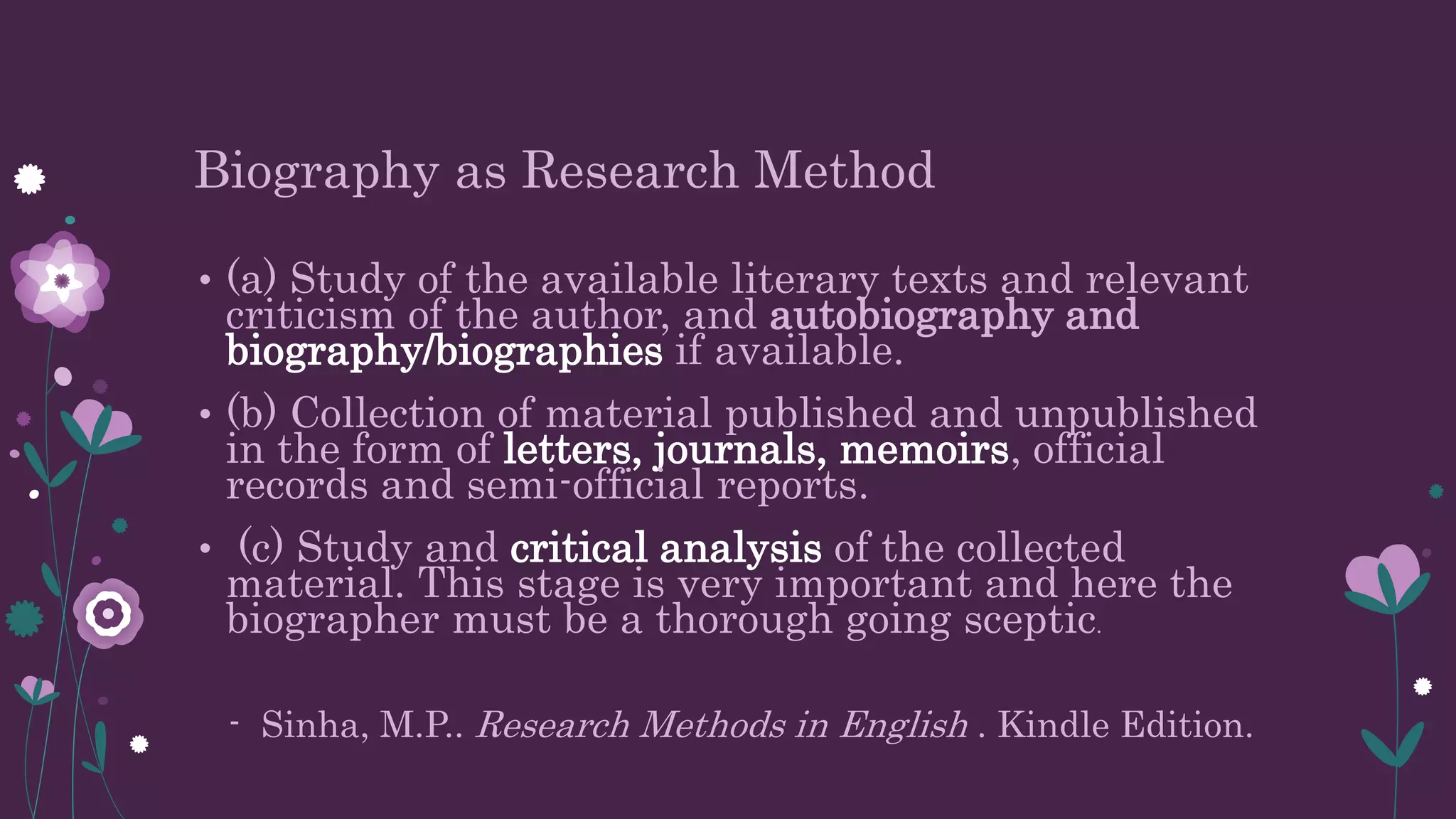
Biography as Research Method
• (a) Study of the available literary texts and relevant
criticism of the author, and autobiography and
biography/biographies if available.
• (b) Collection of material published and unpublished
in the form of letters, journals, memoirs, official
records and semi-official reports.
• (c) Study and critical analysis of the collected
material. This stage is very important and here the
biographer must be a thorough going sceptic.
- Sinha, M.P.. Research Methods in English . Kindle Edition.
Visual Methodologies
Digital Humanities
Numbers and Words: Quantitative
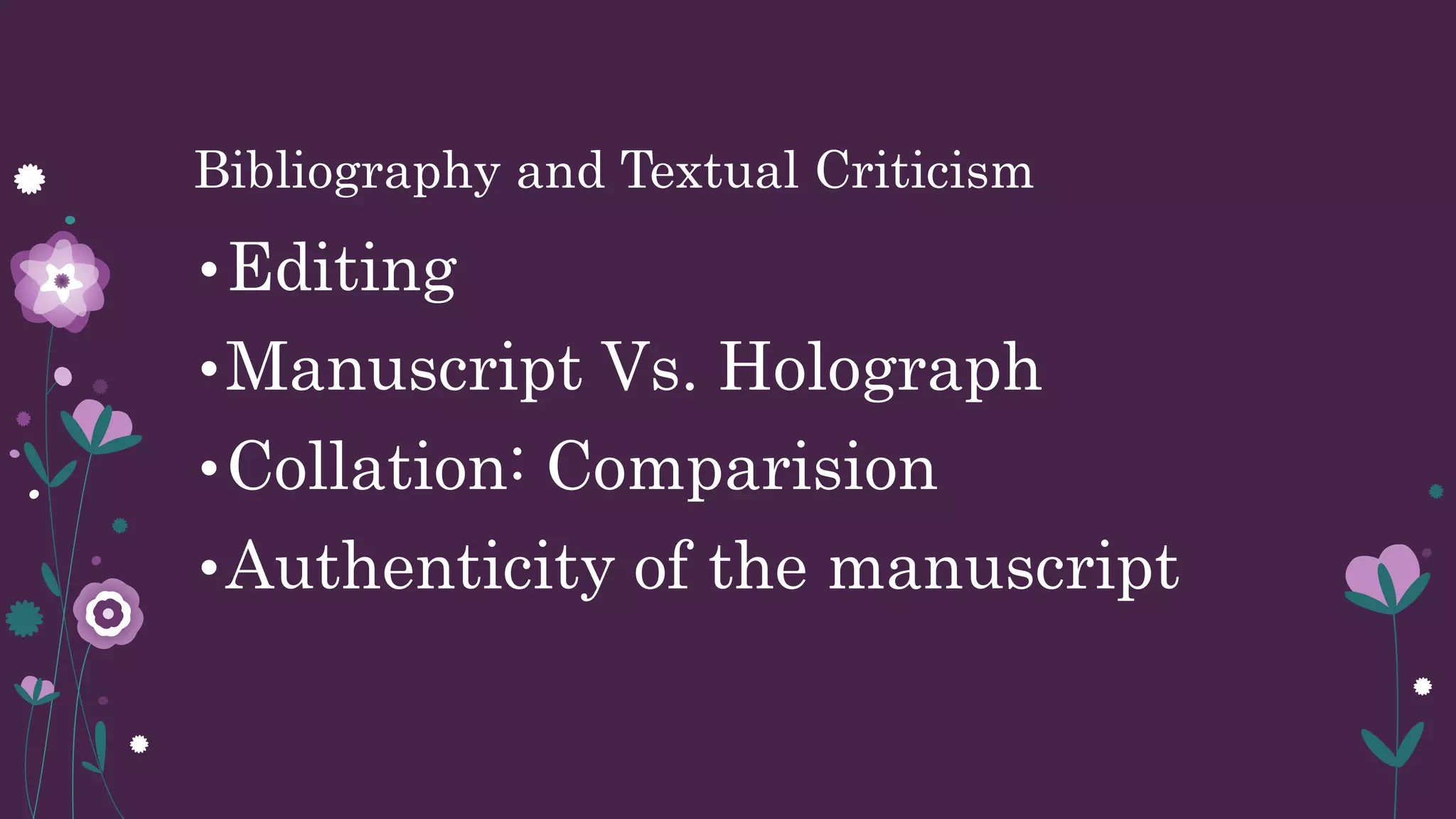
Bibliography and Textual Criticism
•Editing
•Manuscript Vs. Holograph
•Collation: Comparision
•Authenticity of the manuscript
Oral History
History of Ideas
Narratology / technique
• The researcher can do research on an author’s art of
characterization, plot construction, style, use of
symbols and imagery, narrative technique, irony and
poetic diction. But he or she should know that
research on these is not an easy task. It may be that
a particular character is a mythical or historical or
literary figure.
• Sinha, M.P.. Research Methods in English . Kindle
Edition.
Ethnographic Methods
Creative Writing
Interviewing
Digital Humanities
•Masterfile
•Endnote
Materials
• Articles
• Journals
• Libraries
• https://sci-hub.tw
Literary research and interdisciplinary
Tools and techniques for literary
research
• Using online and printed sources
• online sources - institution’s
authenticated gateway -your user ID
and password to log on to your
university account.
• University library will usually have an
institutional subscription to a variety of
online resources
• Scholarly journals, books (both primary sources
and criticism) and reference works are now
available online.
• identify what is available online
• identify your nearest major research library
Using Google for Academic Research
• Delimit search fields and maximise the
retrieval of relevant information
(Boolean)
• Use quotes – “Smoking causes Cancer”
• Use a hyphen to exclude words – Cars - Audi
• Use a colon to search specific sites - Chaucer:
Sparknotes
• Google Scholar (http://scholar.google.com)
• Google Book Search (http://books.google.com)
• Wikipedia and evaluating data
• Participating in scholarly communities
• biographical dictionaries online. The Oxford
Dictionary of National Biography
(www.oxforddnb.com)
• American National Biography
• Encyclopaedia Britannica (www.britannica.com)
•
Using Online Database
• Indexes and abstracts
• e Modern Language Association International
Bibliography , http://firstsearch.oclc.org
• Annual Bibliography of English Language and
Literature http://lion.chadwyck.co.uk
• Routledge Annotated Bibliography of English Studies
(ABES, http://abe.informaworld.com)
• British Humanities Index (BHI, available through
www-md4.csa.
• com).
•Research Gate
•Shodhganga (Thesis Reservoir)
Library catalogues
• COPAC (http://copac.ac.uk) is the best British
cumulative catalogue
• WorldCat – bibliographic details/ Workcited
USING DARKWEB AND DEEP WEB
Full-text journal articles
• JSTOR (www.jstor.org).
• Project Muse (http://muse.jhu.edu)
• The Journal of Commonwealth Literature
• Language and Literature – SAGE Pub
• DOI - Digital Object Identifier
Primary sources and eBooks
• Bartleby (http://bartleby.com)
• Project Gutenberg (www.gutenberg.org/catalog)
• Literature Online (LION;
http://lion.chadwyck.co.uk)
• British National Archives’ Documents
Online site
(www.nationalarchives.gov.uk/documentsonline
INTERDISCIPLINARY APPROACHES TO
LITERARY TEXTS
• Literature and Cultural Studies
• Literature and Other Media
• Literature and Film, Literature and
Graphic Narratives, Music
• Linda Hutcheon’s A Theory of Adaptation
(2006)
TERMS
• Ibid
• ISBN International Standard Book Number
MATERIALS IN ENGLISH RESEARCH
• Primary Text
• Secondary Text
• Manuscripts
• Tools – Note Pad, Recorder, Camera, Etc.
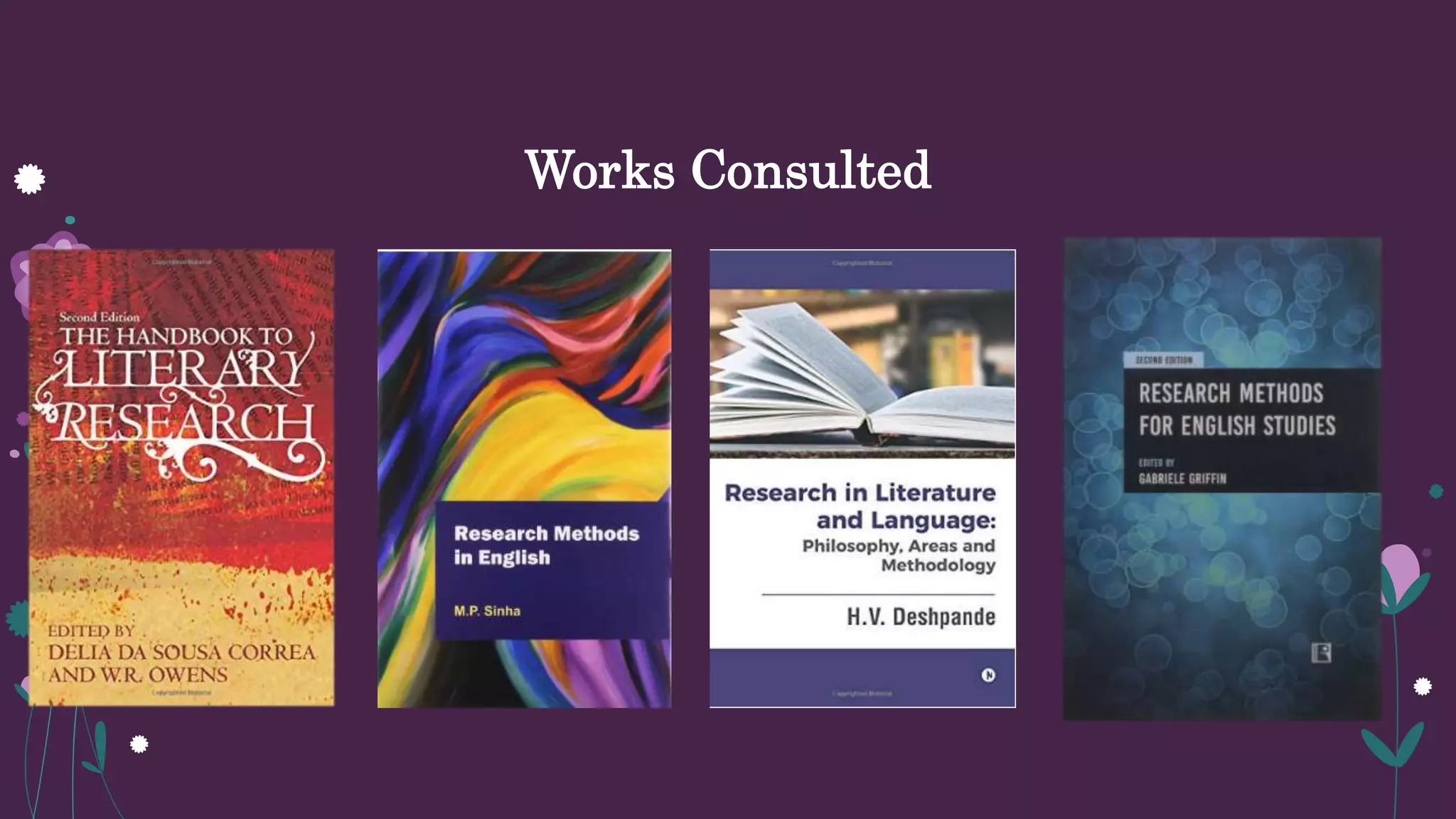
Works Consulted

Research methods and materials in English

  • 1.
  • 2.
    •“A research startswith an empty notebook” - Paul Watson
  • 3.
    English??? •Research in EnglishLiterature •Vs. •Research in English Language
  • 4.
    Research in EnglishLiterature • Application of Theory/Idea/Philosophy • Thematic Analysis (Survival, Violence, Etc. ) • Comparative Study • Translation Studies • Stylistic Appreciation/Criticism
  • 5.
    Research in (English)Language • ELT Methods (Innovation, Criticize, Etc. ) • Linguistic Oriented Language Theories: Problems, Application, Etc. • Comparative, Historical Linguistics • Culture and Language
  • 6.
    Application of Theories/Thematic Analysis • Gender roles/ Gender Victimization • Colonial/Cultural/Class/Age effect on Writer • Historical background/ Biographical • “Deconstruction” – Postmodern Characteristics •Particular Aspect of Writer
  • 7.
    Comparative Literature • Worldliterature/ Archetypal Criticism • Parallelism • Intertextuality • Similarity • Contrastive Criticism (Dissimilarity) • Influence/Confluence/Reception/Imitation • Thematology / Genre / Translation
  • 8.
    Translation Studies • Problemsof Translation • Influence of Culture in Translation • Language Inadequacy • Translation Methods • Coding Decoding, Untranslatability •
  • 9.
    Research Methods vs.Research Methodology • Theoretical and systematic analysis of the strategies employed • methods are approaches you intend to use to collect data • Skills – handling material • Methods – how you carry your research , it determines the kind of research. • Methodology – perspective, feminist, • Materials -
  • 10.
    Textual Analysis asa Research Method • Catherine Belsey • Interpretation • What says? Who says? To whom it says? How? What kinda effect? • Tatquin and Lucretia (1571) • Literally vs in-depth • Sparing use of secondary source, it may hinder your imagination • Minute details of cultural artefacts •
  • 12.
    Discourse Analysis asA Research Method
  • 13.
  • 14.
    Biography as ResearchMethod • (a) Study of the available literary texts and relevant criticism of the author, and autobiography and biography/biographies if available. • (b) Collection of material published and unpublished in the form of letters, journals, memoirs, official records and semi-official reports. • (c) Study and critical analysis of the collected material. This stage is very important and here the biographer must be a thorough going sceptic. - Sinha, M.P.. Research Methods in English . Kindle Edition.
  • 15.
  • 16.
  • 17.
    Numbers and Words:Quantitative
  • 18.
    Bibliography and TextualCriticism •Editing •Manuscript Vs. Holograph •Collation: Comparision •Authenticity of the manuscript
  • 19.
  • 20.
  • 21.
    Narratology / technique •The researcher can do research on an author’s art of characterization, plot construction, style, use of symbols and imagery, narrative technique, irony and poetic diction. But he or she should know that research on these is not an easy task. It may be that a particular character is a mythical or historical or literary figure. • Sinha, M.P.. Research Methods in English . Kindle Edition.
  • 22.
  • 23.
  • 24.
  • 25.
  • 26.
    Materials • Articles • Journals •Libraries • https://sci-hub.tw
  • 27.
    Literary research andinterdisciplinary
  • 28.
    Tools and techniquesfor literary research • Using online and printed sources • online sources - institution’s authenticated gateway -your user ID and password to log on to your university account. • University library will usually have an institutional subscription to a variety of online resources
  • 29.
    • Scholarly journals,books (both primary sources and criticism) and reference works are now available online. • identify what is available online • identify your nearest major research library
  • 30.
    Using Google forAcademic Research • Delimit search fields and maximise the retrieval of relevant information (Boolean) • Use quotes – “Smoking causes Cancer” • Use a hyphen to exclude words – Cars - Audi • Use a colon to search specific sites - Chaucer: Sparknotes • Google Scholar (http://scholar.google.com) • Google Book Search (http://books.google.com)
  • 31.
    • Wikipedia andevaluating data • Participating in scholarly communities • biographical dictionaries online. The Oxford Dictionary of National Biography (www.oxforddnb.com) • American National Biography • Encyclopaedia Britannica (www.britannica.com) •
  • 32.
    Using Online Database •Indexes and abstracts • e Modern Language Association International Bibliography , http://firstsearch.oclc.org • Annual Bibliography of English Language and Literature http://lion.chadwyck.co.uk • Routledge Annotated Bibliography of English Studies (ABES, http://abe.informaworld.com) • British Humanities Index (BHI, available through www-md4.csa. • com).
  • 33.
  • 34.
    Library catalogues • COPAC(http://copac.ac.uk) is the best British cumulative catalogue • WorldCat – bibliographic details/ Workcited
  • 35.
  • 36.
    Full-text journal articles •JSTOR (www.jstor.org). • Project Muse (http://muse.jhu.edu) • The Journal of Commonwealth Literature • Language and Literature – SAGE Pub • DOI - Digital Object Identifier
  • 37.
    Primary sources andeBooks • Bartleby (http://bartleby.com) • Project Gutenberg (www.gutenberg.org/catalog) • Literature Online (LION; http://lion.chadwyck.co.uk) • British National Archives’ Documents Online site (www.nationalarchives.gov.uk/documentsonline
  • 38.
    INTERDISCIPLINARY APPROACHES TO LITERARYTEXTS • Literature and Cultural Studies • Literature and Other Media • Literature and Film, Literature and Graphic Narratives, Music • Linda Hutcheon’s A Theory of Adaptation (2006)
  • 39.
    TERMS • Ibid • ISBNInternational Standard Book Number
  • 40.
    MATERIALS IN ENGLISHRESEARCH • Primary Text • Secondary Text • Manuscripts • Tools – Note Pad, Recorder, Camera, Etc.
  • 41.