
CTG: patterns
Aboubakr Elnashar
Benha University Hospital, EgyptAboubakr Elnashar
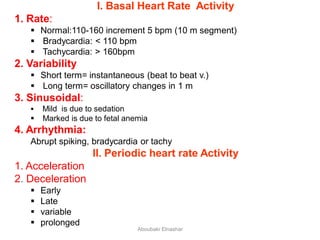
I. Basal Heart Rate Activity
1. Rate:
 Normal:110-160 increment 5 bpm (10 m segment)
 Bradycardia: < 110 bpm
 Tachycardia: > 160bpm
2. Variability
 Short term= instantaneous (beat to beat v.)
 Long term= oscillatory changes in 1 m
3. Sinusoidal:
 Mild is due to sedation
 Marked is due to fetal anemia
4. Arrhythmia:
Abrupt spiking, bradycardia or tachy
II. Periodic heart rate Activity
1. Acceleration
2. Deceleration
 Early
 Late
 variable
 prolonged
Aboubakr Elnashar
I. Baseline
Tachycardia
Baseline FHR > 160 bpm
Bradycardia
Baseline FHR < 110 bpm
Aboubakr Elnashar
1. Normal
FHR in ten beat
intervals ranging
from 30 bpm to
240 bpm.
Normal FHR is 110
to 160 bpm
1. RATE
Aboubakr Elnashar
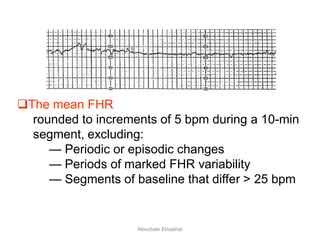
The mean FHR
rounded to increments of 5 bpm during a 10-min
segment, excluding:
— Periodic or episodic changes
— Periods of marked FHR variability
— Segments of baseline that differ > 25 bpm
Aboubakr Elnashar
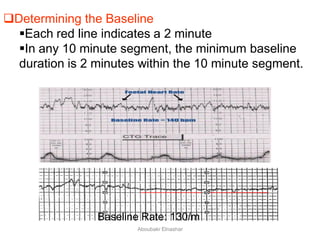
Determining the Baseline
Each red line indicates a 2 minute
In any 10 minute segment, the minimum baseline
duration is 2 minutes within the 10 minute segment.
Baseline Rate: 130/m
Aboubakr Elnashar
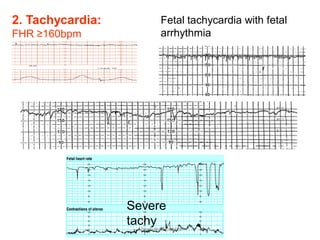
2. Tachycardia:
FHR ≥160bpm
Fetal tachycardia with fetal
arrhythmia
Severe
tachy
Aboubakr Elnashar
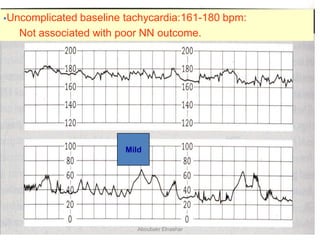
Uncomplicated baseline tachycardia:161-180 bpm:
Not associated with poor NN outcome.
Mild
Aboubakr Elnashar
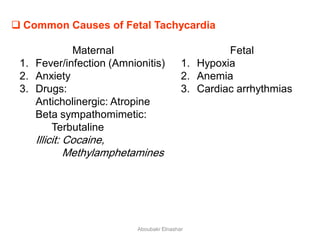
 Common Causes of Fetal Tachycardia
Maternal
1. Fever/infection (Amnionitis)
2. Anxiety
3. Drugs:
Anticholinergic: Atropine
Beta sympathomimetic:
Terbutaline
Illicit: Cocaine,
Methylamphetamines
Fetal
1. Hypoxia
2. Anemia
3. Cardiac arrhythmias
Aboubakr Elnashar
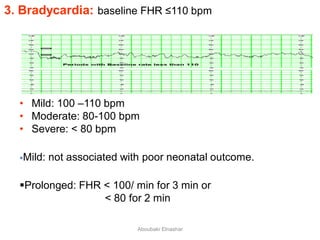
3. Bradycardia: baseline FHR ≤110 bpm
• Mild: 100 –110 bpm
• Moderate: 80-100 bpm
• Severe: < 80 bpm
Mild: not associated with poor neonatal outcome.
Prolonged: FHR < 100/ min for 3 min or
< 80 for 2 min
Aboubakr Elnashar
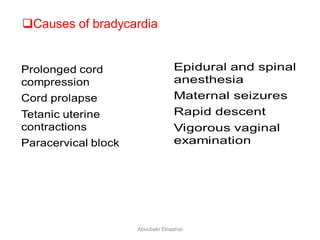
Causes of bradycardia
Aboubakr Elnashar
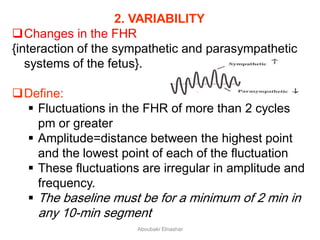
2. VARIABILITY
Changes in the FHR
{interaction of the sympathetic and parasympathetic
systems of the fetus}.
Define:
 Fluctuations in the FHR of more than 2 cycles
pm or greater
 Amplitude=distance between the highest point
and the lowest point of each of the fluctuation
 These fluctuations are irregular in amplitude and
frequency.
 The baseline must be for a minimum of 2 min in
any 10-min segment
Aboubakr Elnashar
Types
1. Short term:
 Change of FHR from one beat to the next
 [Time between cardiac systoles]
 in internal fetal scalp electrode
2. Long term:
 Oscillation of FHR around baseline /min
 [2-6 cycles or waves/min]
Aboubakr Elnashar
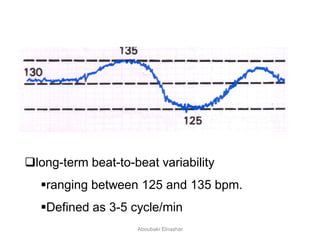
long-term beat-to-beat variability
ranging between 125 and 135 bpm.
Defined as 3-5 cycle/min
Aboubakr Elnashar
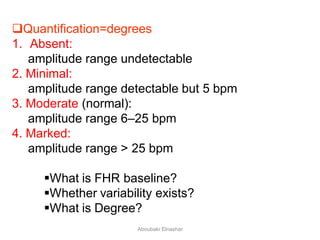
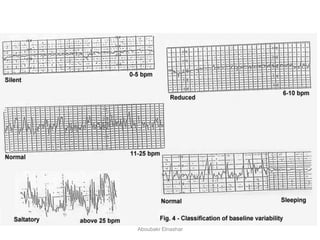
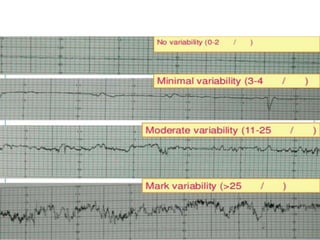
Quantification=degrees
1. Absent:
amplitude range undetectable
2. Minimal:
amplitude range detectable but 5 bpm
3. Moderate (normal):
amplitude range 6–25 bpm
4. Marked:
amplitude range > 25 bpm
What is FHR baseline?
Whether variability exists?
What is Degree?
Aboubakr Elnashar
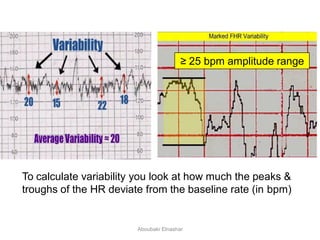
To calculate variability you look at how much the peaks &
troughs of the HR deviate from the baseline rate (in bpm)
≥ 25 bpm amplitude range
Aboubakr Elnashar
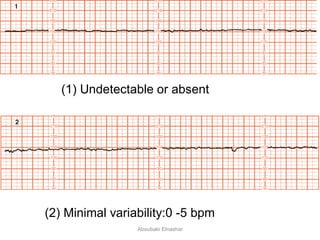
(1) Undetectable or absent
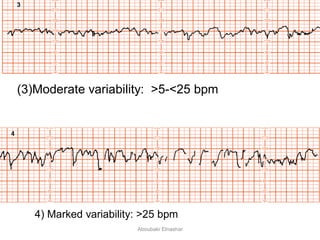
(2) Minimal variability:0 -5 bpm
Aboubakr Elnashar
4) Marked variability: >25 bpm
(3)Moderate variability: >5-<25 bpm
Aboubakr Elnashar
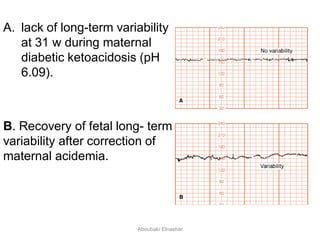
A. lack of long-term variability
at 31 w during maternal
diabetic ketoacidosis (pH
6.09).
B. Recovery of fetal long- term
variability after correction of
maternal acidemia.
Aboubakr Elnashar
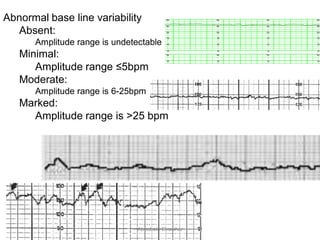
Abnormal base line variability
Absent:
Amplitude range is undetectable
Minimal:
Amplitude range ≤5bpm
Moderate:
Amplitude range is 6-25bpm
Marked:
Amplitude range is >25 bpm
Aboubakr Elnashar
Aboubakr Elnashar
Aboubakr Elnashar
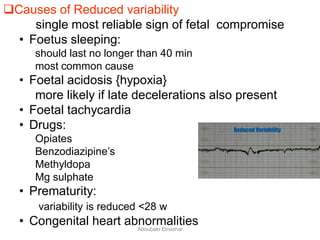
Causes of Reduced variability
single most reliable sign of fetal compromise
• Foetus sleeping:
should last no longer than 40 min
most common cause
• Foetal acidosis {hypoxia}
more likely if late decelerations also present
• Foetal tachycardia
• Drugs:
Opiates
Benzodiazipine’s
Methyldopa
Mg sulphate
• Prematurity:
variability is reduced <28 w
• Congenital heart abnormalitiesAboubakr Elnashar
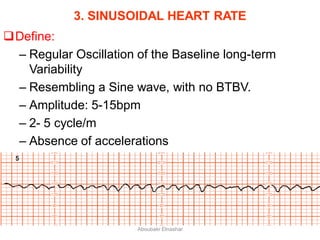
3. SINUSOIDAL HEART RATE
Define:
– Regular Oscillation of the Baseline long-term
Variability
– Resembling a Sine wave, with no BTBV.
– Amplitude: 5-15bpm
– 2- 5 cycle/m
– Absence of accelerations
Aboubakr Elnashar
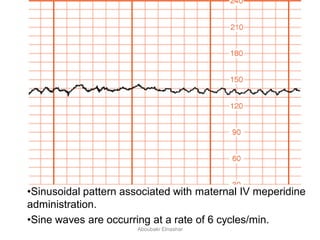
•Sinusoidal pattern associated with maternal IV meperidine
administration.
•Sine waves are occurring at a rate of 6 cycles/min.
Aboubakr Elnashar
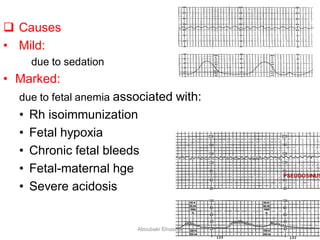
 Causes
• Mild:
due to sedation
• Marked:
due to fetal anemia associated with:
• Rh isoimmunization
• Fetal hypoxia
• Chronic fetal bleeds
• Fetal-maternal hge
• Severe acidosis
PSEUDOSINUS
Aboubakr Elnashar
II. Periodic heart rate Activity
Periodic changes:
accelerations or decelerations in FHR that occur in
direct association with uterine contractions.
Episodic (sporadic) changes:
accelerations or decelerations FHR that occur
independent of uterine contractions, in response to
vaginal exam
maternal vomiting
fetal movement
Aboubakr Elnashar
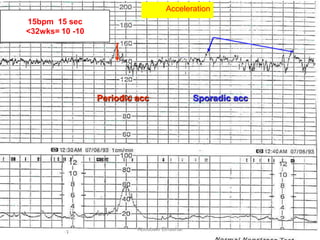
Acceleration
Periodic acc Sporadic acc
15bpm 15 sec
<32wks= 10 -10
Acceleration
Aboubakr Elnashar
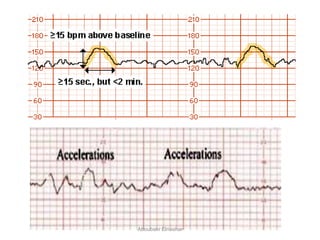
1. ACCELERATION
Define:
An increase in the FHR from the most recently
calculated baseline
Onset to peak:
less than 30 sec
The duration
Time from the initial change in FHR from the
baseline to the return of the FHR to the baseline
less than 2 minutes
Prolonged acceleration
lasts 2 min, but < 10 min
Baseline change
If an acceleration lasts 10 min
Aboubakr Elnashar
Aboubakr Elnashar
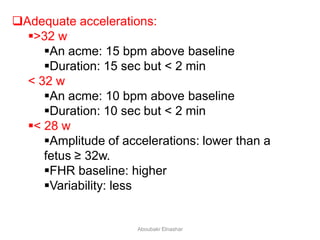
Adequate accelerations:
>32 w
An acme: 15 bpm above baseline
Duration: 15 sec but < 2 min
< 32 w
An acme: 10 bpm above baseline
Duration: 10 sec but < 2 min
< 28 w
Amplitude of accelerations: lower than a
fetus ≥ 32w.
FHR baseline: higher
Variability: less
Aboubakr Elnashar
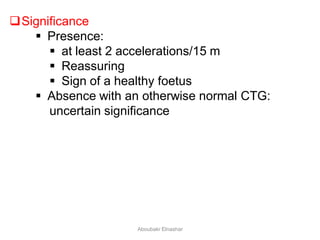
Significance
 Presence:
 at least 2 accelerations/15 m
 Reassuring
 Sign of a healthy foetus
 Absence with an otherwise normal CTG:
uncertain significance
Aboubakr Elnashar
Aboubakr Elnashar
2. DECELERATION
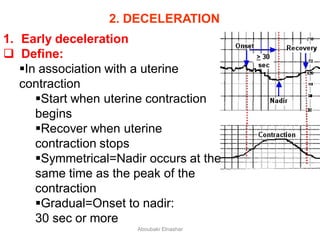
1. Early deceleration
 Define:
In association with a uterine
contraction
Start when uterine contraction
begins
Recover when uterine
contraction stops
Symmetrical=Nadir occurs at the
same time as the peak of the
contraction
Gradual=Onset to nadir:
30 sec or more
Aboubakr Elnashar
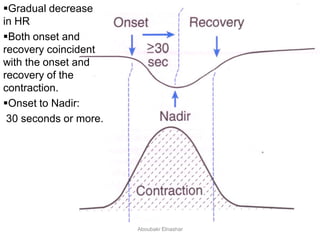
Gradual decrease
in HR
Both onset and
recovery coincident
with the onset and
recovery of the
contraction.
Onset to Nadir:
30 seconds or more.
Aboubakr Elnashar
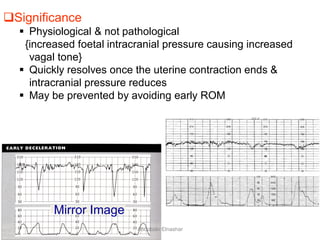
Significance
 Physiological & not pathological
{increased foetal intracranial pressure causing increased
vagal tone}
 Quickly resolves once the uterine contraction ends &
intracranial pressure reduces
 May be prevented by avoiding early ROM
Mirror Image
Aboubakr Elnashar
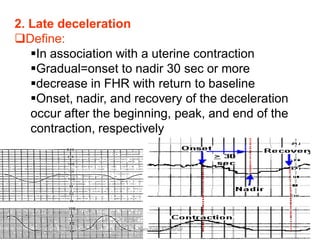
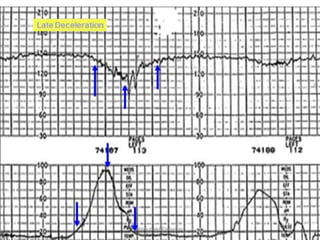
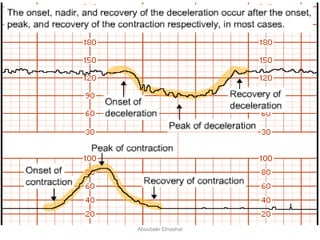
2. Late deceleration
Define:
In association with a uterine contraction
Gradual=onset to nadir 30 sec or more
decrease in FHR with return to baseline
Onset, nadir, and recovery of the deceleration
occur after the beginning, peak, and end of the
contraction, respectively
Aboubakr Elnashar
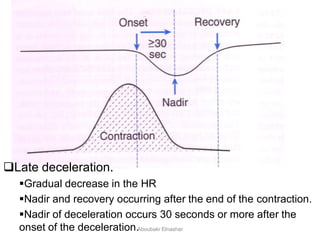
Late deceleration.
Gradual decrease in the HR
Nadir and recovery occurring after the end of the contraction.
Nadir of deceleration occurs 30 seconds or more after the
onset of the deceleration.Aboubakr Elnashar
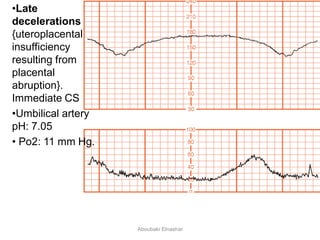
•Late
decelerations
{uteroplacental
insufficiency
resulting from
placental
abruption}.
Immediate CS
•Umbilical artery
pH: 7.05
• Po2: 11 mm Hg.
Aboubakr Elnashar
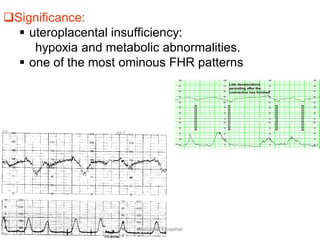
Significance:
 uteroplacental insufficiency:
hypoxia and metabolic abnormalities.
 one of the most ominous FHR patterns
Aboubakr Elnashar
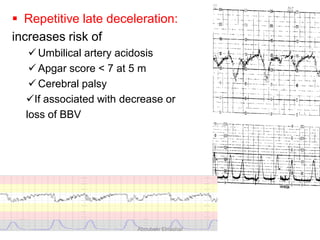
 Repetitive late deceleration:
increases risk of
 Umbilical artery acidosis
 Apgar score < 7 at 5 m
 Cerebral palsy
If associated with decrease or
loss of BBV
Aboubakr Elnashar
Aboubakr Elnashar
Aboubakr Elnashar
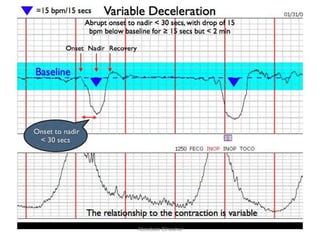
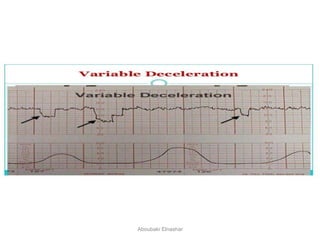
3. Variable deceleration
Define:
Decrease in FHR of > 15 bpm measured from the most
recently determined baseline rate.
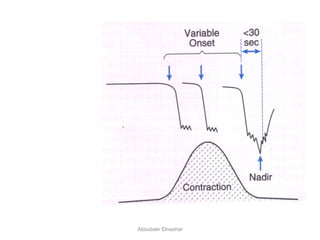
Abrupt=Onset to nadir: less than 30 seconds.
lasts > 15 sec and less than 2 min
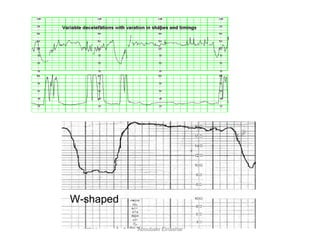
onset commonly varying with successive contractions
may be v-shaped, u-shaped or w-shaped.
Aboubakr Elnashar
Aboubakr Elnashar
W-shaped
Aboubakr Elnashar
Aboubakr Elnashar
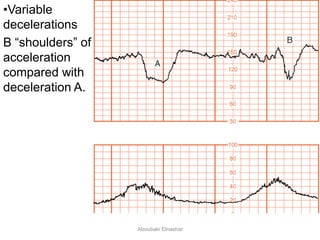
•Variable
decelerations
B ―shoulders‖ of
acceleration
compared with
deceleration A.
Aboubakr Elnashar
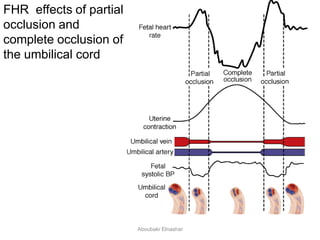
FHR effects of partial
occlusion and
complete occlusion of
the umbilical cord
Aboubakr Elnashar
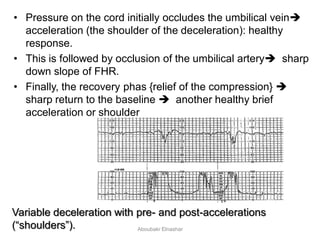
• Pressure on the cord initially occludes the umbilical vein
acceleration (the shoulder of the deceleration): healthy
response.
• This is followed by occlusion of the umbilical artery sharp
down slope of FHR.
• Finally, the recovery phas {relief of the compression} 
sharp return to the baseline  another healthy brief
acceleration or shoulder
Variable deceleration with pre- and post-accelerations
(―shoulders‖). Aboubakr Elnashar
Significance
 depends upon
 how often they occur
 how deep they go
 how long they last.
 how the fetus responds in their presence.
 um cord compression
(Common: 50-80% 2nd stage)
Reassuring variable deceleration:
Abrupt (sharp) onset
Abrupt return to baseline
Preceded & followed by shoulders
Aboubakr Elnashar
Aboubakr Elnashar
Complicated variable decelerations:
Deceleration
Role of 60
depth >60 bpm
for >60 seconds
rate of 60 bpm
Changes in shape: over-shoot
Slow recovery
Baseline FHR:
Decreased or increased following the
decelerations
BBV:
Absent in or between decelerations
Aboubakr Elnashar
Re-assuring
a) Abrupt return to base
line
b) BBV: Normal
c) Initial acceleration
d) Secondary
acceleration
Non-reassuring(atypical)
a) Slow return to baseline
b) BBV: Loss during
deceleration
c) Loss of initial
acceleration
d) Persistent acceleration
after recovery
e) Continuation of base
line at low level
f) Biphasic deceleration
Aboubakr Elnashar
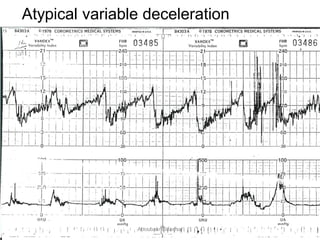
Atypical variable deceleration
Aboubakr Elnashar
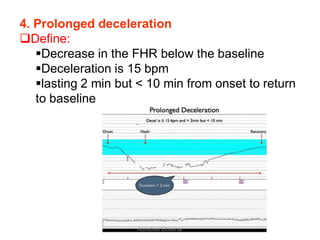
4. Prolonged deceleration
Define:
Decrease in the FHR below the baseline
Deceleration is 15 bpm
lasting 2 min but < 10 min from onset to return
to baseline
Aboubakr Elnashar
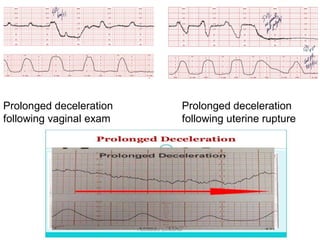
Prolonged deceleration
following uterine rupture
Prolonged deceleration
following vaginal exam
Aboubakr Elnashar
Significance:
• Non-Reasurring: lasts between 2-3 min
• Abnormal: lasts longer than 3 min it is
immediately classed as Action must be taken
quickly
e.g. FB sampling/emergency CS
Maternal
1. Hypotension
2. Hypoxia
3. Uterine
hyperactivity
4. Abruption
5. Uterine rupture
Fetal
1. Hypoxia
2. Fetal hemorrhage
3. Cord prolapse
4. Cord compression
Aboubakr Elnashar
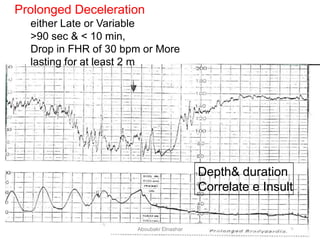
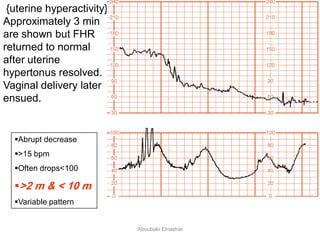
Prolonged Deceleration
either Late or Variable
>90 sec & < 10 min,
Drop in FHR of 30 bpm or More
lasting for at least 2 m
Depth& duration
Correlate e Insult
Aboubakr Elnashar
Abrupt decrease
>15 bpm
Often drops<100
>2 m & < 10 m
Variable pattern
{uterine hyperactivity}
Approximately 3 min
are shown but FHR
returned to normal
after uterine
hypertonus resolved.
Vaginal delivery later
ensued.
Aboubakr Elnashar
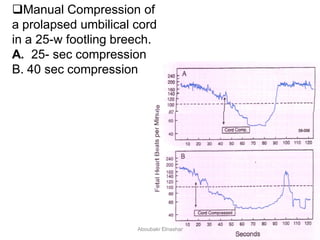
Manual Compression of
a prolapsed umbilical cord
in a 25-w footling breech.
A. 25- sec compression
B. 40 sec compression
Aboubakr Elnashar
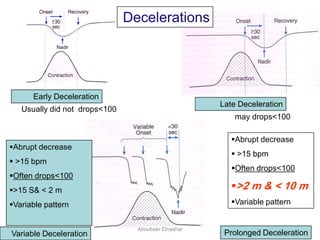
Early Deceleration
Late Deceleration
Variable Deceleration
Abrupt decrease
 >15 bpm
Often drops<100
>15 S& < 2 m
Variable pattern
Abrupt decrease
 >15 bpm
Often drops<100
>2 m & < 10 m
Variable pattern
Prolonged Deceleration
may drops<100
Usually did not drops<100
Decelerations
Aboubakr Elnashar
Thanks
Aboubakr Elnashar

CTG: patterns

  • 1.
    CTG: patterns Aboubakr Elnashar BenhaUniversity Hospital, EgyptAboubakr Elnashar
  • 2.
    I. Basal HeartRate Activity 1. Rate:  Normal:110-160 increment 5 bpm (10 m segment)  Bradycardia: < 110 bpm  Tachycardia: > 160bpm 2. Variability  Short term= instantaneous (beat to beat v.)  Long term= oscillatory changes in 1 m 3. Sinusoidal:  Mild is due to sedation  Marked is due to fetal anemia 4. Arrhythmia: Abrupt spiking, bradycardia or tachy II. Periodic heart rate Activity 1. Acceleration 2. Deceleration  Early  Late  variable  prolonged Aboubakr Elnashar
  • 3.
    I. Baseline Tachycardia Baseline FHR> 160 bpm Bradycardia Baseline FHR < 110 bpm Aboubakr Elnashar
  • 4.
    1. Normal FHR inten beat intervals ranging from 30 bpm to 240 bpm. Normal FHR is 110 to 160 bpm 1. RATE Aboubakr Elnashar
  • 5.
    The mean FHR roundedto increments of 5 bpm during a 10-min segment, excluding: — Periodic or episodic changes — Periods of marked FHR variability — Segments of baseline that differ > 25 bpm Aboubakr Elnashar
  • 6.
    Determining the Baseline Eachred line indicates a 2 minute In any 10 minute segment, the minimum baseline duration is 2 minutes within the 10 minute segment. Baseline Rate: 130/m Aboubakr Elnashar
  • 7.
    2. Tachycardia: FHR ≥160bpm Fetaltachycardia with fetal arrhythmia Severe tachy Aboubakr Elnashar
  • 8.
    Uncomplicated baseline tachycardia:161-180bpm: Not associated with poor NN outcome. Mild Aboubakr Elnashar
  • 9.
     Common Causesof Fetal Tachycardia Maternal 1. Fever/infection (Amnionitis) 2. Anxiety 3. Drugs: Anticholinergic: Atropine Beta sympathomimetic: Terbutaline Illicit: Cocaine, Methylamphetamines Fetal 1. Hypoxia 2. Anemia 3. Cardiac arrhythmias Aboubakr Elnashar
  • 10.
    3. Bradycardia: baselineFHR ≤110 bpm • Mild: 100 –110 bpm • Moderate: 80-100 bpm • Severe: < 80 bpm Mild: not associated with poor neonatal outcome. Prolonged: FHR < 100/ min for 3 min or < 80 for 2 min Aboubakr Elnashar
  • 11.
  • 12.
    2. VARIABILITY Changes inthe FHR {interaction of the sympathetic and parasympathetic systems of the fetus}. Define:  Fluctuations in the FHR of more than 2 cycles pm or greater  Amplitude=distance between the highest point and the lowest point of each of the fluctuation  These fluctuations are irregular in amplitude and frequency.  The baseline must be for a minimum of 2 min in any 10-min segment Aboubakr Elnashar
  • 13.
    Types 1. Short term: Change of FHR from one beat to the next  [Time between cardiac systoles]  in internal fetal scalp electrode 2. Long term:  Oscillation of FHR around baseline /min  [2-6 cycles or waves/min] Aboubakr Elnashar
  • 14.
    long-term beat-to-beat variability rangingbetween 125 and 135 bpm. Defined as 3-5 cycle/min Aboubakr Elnashar
  • 15.
    Quantification=degrees 1. Absent: amplitude rangeundetectable 2. Minimal: amplitude range detectable but 5 bpm 3. Moderate (normal): amplitude range 6–25 bpm 4. Marked: amplitude range > 25 bpm What is FHR baseline? Whether variability exists? What is Degree? Aboubakr Elnashar
  • 16.
    To calculate variabilityyou look at how much the peaks & troughs of the HR deviate from the baseline rate (in bpm) ≥ 25 bpm amplitude range Aboubakr Elnashar
  • 17.
    (1) Undetectable orabsent (2) Minimal variability:0 -5 bpm Aboubakr Elnashar
  • 18.
    4) Marked variability:>25 bpm (3)Moderate variability: >5-<25 bpm Aboubakr Elnashar
  • 19.
    A. lack oflong-term variability at 31 w during maternal diabetic ketoacidosis (pH 6.09). B. Recovery of fetal long- term variability after correction of maternal acidemia. Aboubakr Elnashar
  • 20.
    Abnormal base linevariability Absent: Amplitude range is undetectable Minimal: Amplitude range ≤5bpm Moderate: Amplitude range is 6-25bpm Marked: Amplitude range is >25 bpm Aboubakr Elnashar
  • 21.
  • 22.
  • 23.
    Causes of Reducedvariability single most reliable sign of fetal compromise • Foetus sleeping: should last no longer than 40 min most common cause • Foetal acidosis {hypoxia} more likely if late decelerations also present • Foetal tachycardia • Drugs: Opiates Benzodiazipine’s Methyldopa Mg sulphate • Prematurity: variability is reduced <28 w • Congenital heart abnormalitiesAboubakr Elnashar
  • 24.
    3. SINUSOIDAL HEARTRATE Define: – Regular Oscillation of the Baseline long-term Variability – Resembling a Sine wave, with no BTBV. – Amplitude: 5-15bpm – 2- 5 cycle/m – Absence of accelerations Aboubakr Elnashar
  • 25.
    •Sinusoidal pattern associatedwith maternal IV meperidine administration. •Sine waves are occurring at a rate of 6 cycles/min. Aboubakr Elnashar
  • 26.
     Causes • Mild: dueto sedation • Marked: due to fetal anemia associated with: • Rh isoimmunization • Fetal hypoxia • Chronic fetal bleeds • Fetal-maternal hge • Severe acidosis PSEUDOSINUS Aboubakr Elnashar
  • 27.
    II. Periodic heartrate Activity Periodic changes: accelerations or decelerations in FHR that occur in direct association with uterine contractions. Episodic (sporadic) changes: accelerations or decelerations FHR that occur independent of uterine contractions, in response to vaginal exam maternal vomiting fetal movement Aboubakr Elnashar
  • 28.
    Acceleration Periodic acc Sporadicacc 15bpm 15 sec <32wks= 10 -10 Acceleration Aboubakr Elnashar
  • 29.
    1. ACCELERATION Define: An increasein the FHR from the most recently calculated baseline Onset to peak: less than 30 sec The duration Time from the initial change in FHR from the baseline to the return of the FHR to the baseline less than 2 minutes Prolonged acceleration lasts 2 min, but < 10 min Baseline change If an acceleration lasts 10 min Aboubakr Elnashar
  • 30.
  • 31.
    Adequate accelerations: >32 w Anacme: 15 bpm above baseline Duration: 15 sec but < 2 min < 32 w An acme: 10 bpm above baseline Duration: 10 sec but < 2 min < 28 w Amplitude of accelerations: lower than a fetus ≥ 32w. FHR baseline: higher Variability: less Aboubakr Elnashar
  • 32.
    Significance  Presence:  atleast 2 accelerations/15 m  Reassuring  Sign of a healthy foetus  Absence with an otherwise normal CTG: uncertain significance Aboubakr Elnashar
  • 33.
  • 34.
    2. DECELERATION 1. Earlydeceleration  Define: In association with a uterine contraction Start when uterine contraction begins Recover when uterine contraction stops Symmetrical=Nadir occurs at the same time as the peak of the contraction Gradual=Onset to nadir: 30 sec or more Aboubakr Elnashar
  • 35.
    Gradual decrease in HR Bothonset and recovery coincident with the onset and recovery of the contraction. Onset to Nadir: 30 seconds or more. Aboubakr Elnashar
  • 36.
    Significance  Physiological &not pathological {increased foetal intracranial pressure causing increased vagal tone}  Quickly resolves once the uterine contraction ends & intracranial pressure reduces  May be prevented by avoiding early ROM Mirror Image Aboubakr Elnashar
  • 37.
    2. Late deceleration Define: Inassociation with a uterine contraction Gradual=onset to nadir 30 sec or more decrease in FHR with return to baseline Onset, nadir, and recovery of the deceleration occur after the beginning, peak, and end of the contraction, respectively Aboubakr Elnashar
  • 38.
    Late deceleration. Gradual decreasein the HR Nadir and recovery occurring after the end of the contraction. Nadir of deceleration occurs 30 seconds or more after the onset of the deceleration.Aboubakr Elnashar
  • 39.
  • 40.
    Significance:  uteroplacental insufficiency: hypoxiaand metabolic abnormalities.  one of the most ominous FHR patterns Aboubakr Elnashar
  • 41.
     Repetitive latedeceleration: increases risk of  Umbilical artery acidosis  Apgar score < 7 at 5 m  Cerebral palsy If associated with decrease or loss of BBV Aboubakr Elnashar
  • 42.
  • 43.
  • 44.
    3. Variable deceleration Define: Decreasein FHR of > 15 bpm measured from the most recently determined baseline rate. Abrupt=Onset to nadir: less than 30 seconds. lasts > 15 sec and less than 2 min onset commonly varying with successive contractions may be v-shaped, u-shaped or w-shaped. Aboubakr Elnashar
  • 45.
  • 46.
  • 47.
  • 48.
  • 49.
    FHR effects ofpartial occlusion and complete occlusion of the umbilical cord Aboubakr Elnashar
  • 50.
    • Pressure onthe cord initially occludes the umbilical vein acceleration (the shoulder of the deceleration): healthy response. • This is followed by occlusion of the umbilical artery sharp down slope of FHR. • Finally, the recovery phas {relief of the compression}  sharp return to the baseline  another healthy brief acceleration or shoulder Variable deceleration with pre- and post-accelerations (―shoulders‖). Aboubakr Elnashar
  • 51.
    Significance  depends upon how often they occur  how deep they go  how long they last.  how the fetus responds in their presence.  um cord compression (Common: 50-80% 2nd stage) Reassuring variable deceleration: Abrupt (sharp) onset Abrupt return to baseline Preceded & followed by shoulders Aboubakr Elnashar
  • 52.
  • 53.
    Complicated variable decelerations: Deceleration Roleof 60 depth >60 bpm for >60 seconds rate of 60 bpm Changes in shape: over-shoot Slow recovery Baseline FHR: Decreased or increased following the decelerations BBV: Absent in or between decelerations Aboubakr Elnashar
  • 54.
    Re-assuring a) Abrupt returnto base line b) BBV: Normal c) Initial acceleration d) Secondary acceleration Non-reassuring(atypical) a) Slow return to baseline b) BBV: Loss during deceleration c) Loss of initial acceleration d) Persistent acceleration after recovery e) Continuation of base line at low level f) Biphasic deceleration Aboubakr Elnashar
  • 55.
  • 56.
    4. Prolonged deceleration Define: Decreasein the FHR below the baseline Deceleration is 15 bpm lasting 2 min but < 10 min from onset to return to baseline Aboubakr Elnashar
  • 57.
    Prolonged deceleration following uterinerupture Prolonged deceleration following vaginal exam Aboubakr Elnashar
  • 58.
    Significance: • Non-Reasurring: lastsbetween 2-3 min • Abnormal: lasts longer than 3 min it is immediately classed as Action must be taken quickly e.g. FB sampling/emergency CS Maternal 1. Hypotension 2. Hypoxia 3. Uterine hyperactivity 4. Abruption 5. Uterine rupture Fetal 1. Hypoxia 2. Fetal hemorrhage 3. Cord prolapse 4. Cord compression Aboubakr Elnashar
  • 59.
    Prolonged Deceleration either Lateor Variable >90 sec & < 10 min, Drop in FHR of 30 bpm or More lasting for at least 2 m Depth& duration Correlate e Insult Aboubakr Elnashar
  • 60.
    Abrupt decrease >15 bpm Oftendrops<100 >2 m & < 10 m Variable pattern {uterine hyperactivity} Approximately 3 min are shown but FHR returned to normal after uterine hypertonus resolved. Vaginal delivery later ensued. Aboubakr Elnashar
  • 61.
    Manual Compression of aprolapsed umbilical cord in a 25-w footling breech. A. 25- sec compression B. 40 sec compression Aboubakr Elnashar
  • 62.
    Early Deceleration Late Deceleration VariableDeceleration Abrupt decrease  >15 bpm Often drops<100 >15 S& < 2 m Variable pattern Abrupt decrease  >15 bpm Often drops<100 >2 m & < 10 m Variable pattern Prolonged Deceleration may drops<100 Usually did not drops<100 Decelerations Aboubakr Elnashar
  • 63.