BASIC concepts on
INTRAPARTUM FETAL HEART
RATE MONITORING
INA S. IRABON, MD, FPOGS, FPSRM, FPSGE
OBSTETRICS AND GYNECOLOGY
REPRODUCTIVE ENDOCRINOLOGY AND INFERTILITY
To download lecture deck:
References
• Obstetrics and Gynecology 6th ed, 2010 (Beckmann CRB, Ling FW,
Barzansky BM, Herbert WN, Laube DW, Smith RP editors); Chapter 9
• American College of Obstetricians and Gynecologists. Fetal Heart Rate
patterns: monitoring, interpretation and management. ACOG
technical bulletin 207, 1995.
• www.uptodate.com
• Various pictures take from the internet
Outline
• Electronic fetal monitoring
• Reporting findings for EFM
• Baseline fetal heart rate and contractions
• Variability
• Accelerations
• Decelerations
• Interpretation
Intrapartum fetal heart rate monitoring
• Modality intended to determine if a fetus is well-oxygenated
• RATIONALE: The rationale for intrapartum FHR monitoring is
that identification of FHR changes potentially associated with
inadequate fetal oxygenation may enable timely intervention to
reduce the likelihood of hypoxic injury or death.
• 2 methods: intermittent auscultation and continuous electronic
fetal heart rate (FHR) monitoring
Obstetrics and Gynecology 6th ed, 2010 (Beckmann CRB, Ling
FW, Barzansky BM, Herbert WN, Laube DW, Smith RP editors);
Chapter 9
Intrapartum fetal heart rate monitoring
Intermittent Continuous
stethoscope
Fetal doppler
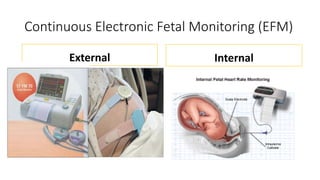
Continuous Electronic Fetal Monitoring (EFM)
External Internal
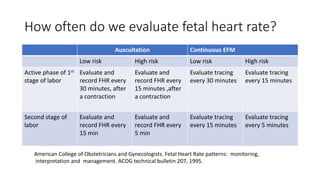
How often do we evaluate fetal heart rate?
Auscultation Continuous EFM
Low risk High risk Low risk High risk
Active phase of 1st
stage of labor
Evaluate and
record FHR every
30 minutes, after
a contraction
Evaluate and
record FHR every
15 minutes ,after
a contraction
Evaluate tracing
every 30 minutes
Evaluate tracing
every 15 minutes
Second stage of
labor
Evaluate and
record FHR every
15 min
Evaluate and
record FHR every
5 min
Evaluate tracing
every 15 minutes
Evaluate tracing
every 5 minutes
American College of Obstetricians and Gynecologists. Fetal Heart Rate patterns: monitoring,
interpretation and management. ACOG technical bulletin 207, 1995.
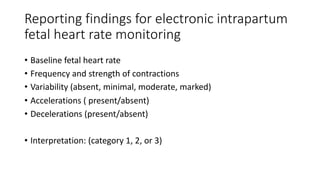
Reporting findings for electronic intrapartum
fetal heart rate monitoring
• Baseline fetal heart rate
• Frequency and strength of contractions
• Variability (absent, minimal, moderate, marked)
• Accelerations ( present/absent)
• Decelerations (present/absent)
• Interpretation: (category 1, 2, or 3)
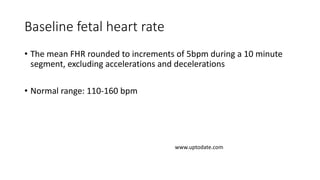
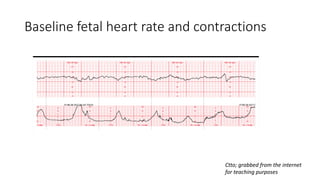
Baseline fetal heart rate
• The mean FHR rounded to increments of 5bpm during a 10 minute
segment, excluding accelerations and decelerations
• Normal range: 110-160 bpm
www.uptodate.com
Baseline fetal heart rate and contractions
Tracing: 3cm/min
Ctto; grabbed from the internet
for teaching purposes
Baseline fetal heart rate and contractions
Ctto; grabbed from the internet
for teaching purposes
Baseline fetal heart rate and contractions
Ctto; grabbed from the internet
for teaching purposes
Baseline fetal heart rate and contractions
Ctto; grabbed from the internet
for teaching purposes
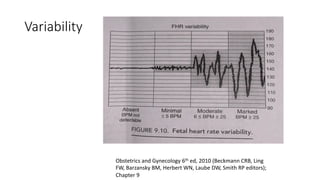
Variability
• Visually quantitated as the amplitude of peak-to-trough in beats per
minute
• Absent: amplitude range undetectable (“almost like a straight line”)
• Minimal: amplitude range detectable but 5bpm or fewer
• Moderate: amplitude range 6-25 bpm
• Marked: amplitude range greater than 25 bpm
www.uptodate.com
Variability
• Moderate baseline variability reflects the oxygenation of the central
nervous system and reliably predicts the absence of damaging
degrees of hypoxia-induced metabolic acidemia at the time it is
observed
• Other conditions potentially associated with minimal or absent
variability include a fetal sleep cycle, arrhythmia, medications,
extreme prematurity, congenital anomalies, or preexisting neurologic
injury.
www.uptodate.com
Variability
Obstetrics and Gynecology 6th ed, 2010 (Beckmann CRB, Ling
FW, Barzansky BM, Herbert WN, Laube DW, Smith RP editors);
Chapter 9
Variability
Ctto; grabbed from the internet
for teaching purposes
Variability
Ctto; grabbed from the internet
for teaching purposes
Acceleration
• Visually apparent increase in the FHR from the baseline
• Duration of acceleration is from the onset of initial change in FHR
from the baseline, to its return to baseline
• Starting at 32 weeks AOG, accelerations should have peak /acme of
15 bpm or more above baseline with duration of at least 15 seconds,
but less than 2 min
• At < 32 weeks AOG, accelerations should have peak /acme of 10 bpm
or more above baseline with duration of at least 10 seconds, but less
than 2 min
Obstetrics and Gynecology 6th ed, 2010 (Beckmann CRB, Ling FW, Barzansky
BM, Herbert WN, Laube DW, Smith RP editors); Chapter 9
Acceleration
• FHR accelerations are frequently associated with fetal movement,
possibly as a result of stimulation of peripheral proprioceptors,
increased catecholamine release, and autonomic stimulation of the
heart.
• As with moderate baseline variability, FHR accelerations reliably
predict the absence of damaging degrees of fetal hypoxia and fetal
metabolic acidemia at the time they are observed
Obstetrics and Gynecology 6th ed, 2010 (Beckmann CRB, Ling FW, Barzansky
BM, Herbert WN, Laube DW, Smith RP editors); Chapter 9
Acceleration
Ctto; grabbed from the internet
for teaching purposes
Accelerations
Ctto; grabbed from the internet
for teaching purposes
Ctto; grabbed from the
internet for teaching
purposes
decelerations
• Visually apparent decrease in FHR from
the baseline
• 3 patterns
• Early decelerations
• Late decelerations
• Variable decelerations
Obstetrics and Gynecology 6th ed, 2010 (Beckmann CRB, Ling FW, Barzansky
BM, Herbert WN, Laube DW, Smith RP editors); Chapter 9
Early deceleration
• likely represents an autonomic response to changes in intracranial
pressure and/or cerebral blood flow caused by intrapartum
compression of the fetal head during a uterine contraction and
maternal expulsive efforts
• Early decelerations are clinically benign: They are not associated with
an interruption of fetal oxygenation, metabolic acidemia, or hypoxic-
ischemic neurologic injury.
www.uptodate.com
Late deceleration
• fetal response to transient hypoxemia during a uterine contraction
• Interruption of the oxygen pathway to the fetus can occur at multiple
maternal levels in addition to uterine contractions, such as the lungs (eg,
maternal hypoxemia), heart (eg, poor cardiac output) or vasculature (eg,
hypotension).
• fetal oxygenation is interrupted sufficiently to result in both severe
hypoxemia and metabolic acidemia and, in turn, direct myocardial
depression and late decelerations
• After the contraction, fetal oxygenation is restored, autonomic reflexes
subside, and the FHR gradually returns to baseline
www.uptodate.com
Late deceleration
• Etiologies of Late Decelerations
• Excessive uterine contractions, maternal hypotension, or
maternal hypoxemia.
• Reduced placental exchange as in hypertensive disorders,
diabetes, IUGR, abruption.
www.uptodate.com
Variable deceleration
• A variable deceleration reflects a fetal autonomic reflex response to
transient mechanical compression of the umbilical cord
• Cord compression with or without other sources of interrupted fetal
oxygenation may result in recurrent variable decelerations with
absent/minimal variability and no accelerations.
Obstetrics and Gynecology 6th ed, 2010 (Beckmann CRB, Ling FW, Barzansky
BM, Herbert WN, Laube DW, Smith RP editors); Chapter 9
Prolonged deceleration
• A prolonged deceleration reflects a fall in FHR by ≥15 bpm, lasting ≥2
but <10 minutes
• It is caused by the same physiologic mechanisms responsible for late
or variable decelerations, but interruption of fetal oxygenation occurs
for a longer period of time.
• If the fall in FHR lasts ≥10 minutes, it is defined as a baseline change
Obstetrics and Gynecology 6th ed, 2010 (Beckmann CRB, Ling FW, Barzansky
BM, Herbert WN, Laube DW, Smith RP editors); Chapter 9
Sinusoidal pattern
• The sinusoidal pattern is a smooth, sine-wave like undulating pattern
in FHR baseline with a cycle frequency of three to five cycles per
minute that persists for at least 20 minutes.
• This pattern is characterized by fluctuations in the FHR baseline that
are regular amplitude and frequency.
• The sinusoidal pattern is associated with severe fetal anemia,
although the pathophysiologic mechanism has not been elucidated.
Obstetrics and Gynecology 6th ed, 2010 (Beckmann CRB, Ling FW, Barzansky
BM, Herbert WN, Laube DW, Smith RP editors); Chapter 9
Obstetrics and Gynecology 6th ed, 2010 (Beckmann CRB, Ling FW, Barzansky
BM, Herbert WN, Laube DW, Smith RP editors); Chapter 9
Late deceleration
Ctto; grabbed from the internet for
teaching purposes
Early decelerations (usually is due to head
compression)
Ctto; grabbed from the internet for
teaching purposes
Late decelerations
Ctto; grabbed from the internet for
teaching purposes
Ctto; grabbed from the internet for
teaching purposes
Variable deceleration
Ctto; grabbed from the internet for
teaching purposes
Interpretation (Category I, II, III)
• Category I FHR pattern
• A category I pattern is normal: it indicates minimal likelihood of significant
metabolic acidemia and ongoing fetal hypoxic injury at that point in time. The
fetal status and FHR pattern may remain stable over time, or the fetal status
may change, resulting in a category II or category III pattern.
• has all of the following components
1. A baseline FHR of 110 to 160 bpm
2. Moderate FHR variability (6 to 25 bpm)
3. Absence of late or variable FHR decelerations
4. Early decelerations may or may not be present
5. Accelerations may or may not be present
www.uptodate.com
Interpretation (Category I, II, III)
• Category III FHR pattern
• A category III pattern is abnormal: it is associated with an increased likelihood of
severe hypoxia and metabolic acidemia at that point in time.
• A category III tracing has at least one of the following components
1. Absent variability with recurrent late decelerations
2. Absent variability with recurrent variable decelerations
3. Absent variability with bradycardia
4. A sinusoidal pattern
• Late decelerations and variable decelerations are considered recurrent
when they occur with at least 50 percent of uterine contractions in a 20-
minute window
• Prompt evaluation, expeditious use of conservative measures to improve
fetal oxygenation, and/or expeditious delivery are indicated when a
category III pattern is observed because fetal/neonatal morbidity or
mortality may occur if the pattern persists.
www.uptodate.com
Interpretation (Category I, II, III)
• Category II FHR pattern
• Category II FHR patterns include all FHR patterns that are not classified as
category I (normal) or category III (abnormal)
• Because category II tracings may remain stable for a prolonged period of time,
have an uncertain prognosis, and are common (observed at some point in 84
percent of tracings, pregnancies with this pattern are the most difficult to
evaluate and manage.
www.uptodate.com
practice
• Baseline FHR: 140-150
• Contractions q 2-3 min,
moderate
• Minimal variability
• No accelerations
• (+) decelerations
• Interpretation:
Category 3
practice
• Baseline fetal heart rate: 130-
140 bpm
• Contractions q2-3min,
moderate
• Moderate variability
• (+) accelerations
• (-) decelerations
• Interpretation: category 1
Thank you!
youtube channel: Ina Irabon
www.wordpress.com: Doc Ina OB Gyne

electonic-fetal-monitoring-sgd.pdf

  • 1.
    BASIC concepts on INTRAPARTUMFETAL HEART RATE MONITORING INA S. IRABON, MD, FPOGS, FPSRM, FPSGE OBSTETRICS AND GYNECOLOGY REPRODUCTIVE ENDOCRINOLOGY AND INFERTILITY
  • 2.
  • 3.
    References • Obstetrics andGynecology 6th ed, 2010 (Beckmann CRB, Ling FW, Barzansky BM, Herbert WN, Laube DW, Smith RP editors); Chapter 9 • American College of Obstetricians and Gynecologists. Fetal Heart Rate patterns: monitoring, interpretation and management. ACOG technical bulletin 207, 1995. • www.uptodate.com • Various pictures take from the internet
  • 4.
    Outline • Electronic fetalmonitoring • Reporting findings for EFM • Baseline fetal heart rate and contractions • Variability • Accelerations • Decelerations • Interpretation
  • 5.
    Intrapartum fetal heartrate monitoring • Modality intended to determine if a fetus is well-oxygenated • RATIONALE: The rationale for intrapartum FHR monitoring is that identification of FHR changes potentially associated with inadequate fetal oxygenation may enable timely intervention to reduce the likelihood of hypoxic injury or death. • 2 methods: intermittent auscultation and continuous electronic fetal heart rate (FHR) monitoring Obstetrics and Gynecology 6th ed, 2010 (Beckmann CRB, Ling FW, Barzansky BM, Herbert WN, Laube DW, Smith RP editors); Chapter 9
  • 6.
    Intrapartum fetal heartrate monitoring Intermittent Continuous stethoscope Fetal doppler
  • 7.
    Continuous Electronic FetalMonitoring (EFM) External Internal
  • 8.
    How often dowe evaluate fetal heart rate? Auscultation Continuous EFM Low risk High risk Low risk High risk Active phase of 1st stage of labor Evaluate and record FHR every 30 minutes, after a contraction Evaluate and record FHR every 15 minutes ,after a contraction Evaluate tracing every 30 minutes Evaluate tracing every 15 minutes Second stage of labor Evaluate and record FHR every 15 min Evaluate and record FHR every 5 min Evaluate tracing every 15 minutes Evaluate tracing every 5 minutes American College of Obstetricians and Gynecologists. Fetal Heart Rate patterns: monitoring, interpretation and management. ACOG technical bulletin 207, 1995.
  • 9.
    Reporting findings forelectronic intrapartum fetal heart rate monitoring • Baseline fetal heart rate • Frequency and strength of contractions • Variability (absent, minimal, moderate, marked) • Accelerations ( present/absent) • Decelerations (present/absent) • Interpretation: (category 1, 2, or 3)
  • 10.
    Baseline fetal heartrate • The mean FHR rounded to increments of 5bpm during a 10 minute segment, excluding accelerations and decelerations • Normal range: 110-160 bpm www.uptodate.com
  • 11.
    Baseline fetal heartrate and contractions Tracing: 3cm/min Ctto; grabbed from the internet for teaching purposes
  • 12.
    Baseline fetal heartrate and contractions Ctto; grabbed from the internet for teaching purposes
  • 13.
    Baseline fetal heartrate and contractions Ctto; grabbed from the internet for teaching purposes
  • 14.
    Baseline fetal heartrate and contractions Ctto; grabbed from the internet for teaching purposes
  • 15.
    Variability • Visually quantitatedas the amplitude of peak-to-trough in beats per minute • Absent: amplitude range undetectable (“almost like a straight line”) • Minimal: amplitude range detectable but 5bpm or fewer • Moderate: amplitude range 6-25 bpm • Marked: amplitude range greater than 25 bpm www.uptodate.com
  • 16.
    Variability • Moderate baselinevariability reflects the oxygenation of the central nervous system and reliably predicts the absence of damaging degrees of hypoxia-induced metabolic acidemia at the time it is observed • Other conditions potentially associated with minimal or absent variability include a fetal sleep cycle, arrhythmia, medications, extreme prematurity, congenital anomalies, or preexisting neurologic injury. www.uptodate.com
  • 17.
    Variability Obstetrics and Gynecology6th ed, 2010 (Beckmann CRB, Ling FW, Barzansky BM, Herbert WN, Laube DW, Smith RP editors); Chapter 9
  • 18.
    Variability Ctto; grabbed fromthe internet for teaching purposes
  • 19.
    Variability Ctto; grabbed fromthe internet for teaching purposes
  • 20.
    Acceleration • Visually apparentincrease in the FHR from the baseline • Duration of acceleration is from the onset of initial change in FHR from the baseline, to its return to baseline • Starting at 32 weeks AOG, accelerations should have peak /acme of 15 bpm or more above baseline with duration of at least 15 seconds, but less than 2 min • At < 32 weeks AOG, accelerations should have peak /acme of 10 bpm or more above baseline with duration of at least 10 seconds, but less than 2 min Obstetrics and Gynecology 6th ed, 2010 (Beckmann CRB, Ling FW, Barzansky BM, Herbert WN, Laube DW, Smith RP editors); Chapter 9
  • 21.
    Acceleration • FHR accelerationsare frequently associated with fetal movement, possibly as a result of stimulation of peripheral proprioceptors, increased catecholamine release, and autonomic stimulation of the heart. • As with moderate baseline variability, FHR accelerations reliably predict the absence of damaging degrees of fetal hypoxia and fetal metabolic acidemia at the time they are observed Obstetrics and Gynecology 6th ed, 2010 (Beckmann CRB, Ling FW, Barzansky BM, Herbert WN, Laube DW, Smith RP editors); Chapter 9
  • 22.
    Acceleration Ctto; grabbed fromthe internet for teaching purposes
  • 23.
    Accelerations Ctto; grabbed fromthe internet for teaching purposes
  • 24.
    Ctto; grabbed fromthe internet for teaching purposes
  • 25.
    decelerations • Visually apparentdecrease in FHR from the baseline • 3 patterns • Early decelerations • Late decelerations • Variable decelerations Obstetrics and Gynecology 6th ed, 2010 (Beckmann CRB, Ling FW, Barzansky BM, Herbert WN, Laube DW, Smith RP editors); Chapter 9
  • 26.
    Early deceleration • likelyrepresents an autonomic response to changes in intracranial pressure and/or cerebral blood flow caused by intrapartum compression of the fetal head during a uterine contraction and maternal expulsive efforts • Early decelerations are clinically benign: They are not associated with an interruption of fetal oxygenation, metabolic acidemia, or hypoxic- ischemic neurologic injury. www.uptodate.com
  • 27.
    Late deceleration • fetalresponse to transient hypoxemia during a uterine contraction • Interruption of the oxygen pathway to the fetus can occur at multiple maternal levels in addition to uterine contractions, such as the lungs (eg, maternal hypoxemia), heart (eg, poor cardiac output) or vasculature (eg, hypotension). • fetal oxygenation is interrupted sufficiently to result in both severe hypoxemia and metabolic acidemia and, in turn, direct myocardial depression and late decelerations • After the contraction, fetal oxygenation is restored, autonomic reflexes subside, and the FHR gradually returns to baseline www.uptodate.com
  • 28.
    Late deceleration • Etiologiesof Late Decelerations • Excessive uterine contractions, maternal hypotension, or maternal hypoxemia. • Reduced placental exchange as in hypertensive disorders, diabetes, IUGR, abruption. www.uptodate.com
  • 29.
    Variable deceleration • Avariable deceleration reflects a fetal autonomic reflex response to transient mechanical compression of the umbilical cord • Cord compression with or without other sources of interrupted fetal oxygenation may result in recurrent variable decelerations with absent/minimal variability and no accelerations. Obstetrics and Gynecology 6th ed, 2010 (Beckmann CRB, Ling FW, Barzansky BM, Herbert WN, Laube DW, Smith RP editors); Chapter 9
  • 30.
    Prolonged deceleration • Aprolonged deceleration reflects a fall in FHR by ≥15 bpm, lasting ≥2 but <10 minutes • It is caused by the same physiologic mechanisms responsible for late or variable decelerations, but interruption of fetal oxygenation occurs for a longer period of time. • If the fall in FHR lasts ≥10 minutes, it is defined as a baseline change Obstetrics and Gynecology 6th ed, 2010 (Beckmann CRB, Ling FW, Barzansky BM, Herbert WN, Laube DW, Smith RP editors); Chapter 9
  • 31.
    Sinusoidal pattern • Thesinusoidal pattern is a smooth, sine-wave like undulating pattern in FHR baseline with a cycle frequency of three to five cycles per minute that persists for at least 20 minutes. • This pattern is characterized by fluctuations in the FHR baseline that are regular amplitude and frequency. • The sinusoidal pattern is associated with severe fetal anemia, although the pathophysiologic mechanism has not been elucidated. Obstetrics and Gynecology 6th ed, 2010 (Beckmann CRB, Ling FW, Barzansky BM, Herbert WN, Laube DW, Smith RP editors); Chapter 9
  • 32.
    Obstetrics and Gynecology6th ed, 2010 (Beckmann CRB, Ling FW, Barzansky BM, Herbert WN, Laube DW, Smith RP editors); Chapter 9
  • 33.
    Late deceleration Ctto; grabbedfrom the internet for teaching purposes
  • 34.
    Early decelerations (usuallyis due to head compression) Ctto; grabbed from the internet for teaching purposes
  • 35.
    Late decelerations Ctto; grabbedfrom the internet for teaching purposes
  • 36.
    Ctto; grabbed fromthe internet for teaching purposes
  • 37.
    Variable deceleration Ctto; grabbedfrom the internet for teaching purposes
  • 38.
    Interpretation (Category I,II, III) • Category I FHR pattern • A category I pattern is normal: it indicates minimal likelihood of significant metabolic acidemia and ongoing fetal hypoxic injury at that point in time. The fetal status and FHR pattern may remain stable over time, or the fetal status may change, resulting in a category II or category III pattern. • has all of the following components 1. A baseline FHR of 110 to 160 bpm 2. Moderate FHR variability (6 to 25 bpm) 3. Absence of late or variable FHR decelerations 4. Early decelerations may or may not be present 5. Accelerations may or may not be present www.uptodate.com
  • 39.
    Interpretation (Category I,II, III) • Category III FHR pattern • A category III pattern is abnormal: it is associated with an increased likelihood of severe hypoxia and metabolic acidemia at that point in time. • A category III tracing has at least one of the following components 1. Absent variability with recurrent late decelerations 2. Absent variability with recurrent variable decelerations 3. Absent variability with bradycardia 4. A sinusoidal pattern • Late decelerations and variable decelerations are considered recurrent when they occur with at least 50 percent of uterine contractions in a 20- minute window • Prompt evaluation, expeditious use of conservative measures to improve fetal oxygenation, and/or expeditious delivery are indicated when a category III pattern is observed because fetal/neonatal morbidity or mortality may occur if the pattern persists. www.uptodate.com
  • 40.
    Interpretation (Category I,II, III) • Category II FHR pattern • Category II FHR patterns include all FHR patterns that are not classified as category I (normal) or category III (abnormal) • Because category II tracings may remain stable for a prolonged period of time, have an uncertain prognosis, and are common (observed at some point in 84 percent of tracings, pregnancies with this pattern are the most difficult to evaluate and manage. www.uptodate.com
  • 41.
    practice • Baseline FHR:140-150 • Contractions q 2-3 min, moderate • Minimal variability • No accelerations • (+) decelerations • Interpretation: Category 3
  • 42.
    practice • Baseline fetalheart rate: 130- 140 bpm • Contractions q2-3min, moderate • Moderate variability • (+) accelerations • (-) decelerations • Interpretation: category 1
  • 43.
    Thank you! youtube channel:Ina Irabon www.wordpress.com: Doc Ina OB Gyne