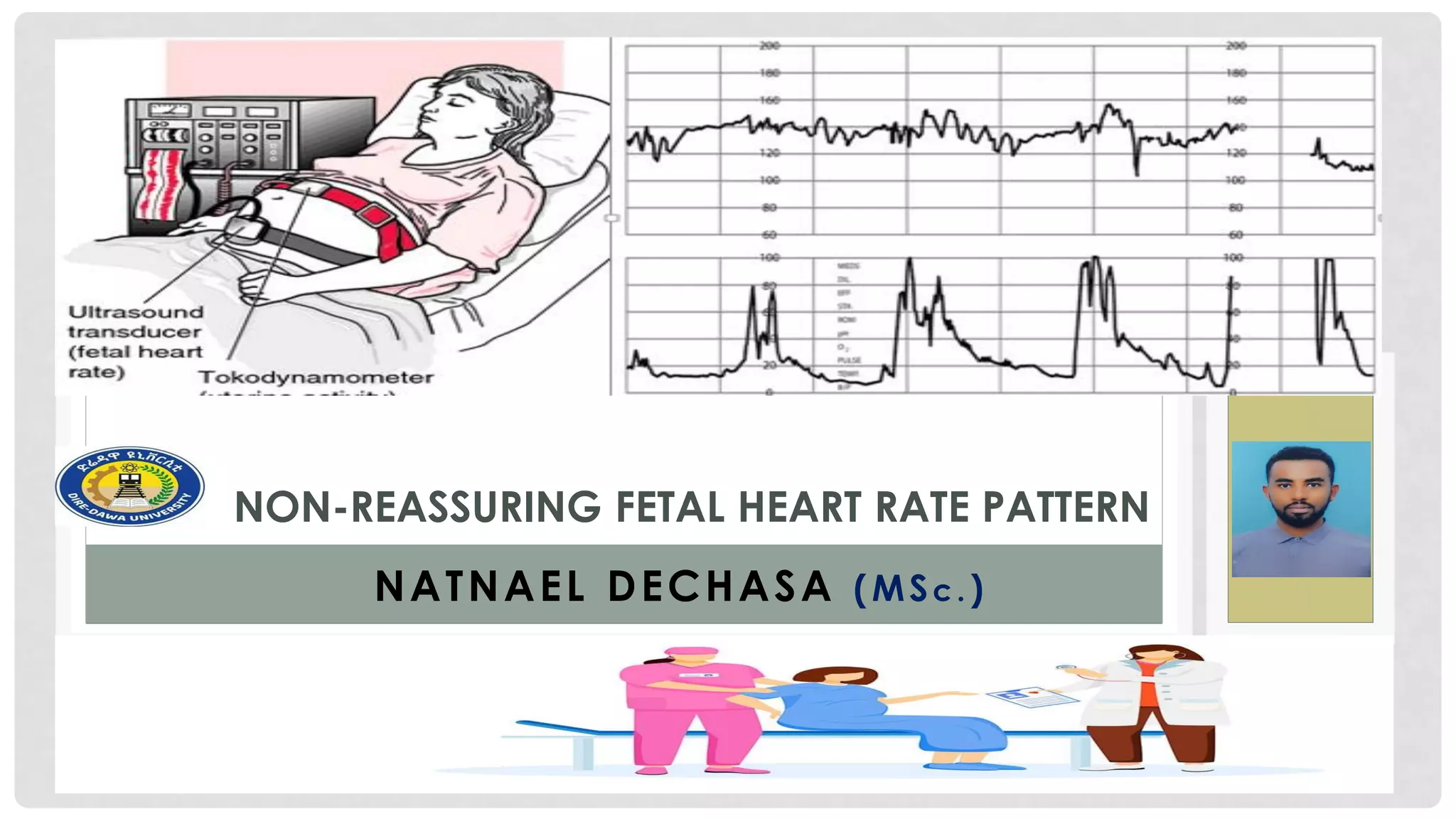
NON-REASSURING FETAL HEART RATE PATTERN
NATNAEL DECHASA (MSc . )
2
 FHR monitoring in real sense is fetal brain monitoring because
fetal brain responds to hypoxia by altering FHR.
 Methods of fetal heart rate monitoring styles .
 Intermittent auscultation
 Fetoscope.
 Doppler US device.
 Continuous electrical FHR monitoring (EFM).
 Cardiotocography (CTG).
FHRM…
3
Intermittent auscultation
Advantages
 widely available, easy inexpensive.
 Effective if done in consistent manner at appropriate
interval for the stage of labor.
Limitation
 Sometimes difficult in obesity & polyhydramnios .
 Can’t detect early fetal heart beat abnormality.
FHRM…
4
Advantages of EFM over clinical monitoring.
 Can detect hypoxia early and can explain the mechanism of
hypoxia and its specific treatment.
 It is an important record for medico legal purpose.
FHRM…
5
Drawbacks:
 Due to error of interpretation C/S rate may be high.
 Instruments are expensive and trained personnel are required to
interpret a trace.
 Mother has to be confined in bed.
FHRM…
6
Indications for electronic fetal monitoring
 Previous history of stillbirth.
 Induction of Labor.
 Preterm labor.
 Non- reassuring fetal status; decreased fetal mov’t
 Meconium staining of amniotic fluid.
FHRM…
7
Full description of a FHR tracings.
FHRM…
8
Base line rate.
 Average fetal heart rate of a ten minutes recording.
 Draw a horizontal line by excluding acceleration and deceleration.
 Normal = 120 to 160 bpm
 Bradycardia <120 bpm
 Tachycardia >160 bpm
FHRM…
Periodic changes…
Acceleration
 An abrupt increase in the FHR above the baseline. Before 32
weeks of gestation, accelerations should last 10 sec and peak 10
bpm above baseline.
 After of 32 weeks gestation, accelerations should last 15 sec and
peak 15 bpm above baseline.
 A prolonged acceleration is lasting 2 minutes above the base
line but less than 10 minutes.
 An acceleration of 10 minutes or more is considered a change in
baseline.
9
Periodic changes…
10
Periodic changes…
Periodic changes…
 Except those associated with variable deceleration, accelerations are
physiologic response to fetal movement.
 Presence of acceleration –reassuring.
 Absence of acceleration-fetus is not moving (doesn’t necessarily mean
hypoxia).
11
Periodic changes…
Deceleration; Four principal type based on timing, relationships to
contractions, duration and shape.
Early deceleration
 Gradual decrease in FHR and return to base line associated with
a uterine contraction.
 The onset, nadir and recovery of decelerations are coincident
with the beginning , peak and ending of contraction
respectively.
 Caused by compression of fetal head by the uterine cervix (it
stimulates vagal nerve).
 Not associated with fetal hypoxia, acidemia or low APGAR
scores.
12
Periodic changes…
Late deceleration
 Gradual decrease and return to baseline FHR associated with
uterine contraction.
 The onset of deceleration occur at or after the pick of uterine
contraction and returning to baseline only after the
contraction has ended.
Causes
• Excessive Ux contraction (oxytocin).
• Feto-placental insufficiency .
• Maternal hypotension (epidural ).
13
Periodic changes…
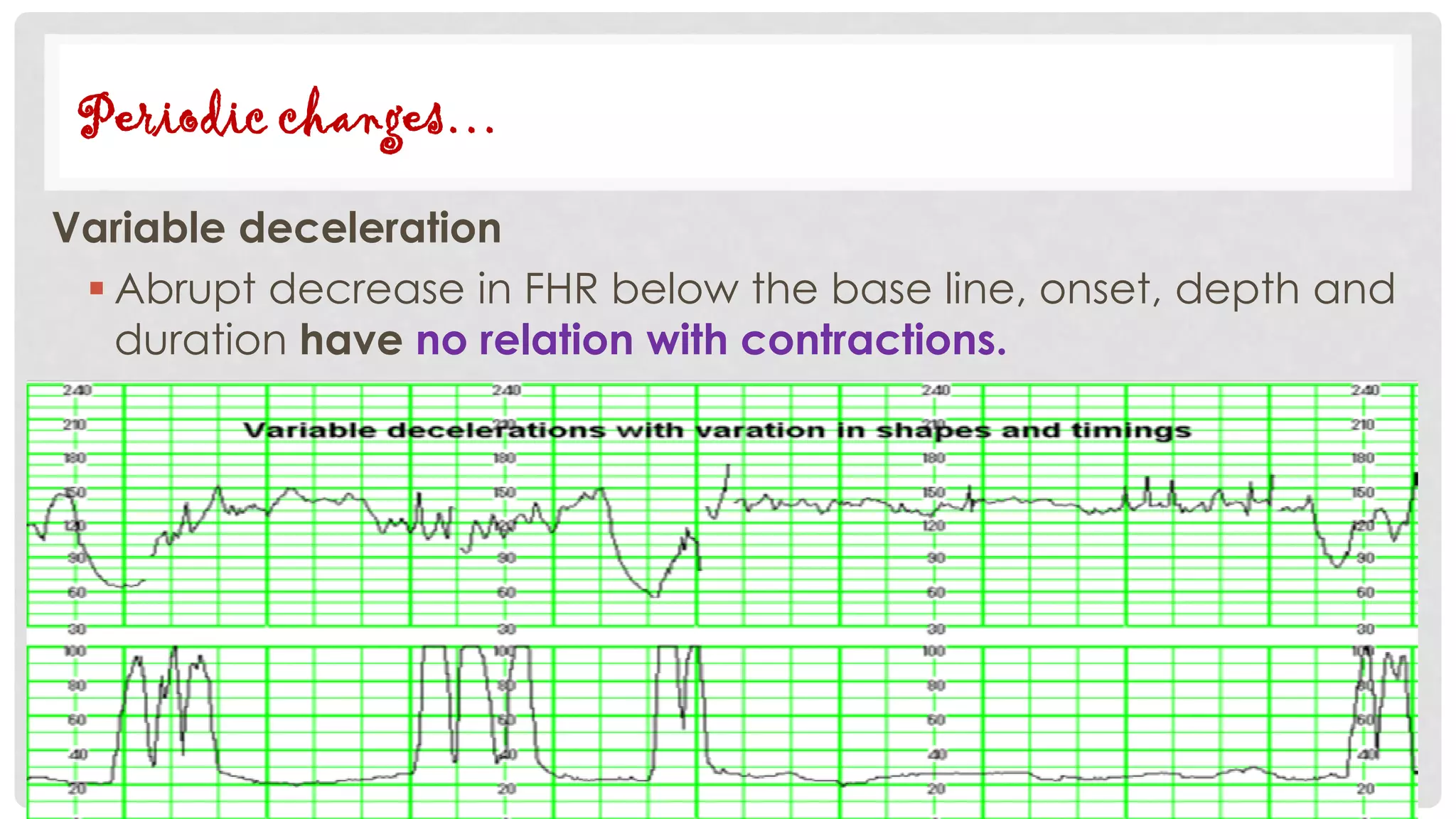
Variable deceleration
 Abrupt decrease in FHR below the base line, onset, depth and
duration have no relation with contractions.
14
Periodic changes…
Causes of variable deceleration.
*Cord compression/occlusion/.*
 Oligohydramnios
 Nuchal cord/cord stretching.
 Cord prolapse/ compression.
15
Periodic changes…
16
Periodic changes…
• Prolonged deceleration
 Decrease in FHR below the baseline ≥15bpm, lasting ≥2min
but <10min from the onset to return to baseline.
 May be caused by any of the mechanisms mentioned so far,
but are of a profound and sustained nature.
17
Periodic changes…
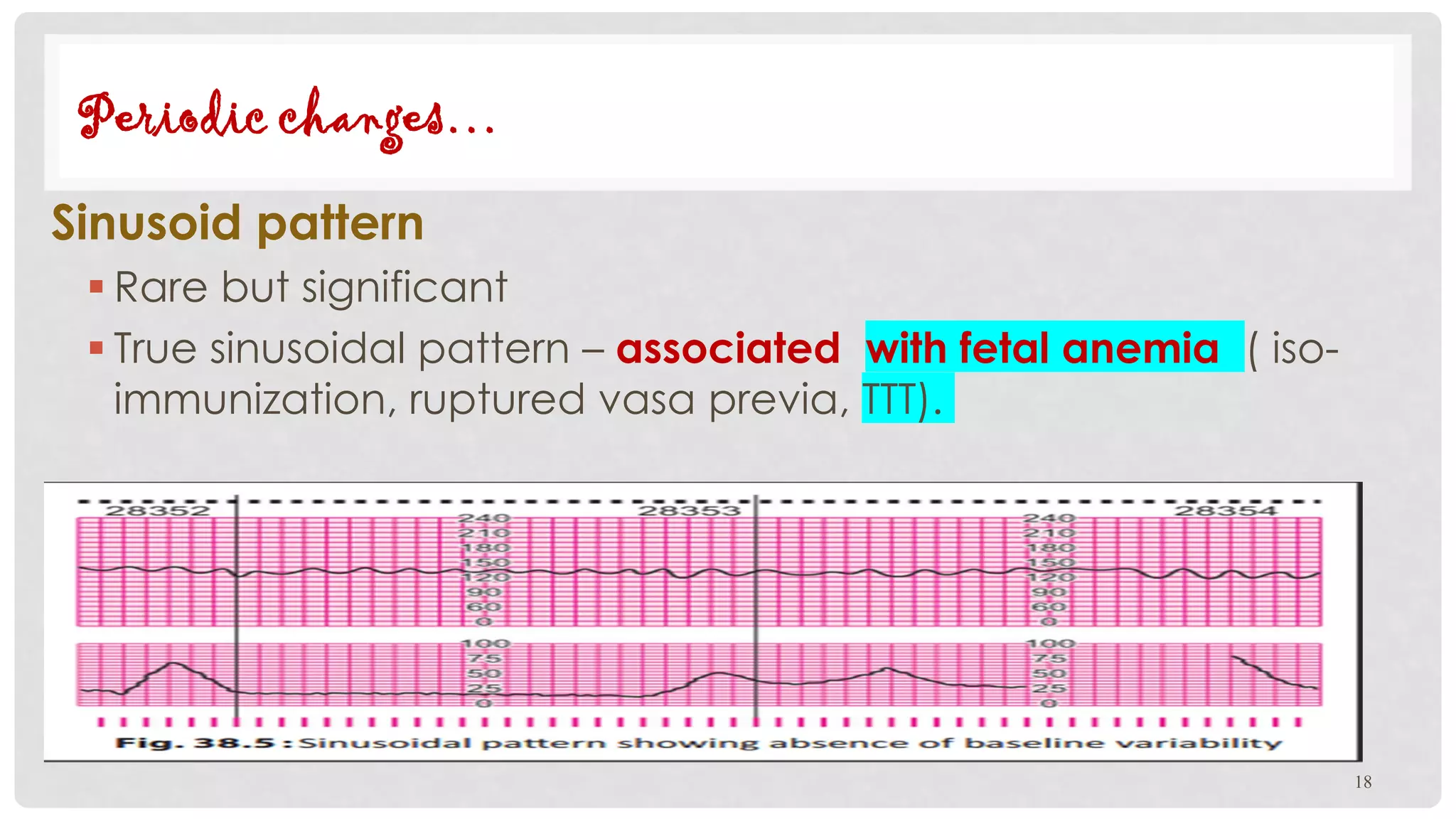
Sinusoid pattern
 Rare but significant
 True sinusoidal pattern – associated with fetal anemia ( iso-
immunization, ruptured vasa previa, TTT).
18
Periodic changes…
Sinusoid pattern…
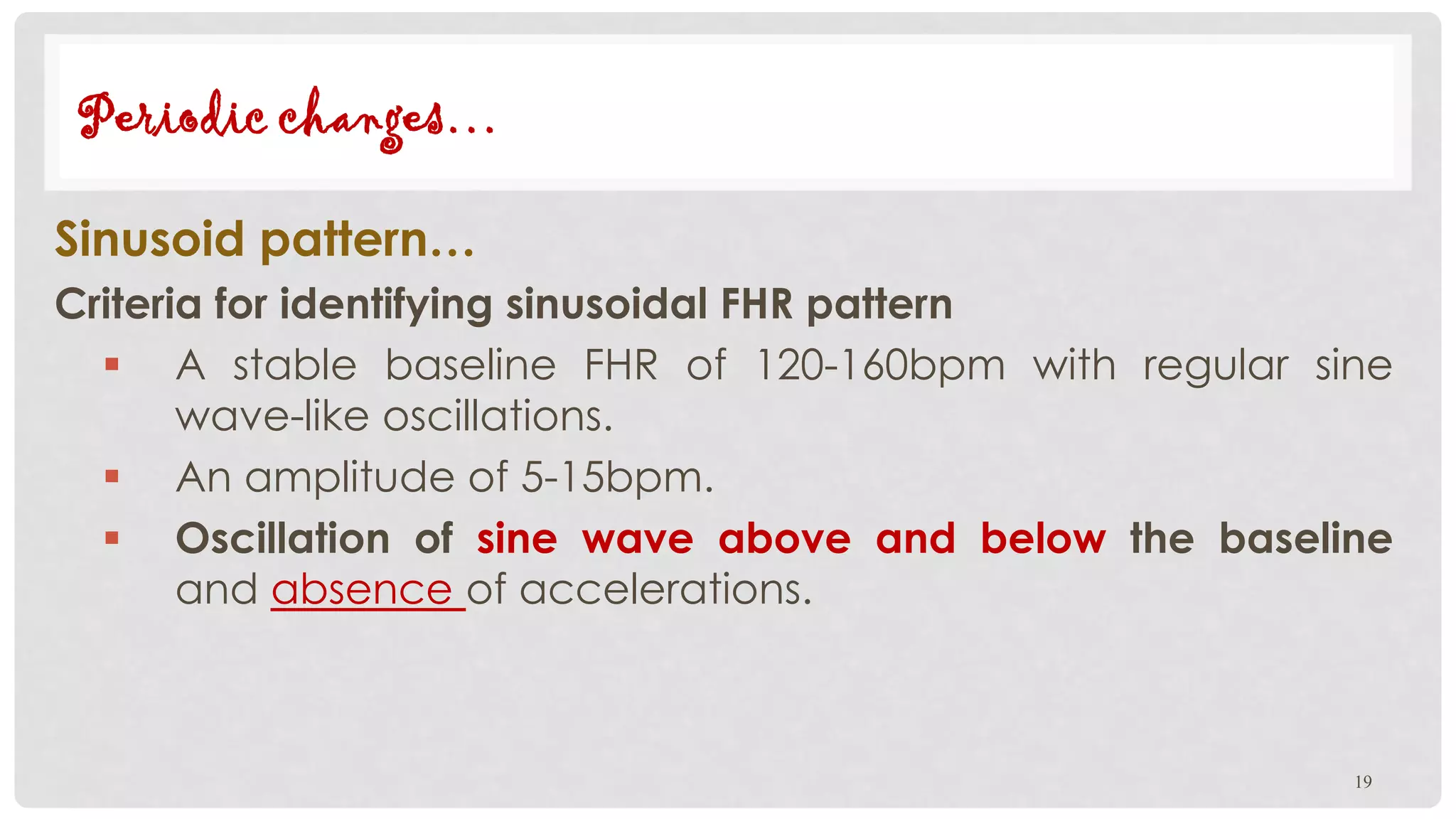
Criteria for identifying sinusoidal FHR pattern
 A stable baseline FHR of 120-160bpm with regular sine
wave-like oscillations.
 An amplitude of 5-15bpm.
 Oscillation of sine wave above and below the baseline
and absence of accelerations.
19
Periodic changes…
Sinusoid pattern…
20
Periodic changes…
Interpretation of FHR patterns
 The FHR pattern recorded by an electronic FHR monitor is typically
interpreted as Reassuring FHRP or Non reassuring FHRP.
Reassuring fetal heart rate pattern includes
 A baseline fetal heart rate of 120 to 160 bpm.
 Absence of late or variable FHR decelerations .
 Moderate FHR variability (6 to 25 bpm).
 Early decelerations may or may not be present.
21
Periodic changes…
Interpretation of FHR patterns…
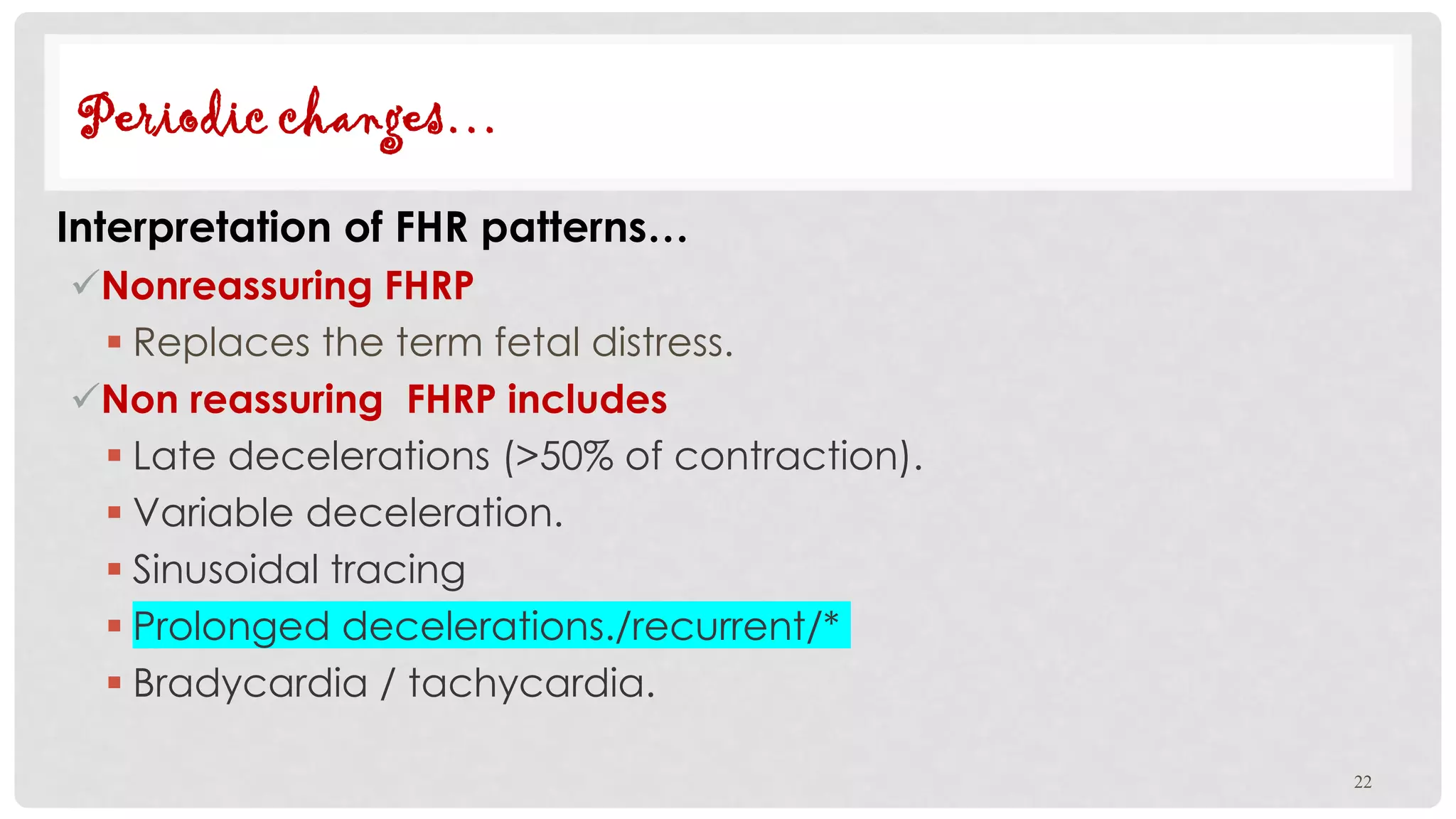
Nonreassuring FHRP
 Replaces the term fetal distress.
Non reassuring FHRP includes
 Late decelerations (>50% of contraction).
 Variable deceleration.
 Sinusoidal tracing
 Prolonged decelerations./recurrent/*
 Bradycardia / tachycardia.
22
Periodic changes…
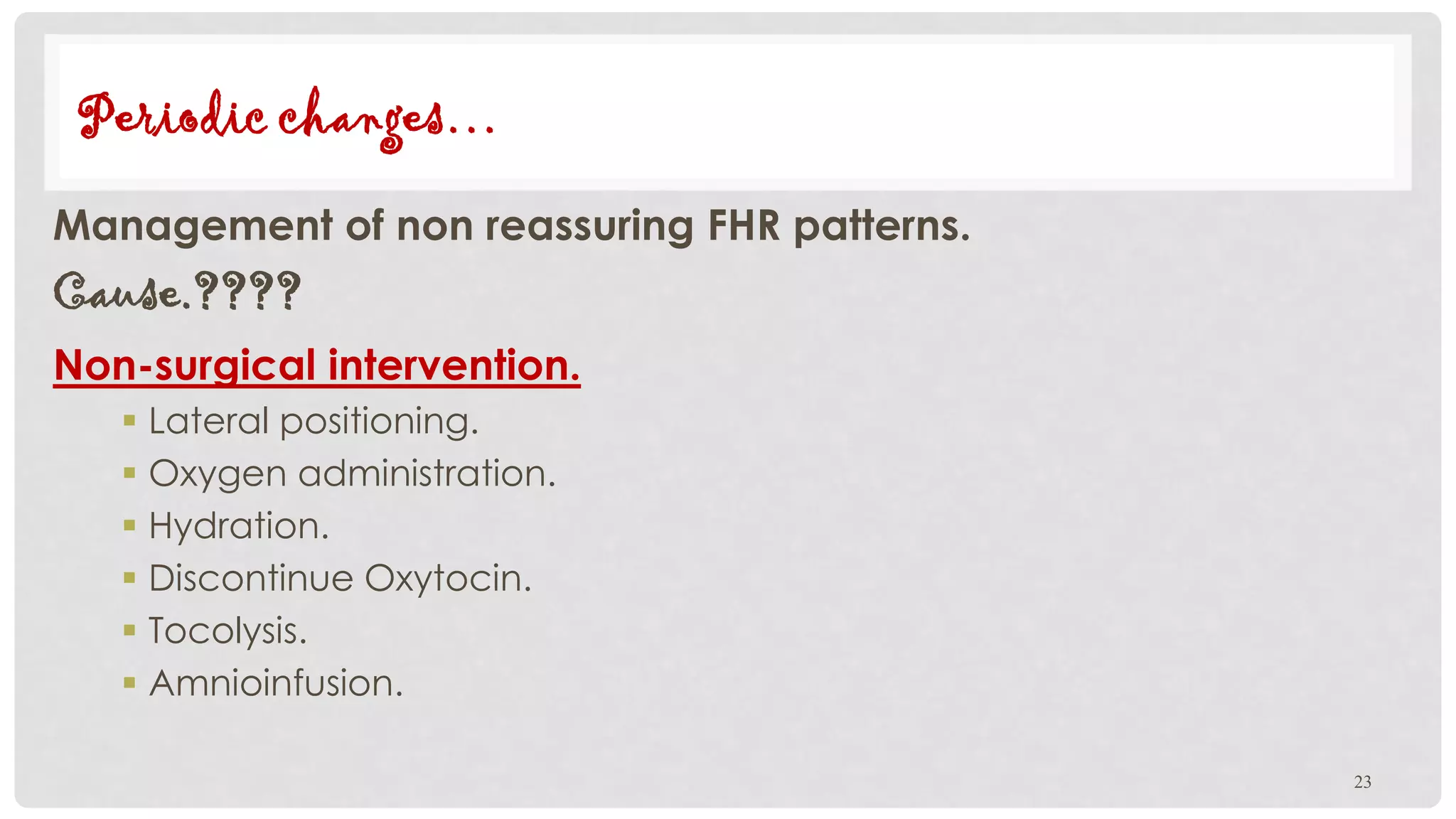
Management of non reassuring FHR patterns.
Cause.????
Non-surgical intervention.
 Lateral positioning.
 Oxygen administration.
 Hydration.
 Discontinue Oxytocin.
 Tocolysis.
 Amnioinfusion.
23
Periodic changes…
S
THANK YOU
Nhati Dream

NRFHRP [ Natnael Dechasa ] PPT.pdf

  • 1.
    NON-REASSURING FETAL HEARTRATE PATTERN NATNAEL DECHASA (MSc . )
  • 2.
    2  FHR monitoringin real sense is fetal brain monitoring because fetal brain responds to hypoxia by altering FHR.  Methods of fetal heart rate monitoring styles .  Intermittent auscultation  Fetoscope.  Doppler US device.  Continuous electrical FHR monitoring (EFM).  Cardiotocography (CTG). FHRM…
  • 3.
    3 Intermittent auscultation Advantages  widelyavailable, easy inexpensive.  Effective if done in consistent manner at appropriate interval for the stage of labor. Limitation  Sometimes difficult in obesity & polyhydramnios .  Can’t detect early fetal heart beat abnormality. FHRM…
  • 4.
    4 Advantages of EFMover clinical monitoring.  Can detect hypoxia early and can explain the mechanism of hypoxia and its specific treatment.  It is an important record for medico legal purpose. FHRM…
  • 5.
    5 Drawbacks:  Due toerror of interpretation C/S rate may be high.  Instruments are expensive and trained personnel are required to interpret a trace.  Mother has to be confined in bed. FHRM…
  • 6.
    6 Indications for electronicfetal monitoring  Previous history of stillbirth.  Induction of Labor.  Preterm labor.  Non- reassuring fetal status; decreased fetal mov’t  Meconium staining of amniotic fluid. FHRM…
  • 7.
    7 Full description ofa FHR tracings. FHRM…
  • 8.
    8 Base line rate. Average fetal heart rate of a ten minutes recording.  Draw a horizontal line by excluding acceleration and deceleration.  Normal = 120 to 160 bpm  Bradycardia <120 bpm  Tachycardia >160 bpm FHRM…
  • 9.
    Periodic changes… Acceleration  Anabrupt increase in the FHR above the baseline. Before 32 weeks of gestation, accelerations should last 10 sec and peak 10 bpm above baseline.  After of 32 weeks gestation, accelerations should last 15 sec and peak 15 bpm above baseline.  A prolonged acceleration is lasting 2 minutes above the base line but less than 10 minutes.  An acceleration of 10 minutes or more is considered a change in baseline. 9 Periodic changes…
  • 10.
  • 11.
    Periodic changes…  Exceptthose associated with variable deceleration, accelerations are physiologic response to fetal movement.  Presence of acceleration –reassuring.  Absence of acceleration-fetus is not moving (doesn’t necessarily mean hypoxia). 11 Periodic changes…
  • 12.
    Deceleration; Four principaltype based on timing, relationships to contractions, duration and shape. Early deceleration  Gradual decrease in FHR and return to base line associated with a uterine contraction.  The onset, nadir and recovery of decelerations are coincident with the beginning , peak and ending of contraction respectively.  Caused by compression of fetal head by the uterine cervix (it stimulates vagal nerve).  Not associated with fetal hypoxia, acidemia or low APGAR scores. 12 Periodic changes…
  • 13.
    Late deceleration  Gradualdecrease and return to baseline FHR associated with uterine contraction.  The onset of deceleration occur at or after the pick of uterine contraction and returning to baseline only after the contraction has ended. Causes • Excessive Ux contraction (oxytocin). • Feto-placental insufficiency . • Maternal hypotension (epidural ). 13 Periodic changes…
  • 14.
    Variable deceleration  Abruptdecrease in FHR below the base line, onset, depth and duration have no relation with contractions. 14 Periodic changes…
  • 15.
    Causes of variabledeceleration. *Cord compression/occlusion/.*  Oligohydramnios  Nuchal cord/cord stretching.  Cord prolapse/ compression. 15 Periodic changes…
  • 16.
  • 17.
    • Prolonged deceleration Decrease in FHR below the baseline ≥15bpm, lasting ≥2min but <10min from the onset to return to baseline.  May be caused by any of the mechanisms mentioned so far, but are of a profound and sustained nature. 17 Periodic changes…
  • 18.
    Sinusoid pattern  Rarebut significant  True sinusoidal pattern – associated with fetal anemia ( iso- immunization, ruptured vasa previa, TTT). 18 Periodic changes…
  • 19.
    Sinusoid pattern… Criteria foridentifying sinusoidal FHR pattern  A stable baseline FHR of 120-160bpm with regular sine wave-like oscillations.  An amplitude of 5-15bpm.  Oscillation of sine wave above and below the baseline and absence of accelerations. 19 Periodic changes…
  • 20.
  • 21.
    Interpretation of FHRpatterns  The FHR pattern recorded by an electronic FHR monitor is typically interpreted as Reassuring FHRP or Non reassuring FHRP. Reassuring fetal heart rate pattern includes  A baseline fetal heart rate of 120 to 160 bpm.  Absence of late or variable FHR decelerations .  Moderate FHR variability (6 to 25 bpm).  Early decelerations may or may not be present. 21 Periodic changes…
  • 22.
    Interpretation of FHRpatterns… Nonreassuring FHRP  Replaces the term fetal distress. Non reassuring FHRP includes  Late decelerations (>50% of contraction).  Variable deceleration.  Sinusoidal tracing  Prolonged decelerations./recurrent/*  Bradycardia / tachycardia. 22 Periodic changes…
  • 23.
    Management of nonreassuring FHR patterns. Cause.???? Non-surgical intervention.  Lateral positioning.  Oxygen administration.  Hydration.  Discontinue Oxytocin.  Tocolysis.  Amnioinfusion. 23 Periodic changes…
  • 24.