Fetal
Cardiotocograph
(CTG)
By:-
Jwan Ali Ahmed AlSofi
objectives
! By the end of this session every
participant will know the principles
required for clinical interpretation of CTG.
How to Read a CTG |
CTG Interpretation |
CTG
•Ctg is done at maturation of sympathetic and
parasympathetic
•Which starts at 28 wk and fully mature at 34 wk
•So we can do ctg from 28 wks
Fetal distress = fetal compromise = fetal hypoxia
• Each
box horizontally on
CTG = 10 seconds,
meaning each
6 boxes = 1 minute.
• Each
box vertically on CT
G = 10 bpm.
Criteria for normal CTG trace:-
Baseline fetal heart rate (FHR) is between
110-160 bpm
Variability of FHR is between 5-25 bpm
Decelerations are absent or early
Accelerations x2 within 20 minutes.
Decreased fetal movement
• Is an indication for doing CTG to reassure
the mother.
• Two or more accelerations with or
without fetal movement within 20
minute is reassuring.
Baseline fetal heart rate
• Normal rate = 110 - 160
• Bradycardia = < 110
• 100-110 is acceptable if all other features
are normal specially in second stage.
• Tachycardia = >160
• 150 -160 is acceptable if the trace is
otherwise normal.
Baseline tachycardia
Causes of baseline tachycardia:-
1. maternal fever,dehydration,
2. Hypotension drugs (atropin, terbutalin )
3. Congenital fetal tachycardia.
4. Chorioamnionitis induce fetal tachycardia before
maternal fever.
5. Fetal compromise (tachycardia with
decelerations ).
Causes of baseline bradycardia
1. Fetal congenital heart block.
2. Serious fetal compromise.
• Early fetal distress  fetal tachycardia
• Late fetal distress  fetal bradycardia
Baseline variability
• Normally the autonomic nervous system (sympathetic and
parasympathetic ) induce beat to beat oscillation of the baseline heart
rate ,resulting in waviness of the baseline.
• FHR variability is the result of integrated activity between the sympathetic
and parasympathetic branches of the autonomic nervous system.
• Moderate baseline variability reflects adequate oxygenation of the CNS
and reliably predicts the absence of damaging degrees of hypoxia-induced
metabolic acidemia at the time it is observed.
• However, the converse is not true: Minimal or absent variability alone is a
poor predictor of fetal metabolic acidemia or hypoxic injury at the time it is
observed
Normal variability= 5-25 beatminute
Causes of decreased baseline variability
• Fetal sleeping period.
• Drugs:-( narcotics ,tranquilizers ,MgSO4 )
• Fetal compromise (with decelerations)
• Extremely preterm fetus,
• Fetal cardiac anomaly,
• Preexisting fetal neurologic injury
Periodic fetal heart
changes
Accelerations:
• Acceleration is :
o an increase in the baseline rate of ≥ 15
Bpm,
o lasting for ≥ 15 second,
o resulting in abrupt increase
o reaching the peak in less than 30 seconds.
• Accelerations are good sign of fetal health.
• Two or more accelerations on a (20
minute) CTG defines a reactive trace.
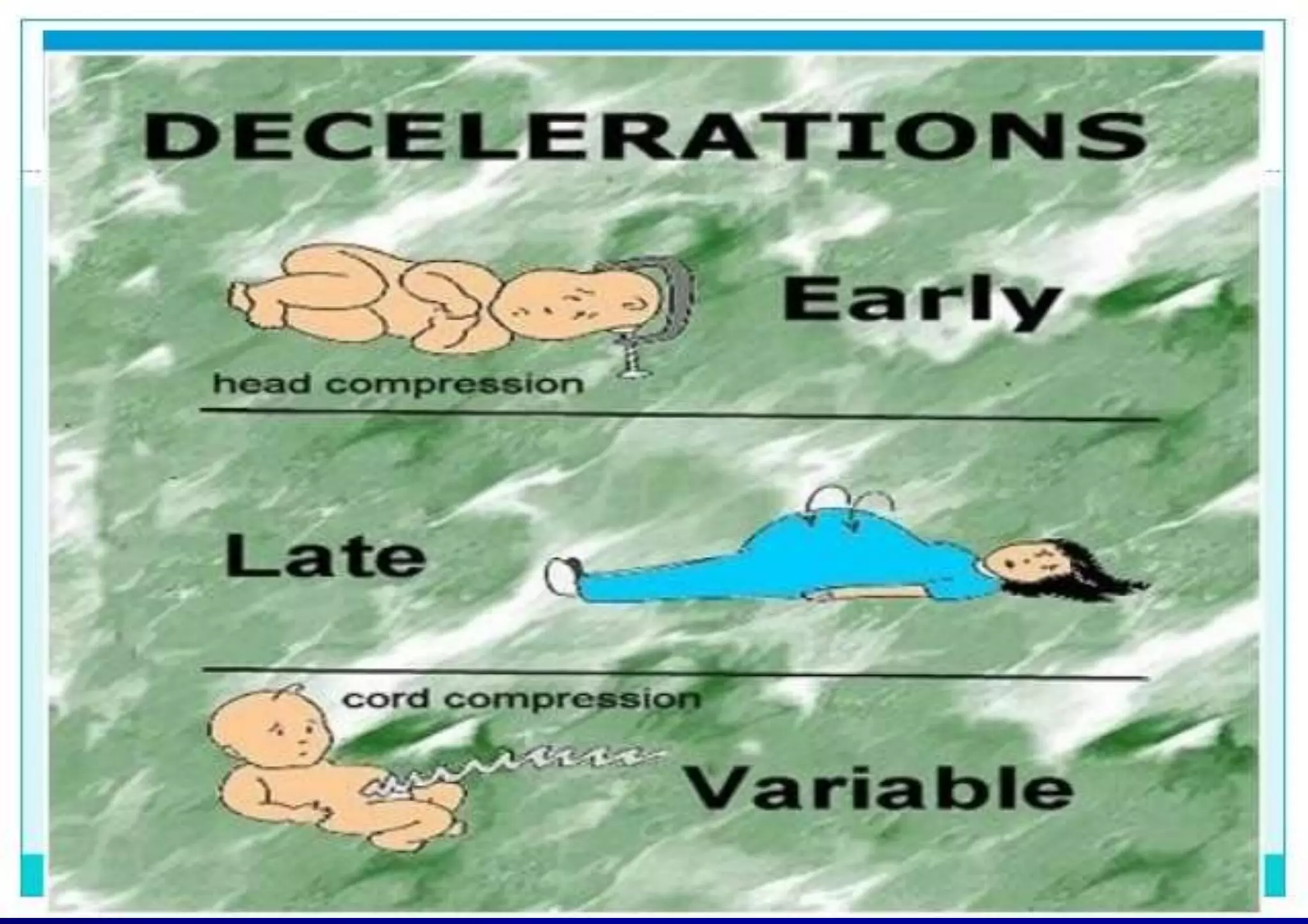
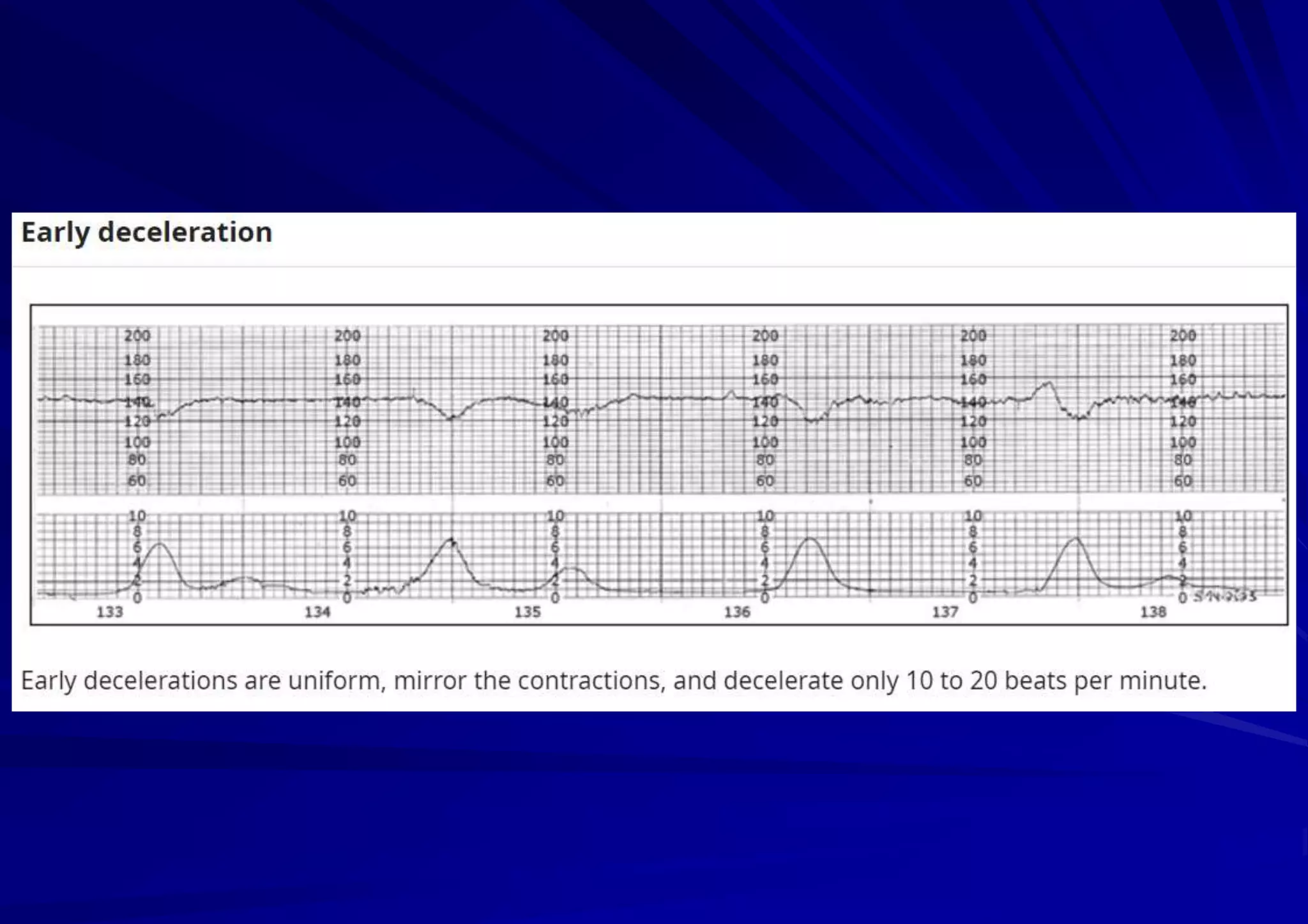
Early decelerations
• Is:- A gradual decrease of the FHR and return to
baseline (≥15 bpm, lasting ≥15 secs below
baseline) associated with a uterine contraction..
• The onset and recovery coincide with the onset
and recovery of the contraction.
• The deceleration's onset, nadir, and termination are usually coincident
with the onset, peak, and termination of the contraction.
• Early decelerations are clinically benign.
• Are due to head compression causing Vagal
nerve stimulation
Late decelerations
• Is:- A gradual decrease of the FHR and return to baseline
(≥15 bpm, lasting ≥15 secs below baseline) associated with a
uterine contraction.
• The deceleration is delayed in timing, with the nadir of the
deceleration occurring after the peak of the contraction. The
onset, nadir, and recovery usually occur after the onset, peak,
and termination of a contraction.
• Begin at or after the peak of the contraction and return to
baseline after the contraction has ended.
• Causes:-
1. maternal hypotension
2. uterine over stimulation.
3. fetal hypoxia.
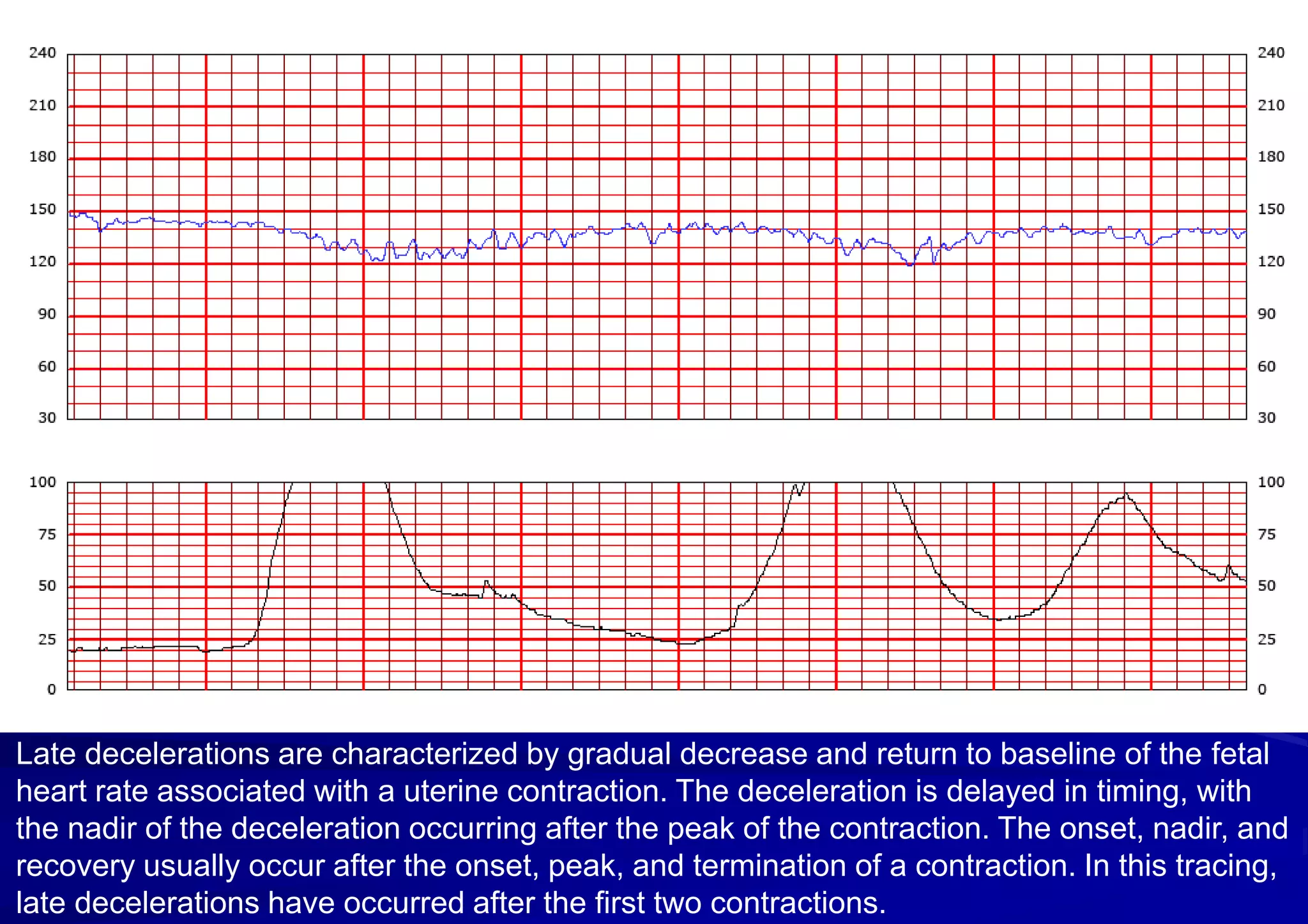
Late decelerations are characterized by gradual decrease and return to baseline of the fetal
heart rate associated with a uterine contraction. The deceleration is delayed in timing, with
the nadir of the deceleration occurring after the peak of the contraction. The onset, nadir, and
recovery usually occur after the onset, peak, and termination of a contraction. In this tracing,
late decelerations have occurred after the first two contractions.
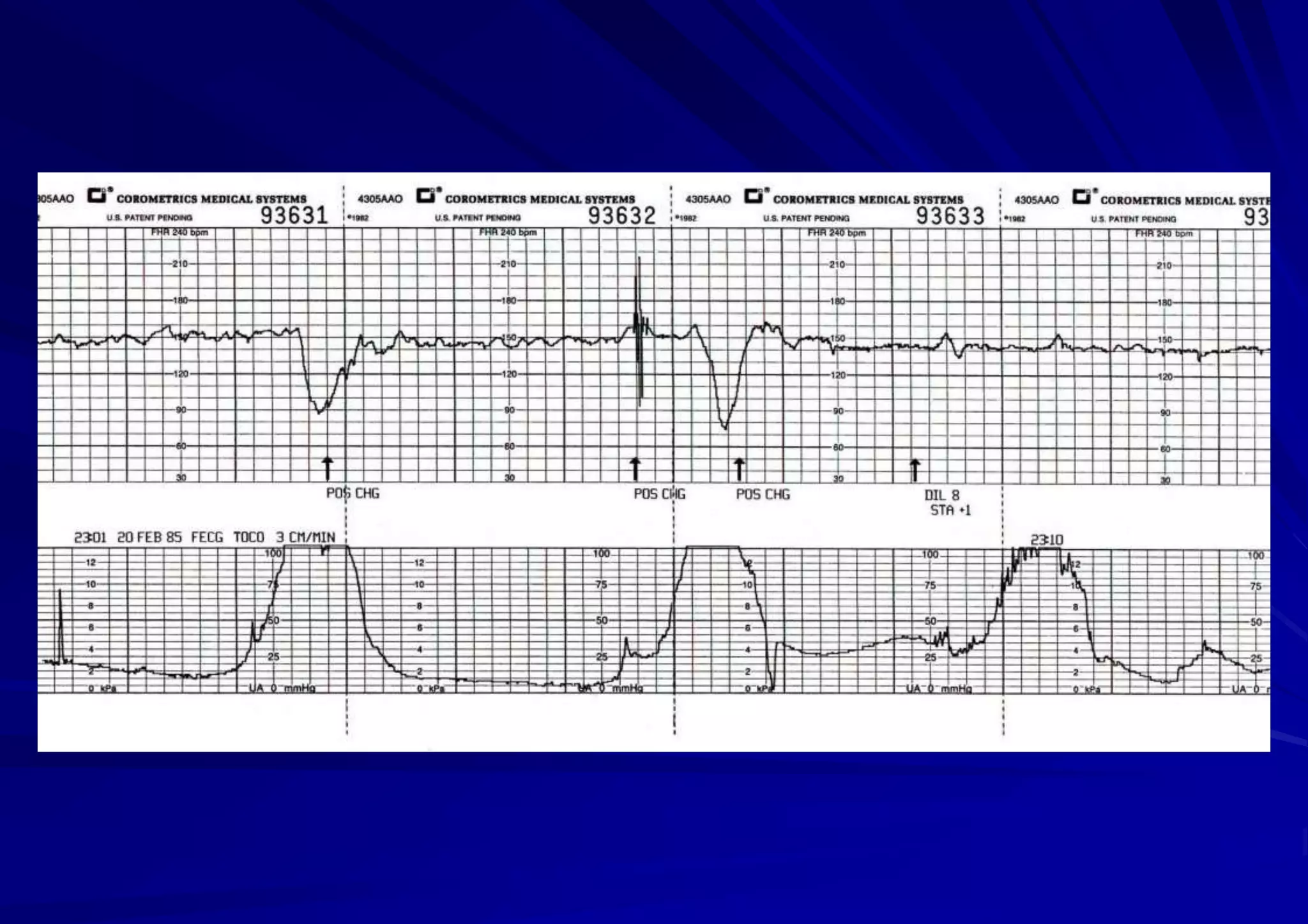
Variable decelerations
• Are the most common deceleration during labor.
• Consist of abrupt decrease in baseline rate lasting less
than 2 minute.
• The decrease is ≥15 bpm, lasting ≥15 secs and <2 minutes
from onset to return to baseline.
• The onset of deceleration varies with successive
contractions.
• The onset, depth, and duration of variable decelerations commonly vary
with successive uterine contractions.
• Are Significant (if decreasing to less than 70 beat per
minute and lasting more than one minute.
• Are due to cord compression.
Prolonged deceleration
A prolonged deceleration reflects a fall in
FHR by ≥15 bpm, lasting ≥2 but <10 minutes
It is caused by the same physiologic
mechanisms responsible for late or variable
decelerations, but interruption of fetal
oxygenation occurs for a longer period of
time.
Sinusoidal pattern
It is defined as a smooth, sine wave-like
undulating pattern in FHR baseline with
– a cycle frequency of 2-5 cycles per minute
– of regular amplitude of 5 -15 bpm
– that persists for at least 20 minutes
– Baseline variability is absent
– there are no accelerations.
It is typically reflective of severe fetal anaemia
TEST YOURSELF
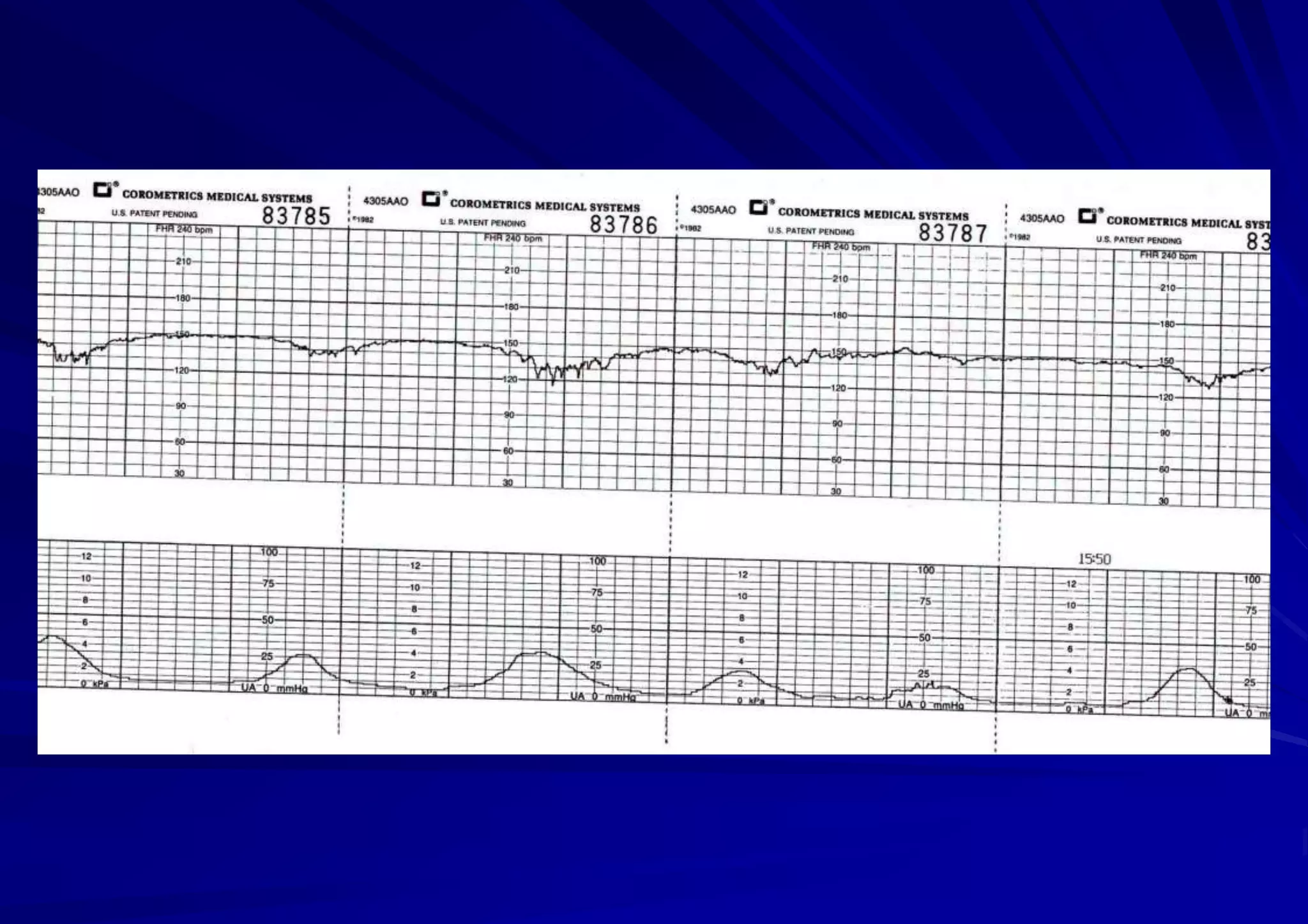
In previous slide:-
Baseline:140-145.
variability: Average
periodic change: mild variable
decelerations and accelerations.
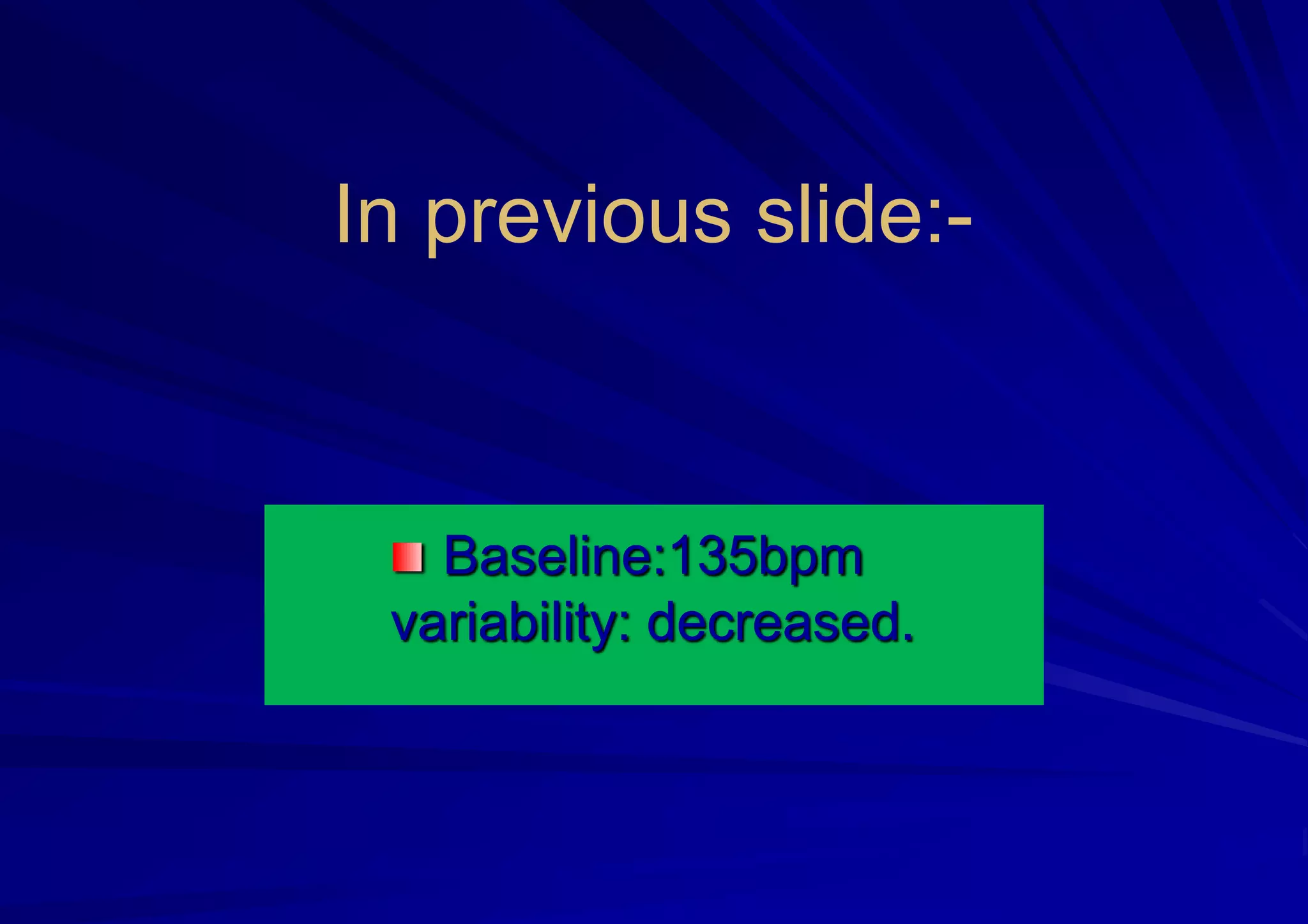
In previous slide:-
Baseline:135bpm
variability: decreased.
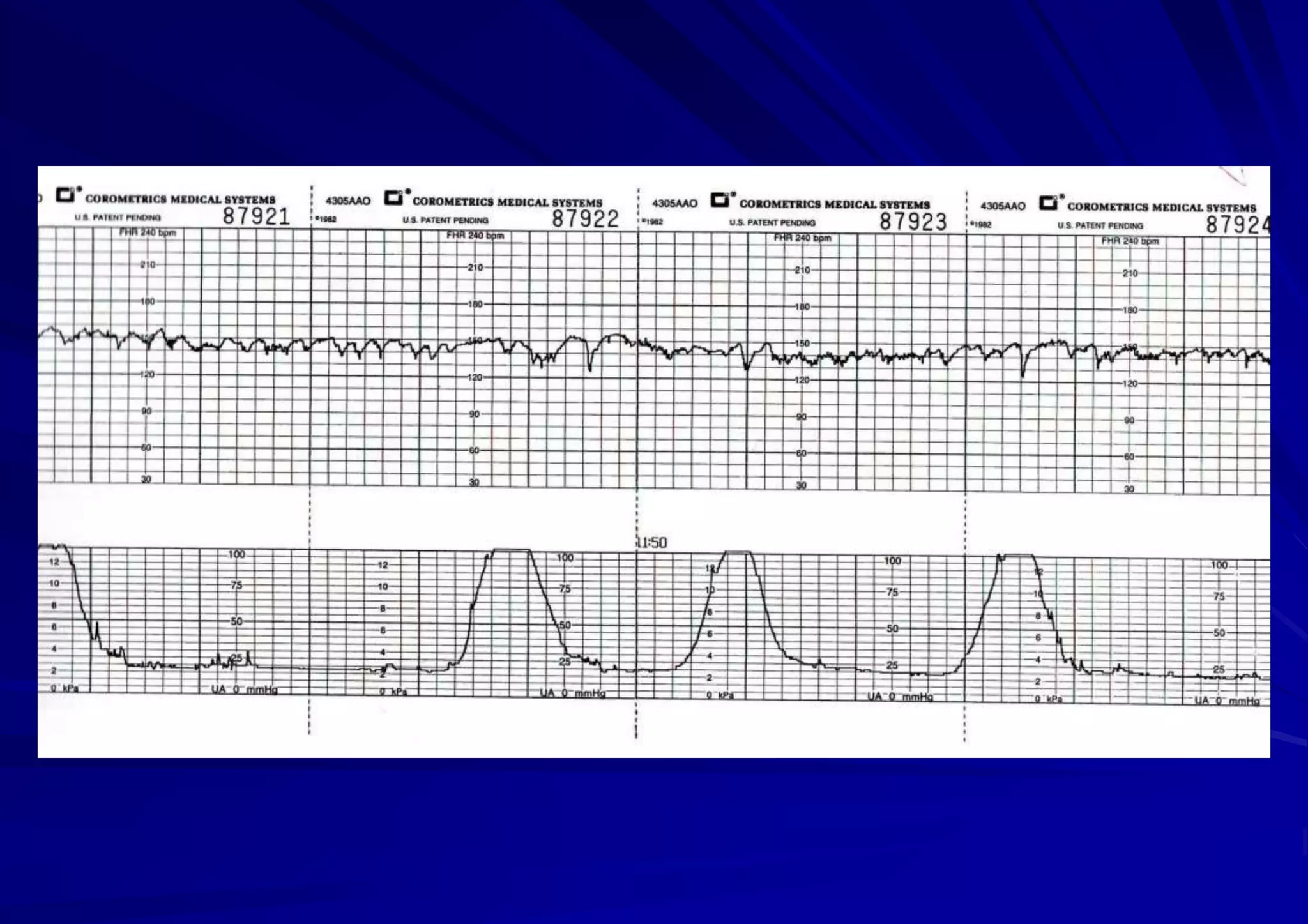
In previous slide:-
1-Baseline:140-145bpm
2 -variability: average
3- periodic change :absent
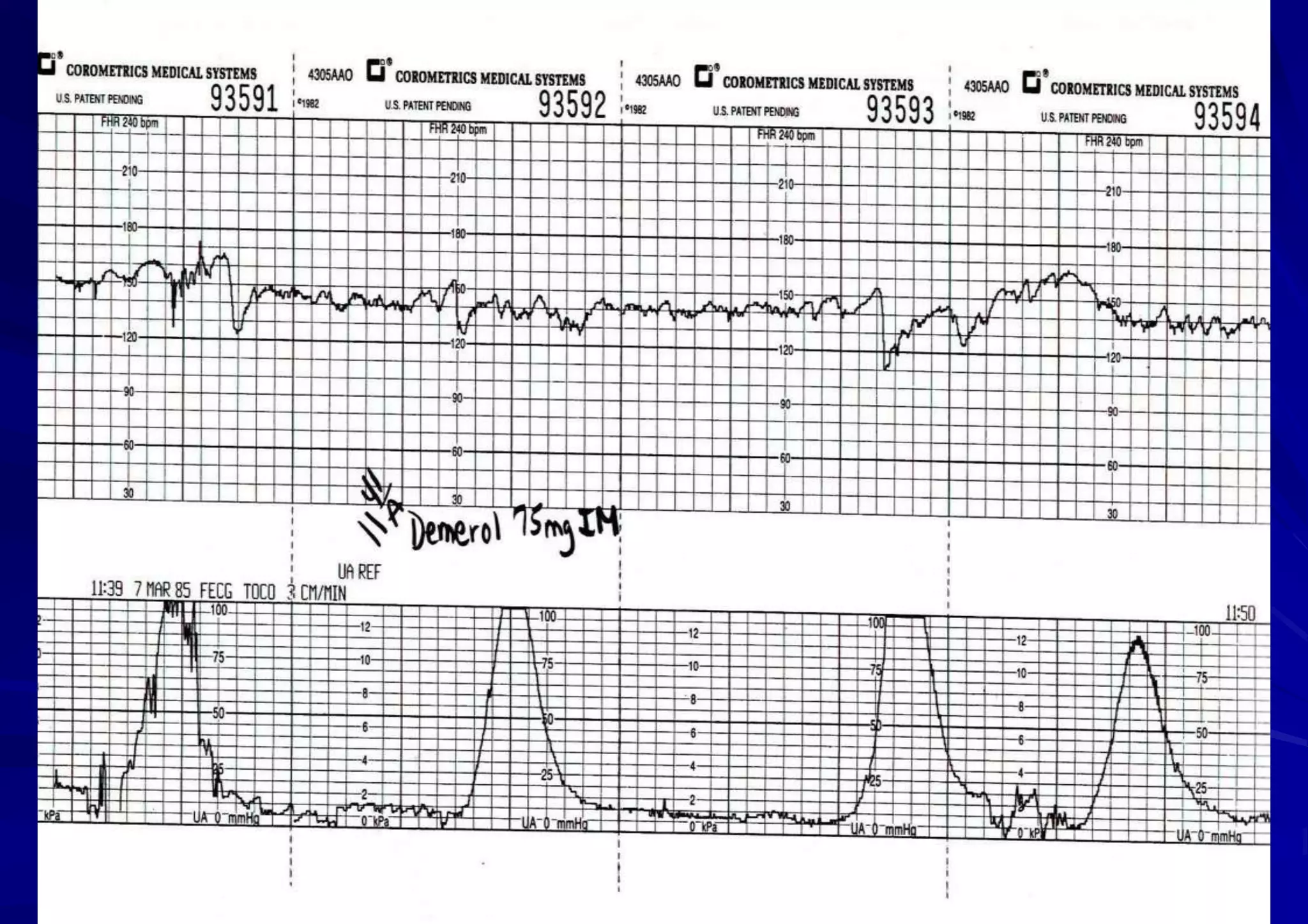
In previous slide:
baseline :120-135
variability :average
periodic changes: accelerations
In previous slide :-
Baseline: 150bpm
Variability :decreased.
Periodic change: early decelerations
In previous slide:-
Baseline:165bpm
Variability : decreased.
Periodic changes :late decelerations.
In previous slide :
Baseline:140-150
Variability: average
Periodic changes: variable
decelerations.
Thanks

Fetal Cardiotocograph (CTG).pptx

  • 1.
  • 2.
    objectives ! By theend of this session every participant will know the principles required for clinical interpretation of CTG.
  • 3.
    How to Reada CTG | CTG Interpretation |
  • 4.
    CTG •Ctg is doneat maturation of sympathetic and parasympathetic •Which starts at 28 wk and fully mature at 34 wk •So we can do ctg from 28 wks Fetal distress = fetal compromise = fetal hypoxia
  • 6.
    • Each box horizontallyon CTG = 10 seconds, meaning each 6 boxes = 1 minute. • Each box vertically on CT G = 10 bpm.
  • 7.
    Criteria for normalCTG trace:- Baseline fetal heart rate (FHR) is between 110-160 bpm Variability of FHR is between 5-25 bpm Decelerations are absent or early Accelerations x2 within 20 minutes.
  • 9.
    Decreased fetal movement •Is an indication for doing CTG to reassure the mother. • Two or more accelerations with or without fetal movement within 20 minute is reassuring.
  • 10.
    Baseline fetal heartrate • Normal rate = 110 - 160 • Bradycardia = < 110 • 100-110 is acceptable if all other features are normal specially in second stage. • Tachycardia = >160 • 150 -160 is acceptable if the trace is otherwise normal.
  • 11.
    Baseline tachycardia Causes ofbaseline tachycardia:- 1. maternal fever,dehydration, 2. Hypotension drugs (atropin, terbutalin ) 3. Congenital fetal tachycardia. 4. Chorioamnionitis induce fetal tachycardia before maternal fever. 5. Fetal compromise (tachycardia with decelerations ).
  • 13.
    Causes of baselinebradycardia 1. Fetal congenital heart block. 2. Serious fetal compromise. • Early fetal distress  fetal tachycardia • Late fetal distress  fetal bradycardia
  • 15.
    Baseline variability • Normallythe autonomic nervous system (sympathetic and parasympathetic ) induce beat to beat oscillation of the baseline heart rate ,resulting in waviness of the baseline. • FHR variability is the result of integrated activity between the sympathetic and parasympathetic branches of the autonomic nervous system. • Moderate baseline variability reflects adequate oxygenation of the CNS and reliably predicts the absence of damaging degrees of hypoxia-induced metabolic acidemia at the time it is observed. • However, the converse is not true: Minimal or absent variability alone is a poor predictor of fetal metabolic acidemia or hypoxic injury at the time it is observed Normal variability= 5-25 beatminute
  • 17.
    Causes of decreasedbaseline variability • Fetal sleeping period. • Drugs:-( narcotics ,tranquilizers ,MgSO4 ) • Fetal compromise (with decelerations) • Extremely preterm fetus, • Fetal cardiac anomaly, • Preexisting fetal neurologic injury
  • 18.
  • 19.
    Accelerations: • Acceleration is: o an increase in the baseline rate of ≥ 15 Bpm, o lasting for ≥ 15 second, o resulting in abrupt increase o reaching the peak in less than 30 seconds. • Accelerations are good sign of fetal health. • Two or more accelerations on a (20 minute) CTG defines a reactive trace.
  • 21.
    Early decelerations • Is:-A gradual decrease of the FHR and return to baseline (≥15 bpm, lasting ≥15 secs below baseline) associated with a uterine contraction.. • The onset and recovery coincide with the onset and recovery of the contraction. • The deceleration's onset, nadir, and termination are usually coincident with the onset, peak, and termination of the contraction. • Early decelerations are clinically benign. • Are due to head compression causing Vagal nerve stimulation
  • 24.
    Late decelerations • Is:-A gradual decrease of the FHR and return to baseline (≥15 bpm, lasting ≥15 secs below baseline) associated with a uterine contraction. • The deceleration is delayed in timing, with the nadir of the deceleration occurring after the peak of the contraction. The onset, nadir, and recovery usually occur after the onset, peak, and termination of a contraction. • Begin at or after the peak of the contraction and return to baseline after the contraction has ended. • Causes:- 1. maternal hypotension 2. uterine over stimulation. 3. fetal hypoxia.
  • 28.
    Late decelerations arecharacterized by gradual decrease and return to baseline of the fetal heart rate associated with a uterine contraction. The deceleration is delayed in timing, with the nadir of the deceleration occurring after the peak of the contraction. The onset, nadir, and recovery usually occur after the onset, peak, and termination of a contraction. In this tracing, late decelerations have occurred after the first two contractions.
  • 30.
    Variable decelerations • Arethe most common deceleration during labor. • Consist of abrupt decrease in baseline rate lasting less than 2 minute. • The decrease is ≥15 bpm, lasting ≥15 secs and <2 minutes from onset to return to baseline. • The onset of deceleration varies with successive contractions. • The onset, depth, and duration of variable decelerations commonly vary with successive uterine contractions. • Are Significant (if decreasing to less than 70 beat per minute and lasting more than one minute. • Are due to cord compression.
  • 35.
    Prolonged deceleration A prolongeddeceleration reflects a fall in FHR by ≥15 bpm, lasting ≥2 but <10 minutes It is caused by the same physiologic mechanisms responsible for late or variable decelerations, but interruption of fetal oxygenation occurs for a longer period of time.
  • 37.
    Sinusoidal pattern It isdefined as a smooth, sine wave-like undulating pattern in FHR baseline with – a cycle frequency of 2-5 cycles per minute – of regular amplitude of 5 -15 bpm – that persists for at least 20 minutes – Baseline variability is absent – there are no accelerations. It is typically reflective of severe fetal anaemia
  • 39.
  • 41.
    In previous slide:- Baseline:140-145. variability:Average periodic change: mild variable decelerations and accelerations.
  • 43.
  • 45.
    In previous slide:- 1-Baseline:140-145bpm 2-variability: average 3- periodic change :absent
  • 47.
    In previous slide: baseline:120-135 variability :average periodic changes: accelerations
  • 49.
    In previous slide:- Baseline: 150bpm Variability :decreased. Periodic change: early decelerations
  • 51.
    In previous slide:- Baseline:165bpm Variability: decreased. Periodic changes :late decelerations.
  • 53.
    In previous slide: Baseline:140-150 Variability: average Periodic changes: variable decelerations.
  • 54.

Editor's Notes

  • #12 The earliest sign of Chorioamnionitis is fetal tachycardia Maternal Supine hypotension  fetal tachycardia
  • #16 Variability > 25  isoimmunised Rh- mother (f fetal Rh disease)) = sinusoidal pattern
  • #18 We have short term and long term variability If less than 5 variability it is marked Variablities can be absent, decreased ,normal, marked Decrease and marked indciate fetal hypoxia, decrease might indicate sleep,sedatives
  • #20 Contraction stress test: CTG if she is in labor Non stress test: CTG is done without contraction Accelerations : It happens in response to fetal movement Its obscene with other abnormal signs is pathological If there is no contration in antenatal care and no acceleration  Just simply stimulate the baby by shaking abdomen of the mother Acceleration should be between 15 sec and 2 min long, less than 10 min or its called change in baseline
  • #22 Just like acceleration itis decrease in fetal baseline heart rate 15 beat at each beat for least for 15 second In 30 second Early decelerations is Physiological in 2nd stage of labor bcz of head compression Sinusoidal pattern ( abnormal) : It happens if baby started to use his SA node Sinusoidal pattern indicates fetal anemia due to maternal fetal hemorrhage,
  • #25 The most serious one It is significant and more dangerous
  • #31 The previous 2 early and late were gradual decreasing in FHR, while variable decelerations are abrupt decrease in FHR. It is significant if last for more than 1 min and fetal heart rate reaches 17 Another cause is uterine overstimulation - Vaso privia
  • #47 Small square vertically : 10 bpm square Small square horzintally : 10 sec