Dr Mohit Goel
JR , 14/06/2012
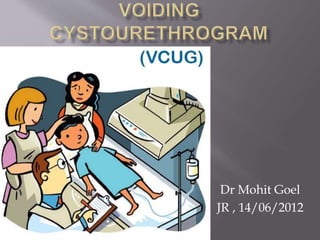
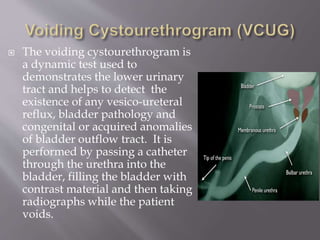
 The voiding cystourethrogram is
a dynamic test used to
demonstrates the lower urinary
tract and helps to detect the
existence of any vesico-ureteral
reflux, bladder pathology and
congenital or acquired anomalies
of bladder outflow tract. It is
performed by passing a catheter
through the urethra into the
bladder, filling the bladder with
contrast material and then taking
radiographs while the patient
voids.
Indications:
Children:
 Urinary tract infection– Usually done after some weeks of acute
stage or may be done under antibiotic converge. MCU is indicated
after the 1st occurrence of UTI in boys or girls.
 voiding difficulties :
dysuria ,
thin stream dribbling,
frequency, urgency ,
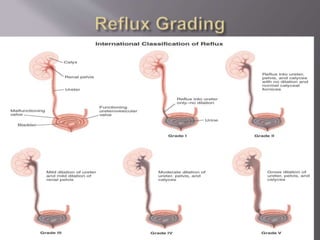
vesico ureteric reflux,
trauma.
 Baseline study prior to lower UT surgery.
Adults:
Trauma to urethra, urethral stricture, urethral diverticula ,UTI,
Reflux nephropathy prior to renal transplant of one/both kidneys.
 Contrast Media:
Urograffin 60% used which is diluted with normal saline in 1:3.

The estimated volume of contrast medium to be given
during the examination is determined mainly by the age of
the child except for children less than one year of age in
whom it is determined by weight.
Less than one year,
Weight (kg) × 7 = capacity (ml)
Less than two years,
(2 × age in years + 2) × 30 = capacity (ml)
More than two years,
(Age in years/2 + 6) × 30 = capacity (ml)
Filming:
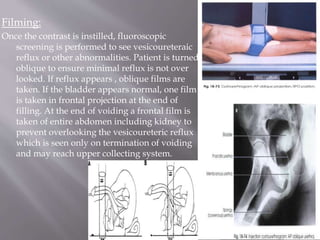
Once the contrast is instilled, fluoroscopic
screening is performed to see vesicoureteraic
reflux or other abnormalities. Patient is turned
oblique to ensure minimal reflux is not over
looked. If reflux appears , oblique films are
taken. If the bladder appears normal, one film
is taken in frontal projection at the end of
filling. At the end of voiding a frontal film is
taken of entire abdomen including kidney to
prevent overlooking the vesicoureteric reflux
which is seen only on termination of voiding
and may reach upper collecting system.
Adult Male:
The voiding study can be modified by
getting the patient to void against resistance
by using a penile clamp or compression of
distilled part of penis, which enhances
visualization of urethra by the artificial
distension.
.
This is known as choke cystourethrography
Complications:
 UTI,
 Adverse reactions may result from absorption of
contrast medium by bladder mucosa.
 Catheter trauma causing dysuria, frequency
hematuria and urinary retention
 perforation by the catheter or from over distention
 Catheterization of vagina or ectopic ureteral orifice
Radiation effect: MCU is a diagnostic procedure that
inevitably exposes gonads to some radiation. It
should be kept to a minimum. Careful attention to
ensure very short screening periods. Tightly
collimated X-ray beam.
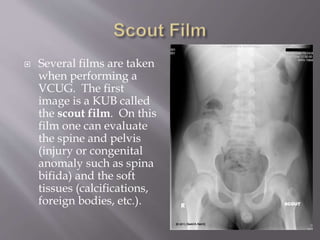
 Several films are taken
when performing a
VCUG. The first
image is a KUB called
the scout film. On this
film one can evaluate
the spine and pelvis
(injury or congenital
anomaly such as spina
bifida) and the soft
tissues (calcifications,
foreign bodies, etc.).
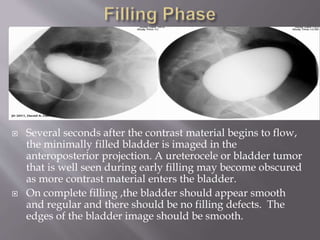
 Several seconds after the contrast material begins to flow,
the minimally filled bladder is imaged in the
anteroposterior projection. A ureterocele or bladder tumor
that is well seen during early filling may become obscured
as more contrast material enters the bladder.
 On complete filling ,the bladder should appear smooth
and regular and there should be no filling defects. The
edges of the bladder image should be smooth.
 Images captured during voiding will
demonstrate the urethra (strictures or
obstruction) and the bladder, and they will
document the presence or absence of
vesicoureteral reflux Unless there is a voiding
film, one cannot determine whether the patient
has reflux because reflux may only occur with
the pressure generated by voiding.
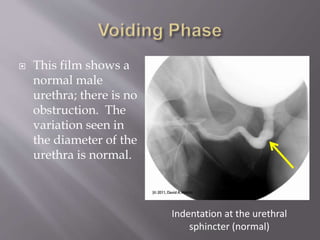
 This film shows a
normal male
urethra; there is no
obstruction. The
variation seen in
the diameter of the
urethra is normal.
Indentation at the urethral
sphincter (normal)
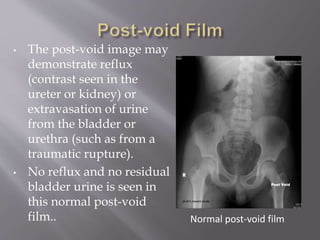
• The post-void image may
demonstrate reflux
(contrast seen in the
ureter or kidney) or
extravasation of urine
from the bladder or
urethra (such as from a
traumatic rupture).
• No reflux and no residual
bladder urine is seen in
this normal post-void
film.. Normal post-void film
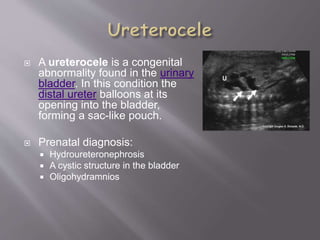
 A ureterocele is a congenital
abnormality found in the urinary
bladder. In this condition the
distal ureter balloons at its
opening into the bladder,
forming a sac-like pouch.
 Prenatal diagnosis:
 Hydroureteronephrosis
 A cystic structure in the bladder
 Oligohydramnios
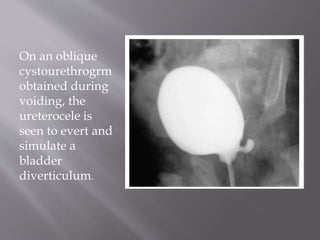
On an oblique
cystourethrogrm
obtained during
voiding, the
ureterocele is
seen to evert and
simulate a
bladder
diverticulum.
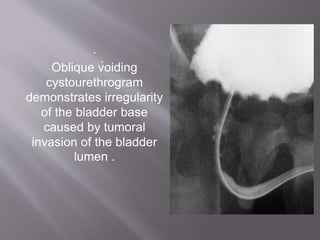
.
Oblique voiding
cystourethrogram
demonstrates irregularity
of the bladder base
caused by tumoral
invasion of the bladder
lumen .
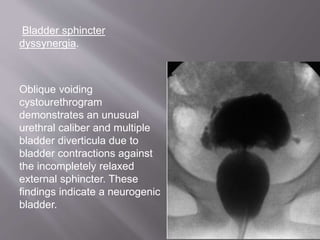
Bladder sphincter
dyssynergia.
Oblique voiding
cystourethrogram
demonstrates an unusual
urethral caliber and multiple
bladder diverticula due to
bladder contractions against
the incompletely relaxed
external sphincter. These
findings indicate a neurogenic
bladder.
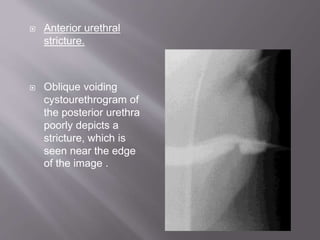
 Anterior urethral
stricture.
 Oblique voiding
cystourethrogram of
the posterior urethra
poorly depicts a
stricture, which is
seen near the edge
of the image .
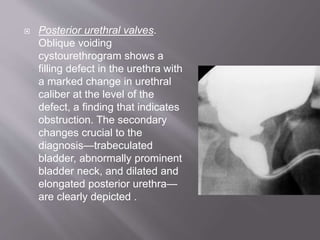
 Posterior urethral valves.
Oblique voiding
cystourethrogram shows a
filling defect in the urethra with
a marked change in urethral
caliber at the level of the
defect, a finding that indicates
obstruction. The secondary
changes crucial to the
diagnosis—trabeculated
bladder, abnormally prominent
bladder neck, and dilated and
elongated posterior urethra—
are clearly depicted .
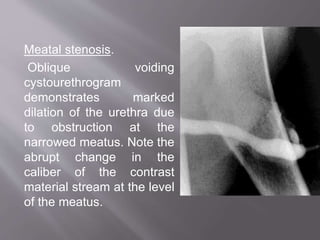
Meatal stenosis.
Oblique voiding
cystourethrogram
demonstrates marked
dilation of the urethra due
to obstruction at the
narrowed meatus. Note the
abrupt change in the
caliber of the contrast
material stream at the level
of the meatus.
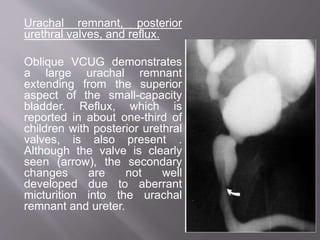
Urachal remnant, posterior
urethral valves, and reflux.
Oblique VCUG demonstrates
a large urachal remnant
extending from the superior
aspect of the small-capacity
bladder. Reflux, which is
reported in about one-third of
children with posterior urethral
valves, is also present .
Although the valve is clearly
seen (arrow), the secondary
changes are not well
developed due to aberrant
micturition into the urachal
remnant and ureter.
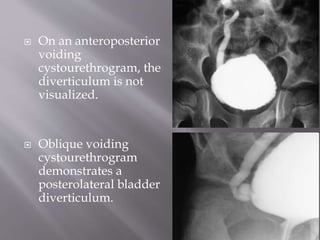
 On an anteroposterior
voiding
cystourethrogram, the
diverticulum is not
visualized.
 Oblique voiding
cystourethrogram
demonstrates a
posterolateral bladder
diverticulum.
 Pseudoureterocele.
Anteroposterior voiding
cystourethrogram shows a
collection of air on the left
side producing a filling
defect (arrowheads). The
air was introduced into the
bladder via a catheter. Air
can also simulate tumor or
blood clots.
Mcu

Mcu

  • 1.
    Dr Mohit Goel JR, 14/06/2012
  • 2.
     The voidingcystourethrogram is a dynamic test used to demonstrates the lower urinary tract and helps to detect the existence of any vesico-ureteral reflux, bladder pathology and congenital or acquired anomalies of bladder outflow tract. It is performed by passing a catheter through the urethra into the bladder, filling the bladder with contrast material and then taking radiographs while the patient voids.
  • 3.
    Indications: Children:  Urinary tractinfection– Usually done after some weeks of acute stage or may be done under antibiotic converge. MCU is indicated after the 1st occurrence of UTI in boys or girls.  voiding difficulties : dysuria , thin stream dribbling, frequency, urgency , vesico ureteric reflux, trauma.  Baseline study prior to lower UT surgery. Adults: Trauma to urethra, urethral stricture, urethral diverticula ,UTI, Reflux nephropathy prior to renal transplant of one/both kidneys.
  • 4.
     Contrast Media: Urograffin60% used which is diluted with normal saline in 1:3.  The estimated volume of contrast medium to be given during the examination is determined mainly by the age of the child except for children less than one year of age in whom it is determined by weight. Less than one year, Weight (kg) × 7 = capacity (ml) Less than two years, (2 × age in years + 2) × 30 = capacity (ml) More than two years, (Age in years/2 + 6) × 30 = capacity (ml)
  • 5.
    Filming: Once the contrastis instilled, fluoroscopic screening is performed to see vesicoureteraic reflux or other abnormalities. Patient is turned oblique to ensure minimal reflux is not over looked. If reflux appears , oblique films are taken. If the bladder appears normal, one film is taken in frontal projection at the end of filling. At the end of voiding a frontal film is taken of entire abdomen including kidney to prevent overlooking the vesicoureteric reflux which is seen only on termination of voiding and may reach upper collecting system.
  • 6.
    Adult Male: The voidingstudy can be modified by getting the patient to void against resistance by using a penile clamp or compression of distilled part of penis, which enhances visualization of urethra by the artificial distension. . This is known as choke cystourethrography
  • 7.
    Complications:  UTI,  Adversereactions may result from absorption of contrast medium by bladder mucosa.  Catheter trauma causing dysuria, frequency hematuria and urinary retention  perforation by the catheter or from over distention  Catheterization of vagina or ectopic ureteral orifice Radiation effect: MCU is a diagnostic procedure that inevitably exposes gonads to some radiation. It should be kept to a minimum. Careful attention to ensure very short screening periods. Tightly collimated X-ray beam.
  • 8.
     Several filmsare taken when performing a VCUG. The first image is a KUB called the scout film. On this film one can evaluate the spine and pelvis (injury or congenital anomaly such as spina bifida) and the soft tissues (calcifications, foreign bodies, etc.).
  • 9.
     Several secondsafter the contrast material begins to flow, the minimally filled bladder is imaged in the anteroposterior projection. A ureterocele or bladder tumor that is well seen during early filling may become obscured as more contrast material enters the bladder.  On complete filling ,the bladder should appear smooth and regular and there should be no filling defects. The edges of the bladder image should be smooth.
  • 10.
     Images capturedduring voiding will demonstrate the urethra (strictures or obstruction) and the bladder, and they will document the presence or absence of vesicoureteral reflux Unless there is a voiding film, one cannot determine whether the patient has reflux because reflux may only occur with the pressure generated by voiding.
  • 11.
     This filmshows a normal male urethra; there is no obstruction. The variation seen in the diameter of the urethra is normal. Indentation at the urethral sphincter (normal)
  • 12.
    • The post-voidimage may demonstrate reflux (contrast seen in the ureter or kidney) or extravasation of urine from the bladder or urethra (such as from a traumatic rupture). • No reflux and no residual bladder urine is seen in this normal post-void film.. Normal post-void film
  • 14.
     A ureteroceleis a congenital abnormality found in the urinary bladder. In this condition the distal ureter balloons at its opening into the bladder, forming a sac-like pouch.  Prenatal diagnosis:  Hydroureteronephrosis  A cystic structure in the bladder  Oligohydramnios
  • 15.
    On an oblique cystourethrogrm obtainedduring voiding, the ureterocele is seen to evert and simulate a bladder diverticulum.
  • 16.
    . Oblique voiding cystourethrogram demonstrates irregularity ofthe bladder base caused by tumoral invasion of the bladder lumen .
  • 17.
    Bladder sphincter dyssynergia. Oblique voiding cystourethrogram demonstratesan unusual urethral caliber and multiple bladder diverticula due to bladder contractions against the incompletely relaxed external sphincter. These findings indicate a neurogenic bladder.
  • 18.
     Anterior urethral stricture. Oblique voiding cystourethrogram of the posterior urethra poorly depicts a stricture, which is seen near the edge of the image .
  • 19.
     Posterior urethralvalves. Oblique voiding cystourethrogram shows a filling defect in the urethra with a marked change in urethral caliber at the level of the defect, a finding that indicates obstruction. The secondary changes crucial to the diagnosis—trabeculated bladder, abnormally prominent bladder neck, and dilated and elongated posterior urethra— are clearly depicted .
  • 20.
    Meatal stenosis. Oblique voiding cystourethrogram demonstratesmarked dilation of the urethra due to obstruction at the narrowed meatus. Note the abrupt change in the caliber of the contrast material stream at the level of the meatus.
  • 22.
    Urachal remnant, posterior urethralvalves, and reflux. Oblique VCUG demonstrates a large urachal remnant extending from the superior aspect of the small-capacity bladder. Reflux, which is reported in about one-third of children with posterior urethral valves, is also present . Although the valve is clearly seen (arrow), the secondary changes are not well developed due to aberrant micturition into the urachal remnant and ureter.
  • 24.
     On ananteroposterior voiding cystourethrogram, the diverticulum is not visualized.  Oblique voiding cystourethrogram demonstrates a posterolateral bladder diverticulum.
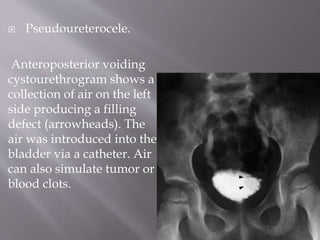
  • 25.
     Pseudoureterocele. Anteroposterior voiding cystourethrogramshows a collection of air on the left side producing a filling defect (arrowheads). The air was introduced into the bladder via a catheter. Air can also simulate tumor or blood clots.