Amy McAllister
April 2014
Contents
 Anatomical approach
 Causes
 Symptoms & Signs
 Investigations
 Management
 Learning points
Introduction
 GUT injury in ~10% of all trauma
patients
 Long term morbidity
-incontinence
-impotence
-psychological
 Usually not life threatening; need to rule
out other injuries
Aetiology
 Penetrating
- Knife, bullet
 Blunt
- MVA
- fall from height
- direct blow/ sports
- straddle injury
- Constriction, Instrumentation
 Also – avulsion, burns, radiation, iatrogenic
Penile injuries
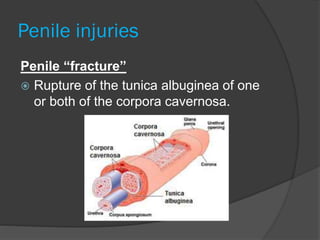
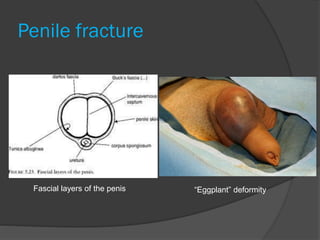
Penile “fracture”
 Rupture of the tunica albuginea of one
or both of the corpora cavernosa.
Penile fracture
 Aetiolgy
- Frequently a sexually related accident but can also be
from a direct blow
- May be associated with urethral injury
 Investigations
- Usually history is enough
- Diagnostic cavernosography or MRI
 Management
- Previous conservative treatment – high complication
rates
- Surgery
Penile fracture
“Eggplant” deformityFascial layers of the penis
Penile amputation
 Accidental or deliberate
 “Double Bag” preservation
 Management
 Reimplantation - success has been
reported after 16 hours of cold
ischaemia
Penile soft tissue injuries
 Penetrating injuries
 Dog bites
 Constriction
 Degloving
Management
 Sutures
 Removal of constricting devices
 Surgery
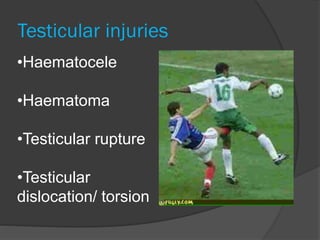
Testicular injuries
•Haematocele
•Haematoma
•Testicular rupture
•Testicular
dislocation/ torsion
Testicular injuries
Signs
 Bruising, swelling, tenderness,
haematuria
Investigation
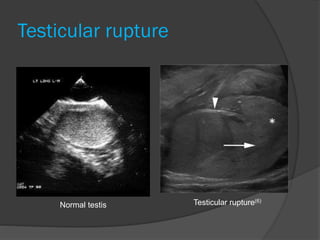
 USS
 Surgical exploration
Testicular rupture
Normal testis Testicular rupture(6)
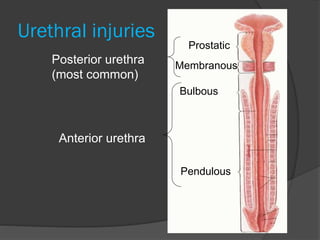
Urethral injuries
Prostatic
Membranous
Bulbous
Pendulous
Anterior urethra
Posterior urethra
(most common)
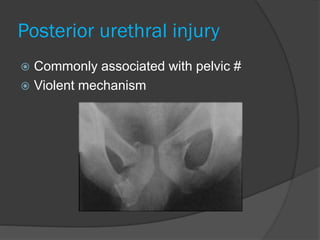
Posterior urethral injury
 Commonly associated with pelvic #
 Violent mechanism
Posterior urethral injury
 Signs
 Blood at meatus
 Gross haematuria
 Inability to void
 Ecchymoses, swelling of penis
 Pelvic/suprapubic tenderness
 “High riding”/absent prostate on DRE
Anterior urethral injury
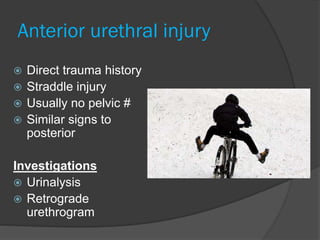
 Direct trauma history
 Straddle injury
 Usually no pelvic #
 Similar signs to
posterior
Investigations
 Urinalysis
 Retrograde
urethrogram
Urinalysis
*False positives*
 Rhabdomyolysis
 Food – berries/beets
 Drugs – Rifampicin, Alphamethyldopa
etc
 If more than a trace on dipstick – send
for urinalysis
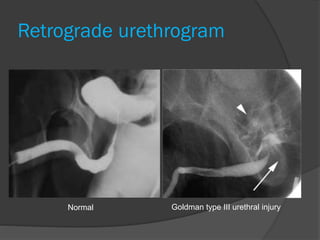
Retrograde urethrogram
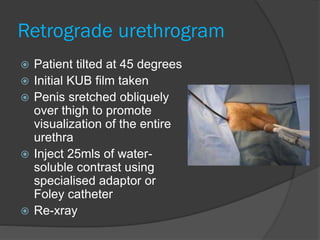
 Patient tilted at 45 degrees
 Initial KUB film taken
 Penis sretched obliquely
over thigh to promote
visualization of the entire
urethra
 Inject 25mls of water-
soluble contrast using
specialised adaptor or
Foley catheter
 Re-xray
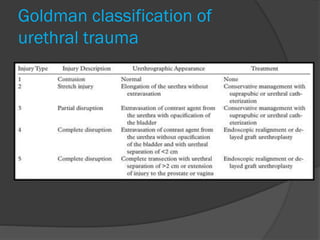
Goldman classification of
urethral trauma
Retrograde urethrogram
Normal Goldman type III urethral injury
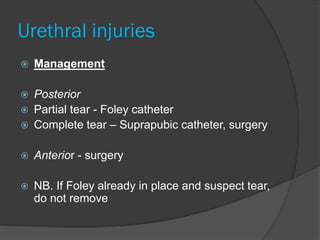
Urethral injuries
 Management
 Posterior
 Partial tear - Foley catheter
 Complete tear – Suprapubic catheter, surgery
 Anterior - surgery
 NB. If Foley already in place and suspect tear,
do not remove
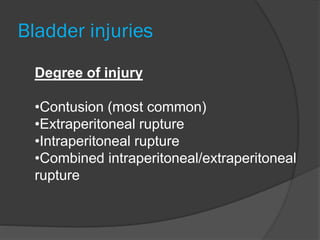
Bladder injuries
Degree of injury
•Contusion (most common)
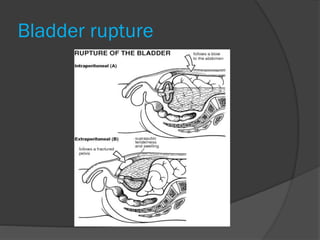
•Extraperitoneal rupture
•Intraperitoneal rupture
•Combined intraperitoneal/extraperitoneal
rupture
Bladder injuries
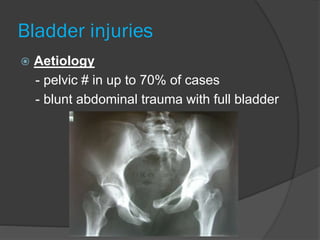
 Aetiology
- pelvic # in up to 70% of cases
- blunt abdominal trauma with full bladder
Bladder rupture
Bladder injuries
Signs
 Gross haematuria
 Microscopic haematuria with pelvic #
 Bruising, suprapubic tenderness, peritonism
 Must rule out urethral injury before placing Foley
Investigations
 Retrograde CT cystography
Management
 Contusions/extraperitoneal – conservative
 Intraperitoneal - surgery
Ureteral injuries
 Ureter injury is rare except a
complication of surgery/ penetrating
trauma
 No haematuria in 25% of ureter injuries
 Have high index of suspicion
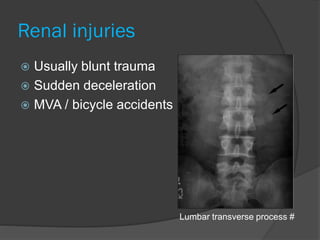
Renal injuries
 Usually blunt trauma
 Sudden deceleration
 MVA / bicycle accidents
Lumbar transverse process #
Renal injuries
Signs
•Eccyhmosis to back / flank / lower thorax / upper
abdomen
•Haematuria
•Shock
Delayed findings
•Fever
•Palpable flank mass (urinoma)
Renal injuries
Investigations
 CT with contrast
 IVP
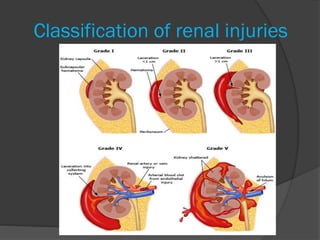
Classification of renal injuries
Renal injuries
 Management
 ABCs
 Grade I and II – conservative
 Grade III and up – operative including
nephrectomy
Learning points
 Rule out life threatening injuries first
 Identification prevents long term
problems
 No Foley if urethral trauma suspected –
wait for u/a and pelvic x-ray
 If Foley is in – do not remove if urethral
trauma suspected afterwards
 Gross haematuria or microscopic
haematuria plus shock = GUT trauma
References
 (1) Urol Clin North Am. 2013 Aug;40(3):323-34. doi:
10.1016/j.ucl.2013.04.001. Epub 2013 Jun 12.Current epidemiology of
genitourinary trauma. McGeady JB1, Breyer BN
 (2) Bhatt S, Kocakoc E, Rubens DJ, Seftel AD, Dogra VS
(2005)Sonographic evaluation of penile trauma. J Ultrasound Med
24:993–1000, quiz 1001
 (3) Kozacioglu Z., Degirmenci T., Arslan M., et al
 : Long-term significance of the number of hours until surgical repair of
penile fractures. Urol Int 2011; 87: 75-79 CrossRef
 (4) J Urol. 2004 Aug;172(2):576-9.
 Long-term experience with surgical and conservative treatment of
penile fracture.
 Muentener M1, Suter S, Hauri D, Sulser T.
 (5) Wei F.C., McKee N.H., Huerta F.J., et al
 : Microsurgical replantation of a completely amputated penis. Ann Plast
Surg 1983; 20: 317-321 CrossRef
References
 (6) Bhandary P, Abbitt PL, Watson L (1992) Ultrasound
diagnosis of traumatic testicular rupture. J Clin Ultrasound
20:346–348
 (7) Lower male genitourinary trauma: a pictorial review Bruce
E. Lehnert & Claudia Sadro & Eric Monroe &Mariam Moshiri
 (8)Gomez RG, Ceballos L, CoburnMet al (2004) Consensus
statement
 on bladder injuries. BJU Int 94:27–32(2)Ramchandani P,
Buckler PM (2009) Imaging of genitourinary trauma. AJR Am
J Roentgenol 192:1514–1523
 (9) Straddle injuries to the bulbar urethra: management and
outcome in 53 patients Elgammal MA.Int Braz J Urol. 2009
Jul-Aug;35(4):450-8. .

Male genital trauma

  • 1.
  • 2.
    Contents  Anatomical approach Causes  Symptoms & Signs  Investigations  Management  Learning points
  • 3.
    Introduction  GUT injuryin ~10% of all trauma patients  Long term morbidity -incontinence -impotence -psychological  Usually not life threatening; need to rule out other injuries
  • 4.
    Aetiology  Penetrating - Knife,bullet  Blunt - MVA - fall from height - direct blow/ sports - straddle injury - Constriction, Instrumentation  Also – avulsion, burns, radiation, iatrogenic
  • 5.
    Penile injuries Penile “fracture” Rupture of the tunica albuginea of one or both of the corpora cavernosa.
  • 6.
    Penile fracture  Aetiolgy -Frequently a sexually related accident but can also be from a direct blow - May be associated with urethral injury  Investigations - Usually history is enough - Diagnostic cavernosography or MRI  Management - Previous conservative treatment – high complication rates - Surgery
  • 7.
  • 8.
    Penile amputation  Accidentalor deliberate  “Double Bag” preservation  Management  Reimplantation - success has been reported after 16 hours of cold ischaemia
  • 9.
    Penile soft tissueinjuries  Penetrating injuries  Dog bites  Constriction  Degloving Management  Sutures  Removal of constricting devices  Surgery
  • 10.
  • 11.
    Testicular injuries Signs  Bruising,swelling, tenderness, haematuria Investigation  USS  Surgical exploration
  • 12.
    Testicular rupture Normal testisTesticular rupture(6)
  • 13.
  • 14.
    Posterior urethral injury Commonly associated with pelvic #  Violent mechanism
  • 15.
    Posterior urethral injury Signs  Blood at meatus  Gross haematuria  Inability to void  Ecchymoses, swelling of penis  Pelvic/suprapubic tenderness  “High riding”/absent prostate on DRE
  • 16.
    Anterior urethral injury Direct trauma history  Straddle injury  Usually no pelvic #  Similar signs to posterior Investigations  Urinalysis  Retrograde urethrogram
  • 17.
    Urinalysis *False positives*  Rhabdomyolysis Food – berries/beets  Drugs – Rifampicin, Alphamethyldopa etc  If more than a trace on dipstick – send for urinalysis
  • 18.
    Retrograde urethrogram  Patienttilted at 45 degrees  Initial KUB film taken  Penis sretched obliquely over thigh to promote visualization of the entire urethra  Inject 25mls of water- soluble contrast using specialised adaptor or Foley catheter  Re-xray
  • 19.
  • 20.
    Retrograde urethrogram Normal Goldmantype III urethral injury
  • 21.
    Urethral injuries  Management Posterior  Partial tear - Foley catheter  Complete tear – Suprapubic catheter, surgery  Anterior - surgery  NB. If Foley already in place and suspect tear, do not remove
  • 22.
    Bladder injuries Degree ofinjury •Contusion (most common) •Extraperitoneal rupture •Intraperitoneal rupture •Combined intraperitoneal/extraperitoneal rupture
  • 23.
    Bladder injuries  Aetiology -pelvic # in up to 70% of cases - blunt abdominal trauma with full bladder
  • 24.
  • 25.
    Bladder injuries Signs  Grosshaematuria  Microscopic haematuria with pelvic #  Bruising, suprapubic tenderness, peritonism  Must rule out urethral injury before placing Foley Investigations  Retrograde CT cystography Management  Contusions/extraperitoneal – conservative  Intraperitoneal - surgery
  • 26.
    Ureteral injuries  Ureterinjury is rare except a complication of surgery/ penetrating trauma  No haematuria in 25% of ureter injuries  Have high index of suspicion
  • 27.
    Renal injuries  Usuallyblunt trauma  Sudden deceleration  MVA / bicycle accidents Lumbar transverse process #
  • 28.
    Renal injuries Signs •Eccyhmosis toback / flank / lower thorax / upper abdomen •Haematuria •Shock Delayed findings •Fever •Palpable flank mass (urinoma)
  • 29.
  • 30.
  • 31.
    Renal injuries  Management ABCs  Grade I and II – conservative  Grade III and up – operative including nephrectomy
  • 32.
    Learning points  Ruleout life threatening injuries first  Identification prevents long term problems  No Foley if urethral trauma suspected – wait for u/a and pelvic x-ray  If Foley is in – do not remove if urethral trauma suspected afterwards  Gross haematuria or microscopic haematuria plus shock = GUT trauma
  • 33.
    References  (1) UrolClin North Am. 2013 Aug;40(3):323-34. doi: 10.1016/j.ucl.2013.04.001. Epub 2013 Jun 12.Current epidemiology of genitourinary trauma. McGeady JB1, Breyer BN  (2) Bhatt S, Kocakoc E, Rubens DJ, Seftel AD, Dogra VS (2005)Sonographic evaluation of penile trauma. J Ultrasound Med 24:993–1000, quiz 1001  (3) Kozacioglu Z., Degirmenci T., Arslan M., et al  : Long-term significance of the number of hours until surgical repair of penile fractures. Urol Int 2011; 87: 75-79 CrossRef  (4) J Urol. 2004 Aug;172(2):576-9.  Long-term experience with surgical and conservative treatment of penile fracture.  Muentener M1, Suter S, Hauri D, Sulser T.  (5) Wei F.C., McKee N.H., Huerta F.J., et al  : Microsurgical replantation of a completely amputated penis. Ann Plast Surg 1983; 20: 317-321 CrossRef
  • 34.
    References  (6) BhandaryP, Abbitt PL, Watson L (1992) Ultrasound diagnosis of traumatic testicular rupture. J Clin Ultrasound 20:346–348  (7) Lower male genitourinary trauma: a pictorial review Bruce E. Lehnert & Claudia Sadro & Eric Monroe &Mariam Moshiri  (8)Gomez RG, Ceballos L, CoburnMet al (2004) Consensus statement  on bladder injuries. BJU Int 94:27–32(2)Ramchandani P, Buckler PM (2009) Imaging of genitourinary trauma. AJR Am J Roentgenol 192:1514–1523  (9) Straddle injuries to the bulbar urethra: management and outcome in 53 patients Elgammal MA.Int Braz J Urol. 2009 Jul-Aug;35(4):450-8. .