PG: Dr. Nasin Usman
Moderator: Dr. Balaji J.
ASCENDING URETHROGRAM
AUG/RGU
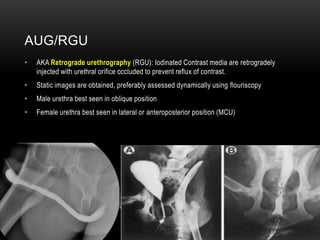
• AKA Retrograde urethrography (RGU): Iodinated Contrast media are retrogradely
injected with urethral orifice occluded to prevent reflux of contrast.
• Static images are obtained, preferably assessed dynamically using flouriscopy
• Male urethra best seen in oblique position
• Female urethra best seen in lateral or anteroposterior position (MCU)
ANATOMY
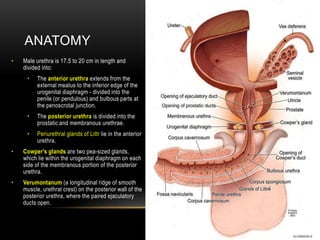
• Male urethra is 17.5 to 20 cm in length and
divided into:
• The anterior urethra extends from the
external meatus to the inferior edge of the
urogenital diaphragm - divided into the
penile (or pendulous) and bulbous parts at
the penoscrotal junction.
• The posterior urethra is divided into the
prostatic and membranous urethrae.
• Periurethral glands of Littr lie in the anterior
urethra.
• Cowper's glands are two pea-sized glands,
which lie within the urogenital diaphragm on each
side of the membranous portion of the posterior
urethra.
• Verumontanum (a longitudinal ridge of smooth
muscle, urethral crest) on the posterior wall of the
posterior urethra, where the paired ejaculatory
ducts open.
ANATOMY
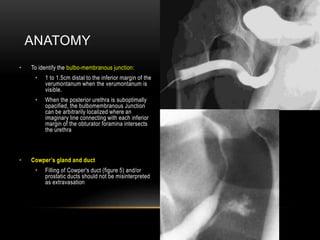
• To identify the bulbo-membranous junction:
• 1 to 1.5cm distal to the inferior margin of the
verumontanum when the verumontanum is
visible.
• When the posterior urethra is suboptimally
opacified, the bulbomembranous Junction
can be arbitrarily localized where an
imaginary line connecting with each inferior
margin of the obturator foramina intersects
the urethra
• Cowper’s gland and duct
• Filling of Cowper's duct (figure 5) and/or
prostatic ducts should not be misinterpreted
as extravasation
INDICATIONS
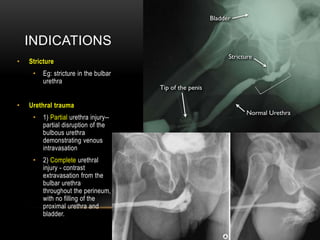
• Stricture
• Eg: stricture in the bulbar
urethra
• Urethral trauma
• 1) Partial urethra injury--
partial disruption of the
bulbous urethra
demonstrating venous
intravasation
• 2) Complete urethral
injury - contrast
extravasation from the
bulbar urethra
throughout the perineum,
with no filling of the
proximal urethra and
bladder.
INDICATIONS
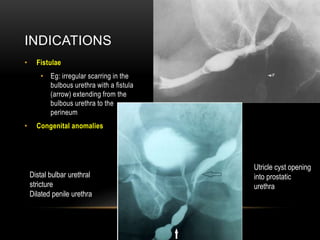
• Fistulae
• Eg: irregular scarring in the
bulbous urethra with a fistula
(arrow) extending from the
bulbous urethra to the
perineum
• Congenital anomalies
Distal bulbar urethral
stricture
Dilated penile urethra
Utricle cyst opening
into prostatic
urethra
INDICATIONS
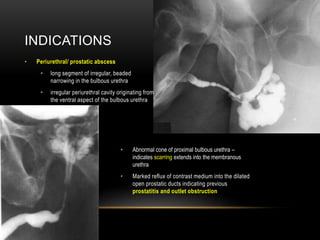
• Periurethral/ prostatic abscess
• long segment of irregular, beaded
narrowing in the bulbous urethra
• irregular periurethral cavity originating from
the ventral aspect of the bulbous urethra
• Abnormal cone of proximal bulbous urethra –
indicates scarring extends into the membranous
urethra
• Marked reflux of contrast medium into the dilated
open prostatic ducts indicating previous
prostatitis and outlet obstruction
CONTRAINDICATIONS
• Recent instrumentation
• Urethritis
• UTI (acute)
TECHNIQUE
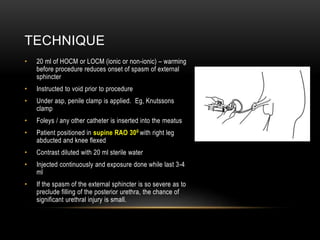
• 20 ml of HOCM or LOCM (ionic or non-ionic) – warming
before procedure reduces onset of spasm of external
sphincter
• Instructed to void prior to procedure
• Under asp, penile clamp is applied. Eg, Knutssons
clamp
• Foleys / any other catheter is inserted into the meatus
• Patient positioned in supine RAO 300 with right leg
abducted and knee flexed
• Contrast diluted with 20 ml sterile water
• Injected continuously and exposure done while last 3-4
ml
• If the spasm of the external sphincter is so severe as to
preclude filling of the posterior urethra, the chance of
significant urethral injury is small.
COMPLICATIONS
• Allergic reactions to contrast (very rare)
• Acute UTI
• Urethral trauma/ bleed
• Intravasation of contrast
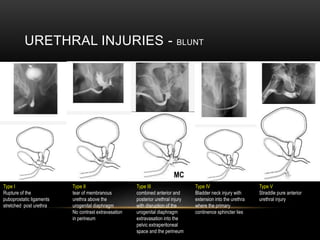
URETHRAL INJURIES - BLUNT
Type I
Rupture of the
puboprostatic ligaments
stretched post urethra
Type II
tear of membranous
urethra above the
urogenital diaphragm
No contrast extravasation
in perineum
Type III
combined anterior and
posterior urethral injury
with disruption of the
urogenital diaphragm
extravasation into the
pelvic extraperitoneal
space and the perineum
Type IV
Bladder neck injury with
extension into the urethra
where the primary
continence sphincter lies
Type V
Straddle pure anterior
urethral injury
MC
AUG
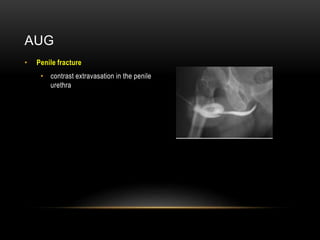
• Penile fracture
• contrast extravasation in the penile
urethra
AUG
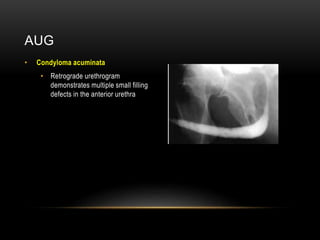
• Condyloma acuminata
• Retrograde urethrogram
demonstrates multiple small filling
defects in the anterior urethra
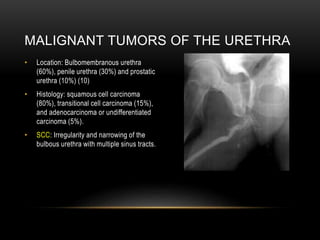
MALIGNANT TUMORS OF THE URETHRA
• Location: Bulbomembranous urethra
(60%), penile urethra (30%) and prostatic
urethra (10%) (10)
• Histology: squamous cell carcinoma
(80%), transitional cell carcinoma (15%),
and adenocarcinoma or undifferentiated
carcinoma (5%).
• SCC: Irregularity and narrowing of the
bulbous urethra with multiple sinus tracts.
AUG
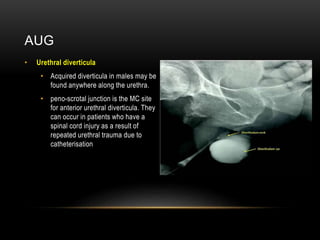
• Urethral diverticula
• Acquired diverticula in males may be
found anywhere along the urethra.
• peno-scrotal junction is the MC site
for anterior urethral diverticula. They
can occur in patients who have a
spinal cord injury as a result of
repeated urethral trauma due to
catheterisation
THANK YOU

ascending urethrogram

  • 1.
    PG: Dr. NasinUsman Moderator: Dr. Balaji J. ASCENDING URETHROGRAM
  • 2.
    AUG/RGU • AKA Retrogradeurethrography (RGU): Iodinated Contrast media are retrogradely injected with urethral orifice occluded to prevent reflux of contrast. • Static images are obtained, preferably assessed dynamically using flouriscopy • Male urethra best seen in oblique position • Female urethra best seen in lateral or anteroposterior position (MCU)
  • 3.
    ANATOMY • Male urethrais 17.5 to 20 cm in length and divided into: • The anterior urethra extends from the external meatus to the inferior edge of the urogenital diaphragm - divided into the penile (or pendulous) and bulbous parts at the penoscrotal junction. • The posterior urethra is divided into the prostatic and membranous urethrae. • Periurethral glands of Littr lie in the anterior urethra. • Cowper's glands are two pea-sized glands, which lie within the urogenital diaphragm on each side of the membranous portion of the posterior urethra. • Verumontanum (a longitudinal ridge of smooth muscle, urethral crest) on the posterior wall of the posterior urethra, where the paired ejaculatory ducts open.
  • 4.
    ANATOMY • To identifythe bulbo-membranous junction: • 1 to 1.5cm distal to the inferior margin of the verumontanum when the verumontanum is visible. • When the posterior urethra is suboptimally opacified, the bulbomembranous Junction can be arbitrarily localized where an imaginary line connecting with each inferior margin of the obturator foramina intersects the urethra • Cowper’s gland and duct • Filling of Cowper's duct (figure 5) and/or prostatic ducts should not be misinterpreted as extravasation
  • 5.
    INDICATIONS • Stricture • Eg:stricture in the bulbar urethra • Urethral trauma • 1) Partial urethra injury-- partial disruption of the bulbous urethra demonstrating venous intravasation • 2) Complete urethral injury - contrast extravasation from the bulbar urethra throughout the perineum, with no filling of the proximal urethra and bladder.
  • 6.
    INDICATIONS • Fistulae • Eg:irregular scarring in the bulbous urethra with a fistula (arrow) extending from the bulbous urethra to the perineum • Congenital anomalies Distal bulbar urethral stricture Dilated penile urethra Utricle cyst opening into prostatic urethra
  • 7.
    INDICATIONS • Periurethral/ prostaticabscess • long segment of irregular, beaded narrowing in the bulbous urethra • irregular periurethral cavity originating from the ventral aspect of the bulbous urethra • Abnormal cone of proximal bulbous urethra – indicates scarring extends into the membranous urethra • Marked reflux of contrast medium into the dilated open prostatic ducts indicating previous prostatitis and outlet obstruction
  • 8.
  • 9.
    TECHNIQUE • 20 mlof HOCM or LOCM (ionic or non-ionic) – warming before procedure reduces onset of spasm of external sphincter • Instructed to void prior to procedure • Under asp, penile clamp is applied. Eg, Knutssons clamp • Foleys / any other catheter is inserted into the meatus • Patient positioned in supine RAO 300 with right leg abducted and knee flexed • Contrast diluted with 20 ml sterile water • Injected continuously and exposure done while last 3-4 ml • If the spasm of the external sphincter is so severe as to preclude filling of the posterior urethra, the chance of significant urethral injury is small.
  • 10.
    COMPLICATIONS • Allergic reactionsto contrast (very rare) • Acute UTI • Urethral trauma/ bleed • Intravasation of contrast
  • 11.
    URETHRAL INJURIES -BLUNT Type I Rupture of the puboprostatic ligaments stretched post urethra Type II tear of membranous urethra above the urogenital diaphragm No contrast extravasation in perineum Type III combined anterior and posterior urethral injury with disruption of the urogenital diaphragm extravasation into the pelvic extraperitoneal space and the perineum Type IV Bladder neck injury with extension into the urethra where the primary continence sphincter lies Type V Straddle pure anterior urethral injury MC
  • 12.
    AUG • Penile fracture •contrast extravasation in the penile urethra
  • 13.
    AUG • Condyloma acuminata •Retrograde urethrogram demonstrates multiple small filling defects in the anterior urethra
  • 14.
    MALIGNANT TUMORS OFTHE URETHRA • Location: Bulbomembranous urethra (60%), penile urethra (30%) and prostatic urethra (10%) (10) • Histology: squamous cell carcinoma (80%), transitional cell carcinoma (15%), and adenocarcinoma or undifferentiated carcinoma (5%). • SCC: Irregularity and narrowing of the bulbous urethra with multiple sinus tracts.
  • 15.
    AUG • Urethral diverticula •Acquired diverticula in males may be found anywhere along the urethra. • peno-scrotal junction is the MC site for anterior urethral diverticula. They can occur in patients who have a spinal cord injury as a result of repeated urethral trauma due to catheterisation
  • 16.