ORGANIZATIONAL
BEHAVIOUR
“LEARNING ORGANIZATION”
PRESENTED BY:-
EKTA RAWAT
DIVYA PARMAR
B.B.A. 3rd sem.
CONTENTS
• WHAT IS A LEARNING ORGANIZATION?
• NATURE
• CHARACTERISTICS
• CORE AREAS
• LEVELS
• CREATING A LEARNING ORGANIZATION
• CONCLUSION
LEARNING
ORGANIZATION
• A learning organization is the term given to a company that facilitates
the learning of its members and continuously transforms itself.
• This concept was coined through the work and research of Peter Senge
and his colleagues.
“A place where people continually expand their capacity to create the
results they truly desire, where new and expansive patterns of thinking are
nurtured, where collective aspirations are set free, where people are
continually learning to learn together.” – Peter Senge
NATURE OF LEARNING
ORGANIZATION
A learning organization is one that:
• Seeks to create its own future.
• Assumes learning is an ongoing and creative process for its
members.
• Develops, adapts and transforms itself in response to the needs
and aspirations of people, both inside and outside itself.
• Allows people at all levels, individually and collectively, to
continually increasing their capacity to produce results.
CHARACTERISTICS
• New ideas and information.
• Strive to reduce structural, process and interpersonal barriers to
the sharing of information, ideas and knowledge.
• Encourage employees and encourage an environment to use
information, ideas and knowledge to achieve corporate goals.
CORE AREAS OF LEARNING
ORGANIZATION
Senge discussed five core areas that need to be emphasized by any
organization that seeks to evolve into a learning organization. They
are:
•Personal mastery
•Mental models
•Working in teams
•Shared visions
•Systems thinking
LEVELS OF LEARNING
ORGANIZATION
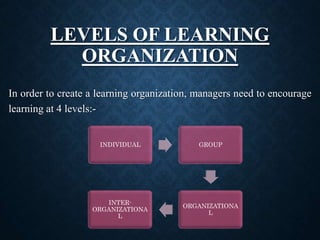
In order to create a learning organization, managers need to encourage
learning at 4 levels:-
INDIVIDUAL GROUP
ORGANIZATIONA
L
INTER-
ORGANIZATIONA
L
CREATING A LEARNING
ORGANIZATION
To create a learning organization the following is a must for an
organization:
• All employees from top management to the rank and file workers
must establish a commitment to change for bringing about changes
for improvements of the organizations.
• To accept change more readily formal boundaries between people
are to be eliminated.
• To adapt effectively, organizations should develop a culture of
openness and growth by fully incorporating employees into
challenges faced by the organization.
CONCLUSION
“Without learning the wise become foolish;
by learning, the foolish become wise.”
Learning organization

Learning organization

  • 1.
  • 2.
    CONTENTS • WHAT ISA LEARNING ORGANIZATION? • NATURE • CHARACTERISTICS • CORE AREAS • LEVELS • CREATING A LEARNING ORGANIZATION • CONCLUSION
  • 3.
    LEARNING ORGANIZATION • A learningorganization is the term given to a company that facilitates the learning of its members and continuously transforms itself. • This concept was coined through the work and research of Peter Senge and his colleagues. “A place where people continually expand their capacity to create the results they truly desire, where new and expansive patterns of thinking are nurtured, where collective aspirations are set free, where people are continually learning to learn together.” – Peter Senge
  • 4.
    NATURE OF LEARNING ORGANIZATION Alearning organization is one that: • Seeks to create its own future. • Assumes learning is an ongoing and creative process for its members. • Develops, adapts and transforms itself in response to the needs and aspirations of people, both inside and outside itself. • Allows people at all levels, individually and collectively, to continually increasing their capacity to produce results.
  • 5.
    CHARACTERISTICS • New ideasand information. • Strive to reduce structural, process and interpersonal barriers to the sharing of information, ideas and knowledge. • Encourage employees and encourage an environment to use information, ideas and knowledge to achieve corporate goals.
  • 6.
    CORE AREAS OFLEARNING ORGANIZATION Senge discussed five core areas that need to be emphasized by any organization that seeks to evolve into a learning organization. They are: •Personal mastery •Mental models •Working in teams •Shared visions •Systems thinking
  • 7.
    LEVELS OF LEARNING ORGANIZATION Inorder to create a learning organization, managers need to encourage learning at 4 levels:- INDIVIDUAL GROUP ORGANIZATIONA L INTER- ORGANIZATIONA L
  • 8.
    CREATING A LEARNING ORGANIZATION Tocreate a learning organization the following is a must for an organization: • All employees from top management to the rank and file workers must establish a commitment to change for bringing about changes for improvements of the organizations. • To accept change more readily formal boundaries between people are to be eliminated. • To adapt effectively, organizations should develop a culture of openness and growth by fully incorporating employees into challenges faced by the organization.
  • 9.
    CONCLUSION “Without learning thewise become foolish; by learning, the foolish become wise.”

Editor's Notes

  • #10 Learning organization is an attitude and philosophy about what an organization is and the role of employees