HUMAN RESOURCE DEVELOPMENT
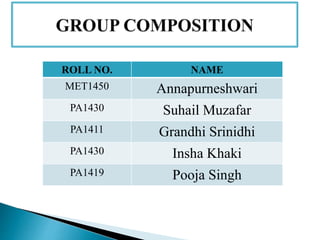
ROLL NO. NAME
MET1450 Annapurneshwari
PA1430 Suhail Muzafar
PA1411 Grandhi Srinidhi
PA1430 Insha Khaki
PA1419 Pooja Singh
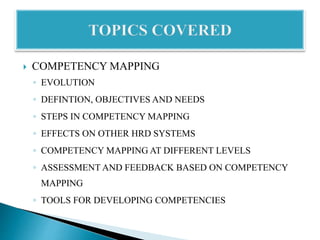
 COMPETENCY MAPPING
◦ EVOLUTION
◦ DEFINTION, OBJECTIVES AND NEEDS
◦ STEPS IN COMPETENCY MAPPING
◦ EFFECTS ON OTHER HRD SYSTEMS
◦ COMPETENCY MAPPING AT DIFFERENT LEVELS
◦ ASSESSMENT AND FEEDBACK BASED ON COMPETENCY
MAPPING
◦ TOOLS FOR DEVELOPING COMPETENCIES
 Beginning of the twentieth century - work brought complex skills to the
job. Business process required specific competencies for the task at hand.
 Era of scientific management – Taylor’s and Ford’s use of assembly line
shifted focus from competency to time and motion study.
 World War II (mid century) enforced management centric views where
officers gave orders to subordinates who obeyed without questions.
 1960 – David McClelland’s landmark article in the American Psychologist
asserted that companies should hire people based upon competencies rather
than test scores.
 1973 – McClelland developed new methods to predict human performance
for US Information Agency. Objective was to eliminate the potential biases
of traditional intelligence and aptitude testing.
 The turning point for competency movement – Article published in
American Psychologist in 1973 by McClelland.
 Equally noteworthy is the pioneering work by Douglas Brey and his
associates at AT&T which gave evidence that the competencies can be
accessed through assessment centers and on the job success can be predicted
to certain extent.
 Behavior Event Interviewing (BEI) was developed by McBer to map the
competencies.
 Increased recognition of the limitations of performance appraisal in
predicting future performance shifted focus to potential appraisal and
assessment centers in seventies.
 Assessment centers were an integral part of the HRD plan given to L&T in
1975.
Any underlying characteristic required for performing a
given task, activity or role successfully can be
considered as competency.
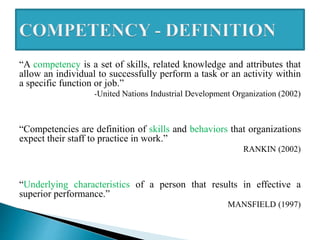
“A competency is a set of skills, related knowledge and attributes that
allow an individual to successfully perform a task or an activity within
a specific function or job.”
-United Nations Industrial Development Organization (2002)
“Competencies are definition of skills and behaviors that organizations
expect their staff to practice in work.”
RANKIN (2002)
“Underlying characteristics of a person that results in effective a
superior performance.”
MANSFIELD (1997)
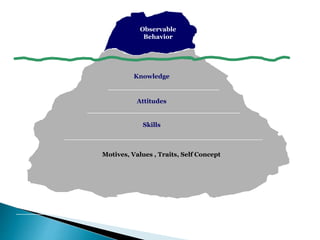
Observable
Behavior
Motives, Values , Traits, Self Concept
Attitudes
Knowledge
Skills
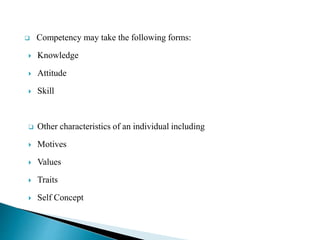
 Competency may take the following forms:
 Knowledge
 Attitude
 Skill
 Other characteristics of an individual including
 Motives
 Values
 Traits
 Self Concept
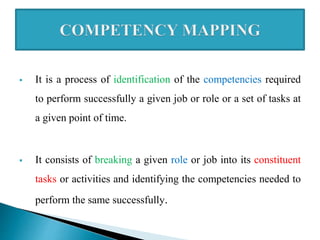
 It is a process of identification of the competencies required
to perform successfully a given job or role or a set of tasks at
a given point of time.
 It consists of breaking a given role or job into its constituent
tasks or activities and identifying the competencies needed to
perform the same successfully.
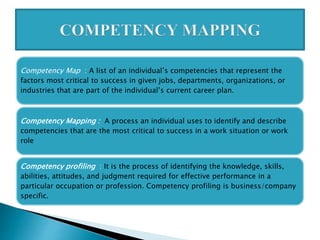
Competency Map : A list of an individual’s competencies that represent the
factors most critical to success in given jobs, departments, organizations, or
industries that are part of the individual’s current career plan.
Competency Mapping : A process an individual uses to identify and describe
competencies that are the most critical to success in a work situation or work
role
Competency profiling : It is the process of identifying the knowledge, skills,
abilities, attitudes, and judgment required for effective performance in a
particular occupation or profession. Competency profiling is business/company
specific.
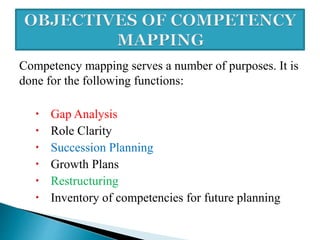
Competency mapping serves a number of purposes. It is
done for the following functions:
 Gap Analysis
 Role Clarity
 Succession Planning
 Growth Plans
 Restructuring
 Inventory of competencies for future planning
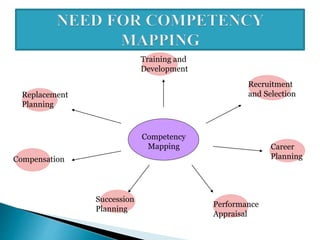
Training and
Development
Recruitment
and Selection
Career
Planning
Performance
Appraisal
Succession
Planning
Compensation
Replacement
Planning
Competency
Mapping
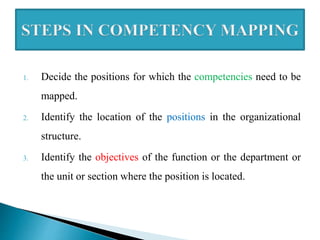
1. Decide the positions for which the competencies need to be
mapped.
2. Identify the location of the positions in the organizational
structure.
3. Identify the objectives of the function or the department or
the unit or section where the position is located.
4. Identify the objectives of the role. Why does the position
exist? What are the main purposes of the role etc. details.
5. Collect the Key Performance Areas (or KRAs, Tasks, etc.) of
the position holder for the last two to three years from the
performance appraisal records.
6. Interview the position holder to list the Tasks and activities expected
to be performed by the Individual. Group them into a set of tasks.
The tasks list may be as many as 15 to 20 for some positions and as
Competency Mapping few as five to six for other positions.
7. Interview the position holder to list the actual knowledge,
attitude, skills, and other competencies required for
performing the task effectively.
8. Repeat the process with all the position set members.
9. Consolidate the list of competencies from all the position holders’
by each task.
10. Edit and finalize. Present it to the supervisors of the position holder
and the position holder for approval and finalization.
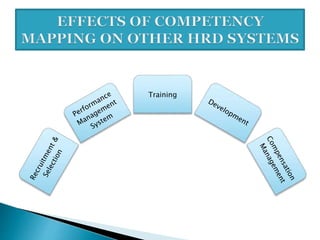
Training
Competency-based recruitment is a process of
recruitment based on the ability of candidates to produce
anecdotes about their professional experience which can
be used as evidence that the candidate has a given
competency.
A competency based approach to recruitment and selection of staff can help an
organization, to make it an effective and successful investment of time, money
and expertise. Such an approach will help to ensure that:
i. The organization is clear regarding the competencies and skill sets
required by the job;
ii. Selection processes encourage a good fit between individuals and their
jobs, managers and staff have the required skills and competencies;
iii. Individual skills and abilities are matched to the requirements of the job;
and
iv. Evaluation of work demands and staffing are accurate
Integrating competencies within the performance management
process supports the provision of feedback to employees not only on
“what” they have accomplished (i.e., performance goals), but also
“how” the work was performed, using competencies for providing
feedback.
 Integrating competency with PMS helps:-
 Employees in understanding performance expectations and enhancing
competencies.
 To provide a mechanism for providing positive feedback about an
employee’s training achievements and on-the-job performance
 To provide job standards for performance appraisal
 To provide clear direction for learning new job skills
Competency Based Training focuses on what the participant is
expected to be able to do in the workplace as opposed to just having
theoretical knowledge.
An important characteristic of Competency Based Training is that it
is focused not only on the actual jobs that are required in the
workplace, but also the ability to transfer and apply skills,
knowledge and attitudes to new Situations and environments.
The advantages of competency based training(CBT)
are:
 Participants will achieve competencies required in the
performance of their jobs.
 Participants build confidence as they succeed in mastering
specific competencies.
 Participants receive a transcript or list of the competencies
they have achieved.
Competencies are the need of the hour and designing
appropriate competency development models is a
necessity.
Advantages of competency based development:-
i. Improvement in productivity, performance and profitability
ii. Identify employee’s capabilities for an organization’s future
needs
iii. Analyzing capability gaps
Competency-based pay fits this new environment. It provides an
ongoing incentive to employees to enhance their ability to perform
their jobs.
Advantages of competency based compensation:-
i. Provides a basis of deciding on the compensation.
ii. Encourages employees to develop their competencies further.
iii. Lead to a focus on totality of job rather than just what is achieved.
iv. This system fits every job.
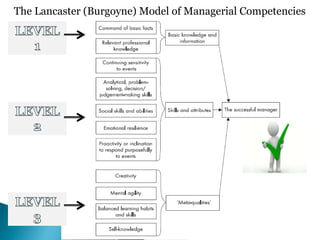
The Lancaster (Burgoyne) Model of Managerial Competencies
A Competency Mapping can address many of the issues
related to performance appraisal:
◦ This ensures agreement on performance criteria, what is
accomplished and what is not accomplished, collecting relevant and
sufficient data
◦ It also ensures opportunity to supervisors to observe behaviour,
specificity and concreteness in discussions about performance
deficiencies
 Provides a shared understanding of what will be monitored
and measured—A Competency Mapping integrated with
performance appraisal ensures a balance between what gets
done and how it gets done.
 The skills, knowledge and characteristics that are important
to success are clearly described. It provides a roadmap of
where to begin the discussion and what areas to focus on.
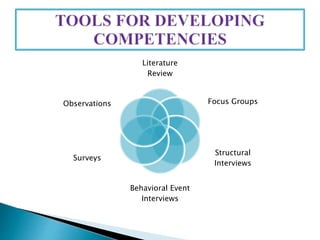
Literature
Review
Focus Groups
Structural
Interviews
Behavioral Event
Interviews
Surveys
Observations
 Literature Review: A preliminary approach for defining job
content and identifying required competencies is to conduct a review of the
literature to learn about previous studies of the job or similar jobs.
 Focus Groups: In focus groups, a facilitator works with a small
group of job incumbents, their managers, supervisees, clients, or others to
define the job content or to identify the competencies they believe are
essential for performance.
 Structured Interviews: In structured interviews, carefully
planned questions are asked individually of job incumbents,
their managers, or others familiar with the job.
 Behavioral Event Interviews: In behavioral event
interviews (BEI), top performers are interviewed individually
about what they did, thought, said, and felt in challenging or
difficult situations. The competencies that were instrumental in
their success are extrapolated from their stories
 Surveys: In surveys, job incumbents, their supervisors, and
perhaps senior managers complete a questionnaire
administered either in print or electronically. The survey
content is based on previous data collection .
 Observations: In this data collection method, the research
team visits high-performing incumbents and observes them at
work. The more complex the job and the greater the variety in
job tasks, the more time is required for an observation.
Competency mapping
Competency mapping

Competency mapping

  • 1.
  • 2.
    ROLL NO. NAME MET1450Annapurneshwari PA1430 Suhail Muzafar PA1411 Grandhi Srinidhi PA1430 Insha Khaki PA1419 Pooja Singh
  • 3.
     COMPETENCY MAPPING ◦EVOLUTION ◦ DEFINTION, OBJECTIVES AND NEEDS ◦ STEPS IN COMPETENCY MAPPING ◦ EFFECTS ON OTHER HRD SYSTEMS ◦ COMPETENCY MAPPING AT DIFFERENT LEVELS ◦ ASSESSMENT AND FEEDBACK BASED ON COMPETENCY MAPPING ◦ TOOLS FOR DEVELOPING COMPETENCIES
  • 4.
     Beginning ofthe twentieth century - work brought complex skills to the job. Business process required specific competencies for the task at hand.  Era of scientific management – Taylor’s and Ford’s use of assembly line shifted focus from competency to time and motion study.  World War II (mid century) enforced management centric views where officers gave orders to subordinates who obeyed without questions.
  • 5.
     1960 –David McClelland’s landmark article in the American Psychologist asserted that companies should hire people based upon competencies rather than test scores.  1973 – McClelland developed new methods to predict human performance for US Information Agency. Objective was to eliminate the potential biases of traditional intelligence and aptitude testing.
  • 6.
     The turningpoint for competency movement – Article published in American Psychologist in 1973 by McClelland.  Equally noteworthy is the pioneering work by Douglas Brey and his associates at AT&T which gave evidence that the competencies can be accessed through assessment centers and on the job success can be predicted to certain extent.
  • 7.
     Behavior EventInterviewing (BEI) was developed by McBer to map the competencies.  Increased recognition of the limitations of performance appraisal in predicting future performance shifted focus to potential appraisal and assessment centers in seventies.  Assessment centers were an integral part of the HRD plan given to L&T in 1975.
  • 8.
    Any underlying characteristicrequired for performing a given task, activity or role successfully can be considered as competency.
  • 9.
    “A competency isa set of skills, related knowledge and attributes that allow an individual to successfully perform a task or an activity within a specific function or job.” -United Nations Industrial Development Organization (2002) “Competencies are definition of skills and behaviors that organizations expect their staff to practice in work.” RANKIN (2002) “Underlying characteristics of a person that results in effective a superior performance.” MANSFIELD (1997)
  • 10.
    Observable Behavior Motives, Values ,Traits, Self Concept Attitudes Knowledge Skills
  • 11.
     Competency maytake the following forms:  Knowledge  Attitude  Skill  Other characteristics of an individual including  Motives  Values  Traits  Self Concept
  • 12.
     It isa process of identification of the competencies required to perform successfully a given job or role or a set of tasks at a given point of time.  It consists of breaking a given role or job into its constituent tasks or activities and identifying the competencies needed to perform the same successfully.
  • 13.
    Competency Map :A list of an individual’s competencies that represent the factors most critical to success in given jobs, departments, organizations, or industries that are part of the individual’s current career plan. Competency Mapping : A process an individual uses to identify and describe competencies that are the most critical to success in a work situation or work role Competency profiling : It is the process of identifying the knowledge, skills, abilities, attitudes, and judgment required for effective performance in a particular occupation or profession. Competency profiling is business/company specific.
  • 14.
    Competency mapping servesa number of purposes. It is done for the following functions:  Gap Analysis  Role Clarity  Succession Planning  Growth Plans  Restructuring  Inventory of competencies for future planning
  • 15.
  • 16.
    1. Decide thepositions for which the competencies need to be mapped. 2. Identify the location of the positions in the organizational structure. 3. Identify the objectives of the function or the department or the unit or section where the position is located.
  • 17.
    4. Identify theobjectives of the role. Why does the position exist? What are the main purposes of the role etc. details. 5. Collect the Key Performance Areas (or KRAs, Tasks, etc.) of the position holder for the last two to three years from the performance appraisal records.
  • 18.
    6. Interview theposition holder to list the Tasks and activities expected to be performed by the Individual. Group them into a set of tasks. The tasks list may be as many as 15 to 20 for some positions and as Competency Mapping few as five to six for other positions. 7. Interview the position holder to list the actual knowledge, attitude, skills, and other competencies required for performing the task effectively.
  • 19.
    8. Repeat theprocess with all the position set members. 9. Consolidate the list of competencies from all the position holders’ by each task. 10. Edit and finalize. Present it to the supervisors of the position holder and the position holder for approval and finalization.
  • 20.
  • 21.
    Competency-based recruitment isa process of recruitment based on the ability of candidates to produce anecdotes about their professional experience which can be used as evidence that the candidate has a given competency.
  • 22.
    A competency basedapproach to recruitment and selection of staff can help an organization, to make it an effective and successful investment of time, money and expertise. Such an approach will help to ensure that: i. The organization is clear regarding the competencies and skill sets required by the job; ii. Selection processes encourage a good fit between individuals and their jobs, managers and staff have the required skills and competencies; iii. Individual skills and abilities are matched to the requirements of the job; and iv. Evaluation of work demands and staffing are accurate
  • 23.
    Integrating competencies withinthe performance management process supports the provision of feedback to employees not only on “what” they have accomplished (i.e., performance goals), but also “how” the work was performed, using competencies for providing feedback.  Integrating competency with PMS helps:-  Employees in understanding performance expectations and enhancing competencies.  To provide a mechanism for providing positive feedback about an employee’s training achievements and on-the-job performance  To provide job standards for performance appraisal  To provide clear direction for learning new job skills
  • 24.
    Competency Based Trainingfocuses on what the participant is expected to be able to do in the workplace as opposed to just having theoretical knowledge. An important characteristic of Competency Based Training is that it is focused not only on the actual jobs that are required in the workplace, but also the ability to transfer and apply skills, knowledge and attitudes to new Situations and environments.
  • 25.
    The advantages ofcompetency based training(CBT) are:  Participants will achieve competencies required in the performance of their jobs.  Participants build confidence as they succeed in mastering specific competencies.  Participants receive a transcript or list of the competencies they have achieved.
  • 26.
    Competencies are theneed of the hour and designing appropriate competency development models is a necessity. Advantages of competency based development:- i. Improvement in productivity, performance and profitability ii. Identify employee’s capabilities for an organization’s future needs iii. Analyzing capability gaps
  • 27.
    Competency-based pay fitsthis new environment. It provides an ongoing incentive to employees to enhance their ability to perform their jobs. Advantages of competency based compensation:- i. Provides a basis of deciding on the compensation. ii. Encourages employees to develop their competencies further. iii. Lead to a focus on totality of job rather than just what is achieved. iv. This system fits every job.
  • 29.
    The Lancaster (Burgoyne)Model of Managerial Competencies
  • 31.
    A Competency Mappingcan address many of the issues related to performance appraisal: ◦ This ensures agreement on performance criteria, what is accomplished and what is not accomplished, collecting relevant and sufficient data ◦ It also ensures opportunity to supervisors to observe behaviour, specificity and concreteness in discussions about performance deficiencies
  • 32.
     Provides ashared understanding of what will be monitored and measured—A Competency Mapping integrated with performance appraisal ensures a balance between what gets done and how it gets done.  The skills, knowledge and characteristics that are important to success are clearly described. It provides a roadmap of where to begin the discussion and what areas to focus on.
  • 33.
  • 34.
     Literature Review:A preliminary approach for defining job content and identifying required competencies is to conduct a review of the literature to learn about previous studies of the job or similar jobs.  Focus Groups: In focus groups, a facilitator works with a small group of job incumbents, their managers, supervisees, clients, or others to define the job content or to identify the competencies they believe are essential for performance.
  • 35.
     Structured Interviews:In structured interviews, carefully planned questions are asked individually of job incumbents, their managers, or others familiar with the job.  Behavioral Event Interviews: In behavioral event interviews (BEI), top performers are interviewed individually about what they did, thought, said, and felt in challenging or difficult situations. The competencies that were instrumental in their success are extrapolated from their stories
  • 36.

     Surveys: Insurveys, job incumbents, their supervisors, and perhaps senior managers complete a questionnaire administered either in print or electronically. The survey content is based on previous data collection .  Observations: In this data collection method, the research team visits high-performing incumbents and observes them at work. The more complex the job and the greater the variety in job tasks, the more time is required for an observation.