FUTURE OF OD
SUBMITTED BY:-
POOJA DESWAL
WHAT IS ORGANIZATION DEVELOPMENT ?
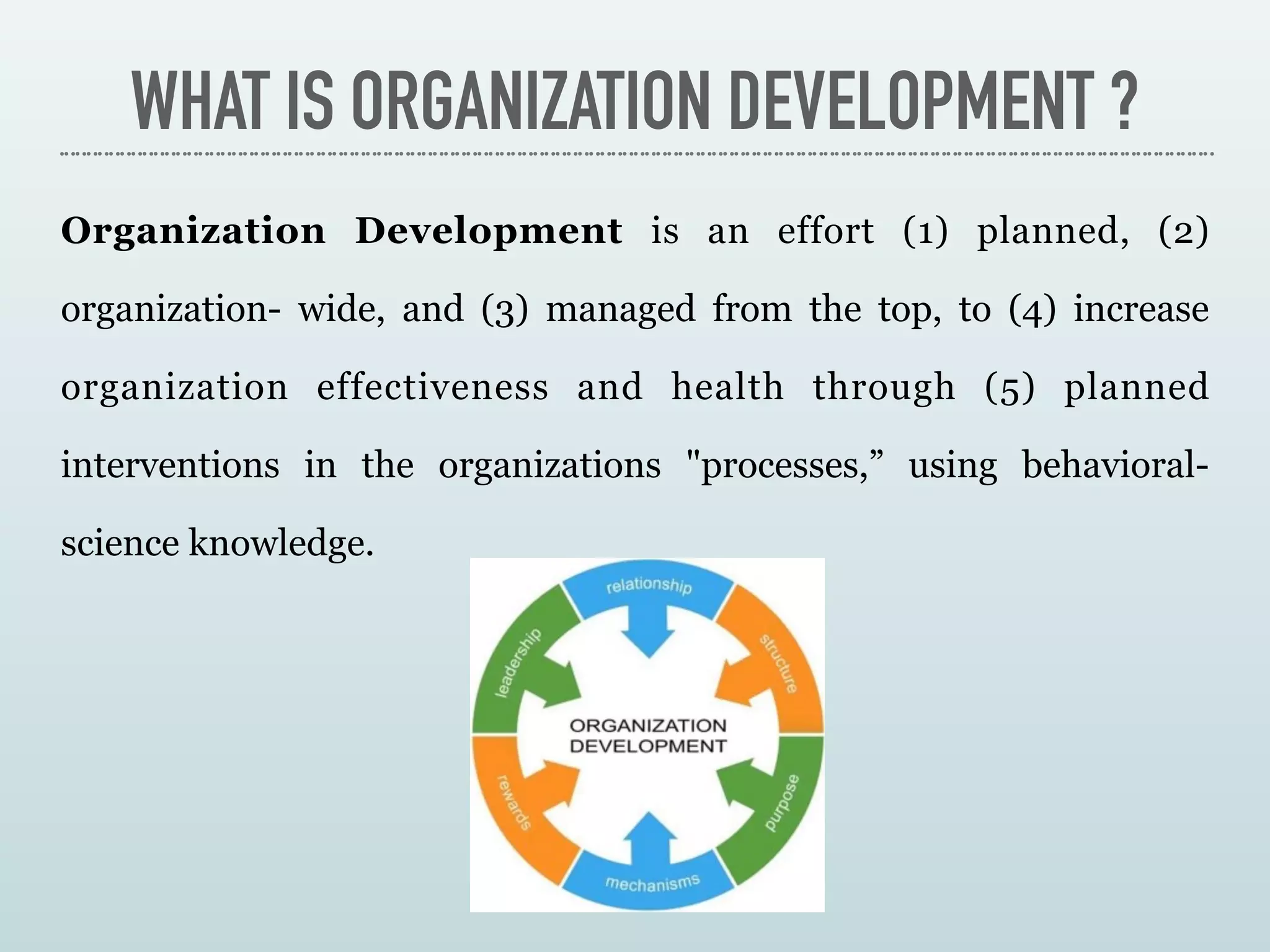
Organization Development is an effort (1) planned, (2)
organization- wide, and (3) managed from the top, to (4) increase
organization effectiveness and health through (5) planned
interventions in the organizations "processes,” using behavioral-
science knowledge.
PAST OF OD
PAST TRENDS OF OD


People used to learn in classrooms
Laboratory training
Leaders were identified on the basis of experience, tenure and
business Performance
Increase Focus on Productivity
Employees were not treated as assets
PAST TRENDS OF OD
One Person One job
Low Performance was tolerated
Employees were given negative motivation like fears and
punishments
Little acknowledgement
Focuses on short term results
Contextual trends and their effect on
OD’s Future
ECONOMY
WORKFORCE
TECHNOLOGY
ORGANISATION
THE ECONOMY
Cultural diversity – Governments face the difficult choice of  preserving their
culture ant the risk of being left out of the global economy.
Income distribution – globalization of the economy is closely related to an
increasing concentration of wealth in relatively few individuals, corporation
and nations.
Ecological sustainability – there are increasingly clear warnings that the
ecosystem no longer can be treated as a factor of  production and that
success cannot be defined as the accumulation of wealth and material goods
at the expense of the environment.
THE WORKFORCE
Diverse – organizations, whether they operate primarily in their home country
or abroad, will need to develop policies and operating styles that embrace the
changing cultural, ethnic, gender and age diversity of the workforce.
Educated – the workforce is becoming more educated. A more educated
workforce demands higher wages, more involvement in decision making and
continued investment of knowledge and skills.
Contingent – the continued high rate of  downsizings, re-engineering efforts,
and mergers and acquisitions is forcing the workforce to become more
contingent and less loyal.
TECHNOLOGY
Internet – the backbone of global economy.
E-commerce – an economy that knows no boundaries. It involves buying
and selling products and services over the internet.
Two types of E-commerce relevant to OD’s Future
Business-to-consumer – garners much attention and awareness because it
is how the public participates in E-commerce.
Business-to-business – more complex
ORGANISATION
Organization involves increasingly networked and knowledge based
nature of organizations. The interventions help organizations become
more streamlined and flexible, more capable of improving themselves
continuously in response to economic and other 
trends and more effective.
Networks – are highly adaptable and can disband and
reform along different task or market lines as the
circumstances demand.
ORGANIZATIONAL DEVELOPMENT WILL BE:-
➢More embedded in the organization's operations
➢More technologically enabled
➢Shorter OD cycle times

➢More interdisciplinary

➢More diverse in client

➢More cross –cultural

➢More concerned with organization
7 PRINCIPLES OF THE FUTURE EMPLOYEE
1- Has a flexible Environment
2- Can customize own work
3- Shares information
4- Uses New ways to communicate and collaborate
5- Can Become a leader
6- Shifts from Knowledge worker to learning worker
7- Learns and teaches at well
IMPLICATIONS OF “OD”
FUTURE
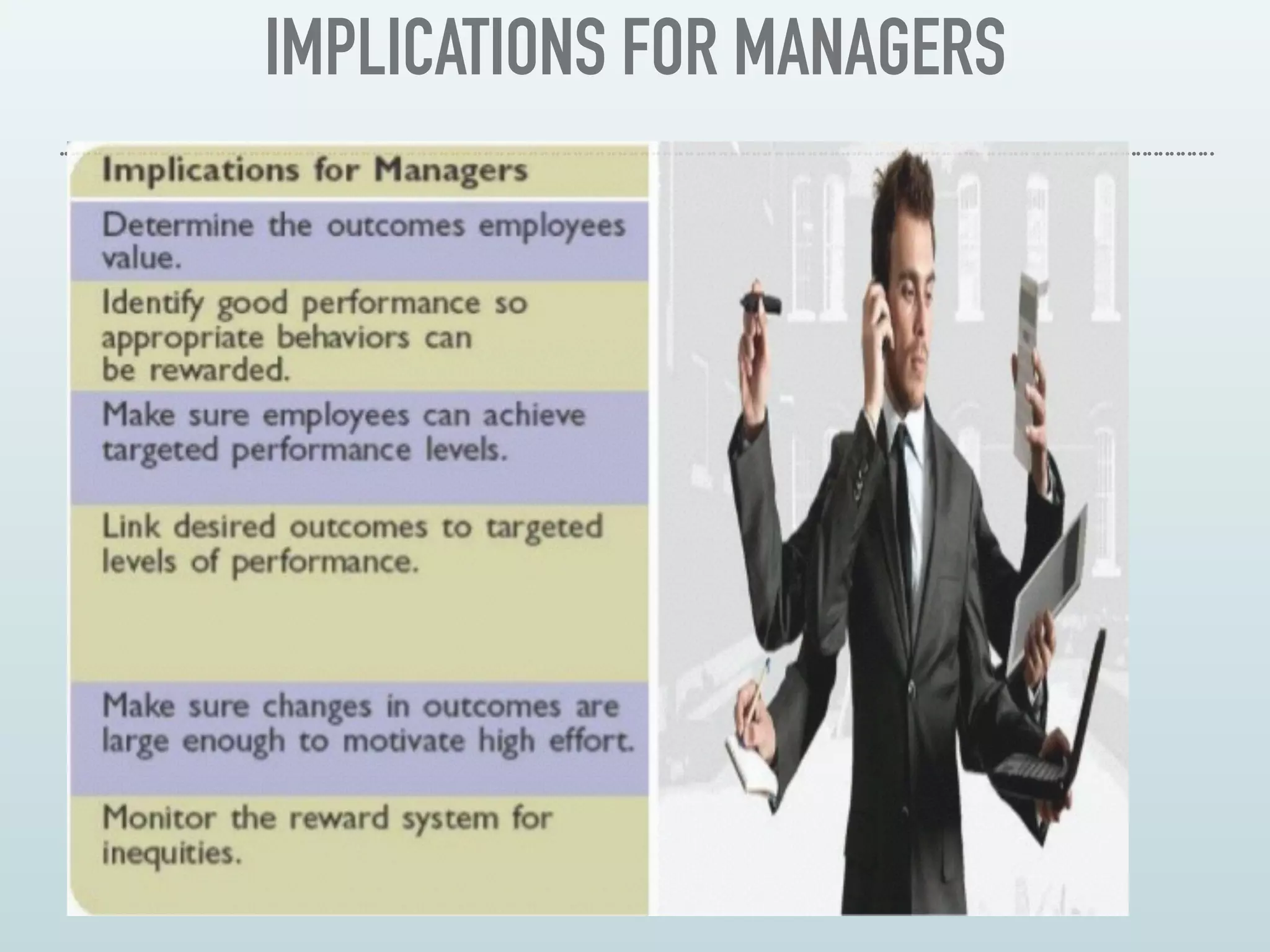
IMPLICATIONS FOR MANAGERS
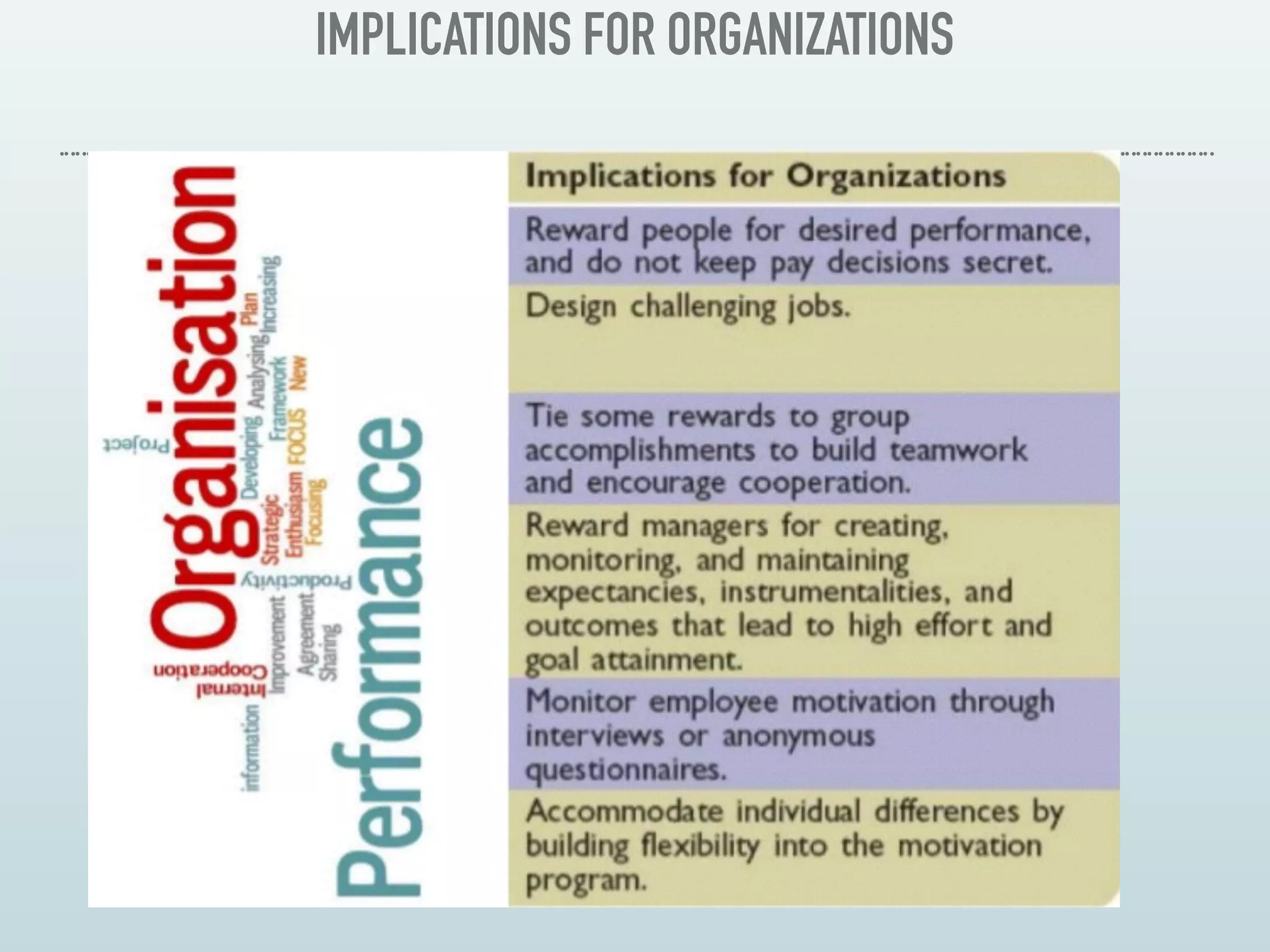
IMPLICATIONS FOR ORGANIZATIONS
THANK YOU

FUTURE OF ORGANIZATION DEVELOPMENT

  • 1.
    FUTURE OF OD SUBMITTEDBY:- POOJA DESWAL
  • 2.
    WHAT IS ORGANIZATIONDEVELOPMENT ? Organization Development is an effort (1) planned, (2) organization- wide, and (3) managed from the top, to (4) increase organization effectiveness and health through (5) planned interventions in the organizations "processes,” using behavioral- science knowledge.
  • 3.
  • 4.
    PAST TRENDS OFOD 
 People used to learn in classrooms Laboratory training Leaders were identified on the basis of experience, tenure and business Performance Increase Focus on Productivity Employees were not treated as assets
  • 5.
    PAST TRENDS OFOD One Person One job Low Performance was tolerated Employees were given negative motivation like fears and punishments Little acknowledgement Focuses on short term results
  • 6.
    Contextual trends andtheir effect on OD’s Future ECONOMY WORKFORCE TECHNOLOGY ORGANISATION
  • 7.
    THE ECONOMY Cultural diversity– Governments face the difficult choice of  preserving their culture ant the risk of being left out of the global economy. Income distribution – globalization of the economy is closely related to an increasing concentration of wealth in relatively few individuals, corporation and nations. Ecological sustainability – there are increasingly clear warnings that the ecosystem no longer can be treated as a factor of  production and that success cannot be defined as the accumulation of wealth and material goods at the expense of the environment.
  • 8.
    THE WORKFORCE Diverse –organizations, whether they operate primarily in their home country or abroad, will need to develop policies and operating styles that embrace the changing cultural, ethnic, gender and age diversity of the workforce. Educated – the workforce is becoming more educated. A more educated workforce demands higher wages, more involvement in decision making and continued investment of knowledge and skills. Contingent – the continued high rate of  downsizings, re-engineering efforts, and mergers and acquisitions is forcing the workforce to become more contingent and less loyal.
  • 9.
    TECHNOLOGY Internet – thebackbone of global economy. E-commerce – an economy that knows no boundaries. It involves buying and selling products and services over the internet. Two types of E-commerce relevant to OD’s Future Business-to-consumer – garners much attention and awareness because it is how the public participates in E-commerce. Business-to-business – more complex
  • 10.
    ORGANISATION Organization involves increasinglynetworked and knowledge based nature of organizations. The interventions help organizations become more streamlined and flexible, more capable of improving themselves continuously in response to economic and other  trends and more effective. Networks – are highly adaptable and can disband and reform along different task or market lines as the circumstances demand.
  • 11.
    ORGANIZATIONAL DEVELOPMENT WILLBE:- ➢More embedded in the organization's operations ➢More technologically enabled ➢Shorter OD cycle times
 ➢More interdisciplinary
 ➢More diverse in client
 ➢More cross –cultural
 ➢More concerned with organization
  • 12.
    7 PRINCIPLES OFTHE FUTURE EMPLOYEE 1- Has a flexible Environment 2- Can customize own work 3- Shares information 4- Uses New ways to communicate and collaborate 5- Can Become a leader 6- Shifts from Knowledge worker to learning worker 7- Learns and teaches at well
  • 13.
  • 14.
  • 15.
  • 16.