Learning Organization
Prepared By
Kindly restrict the use of slides for personal purpose.
Please seek permission to reproduce the same in public forms and presentations.
Manu Melwin Joy
Assistant Professor
Ilahia School of Management Studies
Kerala, India.
Phone – 9744551114
Mail – manu_melwinjoy@yahoo.com
1. Peter Senge is an American
scientist born in 1947, called as
the Strategist of the Century”.
2. He was the director of centre for
Organizational Learning at MIT
school of Management and the
author of “The Fifth Discipline”
in 1990.
3. In his book he explain about the
concept of learning organisation.
Learning Organization
• A learning organization is the
term given to a company that
facilitates the learning of its
members and continuously
transforms itself.
• A learning organization is a place
where people are continually
discovering how they create their
reality.”
Learning Organization
1. Stability is yielding to change
2. Change is constant
3. Rate of change is increasing
geometrically
1. Technology
2. Science
3. Standard of living
Why is Organizational Learning Important?
Why is Organizational Learning
Important?
• For companies to be able to
adapt to changing environments
and stay ahead of their
competition
• To improve the workforce skill-
set
• To improve communication
among employees
• To improve morale and
productivity and make the
employees feel like they are an
important entity of the company.
• To overcome companies
weaknesses and to utilize their
strength more efficiently
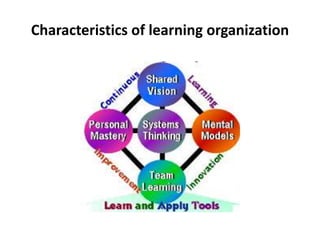
Characteristics of learning organization
Systems Thinking
• The idea of the learning
organization developed from a
body of work called system
thinking.
• This is a conceptual
framework that allows people
to study businesses as
bounded objects.
• Systems thinking states that all
the characteristics must be
apparent at once in an
organization for it to be a
learning organization
Personal Mastery
• The commitment by an
individual to the process of
learning is known as personal
mastery.
• There is a competitive advantage
for an organization whose
workforce can learn more
quickly than the workforce of
other organizations.
• A learning organization has been
described as the sum of
individual learning, but there
must be mechanisms for
individual learning to be
transferred into organizational
learning.
Mental Models
• The assumptions held by
individuals and
organizations are called
mental models.
• To become a learning
organization, these models
must be challenged.
• In creating a learning
environment it is important
to replace confrontational
attitudes with an open
culture that promotes
inquiry and trust.
Shared Vision
• The development of a shared
vision is important in
motivating the staff to learn,
as it creates a common
identity that provides focus
and energy for learning.
• The most successful visions
build on the individual visions
of the employees at all levels
of the organization.
• learning organizations tend to
have flat, decentralized
organizational structure.
Team learning
• The accumulation of
individual learning
constitutes team learning.
• Learning organizations
have structures that
facilitate team learning
with features such as
boundary crossing and
openness.
• Team learning requires
individuals to engage in
dialogue and discussion.
Learning organization - Manu Melwin Joy

Learning organization - Manu Melwin Joy

  • 1.
  • 2.
    Prepared By Kindly restrictthe use of slides for personal purpose. Please seek permission to reproduce the same in public forms and presentations. Manu Melwin Joy Assistant Professor Ilahia School of Management Studies Kerala, India. Phone – 9744551114 Mail – manu_melwinjoy@yahoo.com
  • 3.
    1. Peter Sengeis an American scientist born in 1947, called as the Strategist of the Century”. 2. He was the director of centre for Organizational Learning at MIT school of Management and the author of “The Fifth Discipline” in 1990. 3. In his book he explain about the concept of learning organisation. Learning Organization
  • 4.
    • A learningorganization is the term given to a company that facilitates the learning of its members and continuously transforms itself. • A learning organization is a place where people are continually discovering how they create their reality.” Learning Organization
  • 5.
    1. Stability isyielding to change 2. Change is constant 3. Rate of change is increasing geometrically 1. Technology 2. Science 3. Standard of living Why is Organizational Learning Important?
  • 6.
    Why is OrganizationalLearning Important? • For companies to be able to adapt to changing environments and stay ahead of their competition • To improve the workforce skill- set • To improve communication among employees • To improve morale and productivity and make the employees feel like they are an important entity of the company. • To overcome companies weaknesses and to utilize their strength more efficiently
  • 7.
  • 8.
    Systems Thinking • Theidea of the learning organization developed from a body of work called system thinking. • This is a conceptual framework that allows people to study businesses as bounded objects. • Systems thinking states that all the characteristics must be apparent at once in an organization for it to be a learning organization
  • 9.
    Personal Mastery • Thecommitment by an individual to the process of learning is known as personal mastery. • There is a competitive advantage for an organization whose workforce can learn more quickly than the workforce of other organizations. • A learning organization has been described as the sum of individual learning, but there must be mechanisms for individual learning to be transferred into organizational learning.
  • 10.
    Mental Models • Theassumptions held by individuals and organizations are called mental models. • To become a learning organization, these models must be challenged. • In creating a learning environment it is important to replace confrontational attitudes with an open culture that promotes inquiry and trust.
  • 11.
    Shared Vision • Thedevelopment of a shared vision is important in motivating the staff to learn, as it creates a common identity that provides focus and energy for learning. • The most successful visions build on the individual visions of the employees at all levels of the organization. • learning organizations tend to have flat, decentralized organizational structure.
  • 12.
    Team learning • Theaccumulation of individual learning constitutes team learning. • Learning organizations have structures that facilitate team learning with features such as boundary crossing and openness. • Team learning requires individuals to engage in dialogue and discussion.