LEARNING
BY:
MANAS PANDEY
MBA(IB)
51
ORGANIZATION
Introduction
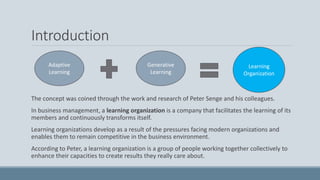
The concept was coined through the work and research of Peter Senge and his colleagues.
In business management, a learning organization is a company that facilitates the learning of its
members and continuously transforms itself.
Learning organizations develop as a result of the pressures facing modern organizations and
enables them to remain competitive in the business environment.
According to Peter, a learning organization is a group of people working together collectively to
enhance their capacities to create results they really care about.
Adaptive
Learning
Generative
Learning
Learning
Organization
Characteristics of
a Learning Organization
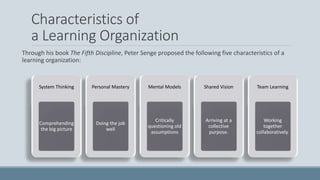
Through his book The Fifth Discipline, Peter Senge proposed the following five characteristics of a
learning organization:
System Thinking
Comprehending
the big picture
Personal Mastery
Doing the job
well
Mental Models
Critically
questioning old
assumptions
Shared Vision
Arriving at a
collective
purpose.
Team Learning
Working
together
collaboratively.
Systems thinking
 An engine has many parts and for any engine to function at its full potential, all parts must be
operational.
 The same principle holds true for organizations.
 Understanding the interconnections and interrelationships that shape the behavior of the systems in
which we exist.
 Organizations are made up of interrelated elements that function as a whole.
 Changes in one element or part of the system can cause changes in other elements.
 Depending of the effect of the change, overall company performance can be either greatly enhanced or
diminished.
Personal mastery
Learning to expand one’s personal capacity to create the future and results one most desires.
No organization can truly be a learning organization without its individual members being free to learn.
Employees must be taught, encouraged and granted permission to become creative architects of their
own work lives.
It should be thought of as of continuous growth and development – not a human state to be achieved.
Mental models
 Mental models are images, assumptions and beliefs that everyone carries around in their heads.
 They include strongly held beliefs about self, family members, employing organizations and the world
at large which exist in the subconscious.
 Surfacing, clarifying, testing and improving one’s internal representations of the world and
understanding how these representations, along with their accompanying implicit assumptions, shape
one’s decisions and actions.
 These mental maps help people simplify, organize and make sense of their complex world.
Shared Vision
 In a learning organization all workers, regardless of their position, are invited and provided with
opportunities to create, test, communicate and promote the company’s mission.
 Building a common sense of purpose and commitment by developing shared images of the future that
we seek to create.
 Employees are asked to play a strategic part in setting the goals and quality standards that will turn
their company’s shared vision into reality.
 Workers are also encouraged and given assistance in setting and aligning their own personal visions
and goals with those of the organization.
 In this way, learning organizations have a definite advantage over their competitors.
Team Learning
 People can learn and think of more things collectively than they can individually.
 This is due to the fact that people learn from one another.
 Reflecting on action as a team and transforming collective thinking skills so that the team can develop
intelligence and ability greater than the sum of individual member’s talents.
 The ideas expressed by one person can set in motion a sweeping avalanche of ideas.
Benefits
Maintaining levels of innovation and remaining competitive
Improved efficiency
Having the knowledge to better link resources to customer needs
Improving quality of outputs at all levels
Improving corporate image by becoming more people oriented
Increasing the pace of change within the organization
Barriers to Learning Organization
Resistance to Change:
This is prevalent mostly in environments with individuals who have been at their jobs for a long time.
 Older companies have a hard time with the organizational learning.
This is where the leader must be able to win the employees over and make them understand that it is
for their benefit, not detriment that changes.
Ignoring Purple Elephants:
There are often problems and situations in a professional environment that everyone knows about , but
nobody wants to discuss.
This may be the result of it being a sensitive subject that could result in offense, or possibly something that
collectively is upsetting to the whole, resulting in the innate desire to turn the other way.
 If problems exist that go ignored then learning dynamics will ultimately fail as a result.
 These things must be discussed openly.
Lack of Direct Leadership:
Leadership that is overly passive is not going to get the job done with organizational learning.
 While some passive, mellow mindset helps in leadership in modern culture, leaders need to be present and
involved in every aspect of learning, to motivate the people and give them the resolve and confidence they
need to press on.
 Leaders must ask difficult questions and be a little tough where need to be – tough love is not always a bad
thing.
Disregard of Team Success:
In many corporate cultures, a mindset sinks in of congratulation and adoration of personal accomplishments,
but a sense of team spirit and unity is not there.
For organizational learning to be successful, the team success and unity must be valued equally to if not
more than individual success and prosperity.
Short-term Focus:
 In business, it’s often easy to focus on stop gaps to solve short term problems without looking at the big
picture.
 The big picture must always be the focus of all involved.
Too Much Control:
While being organized and planned out is always valuable, it is often an unintentional habit for leaders to
force charts and graphs and the like when planning out organizational learning like any other person.
 This will frustrate those involved, and the act of charting and plotting will take on a mind of its own.
It is best to keep the data simple. They are needed, but only in small doses most of the time.
Tsm ppt

Tsm ppt

  • 1.
  • 2.
    Introduction The concept wascoined through the work and research of Peter Senge and his colleagues. In business management, a learning organization is a company that facilitates the learning of its members and continuously transforms itself. Learning organizations develop as a result of the pressures facing modern organizations and enables them to remain competitive in the business environment. According to Peter, a learning organization is a group of people working together collectively to enhance their capacities to create results they really care about. Adaptive Learning Generative Learning Learning Organization
  • 3.
    Characteristics of a LearningOrganization Through his book The Fifth Discipline, Peter Senge proposed the following five characteristics of a learning organization: System Thinking Comprehending the big picture Personal Mastery Doing the job well Mental Models Critically questioning old assumptions Shared Vision Arriving at a collective purpose. Team Learning Working together collaboratively.
  • 4.
    Systems thinking  Anengine has many parts and for any engine to function at its full potential, all parts must be operational.  The same principle holds true for organizations.  Understanding the interconnections and interrelationships that shape the behavior of the systems in which we exist.  Organizations are made up of interrelated elements that function as a whole.  Changes in one element or part of the system can cause changes in other elements.  Depending of the effect of the change, overall company performance can be either greatly enhanced or diminished.
  • 5.
    Personal mastery Learning toexpand one’s personal capacity to create the future and results one most desires. No organization can truly be a learning organization without its individual members being free to learn. Employees must be taught, encouraged and granted permission to become creative architects of their own work lives. It should be thought of as of continuous growth and development – not a human state to be achieved.
  • 6.
    Mental models  Mentalmodels are images, assumptions and beliefs that everyone carries around in their heads.  They include strongly held beliefs about self, family members, employing organizations and the world at large which exist in the subconscious.  Surfacing, clarifying, testing and improving one’s internal representations of the world and understanding how these representations, along with their accompanying implicit assumptions, shape one’s decisions and actions.  These mental maps help people simplify, organize and make sense of their complex world.
  • 7.
    Shared Vision  Ina learning organization all workers, regardless of their position, are invited and provided with opportunities to create, test, communicate and promote the company’s mission.  Building a common sense of purpose and commitment by developing shared images of the future that we seek to create.  Employees are asked to play a strategic part in setting the goals and quality standards that will turn their company’s shared vision into reality.  Workers are also encouraged and given assistance in setting and aligning their own personal visions and goals with those of the organization.  In this way, learning organizations have a definite advantage over their competitors.
  • 8.
    Team Learning  Peoplecan learn and think of more things collectively than they can individually.  This is due to the fact that people learn from one another.  Reflecting on action as a team and transforming collective thinking skills so that the team can develop intelligence and ability greater than the sum of individual member’s talents.  The ideas expressed by one person can set in motion a sweeping avalanche of ideas.
  • 9.
    Benefits Maintaining levels ofinnovation and remaining competitive Improved efficiency Having the knowledge to better link resources to customer needs Improving quality of outputs at all levels Improving corporate image by becoming more people oriented Increasing the pace of change within the organization
  • 10.
    Barriers to LearningOrganization Resistance to Change: This is prevalent mostly in environments with individuals who have been at their jobs for a long time.  Older companies have a hard time with the organizational learning. This is where the leader must be able to win the employees over and make them understand that it is for their benefit, not detriment that changes.
  • 11.
    Ignoring Purple Elephants: Thereare often problems and situations in a professional environment that everyone knows about , but nobody wants to discuss. This may be the result of it being a sensitive subject that could result in offense, or possibly something that collectively is upsetting to the whole, resulting in the innate desire to turn the other way.  If problems exist that go ignored then learning dynamics will ultimately fail as a result.  These things must be discussed openly.
  • 12.
    Lack of DirectLeadership: Leadership that is overly passive is not going to get the job done with organizational learning.  While some passive, mellow mindset helps in leadership in modern culture, leaders need to be present and involved in every aspect of learning, to motivate the people and give them the resolve and confidence they need to press on.  Leaders must ask difficult questions and be a little tough where need to be – tough love is not always a bad thing.
  • 13.
    Disregard of TeamSuccess: In many corporate cultures, a mindset sinks in of congratulation and adoration of personal accomplishments, but a sense of team spirit and unity is not there. For organizational learning to be successful, the team success and unity must be valued equally to if not more than individual success and prosperity.
  • 14.
    Short-term Focus:  Inbusiness, it’s often easy to focus on stop gaps to solve short term problems without looking at the big picture.  The big picture must always be the focus of all involved.
  • 15.
    Too Much Control: Whilebeing organized and planned out is always valuable, it is often an unintentional habit for leaders to force charts and graphs and the like when planning out organizational learning like any other person.  This will frustrate those involved, and the act of charting and plotting will take on a mind of its own. It is best to keep the data simple. They are needed, but only in small doses most of the time.