ROSIN MARY THOMAS
          MACFAST
PETER SENGE


 An American scientist born in 1947.
 Strategist of the Century”
 Director of centre for Organisational Learning at
  MIT school of Management.
 Author of “The Fifth Discipline” in 1990.
 In his book he explain about the concept of learning
  organisation.
LEARNING ORGANISATION


  A learning organization is the term
   given to a company that facilitates
   the learning of its members and
   continuously transforms itself.
  A learning organization is a place
   where people are continually
   discovering how they create their
   reality.”
Why is Organizational Learning
Important?
Stability is yielding to change
Change is constant
Rate of change is increasing geometrically
 Technology
 Science
 Standard of living
Why should organizations become
          Learning Organization
For companies to be able to adapt to changing
 environments and stay ahead of their competition

 To improve the workforce skill-set

 To improve communication among employees

 To improve morale and productivity and make the
employees feel like they are an important entity of
the company.

To overcome companies weaknesses and to utilize
their strength more efficiently
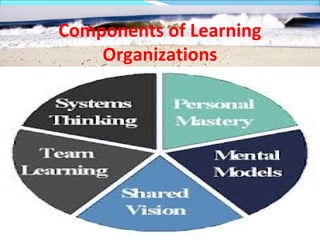
Components of Learning
    Organizations
Systems Thinking
 Thinking about language of describing &
 understanding.

 Interrelationship shapes behavior of system.
Personal Mastery
Considered the “spirit” of organizational learning
Developing, focusing individual vision


Creative tension moves the individual toward a
 solution.
Mental Models
Why Best Ideas Fail.
Mental models determine how we take action
Mental models are so powerful - because they
 affect what we see
Shared Vision
A Common sharing of vision.

A shared vision is a vision that many people
 are truly committed to and it reflects their
 own personal vision.
Team Learning
Members works together.
Importance of dialog and group discussion.
Recognize and resolve negative patterns.
Requires discipline and trust
Conclusion
A learning organization is a place where
 people are continually discovering how they
 create their reality.”
The environment really matters in the
 learning activity.
Learning encourages creativity which is
 essential for organizational development.

The learning organization presentation

  • 1.
  • 2.
    PETER SENGE  AnAmerican scientist born in 1947.  Strategist of the Century”  Director of centre for Organisational Learning at MIT school of Management.  Author of “The Fifth Discipline” in 1990.  In his book he explain about the concept of learning organisation.
  • 3.
    LEARNING ORGANISATION A learning organization is the term given to a company that facilitates the learning of its members and continuously transforms itself. A learning organization is a place where people are continually discovering how they create their reality.”
  • 4.
    Why is OrganizationalLearning Important? Stability is yielding to change Change is constant Rate of change is increasing geometrically Technology Science Standard of living
  • 5.
    Why should organizationsbecome Learning Organization For companies to be able to adapt to changing environments and stay ahead of their competition  To improve the workforce skill-set  To improve communication among employees  To improve morale and productivity and make the employees feel like they are an important entity of the company. To overcome companies weaknesses and to utilize their strength more efficiently
  • 6.
  • 7.
    Systems Thinking  Thinkingabout language of describing & understanding.  Interrelationship shapes behavior of system.
  • 8.
    Personal Mastery Considered the“spirit” of organizational learning Developing, focusing individual vision Creative tension moves the individual toward a solution.
  • 9.
    Mental Models Why BestIdeas Fail. Mental models determine how we take action Mental models are so powerful - because they affect what we see
  • 10.
    Shared Vision A Commonsharing of vision. A shared vision is a vision that many people are truly committed to and it reflects their own personal vision.
  • 11.
    Team Learning Members workstogether. Importance of dialog and group discussion. Recognize and resolve negative patterns. Requires discipline and trust
  • 12.
    Conclusion A learning organizationis a place where people are continually discovering how they create their reality.” The environment really matters in the learning activity. Learning encourages creativity which is essential for organizational development.