“Change is any alternation in the working environment that affects the
ways in which the employees must act.” – Davis
“Alternation in the operations of organizations that are either planned
or unplanned and are a result of either internal or external
environment” –Greenberg and Baron
• Insecurity
• Poor communication
• Personality attribute
• Habit
• Lack of involvement
• Perception of inequity
• Fear of loosing power
• Fear of unknown
• Conflict
• Organizational design
• Organizational culture
• Fixed investment
• Lack of resources
• Inter-organizational conflict
• Threat to power relationship
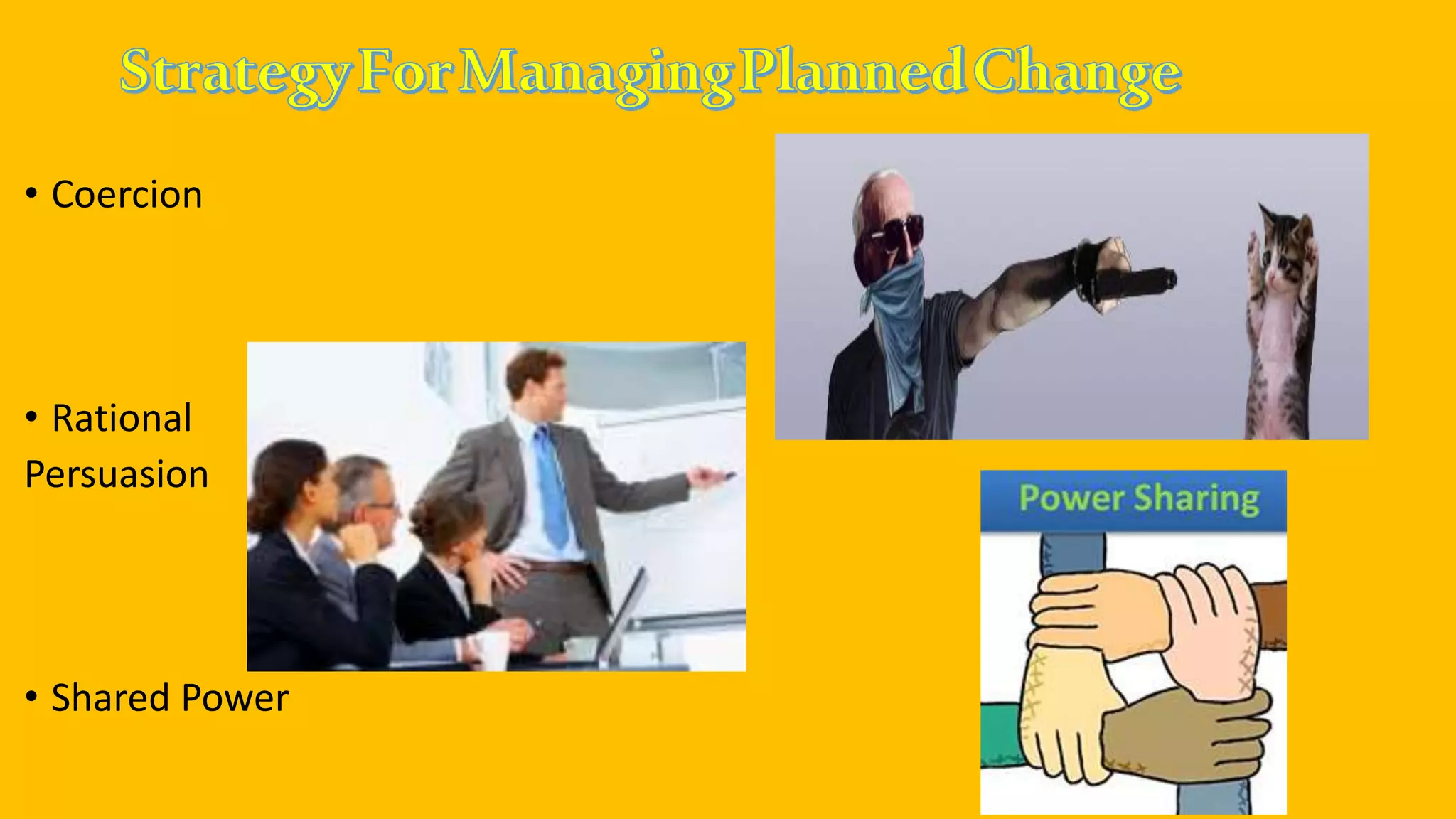
• Coercion
• Rational
Persuasion
• Shared Power
Lewin’s Model
OD intervention refers to the structural activity which are duly planned and
designed by an organization in order to help individual and group to improve their
work efficiency and effectiveness. OD intervention are duly undertaken by OD
consultant in order to facilitate affective planned change in an organization. OD
intervention techniques can be classified into people and techniques based
structure:
A. People based approach
1. Role negotiation
2. Concealing and coaching
3. Management training and development programs
4. Survey feedback
5. Team building
6. Job re-design
B. Structure based approach
1. Re-designing of organization structure
2. Confrontation meeting
3. Goal setting/ MBO
4. Quality of working environment
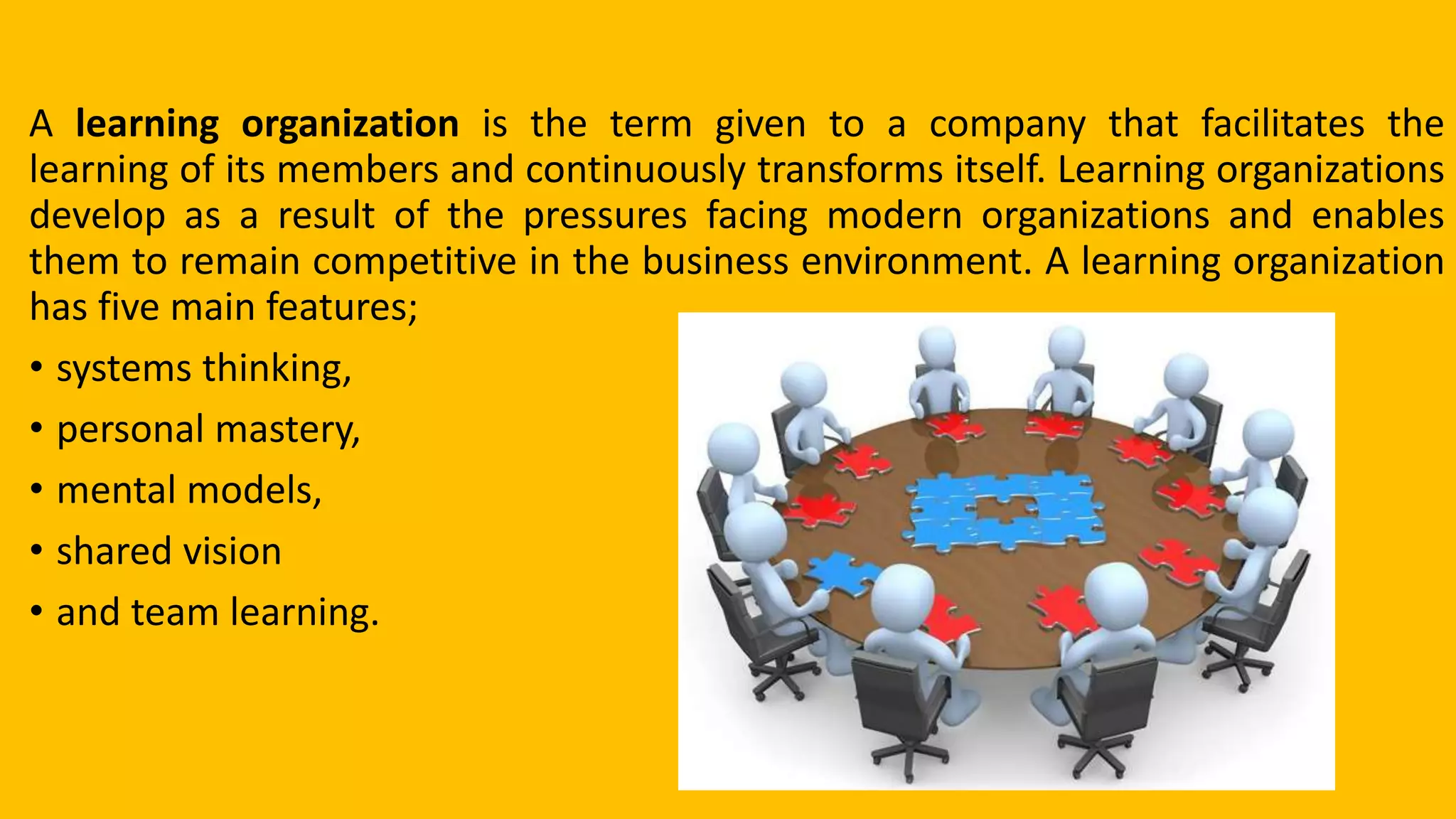
A learning organization is the term given to a company that facilitates the
learning of its members and continuously transforms itself. Learning organizations
develop as a result of the pressures facing modern organizations and enables
them to remain competitive in the business environment. A learning organization
has five main features;
• systems thinking,
• personal mastery,
• mental models,
• shared vision
• and team learning.
1. Systems thinking
The idea of the learning organization developed from a body of work
called systems thinking. This is a conceptual framework that allows
people to study businesses as bounded objects. Learning organizations
use this method of thinking when assessing their company and have
information systems that measure the performance of the organization
as a whole and of its various components. Systems thinking states that
all the characteristics must be apparent at once in an organization for it
to be a learning organization. If some of these characteristics are
missing then the organization will fall short of its goal. However, it
is believed that the characteristics of a learning organization are factors
that are gradually acquired, rather than developed simultaneously.
2. Personal mastery
The commitment by an individual to the process of learning is known as
personal mastery. There is a competitive advantage for an organization whose
workforce can learn more quickly than the workforce of other organizations.
Individual learning is acquired through staff training, development and
continuous self-improvement; however, learning cannot be forced upon an
individual who is not receptive to learning. Research shows that most learning
in the workplace is incidental, rather than the product of formal training,
therefore it is important to develop a culture where personal mastery is
practiced in daily life. A learning organization has been described as the sum of
individual learning, but there must be mechanisms for individual learning to be
transferred into organizational learning.
3. Mental models
The assumptions held by individuals and organizations are called mental
models. To become a learning organization, these models must be challenged.
Individuals tend to espouse theories, which are what they intend to follow, and
theories-in-use, which are what they actually do. Similarly, organizations tend to
have ‘memories’ which preserve certain behaviors, norms and values. In
creating a learning environment it is important to replace confrontational
attitudes with an open culture that promotes inquiry and trust. To achieve this,
the learning organization needs mechanisms for locating and assessing
organizational theories of action. Unwanted values need to be discarded in a
process called ‘unlearning’. Wang and Ahmed refer to this as ‘Triple loop
learning.’
4. Shared vision
The development of a shared vision is important in motivating the staff to learn,
as it creates a common identity that provides focus and energy for learning.The
most successful visions build on the individual visions of the employees at all
levels of the organization,thus the creation of a shared vision can be hindered by
traditional structures where the company vision is imposed from above.
Therefore, learning organizations tend to have flat, decentralized organizational
structures. The shared vision is often to succeed against a competitor;
however, Senge states that these are transitory goals and suggests that there
should also be long-term goals that are intrinsic within the company.
5. Team learning
The accumulation of individual learning constitutes Team learning. The benefit
of team or shared learning is that staff grow more quickly and the problem
solving capacity of the organization is improved through better access to
knowledge and expertise. Learning organizations have structures that facilitate
team learning with features such as boundary crossing and openness. Team
learning requires individuals to engage in dialogue and discussion; therefore
team members must develop open communication, shared meaning, and shared
understanding. Learning organizations typically have excellent knowledge
management structures, allowing creation, acquisition, dissemination, and
implementation of this knowledge in the organization.
Methods of Minimizing Non-sampling Errors
• Checking the sampling process
• Preparation of questionnaire
• Pilot survey
• Fix procedures
• Use of competent manpower
• Provide information
• Provide training
• Use of experts
• Checking data processing and analysis

Organizational change and development

  • 2.
    “Change is anyalternation in the working environment that affects the ways in which the employees must act.” – Davis “Alternation in the operations of organizations that are either planned or unplanned and are a result of either internal or external environment” –Greenberg and Baron
  • 3.
    • Insecurity • Poorcommunication • Personality attribute • Habit • Lack of involvement • Perception of inequity • Fear of loosing power • Fear of unknown
  • 4.
    • Conflict • Organizationaldesign • Organizational culture • Fixed investment • Lack of resources • Inter-organizational conflict • Threat to power relationship
  • 5.
  • 6.
  • 8.
    OD intervention refersto the structural activity which are duly planned and designed by an organization in order to help individual and group to improve their work efficiency and effectiveness. OD intervention are duly undertaken by OD consultant in order to facilitate affective planned change in an organization. OD intervention techniques can be classified into people and techniques based structure: A. People based approach 1. Role negotiation 2. Concealing and coaching 3. Management training and development programs 4. Survey feedback 5. Team building 6. Job re-design
  • 9.
    B. Structure basedapproach 1. Re-designing of organization structure 2. Confrontation meeting 3. Goal setting/ MBO 4. Quality of working environment
  • 10.
    A learning organizationis the term given to a company that facilitates the learning of its members and continuously transforms itself. Learning organizations develop as a result of the pressures facing modern organizations and enables them to remain competitive in the business environment. A learning organization has five main features; • systems thinking, • personal mastery, • mental models, • shared vision • and team learning.
  • 11.
    1. Systems thinking Theidea of the learning organization developed from a body of work called systems thinking. This is a conceptual framework that allows people to study businesses as bounded objects. Learning organizations use this method of thinking when assessing their company and have information systems that measure the performance of the organization as a whole and of its various components. Systems thinking states that all the characteristics must be apparent at once in an organization for it to be a learning organization. If some of these characteristics are missing then the organization will fall short of its goal. However, it is believed that the characteristics of a learning organization are factors that are gradually acquired, rather than developed simultaneously.
  • 12.
    2. Personal mastery Thecommitment by an individual to the process of learning is known as personal mastery. There is a competitive advantage for an organization whose workforce can learn more quickly than the workforce of other organizations. Individual learning is acquired through staff training, development and continuous self-improvement; however, learning cannot be forced upon an individual who is not receptive to learning. Research shows that most learning in the workplace is incidental, rather than the product of formal training, therefore it is important to develop a culture where personal mastery is practiced in daily life. A learning organization has been described as the sum of individual learning, but there must be mechanisms for individual learning to be transferred into organizational learning.
  • 13.
    3. Mental models Theassumptions held by individuals and organizations are called mental models. To become a learning organization, these models must be challenged. Individuals tend to espouse theories, which are what they intend to follow, and theories-in-use, which are what they actually do. Similarly, organizations tend to have ‘memories’ which preserve certain behaviors, norms and values. In creating a learning environment it is important to replace confrontational attitudes with an open culture that promotes inquiry and trust. To achieve this, the learning organization needs mechanisms for locating and assessing organizational theories of action. Unwanted values need to be discarded in a process called ‘unlearning’. Wang and Ahmed refer to this as ‘Triple loop learning.’
  • 14.
    4. Shared vision Thedevelopment of a shared vision is important in motivating the staff to learn, as it creates a common identity that provides focus and energy for learning.The most successful visions build on the individual visions of the employees at all levels of the organization,thus the creation of a shared vision can be hindered by traditional structures where the company vision is imposed from above. Therefore, learning organizations tend to have flat, decentralized organizational structures. The shared vision is often to succeed against a competitor; however, Senge states that these are transitory goals and suggests that there should also be long-term goals that are intrinsic within the company.
  • 15.
    5. Team learning Theaccumulation of individual learning constitutes Team learning. The benefit of team or shared learning is that staff grow more quickly and the problem solving capacity of the organization is improved through better access to knowledge and expertise. Learning organizations have structures that facilitate team learning with features such as boundary crossing and openness. Team learning requires individuals to engage in dialogue and discussion; therefore team members must develop open communication, shared meaning, and shared understanding. Learning organizations typically have excellent knowledge management structures, allowing creation, acquisition, dissemination, and implementation of this knowledge in the organization.
  • 16.
    Methods of MinimizingNon-sampling Errors • Checking the sampling process • Preparation of questionnaire • Pilot survey • Fix procedures • Use of competent manpower • Provide information • Provide training • Use of experts • Checking data processing and analysis