Organisational Implications of
Coaching
At the end of this session you will be able to:
 Define the Learning Organisation
 Explain the advantages and disadvantages of
the Learning Organisation concept
 Evaluate the use of coaching in developing a
Learning Organisation
 Organisational learning happens anyway
 Learning organisation is one that manages its
own learning processes to its advantage
 “the learning company or organisation is not a
defined end state. It is the journey, not the
destination. As Carl Rogers put it ‘we are all in a
process of becoming’. Hence, organisations that
embrace learning commit to an ongoing process.
It would be a contradiction in terms to say ‘We are
now a learning organisation – we’ve got the
plaque on the wall – what’s our next project?’
Hughes, M., (1995, March), Propagating the Learning Organization, Financial Training Review
 An organisation which facilitates the learning
of all its members and continuously transforms
itself as a whole
Pedler, M., Burgoyne. & Boydell, T., (1991), The Learning Company, McGraw Hill
 Organisations where people continually
expand their capacity to create the results
they truly desire, when new and expansive
patterns of thinking are nurtured, where
collective aspiration is set free and where
people are continually learning how to learn
together
 Senge, P., The Fifth Discipline, Centuary
 A Learning Organisation harnesses the full
brainpower, knowledge and experience
available to it, in order to evolve continually for
the benefit of its stakeholders
Mayo, A., & Lank, E. (1995, 16 November), Changing the Soil Spurs New Growth, Personnel Management
 Learning is essential to provide rapid
continuous change
 The competitive advantage of learning quicker
than competitors
 Increasing the rate of change
 Increase in creativity
 Organisations success depends on
engagement and learning at all levels of the
organisation
 Implemented with speed and without careful
consideration of the implications and objectives
 Superficial implementation
 Can be regarded as management fad
 Considered as panacea for all the organisations
ills
◦ Either in time of crises or in an effort to be seen as
progressive
 Consideration not given to triple loop learning
 Can be seen as quick fix which can be achieved
by sending all managers on a short training
course!
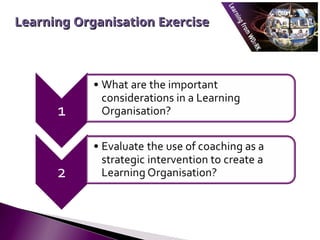
Learning Organisation Exercise
Hughes, M., (1995, March), Propagating the Learning Organization,
Financial Training Review
Pedler, M., Burgoyne. & Boydell, T., (1991), The Learning Company,
McGraw Hill
Senge, P., The Fifth Discipline, Centuary
Mayo, A., & Lank, E. (1995, 16 November), Changing the Soil Spurs New
Growth, Personnel Management
References
References
This resource was created by the University of Plymouth, Learning from WOeRk project. This project is
funded by HEFCE as part of the HEA/JISC OER release programme.
This resource is licensed under the terms of the Attribution-Non-Commercial-Share Alike 2.0
UK: England & Wales license (http://creativecommons.org/licenses/by-nc-sa/2.0/uk/).
The resource, where specified below, contains other 3rd
party materials under their own
licenses. The licenses and attributions are outlined below:
1. The name of the University of Plymouth and its logos are unregistered trade marks of the University. The University
reserves all rights to these items beyond their inclusion in these CC resources.
2. The JISC logo, the and the logo of the Higher Education Academy are licensed under the terms of the Creative
Commons Attribution -non-commercial-No Derivative Works 2.0 UK England & Wales license. All reproductions must
comply with the terms of that license.
Author Jane Stubberfield
Institute University of Plymouth
Title The Learning Organisation
Description The Learning Organisation concept and its implementation
Date Created 17.01.2011
Educational Level 7
Keywords
UKOER, LFWOER, Learning from WOeRK, UOPCPDLM, Continuous
Professional Development, CPD, Work-based Learning, WBL, Learning,
development, strategy, coaching, learning organization, learning
organisation
Back page originally developed by the OER phase 1 C-Change project
©University of Plymouth, 2010, some rights reserved

03 Learning Organisation and its impact

  • 1.
  • 2.
    At the endof this session you will be able to:  Define the Learning Organisation  Explain the advantages and disadvantages of the Learning Organisation concept  Evaluate the use of coaching in developing a Learning Organisation
  • 3.
     Organisational learninghappens anyway  Learning organisation is one that manages its own learning processes to its advantage
  • 4.
     “the learningcompany or organisation is not a defined end state. It is the journey, not the destination. As Carl Rogers put it ‘we are all in a process of becoming’. Hence, organisations that embrace learning commit to an ongoing process. It would be a contradiction in terms to say ‘We are now a learning organisation – we’ve got the plaque on the wall – what’s our next project?’ Hughes, M., (1995, March), Propagating the Learning Organization, Financial Training Review
  • 5.
     An organisationwhich facilitates the learning of all its members and continuously transforms itself as a whole Pedler, M., Burgoyne. & Boydell, T., (1991), The Learning Company, McGraw Hill  Organisations where people continually expand their capacity to create the results they truly desire, when new and expansive patterns of thinking are nurtured, where collective aspiration is set free and where people are continually learning how to learn together  Senge, P., The Fifth Discipline, Centuary
  • 6.
     A LearningOrganisation harnesses the full brainpower, knowledge and experience available to it, in order to evolve continually for the benefit of its stakeholders Mayo, A., & Lank, E. (1995, 16 November), Changing the Soil Spurs New Growth, Personnel Management
  • 7.
     Learning isessential to provide rapid continuous change  The competitive advantage of learning quicker than competitors  Increasing the rate of change  Increase in creativity  Organisations success depends on engagement and learning at all levels of the organisation
  • 8.
     Implemented withspeed and without careful consideration of the implications and objectives  Superficial implementation  Can be regarded as management fad  Considered as panacea for all the organisations ills ◦ Either in time of crises or in an effort to be seen as progressive  Consideration not given to triple loop learning  Can be seen as quick fix which can be achieved by sending all managers on a short training course!
  • 9.
  • 10.
    Hughes, M., (1995,March), Propagating the Learning Organization, Financial Training Review Pedler, M., Burgoyne. & Boydell, T., (1991), The Learning Company, McGraw Hill Senge, P., The Fifth Discipline, Centuary Mayo, A., & Lank, E. (1995, 16 November), Changing the Soil Spurs New Growth, Personnel Management References References
  • 11.
    This resource wascreated by the University of Plymouth, Learning from WOeRk project. This project is funded by HEFCE as part of the HEA/JISC OER release programme. This resource is licensed under the terms of the Attribution-Non-Commercial-Share Alike 2.0 UK: England & Wales license (http://creativecommons.org/licenses/by-nc-sa/2.0/uk/). The resource, where specified below, contains other 3rd party materials under their own licenses. The licenses and attributions are outlined below: 1. The name of the University of Plymouth and its logos are unregistered trade marks of the University. The University reserves all rights to these items beyond their inclusion in these CC resources. 2. The JISC logo, the and the logo of the Higher Education Academy are licensed under the terms of the Creative Commons Attribution -non-commercial-No Derivative Works 2.0 UK England & Wales license. All reproductions must comply with the terms of that license. Author Jane Stubberfield Institute University of Plymouth Title The Learning Organisation Description The Learning Organisation concept and its implementation Date Created 17.01.2011 Educational Level 7 Keywords UKOER, LFWOER, Learning from WOeRK, UOPCPDLM, Continuous Professional Development, CPD, Work-based Learning, WBL, Learning, development, strategy, coaching, learning organization, learning organisation Back page originally developed by the OER phase 1 C-Change project ©University of Plymouth, 2010, some rights reserved

Editor's Notes

  • #1 Welcome to this, the first session in the module on the organisational implications of coaching. In this one we are going to think about an organisation’s learning and development strategy
  • #2 The objectives for this session are that you will be able to: Define the Learning Organisation Explain the advantages and disadvantages of the Learning Organisation concept Evaluate the use of coaching in developing a Learning Organisation
  • #3 Firstly, what is the difference between organisational learning and a learning organisation. Burgoyne (1995) says that organisational learning happens anyway, whether it is single, double or triple loop learning but a learning organisation is one that manages its own learning processes to its advantage. It is one that creates an environment and processes in which individual, team and organisational learning can happen effectively and easily.
  • #4 Hughes in Propagating the Learning Organisation said “the learning company or organisation is not a defined end state. It is the journey, not the destination. As Carl Rogers put it ‘we are all in a process of becoming’. Hence, organisations that embrace learning commit to an ongoing process. It would be a contradiction in terms to say ‘We are now a learning organisation – we’ve got the plaque on the wall – what’s our next project?’ This concept of a learning organisation being a journey rather than a destination is essential to the whole concept. Once an organisation sits back and says “we’ve got there” inevitably the learning has ceased and, paradoxically, it is no longer a learning organisation.
  • #5 Pedler, Burgoyne and Boydell define a learning organisation as one which facilitates the learning of all its members and continuously transforms itself as a whole. It links the learning organisation concept firmly with continuous learning. Senge describes it as organisations where people continually expand their capacity to create the results they truly desire, when new and expansive patterns of thinking are nurtured, where collective aspiration is set free and where people are continually learning how to learn together. Thus incorporating the importance of triple loop learning.
  • #6 Mayo and Lank suggest that a learning organisation harnesses the full brainpower, knowledge and experience available to it, in order to evolve continually for the benefit of its stakeholders. Cunningham (1995) warns that the learning organisation has started to degenerate into a general term linked to the idea of more knowledge and competence sharing in organisations. That is not a bad thing – but it far too limited. It does not accommodate Argyris’ case for double (and triple) loop learning – that is an approach which gets people to re-examine (and change) fundamental beliefs and assumptions.
  • #7 Why would an organisation want to adopt learning organisation principles? Firstly learning is essential to provide rapid continuous change, and continuous improvement in organisations Then there is the competitive advantage of learning quicker than other organisations and, in particular than competitors. This is especially important in providing greatest value for customers Thirdly that it is essential for organisations to keep up with the rapid change in their external environment. The learning organisation culture is one that promotes and actively encourages creativity and new ideas. Not just the thinking up of new ideas, but also the implementation and experimentation and the learning from that And one more is that organisation’s success depends on engagement and learning at all levels of the organisation and the learning organisation concept is one that promotes that learning and engagement.
  • #8 Problems with the Learning Organisation concept can be found if: It is implemented with speed and without careful consideration of the implications and objectives – some organisations get hold of a few of the principles and attempt to implement them very quickly without fully aligning all the strategies and cultural aspects of the organisation and then expect to have success Superficial implementation – this is linked to rapid implementation, where the planning and implementation is not given sufficient consideration Can be regarded as management fad – in some organisations its implementation is seen as a fad and then not taken seriously Considered as panacea for all the organisations ills where it is implemented in time of crises or in an effort to be seen as progressive. Consideration not given to triple loop learning – some organisations see the learning organisation as a fancy name for a learning and development plan and so think it is about implementing training courses etc and completely miss the importance of creating the conditions for triple loop learning Can be seen as quick fix which can be achieved by sending all managers on a short training course! That all that needs to happen is to send all the managers on a learning organisation course and that will be it.
  • #9 This exercise is to help you think about the learning organisation and the value of coaching in that concept What are the important considerations in a learning organisation? Evaluate the use of coaching as a strategic intervention to create a learning organisation?
  • #10 Click to add notes