Individual Interventions Presented by:
Namrata Jadhav
MET Bandra
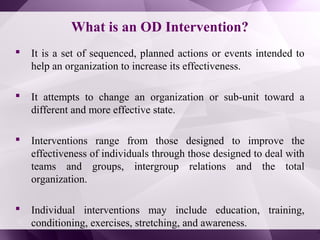
What is an OD Intervention?
 It is a set of sequenced, planned actions or events intended to
help an organization to increase its effectiveness.
 It attempts to change an organization or sub-unit toward a
different and more effective state.
 Interventions range from those designed to improve the
effectiveness of individuals through those designed to deal with
teams and groups, intergroup relations and the total
organization.
 Individual interventions may include education, training,
conditioning, exercises, stretching, and awareness.
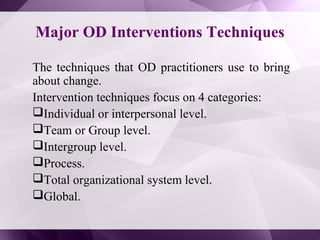
Major OD Interventions Techniques
The techniques that OD practitioners use to bring
about change.
Intervention techniques focus on 4 categories:
Individual or interpersonal level.
Team or Group level.
Intergroup level.
Process.
Total organizational system level.
Global.
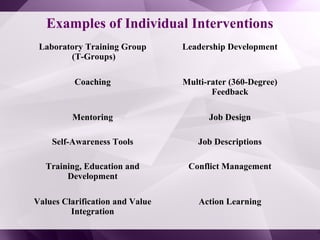
Examples of Individual Interventions
Laboratory Training Group
(T-Groups)
Leadership Development
Coaching Multi-rater (360-Degree)
Feedback
Mentoring Job Design
Self-Awareness Tools Job Descriptions
Training, Education and
Development
Conflict Management
Values Clarification and Value
Integration
Action Learning
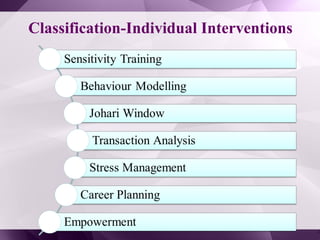
Classification-Individual Interventions
Sensitivity Training
• Social sensitivity in one word is empathy. It is
ability of an individual to sense what others feel
and think from their own point of view.
• Behavioural flexibility is ability to behave
suitably in light of understanding.
Goals of Sensitivity Training
 Method of changing behaviour through unstructured
group interaction.
 Primary focus is on reducing interpersonal friction
 Focuses on individual behaviour within groups.
 Fuels emotional outburst.
 Team members become aware of work-place
dynamics.
 Sensitivity toward those who are disabled
Behaviour Modelling
 Learning by copying or mimicking behaviour.
 Powerful ways to learn what behaviours are acceptable
and what behaviours are objectionable.
MODELLING AS OD TOOL
 Resolve organizational issues
 Instil a vested sense of responsibility
 Simplify Project Management
 Measure & Track
 Respond rapidly
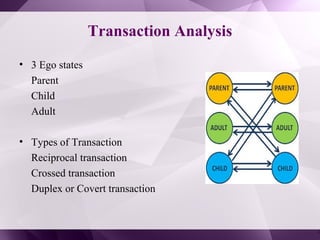
Transaction Analysis
• 3 Ego states
Parent
Child
Adult
• Types of Transaction
Reciprocal transaction
Crossed transaction
Duplex or Covert transaction
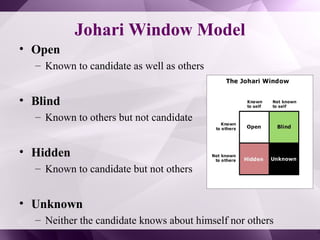
Johari Window Model
• Open
– Known to candidate as well as others
• Blind
– Known to others but not candidate
• Hidden
– Known to candidate but not others
• Unknown
– Neither the candidate knows about himself nor others
Stress management
• Effect of stress
• Stress defense mechanism
• Individual approach:
– Time management
– Physical exercise and relaxation
– Practicing good habits
– Other contributing factors
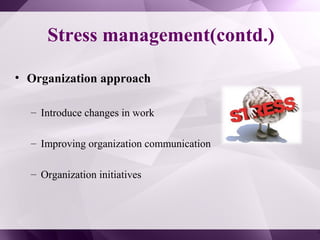
Stress management(contd.)
• Organization approach
– Introduce changes in work
– Improving organization communication
– Organization initiatives
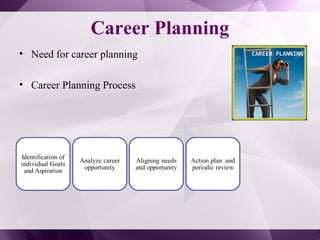
Career Planning
• Need for career planning
• Career Planning Process
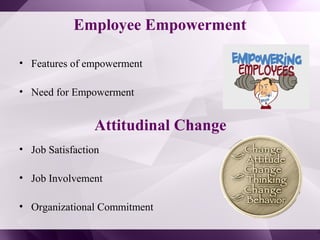
• Features of empowerment
• Need for Empowerment
• Job Satisfaction
• Job Involvement
• Organizational Commitment
Employee Empowerment
Attitudinal Change
Advantages of Individual Intervention
• Managing Employees
• Helps in Organisational Development
• Development of interpersonal skills
• Team Building
• Career Guidance
Disadvantages of Individual Intervention
• Impossible to reach every person
• More focus on psychological factors
• Time Consuming
• Difficulty in sustaining behaviour change
• Outcomes are not measureable
Factors That Impact The Success Of OD
Interventions
• Factors relating to Change Situation:
• Readiness for Change
• Capability to Change
• Capabilities of the Change Agent (OD Consultant)
Results from OD Interventions
• Feedback
• Awareness of changing Socio cultural Norms
• Increase Interaction and Communication
• Education
• Confrontation
• Participation
• Increased Accountability and Optimism
A successful OD intervention
• Communicate more openly
• Collaborate more effectively
• Take more responsibility
• Maintain a shared vision
• Solve problems more effectively
• Show more respect and support for others
• Interact with each other more effectively
• Be more inquisitive
• Be more open to experimentation and new
ways of doing things
Case Study
Self Renewal of a School System
Facilitators: Ravi J Matthai, Udai Pareek and T V Rao for
Sanawar and Udai Pareek
Self Renewal of a School System
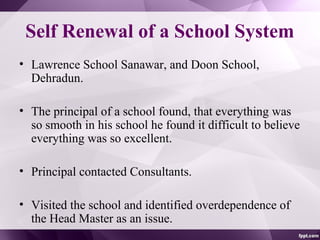
• Lawrence School Sanawar, and Doon School,
Dehradun.
• The principal of a school found, that everything was
so smooth in his school he found it difficult to believe
everything was so excellent.
• Principal contacted Consultants.
• Visited the school and identified overdependence of
the Head Master as an issue.
Self Renewal of a School System
• Also the faculty were losing initiative as result of
their admiration for the head of the Institution.
• Decided to conduct self renewal laboratory for the
entire school, staff covering all the teachers.
• Self renewal alb lasted for five days.
• The school climate was measured and areas for
improvement identified.
Self Renewal of a School System
• Renewal included role negotiating exercises between
the school teachers, principal, Head of departments,
house masters etc.
• Resulted in identification of a number of areas of
improvement.
• Task forces were established to improve various
subsystems of the school like the teaching learning
process, tutorial system etc.
Self Renewal of a School System
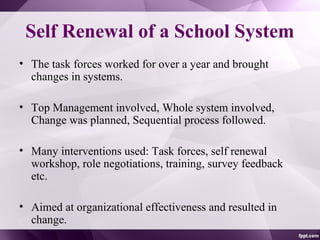
• The task forces worked for over a year and brought
changes in systems.
• Top Management involved, Whole system involved,
Change was planned, Sequential process followed.
• Many interventions used: Task forces, self renewal
workshop, role negotiations, training, survey feedback
etc.
• Aimed at organizational effectiveness and resulted in
change.
Conclusion
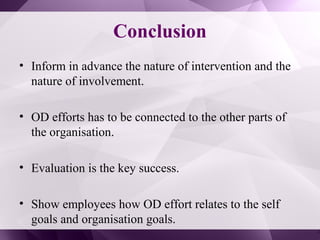
• Inform in advance the nature of intervention and the
nature of involvement.
• OD efforts has to be connected to the other parts of
the organisation.
• Evaluation is the key success.
• Show employees how OD effort relates to the self
goals and organisation goals.
Thank
You

Individual intervention - Organizational Development

  • 1.
    Individual Interventions Presentedby: Namrata Jadhav MET Bandra
  • 2.
    What is anOD Intervention?  It is a set of sequenced, planned actions or events intended to help an organization to increase its effectiveness.  It attempts to change an organization or sub-unit toward a different and more effective state.  Interventions range from those designed to improve the effectiveness of individuals through those designed to deal with teams and groups, intergroup relations and the total organization.  Individual interventions may include education, training, conditioning, exercises, stretching, and awareness.
  • 3.
    Major OD InterventionsTechniques The techniques that OD practitioners use to bring about change. Intervention techniques focus on 4 categories: Individual or interpersonal level. Team or Group level. Intergroup level. Process. Total organizational system level. Global.
  • 4.
    Examples of IndividualInterventions Laboratory Training Group (T-Groups) Leadership Development Coaching Multi-rater (360-Degree) Feedback Mentoring Job Design Self-Awareness Tools Job Descriptions Training, Education and Development Conflict Management Values Clarification and Value Integration Action Learning
  • 5.
  • 6.
    Sensitivity Training • Socialsensitivity in one word is empathy. It is ability of an individual to sense what others feel and think from their own point of view. • Behavioural flexibility is ability to behave suitably in light of understanding.
  • 7.
    Goals of SensitivityTraining  Method of changing behaviour through unstructured group interaction.  Primary focus is on reducing interpersonal friction  Focuses on individual behaviour within groups.  Fuels emotional outburst.  Team members become aware of work-place dynamics.  Sensitivity toward those who are disabled
  • 8.
    Behaviour Modelling  Learningby copying or mimicking behaviour.  Powerful ways to learn what behaviours are acceptable and what behaviours are objectionable. MODELLING AS OD TOOL  Resolve organizational issues  Instil a vested sense of responsibility  Simplify Project Management  Measure & Track  Respond rapidly
  • 9.
    Transaction Analysis • 3Ego states Parent Child Adult • Types of Transaction Reciprocal transaction Crossed transaction Duplex or Covert transaction
  • 10.
    Johari Window Model •Open – Known to candidate as well as others • Blind – Known to others but not candidate • Hidden – Known to candidate but not others • Unknown – Neither the candidate knows about himself nor others
  • 11.
    Stress management • Effectof stress • Stress defense mechanism • Individual approach: – Time management – Physical exercise and relaxation – Practicing good habits – Other contributing factors
  • 12.
    Stress management(contd.) • Organizationapproach – Introduce changes in work – Improving organization communication – Organization initiatives
  • 13.
    Career Planning • Needfor career planning • Career Planning Process
  • 14.
    • Features ofempowerment • Need for Empowerment • Job Satisfaction • Job Involvement • Organizational Commitment Employee Empowerment Attitudinal Change
  • 15.
    Advantages of IndividualIntervention • Managing Employees • Helps in Organisational Development • Development of interpersonal skills • Team Building • Career Guidance
  • 16.
    Disadvantages of IndividualIntervention • Impossible to reach every person • More focus on psychological factors • Time Consuming • Difficulty in sustaining behaviour change • Outcomes are not measureable
  • 17.
    Factors That ImpactThe Success Of OD Interventions • Factors relating to Change Situation: • Readiness for Change • Capability to Change • Capabilities of the Change Agent (OD Consultant)
  • 18.
    Results from ODInterventions • Feedback • Awareness of changing Socio cultural Norms • Increase Interaction and Communication • Education • Confrontation • Participation • Increased Accountability and Optimism
  • 20.
    A successful ODintervention • Communicate more openly • Collaborate more effectively • Take more responsibility • Maintain a shared vision • Solve problems more effectively
  • 21.
    • Show morerespect and support for others • Interact with each other more effectively • Be more inquisitive • Be more open to experimentation and new ways of doing things
  • 22.
    Case Study Self Renewalof a School System Facilitators: Ravi J Matthai, Udai Pareek and T V Rao for Sanawar and Udai Pareek
  • 23.
    Self Renewal ofa School System • Lawrence School Sanawar, and Doon School, Dehradun. • The principal of a school found, that everything was so smooth in his school he found it difficult to believe everything was so excellent. • Principal contacted Consultants. • Visited the school and identified overdependence of the Head Master as an issue.
  • 24.
    Self Renewal ofa School System • Also the faculty were losing initiative as result of their admiration for the head of the Institution. • Decided to conduct self renewal laboratory for the entire school, staff covering all the teachers. • Self renewal alb lasted for five days. • The school climate was measured and areas for improvement identified.
  • 25.
    Self Renewal ofa School System • Renewal included role negotiating exercises between the school teachers, principal, Head of departments, house masters etc. • Resulted in identification of a number of areas of improvement. • Task forces were established to improve various subsystems of the school like the teaching learning process, tutorial system etc.
  • 26.
    Self Renewal ofa School System • The task forces worked for over a year and brought changes in systems. • Top Management involved, Whole system involved, Change was planned, Sequential process followed. • Many interventions used: Task forces, self renewal workshop, role negotiations, training, survey feedback etc. • Aimed at organizational effectiveness and resulted in change.
  • 27.
    Conclusion • Inform inadvance the nature of intervention and the nature of involvement. • OD efforts has to be connected to the other parts of the organisation. • Evaluation is the key success. • Show employees how OD effort relates to the self goals and organisation goals.
  • 28.