BUILDING A
LEARNING ORGANIZATION
DUONGTrong Tan, Agilead
Who knew the term
‘Learning Organization’
before?
• Setting new standards in all segments it enters
• Speed and (not or) quality
• VinGroup Learning Organization:
• All employees must learn(~100hrs/year)
• All managers must teach (1hr/week)
• ‘Forever Entrepreneurship'
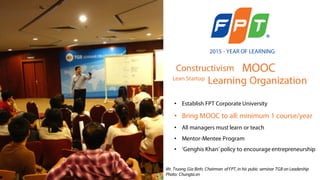
FPT Corporation: Year of Learning (2015)
• Constructivism
• MOOC
• Learning Organization
2015 - YEAR OF LEARNING
Constructivism
Lean Startup
MOOC
• Establish FPT Corporate University
• Bring MOOC to all: minimum 1 course/year
• All managers must learn or teach
• Mentor-Mentee Program
• ‘Genghis Khan’ policy to encourage entrepreneurship
Mr. Truong Gia Binh, Chairman ofFPT,in his pubic seminar TGB on Leadership
Photo: Chungta.vn
Learning Organization
Corporate Universities Everywhere
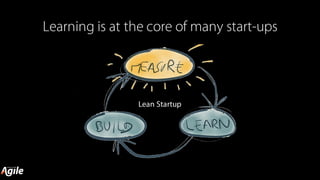
Learning is at the core of many start-ups
Lean Startup
"The rate at which organization and individual
learning may well become the only sustainable
competitive advantage”
- Ray Stata, Analog Devices
“Learning Organization: Where people continually expand their
capacity to create the results they truly desire,
where new and expansive patterns of thinking are nurtured,
where collective aspiration is set free,
and where people are continually learning to see the whole
together.” - P. Senge
What is “learning organization”?
“A learning organization isan organization skilled at creating, acquiring and
transferring knowledge, and at modifying its behavior to reflect new knowledge
and insights”. – D. Garvin
Is your organization a
‘Learning Organization’?
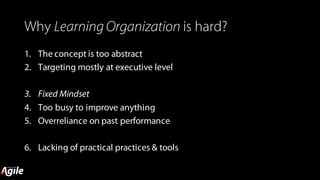
Why Learning Organization is hard?
1. The concept is too abstract
2. Targeting mostly at executive level
3. Fixed Mindset
4. Too busy to improve anything
5. Overreliance on past performance
6. Lacking of practical practices & tools
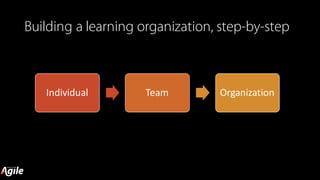
Building a learning organization, step-by-step
Individual Team Organization
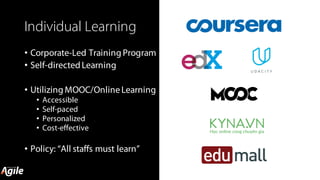
Individual Learning
• Corporate-Led Training Program
• Self-directedLearning
• Utilizing MOOC/OnlineLearning
• Accessible
• Self-paced
• Personalized
• Cost-effective
• Policy: “All staffs must learn”
react-text:	128	Dr.	Barbara	Oakley	/react-text	react-text:	129	
,	Professor	of	Engineering	 /react-text
Industrial	&	Systems	Engineering,	 Oakland	University
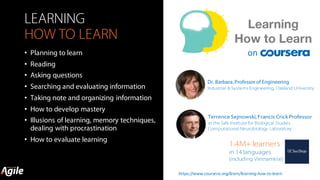
LEARNING
HOW TO LEARN
https://www.coursera.org/learn/learning-how-to-learn
on• Planning to learn
• Reading
• Asking questions
• Searching and evaluating information
• Taking note and organizing information
• How to develop mastery
• Illusions of learning, memory techniques,
dealing with procrastination
• How to evaluate learning
1.4M+ learners
in 14 languages
(including Vietnamese)
Dr. Barbara, Professor of Engineering
Industrial & Systems Engineering, Oakland University
Terrence Sejnowski, Francis Crick Professor
at the Salk Institute for Biological Studies
Computational Neurobiology Laboratory
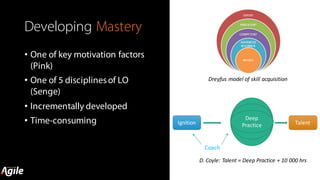
Developing Mastery
• One of key motivation factors
(Pink)
• One of 5 disciplinesof LO
(Senge)
• Incrementally developed
• Time-consuming
react-text:	128	Dr.	Barbara	Oakley	/react-text	react-text:	
129	,	Professor	of	Engineering	 /react-text
Industrial	&	Systems	Engineering,	 Oakland	University
Ignition
Deep
Practice Talent
Coach
D.	Coyle:	Talent	=	Deep	Practice	+	10	000	hrs
Dreyfus	model	of	skill	acquisition
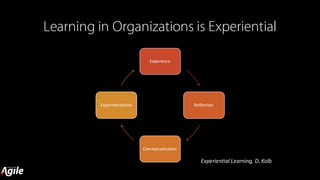
Learning in Organizations is Experiential
Experience
Reflection
Conceptualization
Experimentation
Experiential	Learning,	D.	Kolb
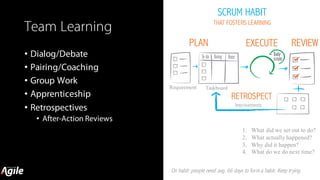
Team Learning
• Dialog/Debate
• Pairing/Coaching
• Group Work
• Apprenticeship
• Retrospectives
• After-Action Reviews
react-text:	128	Dr.	Barbara	Oakley	/react-text	react-text:	129	
,	Professor	of	Engineering	 /react-text
Industrial	&	Systems	Engineering,	 Oakland	University
PLAN EXECUTE REVIEW
RETROSPECT
Requirement Taskboard
Improvements
SCRUM HABIT
THAT FOSTERS LEARNING
1. What did we set out to do?
2. What actually happened?
3. Why did it happen?
4. What do we do next time?
On habit: people need avg. 66 days to form a habit. Keep trying.
Learning at Organization Level
• Systematic Kaizen Programs
• Strategic Training Programs
• Knowlege Management
• Sharing Knowledge
Environment
• Online: KMS, Social Groups
• Offline: Seminars, Conferences,
Workshops…
• Community of Practices
• Tips:
• Developmodular,reusable
learning content
• CareerDevelopmentPlan
• New Roles
• Instructor
• Coach
• Mentor
• Knowledge Manager
• LearningCoordinator
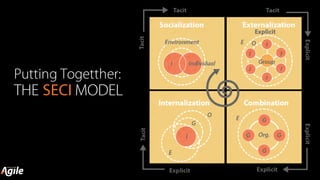
Putting Togetther:
THE SECI MODEL
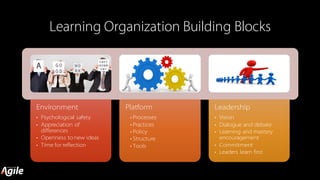
Learning Organization Building Blocks
Environment
• Psychological safety
• Appreciation of
differences
• Openness to new ideas
• Time for reflection
Platform
• Processes
• Practices
• Policy
• Structure
• Tools
Leadership
• Vision
• Dialogue and debate
• Learning and mastery
encouragement
• Commitment
• Leaders learn first
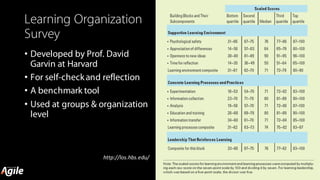
Learning Organization
Survey
• Developed by Prof. David
Garvin at Harvard
• For self-checkand reflection
• A benchmark tool
• Used at groups & organization
level
http://los.hbs.edu/
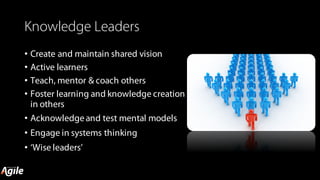
Knowledge Leaders
• Create and maintain shared vision
• Active learners
• Teach, mentor & coach others
• Foster learning and knowledge creation
in others
• Acknowledgeand test mental models
• Engage in systems thinking
• ‘Wise leaders’
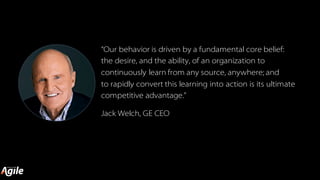
“Our behavior is driven by a fundamental core belief:
the desire, and the ability, of an organization to
continuously learn from any source, anywhere; and
to rapidly convert this learning into action is its ultimate
competitive advantage.”
Jack Welch, GE CEO
Thank you!
www.hocvienagile.com
References
• Coyle, Daniel. The talent code:Greatness isn't born,it's grown. Random
House, 2010.
• Garvin, David A., Amy C. Edmondson, and Francesca Gino. "Is yours a
learning organization?." Harvard business review 86.3 (2008): 109.
• Marquardt, Michael J. Building the learning organization. New York,
NY: McGraw-Hill Companies, 1996.
• Nonaka, Ikujiro, et al. Managingflow. Palgrave Macmillan, 2008.
• Senge, Peter M. The fifth discipline fieldbook:Strategiesand tools for
building a learning organization. Crown Business, 2014. (Kindle
version)

Building a Learning Organization

  • 1.
  • 2.
    Who knew theterm ‘Learning Organization’ before?
  • 3.
    • Setting newstandards in all segments it enters • Speed and (not or) quality • VinGroup Learning Organization: • All employees must learn(~100hrs/year) • All managers must teach (1hr/week) • ‘Forever Entrepreneurship'
  • 4.
    FPT Corporation: Yearof Learning (2015) • Constructivism • MOOC • Learning Organization 2015 - YEAR OF LEARNING Constructivism Lean Startup MOOC • Establish FPT Corporate University • Bring MOOC to all: minimum 1 course/year • All managers must learn or teach • Mentor-Mentee Program • ‘Genghis Khan’ policy to encourage entrepreneurship Mr. Truong Gia Binh, Chairman ofFPT,in his pubic seminar TGB on Leadership Photo: Chungta.vn Learning Organization
  • 5.
  • 6.
    Learning is atthe core of many start-ups Lean Startup
  • 7.
    "The rate atwhich organization and individual learning may well become the only sustainable competitive advantage” - Ray Stata, Analog Devices
  • 8.
    “Learning Organization: Wherepeople continually expand their capacity to create the results they truly desire, where new and expansive patterns of thinking are nurtured, where collective aspiration is set free, and where people are continually learning to see the whole together.” - P. Senge What is “learning organization”? “A learning organization isan organization skilled at creating, acquiring and transferring knowledge, and at modifying its behavior to reflect new knowledge and insights”. – D. Garvin
  • 9.
    Is your organizationa ‘Learning Organization’?
  • 10.
    Why Learning Organizationis hard? 1. The concept is too abstract 2. Targeting mostly at executive level 3. Fixed Mindset 4. Too busy to improve anything 5. Overreliance on past performance 6. Lacking of practical practices & tools
  • 11.
    Building a learningorganization, step-by-step Individual Team Organization
  • 12.
    Individual Learning • Corporate-LedTraining Program • Self-directedLearning • Utilizing MOOC/OnlineLearning • Accessible • Self-paced • Personalized • Cost-effective • Policy: “All staffs must learn”
  • 13.
    react-text: 128 Dr. Barbara Oakley /react-text react-text: 129 , Professor of Engineering /react-text Industrial & Systems Engineering, Oakland University LEARNING HOWTO LEARN https://www.coursera.org/learn/learning-how-to-learn on• Planning to learn • Reading • Asking questions • Searching and evaluating information • Taking note and organizing information • How to develop mastery • Illusions of learning, memory techniques, dealing with procrastination • How to evaluate learning 1.4M+ learners in 14 languages (including Vietnamese) Dr. Barbara, Professor of Engineering Industrial & Systems Engineering, Oakland University Terrence Sejnowski, Francis Crick Professor at the Salk Institute for Biological Studies Computational Neurobiology Laboratory
  • 14.
    Developing Mastery • Oneof key motivation factors (Pink) • One of 5 disciplinesof LO (Senge) • Incrementally developed • Time-consuming react-text: 128 Dr. Barbara Oakley /react-text react-text: 129 , Professor of Engineering /react-text Industrial & Systems Engineering, Oakland University Ignition Deep Practice Talent Coach D. Coyle: Talent = Deep Practice + 10 000 hrs Dreyfus model of skill acquisition
  • 15.
    Learning in Organizationsis Experiential Experience Reflection Conceptualization Experimentation Experiential Learning, D. Kolb
  • 16.
    Team Learning • Dialog/Debate •Pairing/Coaching • Group Work • Apprenticeship • Retrospectives • After-Action Reviews react-text: 128 Dr. Barbara Oakley /react-text react-text: 129 , Professor of Engineering /react-text Industrial & Systems Engineering, Oakland University PLAN EXECUTE REVIEW RETROSPECT Requirement Taskboard Improvements SCRUM HABIT THAT FOSTERS LEARNING 1. What did we set out to do? 2. What actually happened? 3. Why did it happen? 4. What do we do next time? On habit: people need avg. 66 days to form a habit. Keep trying.
  • 17.
    Learning at OrganizationLevel • Systematic Kaizen Programs • Strategic Training Programs • Knowlege Management • Sharing Knowledge Environment • Online: KMS, Social Groups • Offline: Seminars, Conferences, Workshops… • Community of Practices • Tips: • Developmodular,reusable learning content • CareerDevelopmentPlan • New Roles • Instructor • Coach • Mentor • Knowledge Manager • LearningCoordinator
  • 18.
  • 19.
    Learning Organization BuildingBlocks Environment • Psychological safety • Appreciation of differences • Openness to new ideas • Time for reflection Platform • Processes • Practices • Policy • Structure • Tools Leadership • Vision • Dialogue and debate • Learning and mastery encouragement • Commitment • Leaders learn first
  • 20.
    Learning Organization Survey • Developedby Prof. David Garvin at Harvard • For self-checkand reflection • A benchmark tool • Used at groups & organization level http://los.hbs.edu/
  • 21.
    Knowledge Leaders • Createand maintain shared vision • Active learners • Teach, mentor & coach others • Foster learning and knowledge creation in others • Acknowledgeand test mental models • Engage in systems thinking • ‘Wise leaders’
  • 22.
    “Our behavior isdriven by a fundamental core belief: the desire, and the ability, of an organization to continuously learn from any source, anywhere; and to rapidly convert this learning into action is its ultimate competitive advantage.” Jack Welch, GE CEO
  • 23.
  • 24.
    References • Coyle, Daniel.The talent code:Greatness isn't born,it's grown. Random House, 2010. • Garvin, David A., Amy C. Edmondson, and Francesca Gino. "Is yours a learning organization?." Harvard business review 86.3 (2008): 109. • Marquardt, Michael J. Building the learning organization. New York, NY: McGraw-Hill Companies, 1996. • Nonaka, Ikujiro, et al. Managingflow. Palgrave Macmillan, 2008. • Senge, Peter M. The fifth discipline fieldbook:Strategiesand tools for building a learning organization. Crown Business, 2014. (Kindle version)