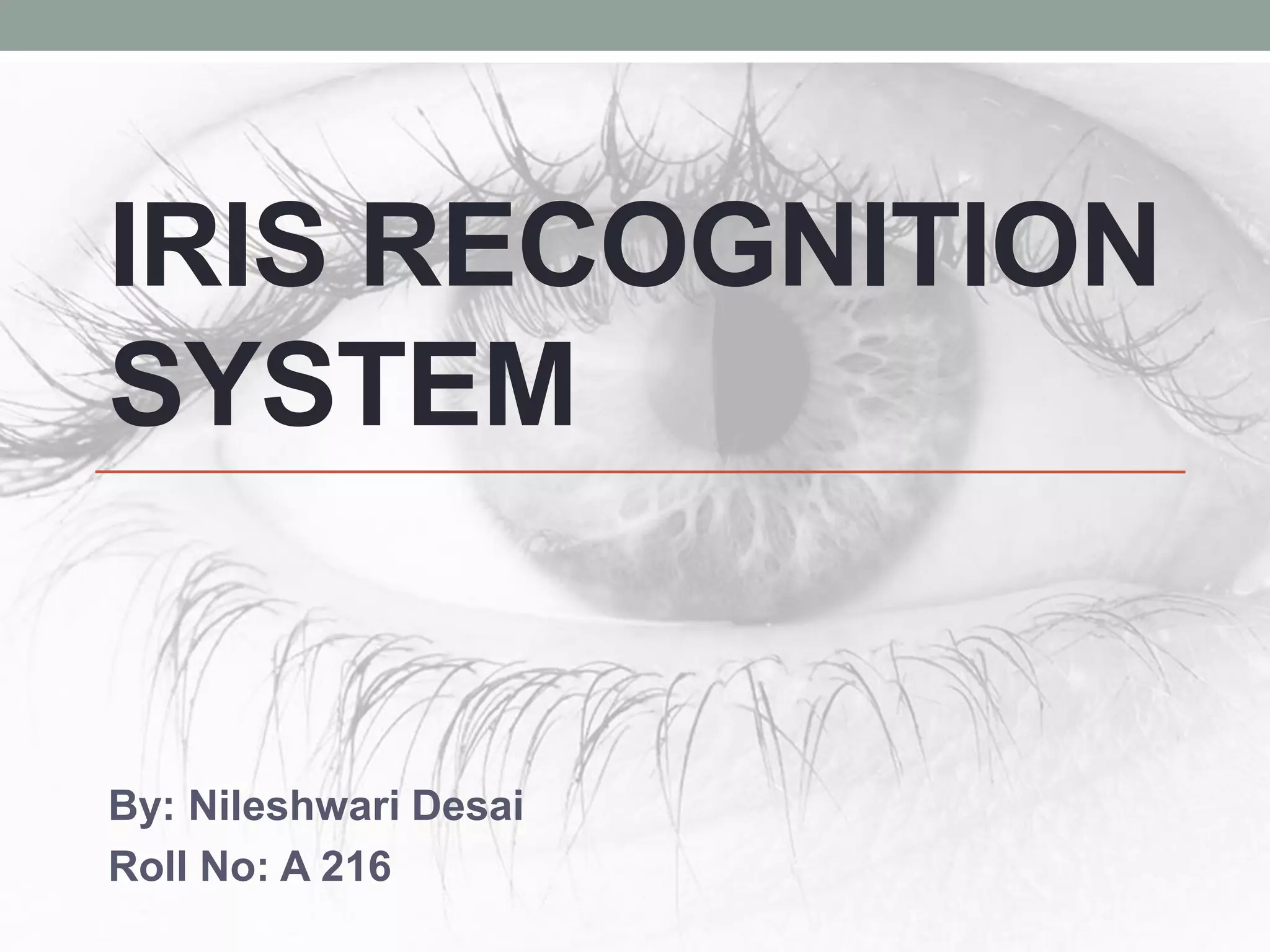
IRIS RECOGNITION
SYSTEM
By: Nileshwari Desai
Roll No: A 216
Outline
• Introduction
• History
• Features
• Database design
• Identification steps
• Feature Extraction
• Matching
• Performance Evaluation
• Advantages
• Concerns/possible improvements
• Disadvantages
• Conclusion
• References
Introduction
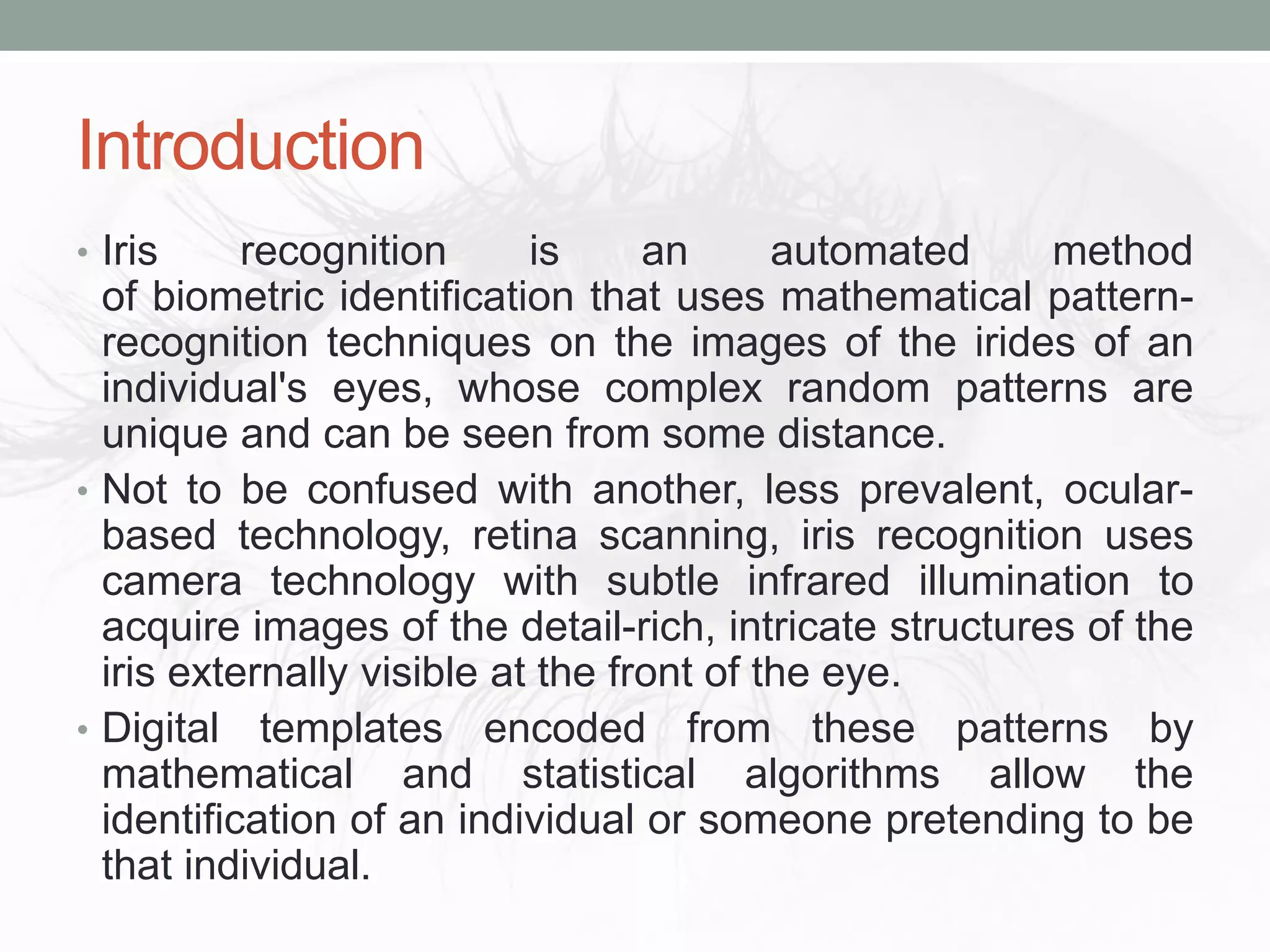
• Iris recognition is an automated method
of biometric identification that uses mathematical pattern-
recognition techniques on the images of the irides of an
individual's eyes, whose complex random patterns are
unique and can be seen from some distance.
• Not to be confused with another, less prevalent, ocular-
based technology, retina scanning, iris recognition uses
camera technology with subtle infrared illumination to
acquire images of the detail-rich, intricate structures of the
iris externally visible at the front of the eye.
• Digital templates encoded from these patterns by
mathematical and statistical algorithms allow the
identification of an individual or someone pretending to be
that individual.
History
• The concept of Iris Recognition was first proposed by Dr.
Frank Burch in 1939.
• It was first implemented in 1990 when Dr. John Daugman
created the algorithms for it.
• These algorithms employ methods of pattern recognition
and some mathematical calculations for iris recognition.
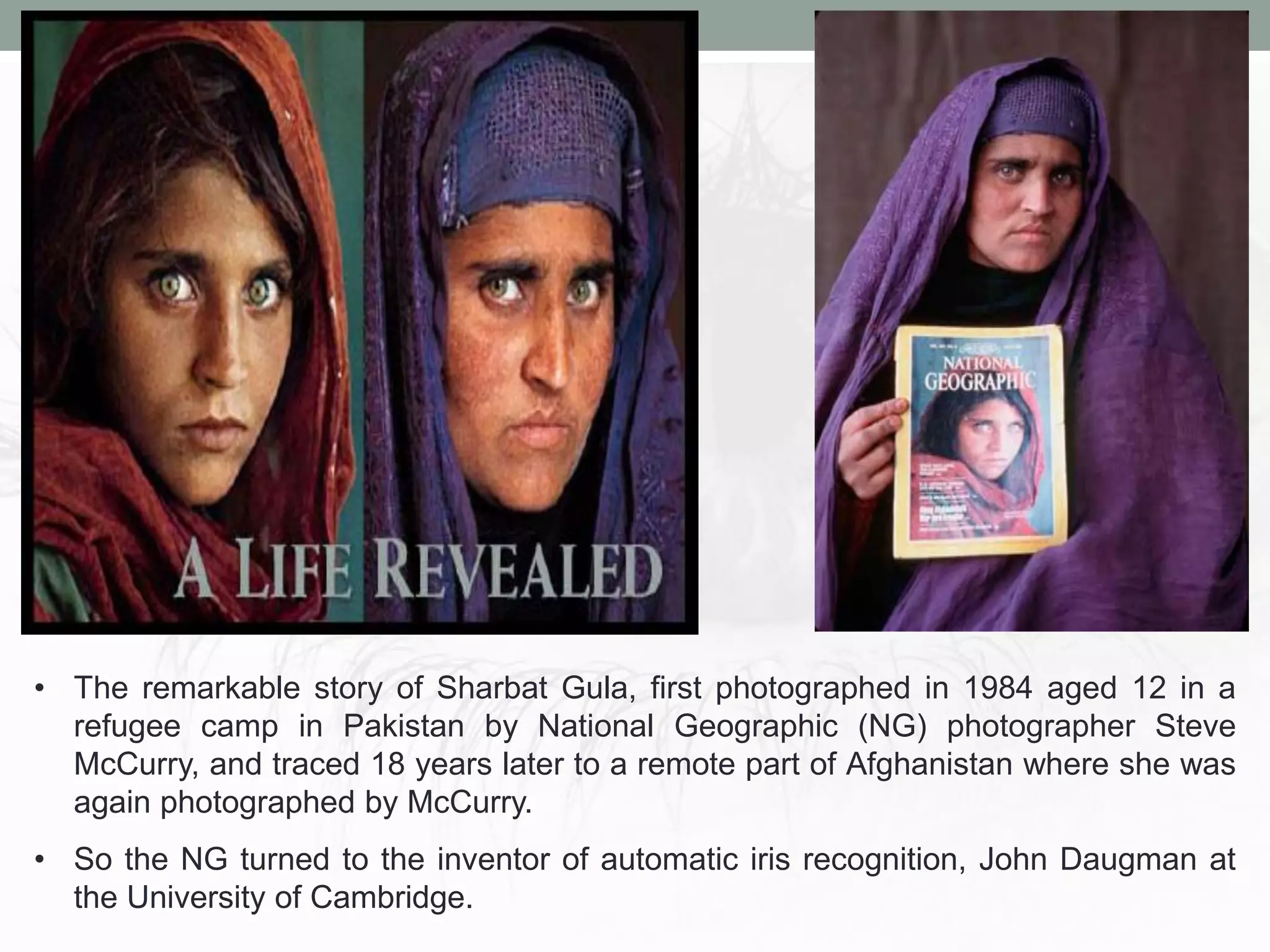
• The remarkable story of Sharbat Gula, first photographed in 1984 aged 12 in a
refugee camp in Pakistan by National Geographic (NG) photographer Steve
McCurry, and traced 18 years later to a remote part of Afghanistan where she was
again photographed by McCurry.
• So the NG turned to the inventor of automatic iris recognition, John Daugman at
the University of Cambridge.
John Daugman and the Eyes of Sharbat
Gula
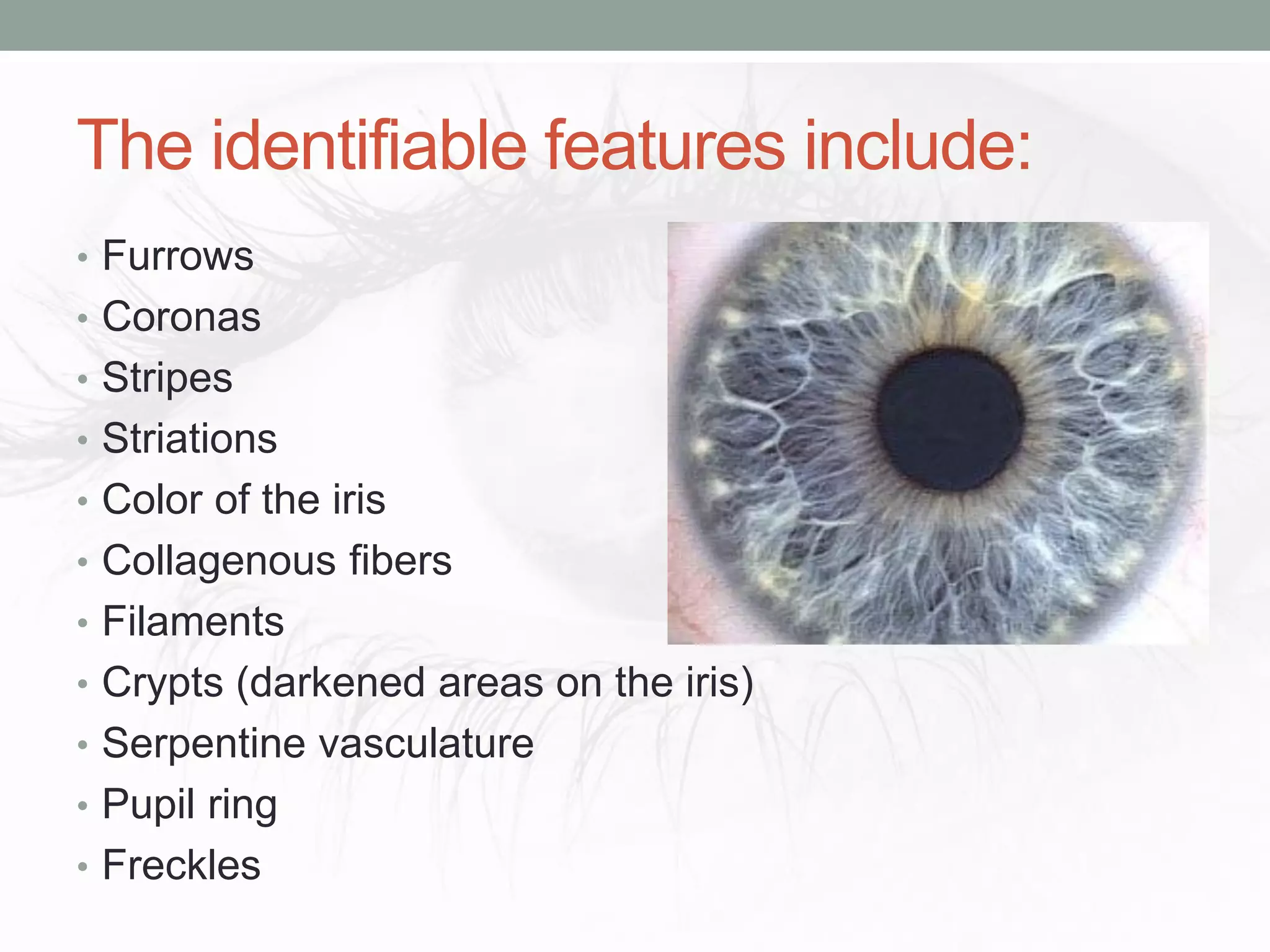
The identifiable features include:
• Furrows
• Coronas
• Stripes
• Striations
• Color of the iris
• Collagenous fibers
• Filaments
• Crypts (darkened areas on the iris)
• Serpentine vasculature
• Pupil ring
• Freckles
Database design
Universality
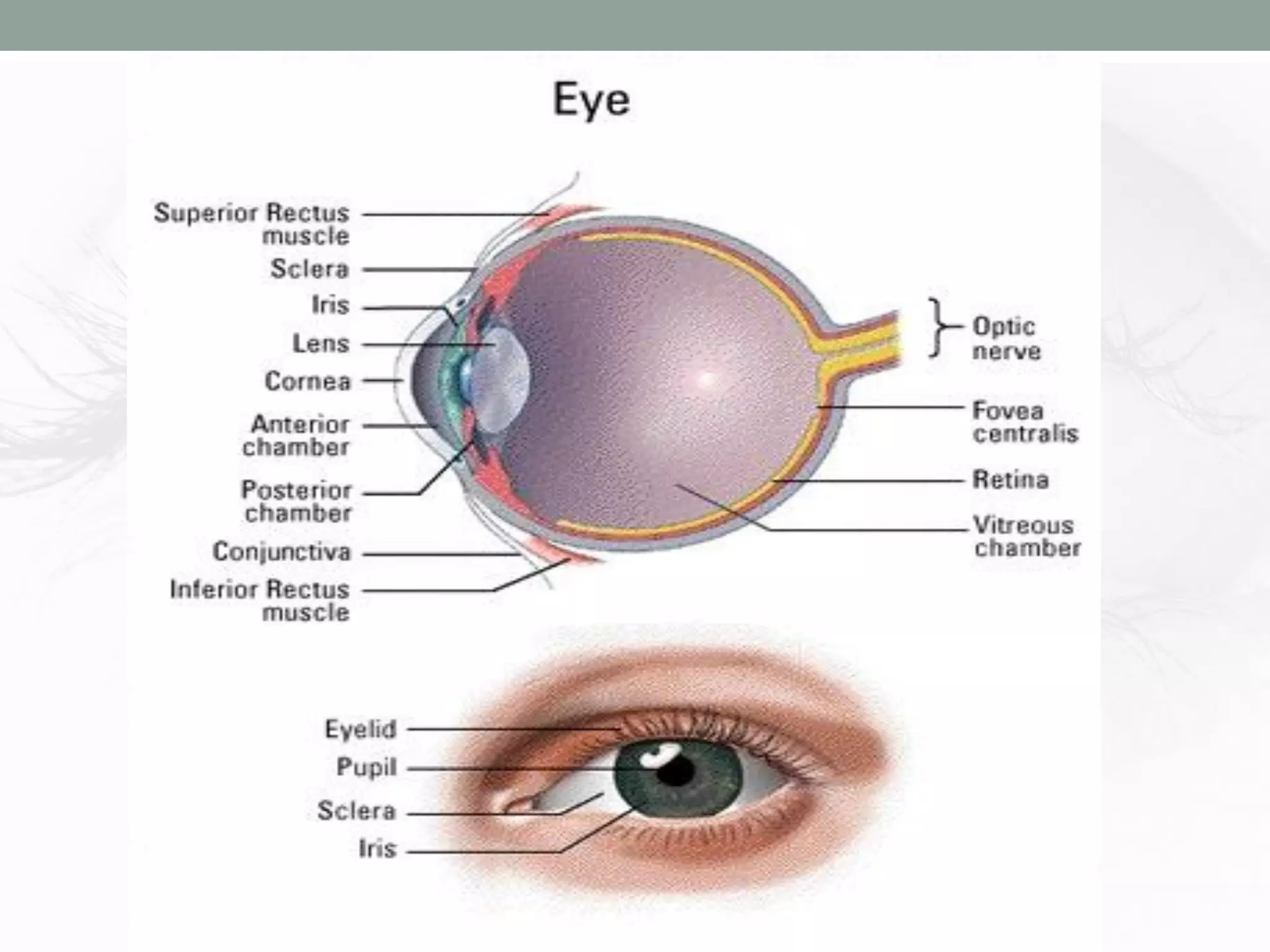
The iris of the eye has been described as the ideal part of the
human body for biometric identification for several reasons:
• It is an internal organ that is well protected against damage and
wear by a highly transparent and sensitive membrane (the
cornea ). This distinguishes it from fingerprints, which can be
difficult to recognize after years of certain types of manual
labor. The iris is mostly flat, and its geometric configuration is
only controlled by two complementary muscles (the sphincter
pupillae and dilator pupillae) that control the diameter of the
pupil.
• Everybody in the world possess eyes, even the blind person
would have an iris. Blindness would only ruin the retina and not
the iris. Thus, Iris can be considered as universal.
Uniqueness
• Every human being have unique iris pattern. Even two identical twins have different
irises.
Permanence
• Most of the time, people's eyes also remain unchanged after eye surgery, and blind
people can use iris scanners as long as their eyes have irises.
• Even after laser surgery or cataract operation, a person’s iris won’t change for at
least 10 years.
• People's retinas change as they age and not the iris, which helps not to lead to
inaccurate readings.
Robustness
• It should not change with time. Iris is a part of the body which does not change over
until 50 years of age.
Performance
• The performance of the system can be predicted only after gathering all the data
and running FAR, FRR like tests on them. Mostly the system is robust and gives
accurate results.
User’s acceptability
• Iris scanning can seem very futuristic, but at the heart of the system is a
simple CCD digital camera. It uses both visible and near-infrared light to
take a clear, high-contrast picture of a person's iris. Some people confuse
iris scans with retinal scans. Retinal scans, however, are an older
technology that required a bright light to illuminate a person's retina. The
sensor would then take a picture of the blood vessel structure in the back of
the person's eye. Some people found retinal scans to be uncomfortable and
invasive. People's retinas also change as they age, which could lead to
inaccurate reading.
Collectability
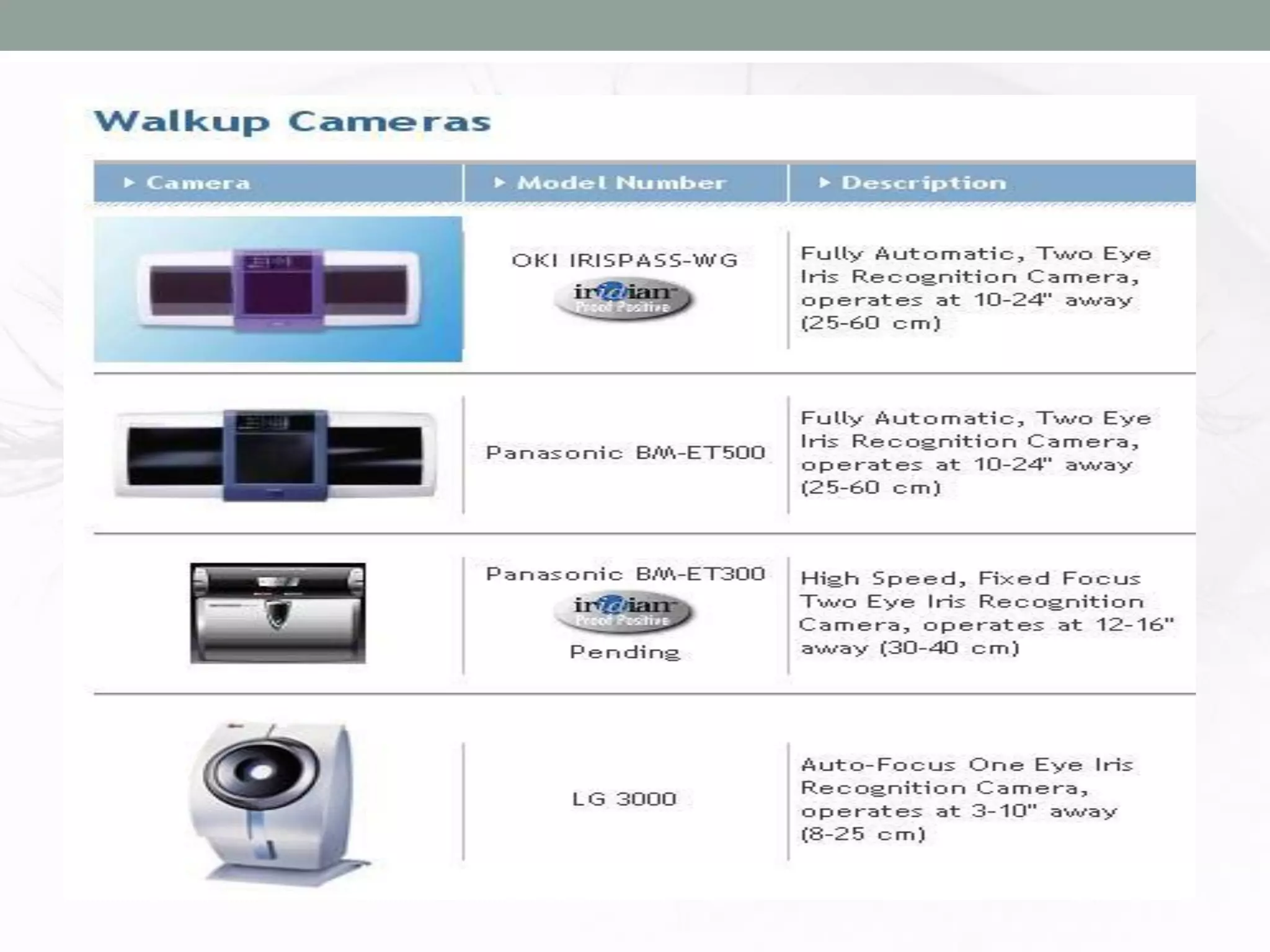
• It is easy to collect the samples. When you look into an iris scanner, your
eye is 3 to 10 inches from the camera. When the camera takes a picture, the
computer locates
-The center of the pupil
-The edge of the pupil
-The edge of the iris
-The eyelids and eyelashes
It then analyzes the patterns in the iris and translates them into a code.
Database collected
• The database has been downloaded/taken from the
CASIA iris image database which is easily accessible. The
version taken is CASIA V2.
• The website link is as follows:-
http://biometrics.idealtest.org/dbDetailForUser.do?id=4
• The irises were scanned by TOPCON TRC50IA optical
device connected with SONY DXC- 950P 3CCD camera.
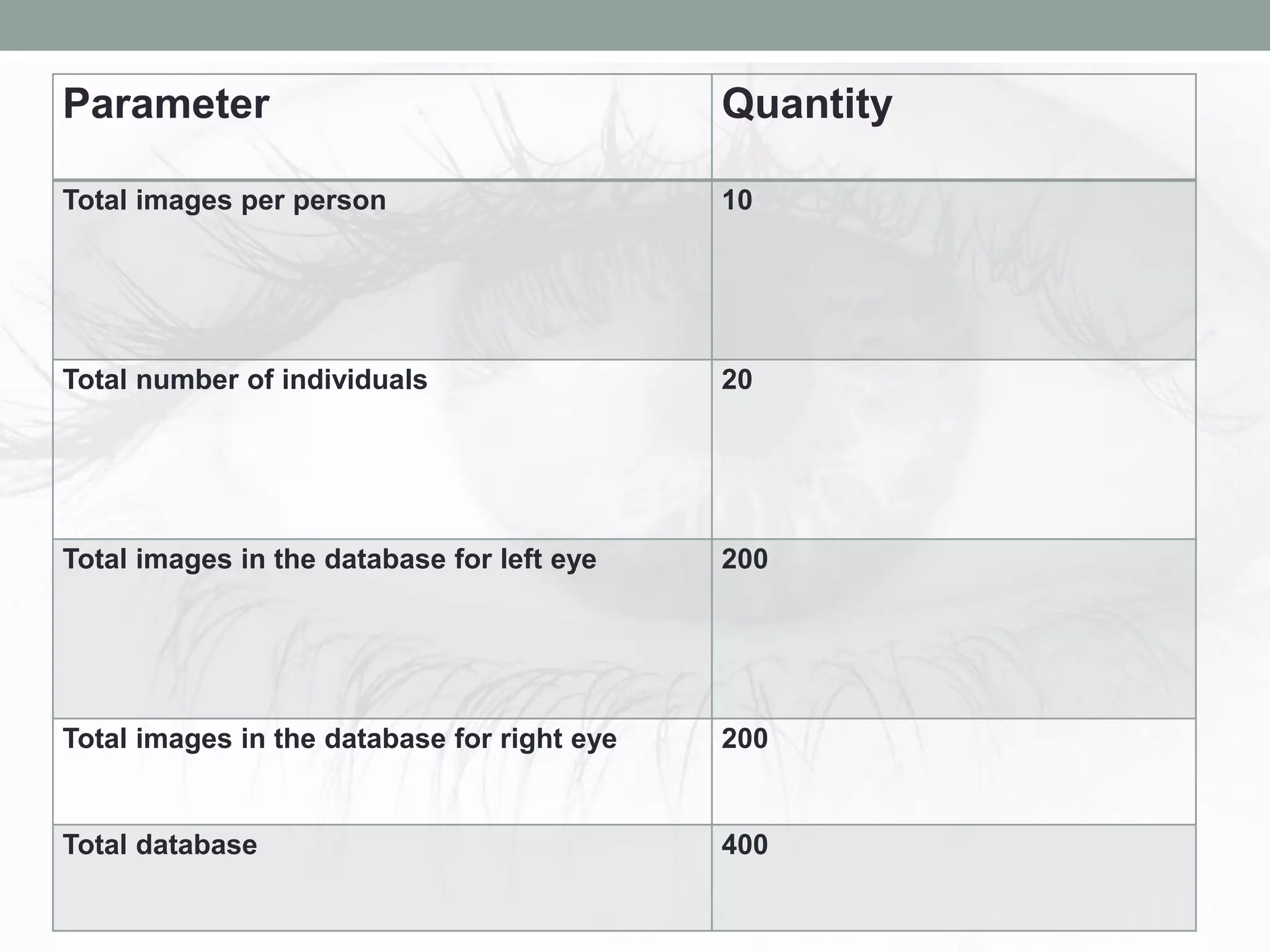
Parameter Quantity
Total images per person 10
Total number of individuals 20
Total images in the database for left eye 200
Total images in the database for right eye 200
Total database 400
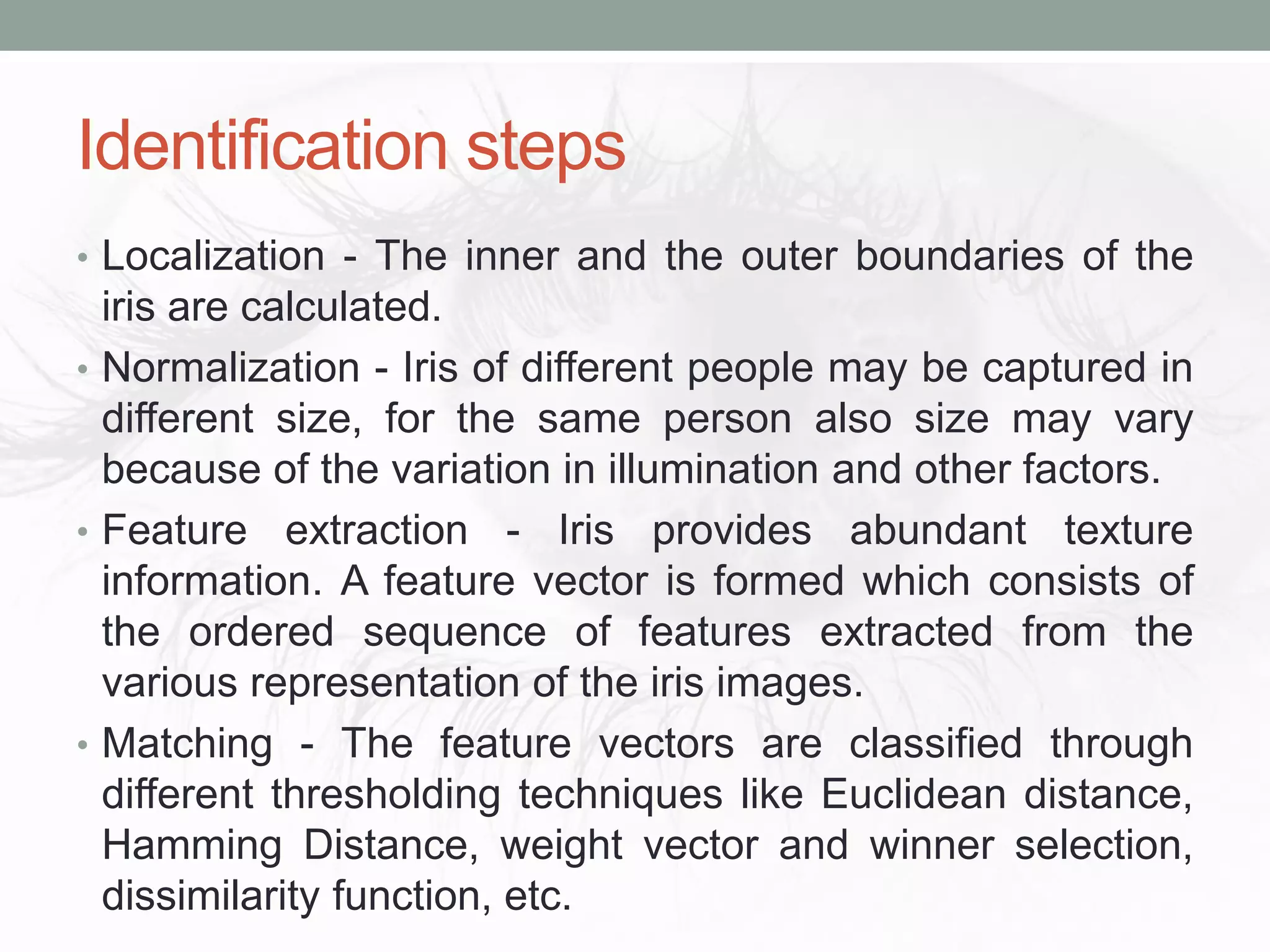
Identification steps
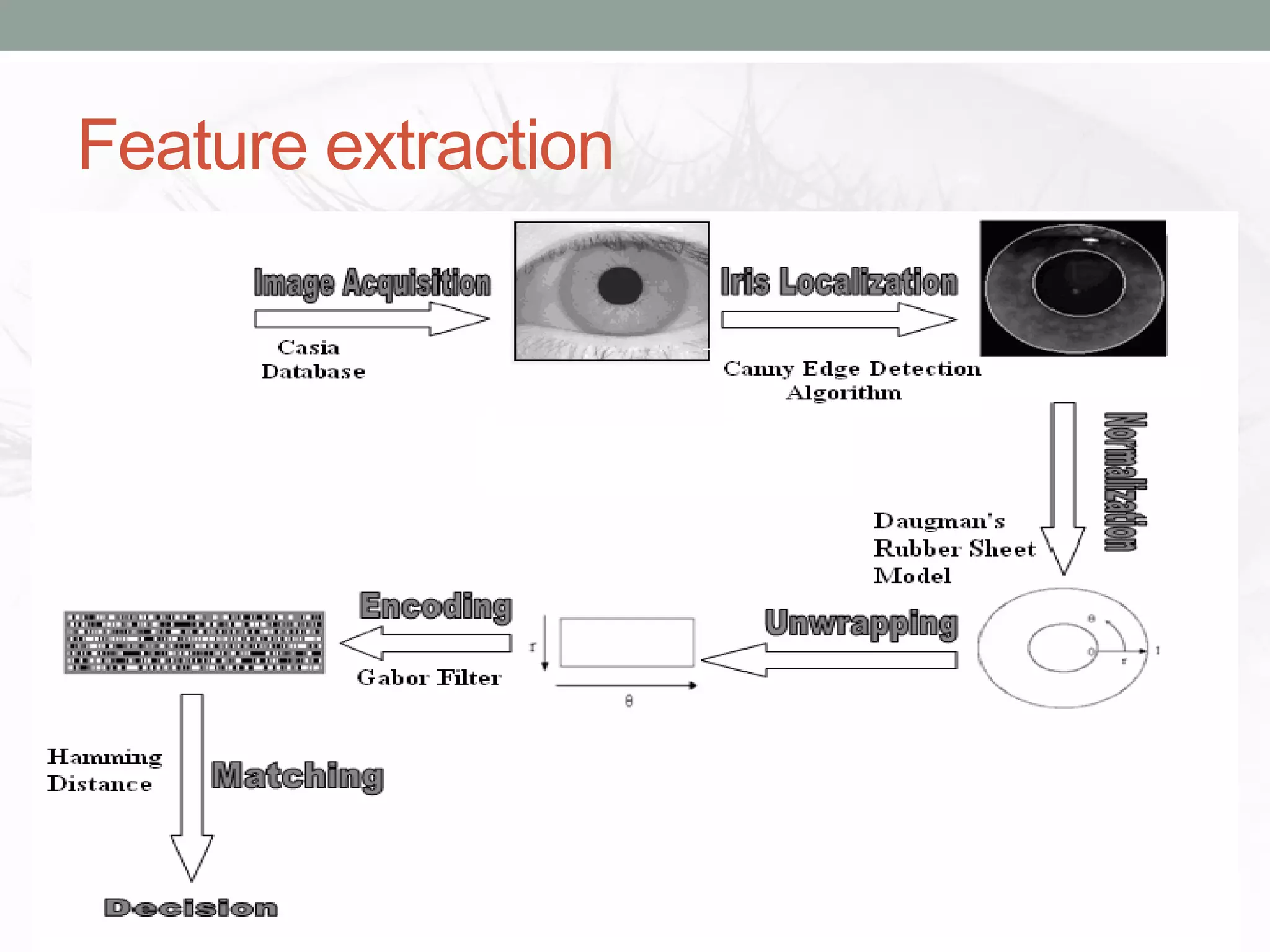
• Localization - The inner and the outer boundaries of the
iris are calculated.
• Normalization - Iris of different people may be captured in
different size, for the same person also size may vary
because of the variation in illumination and other factors.
• Feature extraction - Iris provides abundant texture
information. A feature vector is formed which consists of
the ordered sequence of features extracted from the
various representation of the iris images.
• Matching - The feature vectors are classified through
different thresholding techniques like Euclidean distance,
Hamming Distance, weight vector and winner selection,
dissimilarity function, etc.
Feature extraction
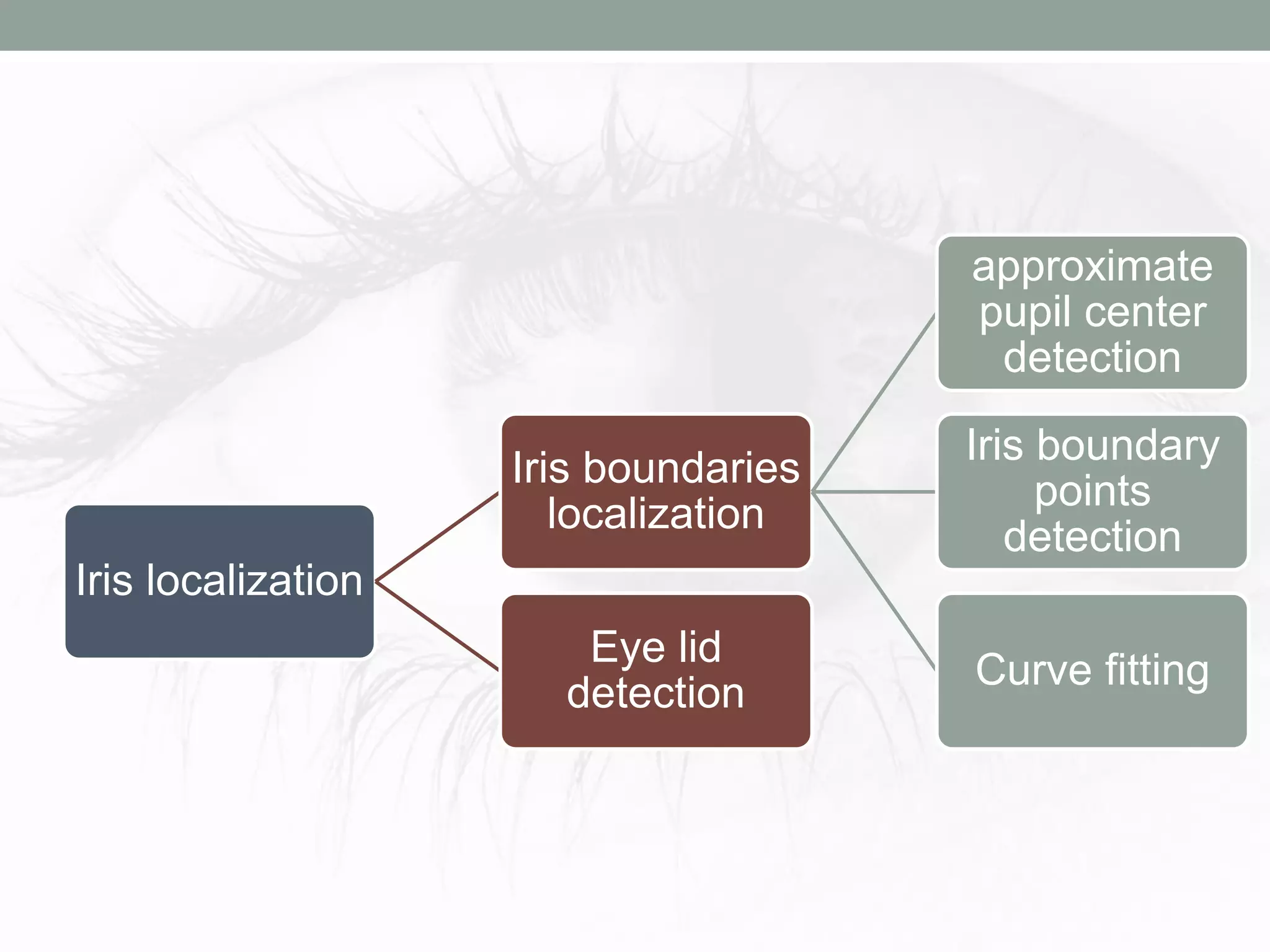
Iris localization
Iris boundaries
localization
approximate
pupil center
detection
Iris boundary
points
detection
Curve fitting
Eye lid
detection
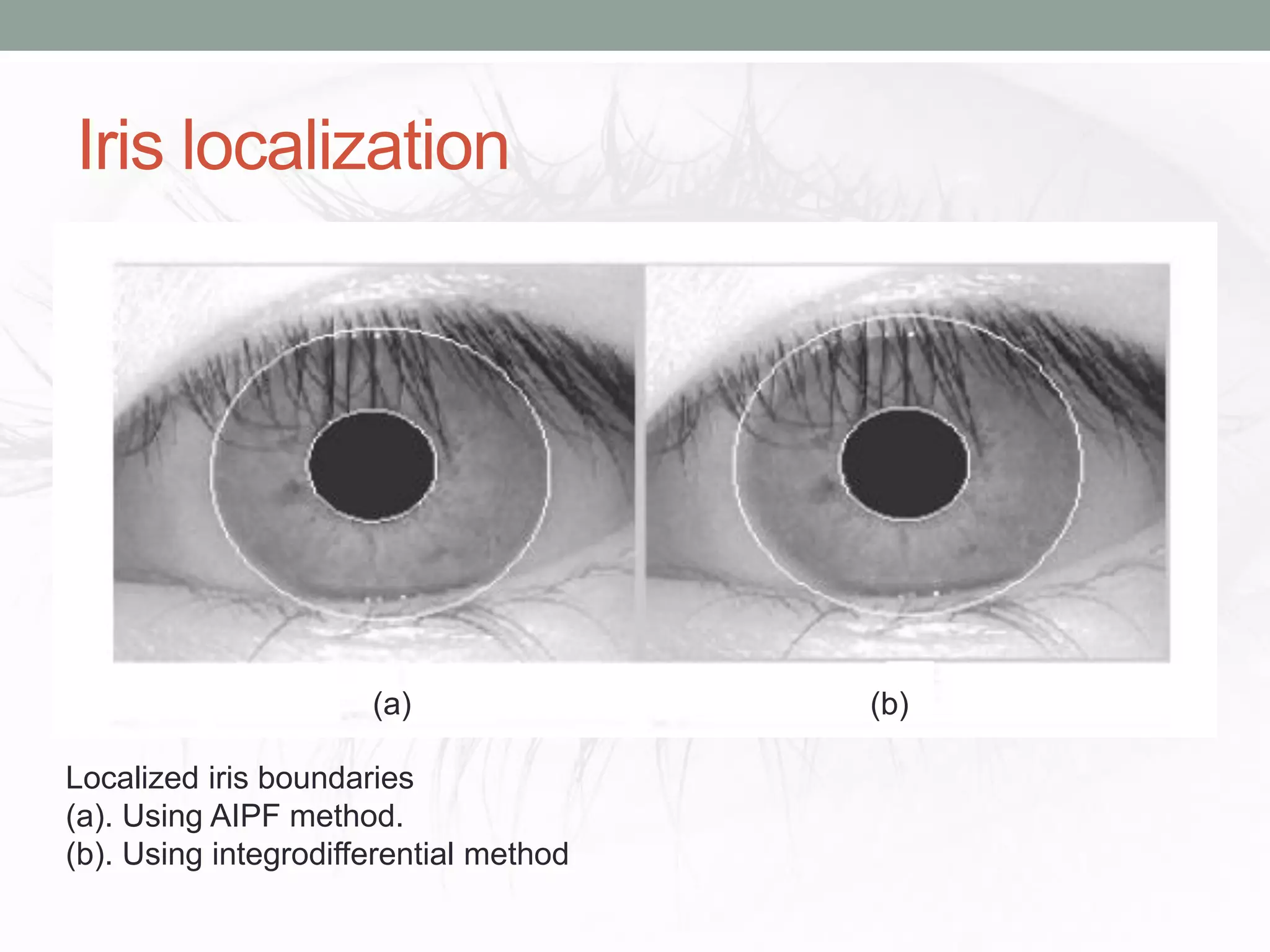
Iris localization
Localized iris boundaries
(a). Using AIPF method.
(b). Using integrodifferential method
(a) (b)
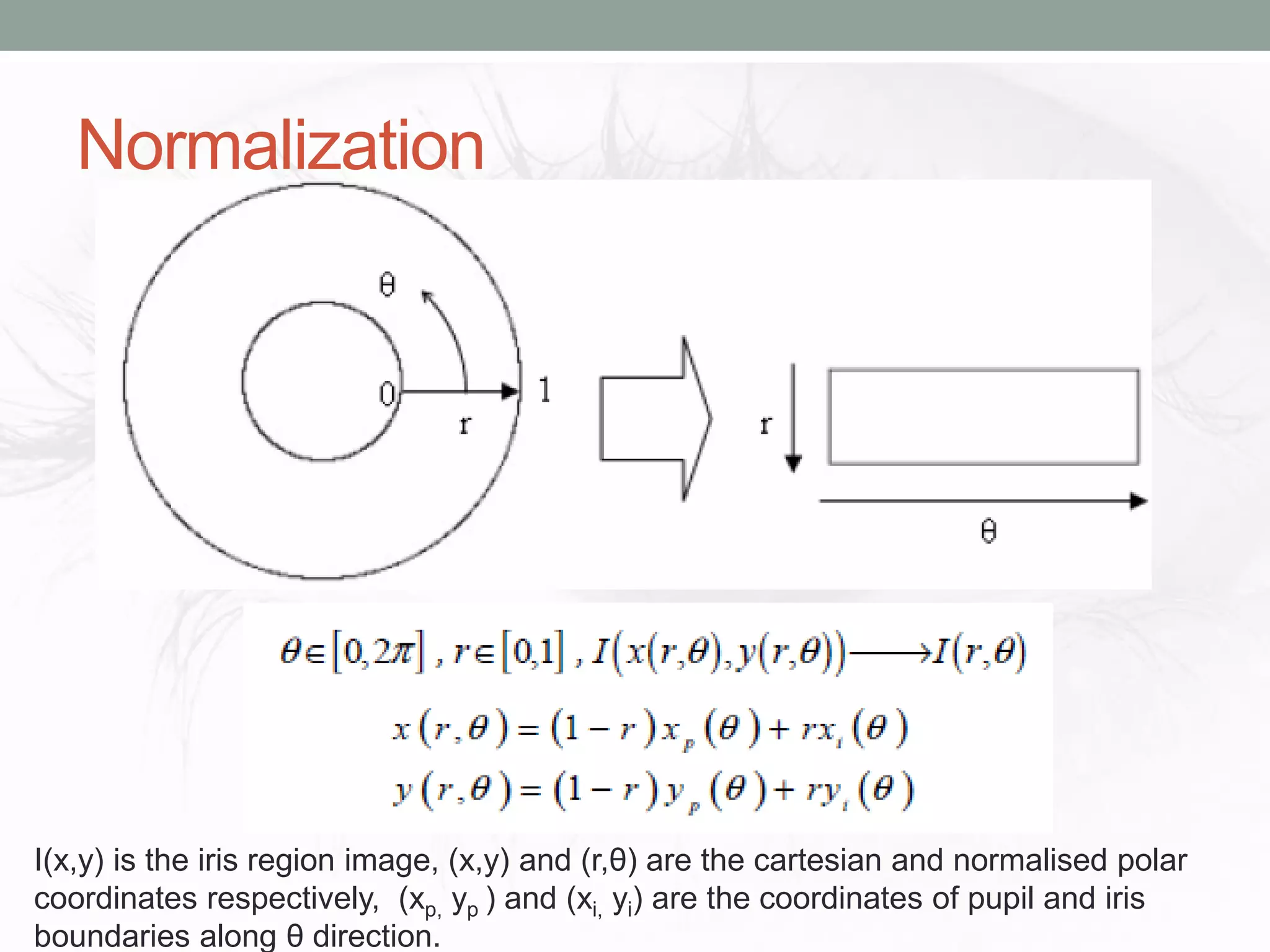
Normalization
I(x,y) is the iris region image, (x,y) and (r,θ) are the cartesian and normalised polar
coordinates respectively, (xp, yp ) and (xi, yi) are the coordinates of pupil and iris
boundaries along θ direction.
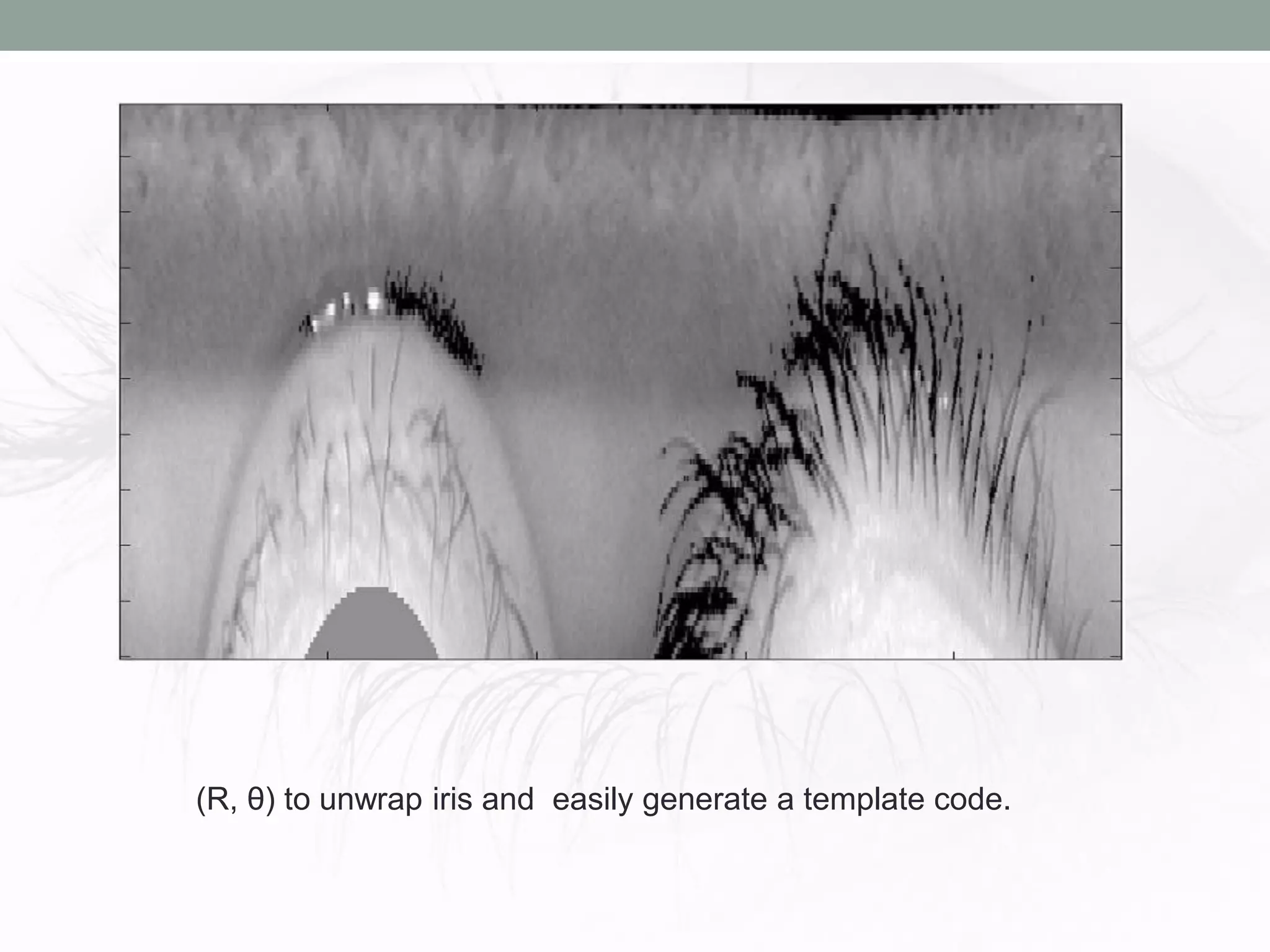
(R, θ) to unwrap iris and easily generate a template code.
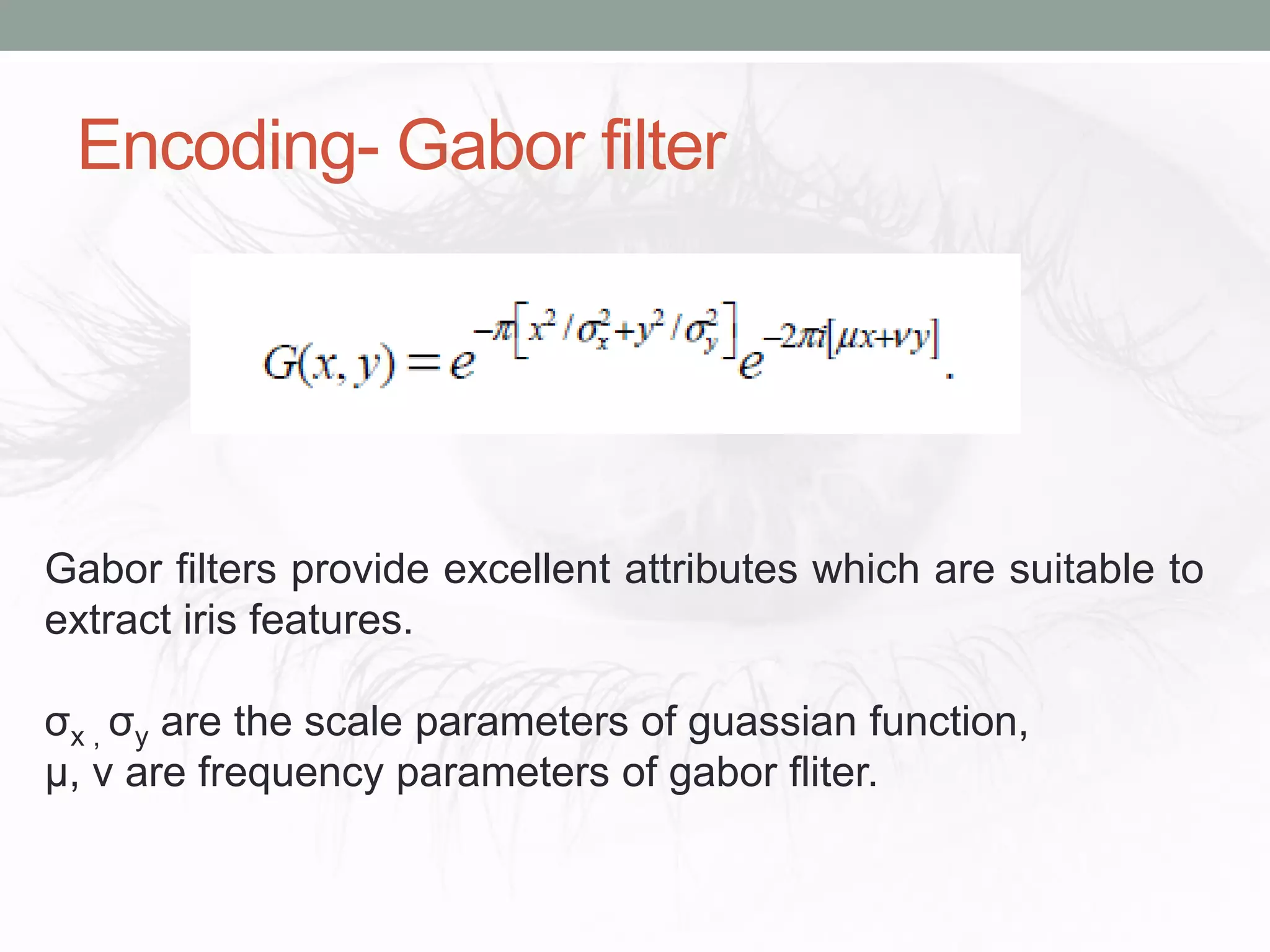
Encoding- Gabor filter
Gabor filters provide excellent attributes which are suitable to
extract iris features.
σx , σy are the scale parameters of guassian function,
µ, v are frequency parameters of gabor fliter.
Matching
• Euclidean distance has been used to perform matching.
• The database image which gives least Euclidean distance
is identified to belong to the genuine user.
• Matching can also be done by hamming distance, weight
vector, winner selection and dissimilarity function for iris
recognition system.
Performance evaluation
• FAR: measurement of how many imposter users are
falsely accepted into the system as “genuine” users.
• FRR: measurement of how many genuine users are
falsely rejected by the system as “imposters”.
• GAR: overall accuracy, measurement of how many
genuine users are accepted into the system as “genuine”
users.
• GRR: measurement of how many genuine users are
rejected by the system as “imposters” because of some
noise present.
Advantages
• Uniqueness of iris patterns hence improved accuracy.
• Highly protected, internal organ of the eye.
• Stability : Persistence of iris patterns.
• Non-invasive : Relatively easy to be acquired.
• Smaller template size so large databases can be easily
stored and checked.
• Cannot be easily forged or modified.
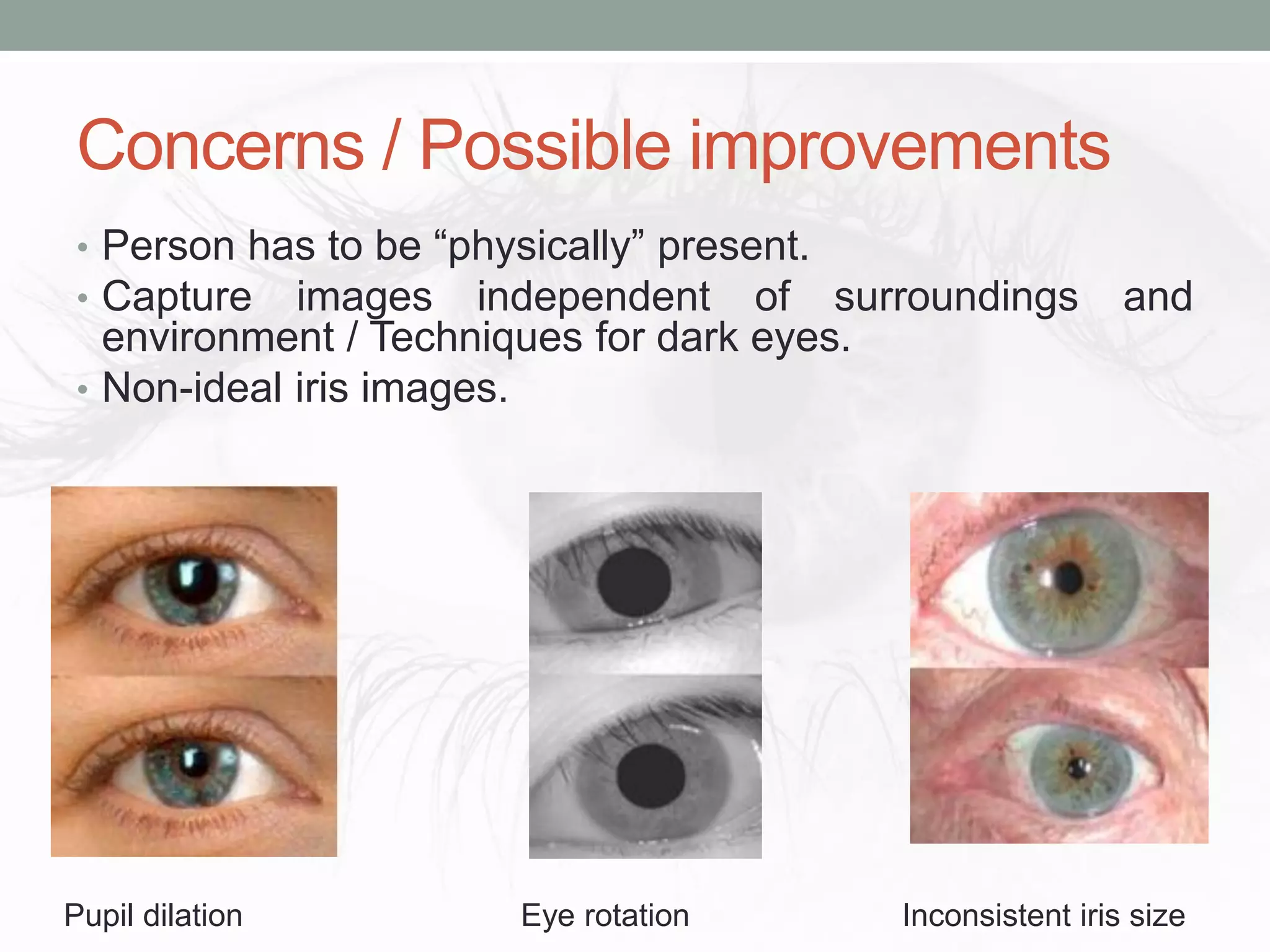
Concerns / Possible improvements
• Person has to be “physically” present.
• Capture images independent of surroundings and
environment / Techniques for dark eyes.
• Non-ideal iris images.
Pupil dilation Eye rotation Inconsistent iris size
Disadvantages
• It will be difficult to capture an image of handicap people
sitting on wheel chair because the cameras are usually
attached on the wall and capture an image up to a certain
height.
• The iris recognition systems are much costlier than other
biometric technologies.
• If a person is wearing glasses or facing direct sunlight for
quite a while, than it may affect the authentication.
Conclusion
• The applications of iris recognition are rapidly growing in
the field of security, due to it’s high rate of accuracy. This
technology has the potential to take over all other security
techniques, as it provides an hands-free, rapid and
reliable identification process.
References
1. J. Daugman’s web site. URL:
http://www.cl.cam.ac.uk/users/jgd1000/
2. J. Daugman, “High Confidence Visual Recognition of Persons
by a Test of Statistical Independence,” IEEE Trans. on Pattern Analysis
and Machine Intelligence, vol. 15, no. 11, pp. 1148 – 1161, 1993.
3. J. Daugman, United States Patent No. 5,291,560 (issued on
March 1994). Biometric Personal Identification System Based on Iris
Analysis, Washington DC: U.S. Government Printing Office, 1994.
4. J. Daugman, “The Importance of Being Random: Statistical
Principles of Iris Recognition,” Pattern Recognition, vol. 36, no. 2, pp
279-291.
5. R. P. Wildes, “Iris Recognition: An Emerging Biometric
Technology,” Proc. of the IEEE, vol. 85, no. 9, 1997, pp. 1348-1363.
Iris recognition system

Iris recognition system

  • 1.
  • 2.
    Outline • Introduction • History •Features • Database design • Identification steps • Feature Extraction • Matching • Performance Evaluation • Advantages • Concerns/possible improvements • Disadvantages • Conclusion • References
  • 4.
    Introduction • Iris recognitionis an automated method of biometric identification that uses mathematical pattern- recognition techniques on the images of the irides of an individual's eyes, whose complex random patterns are unique and can be seen from some distance. • Not to be confused with another, less prevalent, ocular- based technology, retina scanning, iris recognition uses camera technology with subtle infrared illumination to acquire images of the detail-rich, intricate structures of the iris externally visible at the front of the eye. • Digital templates encoded from these patterns by mathematical and statistical algorithms allow the identification of an individual or someone pretending to be that individual.
  • 5.
    History • The conceptof Iris Recognition was first proposed by Dr. Frank Burch in 1939. • It was first implemented in 1990 when Dr. John Daugman created the algorithms for it. • These algorithms employ methods of pattern recognition and some mathematical calculations for iris recognition.
  • 6.
    • The remarkablestory of Sharbat Gula, first photographed in 1984 aged 12 in a refugee camp in Pakistan by National Geographic (NG) photographer Steve McCurry, and traced 18 years later to a remote part of Afghanistan where she was again photographed by McCurry. • So the NG turned to the inventor of automatic iris recognition, John Daugman at the University of Cambridge.
  • 7.
    John Daugman andthe Eyes of Sharbat Gula
  • 8.
    The identifiable featuresinclude: • Furrows • Coronas • Stripes • Striations • Color of the iris • Collagenous fibers • Filaments • Crypts (darkened areas on the iris) • Serpentine vasculature • Pupil ring • Freckles
  • 9.
    Database design Universality The irisof the eye has been described as the ideal part of the human body for biometric identification for several reasons: • It is an internal organ that is well protected against damage and wear by a highly transparent and sensitive membrane (the cornea ). This distinguishes it from fingerprints, which can be difficult to recognize after years of certain types of manual labor. The iris is mostly flat, and its geometric configuration is only controlled by two complementary muscles (the sphincter pupillae and dilator pupillae) that control the diameter of the pupil. • Everybody in the world possess eyes, even the blind person would have an iris. Blindness would only ruin the retina and not the iris. Thus, Iris can be considered as universal.
  • 10.
    Uniqueness • Every humanbeing have unique iris pattern. Even two identical twins have different irises. Permanence • Most of the time, people's eyes also remain unchanged after eye surgery, and blind people can use iris scanners as long as their eyes have irises. • Even after laser surgery or cataract operation, a person’s iris won’t change for at least 10 years. • People's retinas change as they age and not the iris, which helps not to lead to inaccurate readings. Robustness • It should not change with time. Iris is a part of the body which does not change over until 50 years of age. Performance • The performance of the system can be predicted only after gathering all the data and running FAR, FRR like tests on them. Mostly the system is robust and gives accurate results.
  • 11.
    User’s acceptability • Irisscanning can seem very futuristic, but at the heart of the system is a simple CCD digital camera. It uses both visible and near-infrared light to take a clear, high-contrast picture of a person's iris. Some people confuse iris scans with retinal scans. Retinal scans, however, are an older technology that required a bright light to illuminate a person's retina. The sensor would then take a picture of the blood vessel structure in the back of the person's eye. Some people found retinal scans to be uncomfortable and invasive. People's retinas also change as they age, which could lead to inaccurate reading. Collectability • It is easy to collect the samples. When you look into an iris scanner, your eye is 3 to 10 inches from the camera. When the camera takes a picture, the computer locates -The center of the pupil -The edge of the pupil -The edge of the iris -The eyelids and eyelashes It then analyzes the patterns in the iris and translates them into a code.
  • 12.
    Database collected • Thedatabase has been downloaded/taken from the CASIA iris image database which is easily accessible. The version taken is CASIA V2. • The website link is as follows:- http://biometrics.idealtest.org/dbDetailForUser.do?id=4 • The irises were scanned by TOPCON TRC50IA optical device connected with SONY DXC- 950P 3CCD camera.
  • 14.
    Parameter Quantity Total imagesper person 10 Total number of individuals 20 Total images in the database for left eye 200 Total images in the database for right eye 200 Total database 400
  • 15.
    Identification steps • Localization- The inner and the outer boundaries of the iris are calculated. • Normalization - Iris of different people may be captured in different size, for the same person also size may vary because of the variation in illumination and other factors. • Feature extraction - Iris provides abundant texture information. A feature vector is formed which consists of the ordered sequence of features extracted from the various representation of the iris images. • Matching - The feature vectors are classified through different thresholding techniques like Euclidean distance, Hamming Distance, weight vector and winner selection, dissimilarity function, etc.
  • 16.
  • 17.
    Iris localization Iris boundaries localization approximate pupilcenter detection Iris boundary points detection Curve fitting Eye lid detection
  • 18.
    Iris localization Localized irisboundaries (a). Using AIPF method. (b). Using integrodifferential method (a) (b)
  • 19.
    Normalization I(x,y) is theiris region image, (x,y) and (r,θ) are the cartesian and normalised polar coordinates respectively, (xp, yp ) and (xi, yi) are the coordinates of pupil and iris boundaries along θ direction.
  • 20.
    (R, θ) tounwrap iris and easily generate a template code.
  • 21.
    Encoding- Gabor filter Gaborfilters provide excellent attributes which are suitable to extract iris features. σx , σy are the scale parameters of guassian function, µ, v are frequency parameters of gabor fliter.
  • 22.
    Matching • Euclidean distancehas been used to perform matching. • The database image which gives least Euclidean distance is identified to belong to the genuine user. • Matching can also be done by hamming distance, weight vector, winner selection and dissimilarity function for iris recognition system.
  • 23.
    Performance evaluation • FAR:measurement of how many imposter users are falsely accepted into the system as “genuine” users. • FRR: measurement of how many genuine users are falsely rejected by the system as “imposters”. • GAR: overall accuracy, measurement of how many genuine users are accepted into the system as “genuine” users. • GRR: measurement of how many genuine users are rejected by the system as “imposters” because of some noise present.
  • 24.
    Advantages • Uniqueness ofiris patterns hence improved accuracy. • Highly protected, internal organ of the eye. • Stability : Persistence of iris patterns. • Non-invasive : Relatively easy to be acquired. • Smaller template size so large databases can be easily stored and checked. • Cannot be easily forged or modified.
  • 25.
    Concerns / Possibleimprovements • Person has to be “physically” present. • Capture images independent of surroundings and environment / Techniques for dark eyes. • Non-ideal iris images. Pupil dilation Eye rotation Inconsistent iris size
  • 26.
    Disadvantages • It willbe difficult to capture an image of handicap people sitting on wheel chair because the cameras are usually attached on the wall and capture an image up to a certain height. • The iris recognition systems are much costlier than other biometric technologies. • If a person is wearing glasses or facing direct sunlight for quite a while, than it may affect the authentication.
  • 27.
    Conclusion • The applicationsof iris recognition are rapidly growing in the field of security, due to it’s high rate of accuracy. This technology has the potential to take over all other security techniques, as it provides an hands-free, rapid and reliable identification process.
  • 28.
    References 1. J. Daugman’sweb site. URL: http://www.cl.cam.ac.uk/users/jgd1000/ 2. J. Daugman, “High Confidence Visual Recognition of Persons by a Test of Statistical Independence,” IEEE Trans. on Pattern Analysis and Machine Intelligence, vol. 15, no. 11, pp. 1148 – 1161, 1993. 3. J. Daugman, United States Patent No. 5,291,560 (issued on March 1994). Biometric Personal Identification System Based on Iris Analysis, Washington DC: U.S. Government Printing Office, 1994. 4. J. Daugman, “The Importance of Being Random: Statistical Principles of Iris Recognition,” Pattern Recognition, vol. 36, no. 2, pp 279-291. 5. R. P. Wildes, “Iris Recognition: An Emerging Biometric Technology,” Proc. of the IEEE, vol. 85, no. 9, 1997, pp. 1348-1363.