1 | Abi International Journal Of Modern Science & Engineering
Division – Biotechnology
ABI International Journal of Modern Science & Engineering
(1)1 January-June 2012. pp. 1-6
IRIS RECOGNITION FOR SECURED VOTINGUSING LABVIEW
V. GAUTHUGESH, Email: gauthugesh17@gmail.com, Phone:+919841175256
R. PREM KUMAR, Email: premrajum@gmail.com, Phone: +919786420799
H.HEMANTH KUMAR, Email: hhemanth.1990@gmail.com, Phone: +919655563349
GUIDE:
MRS. M. SUGANTHY M.E., ASSISTANT PROFESSOR, Email: suganthym46@gmail.com, Phone: +919677035996
DEPARTMENT OF ECE VEL TECH ENGINEERING COLLEGE
Abstract:
This paper describes an alternate method to identify individuals using images of their iris during voting
process. Iris recognition system is implemented using National Instruments LabVIEW.
Design and implementation of our system is divided into two parts. The first part relates to image
acquisition and also voter’s information in an specially cluster made database in a binary secured
format. The second part deals with the actual iris recognition for verification. Computational time is
also taken into consideration
Keywords: Biometric; iris recognition; circular edge detection ;radius calculation; NI LabVIEW
I . INTRODUCTION
Biometric identification systems, which use physical features to check a person’s identity, ensure
much greater security than password and number systems. Biometric features such as the iris, retina, face or a
fingerprint can be stored
Biometrics is automated methods of recognizing a person based on a physiological or behavioral
characteristic. Biometric technologies are becoming the foundation of an extensive array of highly secure
identification and personal verification solutions.
II. BIOID’S
During the last decade, there has been tremendous growth in biometric recognition technology due to the
emerging requirement of highly reliable personal identification in a number of government and
commercial applications.Biometrics refers to the recognition of an individual by using behavioral or
physical traits of that person. Traditional verification systems based on passwords can be easily hacked
when a password is divulged to an unauthorized user. Biometric systems are supposed to be unique as
they make use of a person’s iris, hand shape, fingerprint and face. The iris is a highly accurate biometric
identifier.
2 | Iris Recognition For Secured VotingUsing Labview
Division – Biotechnology
Iris recognition is considered as the most accurate means of personal identification due to the
uniqueness of the iris patterns. John Daugman developed iris recognition algorithm based on two-
dimensional Gabor wavelets. Most of commercial iris recognition systems are based on this
patented algorithm.
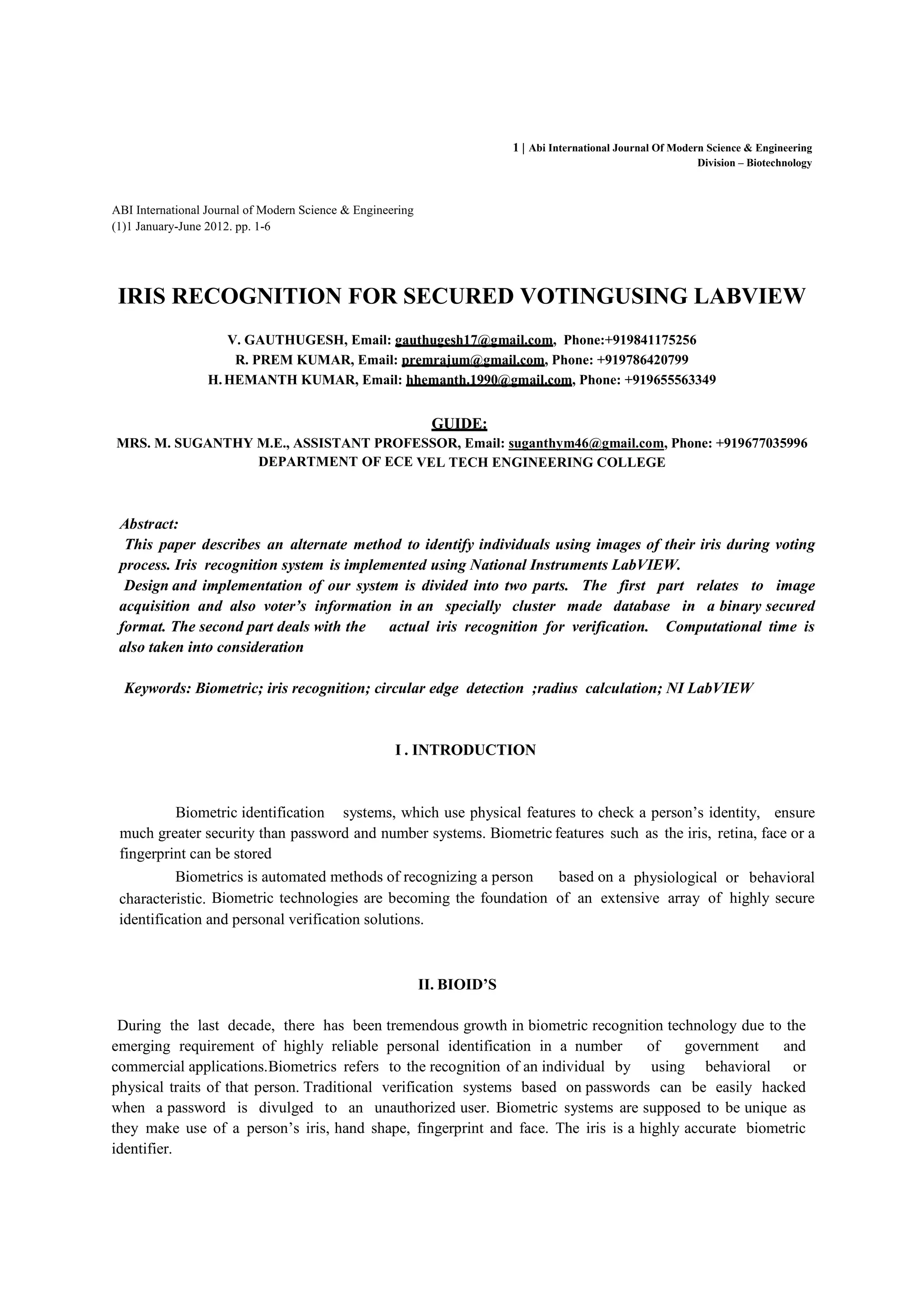
Iris recognition is a method of biometric personal identification based on high- resolution
irises images of human eyes. The human iris is an annular region between the pupil and sclera as
shown in Fig. 1. Generally, iris has many properties that make it an ideal biometric
recognition component:
i) Very little variation over a life's period
ii) Genetic independence
FIGURE . 1
Irises not only differ between identical twins, but also between the left and right eye. No two irises are
same. The ability to accurately measure the iris patterns, the false acceptance rate is 1 in 1031. Iris pattern is
formed during the first year of life, and pigmentation of the stroma takes place for the first few years.
Formation of the unique patterns of the iris is random and not related to any genetic factors. The only
characteristic that is dependent on genetics is the pigmentation of the iris, which determines its colour.
Epigenetic nature of iris patterns results in completely independent iris patterns. Even identical twins possess
uncorrelated iris patterns .
In this paper, we propose an iris recognition system. System is implemented using NI LabVIEW. This paper
is organized into few sections. First section presented the introduction and properties of the human
iris. Second section explains our proposed methodology, third section shows our working screenshot
result. Finally conclusion is drawn in fourth section. This paper is also concerned with secured verification
for voting.
III. PROPOSED METHODOLOGY
Design and implementation of for any iris recognition system can be subdivided into three parts . The
3 | Abi International Journal Of Modern Science & Engineering
Division – Biotechnology
first part relates to image acquisition. The second part is concerned with localizing the iris from a
captured image. The third part is concerned with matching an extracted iris pattern with candidate
data base entries.
In our proposed methodology, we have divided the whole process of iris recognition system into four
main stages namely image acquisition, iris localization, pattern matching and authentication.
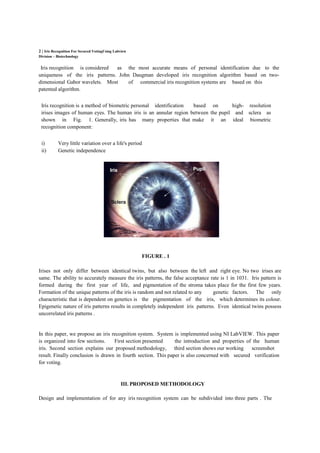
The iris image needs to be preprocessed to obtain useful iris region. Image preprocessing is done by the
process of converting a color image to a single plane of color. This process is also known as Single
color plane extraction. The next process involves detecting circles in an iris image. This single process itself
detects the iris code information. The method is in detail . Then the radius information is used to store in
a database which is compared during the verification and also with the score parameter.
A. IMAGE ACQUISATION
It is a major challenge to get high resolution iris images. It is not very easy to implement a
system that can take high quality images . The images used in this analysis are taken from the
database . RGB image is converted to gray scale for further processing. This conversion is required
as NI LabVIEW matches gray scale images.
Here we use 320 x 280 pixel image of 11 kb each.
FIGURE 2 (IRIS SINGLE COLOR IMAGE)
FIGURE 3 LabVIEW code for single color plane extraction
4 | Iris Recognition For Secured VotingUsing Labview
Division – Biotechnology
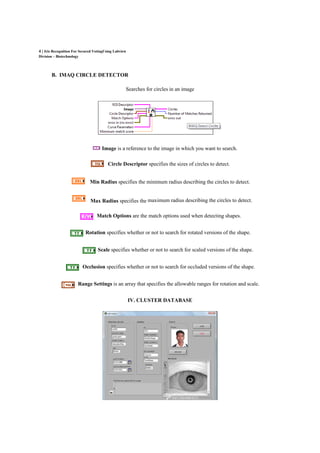
B. IMAQ CIRCLE DETECTOR
Searches for circles in an image
Image is a reference to the image in which you want to search.
Circle Descriptor specifies the sizes of circles to detect.
Min Radius specifies the minimum radius describing the circles to detect.
Max Radius specifies the maximum radius describing the circles to detect.
Match Options are the match options used when detecting shapes.
Rotation specifies whether or not to search for rotated versions of the shape.
Scale specifies whether or not to search for scaled versions of the shape.
Occlusion specifies whether or not to search for occluded versions of the shape.
Range Settings is an array that specifies the allowable ranges for rotation and scale.
IV. CLUSTER DATABASE
5 | Abi International Journal Of Modern Science & Engineering
Division – Biotechnology
this voter id. If the match is found the user is allowed to vote. Also a separate encrypted list of persons who
have voted is stored. This is to ensure that a single person votes only one time. This is all implemented
using the LabVIEW software part.
IV. CONCLUSION AND FUTURE WORK
The database consists of all the details as in election commission’s voter id plus iris
information code. LabVIEW does not require SQL or special database. In LabVIEW we can create
our own secured database.
V. VERIFICATION
On voting day, the voter should enter his/her voter’s id. And user is prompted for iris image
through infrared camera. This iris image is also coded and matched with the iris code from the
database corresponding to this paper describes an alternate method to identify individuals using
images of their iris. This script is tested on images from CASIA database. NI LabVIEW is used for
developing graphical user interface. This identification system is quite simple requiring few
components and is effective enough to be integrated voting systems that require an identity check. The
acquired voter id is matched with the whole database of cluster and the corresponding iris code is
compared with the generated code. It is recommended for large number of users. Voter id match can
drastically reduce the processing time of the system.
REFERENCE:
[1] Invited Talk by Anil K. Jain in Fourth International Conference on Image and Graphics.
[2] J. Daughman "Complete Discrete 2-D Gabor Transformsby Neural Networks for Image Analysis and
Compression", IEEE Transactions on Acoustics, Speech and
signal Processing, VOL.36, No.7, July 1988. [3] Iris database- http://phoenix.inf.upol.cz/iris/download/
[4] J.G. Daugman, “High Confidence Visual Recognition of Persons by a Test of Stastical Independence”,
IEEE Trans. Pattern
Analysis and Machine Intelligence, vol.15, pp. 1148-1161, Nov. 1993.
6 | Iris Recognition For Secured VotingUsing Labview
Division – Biotechnology
[5] R.P. Wildes, “Iris Recognition: An Emerging Biometric Technology”, Proceedings of the IEEE, vo1. 85,
pp.1348-
1363, Sept. 1997.
[6] J. Daugman, "How Iris Recognition Works," IEEE Trans. on Circuits and Systems for Video Technology,
Vol. 14, No.
1, January 2004.
[7] C.C. Teo, and H. T. Ewe, "Development of Iris Preprocessing Method for Portable Devices," Multimedia
University, Jalan Multimedia, Cyberjaya, 63100, Selangor,
Malaysia.
[8] E. Wolff. Anatomy of the Eye and Orbit.
7th edition. H. K. Lewis & Co. LTD, 1976. [9] John Daugman, “Neural Image Processing Strategies Applied
in Real-Time Pattern Recognition, Real-Time Imaging,”
1997, pp 157-171.
[10] R.P. Wildes, J.C. Asmuth, G.L. Green, S.C. Hsu, R.J. Kolczynski, J.R. Matey, S.E. McBride.,”A system
for Automated Iris recognition,”
[11] M.L. Berliner, “Biomicroscopy of the
Eye”,Paul B.Hoeber, Inc.194.

Internation Journal Conference

  • 1.
    1 | AbiInternational Journal Of Modern Science & Engineering Division – Biotechnology ABI International Journal of Modern Science & Engineering (1)1 January-June 2012. pp. 1-6 IRIS RECOGNITION FOR SECURED VOTINGUSING LABVIEW V. GAUTHUGESH, Email: gauthugesh17@gmail.com, Phone:+919841175256 R. PREM KUMAR, Email: premrajum@gmail.com, Phone: +919786420799 H.HEMANTH KUMAR, Email: hhemanth.1990@gmail.com, Phone: +919655563349 GUIDE: MRS. M. SUGANTHY M.E., ASSISTANT PROFESSOR, Email: suganthym46@gmail.com, Phone: +919677035996 DEPARTMENT OF ECE VEL TECH ENGINEERING COLLEGE Abstract: This paper describes an alternate method to identify individuals using images of their iris during voting process. Iris recognition system is implemented using National Instruments LabVIEW. Design and implementation of our system is divided into two parts. The first part relates to image acquisition and also voter’s information in an specially cluster made database in a binary secured format. The second part deals with the actual iris recognition for verification. Computational time is also taken into consideration Keywords: Biometric; iris recognition; circular edge detection ;radius calculation; NI LabVIEW I . INTRODUCTION Biometric identification systems, which use physical features to check a person’s identity, ensure much greater security than password and number systems. Biometric features such as the iris, retina, face or a fingerprint can be stored Biometrics is automated methods of recognizing a person based on a physiological or behavioral characteristic. Biometric technologies are becoming the foundation of an extensive array of highly secure identification and personal verification solutions. II. BIOID’S During the last decade, there has been tremendous growth in biometric recognition technology due to the emerging requirement of highly reliable personal identification in a number of government and commercial applications.Biometrics refers to the recognition of an individual by using behavioral or physical traits of that person. Traditional verification systems based on passwords can be easily hacked when a password is divulged to an unauthorized user. Biometric systems are supposed to be unique as they make use of a person’s iris, hand shape, fingerprint and face. The iris is a highly accurate biometric identifier.
  • 2.
    2 | IrisRecognition For Secured VotingUsing Labview Division – Biotechnology Iris recognition is considered as the most accurate means of personal identification due to the uniqueness of the iris patterns. John Daugman developed iris recognition algorithm based on two- dimensional Gabor wavelets. Most of commercial iris recognition systems are based on this patented algorithm. Iris recognition is a method of biometric personal identification based on high- resolution irises images of human eyes. The human iris is an annular region between the pupil and sclera as shown in Fig. 1. Generally, iris has many properties that make it an ideal biometric recognition component: i) Very little variation over a life's period ii) Genetic independence FIGURE . 1 Irises not only differ between identical twins, but also between the left and right eye. No two irises are same. The ability to accurately measure the iris patterns, the false acceptance rate is 1 in 1031. Iris pattern is formed during the first year of life, and pigmentation of the stroma takes place for the first few years. Formation of the unique patterns of the iris is random and not related to any genetic factors. The only characteristic that is dependent on genetics is the pigmentation of the iris, which determines its colour. Epigenetic nature of iris patterns results in completely independent iris patterns. Even identical twins possess uncorrelated iris patterns . In this paper, we propose an iris recognition system. System is implemented using NI LabVIEW. This paper is organized into few sections. First section presented the introduction and properties of the human iris. Second section explains our proposed methodology, third section shows our working screenshot result. Finally conclusion is drawn in fourth section. This paper is also concerned with secured verification for voting. III. PROPOSED METHODOLOGY Design and implementation of for any iris recognition system can be subdivided into three parts . The
  • 3.
    3 | AbiInternational Journal Of Modern Science & Engineering Division – Biotechnology first part relates to image acquisition. The second part is concerned with localizing the iris from a captured image. The third part is concerned with matching an extracted iris pattern with candidate data base entries. In our proposed methodology, we have divided the whole process of iris recognition system into four main stages namely image acquisition, iris localization, pattern matching and authentication. The iris image needs to be preprocessed to obtain useful iris region. Image preprocessing is done by the process of converting a color image to a single plane of color. This process is also known as Single color plane extraction. The next process involves detecting circles in an iris image. This single process itself detects the iris code information. The method is in detail . Then the radius information is used to store in a database which is compared during the verification and also with the score parameter. A. IMAGE ACQUISATION It is a major challenge to get high resolution iris images. It is not very easy to implement a system that can take high quality images . The images used in this analysis are taken from the database . RGB image is converted to gray scale for further processing. This conversion is required as NI LabVIEW matches gray scale images. Here we use 320 x 280 pixel image of 11 kb each. FIGURE 2 (IRIS SINGLE COLOR IMAGE) FIGURE 3 LabVIEW code for single color plane extraction
  • 4.
    4 | IrisRecognition For Secured VotingUsing Labview Division – Biotechnology B. IMAQ CIRCLE DETECTOR Searches for circles in an image Image is a reference to the image in which you want to search. Circle Descriptor specifies the sizes of circles to detect. Min Radius specifies the minimum radius describing the circles to detect. Max Radius specifies the maximum radius describing the circles to detect. Match Options are the match options used when detecting shapes. Rotation specifies whether or not to search for rotated versions of the shape. Scale specifies whether or not to search for scaled versions of the shape. Occlusion specifies whether or not to search for occluded versions of the shape. Range Settings is an array that specifies the allowable ranges for rotation and scale. IV. CLUSTER DATABASE
  • 5.
    5 | AbiInternational Journal Of Modern Science & Engineering Division – Biotechnology this voter id. If the match is found the user is allowed to vote. Also a separate encrypted list of persons who have voted is stored. This is to ensure that a single person votes only one time. This is all implemented using the LabVIEW software part. IV. CONCLUSION AND FUTURE WORK The database consists of all the details as in election commission’s voter id plus iris information code. LabVIEW does not require SQL or special database. In LabVIEW we can create our own secured database. V. VERIFICATION On voting day, the voter should enter his/her voter’s id. And user is prompted for iris image through infrared camera. This iris image is also coded and matched with the iris code from the database corresponding to this paper describes an alternate method to identify individuals using images of their iris. This script is tested on images from CASIA database. NI LabVIEW is used for developing graphical user interface. This identification system is quite simple requiring few components and is effective enough to be integrated voting systems that require an identity check. The acquired voter id is matched with the whole database of cluster and the corresponding iris code is compared with the generated code. It is recommended for large number of users. Voter id match can drastically reduce the processing time of the system. REFERENCE: [1] Invited Talk by Anil K. Jain in Fourth International Conference on Image and Graphics. [2] J. Daughman "Complete Discrete 2-D Gabor Transformsby Neural Networks for Image Analysis and Compression", IEEE Transactions on Acoustics, Speech and signal Processing, VOL.36, No.7, July 1988. [3] Iris database- http://phoenix.inf.upol.cz/iris/download/ [4] J.G. Daugman, “High Confidence Visual Recognition of Persons by a Test of Stastical Independence”, IEEE Trans. Pattern Analysis and Machine Intelligence, vol.15, pp. 1148-1161, Nov. 1993.
  • 6.
    6 | IrisRecognition For Secured VotingUsing Labview Division – Biotechnology [5] R.P. Wildes, “Iris Recognition: An Emerging Biometric Technology”, Proceedings of the IEEE, vo1. 85, pp.1348- 1363, Sept. 1997. [6] J. Daugman, "How Iris Recognition Works," IEEE Trans. on Circuits and Systems for Video Technology, Vol. 14, No. 1, January 2004. [7] C.C. Teo, and H. T. Ewe, "Development of Iris Preprocessing Method for Portable Devices," Multimedia University, Jalan Multimedia, Cyberjaya, 63100, Selangor, Malaysia. [8] E. Wolff. Anatomy of the Eye and Orbit. 7th edition. H. K. Lewis & Co. LTD, 1976. [9] John Daugman, “Neural Image Processing Strategies Applied in Real-Time Pattern Recognition, Real-Time Imaging,” 1997, pp 157-171. [10] R.P. Wildes, J.C. Asmuth, G.L. Green, S.C. Hsu, R.J. Kolczynski, J.R. Matey, S.E. McBride.,”A system for Automated Iris recognition,” [11] M.L. Berliner, “Biomicroscopy of the Eye”,Paul B.Hoeber, Inc.194.