Department of Gastroenterology and Nutrition
Memorial Sloan-Kettering Cancer Center
September 17, 2015
Management of Acute
Gastrointestinal Bleeding
Clinical Case
 76F w/ Stage IV NSCLC w/ mets to bone on erlotinib, DVT on
lovenox, diverticulosis, naproxen for back pain, now presents from
SAR w/ back pain and anemia. Hb 10.2 -> 6.5 over 1 week.
 PMH
 CAD s/p PCI, HTN, HL
 Meds
 Omeprazole, amlodipine, atorvastatin, candesartan, erlotinib, klonopin,
oxycodone, therapeutic lovenox, senna, colace, fentanyl patch, gabapentin
 Allergies
 Clindamycin, PCN, sulfa drugs
 SH/FH
 Denies tobacco, EtOH, illicit drug use
 Grandmother w/ colon ca
Clinical Case cont.
 ROS
 +Back pain, no fever/chills, no lightheadedness/dizziness,
denies melena, BRBPR, hematemesis, abdominal pain
 PE
 Vitals: BP 126/74, HR 93, RR 20, T 36.8C
 Gen: NAD
 HEENT: OP clear, MMM
 Cards: nls1s2, rrr, no mrg
 Pulm: cta b/l
 Abd: obese, soft, nt, nd, +bs
 Rectal: guaiac positive, dark brown stool
 Ext: no edema
Clinical Case cont.
 Labs
 Na 128, K 4.6, Cl 94, CO2 26, BUN 12, Cr 0.5, Gluc 106
 Nml LFTs
 INR 1.1
 WBC 9.9, Hb 6.5, Plt 432
 FOBT +
 Is this patient stable or unstable?
 What is the differential diagnosis?
 What is the likely source of her anemia?
Upper GI Bleed
 History
 PUD, prior bleeds, EtOH, prior surgical/endoscopic interventions
(marginal ulcers), liver disease (varices), tumor, prior radiation
 Meds – NSAIDs, anti-platelets, anticoagulation
 ROS – epigastric pain (PUD), retching (Mallory-Weiss tear),
odynophagia/dysphagia (esophageal ulcer)
 Physical Exam
 Look for evidence of hypovolemia (tachycardia/hypotension)
 Abdominal exam
 Rectal exam
 Guaiac?!
 Accurate H&P allows for proper assessment of
bleeding severity, volume status, risk factors,
and triage decision
Upper GI Bleed
 Clinical Signs
 Hematemesis (30%) – vomiting of bright red blood or coffee grounds
 50% of pts w/ documented varices bleed from another source
 Melena (20%) – black and tarry stools
 Caused by enzymatic degradation and oxidation of Fe in Hb during
passage through ileum and colon
 Foul smelling, black (not dark)
 Make sure pt not on iron or bismuth
 Hematochezia (5%) – passage of BRBPR or maroon stools
 Usually lower GI or brisk upper GI bleed (≥1L blood loss)
 BUN/Cr – usually >30:1 ratio
 Secondary to blood protein absorption or pre-renal azotemia
 +Guaiac
The Role of FOBT
 Occult blood loss (by definition, a small amount)
 Guaiac relies on peroxidase reaction to identify Hb
 Overt blood loss should be obvious from history and exam
 Primary role of FOBT is in colon cancer screening
 Sensitive, but specificity varies
 False-positive results
 Dietary peroxidases – rare meats, raw broccoli, turnips,
cauliflower, radishes, cantaloupe
 Other – diarrhea/colitis, recent endoscopy, bleeding gums,
hemoptysis, epistaxis, menstruation, hemorrhoids, fissures
 FOBT HAS NO SIGNIFICANT INPATIENT
ROLE
Etiology of Upper GI Bleed
 PUD (50%)
 Esophageal varices
(30%)
 AVMs (6%)
 Mallory-Weiss tear (5%)
 Trauma (post-op)
 Tumors (4%)
 Dieulefoy lesion (1%)
 Other
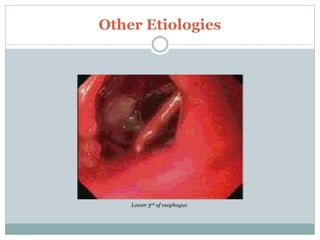
Other Etiologies
Photo Courtesy of Dr. Cavell
Other Etiologies
Lower 3rd of esophagus
Other Etiologies
Risk Stratification
 Rockall score (1996)
 Blatchford score (2000)
A score of less than 2 is associated with low risk of further bleeding
or death
Initial Management
 ABCs
 Include orthostatics – indicates ≥15% acute blood loss
 IV access
 2 large bore IVs (16G or larger), consider central access
 Flow proportional to 4th power of catheter radius (you want
short, large bore catheter)
 22G  35cc/min
 20G  60cc/min
 18G  105cc/min
 16G  205cc/min
 14G  333cc/min
 Run fluids wide open (NOT THROUGH PUMP!!!)
Initial Management
 NPO
 STAT labs (CBC, coags, Type & Screen)
 Monitor CBC q4-6hrs
 Goal Hb >8 (lower goal is better), Plts >50, INR <1.5
 Don’t over-transfuse variceal bleeders
 No need to wait for labs to hang blood products
 Acute bleeders may have normal Hb
 Hold anticoagulation
 IV PPI (protonix) – 80mg bolus, then 8mg/hr
 Consider octreotide if variceal bleed (50mcg bolus, then 50mcg/hr)
 Pre-procedure prokinetics-use in pts with high probability of clot or
fresh blood in stomach
 ICU consult – recurrent hematemesis, active bleeding,
hemodynamic instability, respiratory distress, comorbidities
Acid Suppression w/ PPI
 Clot formation requires pH > 6.8
 IV H2-blockers raise gastric pH, but tolerance leads to
pH 3-5 within 24hrs
 PPI can keep gastric pH >6.8 for over 24hrs
 80mg bolus w/ 8mg/hr infusion raises pH >6 in 20 min
 PPI before endoscopy accelerates clot formation,
stabilizes existing clots, reduces bleeding, need for
endoscopic therapy, LOS, and initiates healing (Lau et al,
NEJM 2007).
 Decrease also seen in rebleeding rates and need for
repeat endoscopy w/ PPI
Laine L and Jensen DM. ACG Practice Guidelines 2012.
NG Lavage
 No benefit to mortality,
LOS, or tsf requirement
 Confirm UGI source
 Assess briskness of bleed
 Negative lavage
 Bleeding stopped
 Source distal to closed pylorus
 May be feculent material
 Irrigate stomach to
facilitate endoscopy
 Remove residual blood, gastric
contents
 Decrease risk of aspiration
Calling a GI Consult
 Place order in computer
 Know the patient
 Know the question you’re asking
 Make sure the patient knows GI is being called
Management of Upper GI Bleed
 EGD – 1st line therapy, can locate and treat source
 Non-variceal UGIB >90% success in stopping initial bleed
 <20% re-bleed rate, 75% stopped w/ 2nd endoscopy
 Tumor bleeding is generally not amenable to endoscopic therapy
 Angiography (IR) – actively bleeding (0.5-1cc/min)
 Tagged RBC scan (>0.1cc/min)
 Surgery
Assessment of Upper GI Ulcers
 Forrest Classification
 Class 1a-Spurting hemorrhage
 Class 1b-Oozing hemorrhage
 Class IIa-Nonbleeding visible vessel
 Class IIb-Adherent clot
 Class IIc-Flag pigmented spot
 Class III-Clean ulcer base
Class Ia Class IIa
Class IIb Class III
Lower GI Bleed
 Same initial management as UGIB (+/- PPI drip)
 11% with suspected LGIB have upper source
 Signs – maroon stools, hematochezia
 Etiology
 Anatomic – diverticular disease (30-50%)
 Vascular – AVMs (10%), ischemia, radiation, hemorrhoids
 Inflammatory (15%) – IBD, infections (C. diff, CMV)
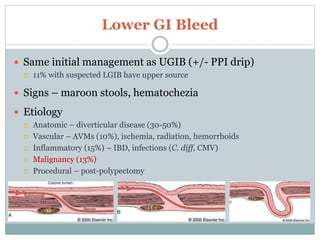
 Malignancy (13%)
 Procedural – post-polypectomy
Lower GI Bleed
 Diverticulosis
 Acute, painless, maroon or BRBPR
 Melena w/ slower R sided bleeds
 Diverticular bleeds usually stop spontaneously (10-40% recur)
 AVMs
 More common in elderly
 Associated w/ aortic stenosis (Heyde’s syndrome)
 Radiation proctitis
 Occurs in 5-20% of pts receiving pelvic XRT (prostate, rectum,
bladder, cervix)
 Risk factors: high radiation dose, age, concurrent chemo
 Treatment: APC, cautery, cryotherapy, RFA
Management of Lower GI Bleed
 Colonoscopy – 1st line therapy, dx yield 74-90%,
ability to intervene. Usually EGD 1st to r/o UGIB.
 Angiography (IR) – actively bleeding (0.5-1cc/min)
 Tagged RBC scan (>0.1cc/min)
 Surgery
Endoscopic Therapy
 Injection w/ epinephrine
 Cautery
Endoscopic Therapy
 Argon Plasma Coagulation (APC)
Endoscopic Therapy
 Clips
Endoscopic Therapy
 Variceal banding
Endoscopic Therapy
 Variceal banding
Endoscopic Therapy
 Capsule endoscopy
Endoscopic Therapy
 Single/Double Balloon Enteroscopy
Clinical Case Follow-up
 76F w/ Stage IV NSCLC adeno ca w/ mets to bone on
erlotinib, DVT on lovenox, diverticulosis, naproxen
for back pain, now presents from SAR w/ back pain,
guaiac positive brown stools, and anemia. Hb 10.2
 6.5 over 1 week.
 What’s the diagnosis?
Clinical Case Follow-up
 CT abd/pelvis w/o con
Conclusions
 Take careful history and physical exam (including rectal)
 No role for FOBT in the inpatient setting
 ABCs
 IV access is critical
 IV PPI for UGIB
 Consider NG tube placement
 Tumor bleeding is not amenable to endoscopic therapy
 EGD/colonoscopy is not a risk-free procedure
 Active bleeder – call ICU, involve GI ASAP
Questions

Gi bleed

  • 1.
    Department of Gastroenterologyand Nutrition Memorial Sloan-Kettering Cancer Center September 17, 2015 Management of Acute Gastrointestinal Bleeding
  • 2.
    Clinical Case  76Fw/ Stage IV NSCLC w/ mets to bone on erlotinib, DVT on lovenox, diverticulosis, naproxen for back pain, now presents from SAR w/ back pain and anemia. Hb 10.2 -> 6.5 over 1 week.  PMH  CAD s/p PCI, HTN, HL  Meds  Omeprazole, amlodipine, atorvastatin, candesartan, erlotinib, klonopin, oxycodone, therapeutic lovenox, senna, colace, fentanyl patch, gabapentin  Allergies  Clindamycin, PCN, sulfa drugs  SH/FH  Denies tobacco, EtOH, illicit drug use  Grandmother w/ colon ca
  • 3.
    Clinical Case cont. ROS  +Back pain, no fever/chills, no lightheadedness/dizziness, denies melena, BRBPR, hematemesis, abdominal pain  PE  Vitals: BP 126/74, HR 93, RR 20, T 36.8C  Gen: NAD  HEENT: OP clear, MMM  Cards: nls1s2, rrr, no mrg  Pulm: cta b/l  Abd: obese, soft, nt, nd, +bs  Rectal: guaiac positive, dark brown stool  Ext: no edema
  • 4.
    Clinical Case cont. Labs  Na 128, K 4.6, Cl 94, CO2 26, BUN 12, Cr 0.5, Gluc 106  Nml LFTs  INR 1.1  WBC 9.9, Hb 6.5, Plt 432  FOBT +  Is this patient stable or unstable?  What is the differential diagnosis?  What is the likely source of her anemia?
  • 5.
    Upper GI Bleed History  PUD, prior bleeds, EtOH, prior surgical/endoscopic interventions (marginal ulcers), liver disease (varices), tumor, prior radiation  Meds – NSAIDs, anti-platelets, anticoagulation  ROS – epigastric pain (PUD), retching (Mallory-Weiss tear), odynophagia/dysphagia (esophageal ulcer)  Physical Exam  Look for evidence of hypovolemia (tachycardia/hypotension)  Abdominal exam  Rectal exam  Guaiac?!  Accurate H&P allows for proper assessment of bleeding severity, volume status, risk factors, and triage decision
  • 6.
    Upper GI Bleed Clinical Signs  Hematemesis (30%) – vomiting of bright red blood or coffee grounds  50% of pts w/ documented varices bleed from another source  Melena (20%) – black and tarry stools  Caused by enzymatic degradation and oxidation of Fe in Hb during passage through ileum and colon  Foul smelling, black (not dark)  Make sure pt not on iron or bismuth  Hematochezia (5%) – passage of BRBPR or maroon stools  Usually lower GI or brisk upper GI bleed (≥1L blood loss)  BUN/Cr – usually >30:1 ratio  Secondary to blood protein absorption or pre-renal azotemia  +Guaiac
  • 7.
    The Role ofFOBT  Occult blood loss (by definition, a small amount)  Guaiac relies on peroxidase reaction to identify Hb  Overt blood loss should be obvious from history and exam  Primary role of FOBT is in colon cancer screening  Sensitive, but specificity varies  False-positive results  Dietary peroxidases – rare meats, raw broccoli, turnips, cauliflower, radishes, cantaloupe  Other – diarrhea/colitis, recent endoscopy, bleeding gums, hemoptysis, epistaxis, menstruation, hemorrhoids, fissures  FOBT HAS NO SIGNIFICANT INPATIENT ROLE
  • 8.
    Etiology of UpperGI Bleed  PUD (50%)  Esophageal varices (30%)  AVMs (6%)  Mallory-Weiss tear (5%)  Trauma (post-op)  Tumors (4%)  Dieulefoy lesion (1%)  Other
  • 9.
  • 10.
  • 11.
  • 12.
    Risk Stratification  Rockallscore (1996)  Blatchford score (2000)
  • 13.
    A score ofless than 2 is associated with low risk of further bleeding or death
  • 15.
    Initial Management  ABCs Include orthostatics – indicates ≥15% acute blood loss  IV access  2 large bore IVs (16G or larger), consider central access  Flow proportional to 4th power of catheter radius (you want short, large bore catheter)  22G  35cc/min  20G  60cc/min  18G  105cc/min  16G  205cc/min  14G  333cc/min  Run fluids wide open (NOT THROUGH PUMP!!!)
  • 16.
    Initial Management  NPO STAT labs (CBC, coags, Type & Screen)  Monitor CBC q4-6hrs  Goal Hb >8 (lower goal is better), Plts >50, INR <1.5  Don’t over-transfuse variceal bleeders  No need to wait for labs to hang blood products  Acute bleeders may have normal Hb  Hold anticoagulation  IV PPI (protonix) – 80mg bolus, then 8mg/hr  Consider octreotide if variceal bleed (50mcg bolus, then 50mcg/hr)  Pre-procedure prokinetics-use in pts with high probability of clot or fresh blood in stomach  ICU consult – recurrent hematemesis, active bleeding, hemodynamic instability, respiratory distress, comorbidities
  • 17.
    Acid Suppression w/PPI  Clot formation requires pH > 6.8  IV H2-blockers raise gastric pH, but tolerance leads to pH 3-5 within 24hrs  PPI can keep gastric pH >6.8 for over 24hrs  80mg bolus w/ 8mg/hr infusion raises pH >6 in 20 min  PPI before endoscopy accelerates clot formation, stabilizes existing clots, reduces bleeding, need for endoscopic therapy, LOS, and initiates healing (Lau et al, NEJM 2007).  Decrease also seen in rebleeding rates and need for repeat endoscopy w/ PPI Laine L and Jensen DM. ACG Practice Guidelines 2012.
  • 18.
    NG Lavage  Nobenefit to mortality, LOS, or tsf requirement  Confirm UGI source  Assess briskness of bleed  Negative lavage  Bleeding stopped  Source distal to closed pylorus  May be feculent material  Irrigate stomach to facilitate endoscopy  Remove residual blood, gastric contents  Decrease risk of aspiration
  • 19.
    Calling a GIConsult  Place order in computer  Know the patient  Know the question you’re asking  Make sure the patient knows GI is being called
  • 20.
    Management of UpperGI Bleed  EGD – 1st line therapy, can locate and treat source  Non-variceal UGIB >90% success in stopping initial bleed  <20% re-bleed rate, 75% stopped w/ 2nd endoscopy  Tumor bleeding is generally not amenable to endoscopic therapy  Angiography (IR) – actively bleeding (0.5-1cc/min)  Tagged RBC scan (>0.1cc/min)  Surgery
  • 21.
    Assessment of UpperGI Ulcers  Forrest Classification  Class 1a-Spurting hemorrhage  Class 1b-Oozing hemorrhage  Class IIa-Nonbleeding visible vessel  Class IIb-Adherent clot  Class IIc-Flag pigmented spot  Class III-Clean ulcer base
  • 22.
    Class Ia ClassIIa Class IIb Class III
  • 24.
    Lower GI Bleed Same initial management as UGIB (+/- PPI drip)  11% with suspected LGIB have upper source  Signs – maroon stools, hematochezia  Etiology  Anatomic – diverticular disease (30-50%)  Vascular – AVMs (10%), ischemia, radiation, hemorrhoids  Inflammatory (15%) – IBD, infections (C. diff, CMV)  Malignancy (13%)  Procedural – post-polypectomy
  • 25.
    Lower GI Bleed Diverticulosis  Acute, painless, maroon or BRBPR  Melena w/ slower R sided bleeds  Diverticular bleeds usually stop spontaneously (10-40% recur)  AVMs  More common in elderly  Associated w/ aortic stenosis (Heyde’s syndrome)  Radiation proctitis  Occurs in 5-20% of pts receiving pelvic XRT (prostate, rectum, bladder, cervix)  Risk factors: high radiation dose, age, concurrent chemo  Treatment: APC, cautery, cryotherapy, RFA
  • 26.
    Management of LowerGI Bleed  Colonoscopy – 1st line therapy, dx yield 74-90%, ability to intervene. Usually EGD 1st to r/o UGIB.  Angiography (IR) – actively bleeding (0.5-1cc/min)  Tagged RBC scan (>0.1cc/min)  Surgery
  • 27.
    Endoscopic Therapy  Injectionw/ epinephrine  Cautery
  • 28.
    Endoscopic Therapy  ArgonPlasma Coagulation (APC)
  • 29.
  • 30.
  • 31.
  • 32.
  • 33.
  • 34.
    Clinical Case Follow-up 76F w/ Stage IV NSCLC adeno ca w/ mets to bone on erlotinib, DVT on lovenox, diverticulosis, naproxen for back pain, now presents from SAR w/ back pain, guaiac positive brown stools, and anemia. Hb 10.2  6.5 over 1 week.  What’s the diagnosis?
  • 35.
    Clinical Case Follow-up CT abd/pelvis w/o con
  • 36.
    Conclusions  Take carefulhistory and physical exam (including rectal)  No role for FOBT in the inpatient setting  ABCs  IV access is critical  IV PPI for UGIB  Consider NG tube placement  Tumor bleeding is not amenable to endoscopic therapy  EGD/colonoscopy is not a risk-free procedure  Active bleeder – call ICU, involve GI ASAP
  • 37.

Editor's Notes

  • #6 Up to 60 percent of patients with a history of an upper GI bleed are bleeding from the same lesion Symptoms that suggest the bleeding is severe include orthostatic dizziness, confusion, angina, severe palpitations, and cold/clammy extremities. ●Varices or portal hypertensive gastropathy in a patient with a history of liver disease or alcohol abuse ●Aorto-enteric fistula in a patient with a history of an abdominal aortic aneurysm or an aortic graft ●Angiodysplasia in a patient with renal disease, aortic stenosis, or hereditary hemorrhagic telangiectasia ●Peptic ulcer disease in a patient with a history of Helicobacter pylori, nonsteroidal anti-inflammatory drug (NSAIDs) use, or smoking ●Malignancy in a patient with a history of smoking, alcohol abuse, or H. pylori infection ●Marginal ulcers (ulcers at an anastomotic site) in a patient with a gastroenteric anastomosis ●Mild to moderate hypovolemia: Resting tachycardia. ●Blood volume loss of at least 15 percent: Orthostatic hypotension (a decrease in the systolic blood pressure of more than 20 mmHg and/or an increase in heart rate of 20 beats per minute when moving from recumbency to standing). ●Blood volume loss of at least 40 percent: Supine hypotension.
  • #7  Majority of melena originates proximal to Ligament of Treitz although can be from R colon or small bowel. Melena may be seen with varying degrees of blood loss (as low as 50cc) Likelihood ratio with patient reported melena 5-6 Melenic stool on exam LR 25 Blood or coffee grounds detected during nasogastric lavage LR 9.6 BUN/Cr >30 LR 7.5 Blood clots in stool lower LR. Hematochezia is usually associated with lower GI bleeding but can also be seen in brisk upper GI bleeds. Typically patient is orthostatic at that time. Examination of stool color may provide clue to location of bleeding but not a reliable indicator Series of 80 patients with severe hematochezia (red/maroon) 74% had colonic lesion, 11 % upper GI lesion, 9% presumed small bowel source, 6% no site was identifiied.
  • #13 Hemodynamic instability, hemoglobin <10, active bleeding at endoscopy, large ulcer size, ulcer location (posterior duodenal bulb or high lesser gastric curvature are factors associated with rebleeding Risk assessment of patients is useful to determine which patients are at higher risk of further bleeding or death and may help inform management decisions such as timing of endoscopy, time of discharge, level of care (ward vs. step-down vs. ICU) Help predict who may be suitable for early hospital discharge or even outpatient care Decreased resources
  • #14 Has been shown to predict risk of further bleeding and death in hospitalized patients with UGIB Also relies on EGD findings Age <60 0 points, 60-79 1 point, >/=80 2 points SBP>/=100, pulse <100 0 points, hypotension with systolic BP <100 2 points No comorbidities 0 points, renal failure/hepatic failure/disseminated cancer 3 points MW tear but no major lesions or stigmata of recent bleed 0 points, other nonmalignant GI diagnoses 1 point, upper GI tract malignancy 2 points Recent hemorrhage, none 0, blood found (adherent clot etc) 2
  • #15 Has been shown to predict the risk of intervention (transfusion vs. endocopy vs. surgery) and death in hospitalized patients The higher the score, the more likely endoscopic intervention will be required. Modified Blatchford score is calculated using only BUN, hemoglobin, SBP and pulse. Performs as well as full Blatchford and outperforms Rockall score with regard to predicitng need for clinical intervention, rebleeding and mortality. AIM65 -Albumin <3 INR>1.5 Altered mental status SBP<90 Age>65 In validation cohort, mortality rate increased with increasing score Increasing score also associated with increased LOS and cost Less is known about rebleeding
  • #16 Patient s should receive supplemental O2 by NC and NPO
  • #17 NEJM article by Villaneuva showed that in a RCT of 921 patients with acute UGIB, restrictive transfusion strategy (tranfusion threshold <7g/dl) with target hemoglobin 7-9 significantly decreased 6-week mortality, length of stay and transfusion-related adverse events compared with a liberal transfusion strategy (transfusion threshold <9g/dl with taret hemoglobin 9-11). Excluded all patients presenting with severe hemorrhagic shock (consensus guidelines suggest higher hemoglobin concentrations), patients with ACS, peripheral vasculopathy, stroke, TIA or blood transfusion within 90 days, recent trauma/surgery, a Rockall score of 0 with hemoglobin level higher than 12g/dl, or if attending physician decided that a patient should avoid a specific medical therapy. Patients in the restrictive group were more likely than those in the liberal group to avoid transfusion (51 vs. 14%) and received fewer units of blood. Mortality was lower in the restrictive strategy group (5 vs. 9%). Patients in the restrictive group were also less likely to have further bleeding or to suffer complications. Among patients with cirrhosis, the risks of death and further bleeding were lower with the restrictive strategy for patients with Child A or B cirrhosis but were similar for patient with Child C cirrhosis. Most of the overall benefit seemed to come from patients with Child A/B cirrhosis Of note, all patients underwent emergent EGD within 5-6 hours Prokinetics have been shown to significantly shorten the duration of endoscopy, reduce the need for repeat endoscopy and decrease the need for blood transfusions. All patients with HD instability (shock, orthostatic hypotension) or active bleeding (hematemesis, BRB per NGT, hematochezia) should be admitted to ICU for resuscitation and observation with BP monitor, EKG, pulse ox. Other patients can be admitted to regular medical ward, though suggest that all admitted patients with exception of low0risk patients receive EKG monitoring Intubation in patients with ongoing hematemesis or altered mental status Initiate blood transfusions if hemoglobin<7g/dl. However, goal to maintain hemoglobin >/=9 for patients at increased risk of adverese events in the setting of signficant anemia, such as those with unstable coronary artery disease Patients with active bleeding and hypovolemia may require blood transfusion despite normal hemoglobin Transfusing patients of variceal bleeding to hemoglobin >10 should be avoided. Provided the aptient is HD stable, urgent endoscopy can usually proceed simultaneously with transfusion and should not be postponed until coagulatopathy is corrected However, in patients with an INR >/=3 we attempt to correct INR <3 prior to starting an endoscopy with additional FFP beging given after the endoscopy if high-risk stigmata for recurrent bleeding were found or if endoscopic therapy was performed and INR is still >1.5. This approach is based on data that suggest endoscopy is safe in patients who are mildly to moderately anticoagulation (24). Transfusion of a unit of FFP should be considered after every 4 untis of PRBCs Platelet transfusions should be considered in patients with life-threatening bleeding who have received antiplatelet agents ie: ASA or plavix. If recent (<1 yr sten) consider discussing with cardiology. Somatostatin and octerotide have a theoretical benefit in bleeding ulcer disease because they reduce splanchnic blood flow, inhibit gastric acid secretion and may have gastric cytoprotective effects
  • #18 A meta-analysis of 21 randomized trials that compared PPIs with either placebo or an H2RA for bleeding ulcers (with or without endoscopic therapy) found a significant and consistent reduction in the risk of recurrent bleeding and the need for surgery. However, no effect on mortality. Meta-analyses of randomized trials have failed to show superior outcomes with high-doses of continuous infusion PPI administration compared with intermittent dosing and using intermittent dosing rather than continuous infusion could decrease resource utilization and cost. Pantoprazole and esomeprazole are the only IV formulations available in the US and IV lansoprazole has been removed from the world market. Small studies suggest that intermittent dosing and continuous infusion have similar effects on gastric pH for the first 12 hours after the initial bolus is given.
  • #24 However, only patients with active bleeding (spurting or oozing), a nonbleeding visible vessel or an adherent clot are generally considered to be at high risk for recurrent bleeding On the other hand, patients without these high-risk stigmata are considered low risk and do not require endoscopic therapy. In patients with high-risk stigmata of recent hemorrhage, the twice daily IV PPI may be switched to a standard dose oral PPI 72 hours after endoscopy, provided there is no evidence of recurrent bleeding However a randomized trial suggested that twice-daily oral dosing may be preferable in patients at high risk of rebleeding. In the trial, patients with Rockall score >/=6 who received a twice-daily oral PPI had a lower rebleeding rate than those who received a once-daily oral PPI In patients who do not have active bleeding or other high-risk stigmata (ie: visible vessel or adherent clots) can switch to standard-dose oral PPI immediately following endoscopy.
  • #28 Three types of contact thermal devices: -Multipolar probes (Gold Probe, quicksilver bipolar probe , BICAP Superconductor) -Heater probe (Heatprobe) -Monopolar probe (Coagrasper) Multipolar probes achieve hemostasis by heating the contacted tissue with electricity that passes between the alternating arrays of positive and negative electrodes located at the tip of the probe. Electrical circuit is completed between two electrodes on the tip of the probe, so circuit is completed locally and no grounding pad is required. Tissue coagulation occurs at the tip or sides of the multipolar probe when tissue temp reaches 70 degrees celsius. Deep tissue coagulation is restricted because resistance to further coagulation increases exponentially once tissue in contact with probe has been completely dessicated Coagulation depth can be increased by using large probes, using lower energy levels applied over a longer period of time and using firmer contact (tamponade) Heater probe: Heater probe has a thermocouple at the tip of probe that heats up to provide tissue coagulation. Because it uses heat transfer across a ceramic tip as its mode of coagulation, the penetration of tissue coagulation is not limited by tissue water, reisstance or dessication, as it is with the multipolar probes. As a result deep coagulation is feasible with the heater probe; this can be dangerous if perforation is a concern such as acutely bleeding lesions with thin bases. Heater probes my be applied perpendicularly to the lesion being treated, which can be a limitation when treating lesions in difficult to access locations. Monopolar probe: designed for bleeding control are similar to hot biopsy forceps except that the jaws are flat, not curved and cutting and rotatable. Similar to other forms of monopolar technology (such as using a snare with cautery) a grounding pad is required. The tissue for therapy is grasped with the forceps and pulled or tented away from the gastrointestinal wall, which helps limit the depth of cautery.
  • #29 APC is a non-contact thermal method of hemostasis. It was introduced as an alternative to contact thermal coagulation (heater probe and bipolar cautery) and non-contact technologies (primarily laser). The advantages of APC include ease of application, speedy treatment of multiple lesions in the case of AVM or wide areas (base of resected polyp or tumor bleeding), safety due to reduced depth of penetration and lower cost compared to laser. Uses argon gas to deliver plasma of evenly distributed thermal energy to a field of tissue adjacent to the probe. A high voltage spark is delivered at the tip of the probe that ionizes the argon gas as it is sprayed from the probe tip in the direction of the target tissue. Argon gas is non-flammable and inexpensive. The ionized gas or plasma then seeks a ground in the nearest tissue, delivering the thermal energy with a depth of penetration of 2-3 mm. Plasma coagulates linearly and tangentially. Good for treating a lesion around a fold and not clearly in view or a lesion that cannot be postioned directly in front of the endoscope.
  • #34 Evaluation of the small bowel is difficult due to its length, intrperitoneal location and contractility. Methods used to evaluate the small bowel include push enteroscopy, video capsule endoscopy and intraoperative enteroscopy. Push enteroscopy: only examines small bowel that is 50-150cm distal to the ligament of Treitz Deep small bowel enterscopy permits visulatization and interventional therapy throughout the small bowel by using insertion techniques that pleat the small bowel onto an overtube. This limits strectching of the small bowel as occurs with push enteroscopy Options include double balloon enterscopy, single balloon enterscopy, spiral enterscopy