Abdominal Compartment Syndrome :
An Unrecognised Cause of AKI


                SAID KHAMIS (MD, KUL Belgium)
                Professor Of Medicine
                Nephrology Consultant
                Menofia University Hospitals
Agenda - IAH and ACS

   Definition – what is it?
   Causes
   Recent increase in recognition
   Physiologic Manifestations
   Prevalence
   Outcome
   Treatment
   Detection:
       Bladder pressure monitoring
Abdominal Compartment Syndrome


Definition


“…….. multiple organ dysfunction caused by
   elevated intra-abdominal pressure.”
                Tim Wolfe, MD
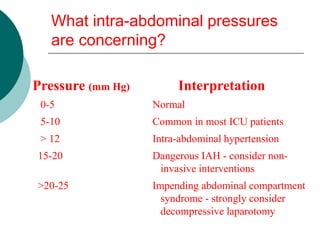
What intra-abdominal pressures
   are concerning?

Pressure (mm Hg)        Interpretation
 0-5               Normal
 5-10              Common in most ICU patients
 > 12              Intra-abdominal hypertension
15-20              Dangerous IAH - consider non-
                    invasive interventions
>20-25             Impending abdominal compartment
                     syndrome - strongly consider
                     decompressive laparotomy
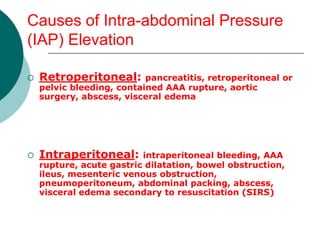
Causes of Intra-abdominal Pressure
(IAP) Elevation

   Retroperitoneal:       pancreatitis, retroperitoneal or
    pelvic bleeding, contained AAA rupture, aortic
    surgery, abscess, visceral edema


   Intraperitoneal:      intraperitoneal bleeding, AAA
    rupture, acute gastric dilatation, bowel obstruction,
    ileus, mesenteric venous obstruction,
    pneumoperitoneum, abdominal packing, abscess,
    visceral edema secondary to resuscitation (SIRS)
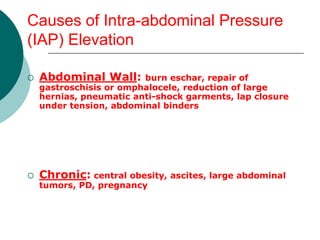
Causes of Intra-abdominal Pressure
(IAP) Elevation

   Abdominal Wall:      burn eschar, repair of
    gastroschisis or omphalocele, reduction of large
    hernias, pneumatic anti-shock garments, lap closure
    under tension, abdominal binders


   Chronic: central obesity, ascites, large abdominal
    tumors, PD, pregnancy
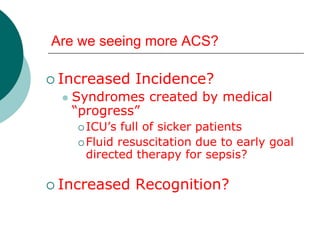
Are we seeing more ACS?

 Increased     Incidence?
     Syndromes created by medical
      “progress”
       ICU’s  full of sicker patients
       Fluid resuscitation due to early goal
        directed therapy for sepsis?

 Increased     Recognition?
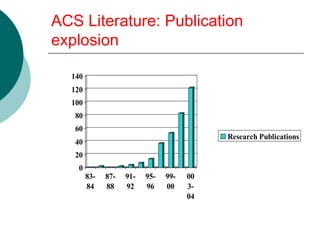
ACS Literature: Publication
explosion

  140
  120
  100
   80
   60
                                           Research Publications
   40
   20
    0
        83-   87-   91-   95-   99-   00
        84    88    92    96    00    3-
                                      04
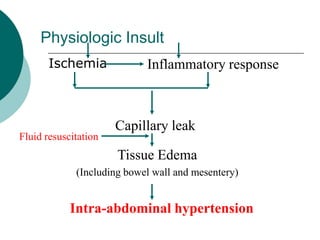
Physiologic Insult
       Ischemia             Inflammatory response


                      Capillary leak
Fluid resuscitation
                      Tissue Edema
             (Including bowel wall and mesentery)


            Intra-abdominal hypertension
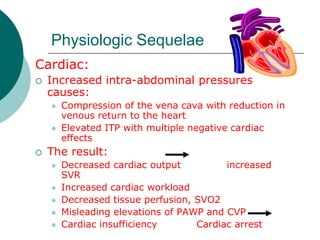
Physiologic Sequelae
Cardiac:
   Increased intra-abdominal pressures
    causes:
       Compression of the vena cava with reduction in
        venous return to the heart
       Elevated ITP with multiple negative cardiac
        effects
   The result:
       Decreased cardiac output          increased
        SVR
       Increased cardiac workload
       Decreased tissue perfusion, SVO2
       Misleading elevations of PAWP and CVP
       Cardiac insufficiency       Cardiac arrest
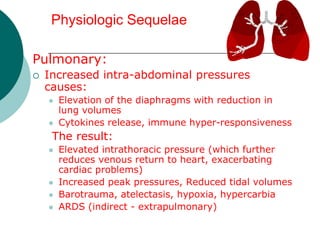
Physiologic Sequelae

Pulmonary:
   Increased intra-abdominal pressures
    causes:
       Elevation of the diaphragms with reduction in
        lung volumes
       Cytokines release, immune hyper-responsiveness
     The result:
       Elevated intrathoracic pressure (which further
        reduces venous return to heart, exacerbating
        cardiac problems)
       Increased peak pressures, Reduced tidal volumes
       Barotrauma, atelectasis, hypoxia, hypercarbia
       ARDS (indirect - extrapulmonary)
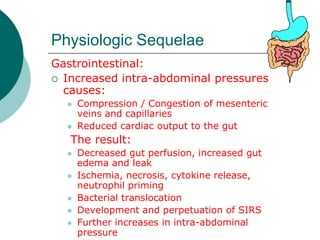
Physiologic Sequelae
Gastrointestinal:
 Increased intra-abdominal pressures
  causes:
     Compression / Congestion of mesenteric
      veins and capillaries
     Reduced cardiac output to the gut
   The result:
     Decreased gut perfusion, increased gut
      edema and leak
     Ischemia, necrosis, cytokine release,
      neutrophil priming
     Bacterial translocation
     Development and perpetuation of SIRS
     Further increases in intra-abdominal
      pressure
Physiologic Sequelae
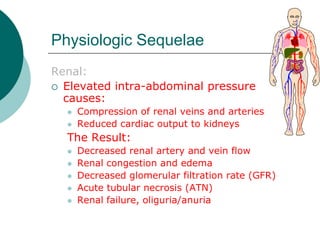
Renal:
 Elevated intra-abdominal pressure
  causes:
     Compression of renal veins and arteries
     Reduced cardiac output to kidneys
  The Result:
     Decreased renal artery and vein flow
     Renal congestion and edema
     Decreased glomerular filtration rate (GFR)
     Acute tubular necrosis (ATN)
     Renal failure, oliguria/anuria
Physiologic Sequelae
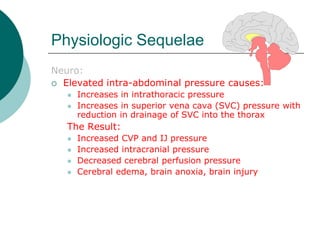
Neuro:
 Elevated intra-abdominal pressure causes:
      Increases in intrathoracic pressure
      Increases in superior vena cava (SVC) pressure with
       reduction in drainage of SVC into the thorax
   The Result:
      Increased CVP and IJ pressure
      Increased intracranial pressure
      Decreased cerebral perfusion pressure
      Cerebral edema, brain anoxia, brain injury
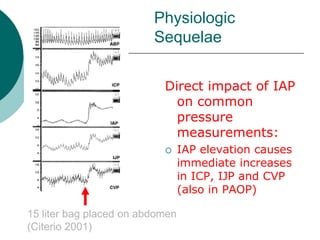
Physiologic
                         Sequelae


                           Direct impact of IAP
                             on common
                             pressure
                             measurements:
                                IAP elevation causes
                                 immediate increases
                                 in ICP, IJP and CVP
                                 (also in PAOP)

15 liter bag placed on abdomen
(Citerio 2001)
Physiologic Sequelae
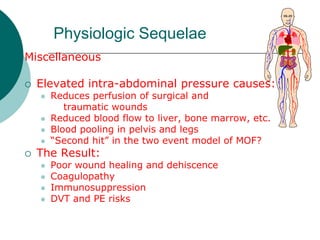
Miscellaneous

   Elevated intra-abdominal pressure causes:
       Reduces perfusion of surgical and
           traumatic wounds
       Reduced blood flow to liver, bone marrow, etc.
       Blood pooling in pelvis and legs
       “Second hit” in the two event model of MOF?
   The Result:
       Poor wound healing and dehiscence
       Coagulopathy
       Immunosuppression
       DVT and PE risks
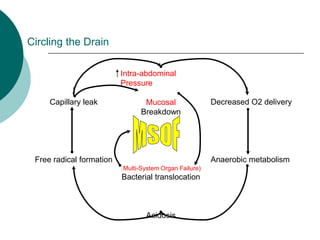
Circling the Drain

                          Intra-abdominal
                          Pressure

     Capillary leak               Mucosal                Decreased O2 delivery
                                 Breakdown


 Free radical formation                                  Anaerobic metabolism
                          (Multi-System Organ Failure)
                          Bacterial translocation


                                  Acidosis
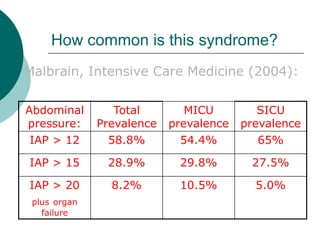
How common is this syndrome?
Malbrain, Intensive Care Medicine (2004):

Abdominal        Total        MICU         SICU
pressure:     Prevalence   prevalence   prevalence
 IAP > 12       58.8%        54.4%         65%

IAP > 15       28.9%        29.8%        27.5%

IAP > 20        8.2%        10.5%         5.0%
 plus organ
   failure
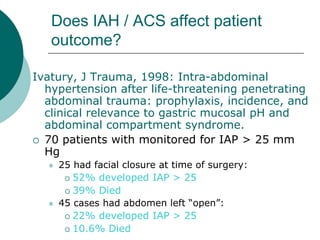
Does IAH / ACS affect patient
   outcome?

Ivatury, J Trauma, 1998: Intra-abdominal
  hypertension after life-threatening penetrating
  abdominal trauma: prophylaxis, incidence, and
  clinical relevance to gastric mucosal pH and
  abdominal compartment syndrome.
 70 patients with monitored for IAP > 25 mm
  Hg
     25 had facial closure at time of surgery:
        52% developed IAP > 25

        39% Died
     45 cases had abdomen left “open”:
        22% developed IAP > 25

        10.6% Died
Does IAH / ACS affect patient
  outcome?

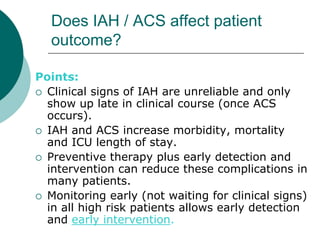
Points:
 Clinical signs of IAH are unreliable and only
  show up late in clinical course (once ACS
  occurs).
 IAH and ACS increase morbidity, mortality
  and ICU length of stay.
 Preventive therapy plus early detection and
  intervention can reduce these complications in
  many patients.
 Monitoring early (not waiting for clinical signs)
  in all high risk patients allows early detection
  and early intervention.
IAH/ACS Management
   Fluids – two edged sword
       Fluids will absolutely improve cardiac indices if
        the patient has inadequate RV filling- so early in
        the course they are necessary
       However, over resuscitation will lead to worsened
        edema
   Abdominal perfusion pressure - optimize
    fluids first then add vasopressors. Shoot for a
    perfusion pressure > 60 mm Hg
   Sedation, Paralytics
   Cathartics / enema to clear bowel?
   Colloids
   Hemofiltration
   Paracentesis
       Need significant free fluid on US
   Decompressive laparotomy
IAH/ACS Management :
        Abdominal Perfusion Pressure

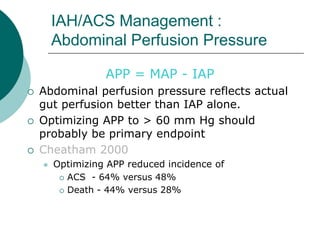
                  APP = MAP - IAP
   Abdominal perfusion pressure reflects actual
    gut perfusion better than IAP alone.
   Optimizing APP to > 60 mm Hg should
    probably be primary endpoint
   Cheatham 2000
       Optimizing APP reduced incidence of
          ACS - 64% versus 48%

          Death - 44% versus 28%
IAH/ACS Management:
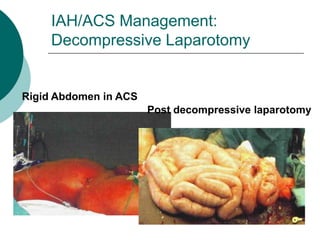
     Decompressive Laparotomy


Rigid Abdomen in ACS
                       Post decompressive laparotomy
Surgical Management of
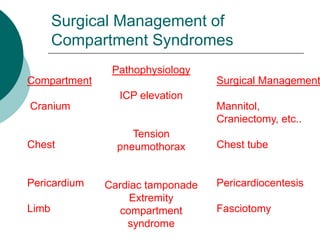
       Compartment Syndromes
               Pathophysiology
Compartment                       Surgical Management
                ICP elevation
Cranium                           Mannitol,
                                  Craniectomy, etc..
                   Tension
Chest           pneumothorax      Chest tube


Pericardium   Cardiac tamponade   Pericardiocentesis
                   Extremity
Limb             compartment      Fasciotomy
                  syndrome
Decompressive Laparotomy

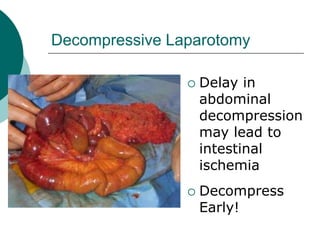
                   Delay in
                    abdominal
                    decompression
                    may lead to
                    intestinal
                    ischemia
                   Decompress
                    Early!
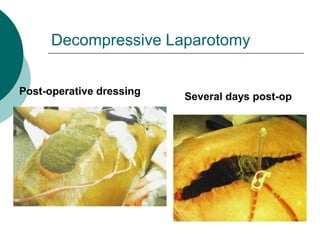
Decompressive Laparotomy


Post-operative dressing   Several days post-op
Intra-Abdominal Pressure
Monitoring

Bladder pressure monitoring through
  the Foley catheter is:
     The current standard for monitoring
      abdominal pressures (Consensus, World
      Congress ACS Dec 2004)

     Comparable to direct intraperitoneal
      pressure measurements, but is non-
      invasive (Bailey, Crit Care 2000)
     More reliable and reproducible than
      clinical judgment (Kirkpatrick, CJS 2000;
      Sugrue World J Surg 2002)
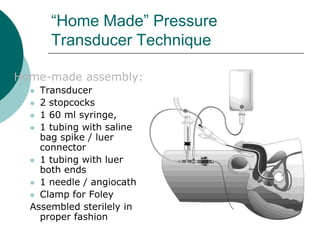
“Home Made” Pressure
      Transducer Technique

Home-made assembly:
   Transducer
   2 stopcocks
   1 60 ml syringe,
   1 tubing with saline
    bag spike / luer
    connector
   1 tubing with luer
    both ends
   1 needle / angiocath
   Clamp for Foley
  Assembled sterilely in
    proper fashion
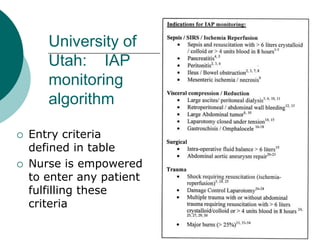
University of
       Utah: IAP
       monitoring
       algorithm

   Entry criteria
    defined in table
   Nurse is empowered
    to enter any patient
    fulfilling these
    criteria
Final Thought
Do NOT wait for signs of ACS to be
 present before you decide to check IAP
     By then the patient has one foot in the
      grave!
     You have lost your opportunity for medical
      therapy

Monitor ALL high risk patients early and
 often:
     TREND IAP like a vital sign
     Intervene early, before critical pressure
      develops
QUESTIONS?

  IAH and ACS Educational Web
             sites:
 www.Abdominalcompartmentsyndrome.
                org

Abdominal compartment syndrome[1]

  • 1.
    Abdominal Compartment Syndrome: An Unrecognised Cause of AKI SAID KHAMIS (MD, KUL Belgium) Professor Of Medicine Nephrology Consultant Menofia University Hospitals
  • 2.
    Agenda - IAHand ACS  Definition – what is it?  Causes  Recent increase in recognition  Physiologic Manifestations  Prevalence  Outcome  Treatment  Detection:  Bladder pressure monitoring
  • 3.
    Abdominal Compartment Syndrome Definition “……..multiple organ dysfunction caused by elevated intra-abdominal pressure.” Tim Wolfe, MD
  • 4.
    What intra-abdominal pressures are concerning? Pressure (mm Hg) Interpretation 0-5 Normal 5-10 Common in most ICU patients > 12 Intra-abdominal hypertension 15-20 Dangerous IAH - consider non- invasive interventions >20-25 Impending abdominal compartment syndrome - strongly consider decompressive laparotomy
  • 5.
    Causes of Intra-abdominalPressure (IAP) Elevation  Retroperitoneal: pancreatitis, retroperitoneal or pelvic bleeding, contained AAA rupture, aortic surgery, abscess, visceral edema  Intraperitoneal: intraperitoneal bleeding, AAA rupture, acute gastric dilatation, bowel obstruction, ileus, mesenteric venous obstruction, pneumoperitoneum, abdominal packing, abscess, visceral edema secondary to resuscitation (SIRS)
  • 6.
    Causes of Intra-abdominalPressure (IAP) Elevation  Abdominal Wall: burn eschar, repair of gastroschisis or omphalocele, reduction of large hernias, pneumatic anti-shock garments, lap closure under tension, abdominal binders  Chronic: central obesity, ascites, large abdominal tumors, PD, pregnancy
  • 7.
    Are we seeingmore ACS?  Increased Incidence?  Syndromes created by medical “progress”  ICU’s full of sicker patients  Fluid resuscitation due to early goal directed therapy for sepsis?  Increased Recognition?
  • 8.
    ACS Literature: Publication explosion 140 120 100 80 60 Research Publications 40 20 0 83- 87- 91- 95- 99- 00 84 88 92 96 00 3- 04
  • 9.
    Physiologic Insult Ischemia Inflammatory response Capillary leak Fluid resuscitation Tissue Edema (Including bowel wall and mesentery) Intra-abdominal hypertension
  • 10.
    Physiologic Sequelae Cardiac:  Increased intra-abdominal pressures causes:  Compression of the vena cava with reduction in venous return to the heart  Elevated ITP with multiple negative cardiac effects  The result:  Decreased cardiac output increased SVR  Increased cardiac workload  Decreased tissue perfusion, SVO2  Misleading elevations of PAWP and CVP  Cardiac insufficiency Cardiac arrest
  • 11.
    Physiologic Sequelae Pulmonary:  Increased intra-abdominal pressures causes:  Elevation of the diaphragms with reduction in lung volumes  Cytokines release, immune hyper-responsiveness The result:  Elevated intrathoracic pressure (which further reduces venous return to heart, exacerbating cardiac problems)  Increased peak pressures, Reduced tidal volumes  Barotrauma, atelectasis, hypoxia, hypercarbia  ARDS (indirect - extrapulmonary)
  • 12.
    Physiologic Sequelae Gastrointestinal:  Increasedintra-abdominal pressures causes:  Compression / Congestion of mesenteric veins and capillaries  Reduced cardiac output to the gut The result:  Decreased gut perfusion, increased gut edema and leak  Ischemia, necrosis, cytokine release, neutrophil priming  Bacterial translocation  Development and perpetuation of SIRS  Further increases in intra-abdominal pressure
  • 13.
    Physiologic Sequelae Renal:  Elevatedintra-abdominal pressure causes:  Compression of renal veins and arteries  Reduced cardiac output to kidneys The Result:  Decreased renal artery and vein flow  Renal congestion and edema  Decreased glomerular filtration rate (GFR)  Acute tubular necrosis (ATN)  Renal failure, oliguria/anuria
  • 14.
    Physiologic Sequelae Neuro:  Elevatedintra-abdominal pressure causes:  Increases in intrathoracic pressure  Increases in superior vena cava (SVC) pressure with reduction in drainage of SVC into the thorax The Result:  Increased CVP and IJ pressure  Increased intracranial pressure  Decreased cerebral perfusion pressure  Cerebral edema, brain anoxia, brain injury
  • 15.
    Physiologic Sequelae Direct impact of IAP on common pressure measurements:  IAP elevation causes immediate increases in ICP, IJP and CVP (also in PAOP) 15 liter bag placed on abdomen (Citerio 2001)
  • 16.
    Physiologic Sequelae Miscellaneous  Elevated intra-abdominal pressure causes:  Reduces perfusion of surgical and traumatic wounds  Reduced blood flow to liver, bone marrow, etc.  Blood pooling in pelvis and legs  “Second hit” in the two event model of MOF?  The Result:  Poor wound healing and dehiscence  Coagulopathy  Immunosuppression  DVT and PE risks
  • 17.
    Circling the Drain Intra-abdominal Pressure Capillary leak Mucosal Decreased O2 delivery Breakdown Free radical formation Anaerobic metabolism (Multi-System Organ Failure) Bacterial translocation Acidosis
  • 18.
    How common isthis syndrome? Malbrain, Intensive Care Medicine (2004): Abdominal Total MICU SICU pressure: Prevalence prevalence prevalence IAP > 12 58.8% 54.4% 65% IAP > 15 28.9% 29.8% 27.5% IAP > 20 8.2% 10.5% 5.0% plus organ failure
  • 19.
    Does IAH /ACS affect patient outcome? Ivatury, J Trauma, 1998: Intra-abdominal hypertension after life-threatening penetrating abdominal trauma: prophylaxis, incidence, and clinical relevance to gastric mucosal pH and abdominal compartment syndrome.  70 patients with monitored for IAP > 25 mm Hg  25 had facial closure at time of surgery:  52% developed IAP > 25  39% Died  45 cases had abdomen left “open”:  22% developed IAP > 25  10.6% Died
  • 20.
    Does IAH /ACS affect patient outcome? Points:  Clinical signs of IAH are unreliable and only show up late in clinical course (once ACS occurs).  IAH and ACS increase morbidity, mortality and ICU length of stay.  Preventive therapy plus early detection and intervention can reduce these complications in many patients.  Monitoring early (not waiting for clinical signs) in all high risk patients allows early detection and early intervention.
  • 21.
    IAH/ACS Management  Fluids – two edged sword  Fluids will absolutely improve cardiac indices if the patient has inadequate RV filling- so early in the course they are necessary  However, over resuscitation will lead to worsened edema  Abdominal perfusion pressure - optimize fluids first then add vasopressors. Shoot for a perfusion pressure > 60 mm Hg  Sedation, Paralytics  Cathartics / enema to clear bowel?  Colloids  Hemofiltration  Paracentesis  Need significant free fluid on US  Decompressive laparotomy
  • 22.
    IAH/ACS Management : Abdominal Perfusion Pressure APP = MAP - IAP  Abdominal perfusion pressure reflects actual gut perfusion better than IAP alone.  Optimizing APP to > 60 mm Hg should probably be primary endpoint  Cheatham 2000  Optimizing APP reduced incidence of  ACS - 64% versus 48%  Death - 44% versus 28%
  • 23.
    IAH/ACS Management: Decompressive Laparotomy Rigid Abdomen in ACS Post decompressive laparotomy
  • 24.
    Surgical Management of Compartment Syndromes Pathophysiology Compartment Surgical Management ICP elevation Cranium Mannitol, Craniectomy, etc.. Tension Chest pneumothorax Chest tube Pericardium Cardiac tamponade Pericardiocentesis Extremity Limb compartment Fasciotomy syndrome
  • 25.
    Decompressive Laparotomy  Delay in abdominal decompression may lead to intestinal ischemia  Decompress Early!
  • 26.
  • 27.
    Intra-Abdominal Pressure Monitoring Bladder pressuremonitoring through the Foley catheter is:  The current standard for monitoring abdominal pressures (Consensus, World Congress ACS Dec 2004)  Comparable to direct intraperitoneal pressure measurements, but is non- invasive (Bailey, Crit Care 2000)  More reliable and reproducible than clinical judgment (Kirkpatrick, CJS 2000; Sugrue World J Surg 2002)
  • 28.
    “Home Made” Pressure Transducer Technique Home-made assembly:  Transducer  2 stopcocks  1 60 ml syringe,  1 tubing with saline bag spike / luer connector  1 tubing with luer both ends  1 needle / angiocath  Clamp for Foley Assembled sterilely in proper fashion
  • 29.
    University of Utah: IAP monitoring algorithm  Entry criteria defined in table  Nurse is empowered to enter any patient fulfilling these criteria
  • 30.
    Final Thought Do NOTwait for signs of ACS to be present before you decide to check IAP  By then the patient has one foot in the grave!  You have lost your opportunity for medical therapy Monitor ALL high risk patients early and often:  TREND IAP like a vital sign  Intervene early, before critical pressure develops
  • 31.
    QUESTIONS? IAHand ACS Educational Web sites: www.Abdominalcompartmentsyndrome. org