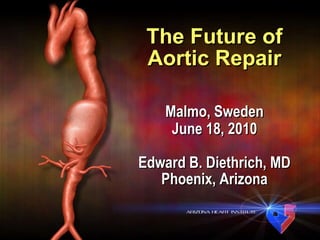
Edward B. Diethrich, MD Phoenix, Arizona The Future of Aortic Repair Malmo, Sweden June 18, 2010
What Perspective? How? Where? Who? What?
How? Where? Who? Classical Endovascular Robotic Laparoscopic Hybrid Cathlab OR Radiology Suite Hybrid Vascular Surgeon Interventional Cardiologist Interventional Radiologist CT Surgeon Hybrid
Infrarenal AAA Local anesthesia Percutaneous Maybe outpatient Anyone What Perspective?
Bown MJ et al.Br J Surg 2002;89:7 14-30. Visser  P 2005 Perioperative Period: Surgical mortality still elevated : 40 – 50% range Open Repair Overall mortality of 75 to 80%
Acute Type B Descending Dissection Asymptomatic What Perspective? Medical Rx Endograft Controversy Waiting for studies Our Data Symptomatic (malperfusion) Endovascular technology with some hybrid combinations
Acute Type A Dissection No AI Limited to zone 0 [endovascular treatment] Type I arch/descending Ascending tube What Perspective? Progressive dissection not inconsequential
Mortality Ruptured Cases All Pathologies TAA Intraop Death 4 (5.5%) 3(12.5%) < 30 Days 9 (12.3%) 5 (20.8%)
Conclusion TEVAR should be the first option of treatment in high risk patients and those with anatomical restraints in order to increase survival. Neuro-deficit is decreased when compared to open repair.
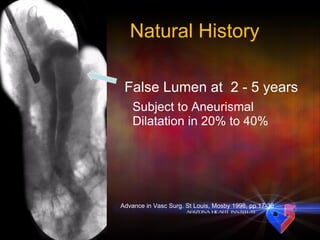
Natural History False Lumen at  2 - 5 years Subject to Aneurismal Dilatation in 20% to 40%  Advance in Vasc Surg. St Louis, Mosby 1998, pp 17-36
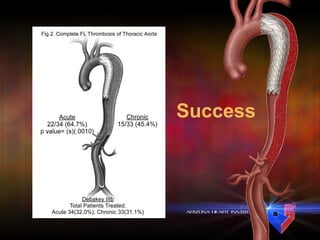
Success
Success
Remodeling Changes Continues Post-op 6 months P/3 M/3 D/3 Retrograde Flow
Observations Retrograde flow at viscerals 17.7% (19pts) Retrograde flow at D/3 18.7% (20pts) Retrograde flow at M/3  1.8% (2pts) Retrograde flow at P/3  1.8% (2pts) flow FL  thrombosis/ patency depend on several factors
Complete thrombosis of  FL  of TA without evidence of antegrade or retrograde flow  –  69 pts   (65.1%) Results Flow
Incidence of Aneurismatic Dilatation Incidence is 20-40% over 5 year period Risk of extending dissection and potential complications including visceral and limb malperfusion   26%
Observations Pre-Op Post-Op 1 month 24 months 6 months Remodeling Changes True lumen gain volume False lumen decrease  in  diameter Whole lumen expand J Vasc Surg 2009;49:20-8.
Post-Op 6 months 24 months Case #3 P/3 D/3
Type B Dissection, Regardless of Symptoms, Should Be Treated By Endografting to Prevent Future Complications?
Exceptions ? Asymptomatic patient without significantly collapsed true lumen, <50%. Inclined to Treat Non-complicated  TBD with ELG
Endograft is well indicated in aortic dissection type B since the natural history demonstrated high degree of success and positive remodeling changes.
No commercial products for many of the pathologies encountered Frequent customization required Complexity of pathology restricts broad training and experience Limitations at Present Example?
June 1998 and June 2009 Retrospective Review Presented with a rAAA  69 (65.2%) -- Open Repair 36 (33.6%) -- EVAR  Our Series: Open vs Endograft
30-Day Mortality Overall was 29.5% (31)  34.8% (24) for  Open   19.4% (7) for  EVAR   (p=0.12)  When comparing those  EVAR  cases with combined use of local anesthesia at initiation of procedure and use of supra-celiac occlusive balloon to those receiving general anesthesia and no balloon ,  the mortality reduced from 27.8% to 11.1 % (p=0.40)
Conclusions EVAR in ruptured AAAs has reduced mortality. Supraceliac occlusive balloon, based on CT findings of large retroperitoneal hematoma, initiated under local anesthetic, can prevent circulatory collapse.
Conclusions Availability of graft to treat larger caliber necks and low profile devices are some of the technology changes that we need.
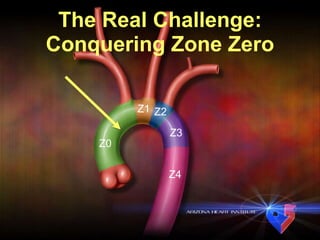
Z0 Z1 Z2 Z3 Z4 The Real Challenge: Conquering Zone Zero
Level of the annulus of the aortic valve Sinus of Valsalva Sinotubular junction Ascending aorta at the level of pulmonary trunk 64 Slice CT Oblique Coronal Images Showing the 4 Diameter Measurements of Aortic Root
Acute Dissection Ascending Aorta Hematoma High Risk Patient for Open Procedure Balloon Occluding Device L. Coronary Artery Sheath with Positioning of ELG Aortic Valve Dissection
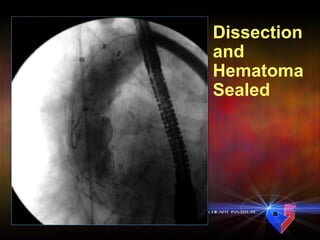
Dissection and Hematoma Sealed
24 ° Post-Op CT
1.  Vortex velocity control in aneurysm 2.  Laminates the flow in collaterals 3.  Accelerates shear stress flow in the vessel Multi-Layered Stent Key Principles
Human Experience (All OUS) Thoraco Abdominal Aneurysm
1 Month Follow-Up Aneurysm excluded All visceral arteries open


Future Potential for  Endovascular ??? Aortic Stenosis Ascending Arch Aneurysm Aortic Stenosis
Neuro Protection Devices Ascending Endoluminal Graft Coronary Inserts Percutaneous Aortic Valve Special Stent to Correct Kink Arch/ Descending Endoluminal Graft with Three Branches
Horizon Looks Favorable…. Training Government FDA CMS Industry
We are the heritage of our undaunted medical forefathers. Our young physicians are the genetic products of those great pioneers. Let their fate be the product of those positive, energetic, inquisitive, creative, and adventurous epigenoms which have the ability to overcome all adversity and bring ultimate success to all endeavers.
 
In All Aspects of Cardiovascular Therapy, the Pendulum is Swinging to Less Invasive Endovascular Approaches CABG Angioplasty Arrhythmia EP Aneurysm Endograft PVD Balloon & Stent ??? Carotid
Evolution of Endovascular Therapies has Created Expanded Opportunities- Created Uncertainties for the Future
Role of the Cardiothoracic Surgeon?
Cardiovascular care is rapidly moving toward catheter-based technologies Surgeons lack skill set Obstacles Even more importantly they often do not recognize the complexity of endovascular
Often not available  to surgeons- High-Quality Imaging is Imperative for High-Quality Results
The No Workshop Phenomenon Portable, suboptimum imaging will not be satisfactory for high performance outcomes Catheterization Laboratory
Hybrid Operating Rooms Arizona Heart Hospital
Integrated Format Medical school-> 6 year thoracic  (9 programs) Joint General Surgery/Thoracic  Surgery Track 4 year general- 3 year thoracic  (10 programs)
Many CT surgeons are now seeking education and training in endovascular surgery!
Percutaneous Aortic Valve Multi-Disciplinary Team
Retroperitoneal Conduit Approach Special Training Required
Hybrid Operating Rooms Hybrid Training Programs Hybrid Procedures A hybrid is a combination of two or more different things, aimed at achieving a particular objective or goal
 
 
Ascending Aorta and Aortic Arch are the Next Generation of Challenges for Endoluminal Grafting
Circulatory arrest Profound hypothermia Significant metabolic  trauma Bleeding Neurologic insult Prolonged recovery And much more Surgery is Effective- But Significant morbidity and mortality
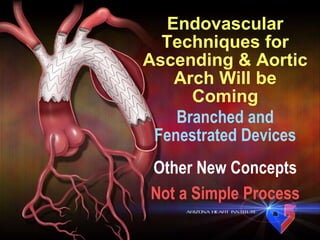
Endovascular Techniques for Ascending & Aortic Arch Will be Coming Branched and Fenestrated Devices Not a Simple Process Other New Concepts
J. L. Andersen, Australia Innovative Endovascular Grafting
J. L. Andersen, Australia
Initial Approach: Concentrate on Distal Arch and Transition into Ascending Aorta
Intent of Hybrid Approaches:   Expand the Landing Zone for Endoluminal Grafting by Rerouting Arterial Branches Hybrid Procedures- No randomized trials Small case volumes Application of a variety of techniques (no uniformity) No commercial products Requires customization Surgical Endovascular
Thoracic Aortic Pathologies Offer Unique Opportunities for Hybrid Procedures Classical Endovascular
57 Year Old Female. Could Not Swallow Without Choking. Esophageal Compression Aberrant RSA
Anomalous Origin Right Subclavian Artery Dysphagia Lusoria
 
Depressurization of the  Aberrant Right Subclavian  Artery Restructured flow to the  Right Upper Extremity Therapeutic Plan
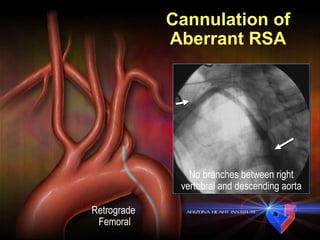
Cannulation of Aberrant RSA Retrograde  Femoral No branches between right vertebral and descending aorta
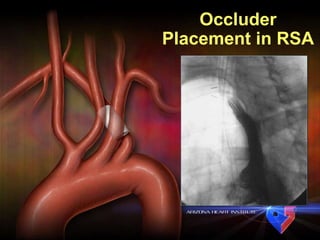
Occluder Placement in RSA
Left Radial Subclavian Stump RSA Anastamosis to Right CCA  Proximal RSA Ligated
No Compression
Post-Op
Aberrant Rt. subclavian artery Left thoracotomy Interposed graft 37 Years Ago
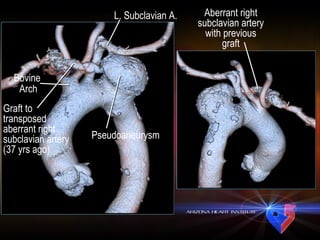
37 Years Later Pseudoaneurysm Degenerated Graft
L. Subclavian A. Bovine  Arch Graft to transposed aberrant right subclavian artery (37 yrs ago) Pseudoaneurysm Aberrant right subclavian artery with previous graft
L. C-S bypass Right C-S  bypass Ligation of degenerated graft ELG deployment
Right  C-S  bypass L. C-S bypass Endoluminal graft Thrombosed pseudoaneurysm
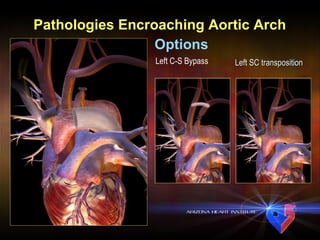
Pathologies Encroaching Aortic Arch Options Left C-S Bypass Left SC transposition
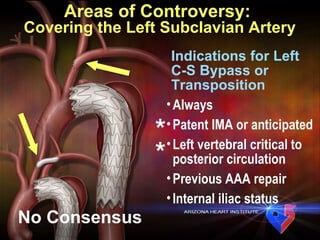
Areas of Controversy:  Covering the Left Subclavian Artery Indications for Left  C-S Bypass or Transposition Always Patent IMA or anticipated Left vertebral critical to posterior circulation Previous AAA repair Internal iliac status No Consensus * *
Hybrid Example Subclavian aneurysm Previous coarctation repair Large associated aneurysm
C-S graft bypass Resection subclavian aneurysm Operative exposure
Endoluminal graft deployed at left CCA Simultaneous: Proximal subclavian  resection Carotid-subclavian  bypass ELG
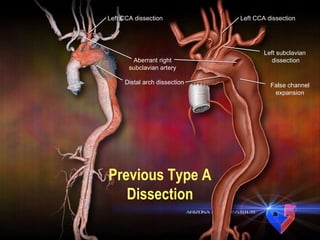
Previous Type A Dissection Aberrant right subclavian artery Left CCA dissection Distal arch dissection False channel expansion Left subclavian  dissection Left CCA dissection
Hybrid Treatment Plan Rt. subclavian- carotid bypass Vertebral LCCA stent deployed  retrograde Rt. aberrant  subclavian closed proximally Lt. carotid-  subclavian bypass
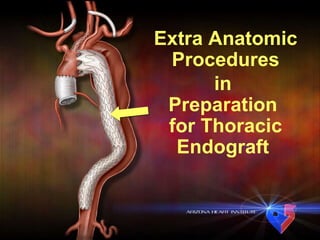
Extra Anatomic Procedures in  Preparation  for Thoracic Endograft
LCCA stent Rt. subclavian- carotid bypass Lt. C-S bypass Rt. aberrant  subclavian closed
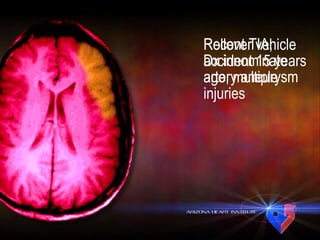
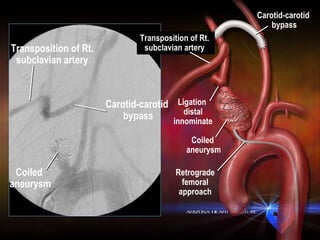
Rollover vehicle accident 15 years ago, multiple injuries Recent TIA,  Dx innominate artery aneurysm
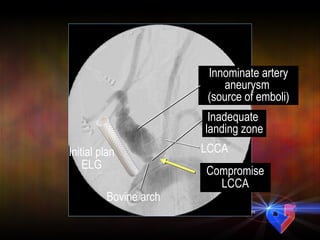
Bovine arch Initial plan ELG Innominate artery aneurysm  (source of emboli) Inadequate  landing zone LCCA Compromise LCCA
Coiled  aneurysm Transposition of Rt.  subclavian artery  Carotid-carotid  bypass Coiled  aneurysm Transposition of Rt.  subclavian artery  Carotid-carotid  bypass Ligation  distal innominate Retrograde femoral approach
Expanding ascending aneurysm Dissection False lumen True lumen Previous ascending graft for type I dissection
Requires Partial Cardiopulmonary Support Femoral Artery-Femoral Vein Bypass Insufficient Graft Length
Ascending graft Left common carotid bypass Innominate bypass Radiopaque marker for ELG landing zone
Ascending graft ELG ascending, arch, descending  To left carotid, innominate Bifurcated graft Original ascending graft for type A repair To innominate
Ascending Aorta and Contiguous Arch Present Specific Challenges
I.  Aortic Valve II.  Coronary Arteries III.  Aortic Root IV. Ascending Aorta  and Trunk Vessels
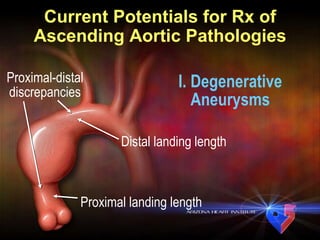
Current Potentials for Rx of Ascending Aortic Pathologies I. Degenerative Aneurysms Proximal landing length Distal landing length Proximal-distal discrepancies
II. Dissections Current Potentials for Rx of Ascending Aortic Pathologies Initial Tear 1-3cm Type II Extensive  Dissection
Anatomic Challenge Larger Diameter Ascending Curvature Short Deployment Area Extremely Friable Tissue
Overcoming Systemic Pressure
Cardiac Pacing Temp. Arrest  (Pharmacological) New Concept Overcoming Systemic Pressure
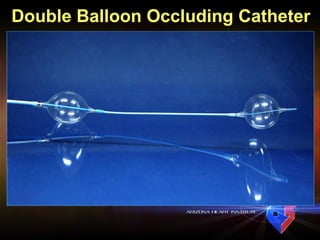
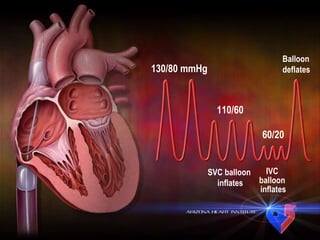
Balloon Occlusion of Cardiac Venous Return Right Atrium IVC SVC Reduce Cardiac Output Decreases Systemic  Pressure
Double Balloon Occluding Catheter
130/80 mmHg Balloon  deflates SVC balloon  inflates 110/60 IVC  balloon  inflates 60/20
Right Atrium Inflated IVC Inflated SVC BP 130/80 mmHg 60/20 mmHg
 
A Better Answer to Stent Graft Expansion or Remodeling The “UnBalloon”
Current Potentials for Rx of Ascending Aortic Pathologies Site of previous vein graft anastomosis Cannulation or  de-airing (vent) site Suture line Dissections (limited) Dissections Type A III. Complications of Previous Interventions
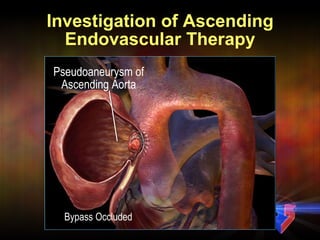
Investigation of Ascending Endovascular Therapy Bypass Occluded Pseudoaneurysm of Ascending Aorta
Coil Embolization
Coils failed to close entry point Aneurysm expanded from 6-10cm in 4 months
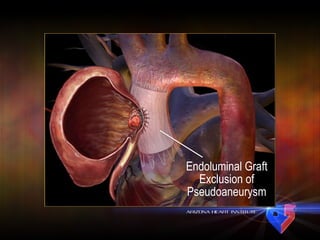
Endoluminal Graft Exclusion of Pseudoaneurysm
1 Year Follow-up
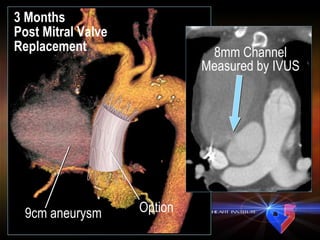
3 Months  Post Mitral Valve Replacement 9cm aneurysm 8mm Channel Measured by IVUS Option
Amplatz Occluder Retrograde femoral delivery Disc Diameter Ranges Small 12mm-30mm Large 14mm-32mm
Aneurysm Excluded
5 Month Follow-Up Preop Small Disc Size 26mm Large Disc Size 30mm
Dissection Ascending  Aorta Enlarging Dissection Ascending  Aorta
Dissection JR4 catheter across dissection entry point
Occluder
Is Endovascular Possible? Aortic Insufficiency Arch Aneurysm
Extending Endovascular Even Further with Hybrid Procedures 50 year old male  Delta Airline  Captain Sudden right leg  pain Right groin  exploration Case History No thrombus, no antegrade flow, loss of motor and sensory function to entire right lower extremities Result
Arch dissection Celiac Left iliac dissection Rt. iliac occlusion CT Examination After Right Groin Exploration Celiac
Femoral-femoral bypass  graft (Acute ischemia with  paralysis) Emergent Fem-Fem Bypass
Ascending tube graft Type A Dissection Cardiopulmonary bypass Mild hypothermia Retrograde left femoral cannulation (above fem-fem)
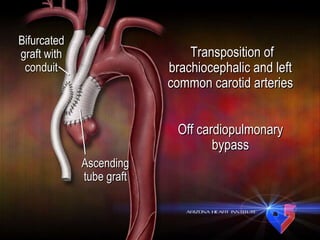
Transposition of brachiocephalic and left common carotid arteries Bifurcated graft with conduit Ascending tube graft Off cardiopulmonary bypass
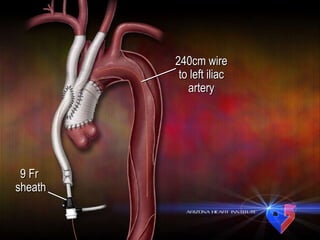
240cm wire to left iliac artery 9 Fr  sheath
Snare retrieval of conduit wire to left femoral sheath
Conduit-Femoral Wire The Banjo Concept
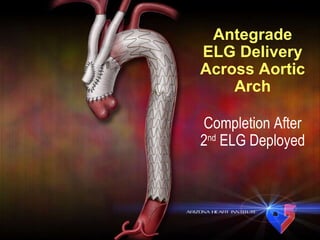
Conduit-Femoral Wire Over comes tortuosity Facilitates difficult arch delivery Reduces manipulations across aortic arch Creates control and stability for delivery
Completion After 2 nd  ELG Deployed Antegrade ELG Delivery Across Aortic Arch
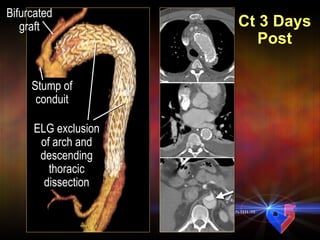
Ct 3 Days Post ELG exclusion of arch and descending thoracic dissection Bifurcated graft Stump of conduit
5 Year Follow-Up No Symptoms, Ready to Fly
Captain Federal Aviation Administration (FAA) Thank You Edward B. Diethrich

Diethrich Sweden

  • 1.
    Edward B. Diethrich,MD Phoenix, Arizona The Future of Aortic Repair Malmo, Sweden June 18, 2010
  • 2.
    What Perspective? How?Where? Who? What?
  • 3.
    How? Where? Who?Classical Endovascular Robotic Laparoscopic Hybrid Cathlab OR Radiology Suite Hybrid Vascular Surgeon Interventional Cardiologist Interventional Radiologist CT Surgeon Hybrid
  • 4.
    Infrarenal AAA Localanesthesia Percutaneous Maybe outpatient Anyone What Perspective?
  • 5.
    Bown MJ etal.Br J Surg 2002;89:7 14-30. Visser P 2005 Perioperative Period: Surgical mortality still elevated : 40 – 50% range Open Repair Overall mortality of 75 to 80%
  • 6.
    Acute Type BDescending Dissection Asymptomatic What Perspective? Medical Rx Endograft Controversy Waiting for studies Our Data Symptomatic (malperfusion) Endovascular technology with some hybrid combinations
  • 7.
    Acute Type ADissection No AI Limited to zone 0 [endovascular treatment] Type I arch/descending Ascending tube What Perspective? Progressive dissection not inconsequential
  • 8.
    Mortality Ruptured CasesAll Pathologies TAA Intraop Death 4 (5.5%) 3(12.5%) < 30 Days 9 (12.3%) 5 (20.8%)
  • 9.
    Conclusion TEVAR shouldbe the first option of treatment in high risk patients and those with anatomical restraints in order to increase survival. Neuro-deficit is decreased when compared to open repair.
  • 10.
    Natural History FalseLumen at 2 - 5 years Subject to Aneurismal Dilatation in 20% to 40% Advance in Vasc Surg. St Louis, Mosby 1998, pp 17-36
  • 11.
  • 12.
  • 13.
    Remodeling Changes ContinuesPost-op 6 months P/3 M/3 D/3 Retrograde Flow
  • 14.
    Observations Retrograde flowat viscerals 17.7% (19pts) Retrograde flow at D/3 18.7% (20pts) Retrograde flow at M/3 1.8% (2pts) Retrograde flow at P/3 1.8% (2pts) flow FL thrombosis/ patency depend on several factors
  • 15.
    Complete thrombosis of FL of TA without evidence of antegrade or retrograde flow – 69 pts (65.1%) Results Flow
  • 16.
    Incidence of AneurismaticDilatation Incidence is 20-40% over 5 year period Risk of extending dissection and potential complications including visceral and limb malperfusion  26%
  • 17.
    Observations Pre-Op Post-Op1 month 24 months 6 months Remodeling Changes True lumen gain volume False lumen decrease in diameter Whole lumen expand J Vasc Surg 2009;49:20-8.
  • 18.
    Post-Op 6 months24 months Case #3 P/3 D/3
  • 19.
    Type B Dissection,Regardless of Symptoms, Should Be Treated By Endografting to Prevent Future Complications?
  • 20.
    Exceptions ? Asymptomaticpatient without significantly collapsed true lumen, <50%. Inclined to Treat Non-complicated TBD with ELG
  • 21.
    Endograft is wellindicated in aortic dissection type B since the natural history demonstrated high degree of success and positive remodeling changes.
  • 22.
    No commercial productsfor many of the pathologies encountered Frequent customization required Complexity of pathology restricts broad training and experience Limitations at Present Example?
  • 23.
    June 1998 andJune 2009 Retrospective Review Presented with a rAAA 69 (65.2%) -- Open Repair 36 (33.6%) -- EVAR Our Series: Open vs Endograft
  • 24.
    30-Day Mortality Overallwas 29.5% (31) 34.8% (24) for Open 19.4% (7) for EVAR (p=0.12) When comparing those EVAR cases with combined use of local anesthesia at initiation of procedure and use of supra-celiac occlusive balloon to those receiving general anesthesia and no balloon , the mortality reduced from 27.8% to 11.1 % (p=0.40)
  • 25.
    Conclusions EVAR inruptured AAAs has reduced mortality. Supraceliac occlusive balloon, based on CT findings of large retroperitoneal hematoma, initiated under local anesthetic, can prevent circulatory collapse.
  • 26.
    Conclusions Availability ofgraft to treat larger caliber necks and low profile devices are some of the technology changes that we need.
  • 27.
    Z0 Z1 Z2Z3 Z4 The Real Challenge: Conquering Zone Zero
  • 28.
    Level of theannulus of the aortic valve Sinus of Valsalva Sinotubular junction Ascending aorta at the level of pulmonary trunk 64 Slice CT Oblique Coronal Images Showing the 4 Diameter Measurements of Aortic Root
  • 29.
    Acute Dissection AscendingAorta Hematoma High Risk Patient for Open Procedure Balloon Occluding Device L. Coronary Artery Sheath with Positioning of ELG Aortic Valve Dissection
  • 30.
  • 31.
  • 32.
    1. Vortexvelocity control in aneurysm 2. Laminates the flow in collaterals 3. Accelerates shear stress flow in the vessel Multi-Layered Stent Key Principles
  • 33.
    Human Experience (AllOUS) Thoraco Abdominal Aneurysm
  • 34.
    1 Month Follow-UpAneurysm excluded All visceral arteries open
  • 35.
  • 36.
  • 37.
  • 38.
    Future Potential for Endovascular ??? Aortic Stenosis Ascending Arch Aneurysm Aortic Stenosis
  • 39.
    Neuro Protection DevicesAscending Endoluminal Graft Coronary Inserts Percutaneous Aortic Valve Special Stent to Correct Kink Arch/ Descending Endoluminal Graft with Three Branches
  • 40.
    Horizon Looks Favorable….Training Government FDA CMS Industry
  • 41.
    We are theheritage of our undaunted medical forefathers. Our young physicians are the genetic products of those great pioneers. Let their fate be the product of those positive, energetic, inquisitive, creative, and adventurous epigenoms which have the ability to overcome all adversity and bring ultimate success to all endeavers.
  • 42.
  • 43.
    In All Aspectsof Cardiovascular Therapy, the Pendulum is Swinging to Less Invasive Endovascular Approaches CABG Angioplasty Arrhythmia EP Aneurysm Endograft PVD Balloon & Stent ??? Carotid
  • 44.
    Evolution of EndovascularTherapies has Created Expanded Opportunities- Created Uncertainties for the Future
  • 45.
    Role of theCardiothoracic Surgeon?
  • 46.
    Cardiovascular care israpidly moving toward catheter-based technologies Surgeons lack skill set Obstacles Even more importantly they often do not recognize the complexity of endovascular
  • 47.
    Often not available to surgeons- High-Quality Imaging is Imperative for High-Quality Results
  • 48.
    The No WorkshopPhenomenon Portable, suboptimum imaging will not be satisfactory for high performance outcomes Catheterization Laboratory
  • 49.
    Hybrid Operating RoomsArizona Heart Hospital
  • 50.
    Integrated Format Medicalschool-> 6 year thoracic (9 programs) Joint General Surgery/Thoracic Surgery Track 4 year general- 3 year thoracic (10 programs)
  • 51.
    Many CT surgeonsare now seeking education and training in endovascular surgery!
  • 52.
    Percutaneous Aortic ValveMulti-Disciplinary Team
  • 53.
    Retroperitoneal Conduit ApproachSpecial Training Required
  • 54.
    Hybrid Operating RoomsHybrid Training Programs Hybrid Procedures A hybrid is a combination of two or more different things, aimed at achieving a particular objective or goal
  • 55.
  • 56.
  • 57.
    Ascending Aorta andAortic Arch are the Next Generation of Challenges for Endoluminal Grafting
  • 58.
    Circulatory arrest Profoundhypothermia Significant metabolic trauma Bleeding Neurologic insult Prolonged recovery And much more Surgery is Effective- But Significant morbidity and mortality
  • 59.
    Endovascular Techniques forAscending & Aortic Arch Will be Coming Branched and Fenestrated Devices Not a Simple Process Other New Concepts
  • 60.
    J. L. Andersen,Australia Innovative Endovascular Grafting
  • 61.
    J. L. Andersen,Australia
  • 62.
    Initial Approach: Concentrateon Distal Arch and Transition into Ascending Aorta
  • 63.
    Intent of HybridApproaches: Expand the Landing Zone for Endoluminal Grafting by Rerouting Arterial Branches Hybrid Procedures- No randomized trials Small case volumes Application of a variety of techniques (no uniformity) No commercial products Requires customization Surgical Endovascular
  • 64.
    Thoracic Aortic PathologiesOffer Unique Opportunities for Hybrid Procedures Classical Endovascular
  • 65.
    57 Year OldFemale. Could Not Swallow Without Choking. Esophageal Compression Aberrant RSA
  • 66.
    Anomalous Origin RightSubclavian Artery Dysphagia Lusoria
  • 67.
  • 68.
    Depressurization of the Aberrant Right Subclavian Artery Restructured flow to the Right Upper Extremity Therapeutic Plan
  • 69.
    Cannulation of AberrantRSA Retrograde Femoral No branches between right vertebral and descending aorta
  • 70.
  • 71.
    Left Radial SubclavianStump RSA Anastamosis to Right CCA Proximal RSA Ligated
  • 72.
  • 73.
  • 74.
    Aberrant Rt. subclavianartery Left thoracotomy Interposed graft 37 Years Ago
  • 75.
    37 Years LaterPseudoaneurysm Degenerated Graft
  • 76.
    L. Subclavian A.Bovine Arch Graft to transposed aberrant right subclavian artery (37 yrs ago) Pseudoaneurysm Aberrant right subclavian artery with previous graft
  • 77.
    L. C-S bypassRight C-S bypass Ligation of degenerated graft ELG deployment
  • 78.
    Right C-S bypass L. C-S bypass Endoluminal graft Thrombosed pseudoaneurysm
  • 79.
    Pathologies Encroaching AorticArch Options Left C-S Bypass Left SC transposition
  • 80.
    Areas of Controversy: Covering the Left Subclavian Artery Indications for Left C-S Bypass or Transposition Always Patent IMA or anticipated Left vertebral critical to posterior circulation Previous AAA repair Internal iliac status No Consensus * *
  • 81.
    Hybrid Example Subclaviananeurysm Previous coarctation repair Large associated aneurysm
  • 82.
    C-S graft bypassResection subclavian aneurysm Operative exposure
  • 83.
    Endoluminal graft deployedat left CCA Simultaneous: Proximal subclavian resection Carotid-subclavian bypass ELG
  • 84.
    Previous Type ADissection Aberrant right subclavian artery Left CCA dissection Distal arch dissection False channel expansion Left subclavian dissection Left CCA dissection
  • 85.
    Hybrid Treatment PlanRt. subclavian- carotid bypass Vertebral LCCA stent deployed retrograde Rt. aberrant subclavian closed proximally Lt. carotid- subclavian bypass
  • 86.
    Extra Anatomic Proceduresin Preparation for Thoracic Endograft
  • 87.
    LCCA stent Rt.subclavian- carotid bypass Lt. C-S bypass Rt. aberrant subclavian closed
  • 88.
    Rollover vehicle accident15 years ago, multiple injuries Recent TIA, Dx innominate artery aneurysm
  • 89.
    Bovine arch Initialplan ELG Innominate artery aneurysm (source of emboli) Inadequate landing zone LCCA Compromise LCCA
  • 90.
    Coiled aneurysmTransposition of Rt. subclavian artery Carotid-carotid bypass Coiled aneurysm Transposition of Rt. subclavian artery Carotid-carotid bypass Ligation distal innominate Retrograde femoral approach
  • 91.
    Expanding ascending aneurysmDissection False lumen True lumen Previous ascending graft for type I dissection
  • 92.
    Requires Partial CardiopulmonarySupport Femoral Artery-Femoral Vein Bypass Insufficient Graft Length
  • 93.
    Ascending graft Leftcommon carotid bypass Innominate bypass Radiopaque marker for ELG landing zone
  • 94.
    Ascending graft ELGascending, arch, descending To left carotid, innominate Bifurcated graft Original ascending graft for type A repair To innominate
  • 95.
    Ascending Aorta andContiguous Arch Present Specific Challenges
  • 96.
    I. AorticValve II. Coronary Arteries III. Aortic Root IV. Ascending Aorta and Trunk Vessels
  • 97.
    Current Potentials forRx of Ascending Aortic Pathologies I. Degenerative Aneurysms Proximal landing length Distal landing length Proximal-distal discrepancies
  • 98.
    II. Dissections CurrentPotentials for Rx of Ascending Aortic Pathologies Initial Tear 1-3cm Type II Extensive Dissection
  • 99.
    Anatomic Challenge LargerDiameter Ascending Curvature Short Deployment Area Extremely Friable Tissue
  • 100.
  • 101.
    Cardiac Pacing Temp.Arrest (Pharmacological) New Concept Overcoming Systemic Pressure
  • 102.
    Balloon Occlusion ofCardiac Venous Return Right Atrium IVC SVC Reduce Cardiac Output Decreases Systemic Pressure
  • 103.
  • 104.
    130/80 mmHg Balloon deflates SVC balloon inflates 110/60 IVC balloon inflates 60/20
  • 105.
    Right Atrium InflatedIVC Inflated SVC BP 130/80 mmHg 60/20 mmHg
  • 106.
  • 107.
    A Better Answerto Stent Graft Expansion or Remodeling The “UnBalloon”
  • 108.
    Current Potentials forRx of Ascending Aortic Pathologies Site of previous vein graft anastomosis Cannulation or de-airing (vent) site Suture line Dissections (limited) Dissections Type A III. Complications of Previous Interventions
  • 109.
    Investigation of AscendingEndovascular Therapy Bypass Occluded Pseudoaneurysm of Ascending Aorta
  • 110.
  • 111.
    Coils failed toclose entry point Aneurysm expanded from 6-10cm in 4 months
  • 112.
    Endoluminal Graft Exclusionof Pseudoaneurysm
  • 113.
  • 114.
    3 Months Post Mitral Valve Replacement 9cm aneurysm 8mm Channel Measured by IVUS Option
  • 115.
    Amplatz Occluder Retrogradefemoral delivery Disc Diameter Ranges Small 12mm-30mm Large 14mm-32mm
  • 116.
  • 117.
    5 Month Follow-UpPreop Small Disc Size 26mm Large Disc Size 30mm
  • 118.
    Dissection Ascending Aorta Enlarging Dissection Ascending Aorta
  • 119.
    Dissection JR4 catheteracross dissection entry point
  • 120.
  • 121.
    Is Endovascular Possible?Aortic Insufficiency Arch Aneurysm
  • 122.
    Extending Endovascular EvenFurther with Hybrid Procedures 50 year old male Delta Airline Captain Sudden right leg pain Right groin exploration Case History No thrombus, no antegrade flow, loss of motor and sensory function to entire right lower extremities Result
  • 123.
    Arch dissection CeliacLeft iliac dissection Rt. iliac occlusion CT Examination After Right Groin Exploration Celiac
  • 124.
    Femoral-femoral bypass graft (Acute ischemia with paralysis) Emergent Fem-Fem Bypass
  • 125.
    Ascending tube graftType A Dissection Cardiopulmonary bypass Mild hypothermia Retrograde left femoral cannulation (above fem-fem)
  • 126.
    Transposition of brachiocephalicand left common carotid arteries Bifurcated graft with conduit Ascending tube graft Off cardiopulmonary bypass
  • 127.
    240cm wire toleft iliac artery 9 Fr sheath
  • 128.
    Snare retrieval ofconduit wire to left femoral sheath
  • 129.
  • 130.
    Conduit-Femoral Wire Overcomes tortuosity Facilitates difficult arch delivery Reduces manipulations across aortic arch Creates control and stability for delivery
  • 131.
    Completion After 2nd ELG Deployed Antegrade ELG Delivery Across Aortic Arch
  • 132.
    Ct 3 DaysPost ELG exclusion of arch and descending thoracic dissection Bifurcated graft Stump of conduit
  • 133.
    5 Year Follow-UpNo Symptoms, Ready to Fly
  • 134.
    Captain Federal AviationAdministration (FAA) Thank You Edward B. Diethrich

Editor's Notes

  • #14 Running, H
  • #18 Elwell, Anne
  • #19 Hathaway Line 1- 2001 Line 2- 2003 Line 3- 2004