Machine Learning     


Srihari


   Basic Concepts in Machine
           Learning
                   Sargur N. Srihari


                                                      1
Machine Learning   


Srihari


     Introduction to ML: Topics
1. Polynomial Curve Fitting
2. Probability Theory of multiple variables
3. Maximum Likelihood
4. Bayesian Approach
5. Model Selection
6. Curse of Dimensionality


                                                  2
Machine Learning     


Srihari


       Polynomial Curve Fitting

                   Sargur N. Srihari


                                                      3
Machine Learning   


Srihari


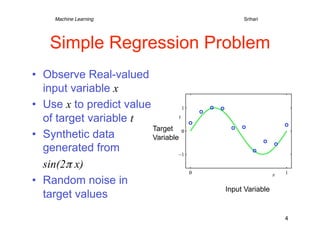
    Simple Regression Problem
•  Observe Real-valued
   input variable x
•  Use x to predict value
   of target variable t
                          Target
•  Synthetic data         Variable
   generated from
   sin(2π x)
•  Random noise in
                                             Input Variable
   target values
                                                              4
Machine Learning   


Srihari


                        Notation
•  N observations of x
   x = (x1,..,xN)T
   t = (t1,..,tN)T
•  Goal is to exploit training
   set to predict value of
   from x
                                     Data Generation:
•  Inherently a difficult            N = 10
   problem                           Spaced uniformly in range [0,1]
                                     Generated from sin(2πx) by adding
•  Probability theory allows         small Gaussian noise
   us to make a prediction           Noise typical due to unobserved variables


                                                                          5
Machine Learning   


Srihari


        Polynomial Curve Fitting
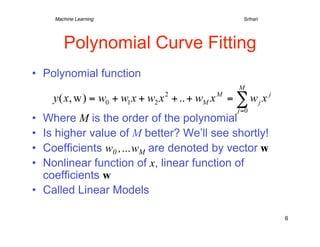
•  Polynomial function


•  Where M is the order of the polynomial
•  Is higher value of M better? We’ll see shortly!
•  Coefficients w0 ,…wM are denoted by vector w
•  Nonlinear function of x, linear function of
   coefficients w
•  Called Linear Models

                                                       6
Machine Learning     


Srihari


                       Error Function
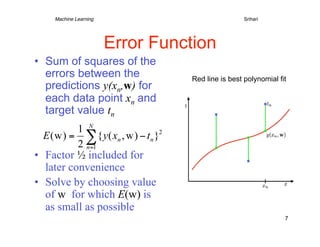
•  Sum of squares of the
   errors between the                Red line is best polynomial fit
   predictions y(xn,w) for
   each data point xn and
   target value tn


•  Factor ½ included for
   later convenience
•  Solve by choosing value
   of w for which E(w) is
   as small as possible
                                                                   7
Machine Learning   


Srihari


    Minimization of Error Function
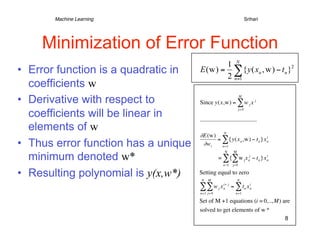
•  Error function is a quadratic in
   coefficients w
•  Derivative with respect to             Since y(x,w) = ∑ w j x j
                                                                              M


   coefficients will be linear in
                                                                              j= 0


   elements of w
                                          ∂E(w) N
                                                = ∑{y(x n ,w) − t n }x n
                                                                       i

•  Thus error function has a unique        ∂w i   n=1


   minimum denoted w*
                                                                  N      M
                                                         = ∑{∑ w j x nj − t n }x n
                                                                                 i

                                                                 n =1   j=0

•  Resulting polynomial is y(x,w*)        Setting equal to zero
                                          N   M                              N

                                          ∑∑w            j   x   i+ j
                                                                 n      = ∑ tn x n
                                                                                 i

                                          n=1 j= 0                        n=1

                                          Set of M +1 equations (i = 0,.., M) are
                                          solved to get elements of w *
                                                                                             8


                                  €
Machine Learning    


Srihari


      Choosing the order of M
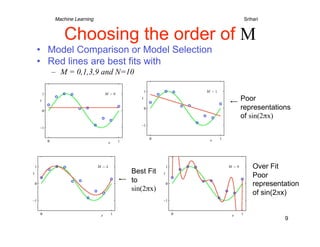
•  Model Comparison or Model Selection
•  Red lines are best fits with
   –  M = 0,1,3,9 and N=10


                                              Poor
                                              representations
                                              of sin(2πx)


                                                   Over Fit
                           Best Fit
                                                   Poor
                           to                      representation
                           sin(2πx)
                                                   of sin(2πx)


                                                            9
Machine Learning        


Srihari


         Generalization Performance
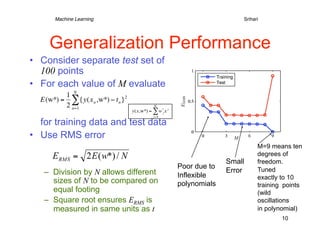
    •  Consider separate test set of
       100 points
    •  For each value of M evaluate
             1 N
      E(w*) = ∑{y(x n ,w*) − t n }2
             2 n=1                                M
                                      y(x,w*) = ∑ w *j x j
                                                 j= 0

       for training data and test data
€   •  Use RMS error €
                                                                                      M=9 means ten
                                                                                      degrees of
                                                                           Small      freedom.
                                                             Poor due to              Tuned
       –  Division by N allows different                                   Error
                                                             Inflexible               exactly to 10
          sizes of N to be compared on                       polynomials              training points
          equal footing                                                               (wild
       –  Square root ensures ERMS is                                                 oscillations
          measured in same units as t                                                 in polynomial)
                                                                                              10
Machine Learning       


Srihari


  Values of Coefficients w* for
different polynomials of order M


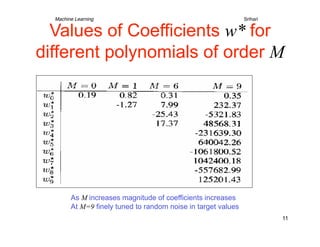
        As M increases magnitude of coefficients increases
        At M=9 finely tuned to random noise in target values
                                                                          11
Machine Learning   


Srihari


    Increasing Size of Data Set

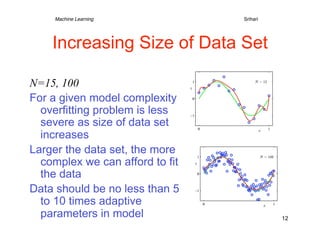
N=15, 100
For a given model complexity
  overfitting problem is less
  severe as size of data set
  increases
Larger the data set, the more
  complex we can afford to fit
  the data
Data should be no less than 5
  to 10 times adaptive
  parameters in model                               12
Machine Learning   


Srihari


 Least Squares is case of Maximum
            Likelihood
•  Unsatisfying to limit the number of parameters to
   size of training set
•  More reasonable to choose model complexity
   according to problem complexity
•  Least squares approach is a specific case of
   maximum likelihood
  –  Over-fitting is a general property of maximum likelihood
•  Bayesian approach avoids over-fitting problem
  –  No. of parameters can greatly exceed no. of data points
  –  Effective no. of parameters adapts automatically to size of
     data set
                                                             13
Machine Learning   


Srihari


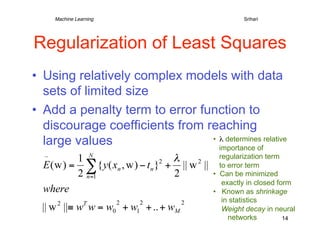
Regularization of Least Squares
•  Using relatively complex models with data
   sets of limited size
•  Add a penalty term to error function to
   discourage coefficients from reaching
   large values                  •  λ determines relative
                                    importance of
                                           regularization term
                                           to error term
                                        •  Can be minimized
                                            exactly in closed form
                                        •  Known as shrinkage
                                            in statistics
                                            Weight decay in neural
                                              networks          14
Machine Learning             


Srihari


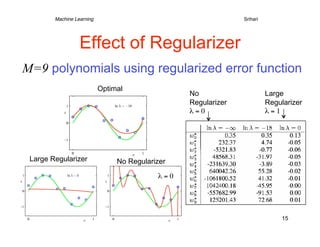
                  Effect of Regularizer
M=9 polynomials using regularized error function
                           Optimal
                                                            No                       Large
                                                            Regularizer              Regularizer
                                                            λ = 0
                   λ = 1


 Large Regularizer              No Regularizer

                                               λ = 0


                                                                                          15
Machine Learning   


Srihari


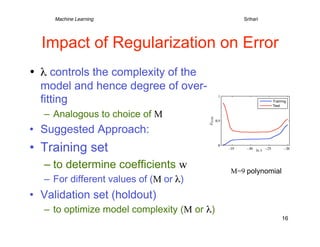
  Impact of Regularization on Error
•  λ controls the complexity of the
   model and hence degree of over-
   fitting
   –  Analogous to choice of M
•  Suggested Approach:
•  Training set
   –  to determine coefficients w             M=9 polynomial
   –  For different values of (M or λ)
•  Validation set (holdout)
   –  to optimize model complexity (M or λ)
                                                               16
Machine Learning   


Srihari


Concluding Remarks on Regression
•  Approach suggests partitioning data into training
   set to determine coefficients w
•  Separate validation set (or hold-out set) to
   optimize model complexity M or λ
•  More sophisticated approaches are not as
   wasteful of training data
•  More principled approach is based on probability
   theory
•  Classification is a special case of regression
   where target value is discrete values
                                                      17

Curve fitting

  • 1.
    Machine Learning Srihari Basic Concepts in Machine Learning Sargur N. Srihari 1
  • 2.
    Machine Learning Srihari Introduction to ML: Topics 1. Polynomial Curve Fitting 2. Probability Theory of multiple variables 3. Maximum Likelihood 4. Bayesian Approach 5. Model Selection 6. Curse of Dimensionality 2
  • 3.
    Machine Learning Srihari Polynomial Curve Fitting Sargur N. Srihari 3
  • 4.
    Machine Learning Srihari Simple Regression Problem •  Observe Real-valued input variable x •  Use x to predict value of target variable t Target •  Synthetic data Variable generated from sin(2π x) •  Random noise in Input Variable target values 4
  • 5.
    Machine Learning Srihari Notation •  N observations of x x = (x1,..,xN)T t = (t1,..,tN)T •  Goal is to exploit training set to predict value of from x Data Generation: •  Inherently a difficult N = 10 problem Spaced uniformly in range [0,1] Generated from sin(2πx) by adding •  Probability theory allows small Gaussian noise us to make a prediction Noise typical due to unobserved variables 5
  • 6.
    Machine Learning Srihari Polynomial Curve Fitting •  Polynomial function •  Where M is the order of the polynomial •  Is higher value of M better? We’ll see shortly! •  Coefficients w0 ,…wM are denoted by vector w •  Nonlinear function of x, linear function of coefficients w •  Called Linear Models 6
  • 7.
    Machine Learning Srihari Error Function •  Sum of squares of the errors between the Red line is best polynomial fit predictions y(xn,w) for each data point xn and target value tn •  Factor ½ included for later convenience •  Solve by choosing value of w for which E(w) is as small as possible 7
  • 8.
    Machine Learning Srihari Minimization of Error Function •  Error function is a quadratic in coefficients w •  Derivative with respect to Since y(x,w) = ∑ w j x j M coefficients will be linear in j= 0 elements of w ∂E(w) N = ∑{y(x n ,w) − t n }x n i •  Thus error function has a unique ∂w i n=1 minimum denoted w* N M = ∑{∑ w j x nj − t n }x n i n =1 j=0 •  Resulting polynomial is y(x,w*) Setting equal to zero N M N ∑∑w j x i+ j n = ∑ tn x n i n=1 j= 0 n=1 Set of M +1 equations (i = 0,.., M) are solved to get elements of w * 8 €
  • 9.
    Machine Learning Srihari Choosing the order of M •  Model Comparison or Model Selection •  Red lines are best fits with –  M = 0,1,3,9 and N=10 Poor representations of sin(2πx) Over Fit Best Fit Poor to representation sin(2πx) of sin(2πx) 9
  • 10.
    Machine Learning Srihari Generalization Performance •  Consider separate test set of 100 points •  For each value of M evaluate 1 N E(w*) = ∑{y(x n ,w*) − t n }2 2 n=1 M y(x,w*) = ∑ w *j x j j= 0 for training data and test data € •  Use RMS error € M=9 means ten degrees of Small freedom. Poor due to Tuned –  Division by N allows different Error Inflexible exactly to 10 sizes of N to be compared on polynomials training points equal footing (wild –  Square root ensures ERMS is oscillations measured in same units as t in polynomial) 10
  • 11.
    Machine Learning Srihari Values of Coefficients w* for different polynomials of order M As M increases magnitude of coefficients increases At M=9 finely tuned to random noise in target values 11
  • 12.
    Machine Learning Srihari Increasing Size of Data Set N=15, 100 For a given model complexity overfitting problem is less severe as size of data set increases Larger the data set, the more complex we can afford to fit the data Data should be no less than 5 to 10 times adaptive parameters in model 12
  • 13.
    Machine Learning Srihari Least Squares is case of Maximum Likelihood •  Unsatisfying to limit the number of parameters to size of training set •  More reasonable to choose model complexity according to problem complexity •  Least squares approach is a specific case of maximum likelihood –  Over-fitting is a general property of maximum likelihood •  Bayesian approach avoids over-fitting problem –  No. of parameters can greatly exceed no. of data points –  Effective no. of parameters adapts automatically to size of data set 13
  • 14.
    Machine Learning Srihari Regularization of Least Squares •  Using relatively complex models with data sets of limited size •  Add a penalty term to error function to discourage coefficients from reaching large values •  λ determines relative importance of regularization term to error term •  Can be minimized exactly in closed form •  Known as shrinkage in statistics Weight decay in neural networks 14
  • 15.
    Machine Learning Srihari Effect of Regularizer M=9 polynomials using regularized error function Optimal No Large Regularizer Regularizer λ = 0 λ = 1 Large Regularizer No Regularizer λ = 0 15
  • 16.
    Machine Learning Srihari Impact of Regularization on Error •  λ controls the complexity of the model and hence degree of over- fitting –  Analogous to choice of M •  Suggested Approach: •  Training set –  to determine coefficients w M=9 polynomial –  For different values of (M or λ) •  Validation set (holdout) –  to optimize model complexity (M or λ) 16
  • 17.
    Machine Learning Srihari Concluding Remarks on Regression •  Approach suggests partitioning data into training set to determine coefficients w •  Separate validation set (or hold-out set) to optimize model complexity M or λ •  More sophisticated approaches are not as wasteful of training data •  More principled approach is based on probability theory •  Classification is a special case of regression where target value is discrete values 17