Continuing Nursing Education Program
Angham Yahia Majrashi
Nurse Educator
 A message announced over a hospital’s public
address system, indicating that a cardiac
arrest or respiratory arrest requiring CPR is in
progress; to be “coded” is to undergo CPR.
 The King Khalid Hospital code to be used by
all staff to summon a trained team of medical
personnel to undertake cardiopulmonary
resuscitation.
RRT CODEBLUE
1. The patient is still responsive but
there is a sudden deterioration in
patient’s status
2. Respiratory distress
3. O2 saturation, Blood pressure, pulse
is gradually dropping/below normal
1. The patient is unresponsive
2. No respiration
3. No pulse
What is the difference between Rapid ResponseTeam (RRT) from Code Blue ?
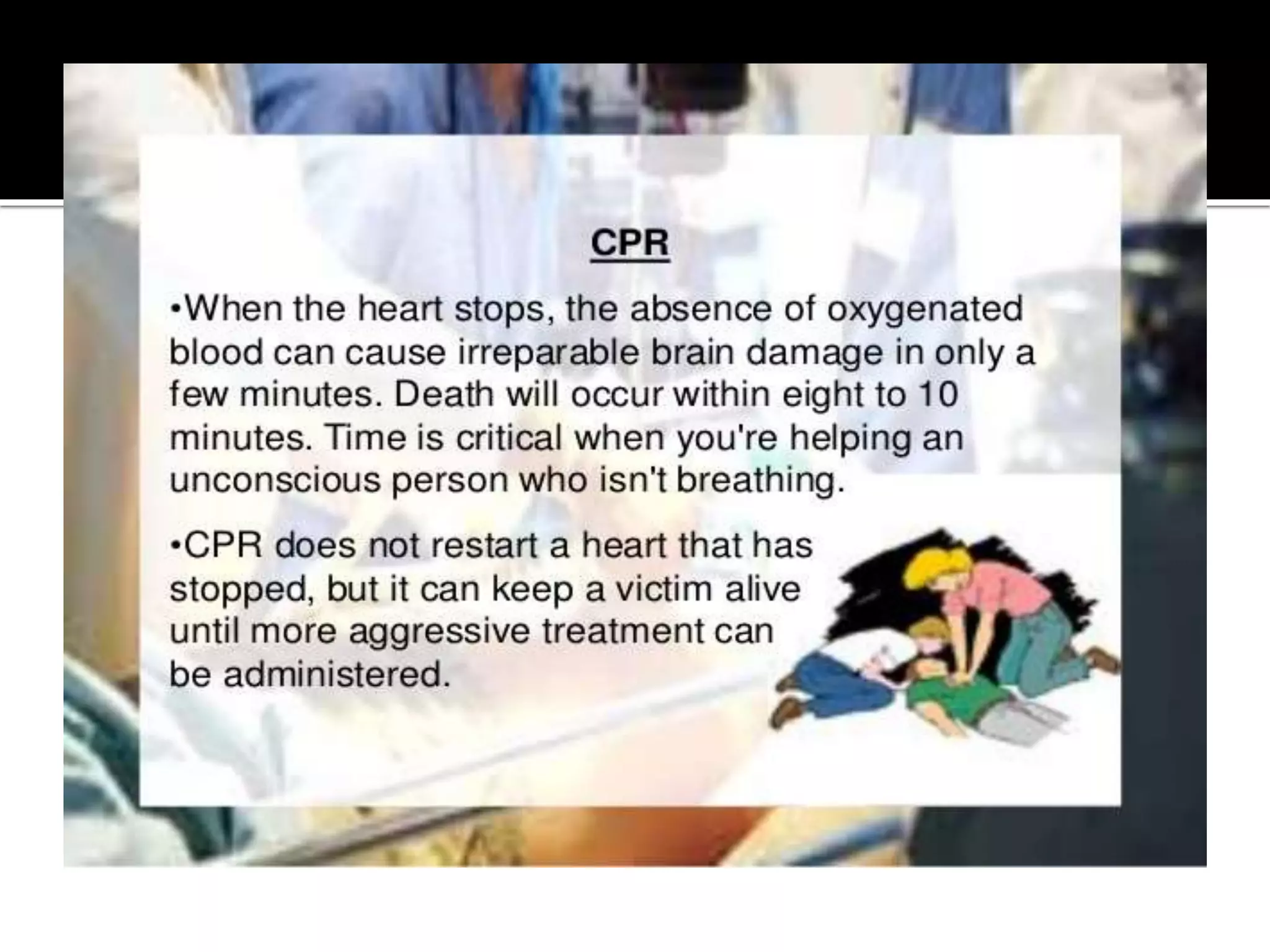
It is the sudden loss of
cardiac function, when
the heart abruptly stops
beating. Unless
resuscitative efforts are
begun immediately,
cardiac arrest leads to
death within a few
minutes.
Pamela Joy Bocala- Blanco
CNEP Coordinator/Nurse Educator
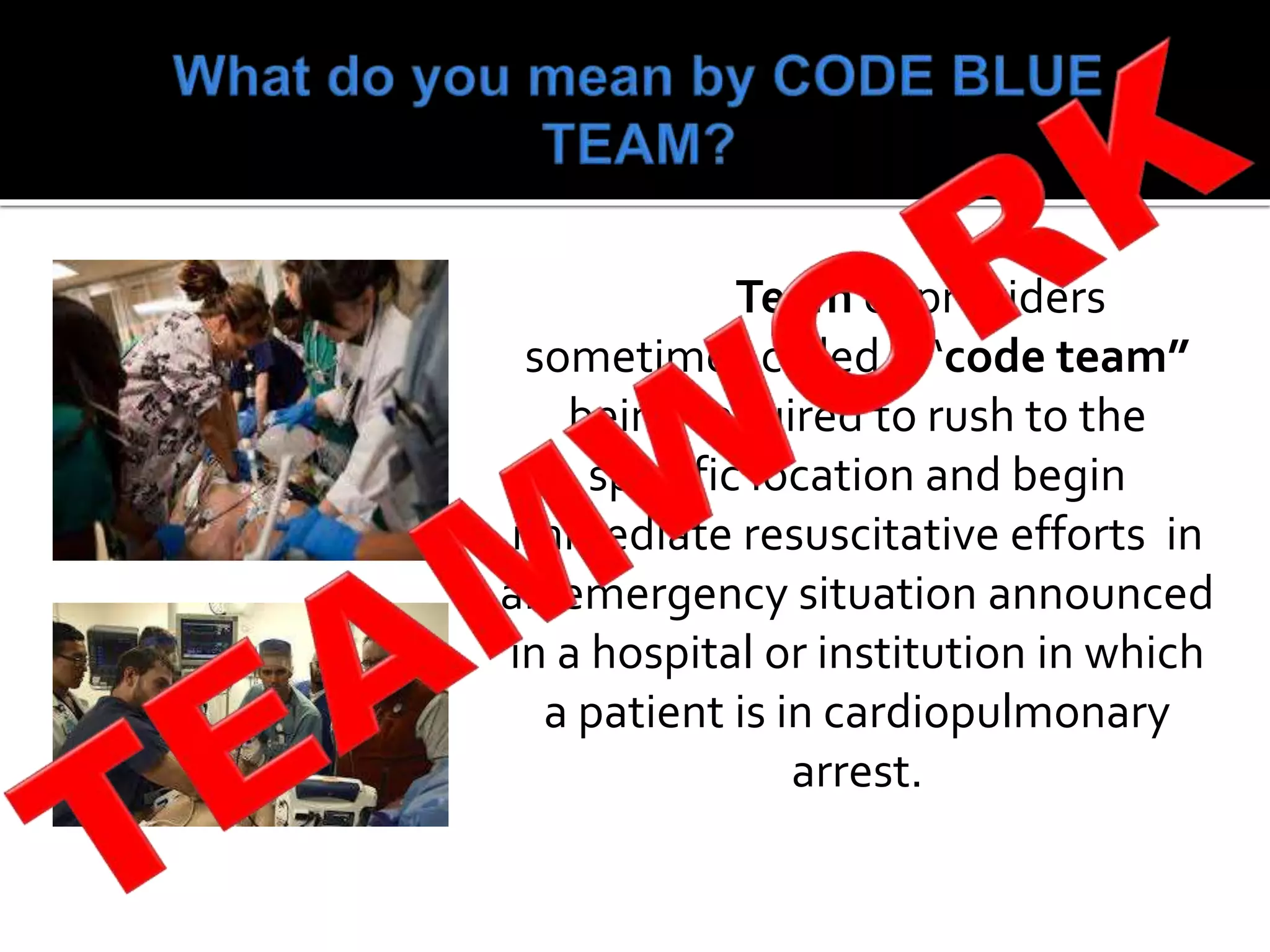
Team of providers
sometimes called a “code team”
being required to rush to the
specific location and begin
immediate resuscitative efforts in
an emergency situation announced
in a hospital or institution in which
a patient is in cardiopulmonary
arrest.
The First Responder is not
actually a member of a team but
is the person who identifies and
confirms cardiopulmonary arrest.
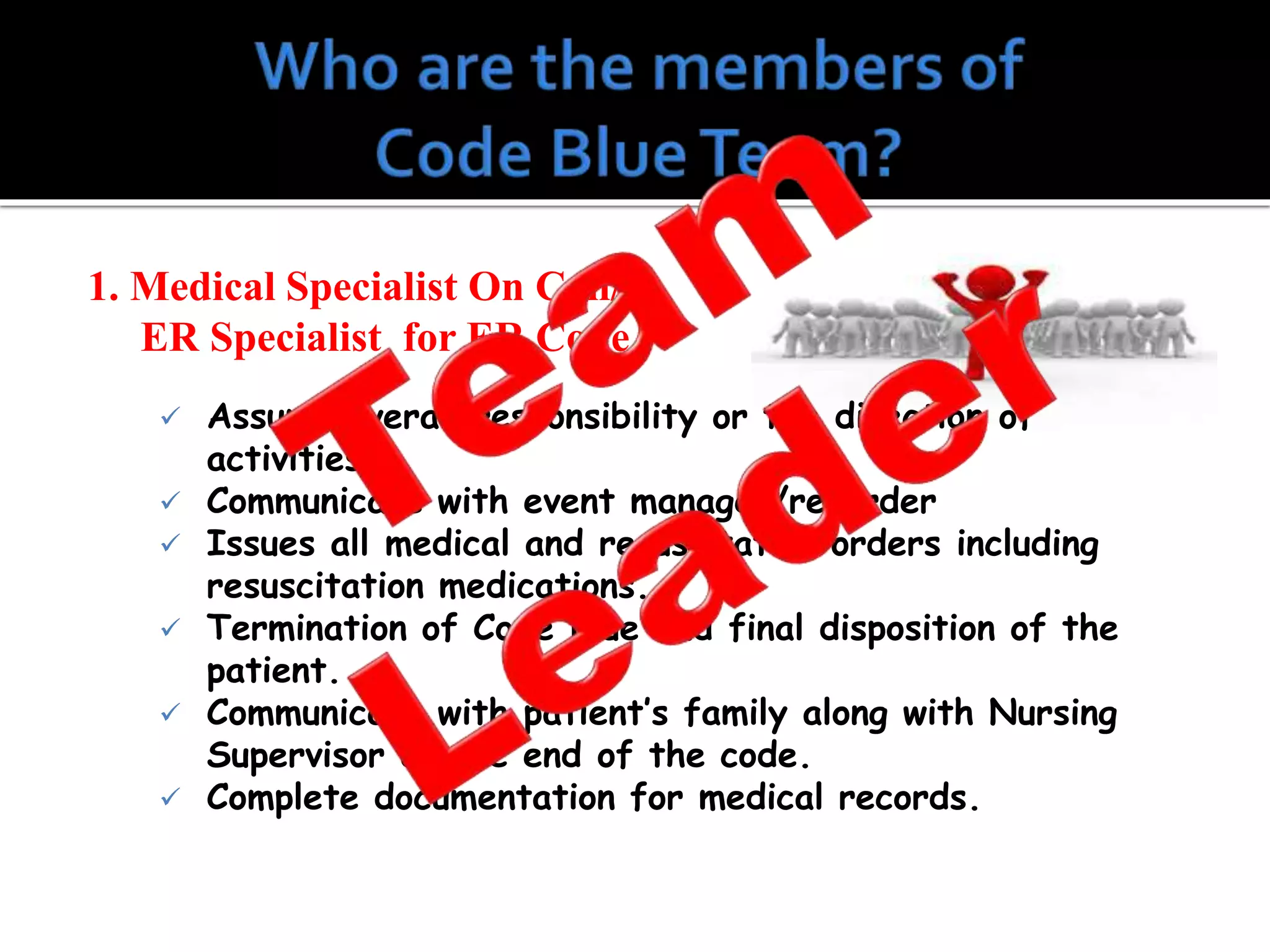
1. Medical Specialist On Call/
ER Specialist for ER Code
 Assume overall responsibility or the direction of
activities.
 Communicate with event manager/recorder
 Issues all medical and resuscitative orders including
resuscitation medications.
 Termination of Code Blue and final disposition of the
patient.
 Communicate with patient’s family along with Nursing
Supervisor at the end of the code.
 Complete documentation for medical records.
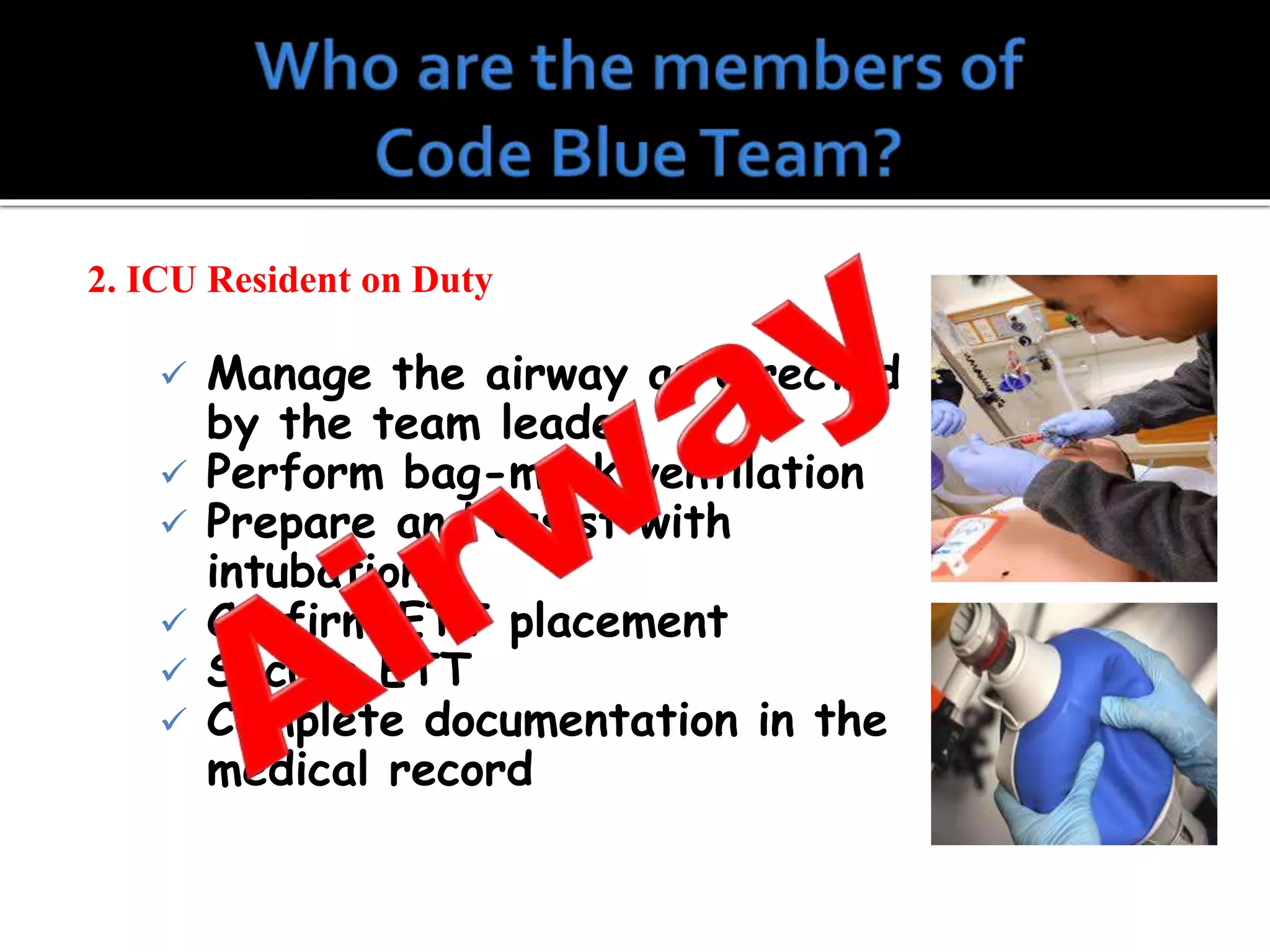
2. ICU Resident on Duty
 Manage the airway as directed
by the team leader
 Perform bag-mask ventilation
 Prepare and assist with
intubation
 Confirm ETT placement
 Secure ETT
 Complete documentation in the
medical record
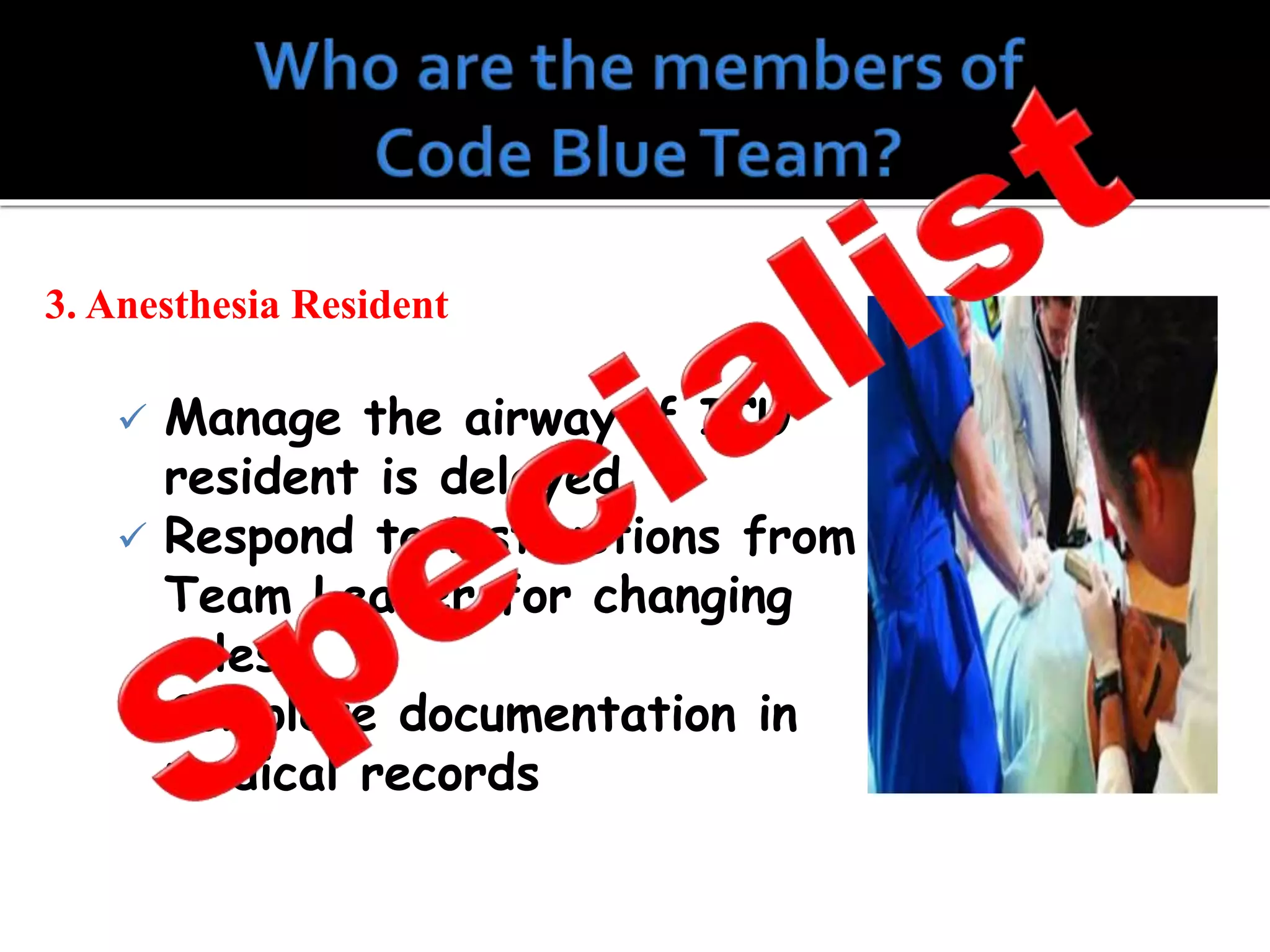
3. Anesthesia Resident
 Manage the airway if ICU
resident is delayed
 Respond to instructions from
Team Leader for changing
roles
 Complete documentation in
medical records
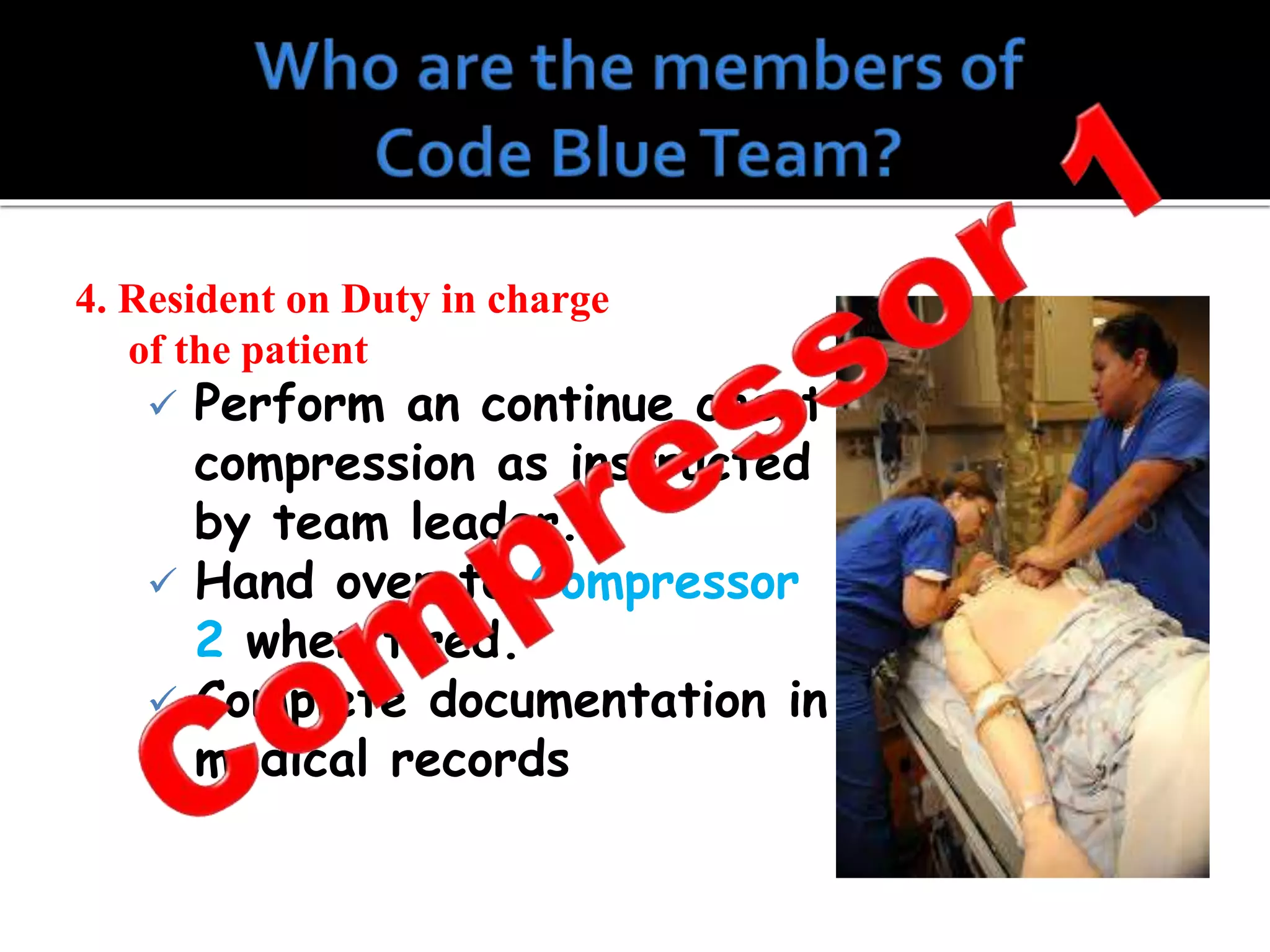
4. Resident on Duty in charge
of the patient
 Perform an continue chest
compression as instructed
by team leader.
 Hand over to Compressor
2 when tired.
 Complete documentation in
medical records
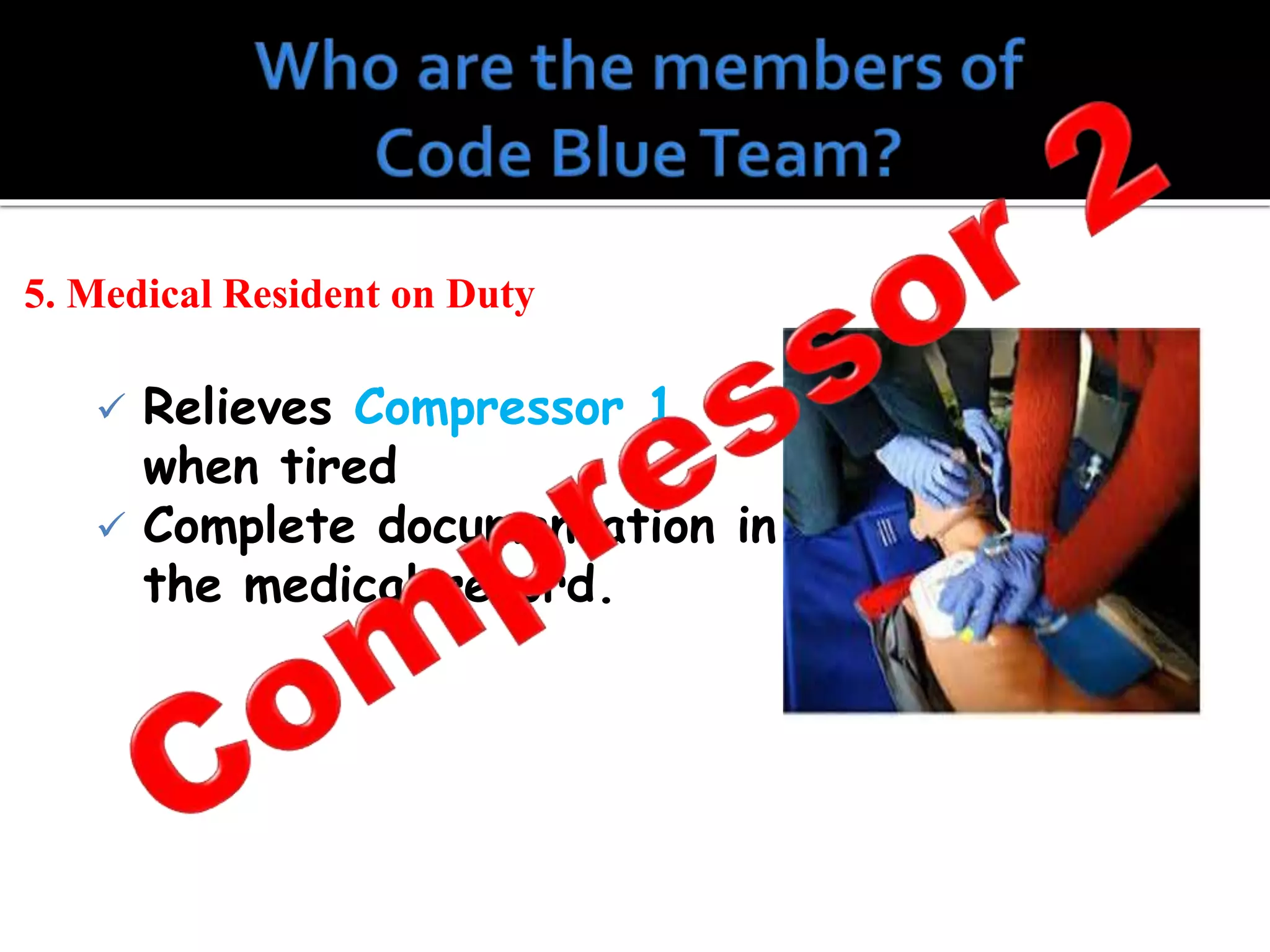
5. Medical Resident on Duty
 Relieves Compressor 1
when tired
 Complete documentation in
the medical record.
6. Nursing Supervisor on Duty
 Help rapid transport of blood
samples to laboratory
 Manage crowd control with
security
 Communicate with the family
 Notify patient Affairs, Social
Worker, Interpreter
 Attend to pastoral needs of
the patient
 Coordinate patient transfer
and placement with team
leader.
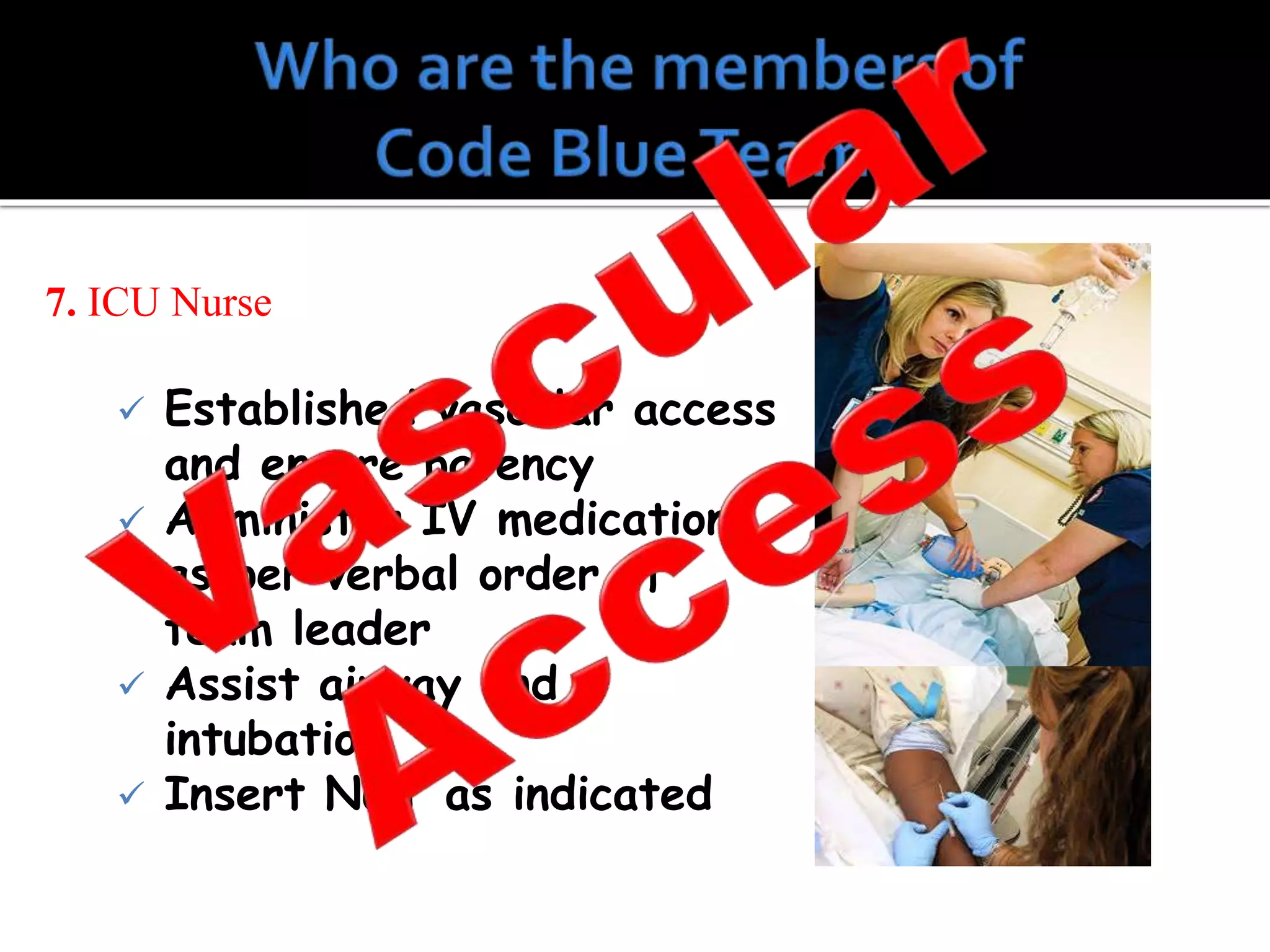
7. ICU Nurse
 Established vascular access
and ensure patency
 Administer IV medication
as per verbal order of
team leader
 Assist airway and
intubation
 Insert NGT as indicated
8. Ward Shift in Charge Nurse
 Ensure providers assume pre-
assigned roles and that the team
knows who is responsible for what
role
 Assign RN1 as recorder
 Assign RN2 to bring equipment
needed
 Once roles established, ensure
management of the rest remaining
work in the ward/unit.
 Ensure crowd control with the help
of security with in the room/ward.
 Notify the switch board if code is
over.
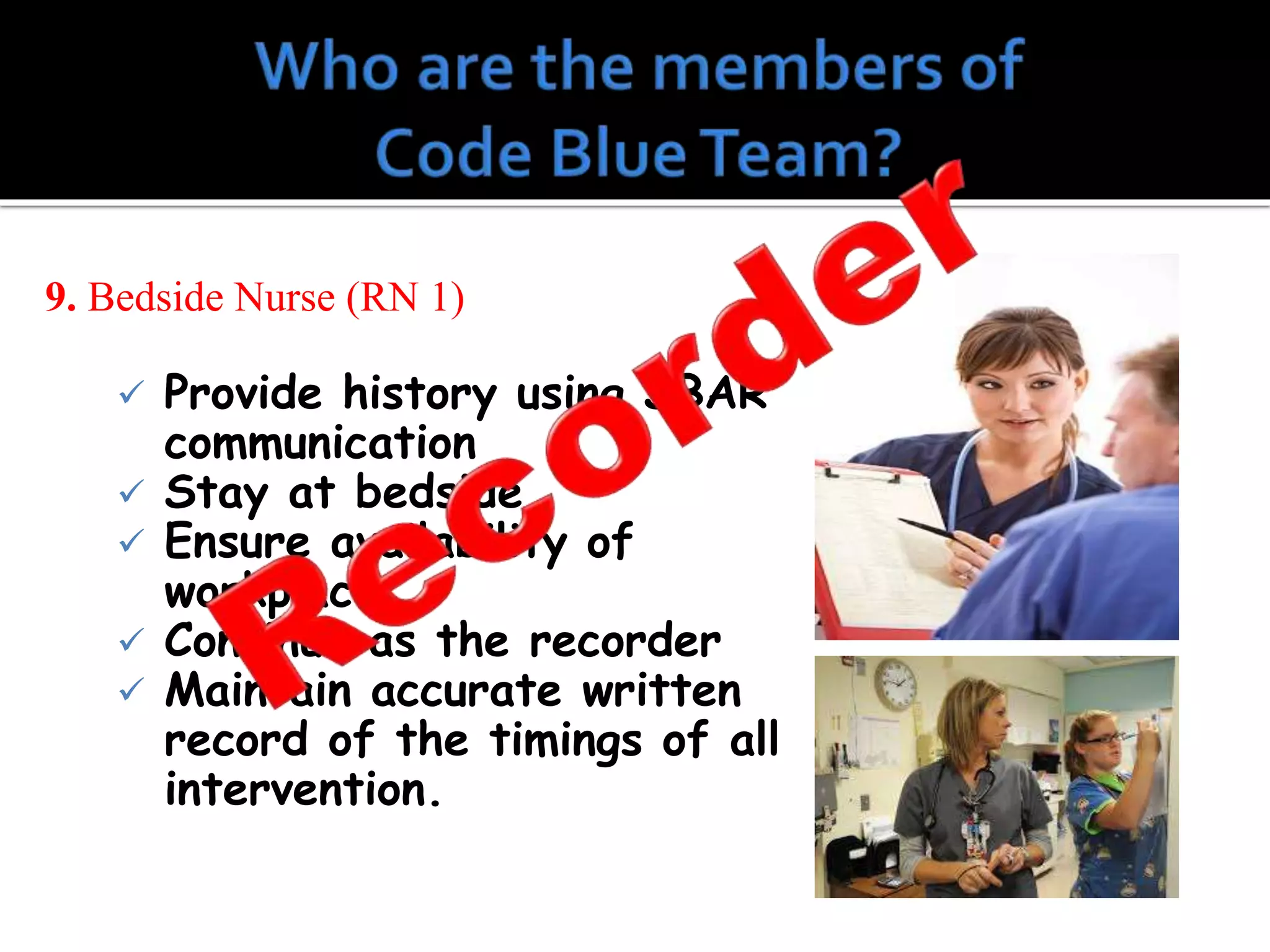
9. Bedside Nurse (RN 1)
 Provide history using SBAR
communication
 Stay at bedside
 Ensure availability of
workplace
 Continue as the recorder
 Maintain accurate written
record of the timings of all
intervention.
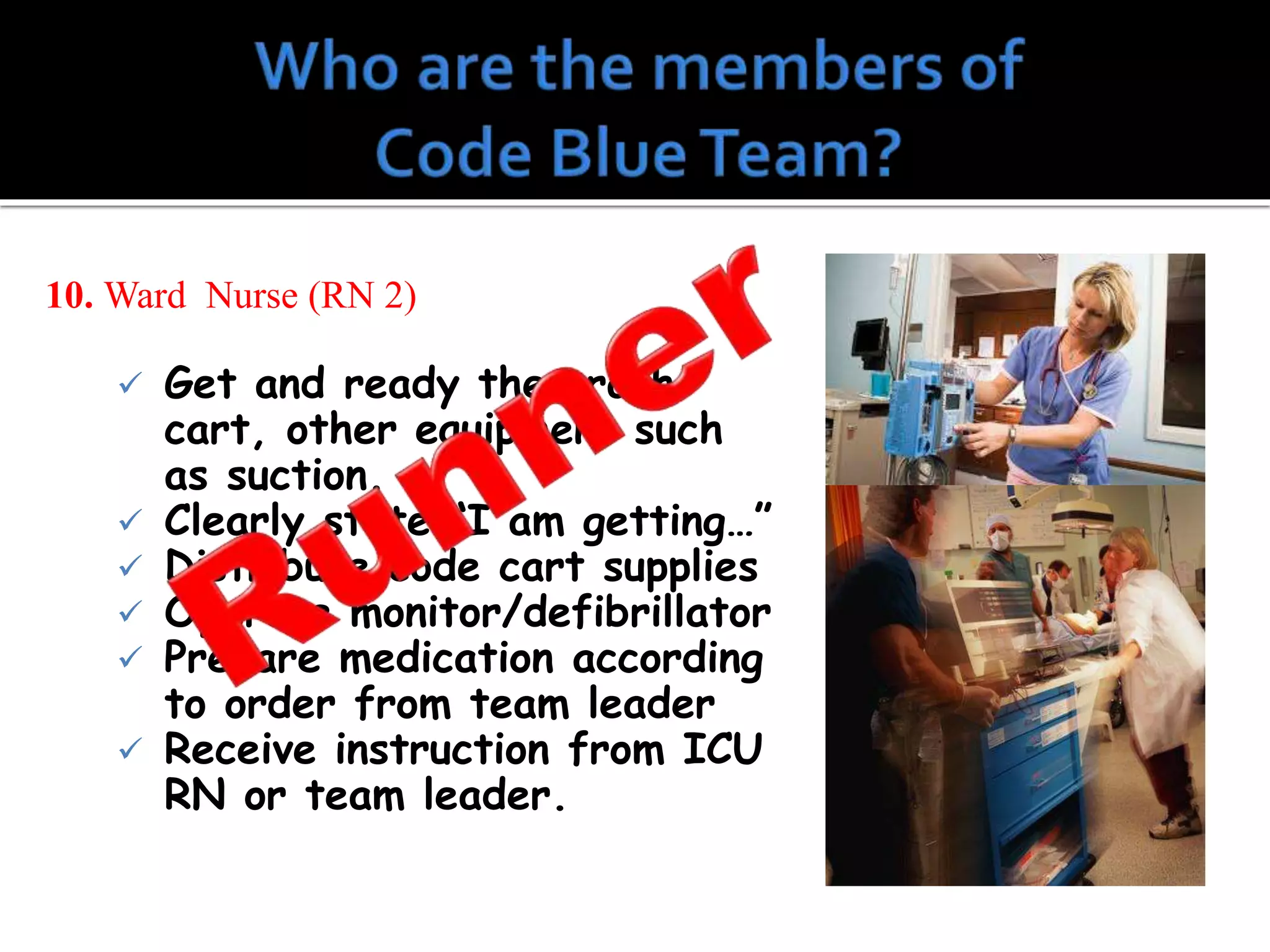
10. Ward Nurse (RN 2)
 Get and ready the crash
cart, other equipment such
as suction.
 Clearly state “I am getting…”
 Distribute code cart supplies
 Operate monitor/defibrillator
 Prepare medication according
to order from team leader
 Receive instruction from ICU
RN or team leader.
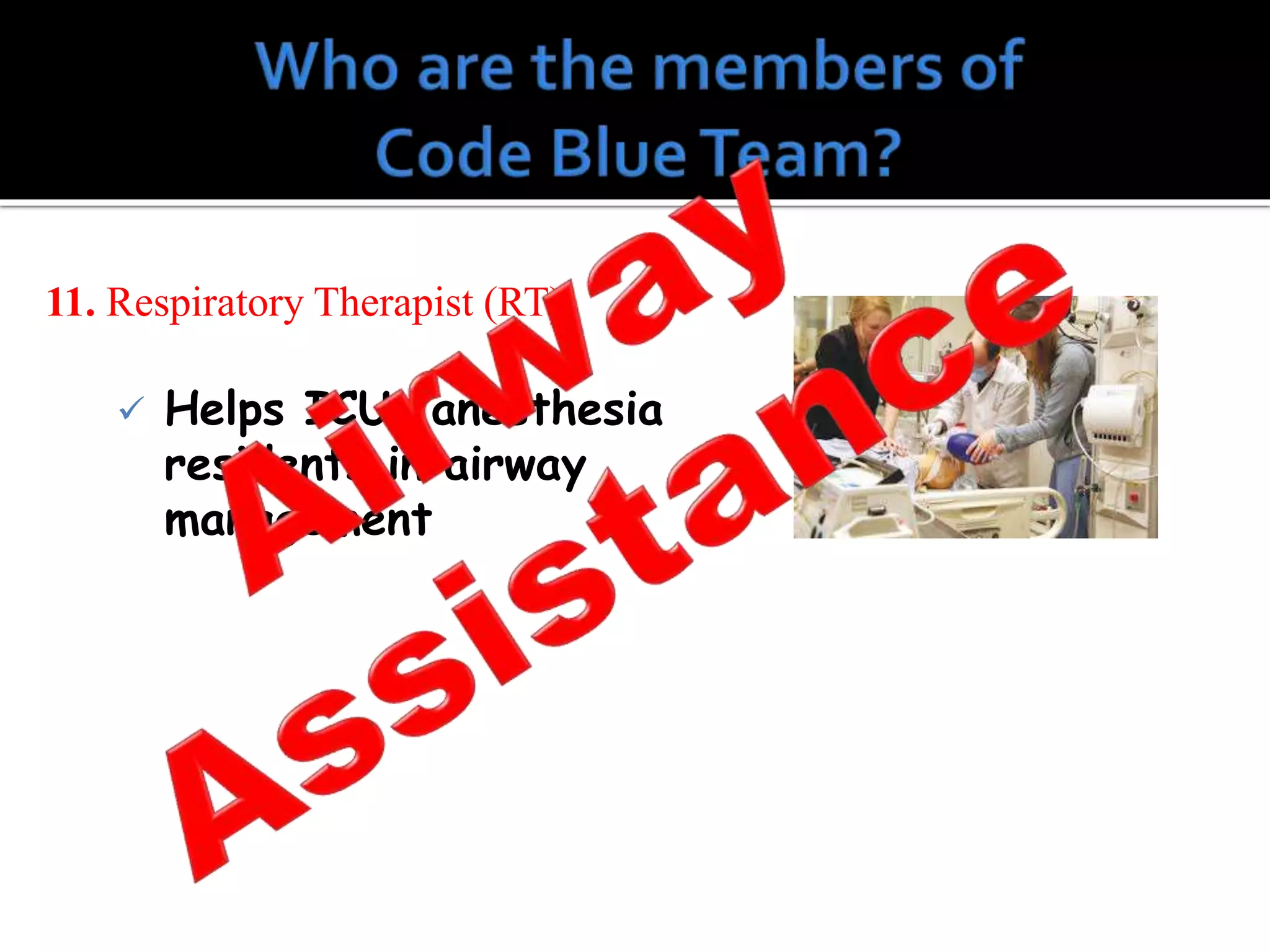
11. Respiratory Therapist (RT)
 Helps ICU, anesthesia
residents in airway
management
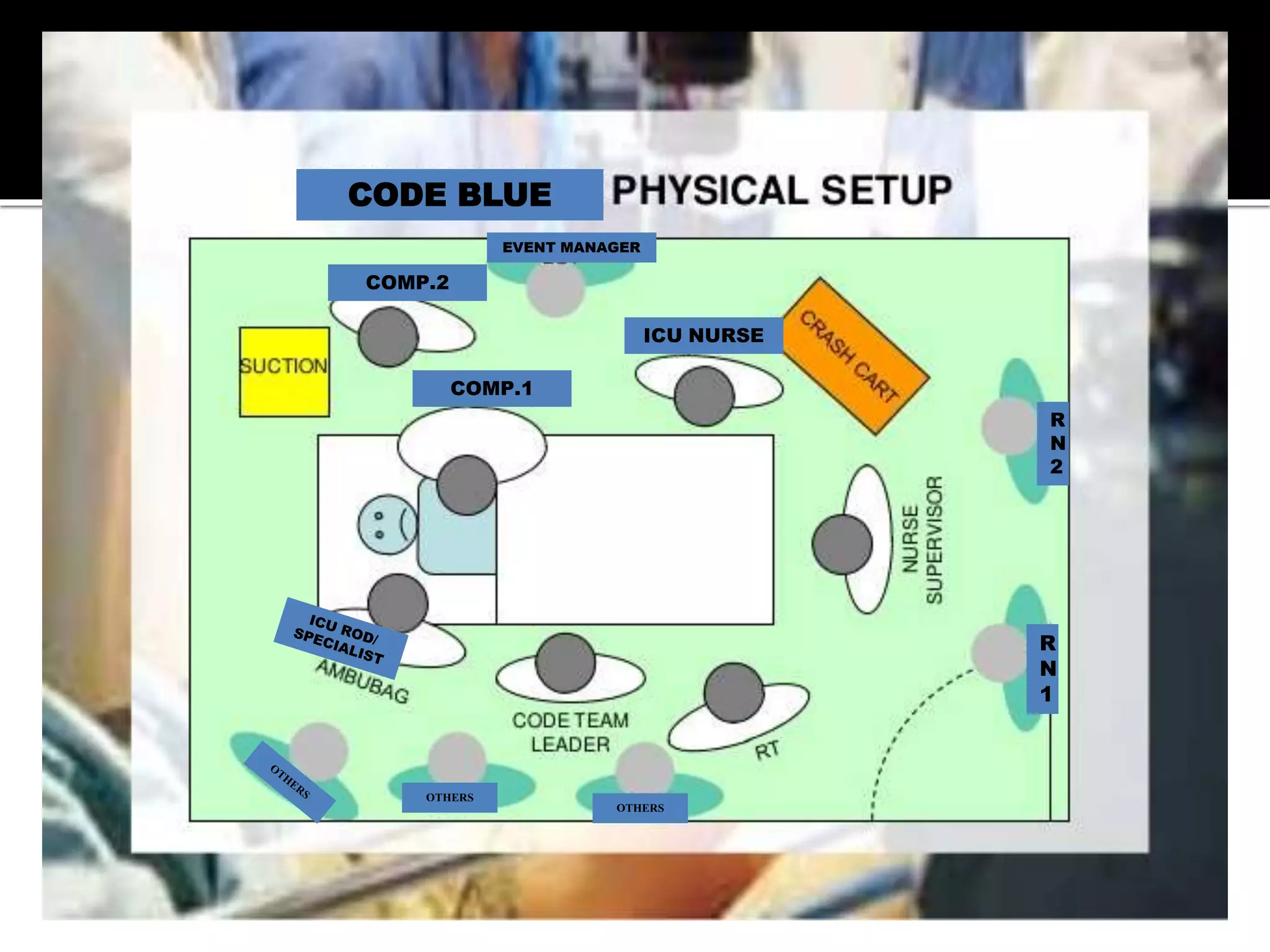
CODE BLUE
R
N
2
R
N
1
ICU NURSE
COMP.2
COMP.1
EVENT MANAGER
OTHERS
OTHERS
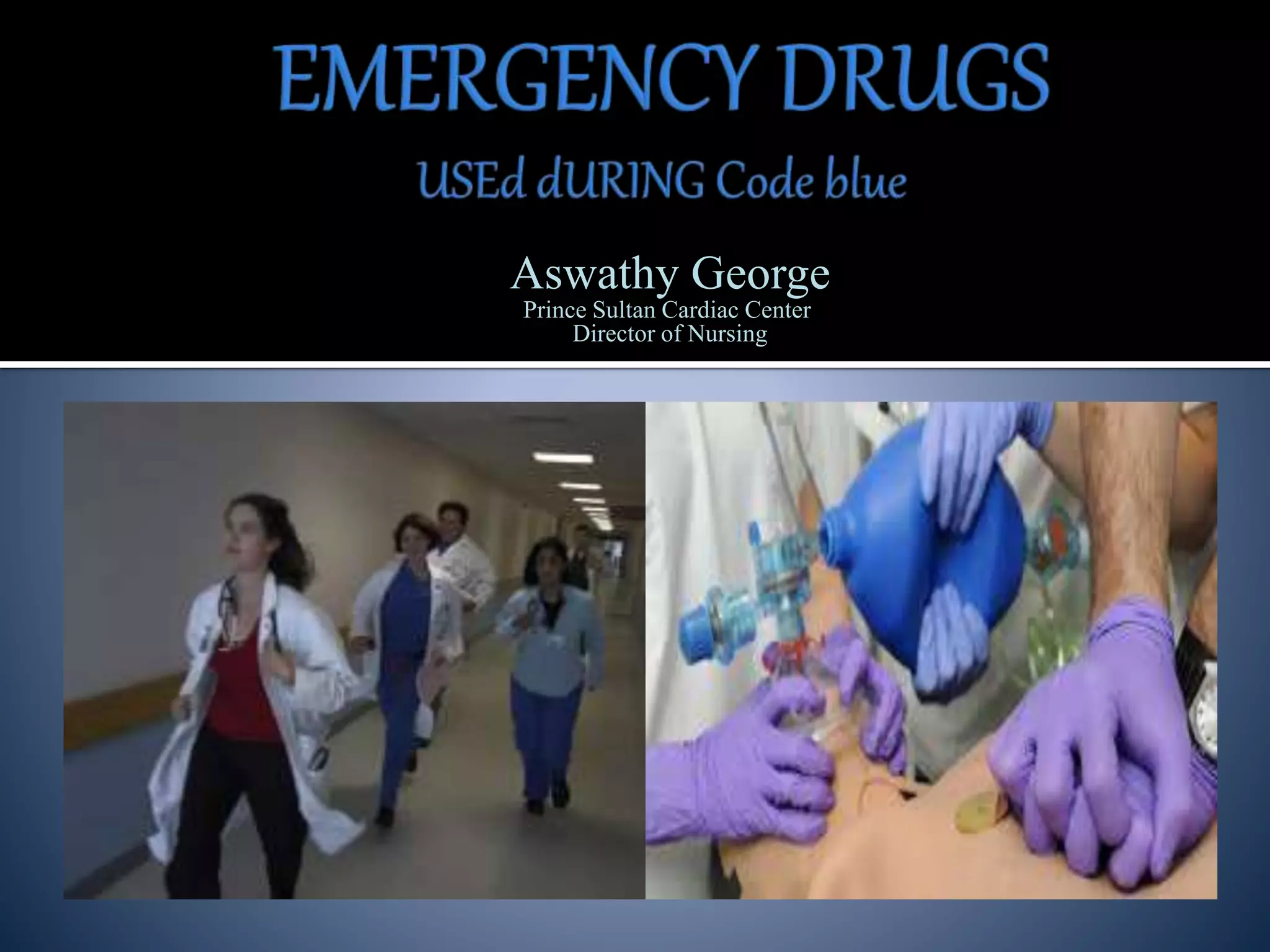
Aswathy George
Prince Sultan Cardiac Center
Director of Nursing
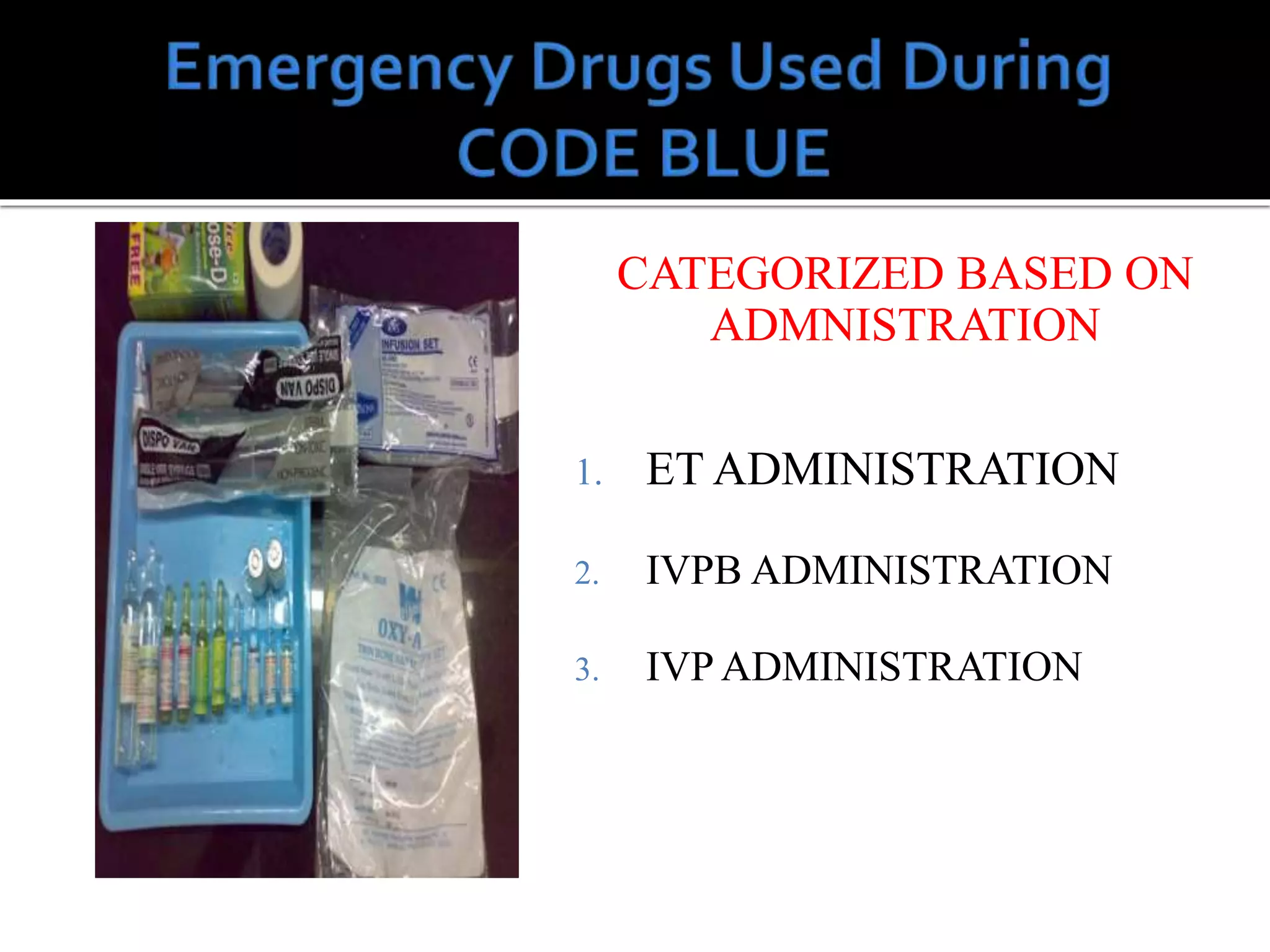
CATEGORIZED BASED ON
ADMNISTRATION
1. ET ADMINISTRATION
2. IVPB ADMINISTRATION
3. IVP ADMINISTRATION
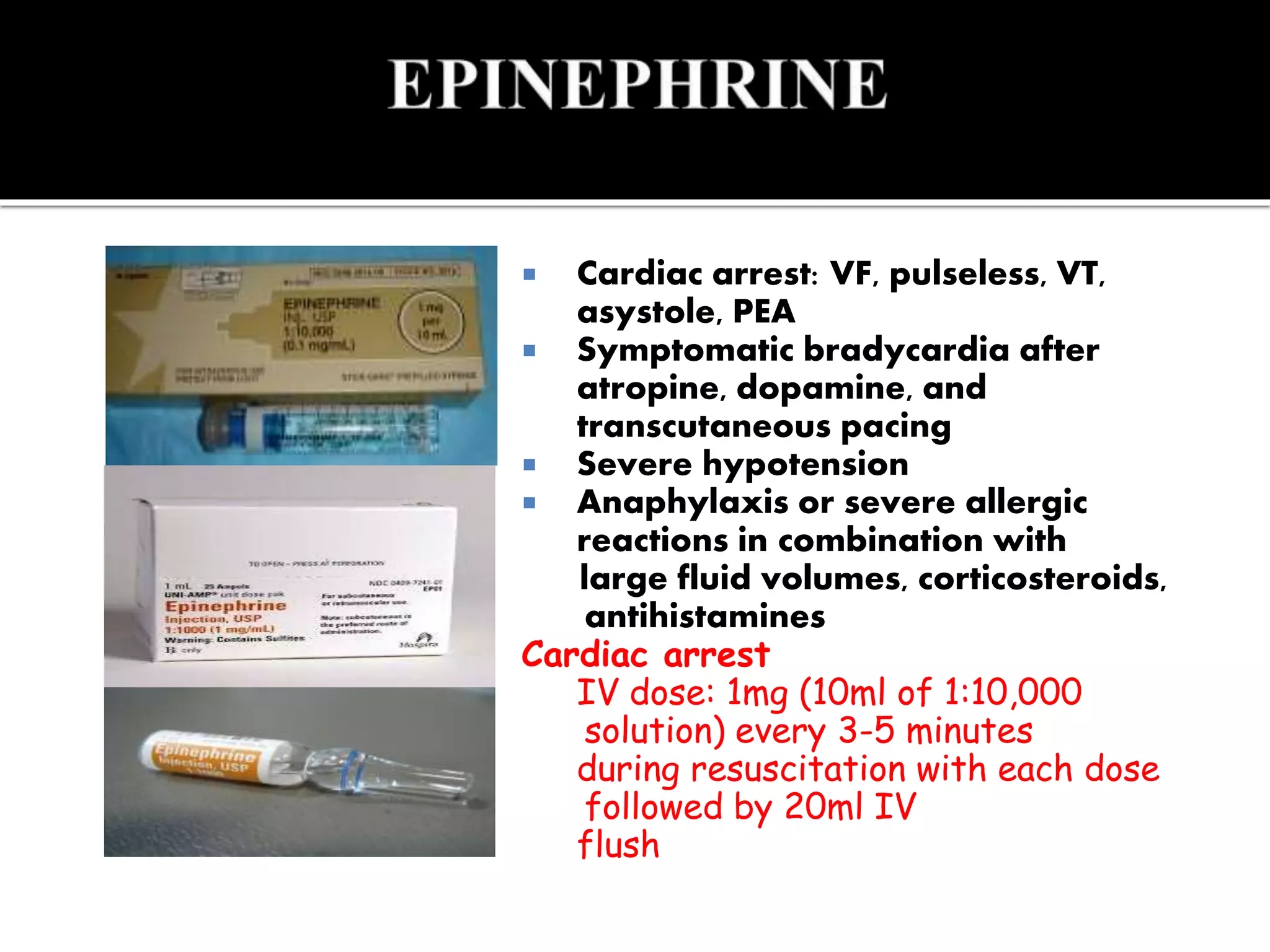
 Cardiac arrest: VF, pulseless, VT,
asystole, PEA
 Symptomatic bradycardia after
atropine, dopamine, and
transcutaneous pacing
 Severe hypotension
 Anaphylaxis or severe allergic
reactions in combination with
large fluid volumes, corticosteroids,
antihistamines
Cardiac arrest
IV dose: 1mg (10ml of 1:10,000
solution) every 3-5 minutes
during resuscitation with each dose
followed by 20ml IV
flush
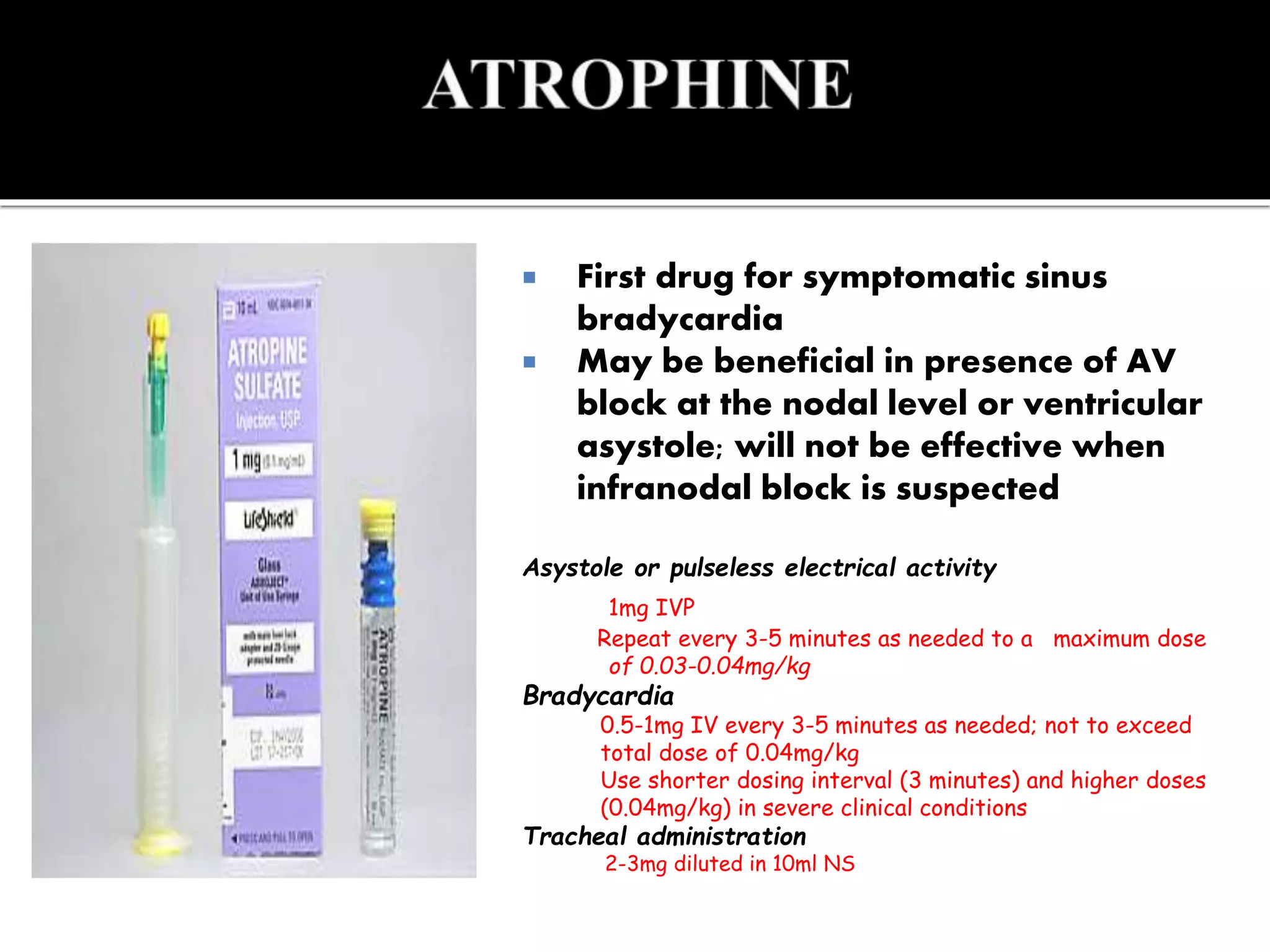
 First drug for symptomatic sinus
bradycardia
 May be beneficial in presence of AV
block at the nodal level or ventricular
asystole; will not be effective when
infranodal block is suspected
Asystole or pulseless electrical activity
1mg IVP
Repeat every 3-5 minutes as needed to a maximum dose
of 0.03-0.04mg/kg
Bradycardia
0.5-1mg IV every 3-5 minutes as needed; not to exceed
total dose of 0.04mg/kg
Use shorter dosing interval (3 minutes) and higher doses
(0.04mg/kg) in severe clinical conditions
Tracheal administration
2-3mg diluted in 10ml NS
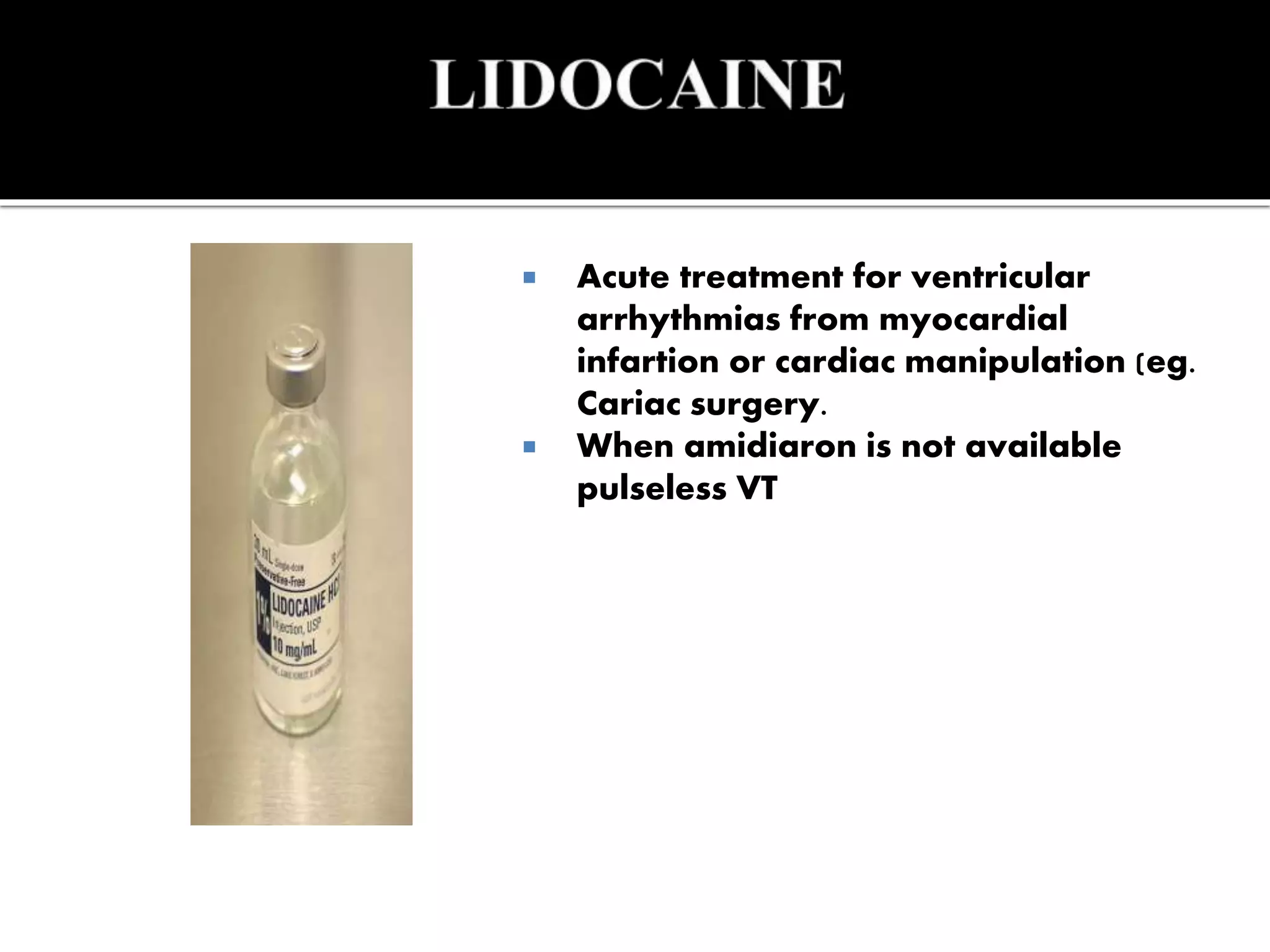
 Acute treatment for ventricular
arrhythmias from myocardial
infartion or cardiac manipulation (eg.
Cariac surgery.
 When amidiaron is not available
pulseless VT
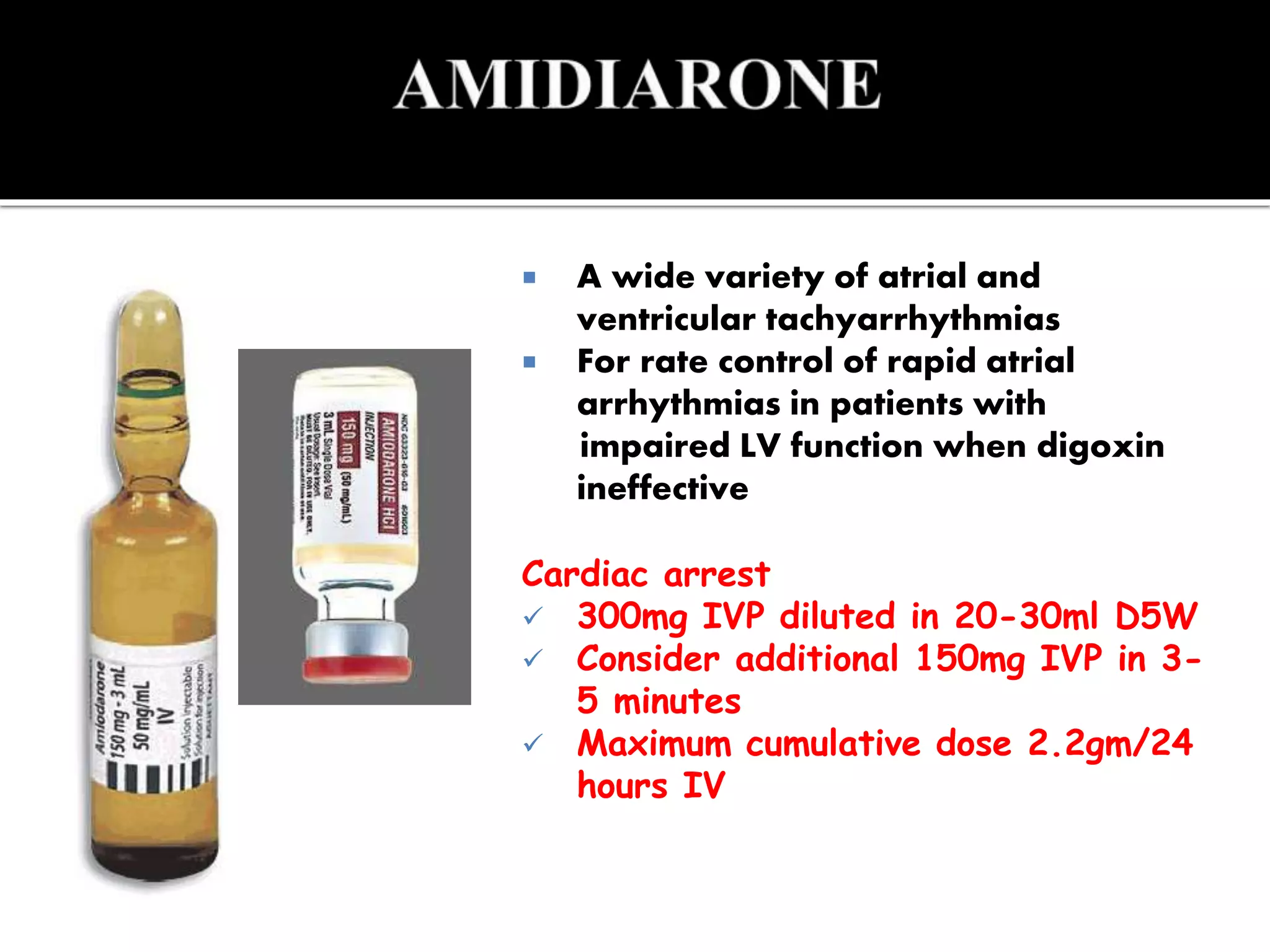
 A wide variety of atrial and
ventricular tachyarrhythmias
 For rate control of rapid atrial
arrhythmias in patients with
impaired LV function when digoxin
ineffective
Cardiac arrest
 300mg IVP diluted in 20-30ml D5W
 Consider additional 150mg IVP in 3-
5 minutes
 Maximum cumulative dose 2.2gm/24
hours IV
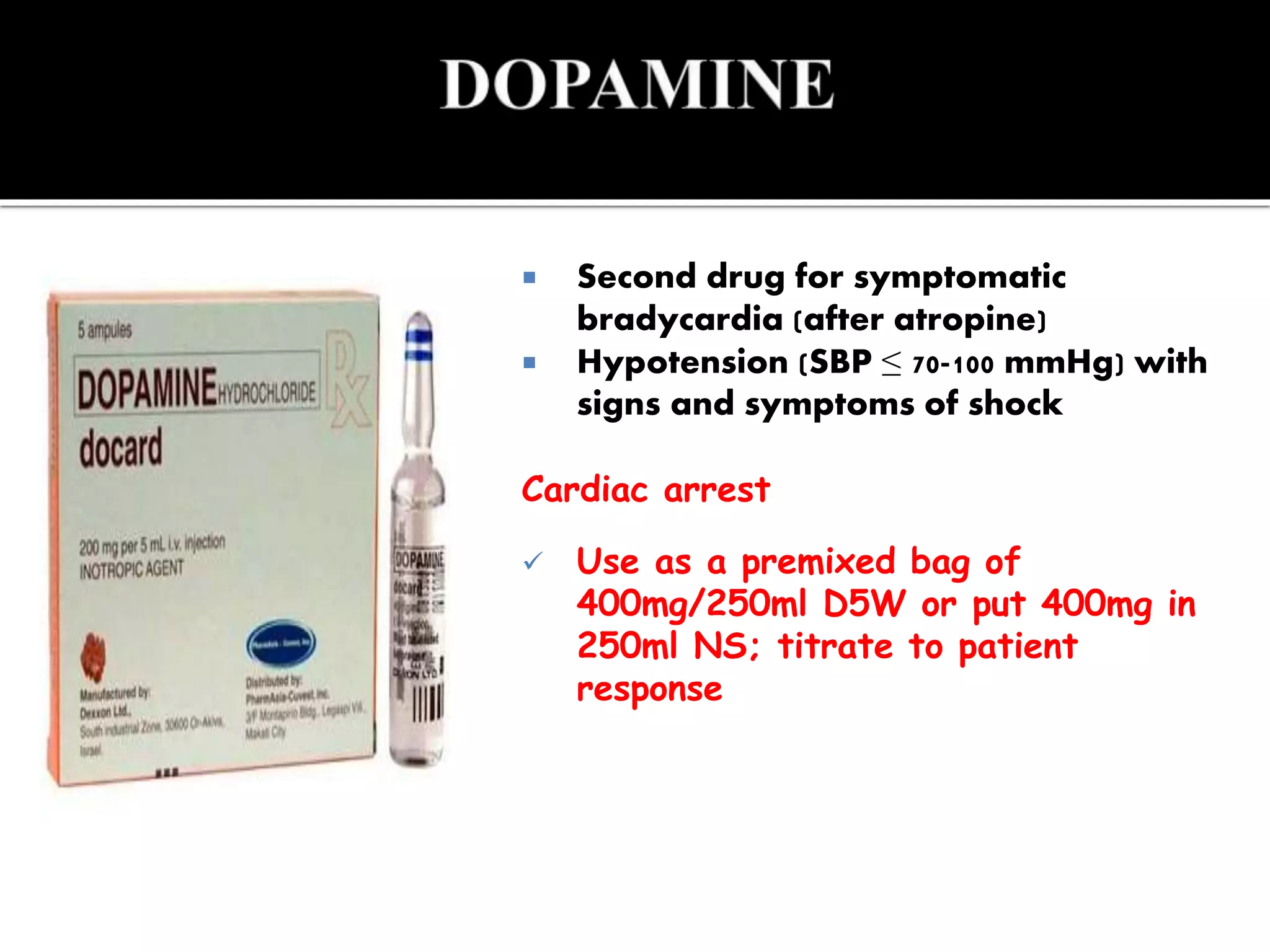
 Second drug for symptomatic
bradycardia (after atropine)
 Hypotension (SBP ≤ 70-100 mmHg) with
signs and symptoms of shock
Cardiac arrest
 Use as a premixed bag of
400mg/250ml D5W or put 400mg in
250ml NS; titrate to patient
response
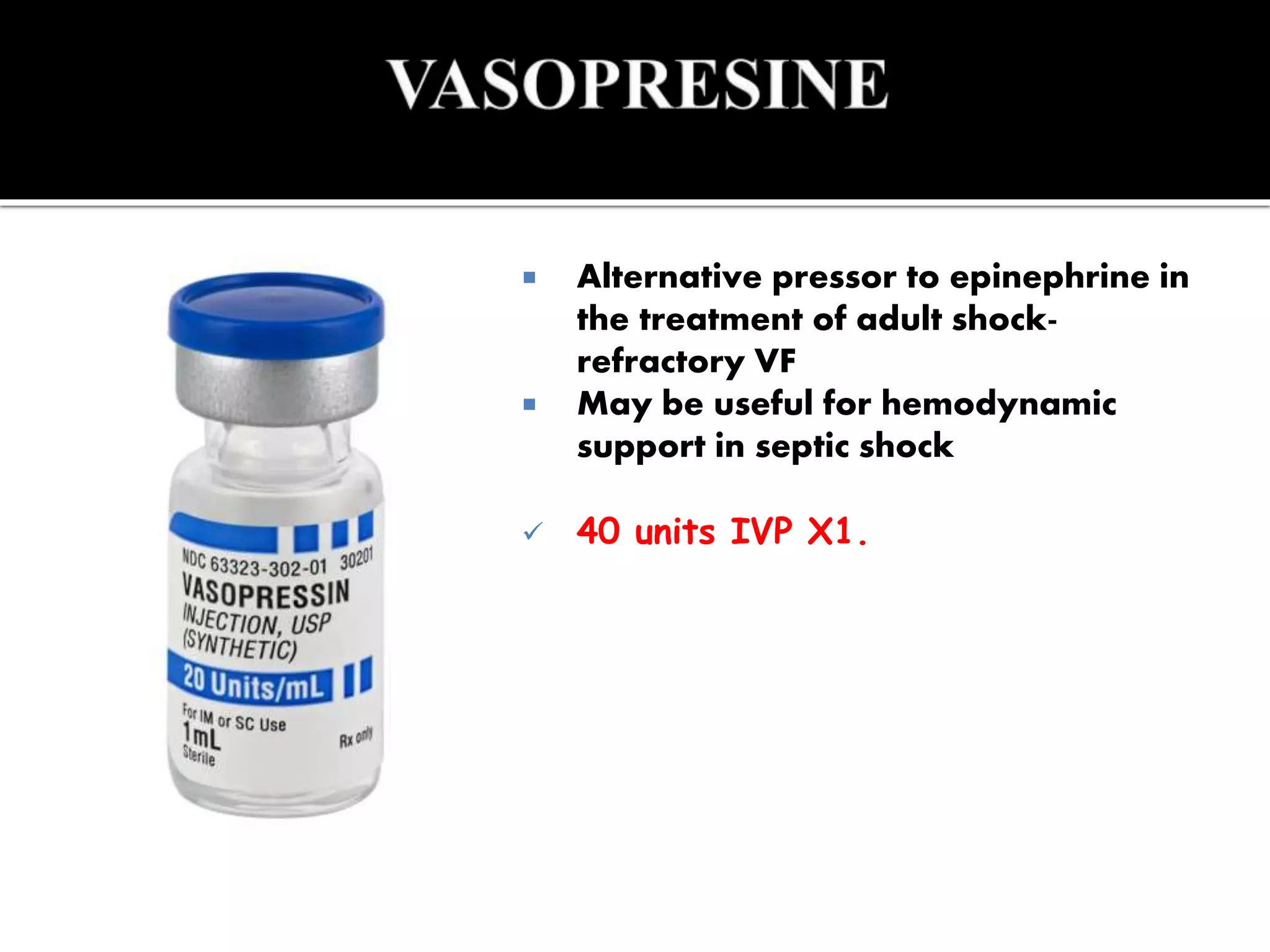
 Alternative pressor to epinephrine in
the treatment of adult shock-
refractory VF
 May be useful for hemodynamic
support in septic shock
 40 units IVP X1.
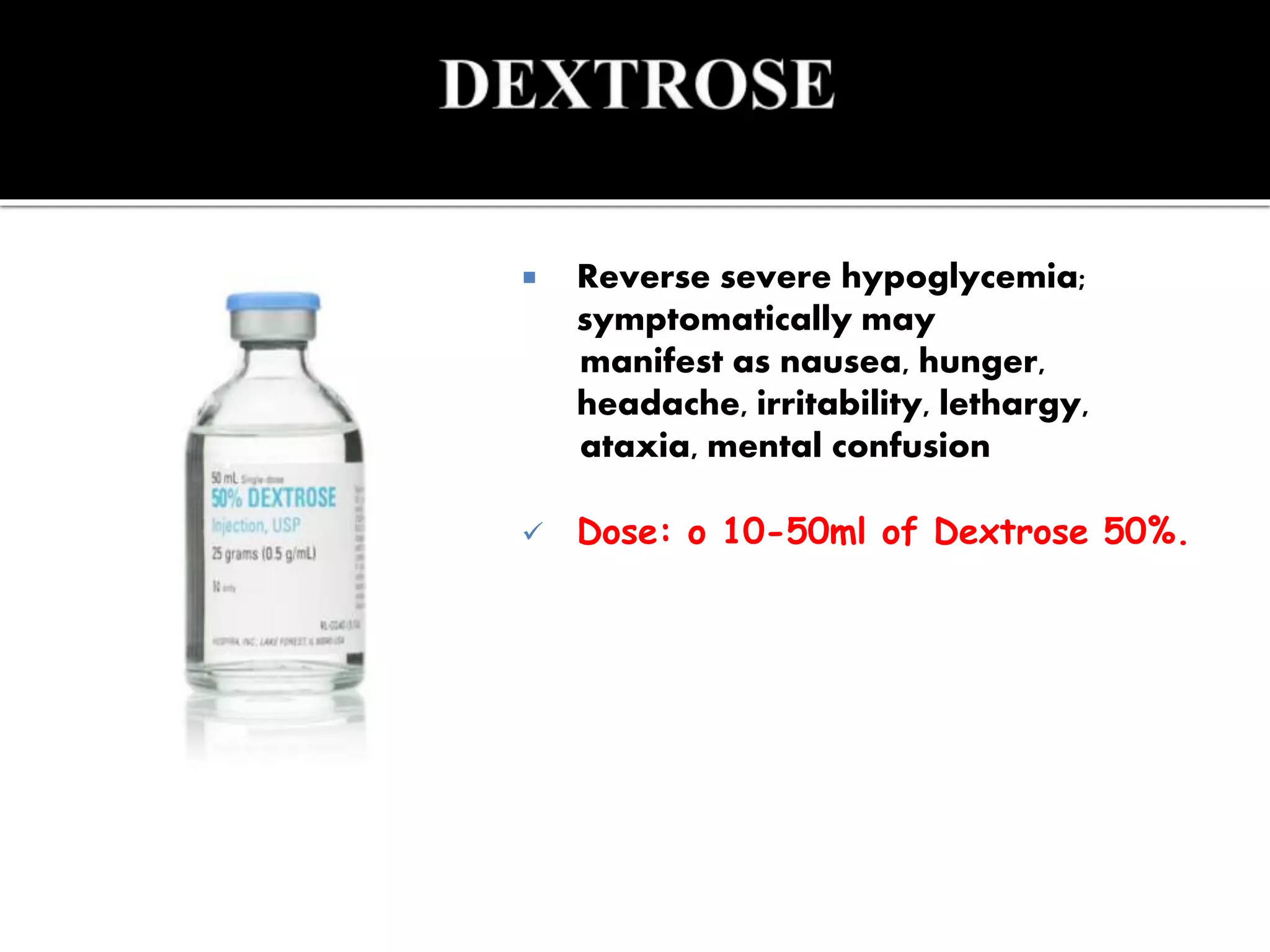
 Reverse severe hypoglycemia;
symptomatically may
manifest as nausea, hunger,
headache, irritability, lethargy,
ataxia, mental confusion
 Dose: o 10-50ml of Dextrose 50%.
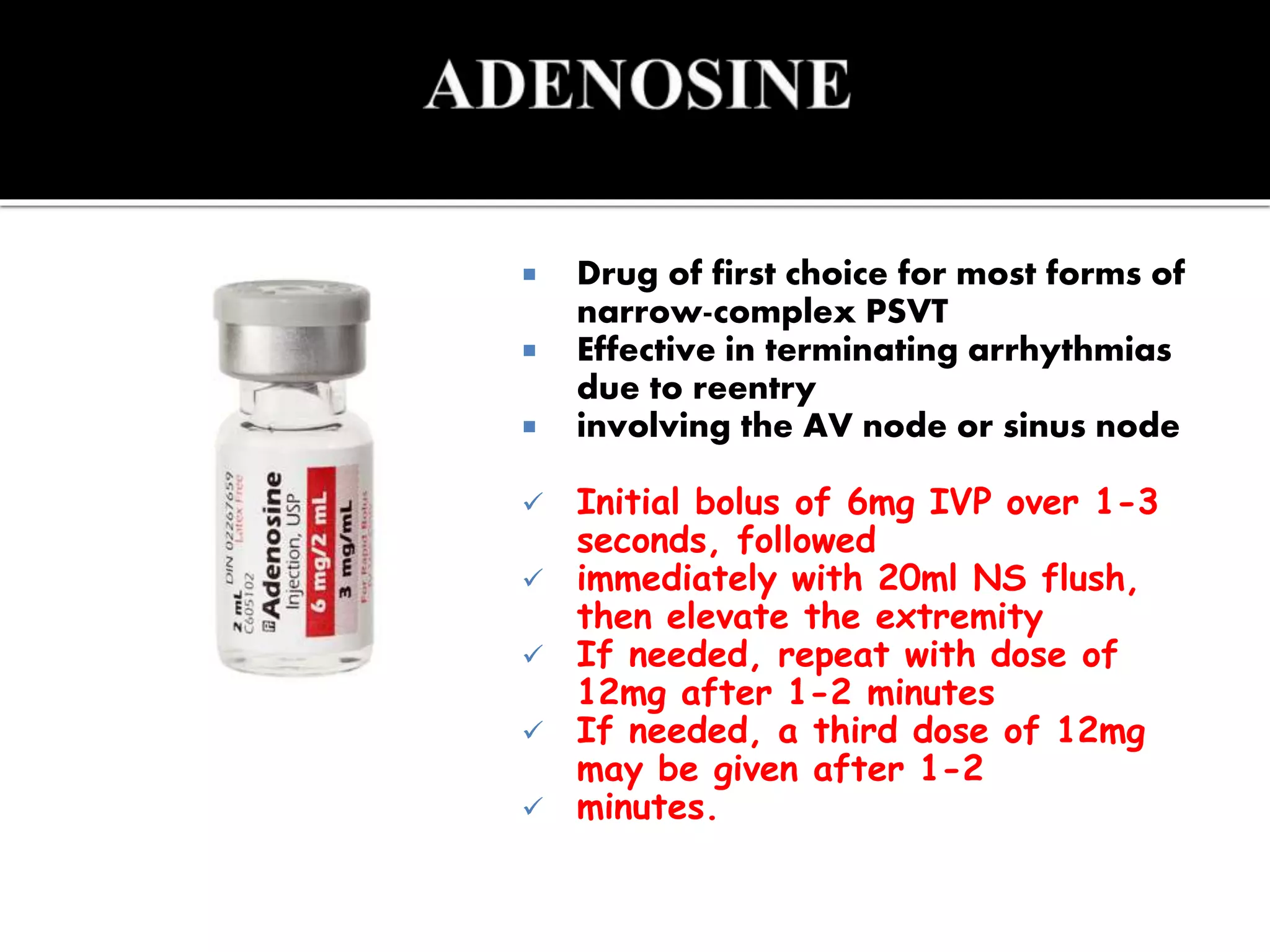
 Drug of first choice for most forms of
narrow-complex PSVT
 Effective in terminating arrhythmias
due to reentry
 involving the AV node or sinus node
 Initial bolus of 6mg IVP over 1-3
seconds, followed
 immediately with 20ml NS flush,
then elevate the extremity
 If needed, repeat with dose of
12mg after 1-2 minutes
 If needed, a third dose of 12mg
may be given after 1-2
 minutes.
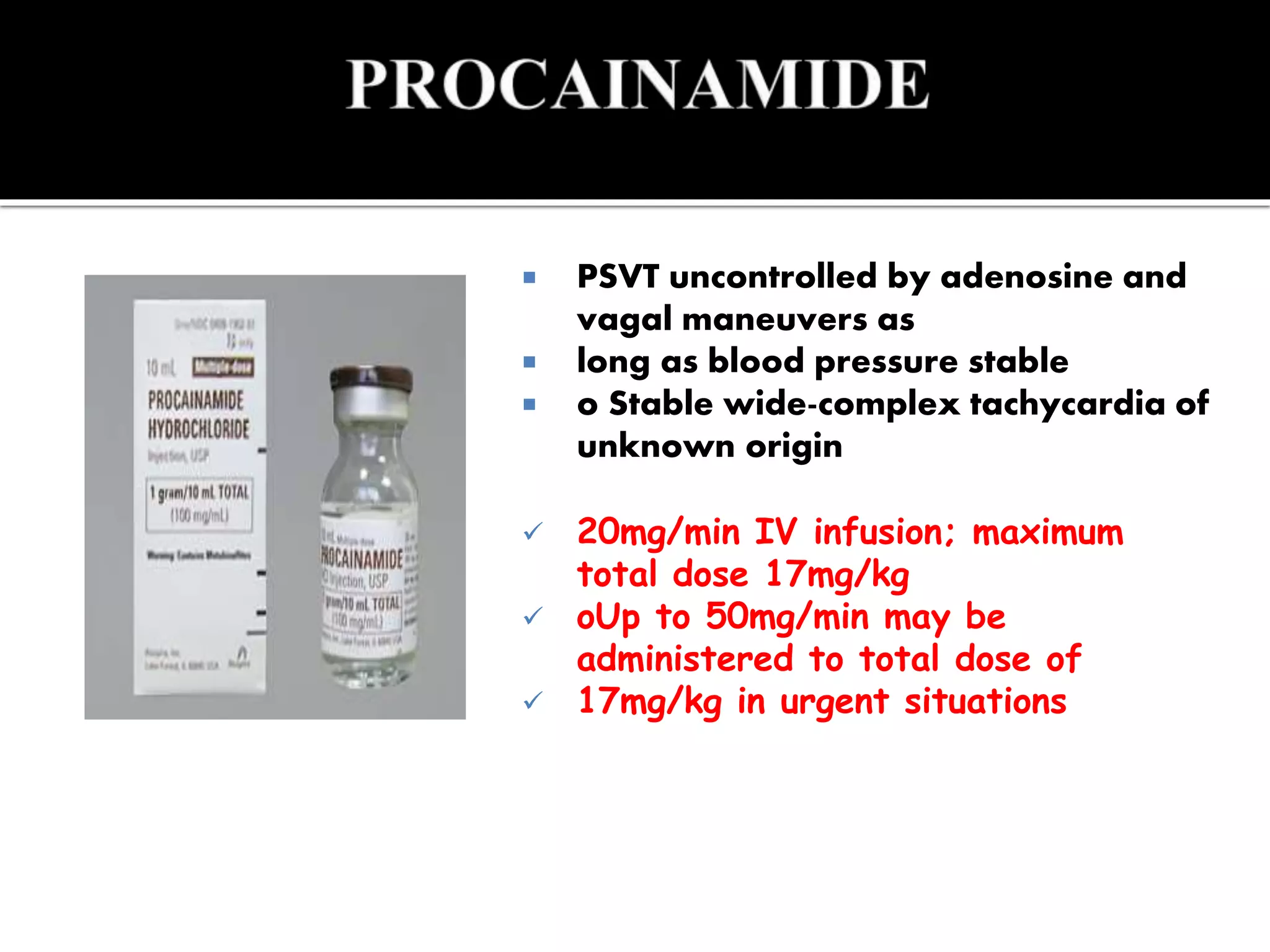
 PSVT uncontrolled by adenosine and
vagal maneuvers as
 long as blood pressure stable
 o Stable wide-complex tachycardia of
unknown origin
 20mg/min IV infusion; maximum
total dose 17mg/kg
 oUp to 50mg/min may be
administered to total dose of
 17mg/kg in urgent situations
 If prolonged resuscitation with
effective ventilation or upon
return of spontaneous circulation
after long arrest interval
 1mEq/kg IV bolus
 Repeat half this dose every 10
minutes
 Use arterial blood gas analysis to
guide bicarbonate therapy;
an acute change in PaCO2 of 1 mmHg
is associated with an increase of
decrease in pH of 0.008 U
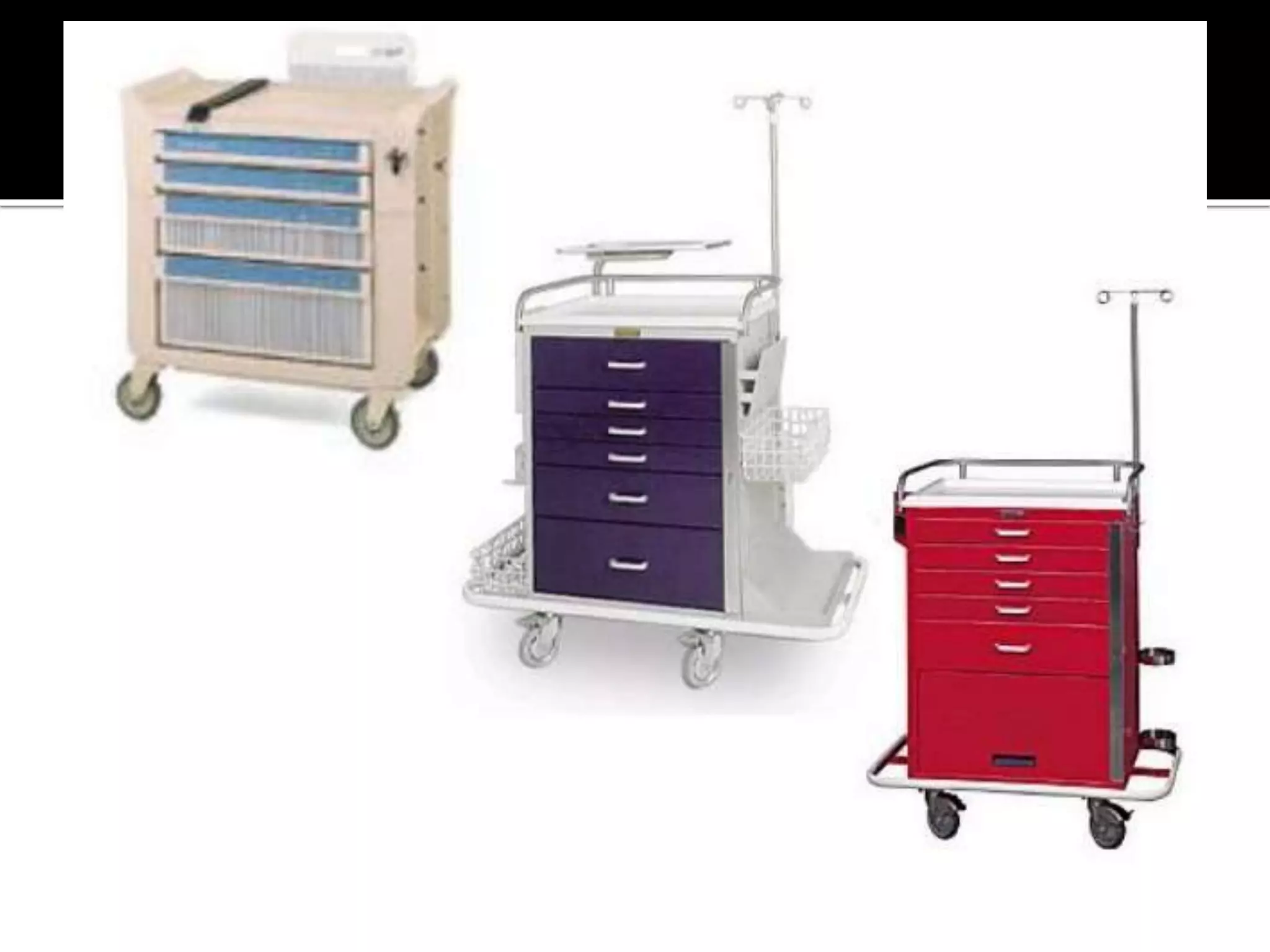
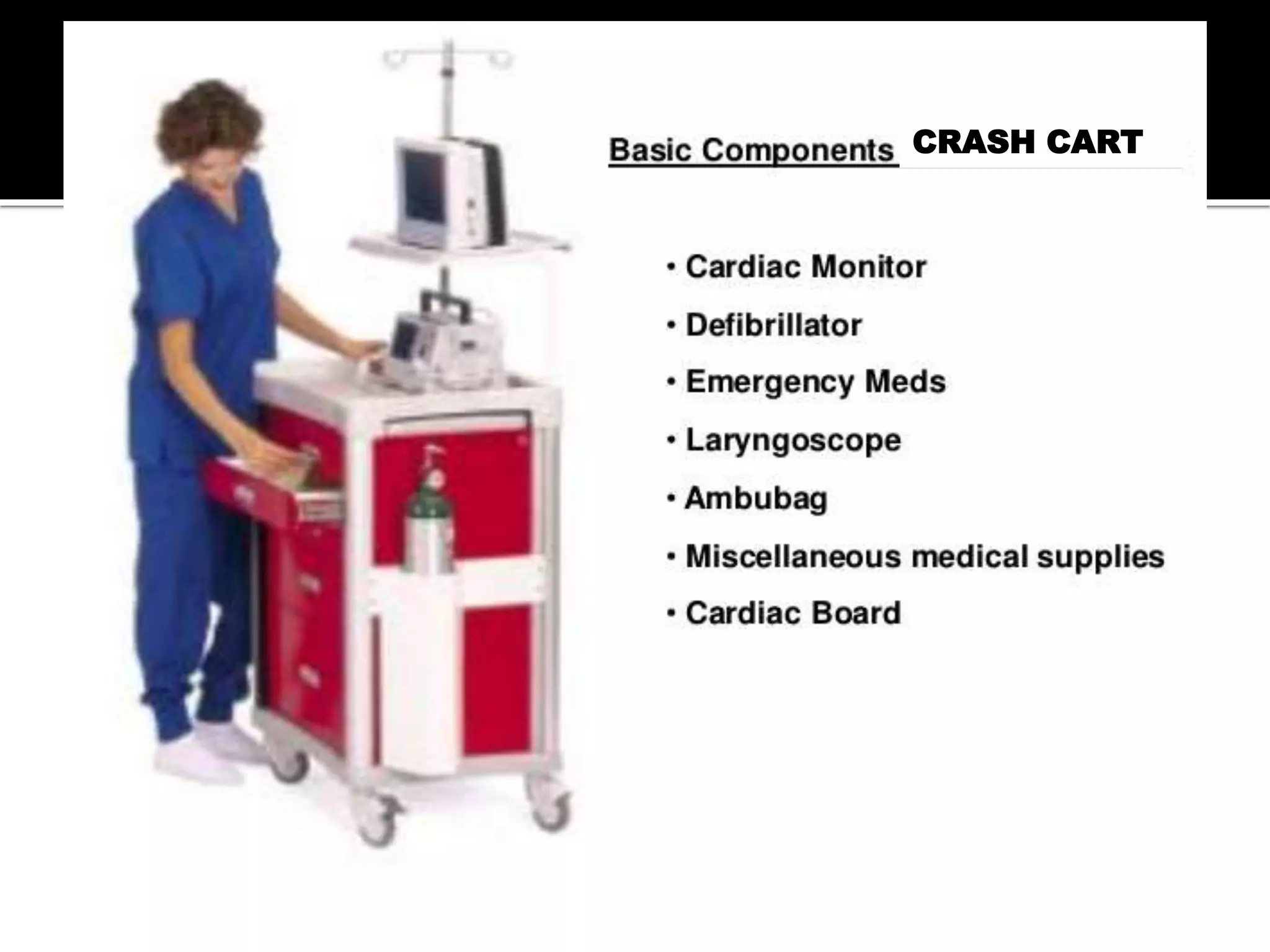
CRASH CART
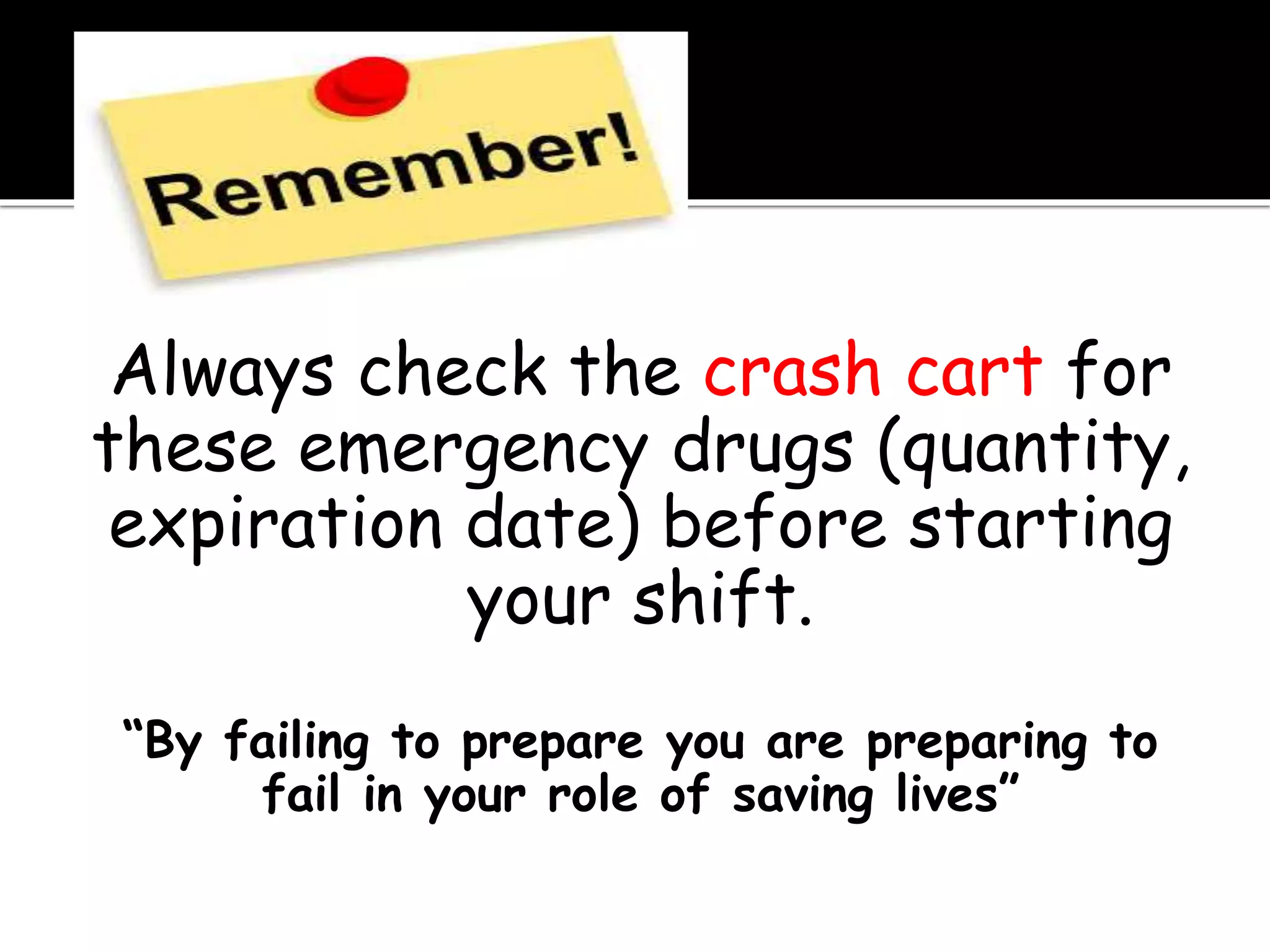
Always check the crash cart for
these emergency drugs (quantity,
expiration date) before starting
your shift.
“By failing to prepare you are preparing to
fail in your role of saving lives”
Gloria Justalero
Nurse Supervisor
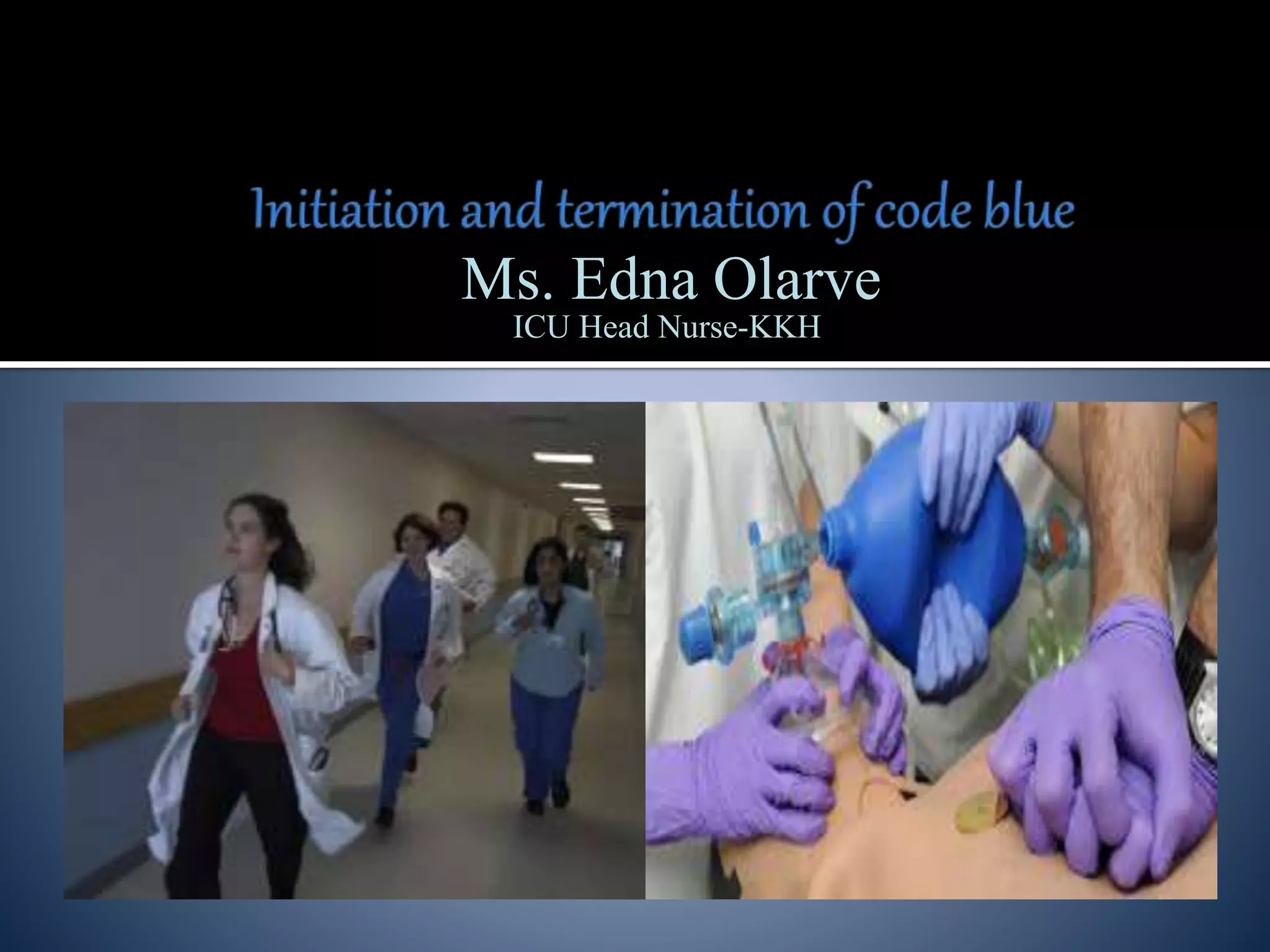
Ms. Edna Olarve
ICU Head Nurse-KKH
 King Khalid Hospital-
Najran is committed to
resuscitate any individual
suffering from Cardio
Pulmonary Arrest within
its premises.
 Code Blue is initiated in
such a case to provide
BLS and ACLS to the
victim of cardiopulmanary
arrest.
 King Khalid Hospital will
provide a multidisciplinary
Code Blue Team available
on a 24 hour on call
basis, comprising of
members listed in order in
this policy.
 Cardiac arrest in ICU will
be managed by ICU team
an code is not announced.
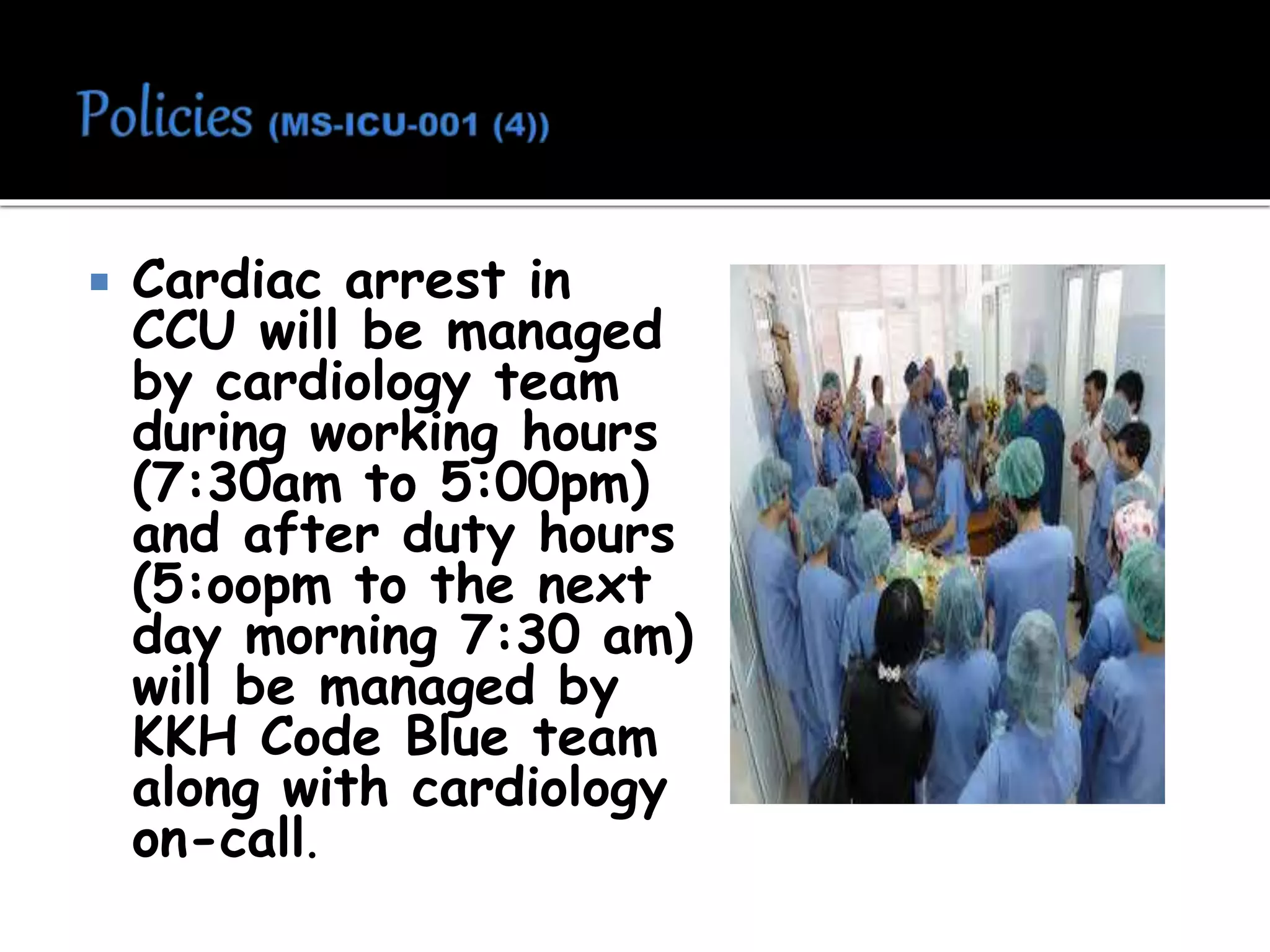
 Cardiac arrest in
CCU will be managed
by cardiology team
during working hours
(7:30am to 5:00pm)
and after duty hours
(5:oopm to the next
day morning 7:30 am)
will be managed by
KKH Code Blue team
along with cardiology
on-call.
 Core Standards
1. The standards of the Saudi Heart Association for Basic Cardiac Life
Support (BCLS) and Advanced Cardiac Life Support (ACLS) are
adopted by King Khalid Hospital for Code Blue
2. The CPR committee of KKH has the responsibility for overseeing
an making recommendation on all aspects of Code Blue.
 Certification an Competency
1. All hospital staff should possess valid BLS certificate to be able to
take part in CPR
2. Medical and Nursing staff should renew their BLS every 2 years to
maintain the privilege
 Initiation of Code Blue
1.The first responder, if not CPR
certified will:
Call for HELP and dial “22”
(switchboard) to initiate CODE BLUE
providing the following information
slowly and clearly and repeating the
information if necessary:
o Responder identity
oThe location of the patient
1. If first responder is BLS certified:
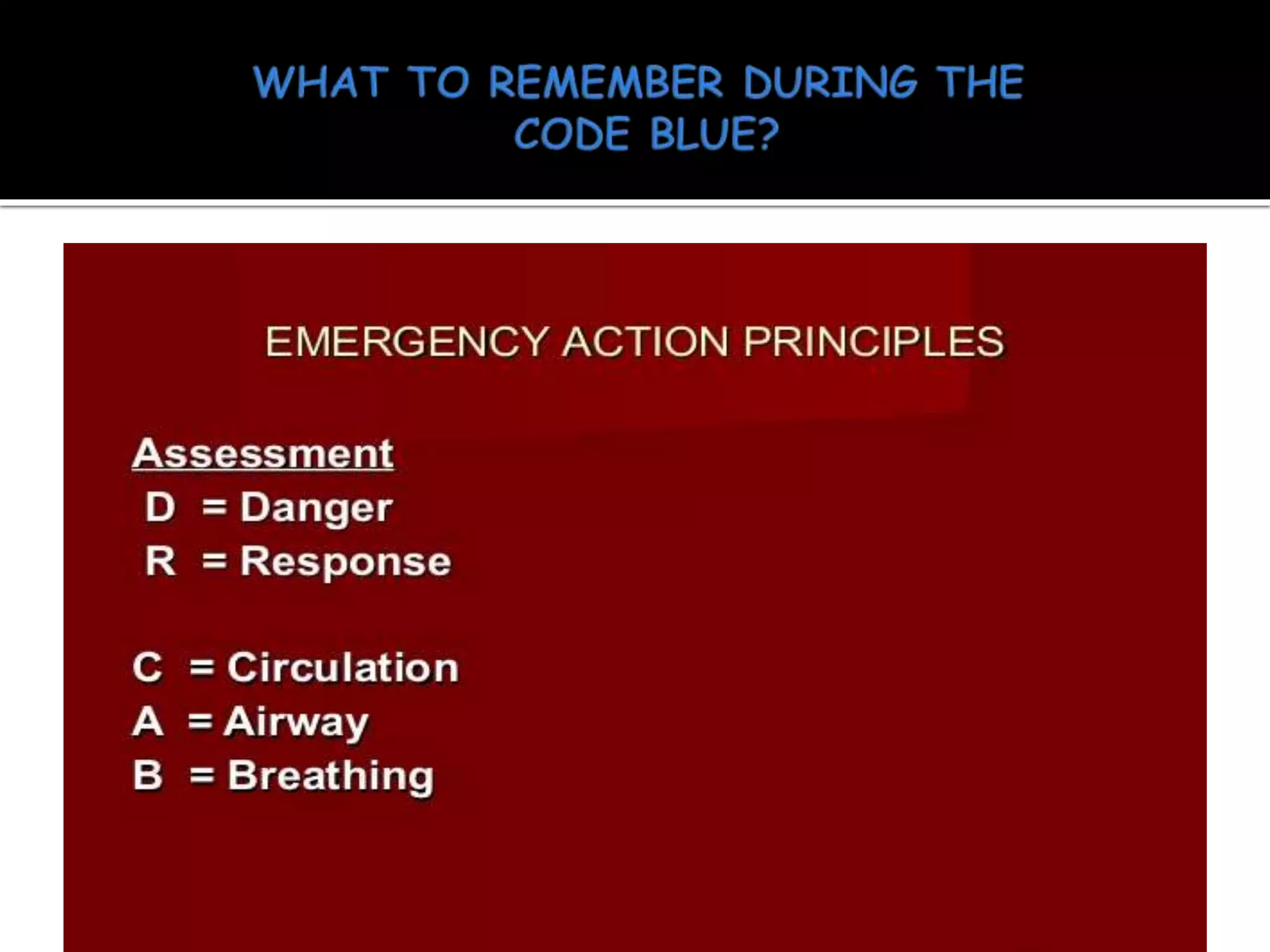
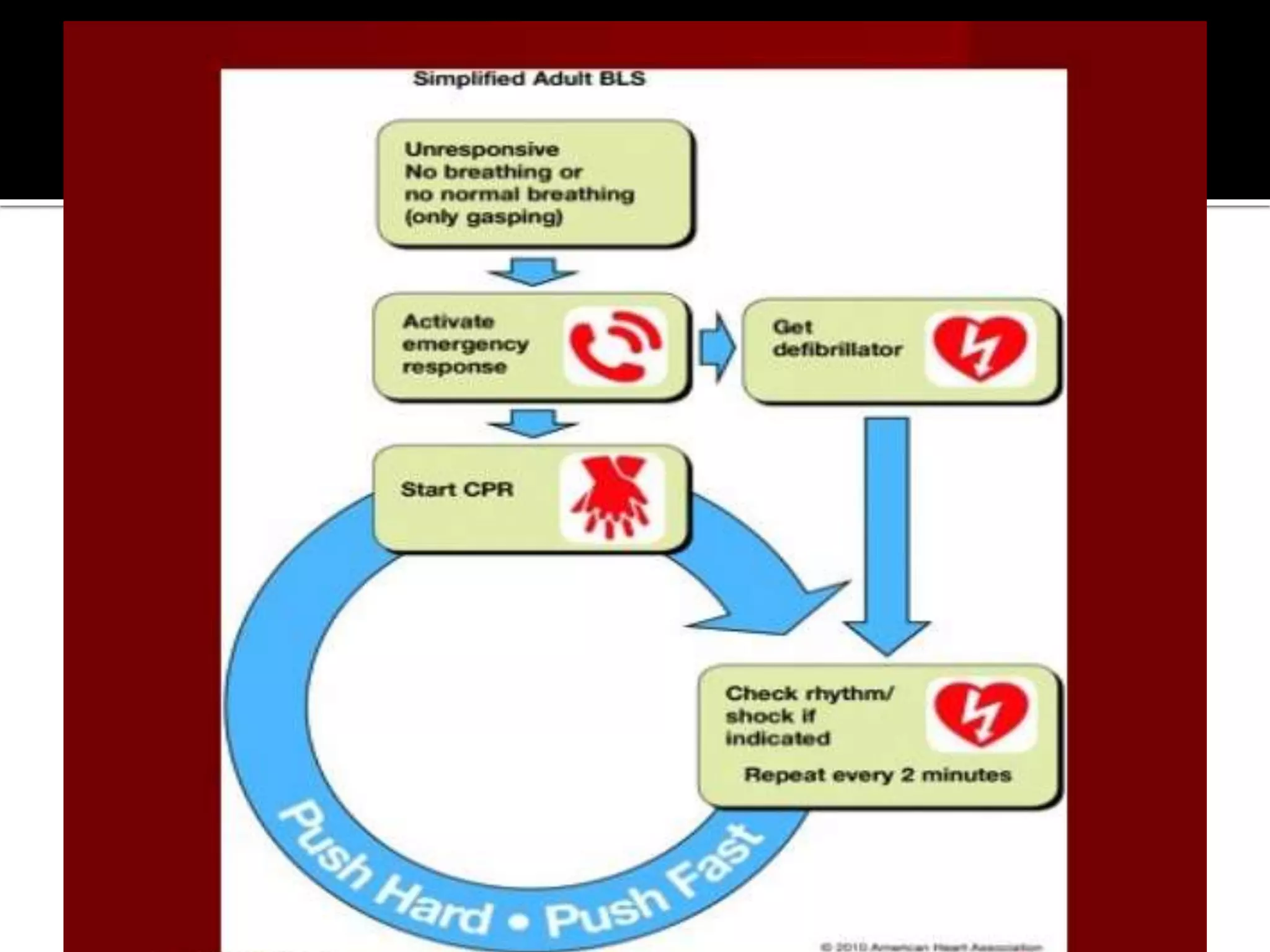
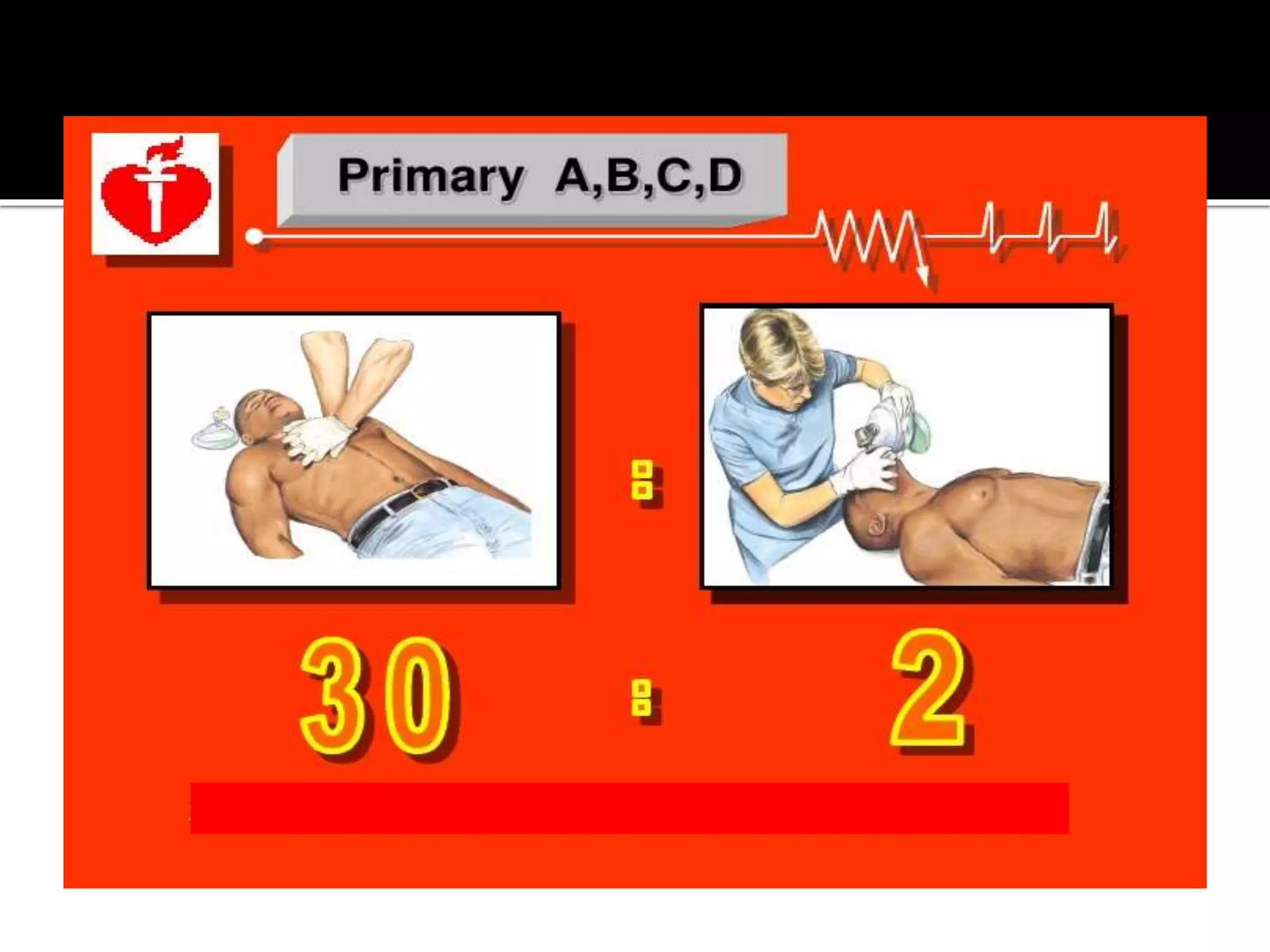
She/He will start ABCs of CPR, attach
defibrillator immediately upon arrival of
this equipment and continue CPR until
code team arrives an team leader takes
over.
 The switchboard will
1. Announce “ATTENTION …CODE
BLUE IN (area)” three times
clearly and bleep the Code Blue
team.
2. Continue to be attentive and direct
responders to the location.
 The team leader will identify self as
leader and start conducting the
procedures systematically after analyzing
the rhythm.
 Each member of the team will start
performing his/her role under guidance of
the team leader till told to stop.
 Any change in role will be as per direction
of the team leader and all must stay on
the scene till allowed by him.
 Termination of Code Blue
1. It is decide by the team leader. If MRP
of the patient available on site, his/her
opinion can be sought in making this
decision.
1. The team leader will allow team
members to stand down an return to
regular duties, with exception of the
Medical Specialist an Nursing
supervisor who will asses an coordinate
further intervention, as required.
Dr. Deyaldeen
ICU Resident-KKH
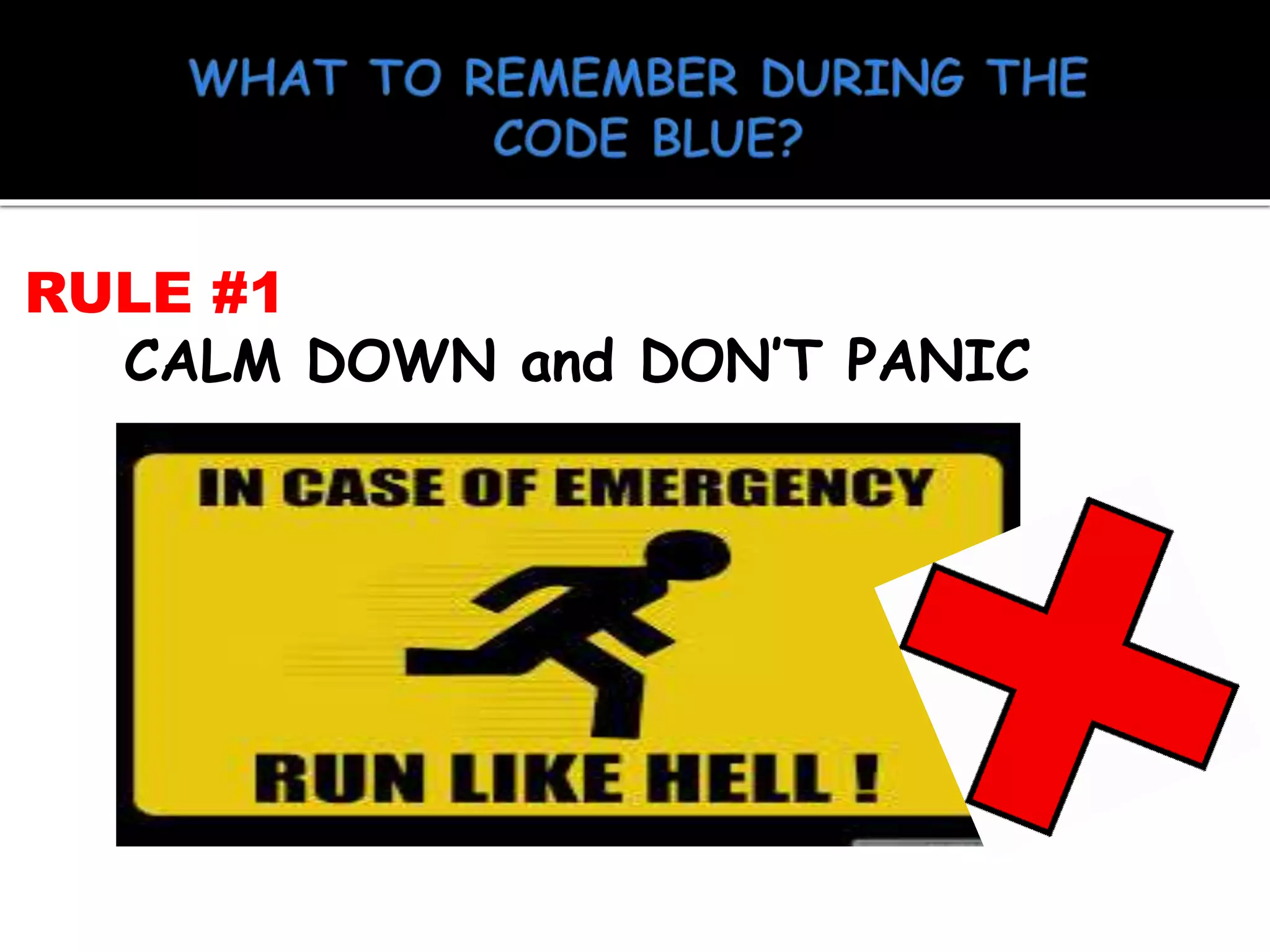
RULE #1
CALM DOWN and DON’T PANIC
RULE #2
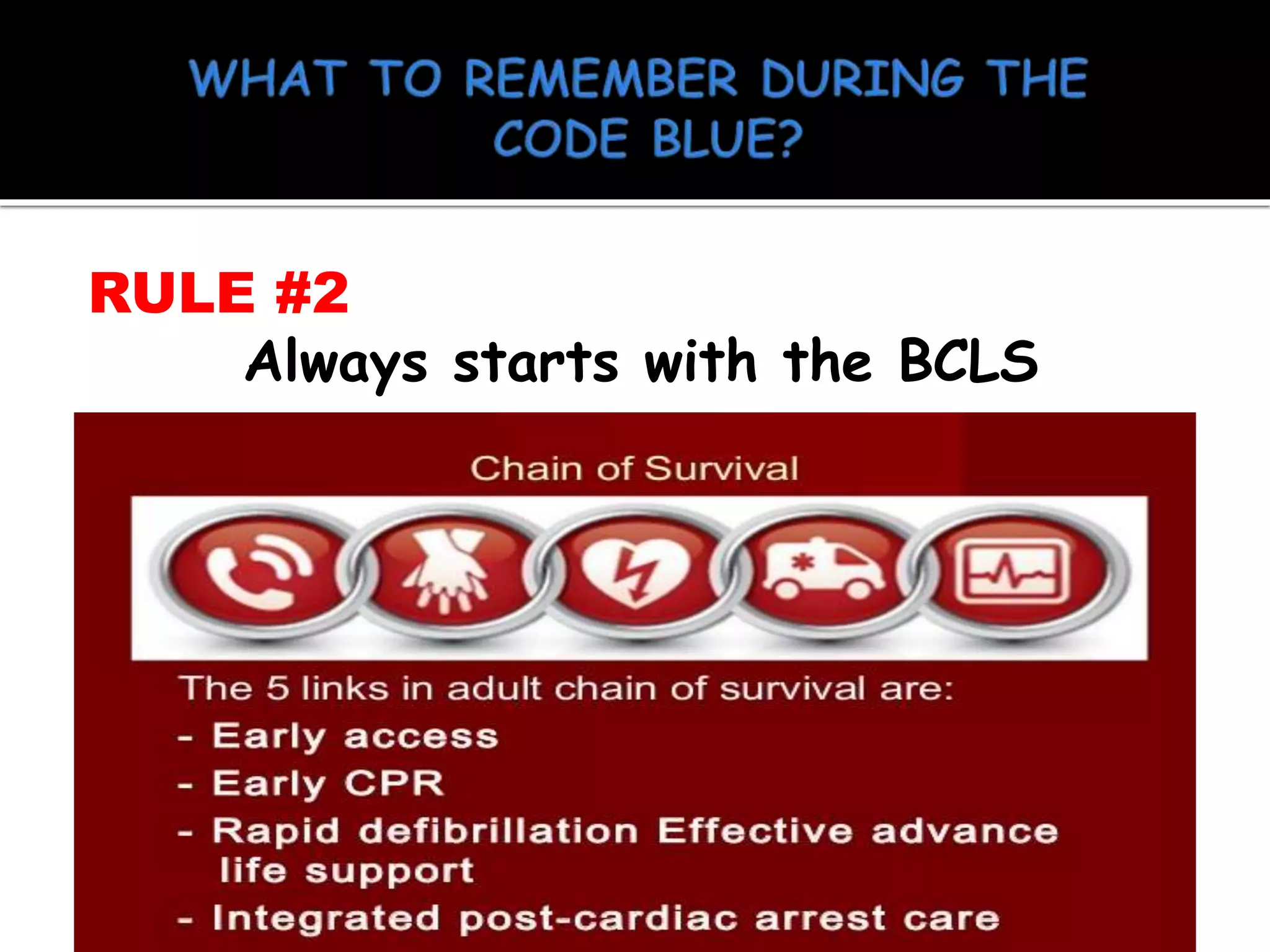
Always starts with the BCLS
RULE #3
Always be systematic in performing ACLS
We are hoping to see competent nurses during code
blue.

Code Blue

  • 1.
  • 2.
  • 3.
     A messageannounced over a hospital’s public address system, indicating that a cardiac arrest or respiratory arrest requiring CPR is in progress; to be “coded” is to undergo CPR.  The King Khalid Hospital code to be used by all staff to summon a trained team of medical personnel to undertake cardiopulmonary resuscitation.
  • 4.
    RRT CODEBLUE 1. Thepatient is still responsive but there is a sudden deterioration in patient’s status 2. Respiratory distress 3. O2 saturation, Blood pressure, pulse is gradually dropping/below normal 1. The patient is unresponsive 2. No respiration 3. No pulse What is the difference between Rapid ResponseTeam (RRT) from Code Blue ?
  • 5.
    It is thesudden loss of cardiac function, when the heart abruptly stops beating. Unless resuscitative efforts are begun immediately, cardiac arrest leads to death within a few minutes.
  • 7.
    Pamela Joy Bocala-Blanco CNEP Coordinator/Nurse Educator
  • 8.
    Team of providers sometimescalled a “code team” being required to rush to the specific location and begin immediate resuscitative efforts in an emergency situation announced in a hospital or institution in which a patient is in cardiopulmonary arrest.
  • 9.
    The First Responderis not actually a member of a team but is the person who identifies and confirms cardiopulmonary arrest.
  • 10.
    1. Medical SpecialistOn Call/ ER Specialist for ER Code  Assume overall responsibility or the direction of activities.  Communicate with event manager/recorder  Issues all medical and resuscitative orders including resuscitation medications.  Termination of Code Blue and final disposition of the patient.  Communicate with patient’s family along with Nursing Supervisor at the end of the code.  Complete documentation for medical records.
  • 11.
    2. ICU Residenton Duty  Manage the airway as directed by the team leader  Perform bag-mask ventilation  Prepare and assist with intubation  Confirm ETT placement  Secure ETT  Complete documentation in the medical record
  • 12.
    3. Anesthesia Resident Manage the airway if ICU resident is delayed  Respond to instructions from Team Leader for changing roles  Complete documentation in medical records
  • 13.
    4. Resident onDuty in charge of the patient  Perform an continue chest compression as instructed by team leader.  Hand over to Compressor 2 when tired.  Complete documentation in medical records
  • 14.
    5. Medical Residenton Duty  Relieves Compressor 1 when tired  Complete documentation in the medical record.
  • 15.
    6. Nursing Supervisoron Duty  Help rapid transport of blood samples to laboratory  Manage crowd control with security  Communicate with the family  Notify patient Affairs, Social Worker, Interpreter  Attend to pastoral needs of the patient  Coordinate patient transfer and placement with team leader.
  • 16.
    7. ICU Nurse Established vascular access and ensure patency  Administer IV medication as per verbal order of team leader  Assist airway and intubation  Insert NGT as indicated
  • 17.
    8. Ward Shiftin Charge Nurse  Ensure providers assume pre- assigned roles and that the team knows who is responsible for what role  Assign RN1 as recorder  Assign RN2 to bring equipment needed  Once roles established, ensure management of the rest remaining work in the ward/unit.  Ensure crowd control with the help of security with in the room/ward.  Notify the switch board if code is over.
  • 18.
    9. Bedside Nurse(RN 1)  Provide history using SBAR communication  Stay at bedside  Ensure availability of workplace  Continue as the recorder  Maintain accurate written record of the timings of all intervention.
  • 19.
    10. Ward Nurse(RN 2)  Get and ready the crash cart, other equipment such as suction.  Clearly state “I am getting…”  Distribute code cart supplies  Operate monitor/defibrillator  Prepare medication according to order from team leader  Receive instruction from ICU RN or team leader.
  • 20.
    11. Respiratory Therapist(RT)  Helps ICU, anesthesia residents in airway management
  • 21.
  • 23.
    Aswathy George Prince SultanCardiac Center Director of Nursing
  • 24.
    CATEGORIZED BASED ON ADMNISTRATION 1.ET ADMINISTRATION 2. IVPB ADMINISTRATION 3. IVP ADMINISTRATION
  • 25.
     Cardiac arrest:VF, pulseless, VT, asystole, PEA  Symptomatic bradycardia after atropine, dopamine, and transcutaneous pacing  Severe hypotension  Anaphylaxis or severe allergic reactions in combination with large fluid volumes, corticosteroids, antihistamines Cardiac arrest IV dose: 1mg (10ml of 1:10,000 solution) every 3-5 minutes during resuscitation with each dose followed by 20ml IV flush
  • 26.
     First drugfor symptomatic sinus bradycardia  May be beneficial in presence of AV block at the nodal level or ventricular asystole; will not be effective when infranodal block is suspected Asystole or pulseless electrical activity 1mg IVP Repeat every 3-5 minutes as needed to a maximum dose of 0.03-0.04mg/kg Bradycardia 0.5-1mg IV every 3-5 minutes as needed; not to exceed total dose of 0.04mg/kg Use shorter dosing interval (3 minutes) and higher doses (0.04mg/kg) in severe clinical conditions Tracheal administration 2-3mg diluted in 10ml NS
  • 27.
     Acute treatmentfor ventricular arrhythmias from myocardial infartion or cardiac manipulation (eg. Cariac surgery.  When amidiaron is not available pulseless VT
  • 28.
     A widevariety of atrial and ventricular tachyarrhythmias  For rate control of rapid atrial arrhythmias in patients with impaired LV function when digoxin ineffective Cardiac arrest  300mg IVP diluted in 20-30ml D5W  Consider additional 150mg IVP in 3- 5 minutes  Maximum cumulative dose 2.2gm/24 hours IV
  • 29.
     Second drugfor symptomatic bradycardia (after atropine)  Hypotension (SBP ≤ 70-100 mmHg) with signs and symptoms of shock Cardiac arrest  Use as a premixed bag of 400mg/250ml D5W or put 400mg in 250ml NS; titrate to patient response
  • 30.
     Alternative pressorto epinephrine in the treatment of adult shock- refractory VF  May be useful for hemodynamic support in septic shock  40 units IVP X1.
  • 31.
     Reverse severehypoglycemia; symptomatically may manifest as nausea, hunger, headache, irritability, lethargy, ataxia, mental confusion  Dose: o 10-50ml of Dextrose 50%.
  • 32.
     Drug offirst choice for most forms of narrow-complex PSVT  Effective in terminating arrhythmias due to reentry  involving the AV node or sinus node  Initial bolus of 6mg IVP over 1-3 seconds, followed  immediately with 20ml NS flush, then elevate the extremity  If needed, repeat with dose of 12mg after 1-2 minutes  If needed, a third dose of 12mg may be given after 1-2  minutes.
  • 33.
     PSVT uncontrolledby adenosine and vagal maneuvers as  long as blood pressure stable  o Stable wide-complex tachycardia of unknown origin  20mg/min IV infusion; maximum total dose 17mg/kg  oUp to 50mg/min may be administered to total dose of  17mg/kg in urgent situations
  • 34.
     If prolongedresuscitation with effective ventilation or upon return of spontaneous circulation after long arrest interval  1mEq/kg IV bolus  Repeat half this dose every 10 minutes  Use arterial blood gas analysis to guide bicarbonate therapy; an acute change in PaCO2 of 1 mmHg is associated with an increase of decrease in pH of 0.008 U
  • 36.
  • 37.
    Always check thecrash cart for these emergency drugs (quantity, expiration date) before starting your shift. “By failing to prepare you are preparing to fail in your role of saving lives”
  • 38.
  • 47.
    Ms. Edna Olarve ICUHead Nurse-KKH
  • 48.
     King KhalidHospital- Najran is committed to resuscitate any individual suffering from Cardio Pulmonary Arrest within its premises.  Code Blue is initiated in such a case to provide BLS and ACLS to the victim of cardiopulmanary arrest.
  • 49.
     King KhalidHospital will provide a multidisciplinary Code Blue Team available on a 24 hour on call basis, comprising of members listed in order in this policy.  Cardiac arrest in ICU will be managed by ICU team an code is not announced.
  • 50.
     Cardiac arrestin CCU will be managed by cardiology team during working hours (7:30am to 5:00pm) and after duty hours (5:oopm to the next day morning 7:30 am) will be managed by KKH Code Blue team along with cardiology on-call.
  • 51.
     Core Standards 1.The standards of the Saudi Heart Association for Basic Cardiac Life Support (BCLS) and Advanced Cardiac Life Support (ACLS) are adopted by King Khalid Hospital for Code Blue 2. The CPR committee of KKH has the responsibility for overseeing an making recommendation on all aspects of Code Blue.  Certification an Competency 1. All hospital staff should possess valid BLS certificate to be able to take part in CPR 2. Medical and Nursing staff should renew their BLS every 2 years to maintain the privilege
  • 52.
     Initiation ofCode Blue 1.The first responder, if not CPR certified will: Call for HELP and dial “22” (switchboard) to initiate CODE BLUE providing the following information slowly and clearly and repeating the information if necessary: o Responder identity oThe location of the patient
  • 53.
    1. If firstresponder is BLS certified: She/He will start ABCs of CPR, attach defibrillator immediately upon arrival of this equipment and continue CPR until code team arrives an team leader takes over.
  • 54.
     The switchboardwill 1. Announce “ATTENTION …CODE BLUE IN (area)” three times clearly and bleep the Code Blue team. 2. Continue to be attentive and direct responders to the location.
  • 55.
     The teamleader will identify self as leader and start conducting the procedures systematically after analyzing the rhythm.  Each member of the team will start performing his/her role under guidance of the team leader till told to stop.  Any change in role will be as per direction of the team leader and all must stay on the scene till allowed by him.
  • 56.
     Termination ofCode Blue 1. It is decide by the team leader. If MRP of the patient available on site, his/her opinion can be sought in making this decision. 1. The team leader will allow team members to stand down an return to regular duties, with exception of the Medical Specialist an Nursing supervisor who will asses an coordinate further intervention, as required.
  • 58.
  • 59.
    RULE #1 CALM DOWNand DON’T PANIC
  • 60.
    RULE #2 Always startswith the BCLS
  • 63.
    RULE #3 Always besystematic in performing ACLS
  • 93.
    We are hopingto see competent nurses during code blue.