PAMELA JOY D. BOCALA
Nurse Educator
King Khalid Hospital- Najran
MILITARY NUCLEAR
SUBMARINE INDUSTRY
AVIATION
INDUSTRY
RAPID RESPONSE TEAM
(Kaiser Permanente)
History
Suzanne Graham
R
ComponentsThis tool has two documents:
 SBAR Guidelines (“Guidelines for
Communicating with
Physicians/healthcare provider
Using the SBAR Process”).
Explains in detail how to
implement the SBAR technique
 SBAR Worksheet (“SBAR report
to physician/healthcare provider
about a critical situation”). A
worksheet/script that a provider
can use to organize information
in preparation for communicating
with a physician about a critically
ill patient
 Urgent or non urgent
communications
 Nurse to doctor communications
 Doctor to doctor consultation
 Conversations with peers
 Change of shift report
 Rising a concern
 Discussions with allied health
professionals
- Respiratory therapy
- Physiotherapy
-Dietician
Other Definitions
shift report - the transfer of information from one
nurse to another about patients at change of
shift in order to provide safe, quality patient
care (Poletick & Holly, 2010)
• Other names may include: handoff report,
nurse to nurse report, handover report and
sign-off
● This method of handoff shift report has improved accountability
and the critical thinking approach to events(Boaro et al., 2010).
● Use of the tool helps nurses to relay information in an objective
and professional manner while increasing their ability to justify the
recommendations chosen (Boaro et al., 2010).
○ Handoff communication becomes more comprehensive and
decreases human error.
• The nurse spent less time writing information and more time
providing patient care and critically thinking about the patient
progression Cornell, Townsend-Gervis, Yates, & Vardaman,
2014).
● SBAR decreases the overall time nurses spent on shift
report, indicating a more focused process of information
transfer (Cornell, et al., 2014).
● SBAR levels the playing field for all nurses regardless of
their level of experience (Cornell, et al., 2014).
● Implementation of an SBAR shift report tool resulted in:
● greater focus and consistency of nursing shift reports
(Cornell et al., 2013).
o increased nurse to nurse communication and decreased
amount of transcribing occurred when a print form of SBAR was
provided.
o SBAR reduced adverse events and drug events (Haig, Sutton,
& Whittington, 2006).
o SBAR decreases the amount of unexpected deaths (Meester,
Verspuy, Monsieurs, & Van Bogaert, 2013).
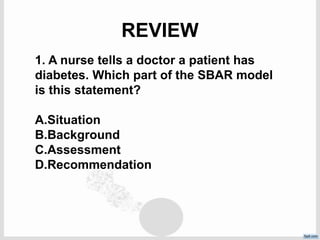
REVIEW
1. A nurse tells a doctor a patient has
diabetes. Which part of the SBAR model
is this statement?
A.Situation
B.Background
C.Assessment
D.Recommendation
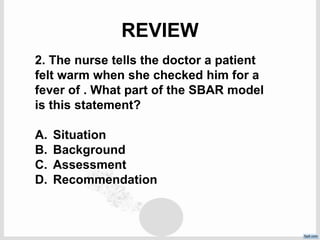
REVIEW
2. The nurse tells the doctor a patient
felt warm when she checked him for a
fever of . What part of the SBAR model
is this statement?
A. Situation
B. Background
C. Assessment
D. Recommendation
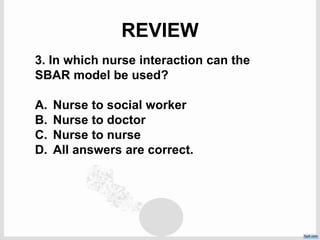
REVIEW
3. In which nurse interaction can the
SBAR model be used?
A. Nurse to social worker
B. Nurse to doctor
C. Nurse to nurse
D. All answers are correct.
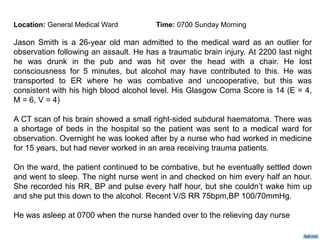
Location: General Medical Ward Time: 0700 Sunday Morning
Jason Smith is a 26-year old man admitted to the medical ward as an outlier for
observation following an assault. He has a traumatic brain injury. At 2200 last night
he was drunk in the pub and was hit over the head with a chair. He lost
consciousness for 5 minutes, but alcohol may have contributed to this. He was
transported to ER where he was combative and uncooperative, but this was
consistent with his high blood alcohol level. His Glasgow Coma Score is 14 (E = 4,
M = 6, V = 4)
A CT scan of his brain showed a small right-sided subdural haematoma. There was
a shortage of beds in the hospital so the patient was sent to a medical ward for
observation. Overnight he was looked after by a nurse who had worked in medicine
for 15 years, but had never worked in an area receiving trauma patients.
On the ward, the patient continued to be combative, but he eventually settled down
and went to sleep. The night nurse went in and checked on him every half an hour.
She recorded his RR, BP and pulse every half hour, but she couldn’t wake him up
and she put this down to the alcohol. Recent V/S RR 75bpm,BP 100/70mmHg.
He was asleep at 0700 when the nurse handed over to the relieving day nurse

2. sbar background

  • 1.
    PAMELA JOY D.BOCALA Nurse Educator King Khalid Hospital- Najran
  • 2.
  • 3.
  • 4.
    RAPID RESPONSE TEAM (KaiserPermanente) History
  • 5.
  • 6.
  • 8.
    ComponentsThis tool hastwo documents:  SBAR Guidelines (“Guidelines for Communicating with Physicians/healthcare provider Using the SBAR Process”). Explains in detail how to implement the SBAR technique  SBAR Worksheet (“SBAR report to physician/healthcare provider about a critical situation”). A worksheet/script that a provider can use to organize information in preparation for communicating with a physician about a critically ill patient
  • 9.
     Urgent ornon urgent communications  Nurse to doctor communications  Doctor to doctor consultation  Conversations with peers  Change of shift report  Rising a concern  Discussions with allied health professionals - Respiratory therapy - Physiotherapy -Dietician
  • 10.
    Other Definitions shift report- the transfer of information from one nurse to another about patients at change of shift in order to provide safe, quality patient care (Poletick & Holly, 2010) • Other names may include: handoff report, nurse to nurse report, handover report and sign-off
  • 11.
    ● This methodof handoff shift report has improved accountability and the critical thinking approach to events(Boaro et al., 2010). ● Use of the tool helps nurses to relay information in an objective and professional manner while increasing their ability to justify the recommendations chosen (Boaro et al., 2010). ○ Handoff communication becomes more comprehensive and decreases human error. • The nurse spent less time writing information and more time providing patient care and critically thinking about the patient progression Cornell, Townsend-Gervis, Yates, & Vardaman, 2014).
  • 12.
    ● SBAR decreasesthe overall time nurses spent on shift report, indicating a more focused process of information transfer (Cornell, et al., 2014). ● SBAR levels the playing field for all nurses regardless of their level of experience (Cornell, et al., 2014). ● Implementation of an SBAR shift report tool resulted in: ● greater focus and consistency of nursing shift reports (Cornell et al., 2013). o increased nurse to nurse communication and decreased amount of transcribing occurred when a print form of SBAR was provided. o SBAR reduced adverse events and drug events (Haig, Sutton, & Whittington, 2006). o SBAR decreases the amount of unexpected deaths (Meester, Verspuy, Monsieurs, & Van Bogaert, 2013).
  • 15.
    REVIEW 1. A nursetells a doctor a patient has diabetes. Which part of the SBAR model is this statement? A.Situation B.Background C.Assessment D.Recommendation
  • 16.
    REVIEW 2. The nursetells the doctor a patient felt warm when she checked him for a fever of . What part of the SBAR model is this statement? A. Situation B. Background C. Assessment D. Recommendation
  • 17.
    REVIEW 3. In whichnurse interaction can the SBAR model be used? A. Nurse to social worker B. Nurse to doctor C. Nurse to nurse D. All answers are correct.
  • 18.
    Location: General MedicalWard Time: 0700 Sunday Morning Jason Smith is a 26-year old man admitted to the medical ward as an outlier for observation following an assault. He has a traumatic brain injury. At 2200 last night he was drunk in the pub and was hit over the head with a chair. He lost consciousness for 5 minutes, but alcohol may have contributed to this. He was transported to ER where he was combative and uncooperative, but this was consistent with his high blood alcohol level. His Glasgow Coma Score is 14 (E = 4, M = 6, V = 4) A CT scan of his brain showed a small right-sided subdural haematoma. There was a shortage of beds in the hospital so the patient was sent to a medical ward for observation. Overnight he was looked after by a nurse who had worked in medicine for 15 years, but had never worked in an area receiving trauma patients. On the ward, the patient continued to be combative, but he eventually settled down and went to sleep. The night nurse went in and checked on him every half an hour. She recorded his RR, BP and pulse every half hour, but she couldn’t wake him up and she put this down to the alcohol. Recent V/S RR 75bpm,BP 100/70mmHg. He was asleep at 0700 when the nurse handed over to the relieving day nurse