ADVANCED CARDIOVASCULAR LIFE
SUPPORT (ACLS)
SAHAM HOSPITAL
SESSION 1
Practice: (1 participant is a CPR-coach while the other is practicing)
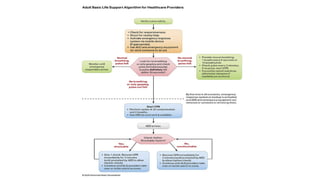
• Adult BLS with AED and rescue breathing
• Infant BLS (1 & 2 rescuer)
ASSESSMENT
SESSION 2
Practice:
• OPA or NPA
• LMA and fixing it
• ETT
• Page Mask Device
• Rescue breathing (can be performed during ROSC)
SESSION 3
Theory
• Acute Coronary Syndrome
• Stroke
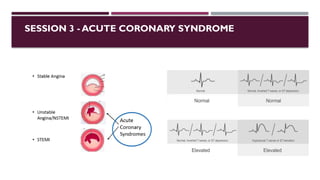
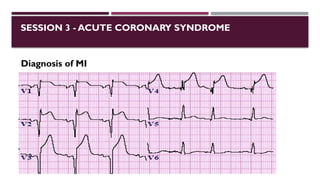
SESSION 3 - ACUTE CORONARY SYNDROME
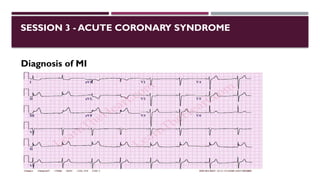
Diagnosis of MI
SESSION 3 - ACUTE CORONARY SYNDROME
Diagnosis of MI
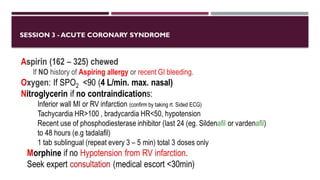
SESSION 3 - ACUTE CORONARY SYNDROME
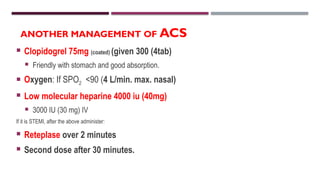
ANOTHER MANAGEMENT OF ACS
 Clopidogrel 75mg (coated) (given 300 (4tab)
 Friendly with stomach and good absorption.
 Oxygen: If SPO2 <90 (4 L/min. max. nasal)
 Low molecular heparine 4000 iu (40mg)
 3000 IU (30 mg) IV
If it is STEMI, after the above administer:
 Reteplase over 2 minutes
 Second dose after 30 minutes.
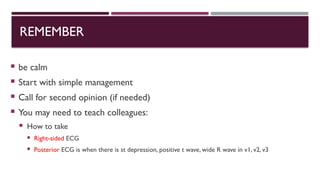
REMEMBER
 be calm
 Start with simple management
 Call for second opinion (if needed)
 You may need to teach colleagues:
 How to take
 Right-sided ECG
 Posterior ECG is when there is st depression, positive t wave, wide R wave in v1, v2, v3
SESSION 3 :STROKE
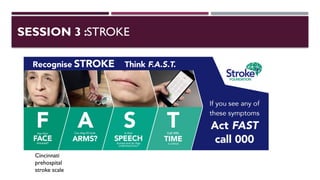
Cincinnati
prehospital
stroke scale
SESSION 3 :STROKE
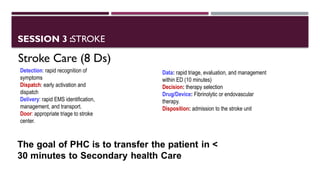
Stroke Care (8 Ds)
Detection: rapid recognition of
symptoms
Dispatch: early activation and
dispatch
Delivery: rapid EMS identification,
management, and transport.
Door: appropriate triage to stroke
center.
Data: rapid triage, evaluation, and management
within ED (10 minutes)
Decision: therapy selection
Drug/Device: Fibrinolytic or endovascular
therapy.
Disposition: admission to the stroke unit
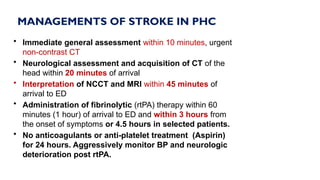
• Immediate general assessment within 10 minutes, urgent
non-contrast CT
• Neurological assessment and acquisition of CT of the
head within 20 minutes of arrival
• Interpretation of NCCT and MRI within 45 minutes of
arrival to ED
• Administration of fibrinolytic (rtPA) therapy within 60
minutes (1 hour) of arrival to ED and within 3 hours from
the onset of symptoms or 4.5 hours in selected patients.
• No anticoagulants or anti-platelet treatment (Aspirin)
for 24 hours. Aggressively monitor BP and neurologic
deterioration post rtPA.
MANAGEMENTS OF STROKE IN PHC
DRUGS
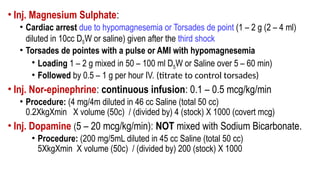
• Inj. Magnesium Sulphate:
• Cardiac arrest due to hypomagnesemia or Torsades de point (1 – 2 g (2 – 4 ml)
diluted in 10cc D5W or saline) given after the third shock
• Torsades de pointes with a pulse or AMI with hypomagnesemia
• Loading 1 – 2 g mixed in 50 – 100 ml D5W or Saline over 5 – 60 min)
• Followed by 0.5 – 1 g per hour IV. (titrate to control torsades)
• Inj. Nor-epinephrine: continuous infusion: 0.1 – 0.5 mcg/kg/min
• Procedure: (4 mg/4m diluted in 46 cc Saline (total 50 cc)
0.2XkgXmin X volume (50c) / (divided by) 4 (stock) X 1000 (covert mcg)
• Inj. Dopamine (5 – 20 mcg/kg/min): NOT mixed with Sodium Bicarbonate.
• Procedure: (200 mg/5mL diluted in 45 cc Saline (total 50 cc)
5XkgXmin X volume (50c) / (divided by) 200 (stock) X 1000
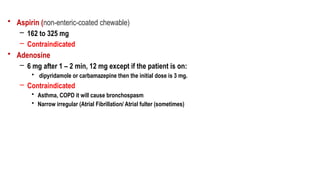
• Aspirin (non-enteric-coated chewable)
– 162 to 325 mg
– Contraindicated
• Adenosine
– 6 mg after 1 – 2 min, 12 mg except if the patient is on:
• dipyridamole or carbamazepine then the initial dose is 3 mg.
– Contraindicated
• Asthma, COPD it will cause bronchospasm
• Narrow irregular (Atrial Fibrillation/ Atrial fulter (sometimes)
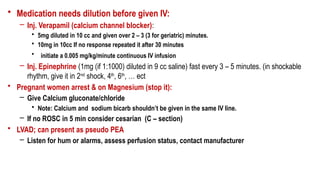
• Medication needs dilution before given IV:
– Inj. Verapamil (calcium channel blocker):
• 5mg diluted in 10 cc and given over 2 – 3 (3 for geriatric) minutes.
• 10mg in 10cc If no response repeated it after 30 minutes
• initiate a 0.005 mg/kg/minute continuous IV infusion
– Inj. Epinephrine (1mg (if 1:1000) diluted in 9 cc saline) fast every 3 – 5 minutes. (in shockable
rhythm, give it in 2nd
shock, 4th
, 6th
, … ect
• Pregnant women arrest & on Magnesium (stop it):
– Give Calcium gluconate/chloride
• Note: Calcium and sodium bicarb shouldn’t be given in the same IV line.
– If no ROSC in 5 min consider cesarian (C – section)
• LVAD; can present as pseudo PEA
– Listen for hum or alarms, assess perfusion status, contact manufacturer
SESSION 4
Theory & Clinical Practice
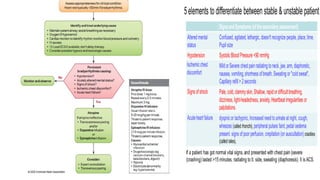
• Managements of Bradycardia
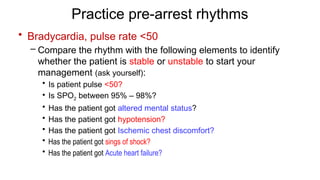
Practice pre-arrest rhythms
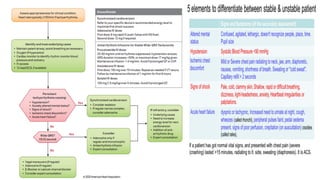
• Bradycardia, pulse rate <50
– Compare the rhythm with the following elements to identify
whether the patient is stable or unstable to start your
management (ask yourself):
• Is patient pulse <50?
• Is SPO2 between 95% – 98%?
• Has the patient got altered mental status?
• Has the patient got hypotension?
• Has the patient got Ischemic chest discomfort?
• Has the patient got sings of shock?
• Has the patient got Acute heart failure?
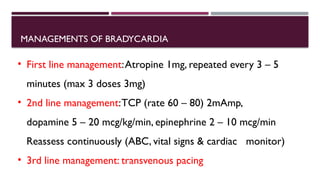
MANAGEMENTS OF BRADYCARDIA
• First line management:Atropine 1mg, repeated every 3 – 5
minutes (max 3 doses 3mg)
• 2nd line management:TCP (rate 60 – 80) 2mAmp,
dopamine 5 – 20 mcg/kg/min, epinephrine 2 – 10 mcg/min
Reassess continuously (ABC, vital signs & cardiac monitor)
• 3rd line management: transvenous pacing
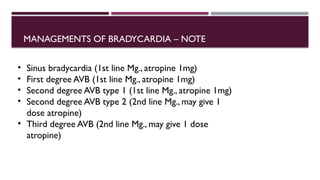
MANAGEMENTS OF BRADYCARDIA – NOTE
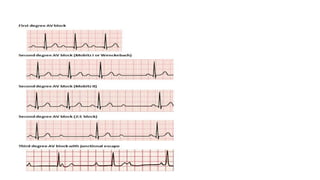
• Sinus bradycardia (1st line Mg., atropine 1mg)
• First degree AVB (1st line Mg., atropine 1mg)
• Second degree AVB type 1 (1st line Mg., atropine 1mg)
• Second degree AVB type 2 (2nd line Mg., may give 1
dose atropine)
• Third degree AVB (2nd line Mg., may give 1 dose
atropine)
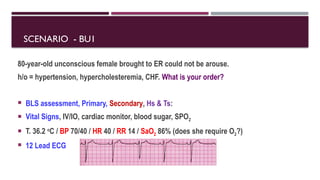
SCENARIO - BU1
80-year-old unconscious female brought to ER could not be arouse.
h/o = hypertension, hypercholesteremia, CHF. What is your order?
 BLS assessment, Primary, Secondary, Hs & Ts:
 Vital Signs, IV/IO, cardiac monitor, blood sugar, SPO2
 T. 36.2 o
C / BP 70/40 / HR 40 / RR 14 / SaO2 86% (does she require O2?)
 12 Lead ECG
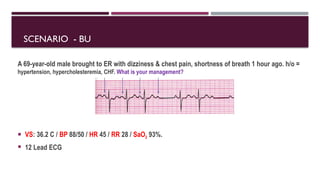
SCENARIO - BU
A 69-year-old male brought to ER with dizziness & chest pain, shortness of breath 1 hour ago. h/o =
hypertension, hypercholesteremia, CHF. What is your management?
 VS: 36.2 C / BP 88/50 / HR 45 / RR 28 / SaO2 93%.
 12 Lead ECG
SESSION 6
Theory & Clinical Practice
• Managements of Tachycardia
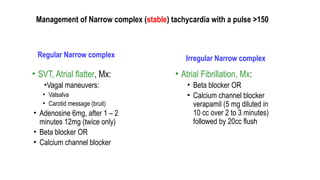
Management of Narrow complex (stable) tachycardia with a pulse >150
Regular Narrow complex
• SVT, Atrial flatter, Mx:
•Vagal maneuvers:
• Valsalva
• Carotid message (bruit)
• Adenosine 6mg, after 1 – 2
minutes 12mg (twice only)
• Beta blocker OR
• Calcium channel blocker
Irregular Narrow complex
• Atrial Fibrillation, Mx:
• Beta blocker OR
• Calcium channel blocker
verapamil (5 mg diluted in
10 cc over 2 to 3 minutes)
followed by 20cc flush
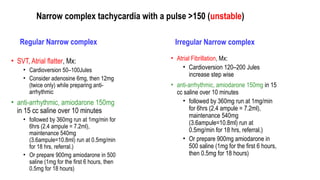
Narrow complex tachycardia with a pulse >150 (unstable)
Regular Narrow complex
• SVT, Atrial flatter, Mx:
• Cardioversion 50–100Jules
• Consider adenosine 6mg, then 12mg
(twice only) while preparing anti-
arrhythmic
• anti-arrhythmic, amiodarone 150mg
in 15 cc saline over 10 minutes
• followed by 360mg run at 1mg/min for
6hrs (2.4 ampule = 7.2ml),
maintenance 540mg
(3.6ampule=10.8ml) run at 0.5mg/min
for 18 hrs, referral.)
• Or prepare 900mg amiodarone in 500
saline (1mg for the first 6 hours, then
0.5mg for 18 hours)
Irregular Narrow complex
• Atrial Fibrillation, Mx:
• Cardioversion 120–200 Jules
increase step wise
• anti-arrhythmic, amiodarone 150mg in 15
cc saline over 10 minutes
• followed by 360mg run at 1mg/min
for 6hrs (2.4 ampule = 7.2ml),
maintenance 540mg
(3.6ampule=10.8ml) run at
0.5mg/min for 18 hrs, referral.)
• Or prepare 900mg amiodarone in
500 saline (1mg for the first 6 hours,
then 0.5mg for 18 hours)
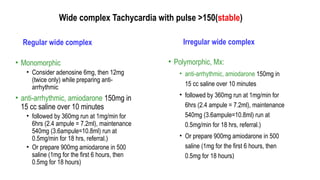
Wide complex Tachycardia with pulse >150(stable)
Regular wide complex
• Monomorphic
• Consider adenosine 6mg, then 12mg
(twice only) while preparing anti-
arrhythmic
• anti-arrhythmic, amiodarone 150mg in
15 cc saline over 10 minutes
• followed by 360mg run at 1mg/min for
6hrs (2.4 ampule = 7.2ml), maintenance
540mg (3.6ampule=10.8ml) run at
0.5mg/min for 18 hrs, referral.)
• Or prepare 900mg amiodarone in 500
saline (1mg for the first 6 hours, then
0.5mg for 18 hours)
Irregular wide complex
• Polymorphic, Mx:
• anti-arrhythmic, amiodarone 150mg in
15 cc saline over 10 minutes
• followed by 360mg run at 1mg/min for
6hrs (2.4 ampule = 7.2ml), maintenance
540mg (3.6ampule=10.8ml) run at
0.5mg/min for 18 hrs, referral.)
• Or prepare 900mg amiodarone in 500
saline (1mg for the first 6 hours, then
0.5mg for 18 hours)
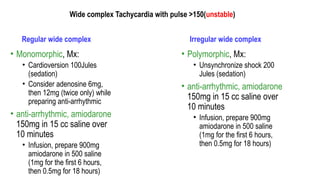
Wide complex Tachycardia with pulse >150(unstable)
Regular wide complex
• Monomorphic, Mx:
• Cardioversion 100Jules
(sedation)
• Consider adenosine 6mg,
then 12mg (twice only) while
preparing anti-arrhythmic
• anti-arrhythmic, amiodarone
150mg in 15 cc saline over
10 minutes
• Infusion, prepare 900mg
amiodarone in 500 saline
(1mg for the first 6 hours,
then 0.5mg for 18 hours)
Irregular wide complex
• Polymorphic, Mx:
• Unsynchronize shock 200
Jules (sedation)
• anti-arrhythmic, amiodarone
150mg in 15 cc saline over
10 minutes
• Infusion, prepare 900mg
amiodarone in 500 saline
(1mg for the first 6 hours,
then 0.5mg for 18 hours)
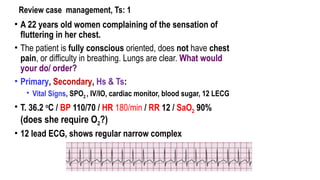
Review case management, Ts: 1
• A 22 years old women complaining of the sensation of
fluttering in her chest.
• The patient is fully conscious oriented, does not have chest
pain, or difficulty in breathing. Lungs are clear. What would
your do/ order?
• Primary, Secondary, Hs & Ts:
• Vital Signs, SPO2 , IV/IO, cardiac monitor, blood sugar, 12 LECG
• T. 36.2 o
C / BP 110/70 / HR 180/min / RR 12 / SaO2 90%
(does she require O2?)
• 12 lead ECG, shows regular narrow complex
What is your management ?
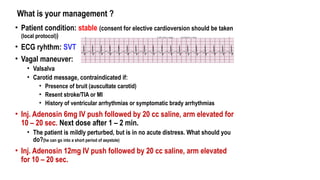
• Patient condition: stable (consent for elective cardioversion should be taken
(local protocol))
• ECG ryhthm: SVT
• Vagal maneuver:
• Valsalva
• Carotid message, contraindicated if:
• Presence of bruit (auscultate carotid)
• Resent stroke/TIA or MI
• History of ventricular arrhythmias or symptomatic brady arrhythmias
• Inj. Adenosin 6mg IV push followed by 20 cc saline, arm elevated for
10 – 20 sec. Next dose after 1 – 2 min.
• The patient is mildly perturbed, but is in no acute distress. What should you
do?(he can go into a short period of asystole)
• Inj. Adenosin 12mg IV push followed by 20 cc saline, arm elevated
for 10 – 20 sec.
T: case 1 stable reg. narrow management Cont’
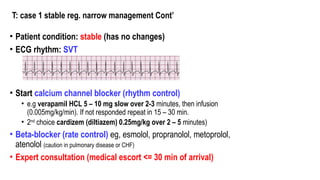
• Patient condition: stable (has no changes)
• ECG rhythm: SVT
• Start calcium channel blocker (rhythm control)
• e.g verapamil HCL 5 – 10 mg slow over 2-3 minutes, then infusion
(0.005mg/kg/min). If not responded repeat in 15 – 30 min.
• 2nd
choice cardizem (diltiazem) 0.25mg/kg over 2 – 5 minutes)
• Beta-blocker (rate control) eg, esmolol, propranolol, metoprolol,
atenolol (caution in pulmonary disease or CHF)
• Expert consultation (medical escort <= 30 min of arrival)
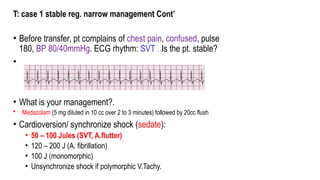
T: case 1 stable reg. narrow management Cont’
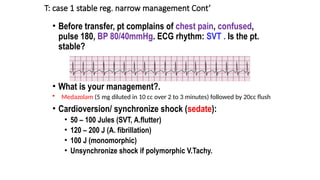
• Before transfer, pt complains of chest pain, confused, pulse
180, BP 80/40mmHg. ECG rhythm: SVT . Is the pt. stable?
•
• What is your management?.
• Medazolam (5 mg diluted in 10 cc over 2 to 3 minutes) followed by 20cc flush
• Cardioversion/ synchronize shock (sedate):
• 50 – 100 Jules (SVT, A.flutter)
• 120 – 200 J (A. fibrillation)
• 100 J (monomorphic)
• Unsynchronize shock if polymorphic V.Tachy.
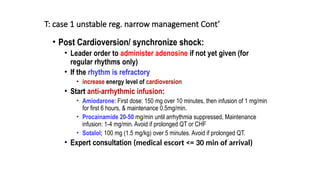
T: case 1 unstable reg. narrow management Cont’
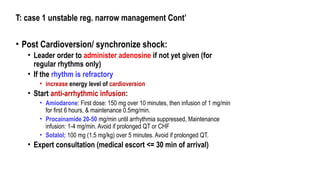
• Post Cardioversion/ synchronize shock:
• Leader order to administer adenosine if not yet given (for
regular rhythms only)
• If the rhythm is refractory
• increase energy level of cardioversion
• Start anti-arrhythmic infusion:
• Amiodarone: First dose: 150 mg over 10 minutes, then infusion of 1 mg/min
for first 6 hours, & maintenance 0.5mg/min.
• Procainamide 20-50 mg/min until arrhythmia suppressed, Maintenance
infusion: 1-4 mg/min. Avoid if prolonged QT or CHF
• Sotalol; 100 mg (1.5 mg/kg) over 5 minutes. Avoid if prolonged QT.
• Expert consultation (medical escort <= 30 min of arrival)
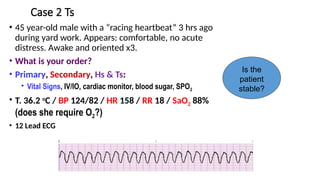
Case 2 Ts
• 45 year-old male with a “racing heartbeat” 3 hrs ago
during yard work. Appears: comfortable, no acute
distress. Awake and oriented x3.
• What is your order?
• Primary, Secondary, Hs & Ts:
• Vital Signs, IV/IO, cardiac monitor, blood sugar, SPO2
• T. 36.2 o
C / BP 124/82 / HR 158 / RR 18 / SaO2 88%
(does she require O2?)
• 12 Lead ECG
Is the
patient
stable?
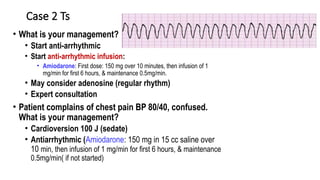
Case 2 Ts
• What is your management?
• Start anti-arrhythmic
• Start anti-arrhythmic infusion:
• Amiodarone: First dose: 150 mg over 10 minutes, then infusion of 1
mg/min for first 6 hours, & maintenance 0.5mg/min.
• May consider adenosine (regular rhythm)
• Expert consultation
• Patient complains of chest pain BP 80/40, confused.
What is your management?
• Cardioversion 100 J (sedate)
• Antiarrhythmic (Amiodarone: 150 mg in 15 cc saline over
10 min, then infusion of 1 mg/min for first 6 hours, & maintenance
0.5mg/min( if not started)
DAY 2
Megacode (Case
Senario)
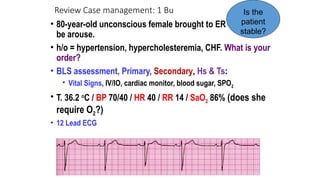
Review Case management: 1 Bu
• 80-year-old unconscious female brought to ER could not
be arouse.
• h/o = hypertension, hypercholesteremia, CHF. What is your
order?
• BLS assessment, Primary, Secondary, Hs & Ts:
• Vital Signs, IV/IO, cardiac monitor, blood sugar, SPO2
• T. 36.2 o
C / BP 70/40 / HR 40 / RR 14 / SaO2 86% (does she
require O2?)
• 12 Lead ECG
Is the
patient
stable?
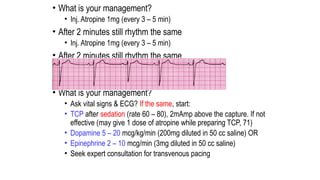
• What is your management?
• Inj. Atropine 1mg (every 3 – 5 min)
• After 2 minutes still rhythm the same
• Inj. Atropine 1mg (every 3 – 5 min)
• After 2 minutes still rhythm the same
• Inj. Atropine 1mg (max. 3mg over)
• What is your management?
• Ask vital signs & ECG? If the same, start:
• TCP after sedation (rate 60 – 80), 2mAmp above the capture. If not
effective (may give 1 dose of atropine while preparing TCP, 71)
• Dopamine 5 – 20 mcg/kg/min (200mg diluted in 50 cc saline) OR
• Epinephrine 2 – 10 mcg/min (3mg diluted in 50 cc saline)
• Seek expert consultation for transvenous pacing
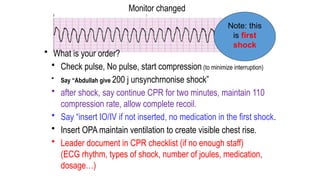
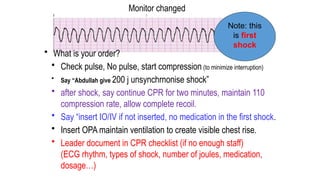
Monitor changed
• What is your order?
• Check pulse, No pulse, start compression (to minimize interruption)
• Say “Abdullah give 200 j unsynchrnonise shock”
• after shock, say continue CPR for two minutes, maintain 110
compression rate, allow complete recoil.
• Say “insert IO/IV if not inserted, no medication in the first shock.
• Insert OPA maintain ventilation to create visible chest rise.
• Leader document in CPR checklist (if no enough staff)
(ECG rhythm, types of shock, number of joules, medication,
dosage…)
Note: this
is first
shock
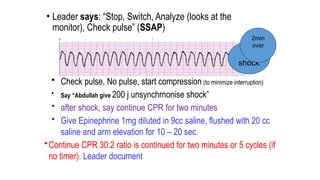
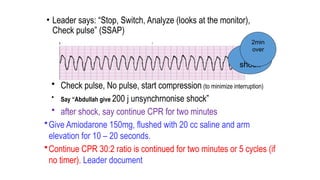
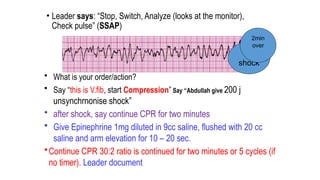
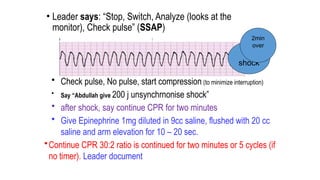
• Leader says: “Stop, Switch, Analyze (looks at the
monitor), Check pulse” (SSAP)
• Check pulse, No pulse, start compression (to minimize interruption)
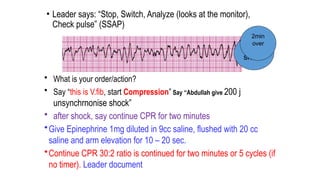
• Say “Abdullah give 200 j unsynchrnonise shock”
• after shock, say continue CPR for two minutes
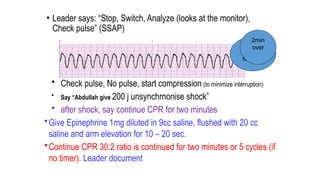
• Give Epinephrine 1mg diluted in 9cc saline, flushed with 20 cc
saline and arm elevation for 10 – 20 sec.
•Continue CPR 30:2 ratio is continued for two minutes or 5 cycles (if
no timer). Leader document
2nd
shock
2min
over
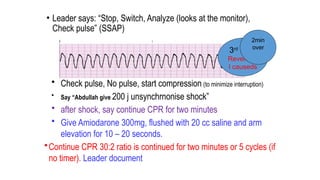
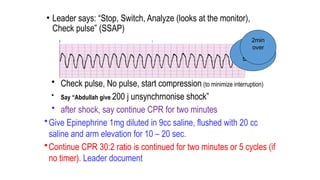
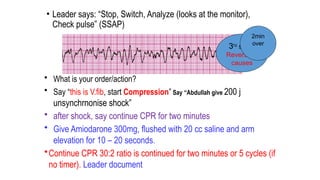
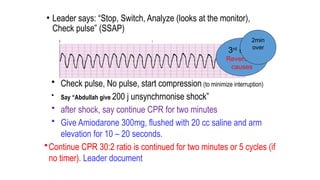
• Leader says: “Stop, Switch, Analyze (looks at the monitor),
Check pulse” (SSAP)
• Check pulse, No pulse, start compression (to minimize interruption)
• Say “Abdullah give 200 j unsynchrnonise shock”
• after shock, say continue CPR for two minutes
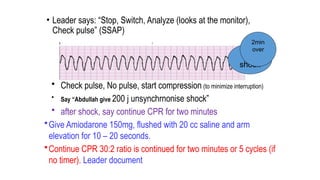
• Give Amiodarone 300mg, flushed with 20 cc saline and arm
elevation for 10 – 20 seconds.
•Continue CPR 30:2 ratio is continued for two minutes or 5 cycles (if
no timer). Leader document
3rd
shock
Reversibe
l causeds
2min
over
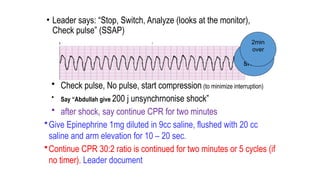
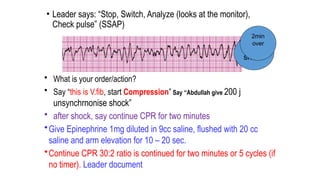
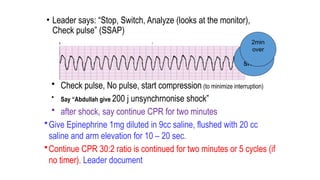
• Leader says: “Stop, Switch, Analyze (looks at the monitor),
Check pulse” (SSAP)
• Check pulse, No pulse, start compression (to minimize interruption)
• Say “Abdullah give 200 j unsynchrnonise shock”
• after shock, say continue CPR for two minutes
•Give Epinephrine 1mg diluted in 9cc saline, flushed with 20 cc
saline and arm elevation for 10 – 20 sec.
•Continue CPR 30:2 ratio is continued for two minutes or 5 cycles (if
no timer). Leader document
4th
shock
2min
over
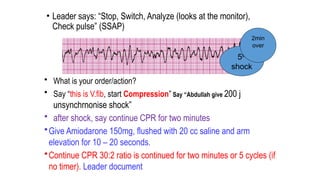
• Leader says: “Stop, Switch, Analyze (looks at the monitor),
Check pulse” (SSAP)
• Check pulse, No pulse, start compression (to minimize interruption)
• Say “Abdullah give 200 j unsynchrnonise shock”
• after shock, say continue CPR for two minutes
•Give Amiodarone 150mg, flushed with 20 cc saline and arm
elevation for 10 – 20 seconds.
•Continue CPR 30:2 ratio is continued for two minutes or 5 cycles (if
no timer). Leader document
5th
shock
2min
over
• Leader says: “Stop, Switch, Analyze (looks at the monitor),
Check pulse” (SSAP)
• Check pulse, No pulse, start compression (to minimize interruption)
• Say “Abdullah give 200 j unsynchrnonise shock”
• after shock, say continue CPR for two minutes
•Give Epinephrine 1mg diluted in 9cc saline, flushed with 20 cc
saline and arm elevation for 10 – 20 sec.
•Continue CPR 30:2 ratio is continued for two minutes or 5 cycles (if
no timer). Leader document
6th
shock
2min
over
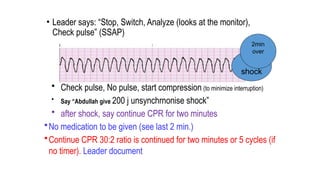
• Leader says: “Stop, Switch, Analyze (looks at the monitor),
Check pulse” (SSAP)
• Check pulse, No pulse, start compression (to minimize interruption)
• Say “Abdullah give 200 j unsynchrnonise shock”
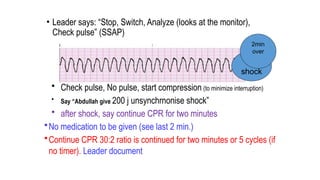
• after shock, say continue CPR for two minutes
•No medication to be given (see last 2 min.)
•Continue CPR 30:2 ratio is continued for two minutes or 5 cycles (if
no timer). Leader document
7th
shock
2min
over
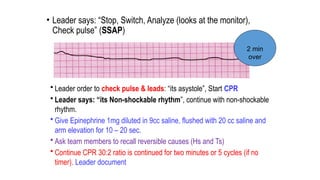
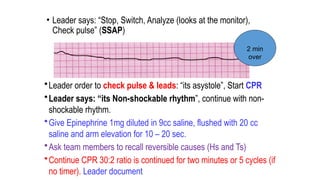
• Leader says: “Stop, Switch, Analyze (looks at the monitor),
Check pulse” (SSAP)
• Leader order to check pulse & leads: “its asystole”, Start CPR
• Leader says: “its Non-shockable rhythm”, continue with non-shockable
rhythm.
• Give Epinephrine 1mg diluted in 9cc saline, flushed with 20 cc saline and
arm elevation for 10 – 20 sec.
• Ask team members to recall reversible causes (Hs and Ts)
• Continue CPR 30:2 ratio is continued for two minutes or 5 cycles (if no
timer). Leader document
2 min
over
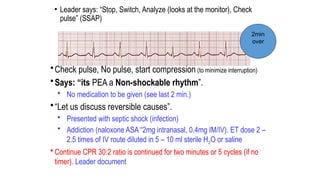
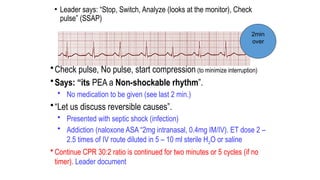
• Leader says: “Stop, Switch, Analyze (looks at the monitor), Check
pulse” (SSAP)
•Check pulse, No pulse, start compression (to minimize interruption)
•Says: “its PEA a Non-shockable rhythm”.
• No medication to be given (see last 2 min.)
•“Let us discuss reversible causes”.
• Presented with septic shock (infection)
• Addiction (naloxone ASA “2mg intranasal, 0.4mg IM/IV). ET dose 2 –
2.5 times of IV route diluted in 5 – 10 ml sterile H2O or saline
• Continue CPR 30:2 ratio is continued for two minutes or 5 cycles (if no
timer). Leader document
2min
over
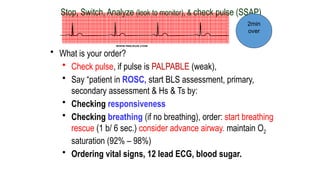
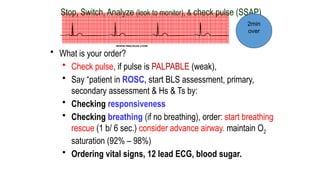
Stop, Switch, Analyze (look to monitor), & check pulse (SSAP)
• What is your order?
• Check pulse, if pulse is PALPABLE (weak),
• Say “patient in ROSC, start BLS assessment, primary,
secondary assessment & Hs & Ts by:
• Checking responsiveness
• Checking breathing (if no breathing), order: start breathing
rescue (1 b/ 6 sec.) consider advance airway. maintain O2
saturation (92% – 98%)
• Ordering vital signs, 12 lead ECG, blood sugar.
2min
over
ROSC achieved …cont’
• Vital Signs (T. 30 o
C, BP 84/42)
• Treat hypotension if SBP <90
• 1 to 2 Liter saline or Lactated ringer
• Vasopressor infusion:
• Epinephrine (2 to 10 mcg per minute)
• Nor-epinephrine (0.1 – 0.5 mcg/kg/min) (patients with severe hypotension (eg,
SBP < 70 mmHg)
• Dopamine (5 - 20 ­
­
­
mcg/kg/min)
ROSC achieved …cont’
• Initiate Targeted Temperature Management (TTM) to
improve neurologic recovery. Consider for any comatose
patient and unresponsive to verbal commands after
ROSC.
(32o
C - 36o
C (89.6o
F & 95.2o
F)
• Call referral hospital, note the name of receiving doctor.
• Medial escort.
Start practice (2)
Go to T
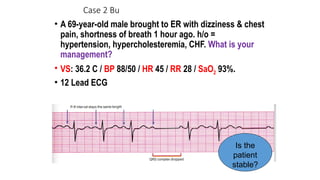
Case 2 Bu
• A 69-year-old male brought to ER with dizziness & chest
pain, shortness of breath 1 hour ago. h/o =
hypertension, hypercholesteremia, CHF. What is your
management?
• VS: 36.2 C / BP 88/50 / HR 45 / RR 28 / SaO2 93%.
• 12 Lead ECG
Is the
patient
stable?
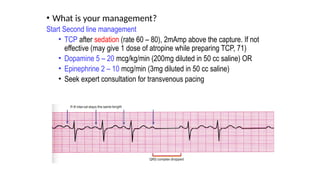
• What is your management?
Start Second line management
• TCP after sedation (rate 60 – 80), 2mAmp above the capture. If not
effective (may give 1 dose of atropine while preparing TCP, 71)
• Dopamine 5 – 20 mcg/kg/min (200mg diluted in 50 cc saline) OR
• Epinephrine 2 – 10 mcg/min (3mg diluted in 50 cc saline)
• Seek expert consultation for transvenous pacing
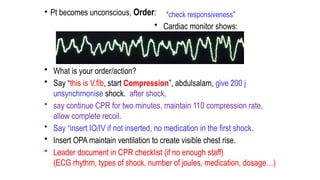
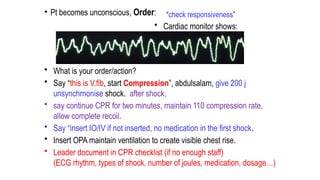
• Pt becomes unconscious, Order:
• What is your order/action?
• Say “this is V.fib, start Compression”, abdulsalam, give 200 j
unsynchrnonise shock. after shock,
• say continue CPR for two minutes, maintain 110 compression rate,
allow complete recoil.
• Say “insert IO/IV if not inserted, no medication in the first shock.
• Insert OPA maintain ventilation to create visible chest rise.
• Leader document in CPR checklist (if no enough staff)
(ECG rhythm, types of shock, number of joules, medication, dosage…)
“check responsiveness”
• Cardiac monitor shows:
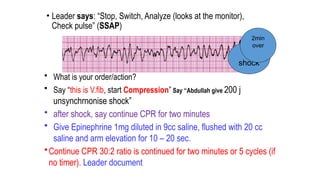
• Leader says: “Stop, Switch, Analyze (looks at the monitor),
Check pulse” (SSAP)
• What is your order/action?
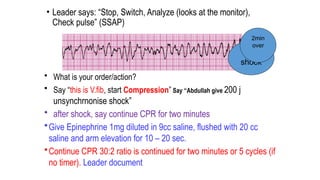
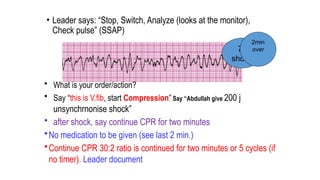
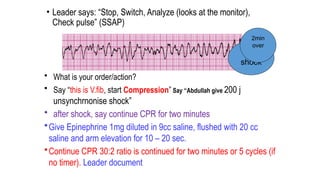
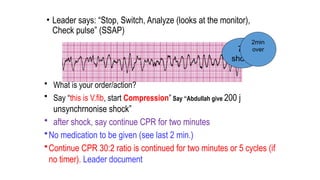
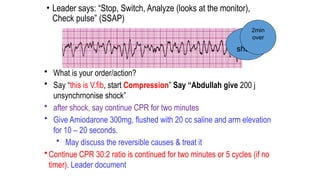
• Say “this is V.fib, start Compression” Say “Abdullah give 200 j
unsynchrnonise shock”
• after shock, say continue CPR for two minutes
• Give Epinephrine 1mg diluted in 9cc saline, flushed with 20 cc
saline and arm elevation for 10 – 20 sec.
•Continue CPR 30:2 ratio is continued for two minutes or 5 cycles (if
no timer). Leader document
2nd
shock
2min
over
• Leader says: “Stop, Switch, Analyze (looks at the monitor),
Check pulse” (SSAP)
• What is your order/action?
• Say “this is V.fib, start Compression” Say “Abdullah give 200 j
unsynchrnonise shock”
• after shock, say continue CPR for two minutes
• Give Amiodarone 300mg, flushed with 20 cc saline and arm
elevation for 10 – 20 seconds.
•Continue CPR 30:2 ratio is continued for two minutes or 5 cycles (if
no timer). Leader document
3rd
shock
Reversible
causes
2min
over
• Leader says: “Stop, Switch, Analyze (looks at the monitor),
Check pulse” (SSAP)
• What is your order/action?
• Say “this is V.fib, start Compression” Say “Abdullah give 200 j
unsynchrnonise shock”
• after shock, say continue CPR for two minutes
•Give Epinephrine 1mg diluted in 9cc saline, flushed with 20 cc
saline and arm elevation for 10 – 20 sec.
•Continue CPR 30:2 ratio is continued for two minutes or 5 cycles (if
no timer). Leader document
4th
shock
2min
over
• Leader says: “Stop, Switch, Analyze (looks at the monitor),
Check pulse” (SSAP)
• What is your order/action?
• Say “this is V.fib, start Compression” Say “Abdullah give 200 j
unsynchrnonise shock”
• after shock, say continue CPR for two minutes
•Give Amiodarone 150mg, flushed with 20 cc saline and arm
elevation for 10 – 20 seconds.
•Continue CPR 30:2 ratio is continued for two minutes or 5 cycles (if
no timer). Leader document
5th
shock
2min
over
• Leader says: “Stop, Switch, Analyze (looks at the monitor),
Check pulse” (SSAP)
• What is your order/action?
• Say “this is V.fib, start Compression” Say “Abdullah give 200 j
unsynchrnonise shock”
• after shock, say continue CPR for two minutes
•Give Epinephrine 1mg diluted in 9cc saline, flushed with 20 cc
saline and arm elevation for 10 – 20 sec.
•Continue CPR 30:2 ratio is continued for two minutes or 5 cycles (if
no timer). Leader document
6th
shock
2min
over
• Leader says: “Stop, Switch, Analyze (looks at the monitor),
Check pulse” (SSAP)
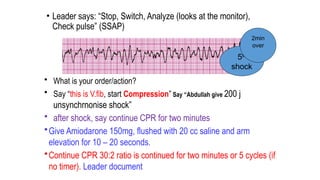
• What is your order/action?
• Say “this is V.fib, start Compression” Say “Abdullah give 200 j
unsynchrnonise shock”
• after shock, say continue CPR for two minutes
•No medication to be given (see last 2 min.)
•Continue CPR 30:2 ratio is continued for two minutes or 5 cycles (if
no timer). Leader document
7th
shock
2min
over
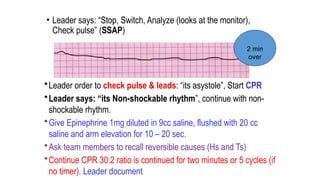
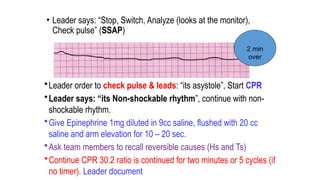
• Leader says: “Stop, Switch, Analyze (looks at the monitor),
Check pulse” (SSAP)
•Leader order to check pulse & leads: “its asystole”, Start CPR
•Leader says: “its Non-shockable rhythm”, continue with non-
shockable rhythm.
•Give Epinephrine 1mg diluted in 9cc saline, flushed with 20 cc
saline and arm elevation for 10 – 20 sec.
•Ask team members to recall reversible causes (Hs and Ts)
•Continue CPR 30:2 ratio is continued for two minutes or 5 cycles (if
no timer). Leader document
2 min
over
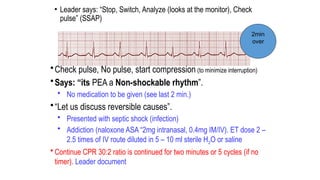
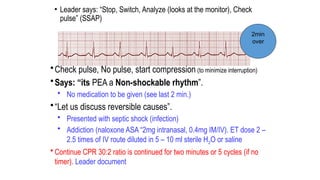
• Leader says: “Stop, Switch, Analyze (looks at the monitor), Check
pulse” (SSAP)
•Check pulse, No pulse, start compression (to minimize interruption)
•Says: “its PEA a Non-shockable rhythm”.
• No medication to be given (see last 2 min.)
•“Let us discuss reversible causes”.
• Presented with septic shock (infection)
• Addiction (naloxone ASA “2mg intranasal, 0.4mg IM/IV). ET dose 2 –
2.5 times of IV route diluted in 5 – 10 ml sterile H2O or saline
• Continue CPR 30:2 ratio is continued for two minutes or 5 cycles (if no
timer). Leader document
2min
over
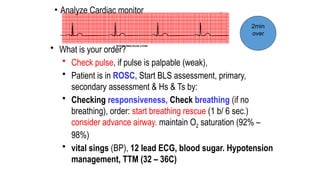
• Analyze Cardiac monitor
• What is your order?
• Check pulse, if pulse is palpable (weak),
• Patient is in ROSC, Start BLS assessment, primary,
secondary assessment & Hs & Ts by:
• Checking responsiveness, Check breathing (if no
breathing), order: start breathing rescue (1 b/ 6 sec.)
consider advance airway. maintain O2 saturation (92% –
98%)
• vital sings (BP), 12 lead ECG, blood sugar. Hypotension
management, TTM (32 – 36C)
2min
over
Next Case (B 3)
Go to T
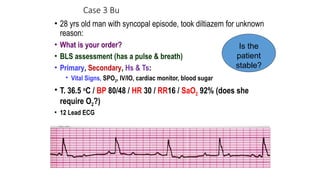
Case 3 Bu
• 28 yrs old man with syncopal episode, took diltiazem for unknown
reason:
• What is your order?
• BLS assessment (has a pulse & breath)
• Primary, Secondary, Hs & Ts:
• Vital Signs, SPO2, IV/IO, cardiac monitor, blood sugar
• T. 36.5 o
C / BP 80/48 / HR 30 / RR16 / SaO2 92% (does she
require O2?)
• 12 Lead ECG
Is the
patient
stable?
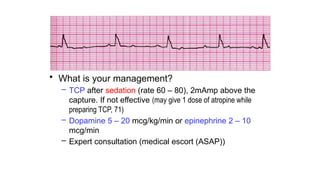
• What is your management?
– TCP after sedation (rate 60 – 80), 2mAmp above the
capture. If not effective (may give 1 dose of atropine while
preparing TCP, 71)
– Dopamine 5 – 20 mcg/kg/min or epinephrine 2 – 10
mcg/min
– Expert consultation (medical escort (ASAP))
Monitor changed
• What is your order?
• Check pulse, No pulse, start compression (to minimize interruption)
• Say “Abdullah give 200 j unsynchrnonise shock”
• after shock, say continue CPR for two minutes, maintain 110
compression rate, allow complete recoil.
• Say “insert IO/IV if not inserted, no medication in the first shock.
• Insert OPA maintain ventilation to create visible chest rise.
• Leader document in CPR checklist (if no enough staff)
(ECG rhythm, types of shock, number of joules, medication,
dosage…)
Note: this
is first
shock
• Leader says: “Stop, Switch, Analyze (looks at the
monitor), Check pulse” (SSAP)
• Check pulse, No pulse, start compression (to minimize interruption)
• Say “Abdullah give 200 j unsynchrnonise shock”
• after shock, say continue CPR for two minutes
• Give Epinephrine 1mg diluted in 9cc saline, flushed with 20 cc
saline and arm elevation for 10 – 20 sec.
•Continue CPR 30:2 ratio is continued for two minutes or 5 cycles (if
no timer). Leader document
2nd
shock
2min
over
• Leader says: “Stop, Switch, Analyze (looks at the monitor),
Check pulse” (SSAP)
• Check pulse, No pulse, start compression (to minimize interruption)
• Say “Abdullah give 200 j unsynchrnonise shock”
• after shock, say continue CPR for two minutes
• Give Amiodarone 300mg, flushed with 20 cc saline and arm
elevation for 10 – 20 seconds.
•Continue CPR 30:2 ratio is continued for two minutes or 5 cycles (if
no timer). Leader document
3rd
shock
Reversible
causes
2min
over
• Leader says: “Stop, Switch, Analyze (looks at the monitor),
Check pulse” (SSAP)
• Check pulse, No pulse, start compression (to minimize interruption)
• Say “Abdullah give 200 j unsynchrnonise shock”
• after shock, say continue CPR for two minutes
•Give Epinephrine 1mg diluted in 9cc saline, flushed with 20 cc
saline and arm elevation for 10 – 20 sec.
•Continue CPR 30:2 ratio is continued for two minutes or 5 cycles (if
no timer). Leader document
4th
shock
2min
over
• Leader says: “Stop, Switch, Analyze (looks at the monitor),
Check pulse” (SSAP)
• Check pulse, No pulse, start compression (to minimize interruption)
• Say “Abdullah give 200 j unsynchrnonise shock”
• after shock, say continue CPR for two minutes
•Give Amiodarone 150mg, flushed with 20 cc saline and arm
elevation for 10 – 20 seconds.
•Continue CPR 30:2 ratio is continued for two minutes or 5 cycles (if
no timer). Leader document
5th
shock
2min
over
• Leader says: “Stop, Switch, Analyze (looks at the monitor),
Check pulse” (SSAP)
• Check pulse, No pulse, start compression (to minimize interruption)
• Say “Abdullah give 200 j unsynchrnonise shock”
• after shock, say continue CPR for two minutes
•Give Epinephrine 1mg diluted in 9cc saline, flushed with 20 cc
saline and arm elevation for 10 – 20 sec.
•Continue CPR 30:2 ratio is continued for two minutes or 5 cycles (if
no timer). Leader document
6th
shock
2min
over
• Leader says: “Stop, Switch, Analyze (looks at the monitor),
Check pulse” (SSAP)
• Check pulse, No pulse, start compression (to minimize interruption)
• Say “Abdullah give 200 j unsynchrnonise shock”
• after shock, say continue CPR for two minutes
•No medication to be given (see last 2 min.)
•Continue CPR 30:2 ratio is continued for two minutes or 5 cycles (if
no timer). Leader document
7th
shock
2min
over
• Leader says: “Stop, Switch, Analyze (looks at the monitor),
Check pulse” (SSAP)
•Leader order to check pulse & leads: “its asystole”, Start CPR
•Leader says: “its Non-shockable rhythm”, continue with non-
shockable rhythm.
•Give Epinephrine 1mg diluted in 9cc saline, flushed with 20 cc
saline and arm elevation for 10 – 20 sec.
•Ask team members to recall reversible causes (Hs and Ts)
•Continue CPR 30:2 ratio is continued for two minutes or 5 cycles (if
no timer). Leader document
2 min
over
• Leader says: “Stop, Switch, Analyze (looks at the monitor), Check
pulse” (SSAP)
•Check pulse, No pulse, start compression (to minimize interruption)
•Says: “its PEA a Non-shockable rhythm”.
• No medication to be given (see last 2 min.)
•“Let us discuss reversible causes”.
• Presented with septic shock (infection)
• Addiction (naloxone ASA “2mg intranasal, 0.4mg IM/IV). ET dose 2 –
2.5 times of IV route diluted in 5 – 10 ml sterile H2O or saline
• Continue CPR 30:2 ratio is continued for two minutes or 5 cycles (if no
timer). Leader document
2min
over
Stop, Switch, Analyze (look to monitor), & check pulse (SSAP)
• What is your order?
• Check pulse, if pulse is PALPABLE (weak),
• Say “patient in ROSC, start BLS assessment, primary,
secondary assessment & Hs & Ts by:
• Checking responsiveness
• Checking breathing (if no breathing), order: start breathing
rescue (1 b/ 6 sec.) consider advance airway. maintain O2
saturation (92% – 98%)
• Ordering vital signs, 12 lead ECG, blood sugar.
2min
over
ROSC achieved …cont’
• Vital Signs (T. 30 o
C, BP 84/42)
• Treat hypotension if SBP <90
• 1 to 2 Liter saline or Lactated ringer
• Vasopressor infusion:
• Epinephrine (2 to 10 mcg per minute)
• Nor-epinephrine (0.1 – 0.5 mcg/kg/min) (patients with severe hypotension (eg,
SBP < 70 mmHg)
• Dopamine (5 - 20 ­
­
­
mcg/kg/min)
ROSC achieved …cont’
• Initiate Targeted Temperature Management (TTM) to
improve neurologic recovery. Consider for any comatose
patient and unresponsive to verbal commands after
ROSC.
(32o
C - 36o
C (89.6o
F & 95.2o
F)
• Call referral hospital, note the name of receiving doctor.
• Medial escort.
Start practice (T1)
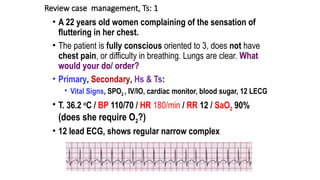
Review case management, Ts: 1
• A 22 years old women complaining of the sensation of
fluttering in her chest.
• The patient is fully conscious oriented to 3, does not have
chest pain, or difficulty in breathing. Lungs are clear. What
would your do/ order?
• Primary, Secondary, Hs & Ts:
• Vital Signs, SPO2 , IV/IO, cardiac monitor, blood sugar, 12 LECG
• T. 36.2 o
C / BP 110/70 / HR 180/min / RR 12 / SaO2 90%
(does she require O2?)
• 12 lead ECG, shows regular narrow complex
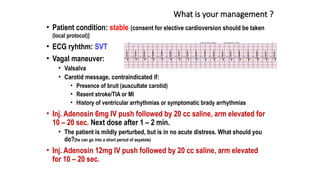
What is your management ?
• Patient condition: stable (consent for elective cardioversion should be taken
(local protocol))
• ECG ryhthm: SVT
• Vagal maneuver:
• Valsalva
• Carotid message, contraindicated if:
• Presence of bruit (auscultate carotid)
• Resent stroke/TIA or MI
• History of ventricular arrhythmias or symptomatic brady arrhythmias
• Inj. Adenosin 6mg IV push followed by 20 cc saline, arm elevated for
10 – 20 sec. Next dose after 1 – 2 min.
• The patient is mildly perturbed, but is in no acute distress. What should you
do?(he can go into a short period of asystole)
• Inj. Adenosin 12mg IV push followed by 20 cc saline, arm elevated
for 10 – 20 sec.
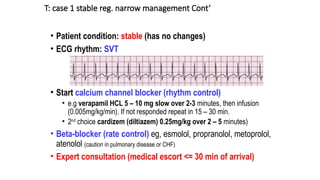
T: case 1 stable reg. narrow management Cont’
• Patient condition: stable (has no changes)
• ECG rhythm: SVT
• Start calcium channel blocker (rhythm control)
• e.g verapamil HCL 5 – 10 mg slow over 2-3 minutes, then infusion
(0.005mg/kg/min). If not responded repeat in 15 – 30 min.
• 2nd
choice cardizem (diltiazem) 0.25mg/kg over 2 – 5 minutes)
• Beta-blocker (rate control) eg, esmolol, propranolol, metoprolol,
atenolol (caution in pulmonary disease or CHF)
• Expert consultation (medical escort <= 30 min of arrival)
T: case 1 stable reg. narrow management Cont’
• Before transfer, pt complains of chest pain, confused,
pulse 180, BP 80/40mmHg. ECG rhythm: SVT . Is the pt.
stable?
• What is your management?.
• Medazolam (5 mg diluted in 10 cc over 2 to 3 minutes) followed by 20cc flush
• Cardioversion/ synchronize shock (sedate):
• 50 – 100 Jules (SVT, A.flutter)
• 120 – 200 J (A. fibrillation)
• 100 J (monomorphic)
• Unsynchronize shock if polymorphic V.Tachy.
T: case 1 unstable reg. narrow management Cont’
• Post Cardioversion/ synchronize shock:
• Leader order to administer adenosine if not yet given (for
regular rhythms only)
• If the rhythm is refractory
• increase energy level of cardioversion
• Start anti-arrhythmic infusion:
• Amiodarone: First dose: 150 mg over 10 minutes, then infusion of 1 mg/min
for first 6 hours, & maintenance 0.5mg/min.
• Procainamide 20-50 mg/min until arrhythmia suppressed, Maintenance
infusion: 1-4 mg/min. Avoid if prolonged QT or CHF
• Sotalol; 100 mg (1.5 mg/kg) over 5 minutes. Avoid if prolonged QT.
• Expert consultation (medical escort <= 30 min of arrival)
• Pt becomes unconscious, Order:
• What is your order/action?
• Say “this is V.fib, start Compression”, abdulsalam, give 200 j
unsynchrnonise shock. after shock,
• say continue CPR for two minutes, maintain 110 compression rate,
allow complete recoil.
• Say “insert IO/IV if not inserted, no medication in the first shock.
• Insert OPA maintain ventilation to create visible chest rise.
• Leader document in CPR checklist (if no enough staff)
(ECG rhythm, types of shock, number of joules, medication, dosage…)
“check responsiveness”
• Cardiac monitor shows:
• Leader says: “Stop, Switch, Analyze (looks at the monitor),
Check pulse” (SSAP)
• What is your order/action?
• Say “this is V.fib, start Compression” Say “Abdullah give 200 j
unsynchrnonise shock”
• after shock, say continue CPR for two minutes
• Give Epinephrine 1mg diluted in 9cc saline, flushed with 20 cc
saline and arm elevation for 10 – 20 sec.
•Continue CPR 30:2 ratio is continued for two minutes or 5 cycles (if
no timer). Leader document
2nd
shock
2min
over
• Leader says: “Stop, Switch, Analyze (looks at the monitor),
Check pulse” (SSAP)
• What is your order/action?
• Say “this is V.fib, start Compression” Say “Abdullah give 200 j
unsynchrnonise shock”
• after shock, say continue CPR for two minutes
• Give Amiodarone 300mg, flushed with 20 cc saline and arm elevation
for 10 – 20 seconds.
• May discuss the reversible causes & treat it
• Continue CPR 30:2 ratio is continued for two minutes or 5 cycles (if no
timer). Leader document
3rd
shock
2min
over
• Leader says: “Stop, Switch, Analyze (looks at the monitor),
Check pulse” (SSAP)
• What is your order/action?
• Say “this is V.fib, start Compression” Say “Abdullah give 200 j
unsynchrnonise shock”
• after shock, say continue CPR for two minutes
•Give Epinephrine 1mg diluted in 9cc saline, flushed with 20 cc
saline and arm elevation for 10 – 20 sec.
•Continue CPR 30:2 ratio is continued for two minutes or 5 cycles (if
no timer). Leader document
4th
shock
2min
over
• Leader says: “Stop, Switch, Analyze (looks at the monitor),
Check pulse” (SSAP)
• What is your order/action?
• Say “this is V.fib, start Compression” Say “Abdullah give 200 j
unsynchrnonise shock”
• after shock, say continue CPR for two minutes
•Give Amiodarone 150mg, flushed with 20 cc saline and arm
elevation for 10 – 20 seconds.
•Continue CPR 30:2 ratio is continued for two minutes or 5 cycles (if
no timer). Leader document
5th
shock
2min
over
• Leader says: “Stop, Switch, Analyze (looks at the monitor),
Check pulse” (SSAP)
• What is your order/action?
• Say “this is V.fib, start Compression” Say “Abdullah give 200 j
unsynchrnonise shock”
• after shock, say continue CPR for two minutes
•Give Epinephrine 1mg diluted in 9cc saline, flushed with 20 cc
saline and arm elevation for 10 – 20 sec.
•Continue CPR 30:2 ratio is continued for two minutes or 5 cycles (if
no timer). Leader document
6th
shock
2min
over
• Leader says: “Stop, Switch, Analyze (looks at the monitor),
Check pulse” (SSAP)
• What is your order/action?
• Say “this is V.fib, start Compression” Say “Abdullah give 200 j
unsynchrnonise shock”
• after shock, say continue CPR for two minutes
•No medication to be given (see last 2 min.)
•Continue CPR 30:2 ratio is continued for two minutes or 5 cycles (if
no timer). Leader document
7th
shock
2min
over
• Leader says: “Stop, Switch, Analyze (looks at the monitor),
Check pulse” (SSAP)
•Leader order to check pulse & leads: “its asystole”, Start CPR
•Leader says: “its Non-shockable rhythm”, continue with non-
shockable rhythm.
•Give Epinephrine 1mg diluted in 9cc saline, flushed with 20 cc
saline and arm elevation for 10 – 20 sec.
•Ask team members to recall reversible causes (Hs and Ts)
•Continue CPR 30:2 ratio is continued for two minutes or 5 cycles (if
no timer). Leader document
2 min
over
• Leader says: “Stop, Switch, Analyze (looks at the monitor), Check
pulse” (SSAP)
•Check pulse, No pulse, start compression (to minimize interruption)
•Says: “its PEA a Non-shockable rhythm”.
• No medication to be given (see last 2 min.)
•“Let us discuss reversible causes”.
• Presented with septic shock (infection)
• Addiction (naloxone ASA “2mg intranasal, 0.4mg IM/IV). ET dose 2 –
2.5 times of IV route diluted in 5 – 10 ml sterile H2O or saline
• Continue CPR 30:2 ratio is continued for two minutes or 5 cycles (if no
timer). Leader document
2min
over
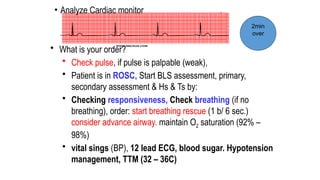
• Analyze Cardiac monitor
• What is your order?
• Check pulse, if pulse is palpable (weak),
• Patient is in ROSC, Start BLS assessment, primary,
secondary assessment & Hs & Ts by:
• Checking responsiveness, Check breathing (if no
breathing), order: start breathing rescue (1 b/ 6 sec.)
consider advance airway. maintain O2 saturation (92% –
98%)
• vital sings (BP), 12 lead ECG, blood sugar. Hypotension
management, TTM (32 – 36C)
2min
over
Next Case (T)
Go to B2
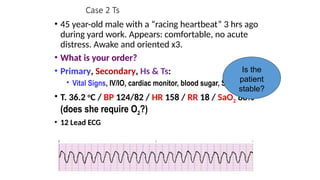
Case 2 Ts
• 45 year-old male with a “racing heartbeat” 3 hrs ago
during yard work. Appears: comfortable, no acute
distress. Awake and oriented x3.
• What is your order?
• Primary, Secondary, Hs & Ts:
• Vital Signs, IV/IO, cardiac monitor, blood sugar, SPO2
• T. 36.2 o
C / BP 124/82 / HR 158 / RR 18 / SaO2 88%
(does she require O2?)
• 12 Lead ECG
Is the
patient
stable?
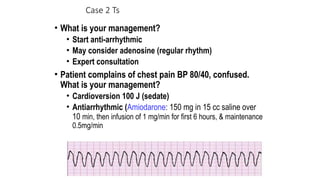
Case 2 Ts
• What is your management?
• Start anti-arrhythmic
• May consider adenosine (regular rhythm)
• Expert consultation
• Patient complains of chest pain BP 80/40, confused.
What is your management?
• Cardioversion 100 J (sedate)
• Antiarrhythmic (Amiodarone: 150 mg in 15 cc saline over
10 min, then infusion of 1 mg/min for first 6 hours, & maintenance
0.5mg/min
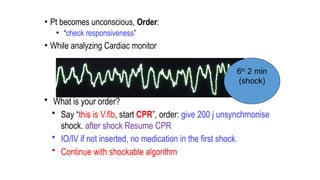
• Pt becomes unconscious, Order:
• “check responsiveness”
• While analyzing Cardiac monitor
• What is your order?
• Say “this is V.fib, start CPR”, order: give 200 j unsynchrnonise
shock. after shock Resume CPR
• IO/IV if not inserted, no medication in the first shock.
• Continue with shockable algorithm
First 2
min
(shock
2nd
2 min
(shock)
3rd
2 min
(shock)
Reversible
causes
4th
2 min
(shock)
5th
2 min
(shock)
6th
2 min
(shock)
• Leader says: “Stop, Switch, Analyze (looks at the monitor),
Check pulse” (SSAP)
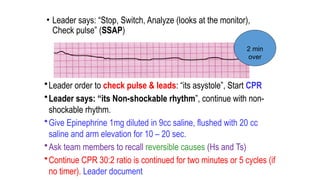
•Leader order to check pulse & leads: “its asystole”, Start CPR
•Leader says: “its Non-shockable rhythm”, continue with non-
shockable rhythm.
•Give Epinephrine 1mg diluted in 9cc saline, flushed with 20 cc
saline and arm elevation for 10 – 20 sec.
•Ask team members to recall reversible causes (Hs and Ts)
•Continue CPR 30:2 ratio is continued for two minutes or 5 cycles (if
no timer). Leader document
2 min
over
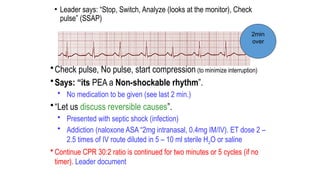
• Leader says: “Stop, Switch, Analyze (looks at the monitor), Check
pulse” (SSAP)
•Check pulse, No pulse, start compression (to minimize interruption)
•Says: “its PEA a Non-shockable rhythm”.
• No medication to be given (see last 2 min.)
•“Let us discuss reversible causes”.
• Presented with septic shock (infection)
• Addiction (naloxone ASA “2mg intranasal, 0.4mg IM/IV). ET dose 2 –
2.5 times of IV route diluted in 5 – 10 ml sterile H2O or saline
• Continue CPR 30:2 ratio is continued for two minutes or 5 cycles (if no
timer). Leader document
2min
over
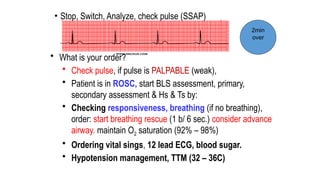
• Stop, Switch, Analyze, check pulse (SSAP)
• What is your order?
• Check pulse, if pulse is PALPABLE (weak),
• Patient is in ROSC, start BLS assessment, primary,
secondary assessment & Hs & Ts by:
• Checking responsiveness, breathing (if no breathing),
order: start breathing rescue (1 b/ 6 sec.) consider advance
airway. maintain O2 saturation (92% – 98%)
• Ordering vital sings, 12 lead ECG, blood sugar.
• Hypotension management, TTM (32 – 36C)
2min
over
End
Next Case
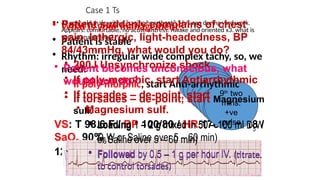
VS: T 98.6 F / BP 100/80 / HR 176 / RR 18 /
SaO2 90%
12 lead ECG
Case 1 Ts
• 45 year-old male with a “racing heartbeat” 1 hrs ago during yard work.
Appears: comfortable, no acute distress. Awake and oriented x3. what is
your management?
Is the
patient
stable?
1st
two
mins.
2nd
two
mins.
3rd
two
mins.
4th
two
mins.
5th
two
mins.
6th
two
mins.
7th
two
mins.
8th
two
mins.
Discuss reversible
causes
9th
two
mins.
+ve
pulse
• What is your management?
• Patient is stable
• Rhythm: irregular wide complex tachy, so, we
need:
• If poly-morphic, start Anti-arrhythmic
• If torsades – de-point, start Magnesium
sulf.
• Loading 1 – 2 g mixed in 50 – 100 ml D5W
or Saline over 5 – 60 min)
• Followed by 0.5 – 1 g per hour IV. (titrate
to control torsades)
• Patient suddenly complains of chest
pain, lethergic, light-headedness, BP
84/43mmHg, what would you do?
• 200J Unsynchronize shock
• If poly-morphic, start Antiarrhythmic
• If torsades – de-point, start
• Magnesium sulf.
• Loading 1 – 2 g mixed in 50 – 100 ml
D5W or Saline over 5 – 60 min)
• Followed by 0.5 – 1 g per hour IV. (titrate
to control torsades)
• Patient becomes unconscious, what
would you do?
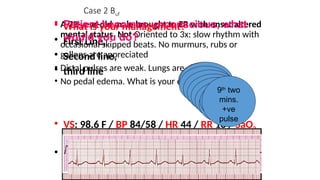
• VS: 98.6 F / BP 84/58 / HR 44 / RR 18 / SaO2
90%
• 12 lead ECG
Case 2 Buf
• A 72-year-old male brought to ER with onset altered
mental status. Not Oriented to 3x: slow rhythm with
occasional skipped beats. No murmurs, rubs or
gallops are appreciated
• Distal pulses are weak. Lungs are clear
• No pedal edema. What is your order?
Is the
patient
stable?
1st
two
mins.
2nd
two
mins.
3rd
two
mins.
4th
two
mins.
5th
two
mins.
6th
two
mins.
7th
two
mins.
Discuss reversible
causes
8th
two
mins.
Discuss reversible
causes
9th
two
mins.
+ve
pulse
• What is your management?
• First Line,
• Second line,
• third line
• Patient becomes unconscious, what
would you do?
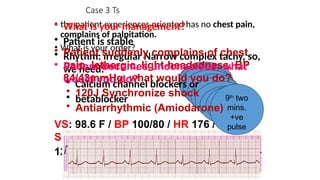
VS: 98.6 F / BP 100/80 / HR 176 / RR 18 /
SaO2 90%
12 lead ECG
Case 3 Ts
• the patient experiences oriented has no chest pain,
complains of palpitation.
• What is your order?
Is the
patient
stable?
1st
two
mins.
2nd
two
mins.
3rd
two
mins.
4th
two
mins.
5th
two
mins.
6th
two
mins.
7th
two
mins.
Discuss reversible
causes
8th
two
mins.
Discuss reversible
causes
9th
two
mins.
+ve
pulse
• What is your management?
• Patient is stable
• Rhythm: irregular Narrow complex tachy, so,
we need:
• Calcium channel blockers or
• betablocker
• Patient suddenly complains of chest
pain, lethergic, light-headedness, BP
84/43mmHg, what would you do?
• 120J Synchronize shock
• Antiarrhythmic (Amiodarone)
• Patient becomes unconscious, what
would you do?
VS: 98.6 F / BP 84/58 / HR 44 / RR 18 /
SaO2 90%
12 lead ECG
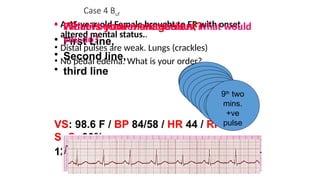
Case 4 Buf
• A 45-year-old Female brought to ER with onset
altered mental status..
• Distal pulses are weak. Lungs (crackles)
• No pedal edema. What is your order?
Is the
patient
stable?
1st
two
mins.
2nd
two
mins.
3rd
two
mins.
4th
two
mins.
5th
two
mins.
6th
two
mins.
7th
two
mins.
Discuss reversible
causes
8th
two
mins.
Discuss reversible
causes
9th
two
mins.
+ve
pulse
• What is your management?
• First Line,
• Second line,
• third line
• Patient becomes unconscious, what would
you do?
Notes:
• antiarrythmic drugs:
• Amiodarone 150 mg over 10 minutes
• Procainamide
• Sotalol
• Expert consultation (medical escort (ASAP))
• Before cardiversion take a consent, sedate the patient,
be ready for CPR, cover patient arms with towels to
prevent injury.
Cases with experience:
• Since the age of 39 a physician had atrial flutter, but he
prefferes to have synchronize shock and go home
(despite stable)
• Expert consultation (medical escort (ASAP))

Advanced Cardiovascular Life Support (ACLS) Final.pptx

  • 1.
  • 2.
    SESSION 1 Practice: (1participant is a CPR-coach while the other is practicing) • Adult BLS with AED and rescue breathing • Infant BLS (1 & 2 rescuer)
  • 4.
  • 5.
    SESSION 2 Practice: • OPAor NPA • LMA and fixing it • ETT • Page Mask Device • Rescue breathing (can be performed during ROSC)
  • 6.
    SESSION 3 Theory • AcuteCoronary Syndrome • Stroke
  • 7.
    SESSION 3 -ACUTE CORONARY SYNDROME
  • 8.
    SESSION 3 -ACUTE CORONARY SYNDROME Diagnosis of MI
  • 9.
    SESSION 3 -ACUTE CORONARY SYNDROME Diagnosis of MI
  • 10.
    SESSION 3 -ACUTE CORONARY SYNDROME
  • 11.
    ANOTHER MANAGEMENT OFACS  Clopidogrel 75mg (coated) (given 300 (4tab)  Friendly with stomach and good absorption.  Oxygen: If SPO2 <90 (4 L/min. max. nasal)  Low molecular heparine 4000 iu (40mg)  3000 IU (30 mg) IV If it is STEMI, after the above administer:  Reteplase over 2 minutes  Second dose after 30 minutes.
  • 12.
    REMEMBER  be calm Start with simple management  Call for second opinion (if needed)  You may need to teach colleagues:  How to take  Right-sided ECG  Posterior ECG is when there is st depression, positive t wave, wide R wave in v1, v2, v3
  • 13.
  • 14.
    SESSION 3 :STROKE StrokeCare (8 Ds) Detection: rapid recognition of symptoms Dispatch: early activation and dispatch Delivery: rapid EMS identification, management, and transport. Door: appropriate triage to stroke center. Data: rapid triage, evaluation, and management within ED (10 minutes) Decision: therapy selection Drug/Device: Fibrinolytic or endovascular therapy. Disposition: admission to the stroke unit
  • 15.
    • Immediate generalassessment within 10 minutes, urgent non-contrast CT • Neurological assessment and acquisition of CT of the head within 20 minutes of arrival • Interpretation of NCCT and MRI within 45 minutes of arrival to ED • Administration of fibrinolytic (rtPA) therapy within 60 minutes (1 hour) of arrival to ED and within 3 hours from the onset of symptoms or 4.5 hours in selected patients. • No anticoagulants or anti-platelet treatment (Aspirin) for 24 hours. Aggressively monitor BP and neurologic deterioration post rtPA. MANAGEMENTS OF STROKE IN PHC
  • 16.
  • 17.
    • Inj. MagnesiumSulphate: • Cardiac arrest due to hypomagnesemia or Torsades de point (1 – 2 g (2 – 4 ml) diluted in 10cc D5W or saline) given after the third shock • Torsades de pointes with a pulse or AMI with hypomagnesemia • Loading 1 – 2 g mixed in 50 – 100 ml D5W or Saline over 5 – 60 min) • Followed by 0.5 – 1 g per hour IV. (titrate to control torsades) • Inj. Nor-epinephrine: continuous infusion: 0.1 – 0.5 mcg/kg/min • Procedure: (4 mg/4m diluted in 46 cc Saline (total 50 cc) 0.2XkgXmin X volume (50c) / (divided by) 4 (stock) X 1000 (covert mcg) • Inj. Dopamine (5 – 20 mcg/kg/min): NOT mixed with Sodium Bicarbonate. • Procedure: (200 mg/5mL diluted in 45 cc Saline (total 50 cc) 5XkgXmin X volume (50c) / (divided by) 200 (stock) X 1000
  • 18.
    • Aspirin (non-enteric-coatedchewable) – 162 to 325 mg – Contraindicated • Adenosine – 6 mg after 1 – 2 min, 12 mg except if the patient is on: • dipyridamole or carbamazepine then the initial dose is 3 mg. – Contraindicated • Asthma, COPD it will cause bronchospasm • Narrow irregular (Atrial Fibrillation/ Atrial fulter (sometimes)
  • 19.
    • Medication needsdilution before given IV: – Inj. Verapamil (calcium channel blocker): • 5mg diluted in 10 cc and given over 2 – 3 (3 for geriatric) minutes. • 10mg in 10cc If no response repeated it after 30 minutes • initiate a 0.005 mg/kg/minute continuous IV infusion – Inj. Epinephrine (1mg (if 1:1000) diluted in 9 cc saline) fast every 3 – 5 minutes. (in shockable rhythm, give it in 2nd shock, 4th , 6th , … ect • Pregnant women arrest & on Magnesium (stop it): – Give Calcium gluconate/chloride • Note: Calcium and sodium bicarb shouldn’t be given in the same IV line. – If no ROSC in 5 min consider cesarian (C – section) • LVAD; can present as pseudo PEA – Listen for hum or alarms, assess perfusion status, contact manufacturer
  • 20.
    SESSION 4 Theory &Clinical Practice • Managements of Bradycardia
  • 24.
    Practice pre-arrest rhythms •Bradycardia, pulse rate <50 – Compare the rhythm with the following elements to identify whether the patient is stable or unstable to start your management (ask yourself): • Is patient pulse <50? • Is SPO2 between 95% – 98%? • Has the patient got altered mental status? • Has the patient got hypotension? • Has the patient got Ischemic chest discomfort? • Has the patient got sings of shock? • Has the patient got Acute heart failure?
  • 26.
    MANAGEMENTS OF BRADYCARDIA •First line management:Atropine 1mg, repeated every 3 – 5 minutes (max 3 doses 3mg) • 2nd line management:TCP (rate 60 – 80) 2mAmp, dopamine 5 – 20 mcg/kg/min, epinephrine 2 – 10 mcg/min Reassess continuously (ABC, vital signs & cardiac monitor) • 3rd line management: transvenous pacing
  • 27.
    MANAGEMENTS OF BRADYCARDIA– NOTE • Sinus bradycardia (1st line Mg., atropine 1mg) • First degree AVB (1st line Mg., atropine 1mg) • Second degree AVB type 1 (1st line Mg., atropine 1mg) • Second degree AVB type 2 (2nd line Mg., may give 1 dose atropine) • Third degree AVB (2nd line Mg., may give 1 dose atropine)
  • 28.
    SCENARIO - BU1 80-year-oldunconscious female brought to ER could not be arouse. h/o = hypertension, hypercholesteremia, CHF. What is your order?  BLS assessment, Primary, Secondary, Hs & Ts:  Vital Signs, IV/IO, cardiac monitor, blood sugar, SPO2  T. 36.2 o C / BP 70/40 / HR 40 / RR 14 / SaO2 86% (does she require O2?)  12 Lead ECG
  • 29.
    SCENARIO - BU A69-year-old male brought to ER with dizziness & chest pain, shortness of breath 1 hour ago. h/o = hypertension, hypercholesteremia, CHF. What is your management?  VS: 36.2 C / BP 88/50 / HR 45 / RR 28 / SaO2 93%.  12 Lead ECG
  • 30.
    SESSION 6 Theory &Clinical Practice • Managements of Tachycardia
  • 32.
    Management of Narrowcomplex (stable) tachycardia with a pulse >150 Regular Narrow complex • SVT, Atrial flatter, Mx: •Vagal maneuvers: • Valsalva • Carotid message (bruit) • Adenosine 6mg, after 1 – 2 minutes 12mg (twice only) • Beta blocker OR • Calcium channel blocker Irregular Narrow complex • Atrial Fibrillation, Mx: • Beta blocker OR • Calcium channel blocker verapamil (5 mg diluted in 10 cc over 2 to 3 minutes) followed by 20cc flush
  • 33.
    Narrow complex tachycardiawith a pulse >150 (unstable) Regular Narrow complex • SVT, Atrial flatter, Mx: • Cardioversion 50–100Jules • Consider adenosine 6mg, then 12mg (twice only) while preparing anti- arrhythmic • anti-arrhythmic, amiodarone 150mg in 15 cc saline over 10 minutes • followed by 360mg run at 1mg/min for 6hrs (2.4 ampule = 7.2ml), maintenance 540mg (3.6ampule=10.8ml) run at 0.5mg/min for 18 hrs, referral.) • Or prepare 900mg amiodarone in 500 saline (1mg for the first 6 hours, then 0.5mg for 18 hours) Irregular Narrow complex • Atrial Fibrillation, Mx: • Cardioversion 120–200 Jules increase step wise • anti-arrhythmic, amiodarone 150mg in 15 cc saline over 10 minutes • followed by 360mg run at 1mg/min for 6hrs (2.4 ampule = 7.2ml), maintenance 540mg (3.6ampule=10.8ml) run at 0.5mg/min for 18 hrs, referral.) • Or prepare 900mg amiodarone in 500 saline (1mg for the first 6 hours, then 0.5mg for 18 hours)
  • 34.
    Wide complex Tachycardiawith pulse >150(stable) Regular wide complex • Monomorphic • Consider adenosine 6mg, then 12mg (twice only) while preparing anti- arrhythmic • anti-arrhythmic, amiodarone 150mg in 15 cc saline over 10 minutes • followed by 360mg run at 1mg/min for 6hrs (2.4 ampule = 7.2ml), maintenance 540mg (3.6ampule=10.8ml) run at 0.5mg/min for 18 hrs, referral.) • Or prepare 900mg amiodarone in 500 saline (1mg for the first 6 hours, then 0.5mg for 18 hours) Irregular wide complex • Polymorphic, Mx: • anti-arrhythmic, amiodarone 150mg in 15 cc saline over 10 minutes • followed by 360mg run at 1mg/min for 6hrs (2.4 ampule = 7.2ml), maintenance 540mg (3.6ampule=10.8ml) run at 0.5mg/min for 18 hrs, referral.) • Or prepare 900mg amiodarone in 500 saline (1mg for the first 6 hours, then 0.5mg for 18 hours)
  • 35.
    Wide complex Tachycardiawith pulse >150(unstable) Regular wide complex • Monomorphic, Mx: • Cardioversion 100Jules (sedation) • Consider adenosine 6mg, then 12mg (twice only) while preparing anti-arrhythmic • anti-arrhythmic, amiodarone 150mg in 15 cc saline over 10 minutes • Infusion, prepare 900mg amiodarone in 500 saline (1mg for the first 6 hours, then 0.5mg for 18 hours) Irregular wide complex • Polymorphic, Mx: • Unsynchronize shock 200 Jules (sedation) • anti-arrhythmic, amiodarone 150mg in 15 cc saline over 10 minutes • Infusion, prepare 900mg amiodarone in 500 saline (1mg for the first 6 hours, then 0.5mg for 18 hours)
  • 36.
    Review case management,Ts: 1 • A 22 years old women complaining of the sensation of fluttering in her chest. • The patient is fully conscious oriented, does not have chest pain, or difficulty in breathing. Lungs are clear. What would your do/ order? • Primary, Secondary, Hs & Ts: • Vital Signs, SPO2 , IV/IO, cardiac monitor, blood sugar, 12 LECG • T. 36.2 o C / BP 110/70 / HR 180/min / RR 12 / SaO2 90% (does she require O2?) • 12 lead ECG, shows regular narrow complex
  • 37.
    What is yourmanagement ? • Patient condition: stable (consent for elective cardioversion should be taken (local protocol)) • ECG ryhthm: SVT • Vagal maneuver: • Valsalva • Carotid message, contraindicated if: • Presence of bruit (auscultate carotid) • Resent stroke/TIA or MI • History of ventricular arrhythmias or symptomatic brady arrhythmias • Inj. Adenosin 6mg IV push followed by 20 cc saline, arm elevated for 10 – 20 sec. Next dose after 1 – 2 min. • The patient is mildly perturbed, but is in no acute distress. What should you do?(he can go into a short period of asystole) • Inj. Adenosin 12mg IV push followed by 20 cc saline, arm elevated for 10 – 20 sec.
  • 38.
    T: case 1stable reg. narrow management Cont’ • Patient condition: stable (has no changes) • ECG rhythm: SVT • Start calcium channel blocker (rhythm control) • e.g verapamil HCL 5 – 10 mg slow over 2-3 minutes, then infusion (0.005mg/kg/min). If not responded repeat in 15 – 30 min. • 2nd choice cardizem (diltiazem) 0.25mg/kg over 2 – 5 minutes) • Beta-blocker (rate control) eg, esmolol, propranolol, metoprolol, atenolol (caution in pulmonary disease or CHF) • Expert consultation (medical escort <= 30 min of arrival)
  • 39.
    T: case 1stable reg. narrow management Cont’ • Before transfer, pt complains of chest pain, confused, pulse 180, BP 80/40mmHg. ECG rhythm: SVT . Is the pt. stable? • • What is your management?. • Medazolam (5 mg diluted in 10 cc over 2 to 3 minutes) followed by 20cc flush • Cardioversion/ synchronize shock (sedate): • 50 – 100 Jules (SVT, A.flutter) • 120 – 200 J (A. fibrillation) • 100 J (monomorphic) • Unsynchronize shock if polymorphic V.Tachy.
  • 40.
    T: case 1unstable reg. narrow management Cont’ • Post Cardioversion/ synchronize shock: • Leader order to administer adenosine if not yet given (for regular rhythms only) • If the rhythm is refractory • increase energy level of cardioversion • Start anti-arrhythmic infusion: • Amiodarone: First dose: 150 mg over 10 minutes, then infusion of 1 mg/min for first 6 hours, & maintenance 0.5mg/min. • Procainamide 20-50 mg/min until arrhythmia suppressed, Maintenance infusion: 1-4 mg/min. Avoid if prolonged QT or CHF • Sotalol; 100 mg (1.5 mg/kg) over 5 minutes. Avoid if prolonged QT. • Expert consultation (medical escort <= 30 min of arrival)
  • 41.
    Case 2 Ts •45 year-old male with a “racing heartbeat” 3 hrs ago during yard work. Appears: comfortable, no acute distress. Awake and oriented x3. • What is your order? • Primary, Secondary, Hs & Ts: • Vital Signs, IV/IO, cardiac monitor, blood sugar, SPO2 • T. 36.2 o C / BP 124/82 / HR 158 / RR 18 / SaO2 88% (does she require O2?) • 12 Lead ECG Is the patient stable?
  • 42.
    Case 2 Ts •What is your management? • Start anti-arrhythmic • Start anti-arrhythmic infusion: • Amiodarone: First dose: 150 mg over 10 minutes, then infusion of 1 mg/min for first 6 hours, & maintenance 0.5mg/min. • May consider adenosine (regular rhythm) • Expert consultation • Patient complains of chest pain BP 80/40, confused. What is your management? • Cardioversion 100 J (sedate) • Antiarrhythmic (Amiodarone: 150 mg in 15 cc saline over 10 min, then infusion of 1 mg/min for first 6 hours, & maintenance 0.5mg/min( if not started)
  • 43.
  • 45.
  • 46.
    Review Case management:1 Bu • 80-year-old unconscious female brought to ER could not be arouse. • h/o = hypertension, hypercholesteremia, CHF. What is your order? • BLS assessment, Primary, Secondary, Hs & Ts: • Vital Signs, IV/IO, cardiac monitor, blood sugar, SPO2 • T. 36.2 o C / BP 70/40 / HR 40 / RR 14 / SaO2 86% (does she require O2?) • 12 Lead ECG Is the patient stable?
  • 47.
    • What isyour management? • Inj. Atropine 1mg (every 3 – 5 min) • After 2 minutes still rhythm the same • Inj. Atropine 1mg (every 3 – 5 min) • After 2 minutes still rhythm the same • Inj. Atropine 1mg (max. 3mg over) • What is your management? • Ask vital signs & ECG? If the same, start: • TCP after sedation (rate 60 – 80), 2mAmp above the capture. If not effective (may give 1 dose of atropine while preparing TCP, 71) • Dopamine 5 – 20 mcg/kg/min (200mg diluted in 50 cc saline) OR • Epinephrine 2 – 10 mcg/min (3mg diluted in 50 cc saline) • Seek expert consultation for transvenous pacing
  • 48.
    Monitor changed • Whatis your order? • Check pulse, No pulse, start compression (to minimize interruption) • Say “Abdullah give 200 j unsynchrnonise shock” • after shock, say continue CPR for two minutes, maintain 110 compression rate, allow complete recoil. • Say “insert IO/IV if not inserted, no medication in the first shock. • Insert OPA maintain ventilation to create visible chest rise. • Leader document in CPR checklist (if no enough staff) (ECG rhythm, types of shock, number of joules, medication, dosage…) Note: this is first shock
  • 49.
    • Leader says:“Stop, Switch, Analyze (looks at the monitor), Check pulse” (SSAP) • Check pulse, No pulse, start compression (to minimize interruption) • Say “Abdullah give 200 j unsynchrnonise shock” • after shock, say continue CPR for two minutes • Give Epinephrine 1mg diluted in 9cc saline, flushed with 20 cc saline and arm elevation for 10 – 20 sec. •Continue CPR 30:2 ratio is continued for two minutes or 5 cycles (if no timer). Leader document 2nd shock 2min over
  • 50.
    • Leader says:“Stop, Switch, Analyze (looks at the monitor), Check pulse” (SSAP) • Check pulse, No pulse, start compression (to minimize interruption) • Say “Abdullah give 200 j unsynchrnonise shock” • after shock, say continue CPR for two minutes • Give Amiodarone 300mg, flushed with 20 cc saline and arm elevation for 10 – 20 seconds. •Continue CPR 30:2 ratio is continued for two minutes or 5 cycles (if no timer). Leader document 3rd shock Reversibe l causeds 2min over
  • 51.
    • Leader says:“Stop, Switch, Analyze (looks at the monitor), Check pulse” (SSAP) • Check pulse, No pulse, start compression (to minimize interruption) • Say “Abdullah give 200 j unsynchrnonise shock” • after shock, say continue CPR for two minutes •Give Epinephrine 1mg diluted in 9cc saline, flushed with 20 cc saline and arm elevation for 10 – 20 sec. •Continue CPR 30:2 ratio is continued for two minutes or 5 cycles (if no timer). Leader document 4th shock 2min over
  • 52.
    • Leader says:“Stop, Switch, Analyze (looks at the monitor), Check pulse” (SSAP) • Check pulse, No pulse, start compression (to minimize interruption) • Say “Abdullah give 200 j unsynchrnonise shock” • after shock, say continue CPR for two minutes •Give Amiodarone 150mg, flushed with 20 cc saline and arm elevation for 10 – 20 seconds. •Continue CPR 30:2 ratio is continued for two minutes or 5 cycles (if no timer). Leader document 5th shock 2min over
  • 53.
    • Leader says:“Stop, Switch, Analyze (looks at the monitor), Check pulse” (SSAP) • Check pulse, No pulse, start compression (to minimize interruption) • Say “Abdullah give 200 j unsynchrnonise shock” • after shock, say continue CPR for two minutes •Give Epinephrine 1mg diluted in 9cc saline, flushed with 20 cc saline and arm elevation for 10 – 20 sec. •Continue CPR 30:2 ratio is continued for two minutes or 5 cycles (if no timer). Leader document 6th shock 2min over
  • 54.
    • Leader says:“Stop, Switch, Analyze (looks at the monitor), Check pulse” (SSAP) • Check pulse, No pulse, start compression (to minimize interruption) • Say “Abdullah give 200 j unsynchrnonise shock” • after shock, say continue CPR for two minutes •No medication to be given (see last 2 min.) •Continue CPR 30:2 ratio is continued for two minutes or 5 cycles (if no timer). Leader document 7th shock 2min over
  • 55.
    • Leader says:“Stop, Switch, Analyze (looks at the monitor), Check pulse” (SSAP) • Leader order to check pulse & leads: “its asystole”, Start CPR • Leader says: “its Non-shockable rhythm”, continue with non-shockable rhythm. • Give Epinephrine 1mg diluted in 9cc saline, flushed with 20 cc saline and arm elevation for 10 – 20 sec. • Ask team members to recall reversible causes (Hs and Ts) • Continue CPR 30:2 ratio is continued for two minutes or 5 cycles (if no timer). Leader document 2 min over
  • 56.
    • Leader says:“Stop, Switch, Analyze (looks at the monitor), Check pulse” (SSAP) •Check pulse, No pulse, start compression (to minimize interruption) •Says: “its PEA a Non-shockable rhythm”. • No medication to be given (see last 2 min.) •“Let us discuss reversible causes”. • Presented with septic shock (infection) • Addiction (naloxone ASA “2mg intranasal, 0.4mg IM/IV). ET dose 2 – 2.5 times of IV route diluted in 5 – 10 ml sterile H2O or saline • Continue CPR 30:2 ratio is continued for two minutes or 5 cycles (if no timer). Leader document 2min over
  • 57.
    Stop, Switch, Analyze(look to monitor), & check pulse (SSAP) • What is your order? • Check pulse, if pulse is PALPABLE (weak), • Say “patient in ROSC, start BLS assessment, primary, secondary assessment & Hs & Ts by: • Checking responsiveness • Checking breathing (if no breathing), order: start breathing rescue (1 b/ 6 sec.) consider advance airway. maintain O2 saturation (92% – 98%) • Ordering vital signs, 12 lead ECG, blood sugar. 2min over
  • 58.
    ROSC achieved …cont’ •Vital Signs (T. 30 o C, BP 84/42) • Treat hypotension if SBP <90 • 1 to 2 Liter saline or Lactated ringer • Vasopressor infusion: • Epinephrine (2 to 10 mcg per minute) • Nor-epinephrine (0.1 – 0.5 mcg/kg/min) (patients with severe hypotension (eg, SBP < 70 mmHg) • Dopamine (5 - 20 ­ ­ ­ mcg/kg/min)
  • 59.
    ROSC achieved …cont’ •Initiate Targeted Temperature Management (TTM) to improve neurologic recovery. Consider for any comatose patient and unresponsive to verbal commands after ROSC. (32o C - 36o C (89.6o F & 95.2o F) • Call referral hospital, note the name of receiving doctor. • Medial escort.
  • 60.
  • 61.
    Case 2 Bu •A 69-year-old male brought to ER with dizziness & chest pain, shortness of breath 1 hour ago. h/o = hypertension, hypercholesteremia, CHF. What is your management? • VS: 36.2 C / BP 88/50 / HR 45 / RR 28 / SaO2 93%. • 12 Lead ECG Is the patient stable?
  • 62.
    • What isyour management? Start Second line management • TCP after sedation (rate 60 – 80), 2mAmp above the capture. If not effective (may give 1 dose of atropine while preparing TCP, 71) • Dopamine 5 – 20 mcg/kg/min (200mg diluted in 50 cc saline) OR • Epinephrine 2 – 10 mcg/min (3mg diluted in 50 cc saline) • Seek expert consultation for transvenous pacing
  • 63.
    • Pt becomesunconscious, Order: • What is your order/action? • Say “this is V.fib, start Compression”, abdulsalam, give 200 j unsynchrnonise shock. after shock, • say continue CPR for two minutes, maintain 110 compression rate, allow complete recoil. • Say “insert IO/IV if not inserted, no medication in the first shock. • Insert OPA maintain ventilation to create visible chest rise. • Leader document in CPR checklist (if no enough staff) (ECG rhythm, types of shock, number of joules, medication, dosage…) “check responsiveness” • Cardiac monitor shows:
  • 64.
    • Leader says:“Stop, Switch, Analyze (looks at the monitor), Check pulse” (SSAP) • What is your order/action? • Say “this is V.fib, start Compression” Say “Abdullah give 200 j unsynchrnonise shock” • after shock, say continue CPR for two minutes • Give Epinephrine 1mg diluted in 9cc saline, flushed with 20 cc saline and arm elevation for 10 – 20 sec. •Continue CPR 30:2 ratio is continued for two minutes or 5 cycles (if no timer). Leader document 2nd shock 2min over
  • 65.
    • Leader says:“Stop, Switch, Analyze (looks at the monitor), Check pulse” (SSAP) • What is your order/action? • Say “this is V.fib, start Compression” Say “Abdullah give 200 j unsynchrnonise shock” • after shock, say continue CPR for two minutes • Give Amiodarone 300mg, flushed with 20 cc saline and arm elevation for 10 – 20 seconds. •Continue CPR 30:2 ratio is continued for two minutes or 5 cycles (if no timer). Leader document 3rd shock Reversible causes 2min over
  • 66.
    • Leader says:“Stop, Switch, Analyze (looks at the monitor), Check pulse” (SSAP) • What is your order/action? • Say “this is V.fib, start Compression” Say “Abdullah give 200 j unsynchrnonise shock” • after shock, say continue CPR for two minutes •Give Epinephrine 1mg diluted in 9cc saline, flushed with 20 cc saline and arm elevation for 10 – 20 sec. •Continue CPR 30:2 ratio is continued for two minutes or 5 cycles (if no timer). Leader document 4th shock 2min over
  • 67.
    • Leader says:“Stop, Switch, Analyze (looks at the monitor), Check pulse” (SSAP) • What is your order/action? • Say “this is V.fib, start Compression” Say “Abdullah give 200 j unsynchrnonise shock” • after shock, say continue CPR for two minutes •Give Amiodarone 150mg, flushed with 20 cc saline and arm elevation for 10 – 20 seconds. •Continue CPR 30:2 ratio is continued for two minutes or 5 cycles (if no timer). Leader document 5th shock 2min over
  • 68.
    • Leader says:“Stop, Switch, Analyze (looks at the monitor), Check pulse” (SSAP) • What is your order/action? • Say “this is V.fib, start Compression” Say “Abdullah give 200 j unsynchrnonise shock” • after shock, say continue CPR for two minutes •Give Epinephrine 1mg diluted in 9cc saline, flushed with 20 cc saline and arm elevation for 10 – 20 sec. •Continue CPR 30:2 ratio is continued for two minutes or 5 cycles (if no timer). Leader document 6th shock 2min over
  • 69.
    • Leader says:“Stop, Switch, Analyze (looks at the monitor), Check pulse” (SSAP) • What is your order/action? • Say “this is V.fib, start Compression” Say “Abdullah give 200 j unsynchrnonise shock” • after shock, say continue CPR for two minutes •No medication to be given (see last 2 min.) •Continue CPR 30:2 ratio is continued for two minutes or 5 cycles (if no timer). Leader document 7th shock 2min over
  • 70.
    • Leader says:“Stop, Switch, Analyze (looks at the monitor), Check pulse” (SSAP) •Leader order to check pulse & leads: “its asystole”, Start CPR •Leader says: “its Non-shockable rhythm”, continue with non- shockable rhythm. •Give Epinephrine 1mg diluted in 9cc saline, flushed with 20 cc saline and arm elevation for 10 – 20 sec. •Ask team members to recall reversible causes (Hs and Ts) •Continue CPR 30:2 ratio is continued for two minutes or 5 cycles (if no timer). Leader document 2 min over
  • 71.
    • Leader says:“Stop, Switch, Analyze (looks at the monitor), Check pulse” (SSAP) •Check pulse, No pulse, start compression (to minimize interruption) •Says: “its PEA a Non-shockable rhythm”. • No medication to be given (see last 2 min.) •“Let us discuss reversible causes”. • Presented with septic shock (infection) • Addiction (naloxone ASA “2mg intranasal, 0.4mg IM/IV). ET dose 2 – 2.5 times of IV route diluted in 5 – 10 ml sterile H2O or saline • Continue CPR 30:2 ratio is continued for two minutes or 5 cycles (if no timer). Leader document 2min over
  • 72.
    • Analyze Cardiacmonitor • What is your order? • Check pulse, if pulse is palpable (weak), • Patient is in ROSC, Start BLS assessment, primary, secondary assessment & Hs & Ts by: • Checking responsiveness, Check breathing (if no breathing), order: start breathing rescue (1 b/ 6 sec.) consider advance airway. maintain O2 saturation (92% – 98%) • vital sings (BP), 12 lead ECG, blood sugar. Hypotension management, TTM (32 – 36C) 2min over
  • 73.
    Next Case (B3) Go to T
  • 74.
    Case 3 Bu •28 yrs old man with syncopal episode, took diltiazem for unknown reason: • What is your order? • BLS assessment (has a pulse & breath) • Primary, Secondary, Hs & Ts: • Vital Signs, SPO2, IV/IO, cardiac monitor, blood sugar • T. 36.5 o C / BP 80/48 / HR 30 / RR16 / SaO2 92% (does she require O2?) • 12 Lead ECG Is the patient stable?
  • 75.
    • What isyour management? – TCP after sedation (rate 60 – 80), 2mAmp above the capture. If not effective (may give 1 dose of atropine while preparing TCP, 71) – Dopamine 5 – 20 mcg/kg/min or epinephrine 2 – 10 mcg/min – Expert consultation (medical escort (ASAP))
  • 76.
    Monitor changed • Whatis your order? • Check pulse, No pulse, start compression (to minimize interruption) • Say “Abdullah give 200 j unsynchrnonise shock” • after shock, say continue CPR for two minutes, maintain 110 compression rate, allow complete recoil. • Say “insert IO/IV if not inserted, no medication in the first shock. • Insert OPA maintain ventilation to create visible chest rise. • Leader document in CPR checklist (if no enough staff) (ECG rhythm, types of shock, number of joules, medication, dosage…) Note: this is first shock
  • 77.
    • Leader says:“Stop, Switch, Analyze (looks at the monitor), Check pulse” (SSAP) • Check pulse, No pulse, start compression (to minimize interruption) • Say “Abdullah give 200 j unsynchrnonise shock” • after shock, say continue CPR for two minutes • Give Epinephrine 1mg diluted in 9cc saline, flushed with 20 cc saline and arm elevation for 10 – 20 sec. •Continue CPR 30:2 ratio is continued for two minutes or 5 cycles (if no timer). Leader document 2nd shock 2min over
  • 78.
    • Leader says:“Stop, Switch, Analyze (looks at the monitor), Check pulse” (SSAP) • Check pulse, No pulse, start compression (to minimize interruption) • Say “Abdullah give 200 j unsynchrnonise shock” • after shock, say continue CPR for two minutes • Give Amiodarone 300mg, flushed with 20 cc saline and arm elevation for 10 – 20 seconds. •Continue CPR 30:2 ratio is continued for two minutes or 5 cycles (if no timer). Leader document 3rd shock Reversible causes 2min over
  • 79.
    • Leader says:“Stop, Switch, Analyze (looks at the monitor), Check pulse” (SSAP) • Check pulse, No pulse, start compression (to minimize interruption) • Say “Abdullah give 200 j unsynchrnonise shock” • after shock, say continue CPR for two minutes •Give Epinephrine 1mg diluted in 9cc saline, flushed with 20 cc saline and arm elevation for 10 – 20 sec. •Continue CPR 30:2 ratio is continued for two minutes or 5 cycles (if no timer). Leader document 4th shock 2min over
  • 80.
    • Leader says:“Stop, Switch, Analyze (looks at the monitor), Check pulse” (SSAP) • Check pulse, No pulse, start compression (to minimize interruption) • Say “Abdullah give 200 j unsynchrnonise shock” • after shock, say continue CPR for two minutes •Give Amiodarone 150mg, flushed with 20 cc saline and arm elevation for 10 – 20 seconds. •Continue CPR 30:2 ratio is continued for two minutes or 5 cycles (if no timer). Leader document 5th shock 2min over
  • 81.
    • Leader says:“Stop, Switch, Analyze (looks at the monitor), Check pulse” (SSAP) • Check pulse, No pulse, start compression (to minimize interruption) • Say “Abdullah give 200 j unsynchrnonise shock” • after shock, say continue CPR for two minutes •Give Epinephrine 1mg diluted in 9cc saline, flushed with 20 cc saline and arm elevation for 10 – 20 sec. •Continue CPR 30:2 ratio is continued for two minutes or 5 cycles (if no timer). Leader document 6th shock 2min over
  • 82.
    • Leader says:“Stop, Switch, Analyze (looks at the monitor), Check pulse” (SSAP) • Check pulse, No pulse, start compression (to minimize interruption) • Say “Abdullah give 200 j unsynchrnonise shock” • after shock, say continue CPR for two minutes •No medication to be given (see last 2 min.) •Continue CPR 30:2 ratio is continued for two minutes or 5 cycles (if no timer). Leader document 7th shock 2min over
  • 83.
    • Leader says:“Stop, Switch, Analyze (looks at the monitor), Check pulse” (SSAP) •Leader order to check pulse & leads: “its asystole”, Start CPR •Leader says: “its Non-shockable rhythm”, continue with non- shockable rhythm. •Give Epinephrine 1mg diluted in 9cc saline, flushed with 20 cc saline and arm elevation for 10 – 20 sec. •Ask team members to recall reversible causes (Hs and Ts) •Continue CPR 30:2 ratio is continued for two minutes or 5 cycles (if no timer). Leader document 2 min over
  • 84.
    • Leader says:“Stop, Switch, Analyze (looks at the monitor), Check pulse” (SSAP) •Check pulse, No pulse, start compression (to minimize interruption) •Says: “its PEA a Non-shockable rhythm”. • No medication to be given (see last 2 min.) •“Let us discuss reversible causes”. • Presented with septic shock (infection) • Addiction (naloxone ASA “2mg intranasal, 0.4mg IM/IV). ET dose 2 – 2.5 times of IV route diluted in 5 – 10 ml sterile H2O or saline • Continue CPR 30:2 ratio is continued for two minutes or 5 cycles (if no timer). Leader document 2min over
  • 85.
    Stop, Switch, Analyze(look to monitor), & check pulse (SSAP) • What is your order? • Check pulse, if pulse is PALPABLE (weak), • Say “patient in ROSC, start BLS assessment, primary, secondary assessment & Hs & Ts by: • Checking responsiveness • Checking breathing (if no breathing), order: start breathing rescue (1 b/ 6 sec.) consider advance airway. maintain O2 saturation (92% – 98%) • Ordering vital signs, 12 lead ECG, blood sugar. 2min over
  • 86.
    ROSC achieved …cont’ •Vital Signs (T. 30 o C, BP 84/42) • Treat hypotension if SBP <90 • 1 to 2 Liter saline or Lactated ringer • Vasopressor infusion: • Epinephrine (2 to 10 mcg per minute) • Nor-epinephrine (0.1 – 0.5 mcg/kg/min) (patients with severe hypotension (eg, SBP < 70 mmHg) • Dopamine (5 - 20 ­ ­ ­ mcg/kg/min)
  • 87.
    ROSC achieved …cont’ •Initiate Targeted Temperature Management (TTM) to improve neurologic recovery. Consider for any comatose patient and unresponsive to verbal commands after ROSC. (32o C - 36o C (89.6o F & 95.2o F) • Call referral hospital, note the name of receiving doctor. • Medial escort.
  • 88.
  • 89.
    Review case management,Ts: 1 • A 22 years old women complaining of the sensation of fluttering in her chest. • The patient is fully conscious oriented to 3, does not have chest pain, or difficulty in breathing. Lungs are clear. What would your do/ order? • Primary, Secondary, Hs & Ts: • Vital Signs, SPO2 , IV/IO, cardiac monitor, blood sugar, 12 LECG • T. 36.2 o C / BP 110/70 / HR 180/min / RR 12 / SaO2 90% (does she require O2?) • 12 lead ECG, shows regular narrow complex
  • 90.
    What is yourmanagement ? • Patient condition: stable (consent for elective cardioversion should be taken (local protocol)) • ECG ryhthm: SVT • Vagal maneuver: • Valsalva • Carotid message, contraindicated if: • Presence of bruit (auscultate carotid) • Resent stroke/TIA or MI • History of ventricular arrhythmias or symptomatic brady arrhythmias • Inj. Adenosin 6mg IV push followed by 20 cc saline, arm elevated for 10 – 20 sec. Next dose after 1 – 2 min. • The patient is mildly perturbed, but is in no acute distress. What should you do?(he can go into a short period of asystole) • Inj. Adenosin 12mg IV push followed by 20 cc saline, arm elevated for 10 – 20 sec.
  • 91.
    T: case 1stable reg. narrow management Cont’ • Patient condition: stable (has no changes) • ECG rhythm: SVT • Start calcium channel blocker (rhythm control) • e.g verapamil HCL 5 – 10 mg slow over 2-3 minutes, then infusion (0.005mg/kg/min). If not responded repeat in 15 – 30 min. • 2nd choice cardizem (diltiazem) 0.25mg/kg over 2 – 5 minutes) • Beta-blocker (rate control) eg, esmolol, propranolol, metoprolol, atenolol (caution in pulmonary disease or CHF) • Expert consultation (medical escort <= 30 min of arrival)
  • 92.
    T: case 1stable reg. narrow management Cont’ • Before transfer, pt complains of chest pain, confused, pulse 180, BP 80/40mmHg. ECG rhythm: SVT . Is the pt. stable? • What is your management?. • Medazolam (5 mg diluted in 10 cc over 2 to 3 minutes) followed by 20cc flush • Cardioversion/ synchronize shock (sedate): • 50 – 100 Jules (SVT, A.flutter) • 120 – 200 J (A. fibrillation) • 100 J (monomorphic) • Unsynchronize shock if polymorphic V.Tachy.
  • 93.
    T: case 1unstable reg. narrow management Cont’ • Post Cardioversion/ synchronize shock: • Leader order to administer adenosine if not yet given (for regular rhythms only) • If the rhythm is refractory • increase energy level of cardioversion • Start anti-arrhythmic infusion: • Amiodarone: First dose: 150 mg over 10 minutes, then infusion of 1 mg/min for first 6 hours, & maintenance 0.5mg/min. • Procainamide 20-50 mg/min until arrhythmia suppressed, Maintenance infusion: 1-4 mg/min. Avoid if prolonged QT or CHF • Sotalol; 100 mg (1.5 mg/kg) over 5 minutes. Avoid if prolonged QT. • Expert consultation (medical escort <= 30 min of arrival)
  • 94.
    • Pt becomesunconscious, Order: • What is your order/action? • Say “this is V.fib, start Compression”, abdulsalam, give 200 j unsynchrnonise shock. after shock, • say continue CPR for two minutes, maintain 110 compression rate, allow complete recoil. • Say “insert IO/IV if not inserted, no medication in the first shock. • Insert OPA maintain ventilation to create visible chest rise. • Leader document in CPR checklist (if no enough staff) (ECG rhythm, types of shock, number of joules, medication, dosage…) “check responsiveness” • Cardiac monitor shows:
  • 95.
    • Leader says:“Stop, Switch, Analyze (looks at the monitor), Check pulse” (SSAP) • What is your order/action? • Say “this is V.fib, start Compression” Say “Abdullah give 200 j unsynchrnonise shock” • after shock, say continue CPR for two minutes • Give Epinephrine 1mg diluted in 9cc saline, flushed with 20 cc saline and arm elevation for 10 – 20 sec. •Continue CPR 30:2 ratio is continued for two minutes or 5 cycles (if no timer). Leader document 2nd shock 2min over
  • 96.
    • Leader says:“Stop, Switch, Analyze (looks at the monitor), Check pulse” (SSAP) • What is your order/action? • Say “this is V.fib, start Compression” Say “Abdullah give 200 j unsynchrnonise shock” • after shock, say continue CPR for two minutes • Give Amiodarone 300mg, flushed with 20 cc saline and arm elevation for 10 – 20 seconds. • May discuss the reversible causes & treat it • Continue CPR 30:2 ratio is continued for two minutes or 5 cycles (if no timer). Leader document 3rd shock 2min over
  • 97.
    • Leader says:“Stop, Switch, Analyze (looks at the monitor), Check pulse” (SSAP) • What is your order/action? • Say “this is V.fib, start Compression” Say “Abdullah give 200 j unsynchrnonise shock” • after shock, say continue CPR for two minutes •Give Epinephrine 1mg diluted in 9cc saline, flushed with 20 cc saline and arm elevation for 10 – 20 sec. •Continue CPR 30:2 ratio is continued for two minutes or 5 cycles (if no timer). Leader document 4th shock 2min over
  • 98.
    • Leader says:“Stop, Switch, Analyze (looks at the monitor), Check pulse” (SSAP) • What is your order/action? • Say “this is V.fib, start Compression” Say “Abdullah give 200 j unsynchrnonise shock” • after shock, say continue CPR for two minutes •Give Amiodarone 150mg, flushed with 20 cc saline and arm elevation for 10 – 20 seconds. •Continue CPR 30:2 ratio is continued for two minutes or 5 cycles (if no timer). Leader document 5th shock 2min over
  • 99.
    • Leader says:“Stop, Switch, Analyze (looks at the monitor), Check pulse” (SSAP) • What is your order/action? • Say “this is V.fib, start Compression” Say “Abdullah give 200 j unsynchrnonise shock” • after shock, say continue CPR for two minutes •Give Epinephrine 1mg diluted in 9cc saline, flushed with 20 cc saline and arm elevation for 10 – 20 sec. •Continue CPR 30:2 ratio is continued for two minutes or 5 cycles (if no timer). Leader document 6th shock 2min over
  • 100.
    • Leader says:“Stop, Switch, Analyze (looks at the monitor), Check pulse” (SSAP) • What is your order/action? • Say “this is V.fib, start Compression” Say “Abdullah give 200 j unsynchrnonise shock” • after shock, say continue CPR for two minutes •No medication to be given (see last 2 min.) •Continue CPR 30:2 ratio is continued for two minutes or 5 cycles (if no timer). Leader document 7th shock 2min over
  • 101.
    • Leader says:“Stop, Switch, Analyze (looks at the monitor), Check pulse” (SSAP) •Leader order to check pulse & leads: “its asystole”, Start CPR •Leader says: “its Non-shockable rhythm”, continue with non- shockable rhythm. •Give Epinephrine 1mg diluted in 9cc saline, flushed with 20 cc saline and arm elevation for 10 – 20 sec. •Ask team members to recall reversible causes (Hs and Ts) •Continue CPR 30:2 ratio is continued for two minutes or 5 cycles (if no timer). Leader document 2 min over
  • 102.
    • Leader says:“Stop, Switch, Analyze (looks at the monitor), Check pulse” (SSAP) •Check pulse, No pulse, start compression (to minimize interruption) •Says: “its PEA a Non-shockable rhythm”. • No medication to be given (see last 2 min.) •“Let us discuss reversible causes”. • Presented with septic shock (infection) • Addiction (naloxone ASA “2mg intranasal, 0.4mg IM/IV). ET dose 2 – 2.5 times of IV route diluted in 5 – 10 ml sterile H2O or saline • Continue CPR 30:2 ratio is continued for two minutes or 5 cycles (if no timer). Leader document 2min over
  • 103.
    • Analyze Cardiacmonitor • What is your order? • Check pulse, if pulse is palpable (weak), • Patient is in ROSC, Start BLS assessment, primary, secondary assessment & Hs & Ts by: • Checking responsiveness, Check breathing (if no breathing), order: start breathing rescue (1 b/ 6 sec.) consider advance airway. maintain O2 saturation (92% – 98%) • vital sings (BP), 12 lead ECG, blood sugar. Hypotension management, TTM (32 – 36C) 2min over
  • 104.
  • 105.
    Case 2 Ts •45 year-old male with a “racing heartbeat” 3 hrs ago during yard work. Appears: comfortable, no acute distress. Awake and oriented x3. • What is your order? • Primary, Secondary, Hs & Ts: • Vital Signs, IV/IO, cardiac monitor, blood sugar, SPO2 • T. 36.2 o C / BP 124/82 / HR 158 / RR 18 / SaO2 88% (does she require O2?) • 12 Lead ECG Is the patient stable?
  • 106.
    Case 2 Ts •What is your management? • Start anti-arrhythmic • May consider adenosine (regular rhythm) • Expert consultation • Patient complains of chest pain BP 80/40, confused. What is your management? • Cardioversion 100 J (sedate) • Antiarrhythmic (Amiodarone: 150 mg in 15 cc saline over 10 min, then infusion of 1 mg/min for first 6 hours, & maintenance 0.5mg/min
  • 107.
    • Pt becomesunconscious, Order: • “check responsiveness” • While analyzing Cardiac monitor • What is your order? • Say “this is V.fib, start CPR”, order: give 200 j unsynchrnonise shock. after shock Resume CPR • IO/IV if not inserted, no medication in the first shock. • Continue with shockable algorithm First 2 min (shock 2nd 2 min (shock) 3rd 2 min (shock) Reversible causes 4th 2 min (shock) 5th 2 min (shock) 6th 2 min (shock)
  • 108.
    • Leader says:“Stop, Switch, Analyze (looks at the monitor), Check pulse” (SSAP) •Leader order to check pulse & leads: “its asystole”, Start CPR •Leader says: “its Non-shockable rhythm”, continue with non- shockable rhythm. •Give Epinephrine 1mg diluted in 9cc saline, flushed with 20 cc saline and arm elevation for 10 – 20 sec. •Ask team members to recall reversible causes (Hs and Ts) •Continue CPR 30:2 ratio is continued for two minutes or 5 cycles (if no timer). Leader document 2 min over
  • 109.
    • Leader says:“Stop, Switch, Analyze (looks at the monitor), Check pulse” (SSAP) •Check pulse, No pulse, start compression (to minimize interruption) •Says: “its PEA a Non-shockable rhythm”. • No medication to be given (see last 2 min.) •“Let us discuss reversible causes”. • Presented with septic shock (infection) • Addiction (naloxone ASA “2mg intranasal, 0.4mg IM/IV). ET dose 2 – 2.5 times of IV route diluted in 5 – 10 ml sterile H2O or saline • Continue CPR 30:2 ratio is continued for two minutes or 5 cycles (if no timer). Leader document 2min over
  • 110.
    • Stop, Switch,Analyze, check pulse (SSAP) • What is your order? • Check pulse, if pulse is PALPABLE (weak), • Patient is in ROSC, start BLS assessment, primary, secondary assessment & Hs & Ts by: • Checking responsiveness, breathing (if no breathing), order: start breathing rescue (1 b/ 6 sec.) consider advance airway. maintain O2 saturation (92% – 98%) • Ordering vital sings, 12 lead ECG, blood sugar. • Hypotension management, TTM (32 – 36C) 2min over
  • 111.
  • 112.
    VS: T 98.6F / BP 100/80 / HR 176 / RR 18 / SaO2 90% 12 lead ECG Case 1 Ts • 45 year-old male with a “racing heartbeat” 1 hrs ago during yard work. Appears: comfortable, no acute distress. Awake and oriented x3. what is your management? Is the patient stable? 1st two mins. 2nd two mins. 3rd two mins. 4th two mins. 5th two mins. 6th two mins. 7th two mins. 8th two mins. Discuss reversible causes 9th two mins. +ve pulse • What is your management? • Patient is stable • Rhythm: irregular wide complex tachy, so, we need: • If poly-morphic, start Anti-arrhythmic • If torsades – de-point, start Magnesium sulf. • Loading 1 – 2 g mixed in 50 – 100 ml D5W or Saline over 5 – 60 min) • Followed by 0.5 – 1 g per hour IV. (titrate to control torsades) • Patient suddenly complains of chest pain, lethergic, light-headedness, BP 84/43mmHg, what would you do? • 200J Unsynchronize shock • If poly-morphic, start Antiarrhythmic • If torsades – de-point, start • Magnesium sulf. • Loading 1 – 2 g mixed in 50 – 100 ml D5W or Saline over 5 – 60 min) • Followed by 0.5 – 1 g per hour IV. (titrate to control torsades) • Patient becomes unconscious, what would you do?
  • 113.
    • VS: 98.6F / BP 84/58 / HR 44 / RR 18 / SaO2 90% • 12 lead ECG Case 2 Buf • A 72-year-old male brought to ER with onset altered mental status. Not Oriented to 3x: slow rhythm with occasional skipped beats. No murmurs, rubs or gallops are appreciated • Distal pulses are weak. Lungs are clear • No pedal edema. What is your order? Is the patient stable? 1st two mins. 2nd two mins. 3rd two mins. 4th two mins. 5th two mins. 6th two mins. 7th two mins. Discuss reversible causes 8th two mins. Discuss reversible causes 9th two mins. +ve pulse • What is your management? • First Line, • Second line, • third line • Patient becomes unconscious, what would you do?
  • 114.
    VS: 98.6 F/ BP 100/80 / HR 176 / RR 18 / SaO2 90% 12 lead ECG Case 3 Ts • the patient experiences oriented has no chest pain, complains of palpitation. • What is your order? Is the patient stable? 1st two mins. 2nd two mins. 3rd two mins. 4th two mins. 5th two mins. 6th two mins. 7th two mins. Discuss reversible causes 8th two mins. Discuss reversible causes 9th two mins. +ve pulse • What is your management? • Patient is stable • Rhythm: irregular Narrow complex tachy, so, we need: • Calcium channel blockers or • betablocker • Patient suddenly complains of chest pain, lethergic, light-headedness, BP 84/43mmHg, what would you do? • 120J Synchronize shock • Antiarrhythmic (Amiodarone) • Patient becomes unconscious, what would you do?
  • 115.
    VS: 98.6 F/ BP 84/58 / HR 44 / RR 18 / SaO2 90% 12 lead ECG Case 4 Buf • A 45-year-old Female brought to ER with onset altered mental status.. • Distal pulses are weak. Lungs (crackles) • No pedal edema. What is your order? Is the patient stable? 1st two mins. 2nd two mins. 3rd two mins. 4th two mins. 5th two mins. 6th two mins. 7th two mins. Discuss reversible causes 8th two mins. Discuss reversible causes 9th two mins. +ve pulse • What is your management? • First Line, • Second line, • third line • Patient becomes unconscious, what would you do?
  • 116.
    Notes: • antiarrythmic drugs: •Amiodarone 150 mg over 10 minutes • Procainamide • Sotalol • Expert consultation (medical escort (ASAP)) • Before cardiversion take a consent, sedate the patient, be ready for CPR, cover patient arms with towels to prevent injury.
  • 117.
    Cases with experience: •Since the age of 39 a physician had atrial flutter, but he prefferes to have synchronize shock and go home (despite stable) • Expert consultation (medical escort (ASAP))

Editor's Notes

  • #4 Use the AVPU acronym to quickly measure alertness Alert (fully alert but not necessarily oriented) Voice Painful Unresponsive (A) Allergies (M) Medications (P) Past Illnesses (L) Last meal (E) Events causes the present illness Hypothermia Hypoxia Hypovolemia Hypo-hyperkalemia Hydrogen Ions Hypoglycaemia (in paed) Toxins Tension pneumothorax (needle decompression “chest tube”) Tamponade cardiac (pericardiocentesis) Thrombosis coronary Thrombosis pulmonary Trauma (in paediatric)
  • #7 What the different between stable angina – unstable – Myocardial infraction What are the possible cause of chest discomfortable that may be life threating: Aortic dissection – pulmonary embolism – Acute pericarditis – cardiac tamponade – pneumothorax – esophageal rupture What the classic symptoms of acute ischemia ( 15 – 20)
  • #10  What are the goals of therapy for patients with ACS ? Relief ischemia and chest discomfortable What role dose aspirin play in ACS
  • #11  Enteric-coated aspirin is designed to resist dissolving and being absorbed in the stomach. As such, enteric-coated aspirin passes into the small intestine, https://bmcemergmed.biomedcentral.com/articles/10.1186/s12873-021-00523-2 giving nitroglycerin 10 min after aspirin was associated with a reduction in subjective pain scores, as well as a reduced need for additional nitroglycerin or opioids
  • #12 We take posterior ECG when there is st depression, positive t wave, wide R wave in v1, v2, v3 https://www.youtube.com/watch?v=Zj3ozXAM-3k
  • #14 How are the typical stroke? What is signs & symptoms ? Sudden weakness or numbness of the face and arm or leg especially one side of body , confusion- trouble speaking – seeing – walking – dizziness or loss of balance – sudden sever headache. What are the major types of stroke ? If the patient having stroke. What are some goals for stroke care? Minimize patient brain injury and maximize recovery Rapid recog – rapid activation – rapid trans – rapid dign & T What are 3 Important physical finding ? 1 finding 72% probability – 3 85%
  • #15 What is the initial emergency department assessment & Stabilization ? Assess ABCD – Provide o2 – IV obtain blood ( blood count – coagulation ) CT- ECG Which test result make the patient candidate for fibrinolytic therapy ? CT Positive What dose fibrinolytic therapy do for patients with ischemic stroke ? Studies show improve clinical outcome when fibrinolytic administration occurred between 3 – 4.5 hrs after symptoms onset.
  • #18 Dormicum 15mg/ 3 ml dilute it in 12 cc saline, start by 2 mg, then increase slowly.
  • #20 Rapid infusion/Bolus: 150mg over 10 minutes (15mg/min), may repeat q10min if necessary. Procedure: (150 mg/3m diluted in 12 cc D5W (total 15 cc) infused at a rate of 150ml/hour) 15x60x15 (volume) / 150 (stock) = 90ml/hr To make sure that this 90 ml will run over 10 minutes (90ml/60(min) = 15ml/?(min) (15X60/90 = 10 minutes) Another solution: order 150mg in 10 minuets diluted in 15ml (Volume / hour). First convert 10(min) to hour (10/60 = 1.6666667) = 15/0.166667 = 90 ml/hour.
  • #23 Verapamil: https://www.pdr.net/drug-summary/Verapamil-Hydrochloride-Injection-verapamil-hydrochloride-2813
  • #45 Cardiac: No murmurs, rubs or gallops Distal pulses +2 with normal capillary refill
  • #46 Vagal maneuvers
  • #50 Management of bradycardia – AMBOSS
  • #51 Management of bradycardia – AMBOSS Avoid atropine  in patients with myocardial infarction  or a recent heart transplant .
  • #65 Management of bradycardia – AMBOSS
  • #66 Management of bradycardia – AMBOSS Avoid atropine  in patients with myocardial infarction  or a recent heart transplant .
  • #78  3 L by nasal prongs TCP, dopamine, transfer
  • #79 TCP, dopamine, transfer
  • #109 Cardiac: No murmurs, rubs or gallops Distal pulses +2 with normal capillary refill
  • #110 Vagal maneuvers
  • #116 As seen here, it’s essential that patients are warned of the significant albeit transient side effects prior to adenosine injection, which include flushing , chest pain and difficulty breathing. If it is Torsades de point give magnesium
  • #117 2 – 3 L of O2 via nasal cannula (more than that it will cause dry nose) Inj. Atropine 0.5mg hypoxemia is a common cause of symptomatic bradycardia and initiation of 2L of O2 via nasal cannula is an appropriate initial measure for patients with an SaO2 <94%. Providers should ensure ongoing monitoring of respiratory status in individuals with symptomatic bradycardia, as they are at risk for developing pulmonary edema
  • #118 2 – 3 L of O2 via nasal cannula (more than that it will cause dry nose) Inj. Atropine 0.5mg hypoxemia is a common cause of symptomatic bradycardia and initiation of 2L of O2 via nasal cannula is an appropriate initial measure for patients with an SaO2 <94%. Providers should ensure ongoing monitoring of respiratory status in individuals with symptomatic bradycardia, as they are at risk for developing pulmonary edema
  • #119 2 – 3 L of O2 via nasal cannula (more than that it will cause dry nose) Inj. Atropine 0.5mg hypoxemia is a common cause of symptomatic bradycardia and initiation of 2L of O2 via nasal cannula is an appropriate initial measure for patients with an SaO2 <94%. Providers should ensure ongoing monitoring of respiratory status in individuals with symptomatic bradycardia, as they are at risk for developing pulmonary edema
  • #120 Check a pulse : No pulse. CPR Defibrillate Rhythm is V.fib (distorted)