CardioPulmonary Resuscitation
Fasha Murshida Binti Abdul Hamid
Student ID : 59218120395
Scenario
• You are performing vital signs checking for a
patient who is post angioplasty. Upon taking
vital sign checking, patient complaint of
chest pain and suddenly nauseated and
went to unconscious and pulseless. You
activated code blue.
This Photo by Unknown Author is licensed under CC BY-SA
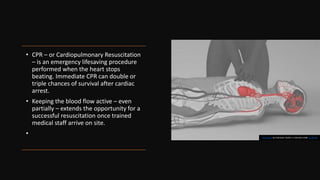
• CPR – or Cardiopulmonary Resuscitation
– is an emergency lifesaving procedure
performed when the heart stops
beating. Immediate CPR can double or
triple chances of survival after cardiac
arrest.
• Keeping the blood flow active – even
partially – extends the opportunity for a
successful resuscitation once trained
medical staff arrive on site.
• This Photo by Unknown Author is licensed under CC BY-NC
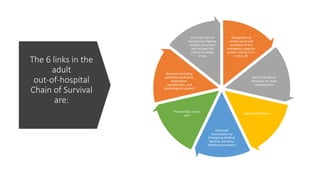
The 6 links in the
adult
out-of-hospital
Chain of Survival
are:
Recognition of
cardiac arrest and
activation of the
emergency response
system (calling 9-1-1
in the US)
Early CPR with an
emphasis on chest
compressions
Rapid defibrillation
Advanced
resuscitation by
Emergency Medical
Services and other
healthcare providers
Post-cardiac arrest
care
Recovery (including
additional treatment,
observation,
rehabilitation, and
psychological support)
A strong Chain of
Survival can improve
chances of survival
and recovery for
victims of cardiac
arrest.
How is CPR Performed?
• There are two commonly known versions of CPR:
• For healthcare providers and those trained: conventional CPR using chest
compressions and mouth-to-mouth breathing at a ratio of 30:2 compressions-
to-breaths. In adult victims of cardiac arrest, it is reasonable for rescuers to
perform chest compressions at a rate of 100 to 120/min and to a depth of at
least 2 inches (5 cm) for an average adult, while avoiding excessive chest
compression depths (greater than 2.4 inches [6 cm]).
• For the general public or bystanders who witness an adult suddenly
collapse: compression-only CPR, or Hands-Only CPR. Hands-Only CPR is CPR
without mouth-to-mouth breaths. It is recommended for use by people who
see a teen or adult suddenly collapse in an out-of-hospital setting (such as at
home, at work, or in a park).
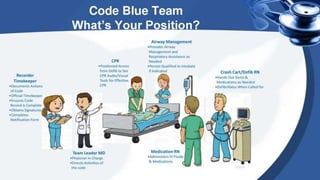
Nurses role in Code Blue
• First Responder (Compressor)
• Emergency trolley operator (Medicine)
• Airway manager
• Defibrillator operator
• Documentar
• Leader
First responder/compressor
Immediately begins chest
compressions at a rate of at least
100 compressions per minute
The beat at right cadence for the
effective timing of compressions.
Don't wait for a backboard to be
placed to begin compressions
Switch compressor roles
approximately every 2 minutes (or
after about 5 cycles of
compressions and ventilations at a
ratio of 30:2) to prevent decreases
in the quality of compressions.
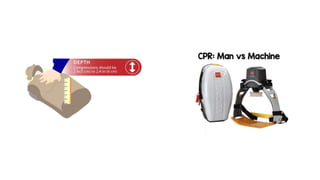
The depth of chest compressions
is at least 2 inches (5 cm) with
complete chest recoil after each
compression to allow the heart to
fill completely before the next
compression.
Minimize the frequency and
duration of interruptions in
compressions to maximize the
number of compressions delivered
per minute.
Chest compressions cause air to be
expelled from the chest and
oxygen to be drawn into the chest
due to the elastic recoil of the
chest.
This Photo by Unknown Author is licensed under CC BY-SA-NC This Photo by Unknown Author is licensed under CC BY-NC-ND
Emergency trolley operator (Medicine)
This Photo by Unknown Author is licensed under CC BY-SA
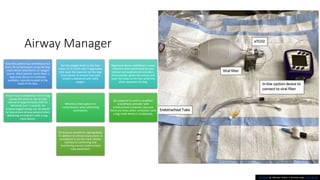
Airway Manager
Give the patient two ventilations for
every 30 compressions using the bag-
mask device attached to an oxygen
source. Most patient rooms have a
bag-mask device immediately
available, typically located at the
head of the bed.
Set the oxygen level on the flow
meter at 15 L/min and, if applicable,
fully open the reservoir on the bag-
mask device to ensure that each
breath is delivered with 100%
oxygen.
Bag-mask device ventilation is most
effective when performed by two
trained and experienced providers.
One provider opens the airway and
seals the mask to the face while the
other squeezes the bag.
Ensure each compression of the bag
causes the chest to rise (a tidal
volume of approximately 600 mL
delivered over 1 second). An
oropharyngeal airway can be placed
to help ensure airway patency when
delivering ventilations with a bag-
mask device.
Minimize interruptions in
compressions when delivering
ventilations.
Be prepared to assist a qualified
anaesthesia provider with
endotracheal intubation because
there are times when ventilation with
a bag-mask device is inadequate.
Continuous waveform capnography,
in addition to clinical assessment, is
considered to be the most reliable
method of confirming and
monitoring correct endotracheal
tube placement.
This Photo by Unknown Author is licensed under CC BY-NC-ND
Defibrillator operator
• Placement of hands-free defibrillation pads versus traditional handheld defibrillation paddles is
recommended as a safer option and allows for more rapid defibrillation.
• The patient should be connected to a 3- or 5-lead cardiac monitor
• Using the automated external defibrillator (AED) function on the defibrillator, if available, to ensure
early defibrillation when indicated before the code team arrives.
• Once a shockable rhythm is identified, the defibrillator manager sets the energy level on the
defibrillator, as directed by the team leader, using “closed loop” communication to ensure
understanding of the order before defibrillation.
• Using this technique, the team leader gives the order, such as “defibrillate with 200 joules,” the
defibrillator manager repeats, “Charging to 200 joules.” The defibrillator manager then announces the
delivery of 200 joules after the shock is delivered. (See Safety guidelines for defibrillation.)
• As soon as the shock is delivered, resume chest compressions immediately; don't delay resumption of
chest compressions to recheck the rhythm or pulse.
• Even resumption of a normal heart rhythm won't initially produce enough cardiac output for adequate
perfusion, so CPR should continue.
• After about 5 cycles of CPR (about 2 minutes), ending with compressions, the cardiac rhythm should be
checked during the change of compressor roles. If an organized electrical rhythm is present, check for
return of spontaneous circulation (ROSC) by checking the carotid pulse.
This Photo by Unknown Author is licensed under CC BY-SA
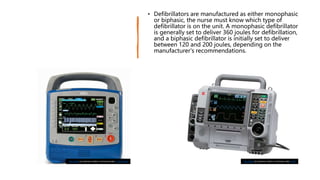
• Defibrillators are manufactured as either monophasic
or biphasic, the nurse must know which type of
defibrillator is on the unit. A monophasic defibrillator
is generally set to deliver 360 joules for defibrillation,
and a biphasic defibrillator is initially set to deliver
between 120 and 200 joules, depending on the
manufacturer's recommendations.
This Photo by Unknown Author is licensed under CC BY-NC-ND This Photo by Unknown Author is licensed under CC BY
Documentar
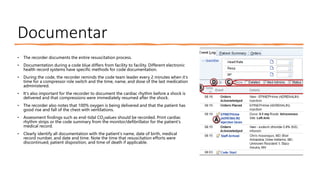
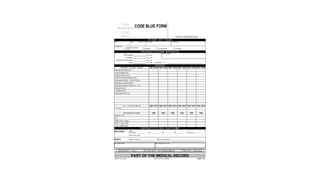
• The recorder documents the entire resuscitation process.
• Documentation during a code blue differs from facility to facility. Different electronic
health record systems have specific methods for code documentation.
• During the code, the recorder reminds the code team leader every 2 minutes when it's
time for a compressor role switch and the time, name, and dose of the last medication
administered.
• It's also important for the recorder to document the cardiac rhythm before a shock is
delivered and that compressions were immediately resumed after the shock.
• The recorder also notes that 100% oxygen is being delivered and that the patient has
good rise and fall of the chest with ventilations.
• Assessment findings such as end-tidal CO2values should be recorded. Print cardiac
rhythm strips or the code summary from the monitor/defibrillator for the patient's
medical record.
• Clearly identify all documentation with the patient's name, date of birth, medical
record number, and date and time. Note the time that resuscitation efforts were
discontinued, patient disposition, and time of death if applicable.
Leader
• The code team leader directs resuscitation efforts,
communicates with all team members, and monitors the
patient's cardiac rhythm.
• The code team leader needs to be in a position to
effectively observe all aspects of the resuscitation efforts.
This role may be taken by a physician or an advanced care
provider.
Reference
• Craig-Brangan, K. J., & Day, M. P.
(2021). AHA update: BLS, ACLS, and
PALS. Nursing2023, 51(6), 24-30
• Jackson, J. E., & Grugan, A. S. (2015).
Code blue: Do you know what to
do?. Nursing2022, 45(5), 34-39.

Code blue - Nurses Role.pptx

  • 1.
    CardioPulmonary Resuscitation Fasha MurshidaBinti Abdul Hamid Student ID : 59218120395
  • 2.
    Scenario • You areperforming vital signs checking for a patient who is post angioplasty. Upon taking vital sign checking, patient complaint of chest pain and suddenly nauseated and went to unconscious and pulseless. You activated code blue. This Photo by Unknown Author is licensed under CC BY-SA
  • 3.
    • CPR –or Cardiopulmonary Resuscitation – is an emergency lifesaving procedure performed when the heart stops beating. Immediate CPR can double or triple chances of survival after cardiac arrest. • Keeping the blood flow active – even partially – extends the opportunity for a successful resuscitation once trained medical staff arrive on site. • This Photo by Unknown Author is licensed under CC BY-NC
  • 4.
    The 6 linksin the adult out-of-hospital Chain of Survival are: Recognition of cardiac arrest and activation of the emergency response system (calling 9-1-1 in the US) Early CPR with an emphasis on chest compressions Rapid defibrillation Advanced resuscitation by Emergency Medical Services and other healthcare providers Post-cardiac arrest care Recovery (including additional treatment, observation, rehabilitation, and psychological support) A strong Chain of Survival can improve chances of survival and recovery for victims of cardiac arrest.
  • 6.
    How is CPRPerformed? • There are two commonly known versions of CPR: • For healthcare providers and those trained: conventional CPR using chest compressions and mouth-to-mouth breathing at a ratio of 30:2 compressions- to-breaths. In adult victims of cardiac arrest, it is reasonable for rescuers to perform chest compressions at a rate of 100 to 120/min and to a depth of at least 2 inches (5 cm) for an average adult, while avoiding excessive chest compression depths (greater than 2.4 inches [6 cm]). • For the general public or bystanders who witness an adult suddenly collapse: compression-only CPR, or Hands-Only CPR. Hands-Only CPR is CPR without mouth-to-mouth breaths. It is recommended for use by people who see a teen or adult suddenly collapse in an out-of-hospital setting (such as at home, at work, or in a park).
  • 7.
    Nurses role inCode Blue • First Responder (Compressor) • Emergency trolley operator (Medicine) • Airway manager • Defibrillator operator • Documentar • Leader
  • 8.
    First responder/compressor Immediately beginschest compressions at a rate of at least 100 compressions per minute The beat at right cadence for the effective timing of compressions. Don't wait for a backboard to be placed to begin compressions Switch compressor roles approximately every 2 minutes (or after about 5 cycles of compressions and ventilations at a ratio of 30:2) to prevent decreases in the quality of compressions. The depth of chest compressions is at least 2 inches (5 cm) with complete chest recoil after each compression to allow the heart to fill completely before the next compression. Minimize the frequency and duration of interruptions in compressions to maximize the number of compressions delivered per minute. Chest compressions cause air to be expelled from the chest and oxygen to be drawn into the chest due to the elastic recoil of the chest.
  • 9.
    This Photo byUnknown Author is licensed under CC BY-SA-NC This Photo by Unknown Author is licensed under CC BY-NC-ND
  • 10.
    Emergency trolley operator(Medicine) This Photo by Unknown Author is licensed under CC BY-SA
  • 11.
    Airway Manager Give thepatient two ventilations for every 30 compressions using the bag- mask device attached to an oxygen source. Most patient rooms have a bag-mask device immediately available, typically located at the head of the bed. Set the oxygen level on the flow meter at 15 L/min and, if applicable, fully open the reservoir on the bag- mask device to ensure that each breath is delivered with 100% oxygen. Bag-mask device ventilation is most effective when performed by two trained and experienced providers. One provider opens the airway and seals the mask to the face while the other squeezes the bag. Ensure each compression of the bag causes the chest to rise (a tidal volume of approximately 600 mL delivered over 1 second). An oropharyngeal airway can be placed to help ensure airway patency when delivering ventilations with a bag- mask device. Minimize interruptions in compressions when delivering ventilations. Be prepared to assist a qualified anaesthesia provider with endotracheal intubation because there are times when ventilation with a bag-mask device is inadequate. Continuous waveform capnography, in addition to clinical assessment, is considered to be the most reliable method of confirming and monitoring correct endotracheal tube placement. This Photo by Unknown Author is licensed under CC BY-NC-ND
  • 12.
    Defibrillator operator • Placementof hands-free defibrillation pads versus traditional handheld defibrillation paddles is recommended as a safer option and allows for more rapid defibrillation. • The patient should be connected to a 3- or 5-lead cardiac monitor • Using the automated external defibrillator (AED) function on the defibrillator, if available, to ensure early defibrillation when indicated before the code team arrives. • Once a shockable rhythm is identified, the defibrillator manager sets the energy level on the defibrillator, as directed by the team leader, using “closed loop” communication to ensure understanding of the order before defibrillation. • Using this technique, the team leader gives the order, such as “defibrillate with 200 joules,” the defibrillator manager repeats, “Charging to 200 joules.” The defibrillator manager then announces the delivery of 200 joules after the shock is delivered. (See Safety guidelines for defibrillation.) • As soon as the shock is delivered, resume chest compressions immediately; don't delay resumption of chest compressions to recheck the rhythm or pulse. • Even resumption of a normal heart rhythm won't initially produce enough cardiac output for adequate perfusion, so CPR should continue. • After about 5 cycles of CPR (about 2 minutes), ending with compressions, the cardiac rhythm should be checked during the change of compressor roles. If an organized electrical rhythm is present, check for return of spontaneous circulation (ROSC) by checking the carotid pulse. This Photo by Unknown Author is licensed under CC BY-SA
  • 13.
    • Defibrillators aremanufactured as either monophasic or biphasic, the nurse must know which type of defibrillator is on the unit. A monophasic defibrillator is generally set to deliver 360 joules for defibrillation, and a biphasic defibrillator is initially set to deliver between 120 and 200 joules, depending on the manufacturer's recommendations. This Photo by Unknown Author is licensed under CC BY-NC-ND This Photo by Unknown Author is licensed under CC BY
  • 14.
    Documentar • The recorderdocuments the entire resuscitation process. • Documentation during a code blue differs from facility to facility. Different electronic health record systems have specific methods for code documentation. • During the code, the recorder reminds the code team leader every 2 minutes when it's time for a compressor role switch and the time, name, and dose of the last medication administered. • It's also important for the recorder to document the cardiac rhythm before a shock is delivered and that compressions were immediately resumed after the shock. • The recorder also notes that 100% oxygen is being delivered and that the patient has good rise and fall of the chest with ventilations. • Assessment findings such as end-tidal CO2values should be recorded. Print cardiac rhythm strips or the code summary from the monitor/defibrillator for the patient's medical record. • Clearly identify all documentation with the patient's name, date of birth, medical record number, and date and time. Note the time that resuscitation efforts were discontinued, patient disposition, and time of death if applicable.
  • 16.
    Leader • The codeteam leader directs resuscitation efforts, communicates with all team members, and monitors the patient's cardiac rhythm. • The code team leader needs to be in a position to effectively observe all aspects of the resuscitation efforts. This role may be taken by a physician or an advanced care provider.
  • 18.
    Reference • Craig-Brangan, K.J., & Day, M. P. (2021). AHA update: BLS, ACLS, and PALS. Nursing2023, 51(6), 24-30 • Jackson, J. E., & Grugan, A. S. (2015). Code blue: Do you know what to do?. Nursing2022, 45(5), 34-39.