CODE BLUE
PROCEDURES
Luis Enriquez RN, BS.
Los Angeles County USC Medical Center
Department of Emergency Medicine
CODE BLUE TEAM
 Trained patient care providers who perform
resuscitation on any person who sustains
Cardiopulmonary arrest
Respiratory arrest
Airway problem
 Train providers:
Doctor
Nurse
Support Personnel
CODE BLUE ACTIVATION
 All employees must be educated to activate
Code Blue response in the event of
 Cardiac arrest
 Respiratory arrest
 Activate Code Blue Response by
 Calling Hospital Emergency Operator
 Provide Information: Patient location, Adult/Pediatric
 Hospital Emergency Operator will activate
response when notified of Code Blue event
 Code blue pager system
 Announce overhead the location of the code event
CODE BLUE MEMBERS
 Physician: Emergency Department
 Pediatric attending or senior resident
 Physician: Internal Medicine
 Physician: general Surgery
 Intensive Care Unit/Emergency Nurse
 Respiratory Therapist
 EKG (Electrocardiogram) Technician
 Nursing Supervisor Los Angeles County + USC
Medical Center
Code Blue Protocol
ROLE OF THE TEAM MEMBERS
EMERGENCY PHYSICIAN
 Team Leader: direct overall patient care
 Manage the Code
 Medication
 Defibrillation
 Other procedures: Intubation, compressions
 Evaluate Code Blue procedures
 Effectiveness of Chest Compression
 Effectiveness of assisted respirations
 Rhythm/pulse check
 Document in the medical record
ROLE OF THE TEAM MEMBERS
EMERGENCY NURSE
 Maintains airway/oxygenation/ventilation
 Applies monitor leads/defibrillator pads
 Starts Intravenous access
 Administer medications
 Administers Electrical Shock (ACLS trained)
 Assist with intubation procedures
 Completes CPR record
ROLE OF THE TEAM MEMBERS
PRIMARY NURSE
 Activate code blue team
 Bring Emergency Resuscitation Cart
 Place backboard under patient
 Initiate 2 man Cardio Pulmonary Resuscitation
 Administer ventilations with 100% O2 with Bag/valve/mask
 Attach Electro cardiogram leads
 Attach “hands off” defibrillator pads
 Ensure patient Intra Venous access
 Prepare suction
 Obtain supplies from CPR Cart/Ward Stock
 Record events on CPR record
CODE BLUE
NURSING SKILLS
 Identify respiratory/cardiac arrest
 Activate Code Blue
 Oxygen administration: Nasal cannula, mask
 Bag-Valve-Mask resuscitation with 100% O2
 Cardiac Monitor/defibrillator pads Application
 Intra Venous access
 Medication Administration
 Defibrillation (ACLS trained)
 CPR documentation
ROLE OF THE TEAM MEMBERS
SUPPORT PERSONNEL
 Respiratory Therapist
Maintains airway and oxygenation/ventilation
Assist with intubation procedures
 EKG Technician: Performs 12-lead EKG
 Pharmacist: Prepares medications
BASIC LIFE SUPPORT
SURVEY
1- Establish Unresponsiveness
2- Activate Emergency Response System
3- Circulation
4- Defibrillation
Simplified adult BLS algorithm.
Berg R A et al. Circulation 2010;122:S685-S705
Copyright © American Heart Association
ESTABLISH
UNRESPONSIVENESS
 Tap and Shout “are you all right”
 Check for absent/abnormal breathing
by scanning the chest for movement
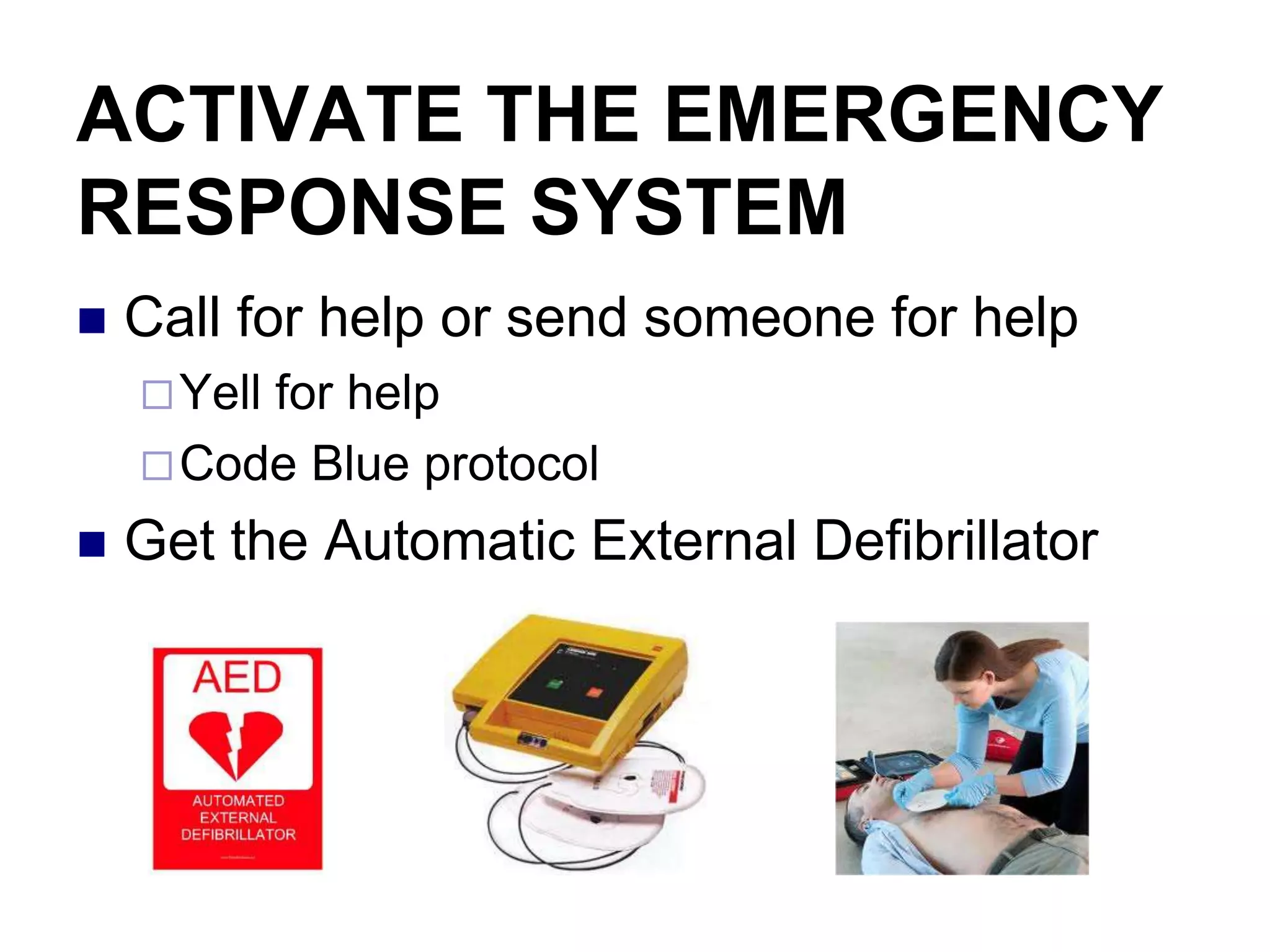
ACTIVATE THE EMERGENCY
RESPONSE SYSTEM
 Call for help or send someone for help
Yell for help
Code Blue protocol
 Get the Automatic External Defibrillator
CIRCULATION
 Check corotid pulse for 5-10 seconds
 If no pulse Begin Cardio Pulmonary Resuscitation
 Compress center of chest (lower ½ of sternum)
 Ratio: 30:2 compressions to breaths
 Depth: at least 2 inches
 Rate: at least 100 compressions per minute
 Allow complete chest recoil
 Minimize interruptions
 Switch providers every 2 minutes
 Avoid excessive ventilation
 If pulse present start rescue breathing
 1breath every 5-6 seconds (10-12 breaths per min.)
 Check pulse every 2 minutes
DEFIBRILLATION
 If no pulse check for shockable
rhythm as soon as AED arrives
 Provide shocks as indicated
 Follow each shock immediately with
CPR compressions
Advance Cardiac
Life Support Survey
 Airway
 Breathing
 Circulation
 Differential Diagnosis
AIRWAY
 Maintain patent airway in unconscious Pt’s
Head tilt chin lift
Simple airway adjuncts:
 Use advance airway if needed:
Confirm proper placement
 Physical exam
 Quantitative waveform Capnography
Secure Device to prevent dislodgement
Monitor airway placement with continuous
quantitative waveform Capnography
BREATHING
 Supplemental O2 when indicated
Titrate O2 to oxygen sat ≥ 94% non arrest Pt’s
100% O2 for Pt’s in cardiac arrest
 Monitor adequacy of ventilation and
oxygenation
Clinical criteria: chest rise and cyanosis
Quantitative waveform capnography
Oxygen saturation
 Avoid excessive ventilation
CIRCULATION
 Monitor CPR quality
 Attach monitor/Defibrillator
 Monitor for arrhythmias or arrest rhythms
 Provide defibrillation/Cardioversion
 Obtain IV/IO access
 Give appropriate drugs
 Give fluids if needed
DIFFERENTIAL DIAGNOSIS
search for and treat reversible causes
H’s AND
 Hypoxia
 Hypovolemia
 Hydrogen ion (acidosis)
 Hypo/hyper kalemia
 Hypothermia
T’s
 Tension pneumothorax
 Tamponade cardiac
 Toxins
 Thrombosis Pulmonary
 Thrombosis Coronary
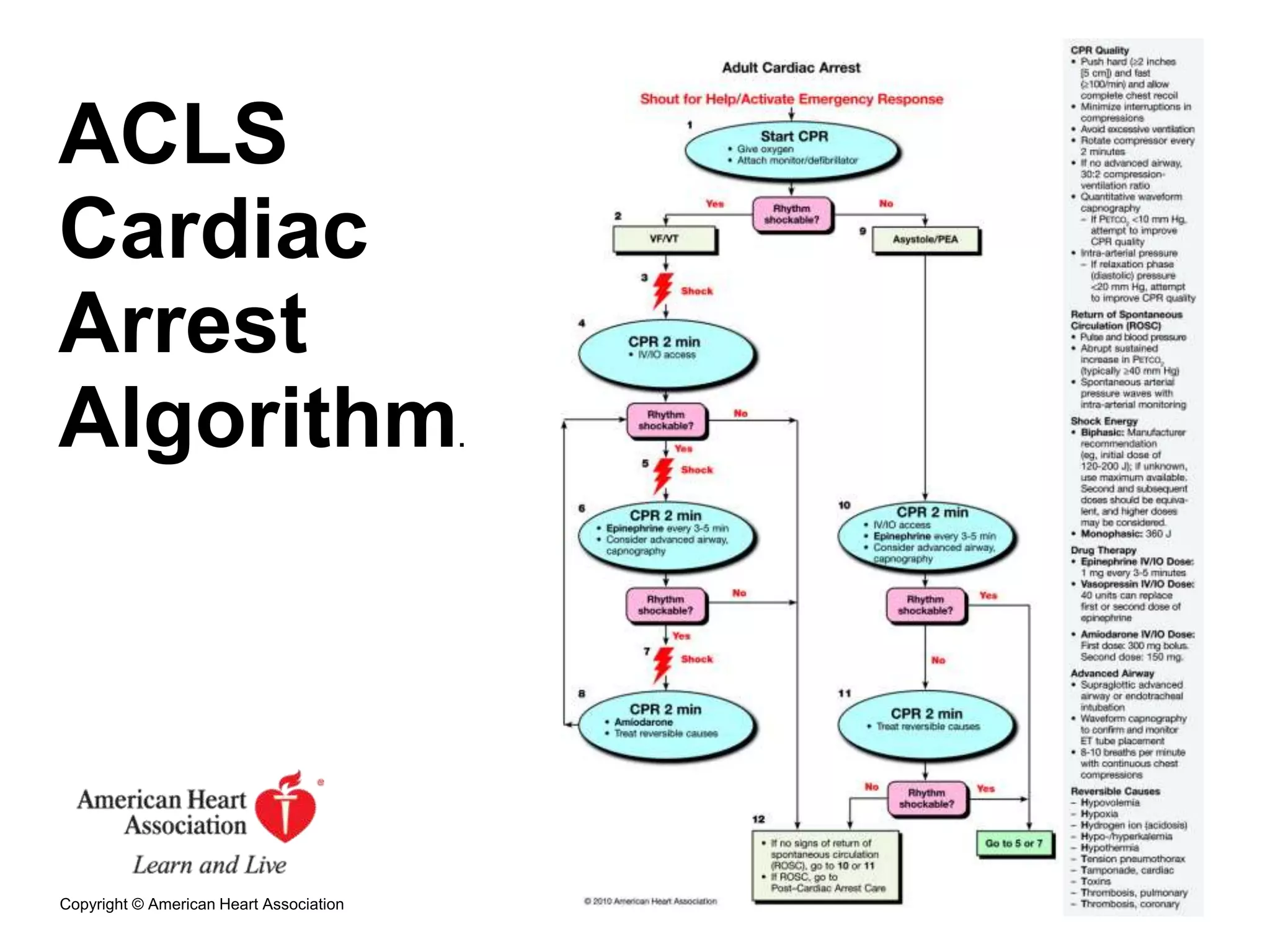
ACLS
Cardiac
Arrest
Algorithm.
Copyright © American Heart Association
ACLS Cardiac Arrest Circular Algorithm.
Neumar R W et al. Circulation 2010;122:S729-S767
Copyright © American Heart Association
Bradycardia Algorithm.
Neumar R W et al. Circulation 2010;122:S729-S767
Copyright © American Heart Association
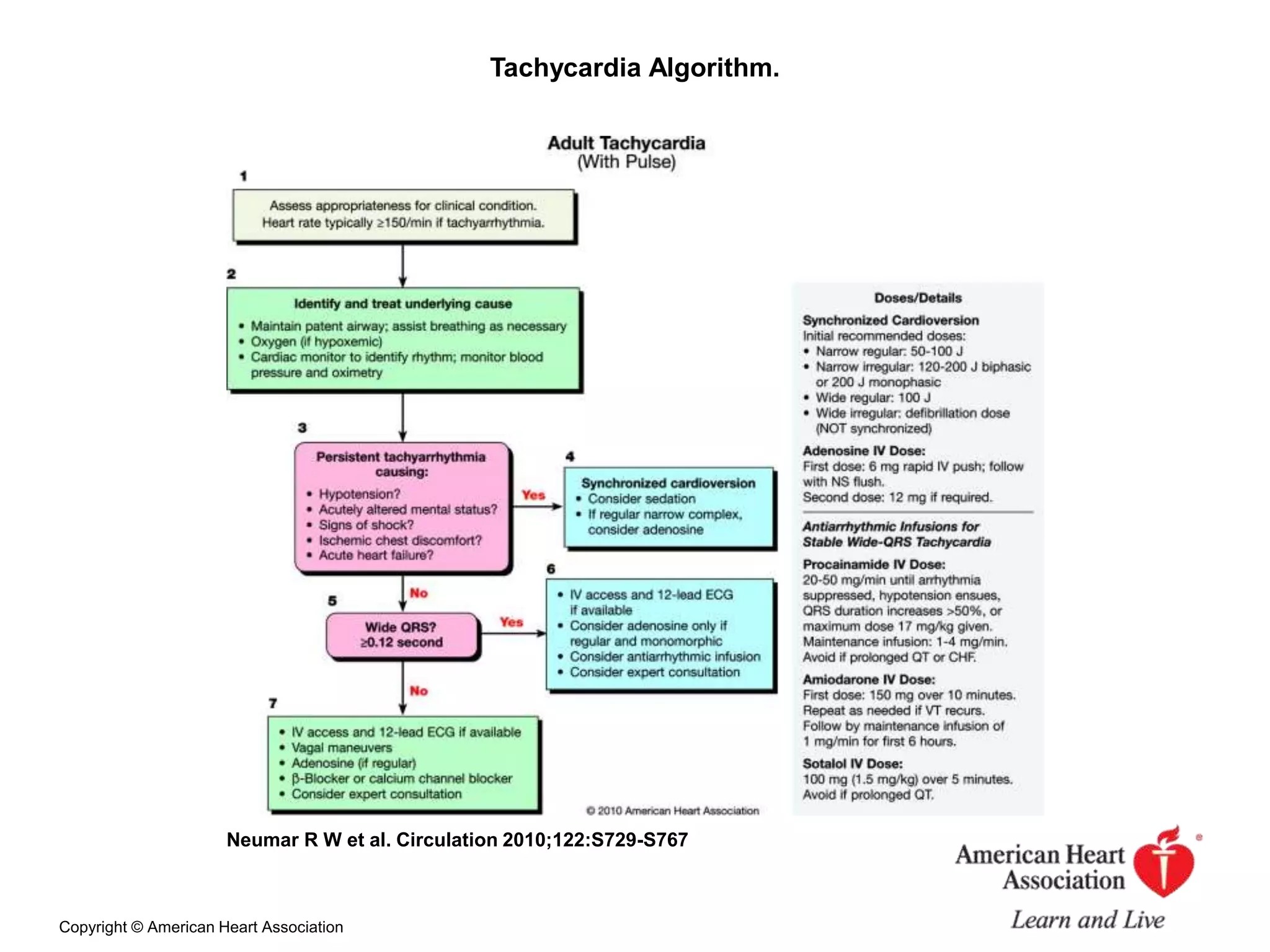
Tachycardia Algorithm.
Neumar R W et al. Circulation 2010;122:S729-S767
Copyright © American Heart Association
NSR with Ectopy > VT>VF>NSR
• A 48 year old iron worker is brought to the
Emergency Department by co-workers following an
onset of sudden sever “pressure-type” chest pain
radiating to his neck, jaw and left arm.
• He is pale slightly diaphoretic, and very anxious.
Wide-complex tachycardia >VF>NSR
• A 63-Year-old woman alcoholic with a history of
CHF is brought to the hospital by her daughters
becouse of worsening symptoms of dyspnea, cough
and wheezing.
• She looks moderately ill but denies chest pain.

165483335-EN-RN-CODE-BLUE-pptx.pptx

  • 1.
    CODE BLUE PROCEDURES Luis EnriquezRN, BS. Los Angeles County USC Medical Center Department of Emergency Medicine
  • 2.
    CODE BLUE TEAM Trained patient care providers who perform resuscitation on any person who sustains Cardiopulmonary arrest Respiratory arrest Airway problem  Train providers: Doctor Nurse Support Personnel
  • 3.
    CODE BLUE ACTIVATION All employees must be educated to activate Code Blue response in the event of  Cardiac arrest  Respiratory arrest  Activate Code Blue Response by  Calling Hospital Emergency Operator  Provide Information: Patient location, Adult/Pediatric  Hospital Emergency Operator will activate response when notified of Code Blue event  Code blue pager system  Announce overhead the location of the code event
  • 4.
    CODE BLUE MEMBERS Physician: Emergency Department  Pediatric attending or senior resident  Physician: Internal Medicine  Physician: general Surgery  Intensive Care Unit/Emergency Nurse  Respiratory Therapist  EKG (Electrocardiogram) Technician  Nursing Supervisor Los Angeles County + USC Medical Center Code Blue Protocol
  • 5.
    ROLE OF THETEAM MEMBERS EMERGENCY PHYSICIAN  Team Leader: direct overall patient care  Manage the Code  Medication  Defibrillation  Other procedures: Intubation, compressions  Evaluate Code Blue procedures  Effectiveness of Chest Compression  Effectiveness of assisted respirations  Rhythm/pulse check  Document in the medical record
  • 6.
    ROLE OF THETEAM MEMBERS EMERGENCY NURSE  Maintains airway/oxygenation/ventilation  Applies monitor leads/defibrillator pads  Starts Intravenous access  Administer medications  Administers Electrical Shock (ACLS trained)  Assist with intubation procedures  Completes CPR record
  • 7.
    ROLE OF THETEAM MEMBERS PRIMARY NURSE  Activate code blue team  Bring Emergency Resuscitation Cart  Place backboard under patient  Initiate 2 man Cardio Pulmonary Resuscitation  Administer ventilations with 100% O2 with Bag/valve/mask  Attach Electro cardiogram leads  Attach “hands off” defibrillator pads  Ensure patient Intra Venous access  Prepare suction  Obtain supplies from CPR Cart/Ward Stock  Record events on CPR record
  • 8.
    CODE BLUE NURSING SKILLS Identify respiratory/cardiac arrest  Activate Code Blue  Oxygen administration: Nasal cannula, mask  Bag-Valve-Mask resuscitation with 100% O2  Cardiac Monitor/defibrillator pads Application  Intra Venous access  Medication Administration  Defibrillation (ACLS trained)  CPR documentation
  • 9.
    ROLE OF THETEAM MEMBERS SUPPORT PERSONNEL  Respiratory Therapist Maintains airway and oxygenation/ventilation Assist with intubation procedures  EKG Technician: Performs 12-lead EKG  Pharmacist: Prepares medications
  • 10.
    BASIC LIFE SUPPORT SURVEY 1-Establish Unresponsiveness 2- Activate Emergency Response System 3- Circulation 4- Defibrillation
  • 11.
    Simplified adult BLSalgorithm. Berg R A et al. Circulation 2010;122:S685-S705 Copyright © American Heart Association
  • 12.
    ESTABLISH UNRESPONSIVENESS  Tap andShout “are you all right”  Check for absent/abnormal breathing by scanning the chest for movement
  • 13.
    ACTIVATE THE EMERGENCY RESPONSESYSTEM  Call for help or send someone for help Yell for help Code Blue protocol  Get the Automatic External Defibrillator
  • 14.
    CIRCULATION  Check corotidpulse for 5-10 seconds  If no pulse Begin Cardio Pulmonary Resuscitation  Compress center of chest (lower ½ of sternum)  Ratio: 30:2 compressions to breaths  Depth: at least 2 inches  Rate: at least 100 compressions per minute  Allow complete chest recoil  Minimize interruptions  Switch providers every 2 minutes  Avoid excessive ventilation  If pulse present start rescue breathing  1breath every 5-6 seconds (10-12 breaths per min.)  Check pulse every 2 minutes
  • 15.
    DEFIBRILLATION  If nopulse check for shockable rhythm as soon as AED arrives  Provide shocks as indicated  Follow each shock immediately with CPR compressions
  • 16.
    Advance Cardiac Life SupportSurvey  Airway  Breathing  Circulation  Differential Diagnosis
  • 17.
    AIRWAY  Maintain patentairway in unconscious Pt’s Head tilt chin lift Simple airway adjuncts:  Use advance airway if needed: Confirm proper placement  Physical exam  Quantitative waveform Capnography Secure Device to prevent dislodgement Monitor airway placement with continuous quantitative waveform Capnography
  • 18.
    BREATHING  Supplemental O2when indicated Titrate O2 to oxygen sat ≥ 94% non arrest Pt’s 100% O2 for Pt’s in cardiac arrest  Monitor adequacy of ventilation and oxygenation Clinical criteria: chest rise and cyanosis Quantitative waveform capnography Oxygen saturation  Avoid excessive ventilation
  • 19.
    CIRCULATION  Monitor CPRquality  Attach monitor/Defibrillator  Monitor for arrhythmias or arrest rhythms  Provide defibrillation/Cardioversion  Obtain IV/IO access  Give appropriate drugs  Give fluids if needed
  • 20.
    DIFFERENTIAL DIAGNOSIS search forand treat reversible causes H’s AND  Hypoxia  Hypovolemia  Hydrogen ion (acidosis)  Hypo/hyper kalemia  Hypothermia T’s  Tension pneumothorax  Tamponade cardiac  Toxins  Thrombosis Pulmonary  Thrombosis Coronary
  • 21.
  • 22.
    ACLS Cardiac ArrestCircular Algorithm. Neumar R W et al. Circulation 2010;122:S729-S767 Copyright © American Heart Association
  • 23.
    Bradycardia Algorithm. Neumar RW et al. Circulation 2010;122:S729-S767 Copyright © American Heart Association
  • 24.
    Tachycardia Algorithm. Neumar RW et al. Circulation 2010;122:S729-S767 Copyright © American Heart Association
  • 25.
    NSR with Ectopy> VT>VF>NSR • A 48 year old iron worker is brought to the Emergency Department by co-workers following an onset of sudden sever “pressure-type” chest pain radiating to his neck, jaw and left arm. • He is pale slightly diaphoretic, and very anxious. Wide-complex tachycardia >VF>NSR • A 63-Year-old woman alcoholic with a history of CHF is brought to the hospital by her daughters becouse of worsening symptoms of dyspnea, cough and wheezing. • She looks moderately ill but denies chest pain.

Editor's Notes

  • #12 Simplified adult BLS algorithm.
  • #22 ACLS Cardiac Arrest Algorithm.
  • #23 ACLS Cardiac Arrest Circular Algorithm.
  • #24 Bradycardia Algorithm.
  • #25 Tachycardia Algorithm.