Sandhya c
Nursing Tutor
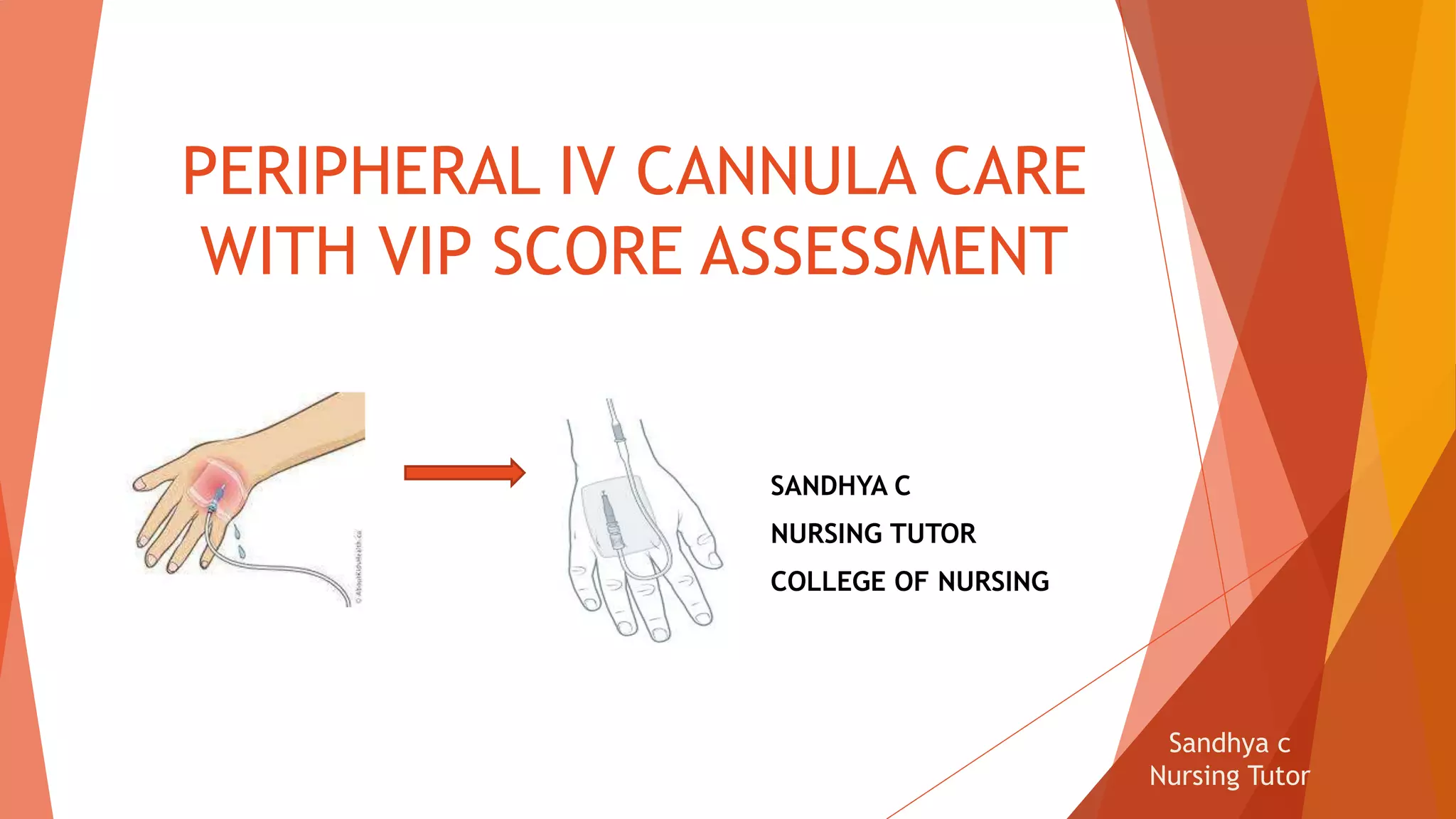
PERIPHERAL IV CANNULA CARE
WITH VIP SCORE ASSESSMENT
SANDHYA C
NURSING TUTOR
COLLEGE OF NURSING
SANDHYA C
NURSING TUTOR
SANDHYA C
NURSING TUTOR
Selection of Peripheral IV catheter site
In adults, common sites used
for IV cannula insertion
Common sites used in
paediatric patients
Sites to avoid IV cannula
insertion
1
3
2
SANDHYA C
NURSING TUTOR
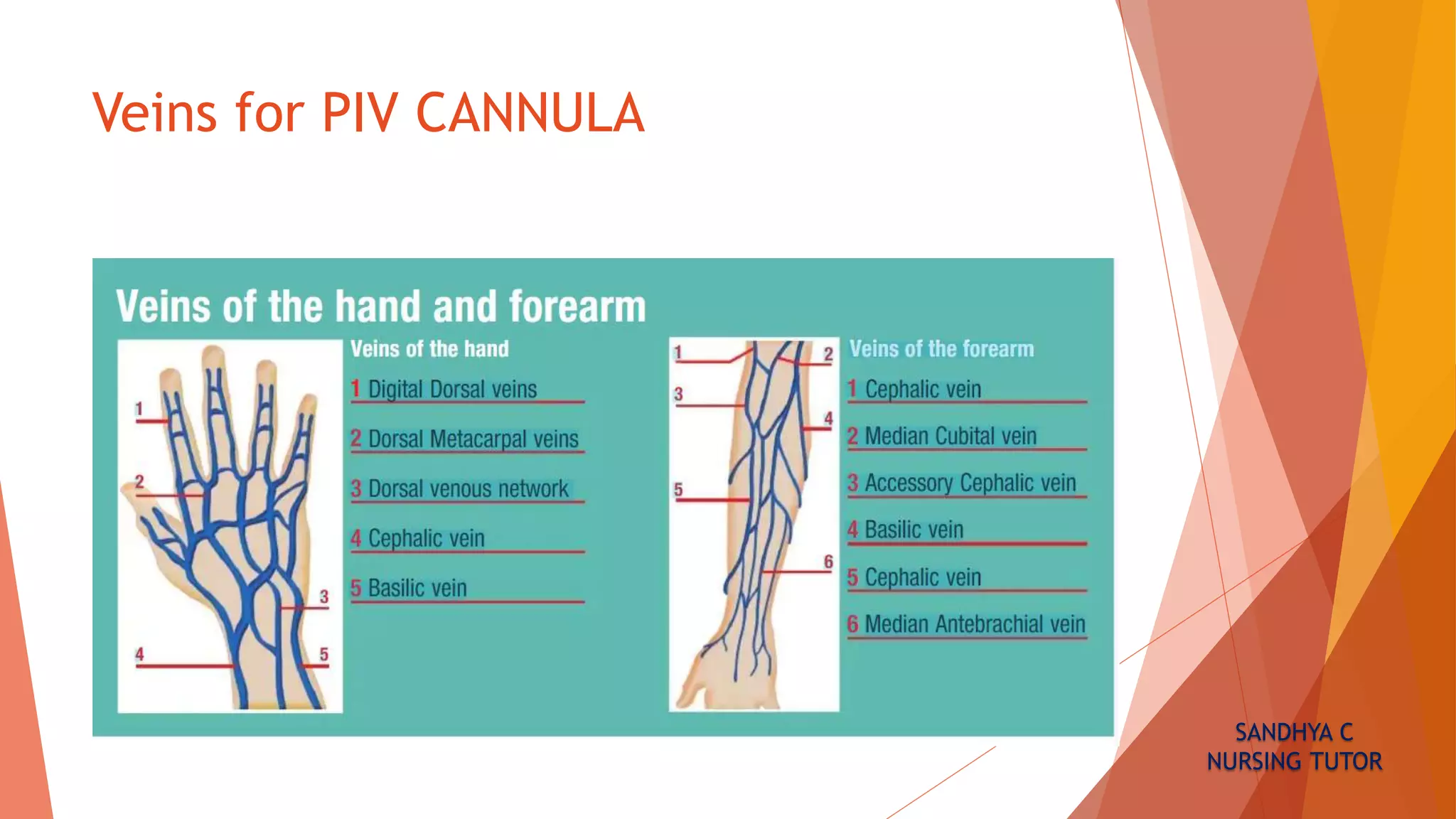
Veins for PIV CANNULA
SANDHYA C
NURSING TUTOR
Ongoing Care of a Peripheral Vascular
Cannula (PVC)
ANTT
Decontaminate hands prior to
after accessing pvc.
Skin preparation and Injection
ports/hubs- Scrub the hub with
2% Chlorhexidine in 70% Isopropyl
alcohol wipe for 30 secs before
and after accessing the system
Flush pre and post drug
administration with 5-10ml of
sodium chloride 0.9% in a 10ml
syringe
The dressing should be changed
immediately when it becomes
loose, damp or soiled. An aseptic
non-touch technique should be
used when changing the dressing.
A PVC should not be used for
routine blood sampling. However,
if necessary, blood can be drawn
ONLY ONCE immediately
following insertion.
The dressing should be changed
as required, if it becomes loose,
damp or soiled or at 7 days if still
remains insitu.
If bandages are use as extra support
to secure PVC, they should be
removed at least daily and every
time the PVC is accessed or infusion
rates are altered in order to inspect
the insertion site.
The site should be monitored at
each intervention and the VIP
score recorded at least
(minimum) daily.
The site should be inspected for
signs of infiltration, extravasation,
leakage and using VIP score for signs
of phlebitis (Loveday et al 2014).
SANDHYA C
NURSING TUTOR
1. A patient is being transfused 1 unit of packed RBC’s. The patient complains of
burning at the IV set and pain is present. Which action will you take first and
arrange them in a correct order?
A. flush the IV with normal saline to check patency
B. Stop the infusion
C. Resume administration at a slower rate
D. Assess the IV site for any signs of complications.
Answer : B-D-A-C
SANDHYA C
NURSING TUTOR
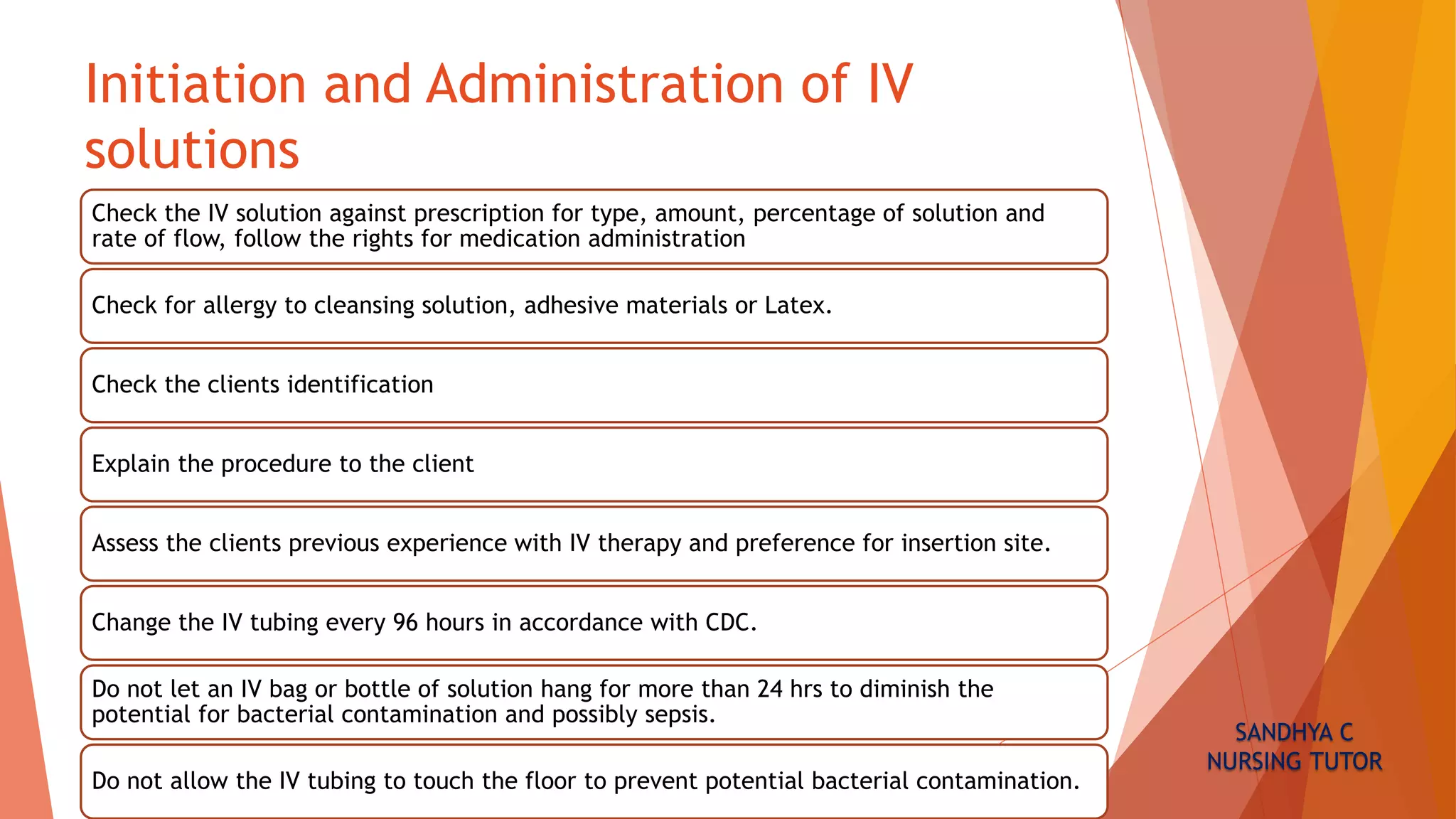
Initiation and Administration of IV
solutions
Check the IV solution against prescription for type, amount, percentage of solution and
rate of flow, follow the rights for medication administration
Check for allergy to cleansing solution, adhesive materials or Latex.
Check the clients identification
Explain the procedure to the client
Assess the clients previous experience with IV therapy and preference for insertion site.
Change the IV tubing every 96 hours in accordance with CDC.
Do not let an IV bag or bottle of solution hang for more than 24 hrs to diminish the
potential for bacterial contamination and possibly sepsis.
Do not allow the IV tubing to touch the floor to prevent potential bacterial contamination.
SANDHYA C
NURSING TUTOR
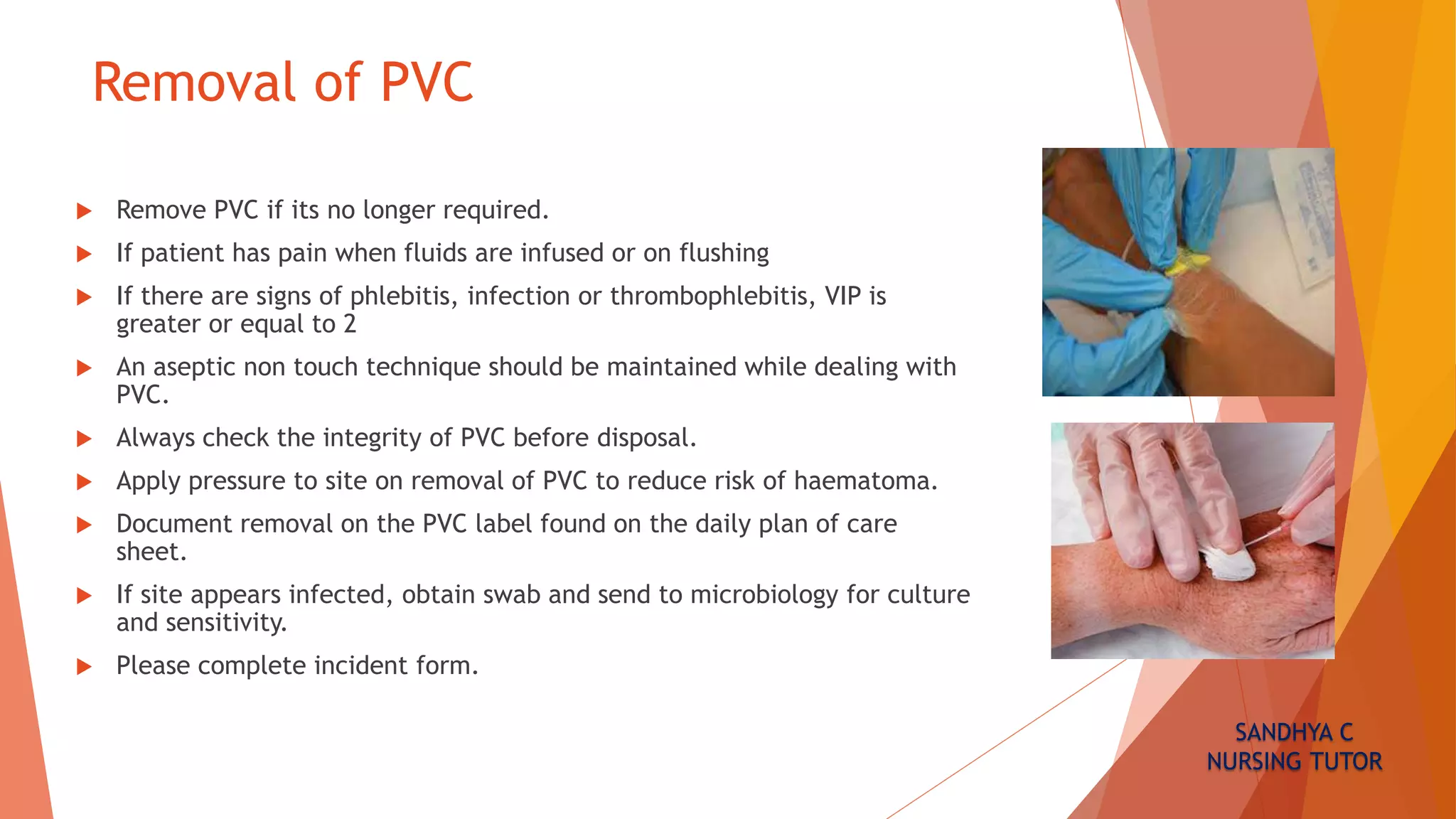
Removal of PVC
 Remove PVC if its no longer required.
 If patient has pain when fluids are infused or on flushing
 If there are signs of phlebitis, infection or thrombophlebitis, VIP is
greater or equal to 2
 An aseptic non touch technique should be maintained while dealing with
PVC.
 Always check the integrity of PVC before disposal.
 Apply pressure to site on removal of PVC to reduce risk of haematoma.
 Document removal on the PVC label found on the daily plan of care
sheet.
 If site appears infected, obtain swab and send to microbiology for culture
and sensitivity.
 Please complete incident form.
SANDHYA C
NURSING TUTOR
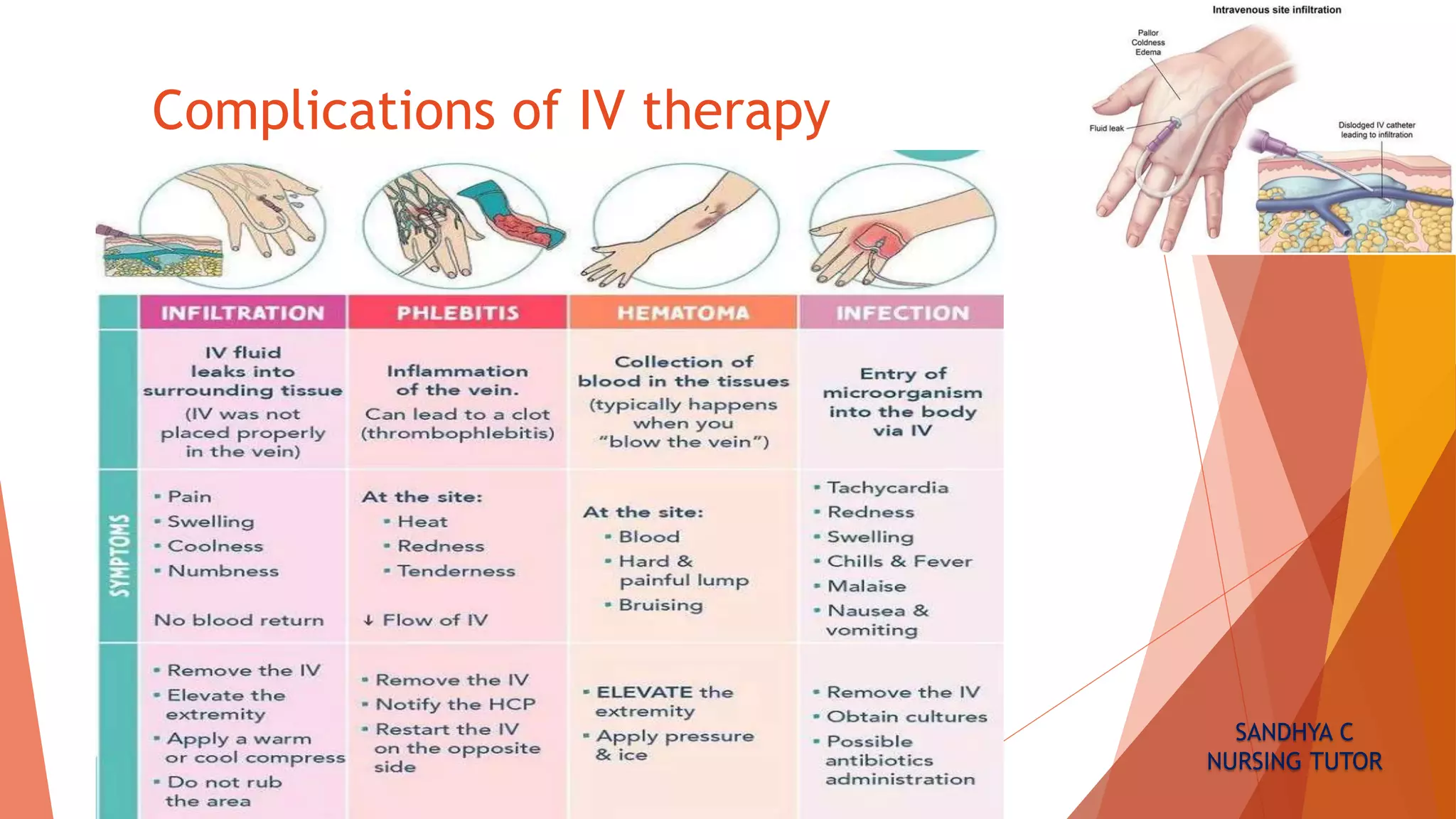
Complications of IV therapy
SANDHYA C
NURSING TUTOR
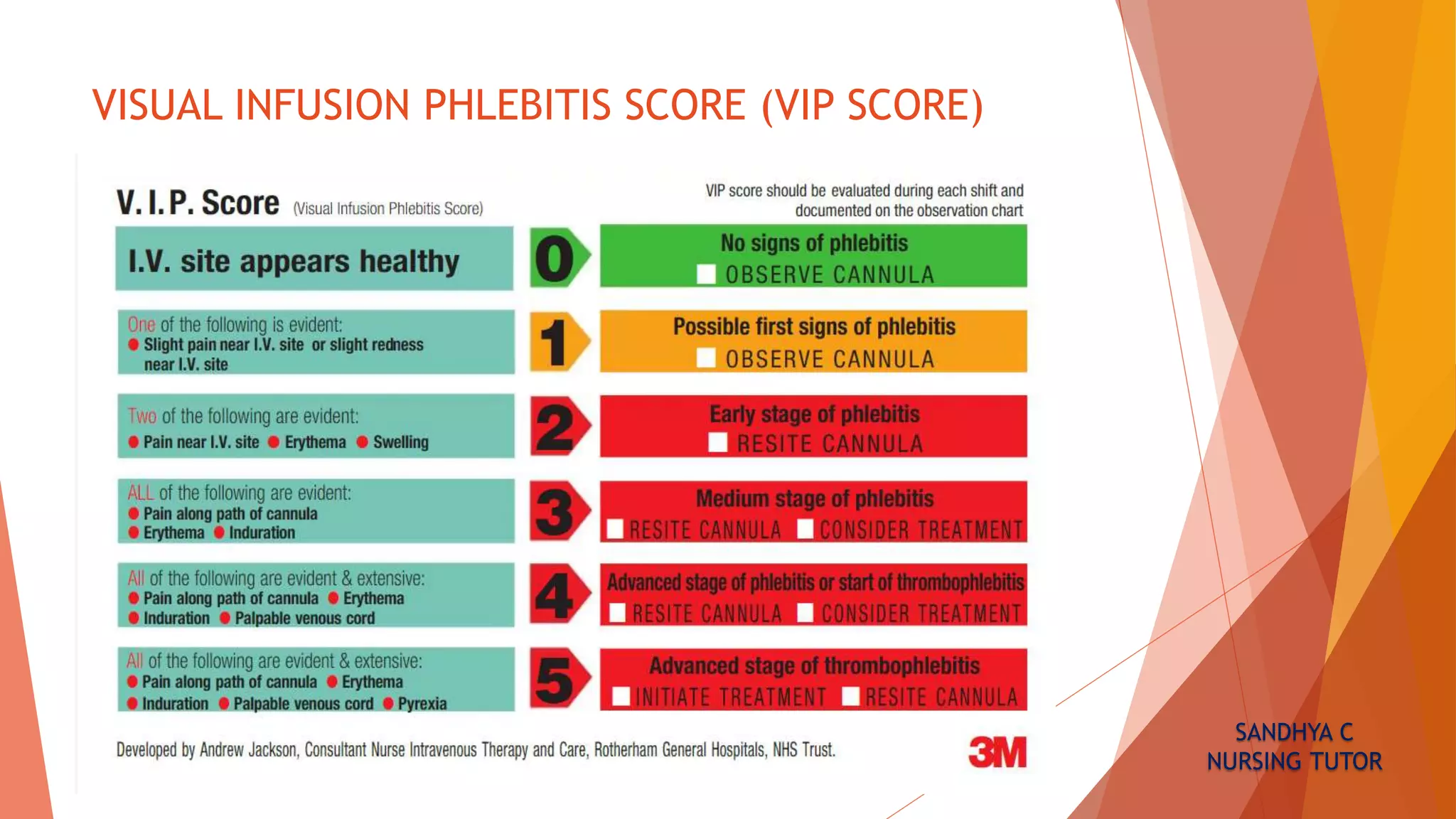
VISUAL INFUSION PHLEBITIS SCORE (VIP SCORE)
SANDHYA C
NURSING TUTOR
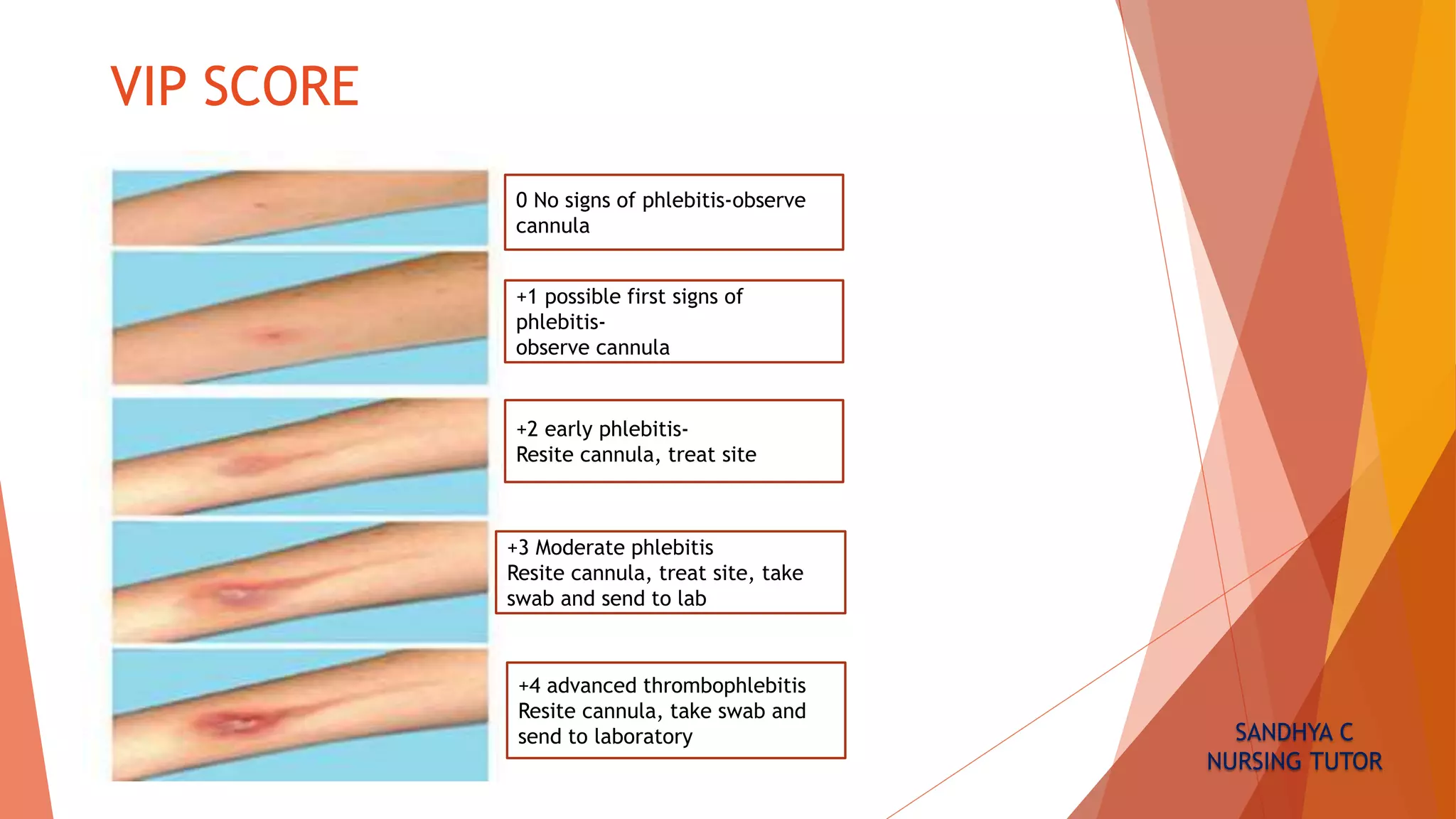
VIP SCORE
0 No signs of phlebitis-observe
cannula
+1 possible first signs of
phlebitis-
observe cannula
+2 early phlebitis-
Resite cannula, treat site
+4 advanced thrombophlebitis
Resite cannula, take swab and
send to laboratory
+3 Moderate phlebitis
Resite cannula, treat site, take
swab and send to lab
SANDHYA C
NURSING TUTOR
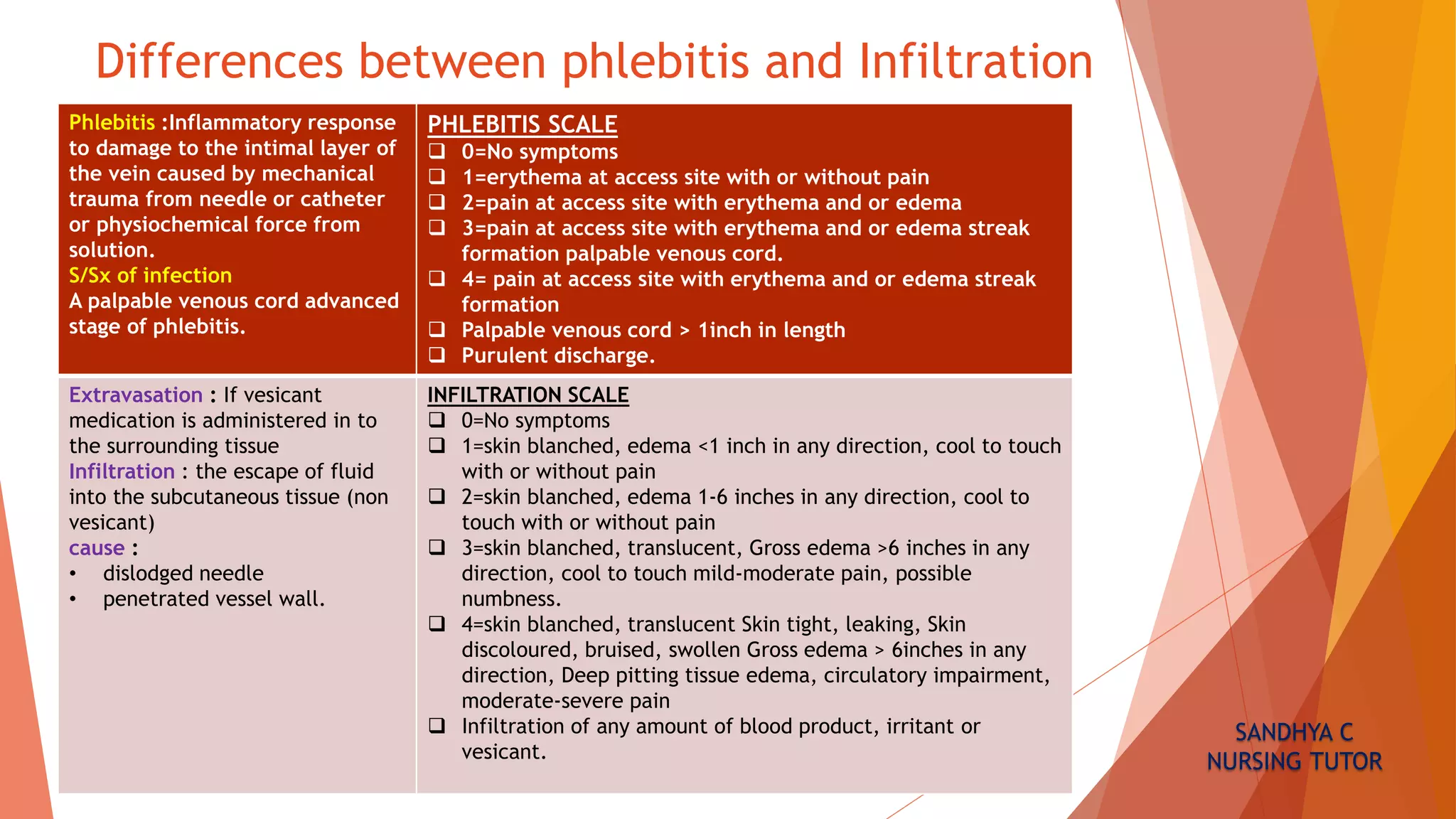
Differences between phlebitis and Infiltration
Phlebitis :Inflammatory response
to damage to the intimal layer of
the vein caused by mechanical
trauma from needle or catheter
or physiochemical force from
solution.
S/Sx of infection
A palpable venous cord advanced
stage of phlebitis.
PHLEBITIS SCALE
 0=No symptoms
 1=erythema at access site with or without pain
 2=pain at access site with erythema and or edema
 3=pain at access site with erythema and or edema streak
formation palpable venous cord.
 4= pain at access site with erythema and or edema streak
formation
 Palpable venous cord > 1inch in length
 Purulent discharge.
Extravasation : If vesicant
medication is administered in to
the surrounding tissue
Infiltration : the escape of fluid
into the subcutaneous tissue (non
vesicant)
cause :
• dislodged needle
• penetrated vessel wall.
INFILTRATION SCALE
 0=No symptoms
 1=skin blanched, edema <1 inch in any direction, cool to touch
with or without pain
 2=skin blanched, edema 1-6 inches in any direction, cool to
touch with or without pain
 3=skin blanched, translucent, Gross edema >6 inches in any
direction, cool to touch mild-moderate pain, possible
numbness.
 4=skin blanched, translucent Skin tight, leaking, Skin
discoloured, bruised, swollen Gross edema > 6inches in any
direction, Deep pitting tissue edema, circulatory impairment,
moderate-severe pain
 Infiltration of any amount of blood product, irritant or
vesicant.
SANDHYA C
NURSING TUTOR
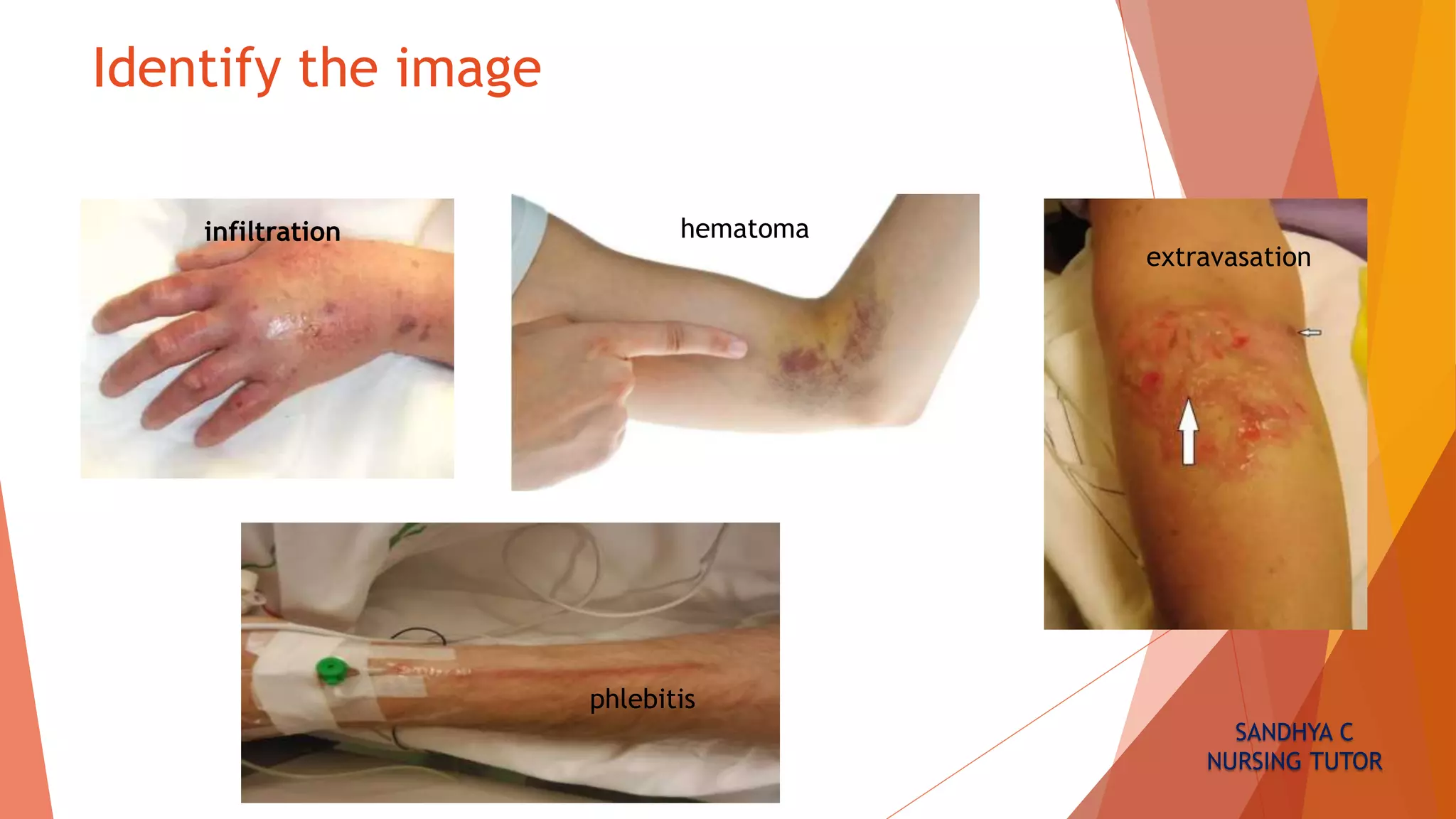
Identify the image
infiltration hematoma
extravasation
phlebitis
SANDHYA C
NURSING TUTOR
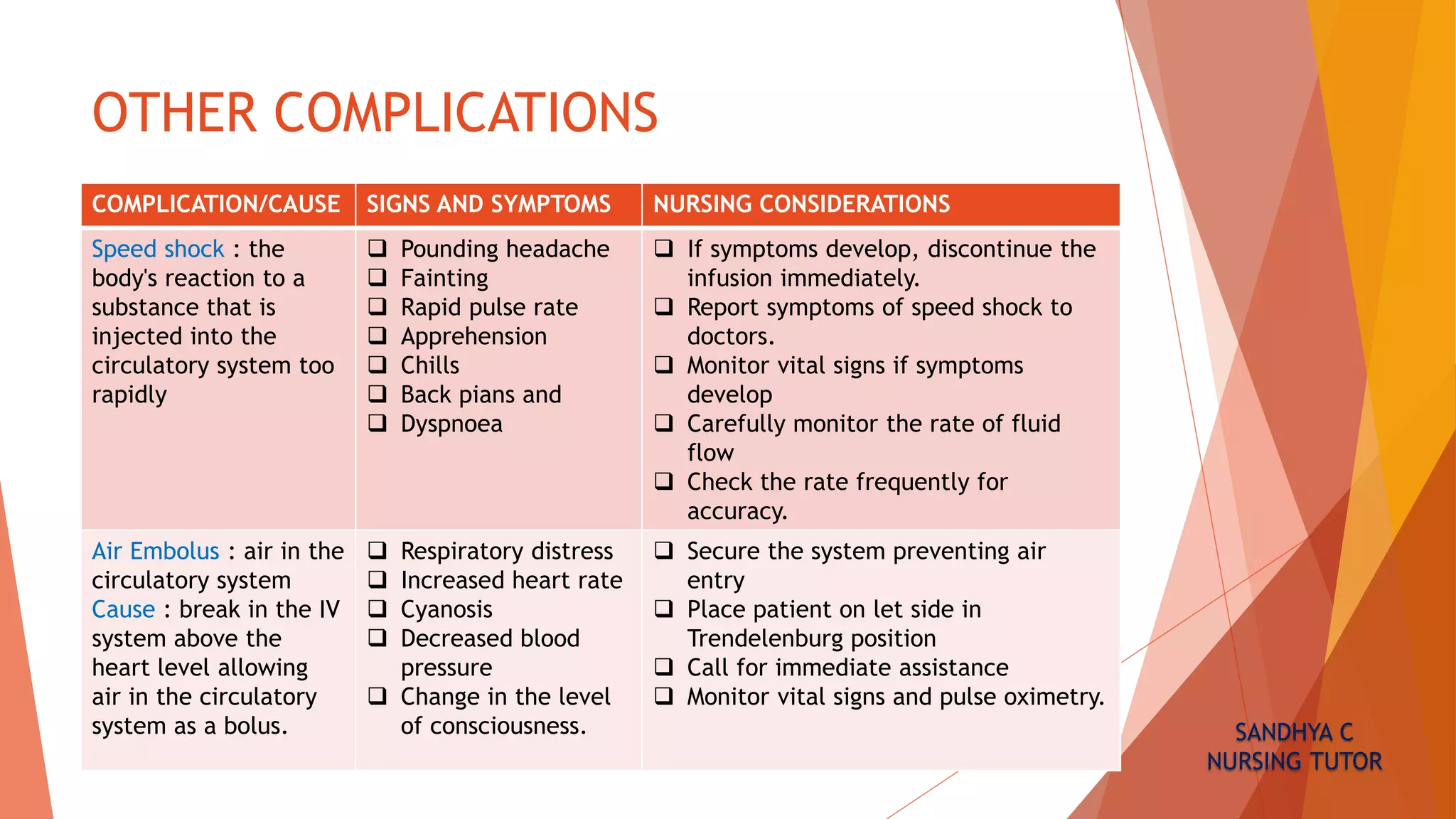
OTHER COMPLICATIONS
COMPLICATION/CAUSE SIGNS AND SYMPTOMS NURSING CONSIDERATIONS
Speed shock : the
body's reaction to a
substance that is
injected into the
circulatory system too
rapidly
 Pounding headache
 Fainting
 Rapid pulse rate
 Apprehension
 Chills
 Back pians and
 Dyspnoea
 If symptoms develop, discontinue the
infusion immediately.
 Report symptoms of speed shock to
doctors.
 Monitor vital signs if symptoms
develop
 Carefully monitor the rate of fluid
flow
 Check the rate frequently for
accuracy.
Air Embolus : air in the
circulatory system
Cause : break in the IV
system above the
heart level allowing
air in the circulatory
system as a bolus.
 Respiratory distress
 Increased heart rate
 Cyanosis
 Decreased blood
pressure
 Change in the level
of consciousness.
 Secure the system preventing air
entry
 Place patient on let side in
Trendelenburg position
 Call for immediate assistance
 Monitor vital signs and pulse oximetry.
SANDHYA C
NURSING TUTOR
Conclusion
 As the RN workforce continues to dwindle, newly
graduated nurses are often tasked with starting PIVCs
without much hands-on experience.
 We need to ensure that the infusion education
provided has a sound foundation and is evidence
based.
 National IV nurse day Jan 25th in US.
SANDHYA C
NURSING TUTOR

peripheral IV care.pptx

  • 1.
    Sandhya c Nursing Tutor PERIPHERALIV CANNULA CARE WITH VIP SCORE ASSESSMENT SANDHYA C NURSING TUTOR COLLEGE OF NURSING
  • 2.
  • 3.
    SANDHYA C NURSING TUTOR Selectionof Peripheral IV catheter site In adults, common sites used for IV cannula insertion Common sites used in paediatric patients Sites to avoid IV cannula insertion 1 3 2
  • 4.
  • 5.
    SANDHYA C NURSING TUTOR OngoingCare of a Peripheral Vascular Cannula (PVC) ANTT Decontaminate hands prior to after accessing pvc. Skin preparation and Injection ports/hubs- Scrub the hub with 2% Chlorhexidine in 70% Isopropyl alcohol wipe for 30 secs before and after accessing the system Flush pre and post drug administration with 5-10ml of sodium chloride 0.9% in a 10ml syringe The dressing should be changed immediately when it becomes loose, damp or soiled. An aseptic non-touch technique should be used when changing the dressing. A PVC should not be used for routine blood sampling. However, if necessary, blood can be drawn ONLY ONCE immediately following insertion. The dressing should be changed as required, if it becomes loose, damp or soiled or at 7 days if still remains insitu. If bandages are use as extra support to secure PVC, they should be removed at least daily and every time the PVC is accessed or infusion rates are altered in order to inspect the insertion site. The site should be monitored at each intervention and the VIP score recorded at least (minimum) daily. The site should be inspected for signs of infiltration, extravasation, leakage and using VIP score for signs of phlebitis (Loveday et al 2014).
  • 6.
    SANDHYA C NURSING TUTOR 1.A patient is being transfused 1 unit of packed RBC’s. The patient complains of burning at the IV set and pain is present. Which action will you take first and arrange them in a correct order? A. flush the IV with normal saline to check patency B. Stop the infusion C. Resume administration at a slower rate D. Assess the IV site for any signs of complications. Answer : B-D-A-C
  • 7.
    SANDHYA C NURSING TUTOR Initiationand Administration of IV solutions Check the IV solution against prescription for type, amount, percentage of solution and rate of flow, follow the rights for medication administration Check for allergy to cleansing solution, adhesive materials or Latex. Check the clients identification Explain the procedure to the client Assess the clients previous experience with IV therapy and preference for insertion site. Change the IV tubing every 96 hours in accordance with CDC. Do not let an IV bag or bottle of solution hang for more than 24 hrs to diminish the potential for bacterial contamination and possibly sepsis. Do not allow the IV tubing to touch the floor to prevent potential bacterial contamination.
  • 8.
    SANDHYA C NURSING TUTOR Removalof PVC  Remove PVC if its no longer required.  If patient has pain when fluids are infused or on flushing  If there are signs of phlebitis, infection or thrombophlebitis, VIP is greater or equal to 2  An aseptic non touch technique should be maintained while dealing with PVC.  Always check the integrity of PVC before disposal.  Apply pressure to site on removal of PVC to reduce risk of haematoma.  Document removal on the PVC label found on the daily plan of care sheet.  If site appears infected, obtain swab and send to microbiology for culture and sensitivity.  Please complete incident form.
  • 9.
  • 10.
    SANDHYA C NURSING TUTOR VISUALINFUSION PHLEBITIS SCORE (VIP SCORE)
  • 11.
    SANDHYA C NURSING TUTOR VIPSCORE 0 No signs of phlebitis-observe cannula +1 possible first signs of phlebitis- observe cannula +2 early phlebitis- Resite cannula, treat site +4 advanced thrombophlebitis Resite cannula, take swab and send to laboratory +3 Moderate phlebitis Resite cannula, treat site, take swab and send to lab
  • 12.
    SANDHYA C NURSING TUTOR Differencesbetween phlebitis and Infiltration Phlebitis :Inflammatory response to damage to the intimal layer of the vein caused by mechanical trauma from needle or catheter or physiochemical force from solution. S/Sx of infection A palpable venous cord advanced stage of phlebitis. PHLEBITIS SCALE  0=No symptoms  1=erythema at access site with or without pain  2=pain at access site with erythema and or edema  3=pain at access site with erythema and or edema streak formation palpable venous cord.  4= pain at access site with erythema and or edema streak formation  Palpable venous cord > 1inch in length  Purulent discharge. Extravasation : If vesicant medication is administered in to the surrounding tissue Infiltration : the escape of fluid into the subcutaneous tissue (non vesicant) cause : • dislodged needle • penetrated vessel wall. INFILTRATION SCALE  0=No symptoms  1=skin blanched, edema <1 inch in any direction, cool to touch with or without pain  2=skin blanched, edema 1-6 inches in any direction, cool to touch with or without pain  3=skin blanched, translucent, Gross edema >6 inches in any direction, cool to touch mild-moderate pain, possible numbness.  4=skin blanched, translucent Skin tight, leaking, Skin discoloured, bruised, swollen Gross edema > 6inches in any direction, Deep pitting tissue edema, circulatory impairment, moderate-severe pain  Infiltration of any amount of blood product, irritant or vesicant.
  • 13.
    SANDHYA C NURSING TUTOR Identifythe image infiltration hematoma extravasation phlebitis
  • 14.
    SANDHYA C NURSING TUTOR OTHERCOMPLICATIONS COMPLICATION/CAUSE SIGNS AND SYMPTOMS NURSING CONSIDERATIONS Speed shock : the body's reaction to a substance that is injected into the circulatory system too rapidly  Pounding headache  Fainting  Rapid pulse rate  Apprehension  Chills  Back pians and  Dyspnoea  If symptoms develop, discontinue the infusion immediately.  Report symptoms of speed shock to doctors.  Monitor vital signs if symptoms develop  Carefully monitor the rate of fluid flow  Check the rate frequently for accuracy. Air Embolus : air in the circulatory system Cause : break in the IV system above the heart level allowing air in the circulatory system as a bolus.  Respiratory distress  Increased heart rate  Cyanosis  Decreased blood pressure  Change in the level of consciousness.  Secure the system preventing air entry  Place patient on let side in Trendelenburg position  Call for immediate assistance  Monitor vital signs and pulse oximetry.
  • 15.
    SANDHYA C NURSING TUTOR Conclusion As the RN workforce continues to dwindle, newly graduated nurses are often tasked with starting PIVCs without much hands-on experience.  We need to ensure that the infusion education provided has a sound foundation and is evidence based.  National IV nurse day Jan 25th in US.
  • 16.