Code Blue

American Heart Association Basic Life Support, Advanced
Cardiac Life Support, and Pediatric Advanced Life Support
protocols are implemented promptly upon recognition of
cardiopulmonary arrest unless a written physician order
states otherwise
   Associates in areas where patient care is delivered complete a
    BLS course or are trained in BLS every two years according to
    AHA standards
   Whenever a Code Blue is called, the attending physician is
    notified as soon as possible
Code Blue (continued)

Nurses working in critical care,
emergency department, nursing
supervisors, and other key personnel
successfully complete a course in
Advanced Cardiac Life Support (ACLS)
according to AHA standards every two
years
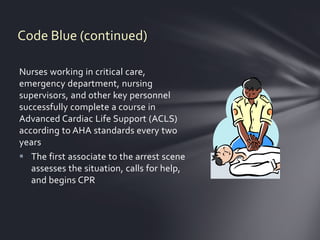
 The first associate to the arrest scene
   assesses the situation, calls for help,
   and begins CPR
Code Blue (continued)

 The code for cardiopulmonary arrest is CODE BLUE
   • Code Blue is also called for patients with acute respiratory
      distress and/or severe hypotension
 The emergency phone number is 5555
   • This number provides a direct line to notify the switchboard
      operator of the Code Blue
   • When the operator answers, the caller indicates the location
      of the arrest by stating Code Blue Room ___
 The operator may also be notified of a Code Blue by activating
  the Code Blue button, where present, in the patient room
Code Blue (continued)
 On the South Campus the Emergency Code can be called by
  activating the Code Blue button in the room or dialing 5555 or by
  dialing 66 from the patient room
 When dialing 66 you are automatically on the intercom and may
  call the Code by saying “CODE BLUE”, Room ______” three times.
 The operator will then continue to page every 10 seconds until
  notified to discontinue the page
 The Paramedic Service is notified by picking up the “Blue Phone”
  on the station.
 The closest exterior entrance doors for Paramedic arrival are
  opened by a staff member.
 The paramedic Service dispatch transports the patient to White
  County Medical Center Emergency Department
Code Blue (continued)
 Important: Let the operator know as soon as the code team is
  assembled to discontinue the overhead page
   • To do this, dial 5555 and state “STOP PAGING THE CODE”
   • The operator will then stop announcing the location of the code
 If a code is called mistakenly, let the operator know by dialing 5555
  and state “CODE BLUE ALL CLEAR”
   • The operator will then announce “CODE BLUE ALL CLEAR” and
       there is no longer any need to respond
   • Do not say “CODE BLUE ALL CLEAR” unless the situation has
       been resolved or the code was called by mistake and help is not
       needed
 These are the only two phrases the operator will recognize relating
  to Code Blue
Code Blue (continued)

 Advanced Cardiac Life Support is provided by the Code Team
  and is continued until:
   • Effective spontaneous circulation and ventilation is restored
     as determined by the team captain
   • The physician makes the decision to terminate resuscitative
     efforts based on the evaluation of the cerebral and
     cardiovascular status of the patient
 Respiratory Distress/Hypotension
   • In the event a patient needs immediate medical attention as
     a result of acute respiratory distress and/or severe
     hypotension a Code Blue is called
Code Blue (continued)

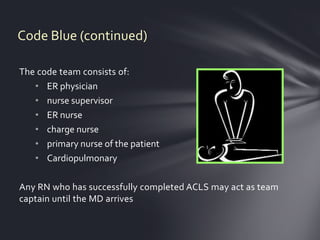
The code team consists of:
   • ER physician
   • nurse supervisor
   • ER nurse
   • charge nurse
   • primary nurse of the patient
   • Cardiopulmonary

Any RN who has successfully completed ACLS may act as team
captain until the MD arrives
Code Blue (continued)
Immediate Interventions are as follows:
 Whenever a patient is found to be pulseless a call for help is
  made and BLS is initiated
 The patient is ventilated with 100 % oxygen and high quality
  compressions are performed
 ECG monitoring is established
 BLS is continued until a defibrillator arrives
 If the patient has Ventricular Fibrillation or Pulseless Ventricular
  Tachycardia the RN delivers appropriate defibrillation every 5th
  cycle of CPR
 Epinephrine 1:10,000 1mg IVP is given every 3 to 5 minutes.
 The above therapy continues until the physician or an RN that
  has completed ACLS is present to direct the team
Code Blue (continued)
The primary nurse is responsible for:
    Establishing EKG monitoring if not already done
    Assuring the patient's chart is in the room
    Notifying patient's attending physician of Code Blue
    Observing to determine when CPR team has arrived and
       notifying operator to “Discontinue the Page”
    Recording on resuscitation sheet
    Directing CPR team members to appropriate room
    Assisting in clearing room of unnecessary personnel and
       equipment - assists with family members
    Obtaining equipment/supplies as needed
    After the code, the primary nurse is responsible for notifying
       pharmacy to obtain an exchange cart
Code Blue (continued)

 The information from the code must be transcribed onto the
  resuscitation record if not already
 Information on the resuscitation record need not be documented
  again in CPSI
 Rhythm monitoring is included and is mounted and identified with
  patient's name, chart number, date, time, and then attached to
  the appropriate form
 A Code Review form is completed for every code by the shift
  supervisor who then directs the form to the clinical manager of
  the area
Code Blue (continued) - Pediatrics

In the event of a pediatric code:
 The pediatric crash cart and the adult crash cart are both taken to
    the scene
 In the event of any delay in the arrival of a physician to the code
    blue location, the following therapy is instituted by the
    appropriate Code Blue team member:
An ACLS or PALS RN acts as team captain and is responsible for
evaluation of the patient's condition in regard to cardiac and respiratory
status
  • Patient is ventilated with 100% oxygen and high quality
    compressions are started as needed and pulse oximetry is applied

       Interventions continued on next slide
Code Blue (continued) - Pediatrics

Interventions continued:
 Patient is intubated, placement of ET tube is verified with ETCO2
  device, and tube is secured as soon as possible
 Defibrillate Ventricular Fibrillation or Pulseless Ventricular
  Tachycardia
 Defibrillate once if needed, using 2J/kg
 Then defibrillate as needed after every 5 cycles of CPR using 4 J/kg
The above therapy continues until the physician is present to direct
the team
Code Blue (continued) – South Campus
 On the South Campus – the Code Team consists of:
   • Nurse supervisor
   • Charge nurse
   • Primary nurse of the patient
   • Cardiopulmonary
   • CSA/HUC
 On the South Campus - BLS, use of the AED every two
  minutes, starting an IV of normal saline, and giving epinephrine
  1:10,000, 1mg IVP every 3 to 5 minutes while BLS is being
  provided is performed by the code team until one of the following
  occurs:
  • Spontaneous circulation and ventilation is restored
  • Decision is made to terminate resuscitative efforts
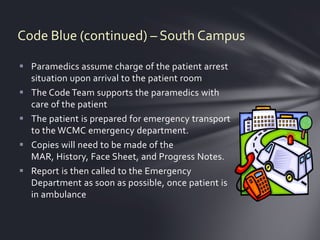
Code Blue (continued) – South Campus

 Paramedics assume charge of the patient arrest
  situation upon arrival to the patient room
 The Code Team supports the paramedics with
  care of the patient
 The patient is prepared for emergency transport
  to the WCMC emergency department.
 Copies will need to be made of the
  MAR, History, Face Sheet, and Progress Notes.
 Report is then called to the Emergency
  Department as soon as possible, once patient is
  in ambulance
Code Blue (continued) – Crash Cart

Whenever the crash cart is opened, an exchange cart is obtained from
the Pharmacy
 A Pharmacy requisition should be sent with the patient’s label on it
  along with “replace crash cart”
 Nursing transfers items on top of the cart such as the defibrillator and
  suction machine to the new cart
 Pharmacy takes the used cart and refills it
 If the exchange cart is unavailable, the used drawers are replaced with
  stocked, sealed drawers – the cart is then resealed with a seal obtained
  from Pharmacy
 Be sure to return the clear drawer covers and remove any used
  equipment from the cart before calling pharmacy to obtain an
  exchange cart
Code Blue (continued) – Crash Cart

 All chargeable items used from the cart during a code are
  charged in CPSI
 Medications used are charged by the Pharmacy when
  replaced
 Other used items are charged to the patient with a
  sticker or through the computer system by the area
  where the supplies were used
 Remember to charge all stickered items used from the
  cart in CPSI
 Each cart is checked monthly for outdated drugs and
  other supplies by the Pharmacy
Code Blue (continued) – Crash Cart

Pediatric Crash Carts
 Pediatric Cardiac arrests are most
  often secondary to respiratory
  arrest
 All areas that care for pediatric
  patients have age appropriate
  equipment available for emergency
 The adult crash cart (which contains
  additional medications) is taken to
  the emergency situation along with
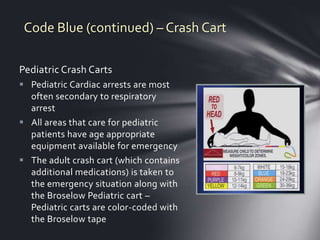
  the Broselow Pediatric cart –
  Pediatric carts are color-coded with
  the Broselow tape
Code Blue (continued) – Crash Cart

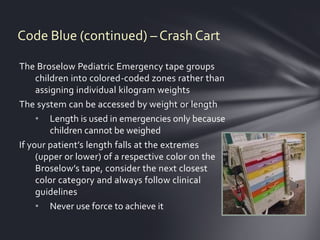
The Broselow Pediatric Emergency tape groups
     children into colored-coded zones rather than
     assigning individual kilogram weights
The system can be accessed by weight or length
     • Length is used in emergencies only because
         children cannot be weighed
If your patient’s length falls at the extremes
     (upper or lower) of a respective color on the
     Broselow’s tape, consider the next closest
     color category and always follow clinical
     guidelines
     • Never use force to achieve it

Code blue

  • 1.
    Code Blue American HeartAssociation Basic Life Support, Advanced Cardiac Life Support, and Pediatric Advanced Life Support protocols are implemented promptly upon recognition of cardiopulmonary arrest unless a written physician order states otherwise  Associates in areas where patient care is delivered complete a BLS course or are trained in BLS every two years according to AHA standards  Whenever a Code Blue is called, the attending physician is notified as soon as possible
  • 2.
    Code Blue (continued) Nursesworking in critical care, emergency department, nursing supervisors, and other key personnel successfully complete a course in Advanced Cardiac Life Support (ACLS) according to AHA standards every two years  The first associate to the arrest scene assesses the situation, calls for help, and begins CPR
  • 3.
    Code Blue (continued) The code for cardiopulmonary arrest is CODE BLUE • Code Blue is also called for patients with acute respiratory distress and/or severe hypotension  The emergency phone number is 5555 • This number provides a direct line to notify the switchboard operator of the Code Blue • When the operator answers, the caller indicates the location of the arrest by stating Code Blue Room ___  The operator may also be notified of a Code Blue by activating the Code Blue button, where present, in the patient room
  • 4.
    Code Blue (continued) On the South Campus the Emergency Code can be called by activating the Code Blue button in the room or dialing 5555 or by dialing 66 from the patient room  When dialing 66 you are automatically on the intercom and may call the Code by saying “CODE BLUE”, Room ______” three times.  The operator will then continue to page every 10 seconds until notified to discontinue the page  The Paramedic Service is notified by picking up the “Blue Phone” on the station.  The closest exterior entrance doors for Paramedic arrival are opened by a staff member.  The paramedic Service dispatch transports the patient to White County Medical Center Emergency Department
  • 5.
    Code Blue (continued) Important: Let the operator know as soon as the code team is assembled to discontinue the overhead page • To do this, dial 5555 and state “STOP PAGING THE CODE” • The operator will then stop announcing the location of the code  If a code is called mistakenly, let the operator know by dialing 5555 and state “CODE BLUE ALL CLEAR” • The operator will then announce “CODE BLUE ALL CLEAR” and there is no longer any need to respond • Do not say “CODE BLUE ALL CLEAR” unless the situation has been resolved or the code was called by mistake and help is not needed  These are the only two phrases the operator will recognize relating to Code Blue
  • 6.
    Code Blue (continued) Advanced Cardiac Life Support is provided by the Code Team and is continued until: • Effective spontaneous circulation and ventilation is restored as determined by the team captain • The physician makes the decision to terminate resuscitative efforts based on the evaluation of the cerebral and cardiovascular status of the patient  Respiratory Distress/Hypotension • In the event a patient needs immediate medical attention as a result of acute respiratory distress and/or severe hypotension a Code Blue is called
  • 7.
    Code Blue (continued) Thecode team consists of: • ER physician • nurse supervisor • ER nurse • charge nurse • primary nurse of the patient • Cardiopulmonary Any RN who has successfully completed ACLS may act as team captain until the MD arrives
  • 8.
    Code Blue (continued) ImmediateInterventions are as follows:  Whenever a patient is found to be pulseless a call for help is made and BLS is initiated  The patient is ventilated with 100 % oxygen and high quality compressions are performed  ECG monitoring is established  BLS is continued until a defibrillator arrives  If the patient has Ventricular Fibrillation or Pulseless Ventricular Tachycardia the RN delivers appropriate defibrillation every 5th cycle of CPR  Epinephrine 1:10,000 1mg IVP is given every 3 to 5 minutes.  The above therapy continues until the physician or an RN that has completed ACLS is present to direct the team
  • 9.
    Code Blue (continued) Theprimary nurse is responsible for:  Establishing EKG monitoring if not already done  Assuring the patient's chart is in the room  Notifying patient's attending physician of Code Blue  Observing to determine when CPR team has arrived and notifying operator to “Discontinue the Page”  Recording on resuscitation sheet  Directing CPR team members to appropriate room  Assisting in clearing room of unnecessary personnel and equipment - assists with family members  Obtaining equipment/supplies as needed  After the code, the primary nurse is responsible for notifying pharmacy to obtain an exchange cart
  • 10.
    Code Blue (continued) The information from the code must be transcribed onto the resuscitation record if not already  Information on the resuscitation record need not be documented again in CPSI  Rhythm monitoring is included and is mounted and identified with patient's name, chart number, date, time, and then attached to the appropriate form  A Code Review form is completed for every code by the shift supervisor who then directs the form to the clinical manager of the area
  • 11.
    Code Blue (continued)- Pediatrics In the event of a pediatric code:  The pediatric crash cart and the adult crash cart are both taken to the scene  In the event of any delay in the arrival of a physician to the code blue location, the following therapy is instituted by the appropriate Code Blue team member: An ACLS or PALS RN acts as team captain and is responsible for evaluation of the patient's condition in regard to cardiac and respiratory status • Patient is ventilated with 100% oxygen and high quality compressions are started as needed and pulse oximetry is applied Interventions continued on next slide
  • 12.
    Code Blue (continued)- Pediatrics Interventions continued:  Patient is intubated, placement of ET tube is verified with ETCO2 device, and tube is secured as soon as possible  Defibrillate Ventricular Fibrillation or Pulseless Ventricular Tachycardia  Defibrillate once if needed, using 2J/kg  Then defibrillate as needed after every 5 cycles of CPR using 4 J/kg The above therapy continues until the physician is present to direct the team
  • 13.
    Code Blue (continued)– South Campus  On the South Campus – the Code Team consists of: • Nurse supervisor • Charge nurse • Primary nurse of the patient • Cardiopulmonary • CSA/HUC  On the South Campus - BLS, use of the AED every two minutes, starting an IV of normal saline, and giving epinephrine 1:10,000, 1mg IVP every 3 to 5 minutes while BLS is being provided is performed by the code team until one of the following occurs: • Spontaneous circulation and ventilation is restored • Decision is made to terminate resuscitative efforts
  • 14.
    Code Blue (continued)– South Campus  Paramedics assume charge of the patient arrest situation upon arrival to the patient room  The Code Team supports the paramedics with care of the patient  The patient is prepared for emergency transport to the WCMC emergency department.  Copies will need to be made of the MAR, History, Face Sheet, and Progress Notes.  Report is then called to the Emergency Department as soon as possible, once patient is in ambulance
  • 15.
    Code Blue (continued)– Crash Cart Whenever the crash cart is opened, an exchange cart is obtained from the Pharmacy  A Pharmacy requisition should be sent with the patient’s label on it along with “replace crash cart”  Nursing transfers items on top of the cart such as the defibrillator and suction machine to the new cart  Pharmacy takes the used cart and refills it  If the exchange cart is unavailable, the used drawers are replaced with stocked, sealed drawers – the cart is then resealed with a seal obtained from Pharmacy  Be sure to return the clear drawer covers and remove any used equipment from the cart before calling pharmacy to obtain an exchange cart
  • 16.
    Code Blue (continued)– Crash Cart  All chargeable items used from the cart during a code are charged in CPSI  Medications used are charged by the Pharmacy when replaced  Other used items are charged to the patient with a sticker or through the computer system by the area where the supplies were used  Remember to charge all stickered items used from the cart in CPSI  Each cart is checked monthly for outdated drugs and other supplies by the Pharmacy
  • 17.
    Code Blue (continued)– Crash Cart Pediatric Crash Carts  Pediatric Cardiac arrests are most often secondary to respiratory arrest  All areas that care for pediatric patients have age appropriate equipment available for emergency  The adult crash cart (which contains additional medications) is taken to the emergency situation along with the Broselow Pediatric cart – Pediatric carts are color-coded with the Broselow tape
  • 18.
    Code Blue (continued)– Crash Cart The Broselow Pediatric Emergency tape groups children into colored-coded zones rather than assigning individual kilogram weights The system can be accessed by weight or length • Length is used in emergencies only because children cannot be weighed If your patient’s length falls at the extremes (upper or lower) of a respective color on the Broselow’s tape, consider the next closest color category and always follow clinical guidelines • Never use force to achieve it