Management of
Medicine
Dr.Shrikant Raut
Clinical Pharmacologist
Pre-Test
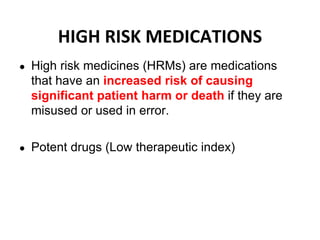
HIGH RISK MEDICATIONS
● High risk medicines (HRMs) are medications
that have an increased risk of causing
significant patient harm or death if they are
misused or used in error.
● Potent drugs (Low therapeutic index)
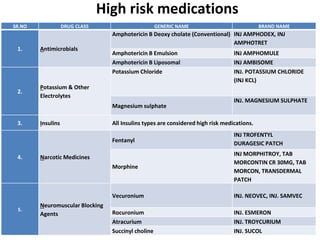
High risk medications
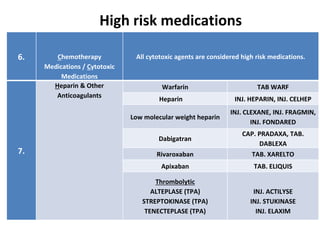
SR.NO DRUG CLASS GENERIC NAME BRAND NAME
1. Antimicrobials
Amphotericin B Deoxy cholate (Conventional) INJ AMPHODEX, INJ
AMPHOTRET
Amphotericin B Emulsion INJ AMPHOMULE
Amphotericin B Liposomal INJ AMBISOME
2.
Potassium & Other
Electrolytes
Potassium Chloride INJ. POTASSIUM CHLORIDE
(INJ KCL)
Magnesium sulphate
INJ. MAGNESIUM SULPHATE
3. Insulins All Insulins types are considered high risk medications.
4. Narcotic Medicines
Fentanyl
INJ TROFENTYL
DURAGESIC PATCH
Morphine
INJ MORPHITROY, TAB
MORCONTIN CR 30MG, TAB
MORCON, TRANSDERMAL
PATCH
5.
Neuromuscular Blocking
Agents
Vecuronium INJ. NEOVEC, INJ. SAMVEC
Rocuronium INJ. ESMERON
Atracurium INJ. TROYCURIUM
Succinyl choline INJ. SUCOL
6. Chemotherapy
Medications / Cytotoxic
Medications
All cytotoxic agents are considered high risk medications.
7.
Heparin & Other
Anticoagulants
Warfarin TAB WARF
Heparin INJ. HEPARIN, INJ. CELHEP
Low molecular weight heparin
INJ. CLEXANE, INJ. FRAGMIN,
INJ. FONDARED
Dabigatran
CAP. PRADAXA, TAB.
DABLEXA
Rivaroxaban TAB. XARELTO
Apixaban TAB. ELIQUIS
Thrombolytic
ALTEPLASE (TPA)
STREPTOKINASE (TPA)
TENECTEPLASE (TPA)
INJ. ACTILYSE
INJ. STUKINASE
INJ. ELAXIM
High risk medications
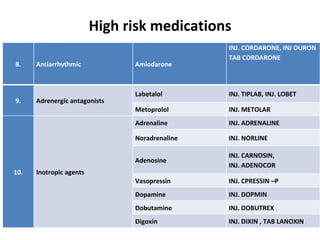
8. Antiarrhythmic Amiodarone
INJ. CORDARONE, INJ DURON
TAB CORDARONE
9. Adrenergic antagonists
Labetalol INJ. TIPLAB, INJ. LOBET
Metoprolol INJ. METOLAR
10. Inotropic agents
Adrenaline INJ. ADRENALINE
Noradrenaline INJ. NORLINE
Adenosine
INJ. CARNOSIN,
INJ. ADENOCOR
Vasopressin INJ. CPRESSIN –P
Dopamine INJ. DOPMIN
Dobutamine INJ. DOBUTREX
Digoxin INJ. DIXIN , TAB LANOXIN
High risk medications
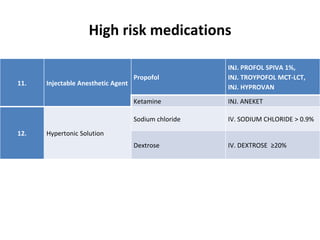
11. Injectable Anesthetic Agent
Propofol
INJ. PROFOL SPIVA 1%,
INJ. TROYPOFOL MCT-LCT,
INJ. HYPROVAN
Ketamine INJ. ANEKET
12. Hypertonic Solution
Sodium chloride IV. SODIUM CHLORIDE > 0.9%
Dextrose IV. DEXTROSE ≥20%
High risk medications
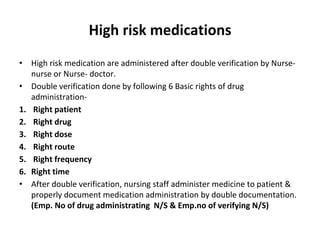
• High risk medication are administered after double verification by Nurse-
nurse or Nurse- doctor.
• Double verification done by following 6 Basic rights of drug
administration-
1. Right patient
2. Right drug
3. Right dose
4. Right route
5. Right frequency
6. Right time
• After double verification, nursing staff administer medicine to patient &
properly document medication administration by double documentation.
(Emp. No of drug administrating N/S & Emp.no of verifying N/S)
High risk medications
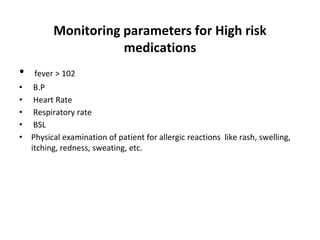
Monitoring parameters for High risk
medications
• fever > 102
• B.P
• Heart Rate
• Respiratory rate
• BSL
• Physical examination of patient for allergic reactions like rash, swelling,
itching, redness, sweating, etc.
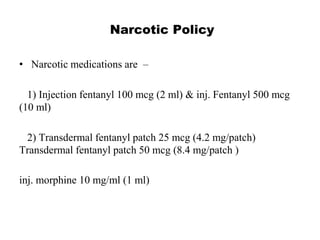
Narcotic Policy
• Narcotic medications are –
1) Injection fentanyl 100 mcg (2 ml) & inj. Fentanyl 500 mcg
(10 ml)
2) Transdermal fentanyl patch 25 mcg (4.2 mg/patch)
Transdermal fentanyl patch 50 mcg (8.4 mg/patch )
inj. morphine 10 mg/ml (1 ml)
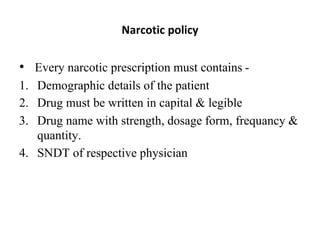
• Every narcotic prescription must contains -
1. Demographic details of the patient
2. Drug must be written in capital & legible
3. Drug name with strength, dosage form, frequancy &
quantity.
4. SNDT of respective physician
Narcotic policy
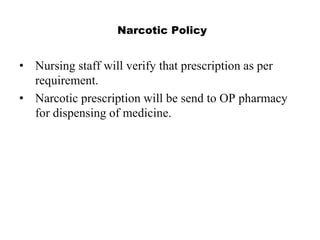
• Nursing staff will verify that prescription as per
requirement.
• Narcotic prescription will be send to OP pharmacy
for dispensing of medicine.
Narcotic Policy
Role of Pharmacist
• Receive the prescription:
– Verify demographics.
– Verify Drug Name, dosage form , Strength, route, Qty to
be supplied.
– SNDT of Physician.
• Dispensing of medicine
- Receive medication from double lock & key (2 keys with 2
different person)
- double verification before dispensing
- high risk & drug supplied stamp after double verification.
- maintain record of narcotics dispensed as per
requirement.
Role of nursing staff in Narcotic Policy
• Administration- Double verification and Double sign.
• Remaining medicine must be-discard In front of witness
under running tap water.
• Empty Ampules- Submit to Pharmacist on daily basis.
• Maintain record of empty ampules returned.
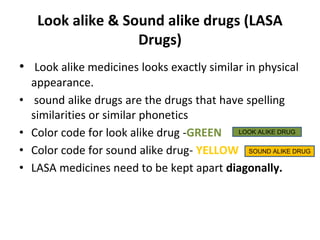
Look alike & Sound alike drugs (LASA
Drugs)
• Look alike medicines looks exactly similar in physical
appearance.
• sound alike drugs are the drugs that have spelling
similarities or similar phonetics
• Color code for look alike drug -GREEN
• Color code for sound alike drug- YELLOW
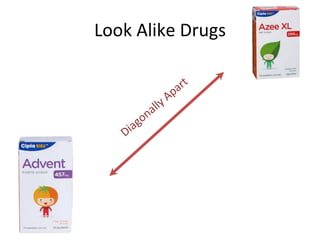
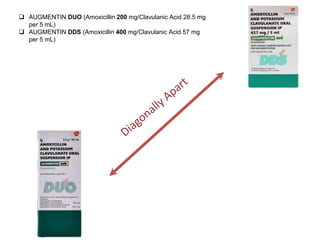
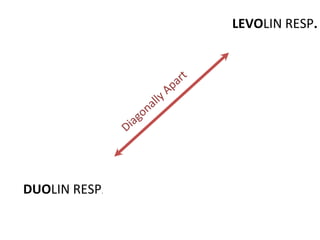
• LASA medicines need to be kept apart diagonally.
LOOK ALIKE DRUG
SOUND ALIKE DRUG
Look Alike Drugs
 AUGMENTIN DUO (Amoxicillin 200 mg/Clavulanic Acid 28.5 mg
per 5 mL)
 AUGMENTIN DDS (Amoxicillin 400 mg/Clavulanic Acid 57 mg
per 5 mL)
DUOLIN RESP.
LEVOLIN RESP.
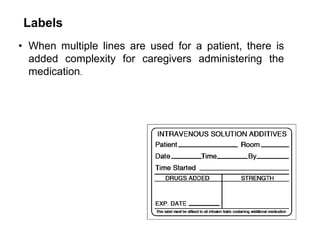
• When multiple lines are used for a patient, there is
added complexity for caregivers administering the
medication.
Labels
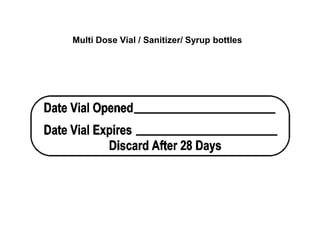
Multi Dose Vial / Sanitizer/ Syrup bottles
Crash cart Trolley
• Crash cart is used only in Emergency conditions. (code blue
situations like respiratory arrest, cardiac arrest, RTA, Stroke, etc. )
• Crash cart list is displayed to crash cart which includes all
emergency medicines. Crash cart list to be revised every yearly.
• Entry of consumed items is maintained in crash cart book.
• Stock of crash cart is refilled immediately after consumption.
• Crash cart is sealed after replacement of used items.
• Near expiry items need to be segregated in every last week of the
month.
• Crash cart audit is conducted every monthly by clinical
pharmacologist to check availability of emergency medicines .
Adverse Drug Reaction & its management
• A response to a drug which is noxious and unintended and which occurs at
doses normally used in man for prophylaxis, diagnosis, or therapy of
disease or for the modification of physiologic function.
• Any nursing staffs who witness a suspected adverse drug reaction will
notify the doctors.
• The doctor will examine the patient, and shall order necessary
intervention, if needed like stoppage of medicine.
• Resident doctor shall inform to the treating consultant about the reaction.
The consultant will take a decision regarding the dose reduction or
stoppage of medicine.
• Attending doctor / staff nurse shall report adverse drug reaction with
adverse drug reaction reporting form immediately after the reaction has
occurred.
Adverse Drug Reaction & its
management
• Completely filled adverse drug reaction form shall be sent to Clinical
pharmacologist.
• Meanwhile, Clinical pharmacologist shall discuss with the treating
consultant about ADR and then decide about the recall/stoppage of the
drug use in the hospital depending upon the severity of reaction and
occurrence of ADR in multiple patients.
• Decision of Recall of drugs shall be taken in consultation with Pharmacy
HOD, Clinical Pharmacologist, Supply chain head and/or Medical director .
• Pharmacy & Therapeutic Committee shall review all ADRs quarterly.
Verbal order policy
• verbal and telephonic orders shall be utilized only in emergency
situations where delay will result in compromise in patient care.
• verbal confirmation can be obtained from Prescribing consultant &
accepted by Registered doctor & nurse
• Verbal orders for high alert medications and Narcotics & psychotropic
substances will not be accepted (except for Insulin and Dextrose 25% ).
Verbal order policy
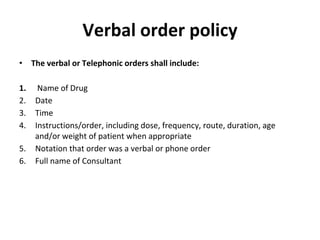
• The verbal or Telephonic orders shall include:
1. Name of Drug
2. Date
3. Time
4. Instructions/order, including dose, frequency, route, duration, age
and/or weight of patient when appropriate
5. Notation that order was a verbal or phone order
6. Full name of Consultant
Verbal order policy
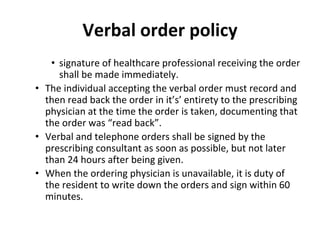
• signature of healthcare professional receiving the order
shall be made immediately.
• The individual accepting the verbal order must record and
then read back the order in it’s’ entirety to the prescribing
physician at the time the order is taken, documenting that
the order was “read back”.
• Verbal and telephone orders shall be signed by the
prescribing consultant as soon as possible, but not later
than 24 hours after being given.
• When the ordering physician is unavailable, it is duty of
the resident to write down the orders and sign within 60
minutes.
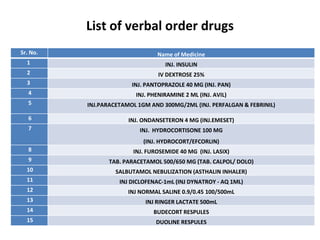
List of verbal order drugs
Sr. No. Name of Medicine
1 INJ. INSULIN
2 IV DEXTROSE 25%
3 INJ. PANTOPRAZOLE 40 MG (INJ. PAN)
4 INJ. PHENIRAMINE 2 ML (INJ. AVIL)
5 INJ.PARACETAMOL 1GM AND 300MG/2ML (INJ. PERFALGAN & FEBRINIL)
6 INJ. ONDANSETERON 4 MG (INJ.EMESET)
7 INJ. HYDROCORTISONE 100 MG
(INJ. HYDROCORT/EFCORLIN)
8 INJ. FUROSEMIDE 40 MG (INJ. LASIX)
9 TAB. PARACETAMOL 500/650 MG (TAB. CALPOL/ DOLO)
10 SALBUTAMOL NEBULIZATION (ASTHALIN INHALER)
11 INJ DICLOFENAC-1mL (INJ DYNATROY - AQ 1ML)
12 INJ NORMAL SALINE 0.9/0.45 100/500mL
13 INJ RINGER LACTATE 500mL
14 BUDECORT RESPULES
15 DUOLINE RESPULES
Medication error
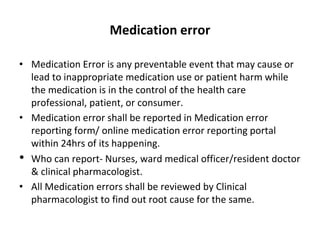
• Medication Error is any preventable event that may cause or
lead to inappropriate medication use or patient harm while
the medication is in the control of the health care
professional, patient, or consumer.
• Medication error shall be reported in Medication error
reporting form/ online medication error reporting portal
within 24hrs of its happening.
• Who can report- Nurses, ward medical officer/resident doctor
& clinical pharmacologist.
• All Medication errors shall be reviewed by Clinical
pharmacologist to find out root cause for the same.
Medication error
• Corrective & preventive action need to be taken to avoid
such incidence in future.
• Types of medication error-
1. Prescription error
2. Transcription error
3. Dispensing error
4. Administration error
5. Storage error
6. Documentation error
OUTSIDE MEDICATION FORM
• Any Medicine that patient don’t want to
buy from our hospital.
• OUTSIDE MEDICATION FORM.pdf
Post-Test
Thank You

Nursing NABH TRAINING.pptx

  • 1.
  • 2.
  • 3.
    HIGH RISK MEDICATIONS ●High risk medicines (HRMs) are medications that have an increased risk of causing significant patient harm or death if they are misused or used in error. ● Potent drugs (Low therapeutic index)
  • 4.
    High risk medications SR.NODRUG CLASS GENERIC NAME BRAND NAME 1. Antimicrobials Amphotericin B Deoxy cholate (Conventional) INJ AMPHODEX, INJ AMPHOTRET Amphotericin B Emulsion INJ AMPHOMULE Amphotericin B Liposomal INJ AMBISOME 2. Potassium & Other Electrolytes Potassium Chloride INJ. POTASSIUM CHLORIDE (INJ KCL) Magnesium sulphate INJ. MAGNESIUM SULPHATE 3. Insulins All Insulins types are considered high risk medications. 4. Narcotic Medicines Fentanyl INJ TROFENTYL DURAGESIC PATCH Morphine INJ MORPHITROY, TAB MORCONTIN CR 30MG, TAB MORCON, TRANSDERMAL PATCH 5. Neuromuscular Blocking Agents Vecuronium INJ. NEOVEC, INJ. SAMVEC Rocuronium INJ. ESMERON Atracurium INJ. TROYCURIUM Succinyl choline INJ. SUCOL
  • 5.
    6. Chemotherapy Medications /Cytotoxic Medications All cytotoxic agents are considered high risk medications. 7. Heparin & Other Anticoagulants Warfarin TAB WARF Heparin INJ. HEPARIN, INJ. CELHEP Low molecular weight heparin INJ. CLEXANE, INJ. FRAGMIN, INJ. FONDARED Dabigatran CAP. PRADAXA, TAB. DABLEXA Rivaroxaban TAB. XARELTO Apixaban TAB. ELIQUIS Thrombolytic ALTEPLASE (TPA) STREPTOKINASE (TPA) TENECTEPLASE (TPA) INJ. ACTILYSE INJ. STUKINASE INJ. ELAXIM High risk medications
  • 6.
    8. Antiarrhythmic Amiodarone INJ.CORDARONE, INJ DURON TAB CORDARONE 9. Adrenergic antagonists Labetalol INJ. TIPLAB, INJ. LOBET Metoprolol INJ. METOLAR 10. Inotropic agents Adrenaline INJ. ADRENALINE Noradrenaline INJ. NORLINE Adenosine INJ. CARNOSIN, INJ. ADENOCOR Vasopressin INJ. CPRESSIN –P Dopamine INJ. DOPMIN Dobutamine INJ. DOBUTREX Digoxin INJ. DIXIN , TAB LANOXIN High risk medications
  • 7.
    11. Injectable AnestheticAgent Propofol INJ. PROFOL SPIVA 1%, INJ. TROYPOFOL MCT-LCT, INJ. HYPROVAN Ketamine INJ. ANEKET 12. Hypertonic Solution Sodium chloride IV. SODIUM CHLORIDE > 0.9% Dextrose IV. DEXTROSE ≥20% High risk medications
  • 8.
    • High riskmedication are administered after double verification by Nurse- nurse or Nurse- doctor. • Double verification done by following 6 Basic rights of drug administration- 1. Right patient 2. Right drug 3. Right dose 4. Right route 5. Right frequency 6. Right time • After double verification, nursing staff administer medicine to patient & properly document medication administration by double documentation. (Emp. No of drug administrating N/S & Emp.no of verifying N/S) High risk medications
  • 9.
    Monitoring parameters forHigh risk medications • fever > 102 • B.P • Heart Rate • Respiratory rate • BSL • Physical examination of patient for allergic reactions like rash, swelling, itching, redness, sweating, etc.
  • 10.
    Narcotic Policy • Narcoticmedications are – 1) Injection fentanyl 100 mcg (2 ml) & inj. Fentanyl 500 mcg (10 ml) 2) Transdermal fentanyl patch 25 mcg (4.2 mg/patch) Transdermal fentanyl patch 50 mcg (8.4 mg/patch ) inj. morphine 10 mg/ml (1 ml)
  • 11.
    • Every narcoticprescription must contains - 1. Demographic details of the patient 2. Drug must be written in capital & legible 3. Drug name with strength, dosage form, frequancy & quantity. 4. SNDT of respective physician Narcotic policy
  • 12.
    • Nursing staffwill verify that prescription as per requirement. • Narcotic prescription will be send to OP pharmacy for dispensing of medicine. Narcotic Policy
  • 13.
    Role of Pharmacist •Receive the prescription: – Verify demographics. – Verify Drug Name, dosage form , Strength, route, Qty to be supplied. – SNDT of Physician. • Dispensing of medicine - Receive medication from double lock & key (2 keys with 2 different person) - double verification before dispensing - high risk & drug supplied stamp after double verification. - maintain record of narcotics dispensed as per requirement.
  • 14.
    Role of nursingstaff in Narcotic Policy • Administration- Double verification and Double sign. • Remaining medicine must be-discard In front of witness under running tap water. • Empty Ampules- Submit to Pharmacist on daily basis. • Maintain record of empty ampules returned.
  • 15.
    Look alike &Sound alike drugs (LASA Drugs) • Look alike medicines looks exactly similar in physical appearance. • sound alike drugs are the drugs that have spelling similarities or similar phonetics • Color code for look alike drug -GREEN • Color code for sound alike drug- YELLOW • LASA medicines need to be kept apart diagonally. LOOK ALIKE DRUG SOUND ALIKE DRUG
  • 16.
  • 17.
     AUGMENTIN DUO(Amoxicillin 200 mg/Clavulanic Acid 28.5 mg per 5 mL)  AUGMENTIN DDS (Amoxicillin 400 mg/Clavulanic Acid 57 mg per 5 mL)
  • 18.
  • 19.
    • When multiplelines are used for a patient, there is added complexity for caregivers administering the medication. Labels
  • 20.
    Multi Dose Vial/ Sanitizer/ Syrup bottles
  • 21.
    Crash cart Trolley •Crash cart is used only in Emergency conditions. (code blue situations like respiratory arrest, cardiac arrest, RTA, Stroke, etc. ) • Crash cart list is displayed to crash cart which includes all emergency medicines. Crash cart list to be revised every yearly. • Entry of consumed items is maintained in crash cart book. • Stock of crash cart is refilled immediately after consumption. • Crash cart is sealed after replacement of used items. • Near expiry items need to be segregated in every last week of the month. • Crash cart audit is conducted every monthly by clinical pharmacologist to check availability of emergency medicines .
  • 22.
    Adverse Drug Reaction& its management • A response to a drug which is noxious and unintended and which occurs at doses normally used in man for prophylaxis, diagnosis, or therapy of disease or for the modification of physiologic function. • Any nursing staffs who witness a suspected adverse drug reaction will notify the doctors. • The doctor will examine the patient, and shall order necessary intervention, if needed like stoppage of medicine. • Resident doctor shall inform to the treating consultant about the reaction. The consultant will take a decision regarding the dose reduction or stoppage of medicine. • Attending doctor / staff nurse shall report adverse drug reaction with adverse drug reaction reporting form immediately after the reaction has occurred.
  • 23.
    Adverse Drug Reaction& its management • Completely filled adverse drug reaction form shall be sent to Clinical pharmacologist. • Meanwhile, Clinical pharmacologist shall discuss with the treating consultant about ADR and then decide about the recall/stoppage of the drug use in the hospital depending upon the severity of reaction and occurrence of ADR in multiple patients. • Decision of Recall of drugs shall be taken in consultation with Pharmacy HOD, Clinical Pharmacologist, Supply chain head and/or Medical director . • Pharmacy & Therapeutic Committee shall review all ADRs quarterly.
  • 24.
    Verbal order policy •verbal and telephonic orders shall be utilized only in emergency situations where delay will result in compromise in patient care. • verbal confirmation can be obtained from Prescribing consultant & accepted by Registered doctor & nurse • Verbal orders for high alert medications and Narcotics & psychotropic substances will not be accepted (except for Insulin and Dextrose 25% ).
  • 25.
    Verbal order policy •The verbal or Telephonic orders shall include: 1. Name of Drug 2. Date 3. Time 4. Instructions/order, including dose, frequency, route, duration, age and/or weight of patient when appropriate 5. Notation that order was a verbal or phone order 6. Full name of Consultant
  • 26.
    Verbal order policy •signature of healthcare professional receiving the order shall be made immediately. • The individual accepting the verbal order must record and then read back the order in it’s’ entirety to the prescribing physician at the time the order is taken, documenting that the order was “read back”. • Verbal and telephone orders shall be signed by the prescribing consultant as soon as possible, but not later than 24 hours after being given. • When the ordering physician is unavailable, it is duty of the resident to write down the orders and sign within 60 minutes.
  • 27.
    List of verbalorder drugs Sr. No. Name of Medicine 1 INJ. INSULIN 2 IV DEXTROSE 25% 3 INJ. PANTOPRAZOLE 40 MG (INJ. PAN) 4 INJ. PHENIRAMINE 2 ML (INJ. AVIL) 5 INJ.PARACETAMOL 1GM AND 300MG/2ML (INJ. PERFALGAN & FEBRINIL) 6 INJ. ONDANSETERON 4 MG (INJ.EMESET) 7 INJ. HYDROCORTISONE 100 MG (INJ. HYDROCORT/EFCORLIN) 8 INJ. FUROSEMIDE 40 MG (INJ. LASIX) 9 TAB. PARACETAMOL 500/650 MG (TAB. CALPOL/ DOLO) 10 SALBUTAMOL NEBULIZATION (ASTHALIN INHALER) 11 INJ DICLOFENAC-1mL (INJ DYNATROY - AQ 1ML) 12 INJ NORMAL SALINE 0.9/0.45 100/500mL 13 INJ RINGER LACTATE 500mL 14 BUDECORT RESPULES 15 DUOLINE RESPULES
  • 28.
    Medication error • MedicationError is any preventable event that may cause or lead to inappropriate medication use or patient harm while the medication is in the control of the health care professional, patient, or consumer. • Medication error shall be reported in Medication error reporting form/ online medication error reporting portal within 24hrs of its happening. • Who can report- Nurses, ward medical officer/resident doctor & clinical pharmacologist. • All Medication errors shall be reviewed by Clinical pharmacologist to find out root cause for the same.
  • 29.
    Medication error • Corrective& preventive action need to be taken to avoid such incidence in future. • Types of medication error- 1. Prescription error 2. Transcription error 3. Dispensing error 4. Administration error 5. Storage error 6. Documentation error
  • 30.
    OUTSIDE MEDICATION FORM •Any Medicine that patient don’t want to buy from our hospital. • OUTSIDE MEDICATION FORM.pdf
  • 31.
  • 32.