INTERIOR MATERIALINTERIOR MATERIAL 
AND
TECHNOLOGY I
FERROUS METAL
AND
O O SNON-FERROUS METAL
FERROUS METAL
A metal containing iron as a primary material
Iron- Iron
- Cast Iron
- Steel
- Stainless Steel
Wrought Iron- Wrought Iron
NON-FERROUS METAL
A metal containing little or no iron
Aluminum- Aluminum
- Bronze
- Brass
- Copper
Lead- Lead
IRON
Iron is a metal extracted mainly from the iron ore
hematite. It oxidizes readily in air and water to form
Fe2O3 and is rarely found as a free element.
Iron is believed to be the sixth most abundant element
in the universe
Pig iron is the intermediate product of melting
iron ore with coke and resin
Cast into pigs in preparation for conversion into
cast iron wrought iron or steelcast iron, wrought iron or steel
Pig iron has a very high carbon content,
typically 3.5 - 4.5%, which makes it very brittle
and not useful directly as a material except for
limited applications
FERROUS METALS
CAST IRON
A hard, brittle, nonmalleable iron-based alloy
containing 2% 4 5% carbon and 0 5% 3% siliconcontaining 2%-4.5% carbon and 0.5%-3% silicon
FERROUS METALS
CAST IRON
APPLICATIONAPPLICATION:
- Piping & Fittings
- Ornamental Ironwork
Hardware- Hardware
- Base Metal for Porcelain Enameled Plumbing Fixtures
- Floor & Wall Brackets for Railings
- Circular StairsCircular Stairs
- Manhole Cover
- Gratings
FERROUS METALS
WROUGHT IRON
A tough, malleable, readily soft iron that is easily
forged & welded Fatigue & corrosion resistant
Commercially pure iron, containing only
forged & welded. Fatigue & corrosion resistant
approximately 0.2% carbon
A fibrous material due to the slag inclusionsA fibrous material due to the slag inclusions,
that gives it a "grain" resembling wood, which is
visible when it is etched or bent to the point ofvisible when it is etched or bent to the point of
failure
FERROUS METALS
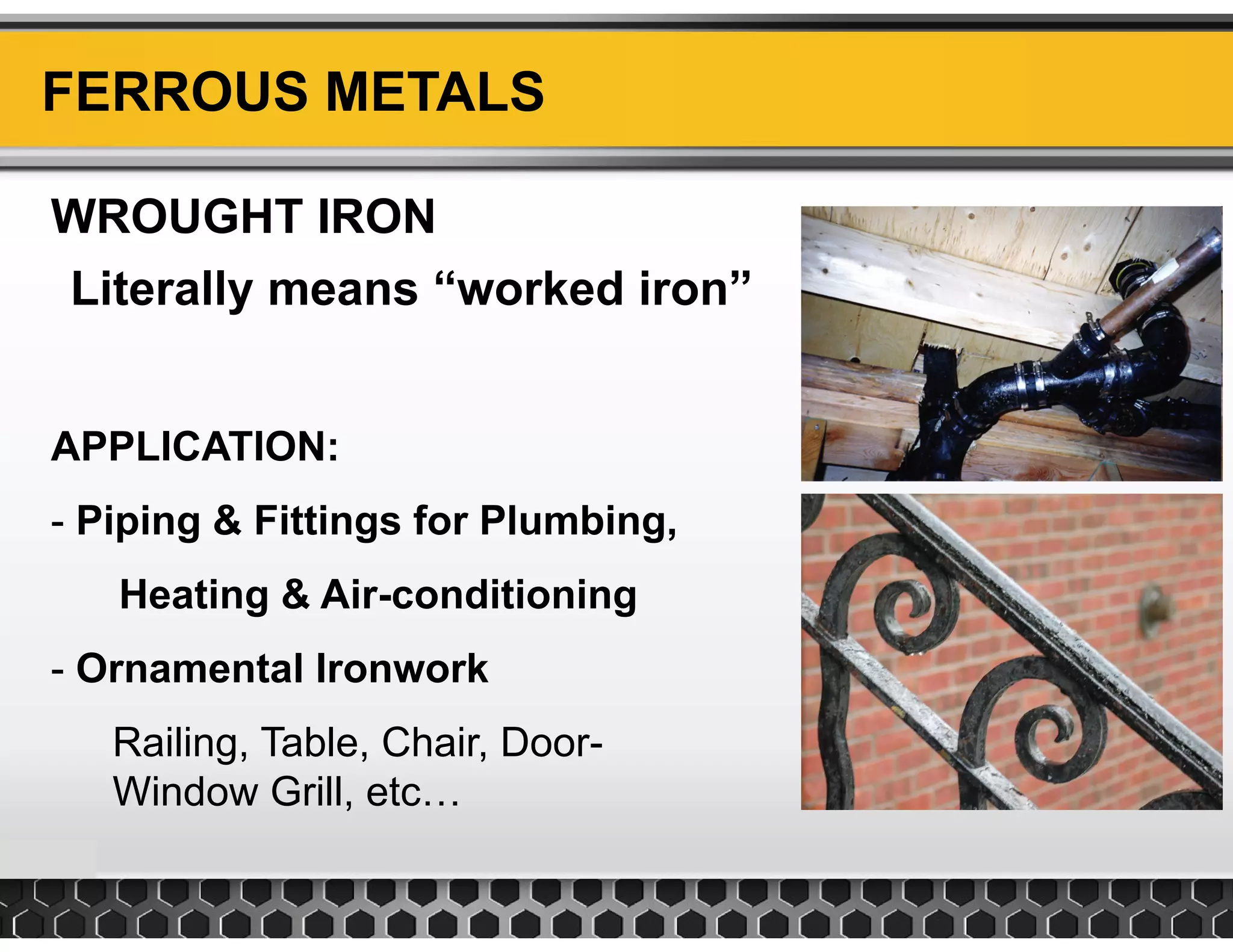
WROUGHT IRON
Literally means “worked iron”
APPLICATION:
- Piping & Fittings for Plumbing,
Heating & Air conditioningHeating & Air-conditioning
- Ornamental Ironwork
Railing, Table, Chair, Door-
Window Grill, etc…
FERROUS METALS
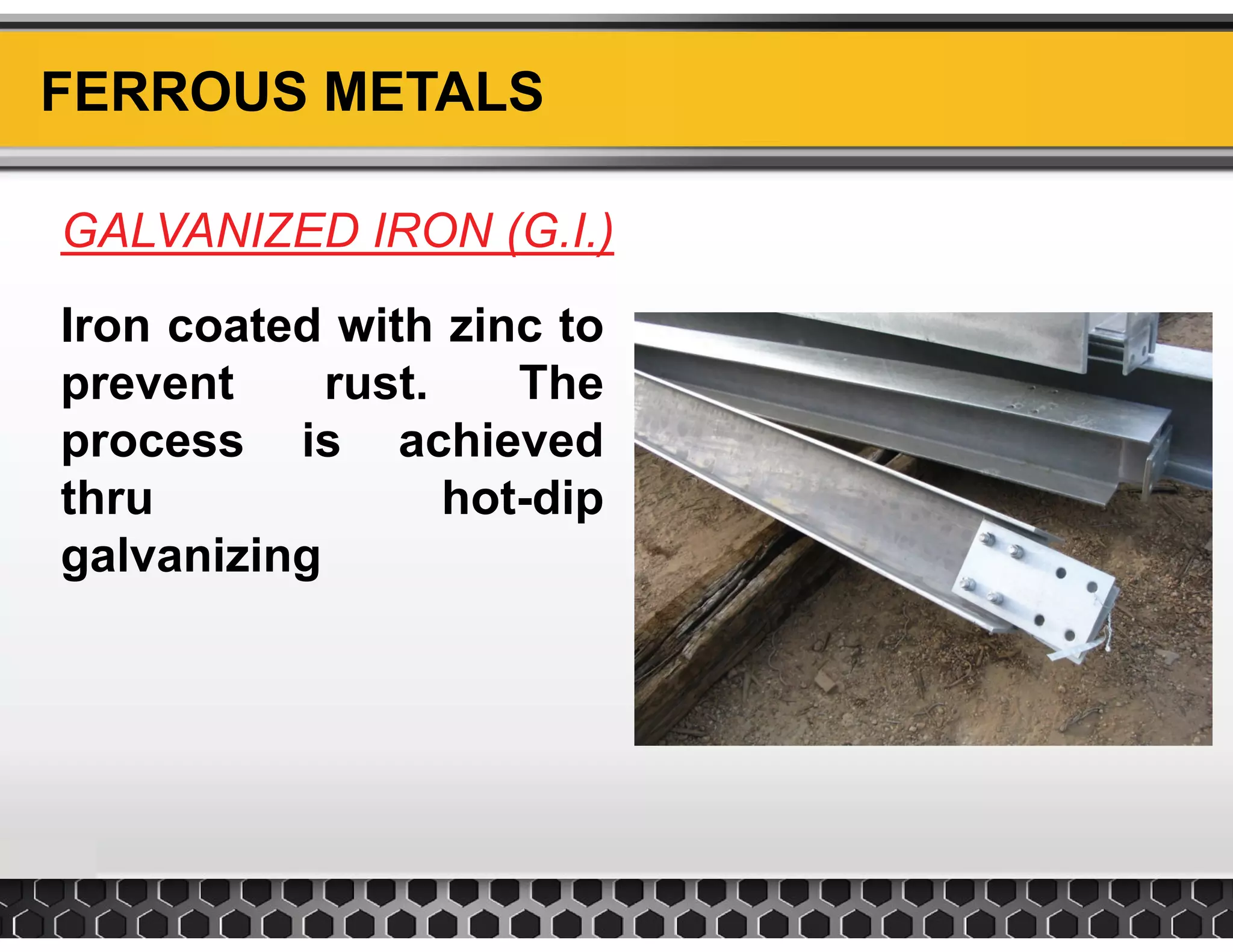
GALVANIZED IRON (G.I.)GALVANIZED IRON (G.I.)
Iron coated with zinc to
prevent rust. The
process is achieved
thru hot-dip
galvanizing
FERROUS METALS
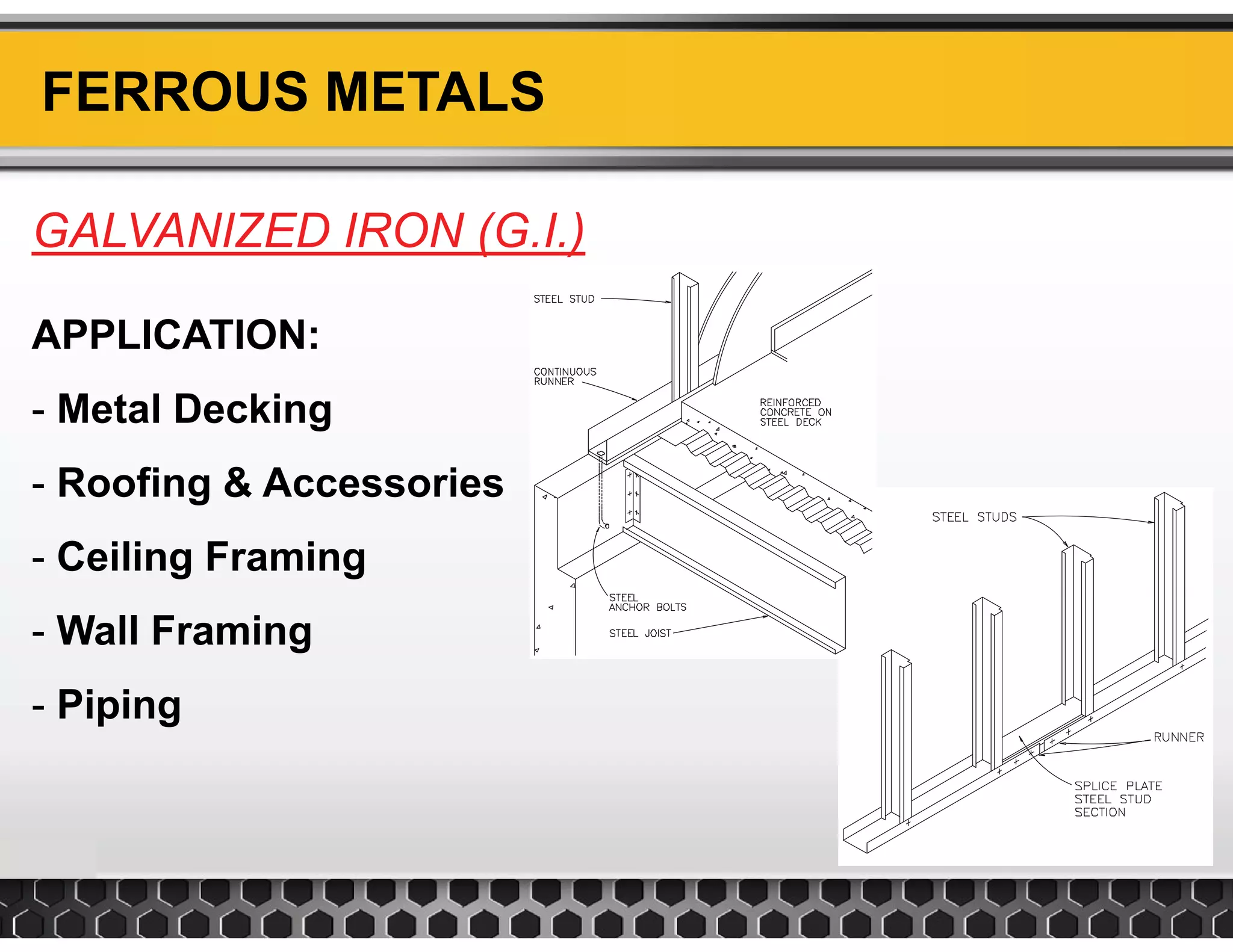
GALVANIZED IRON (G.I.)
APPLICATION:
GALVANIZED IRON (G.I.)
- Metal Decking
Roofing & Accessories- Roofing & Accessories
- Ceiling Framing
- Wall Framing
- Piping- Piping
FERROUS METALS
STEEL
Alloys of iron and carbon
Carbon content is no more than 2%
Alloy elements is composed of phosphorousAlloy elements is composed of phosphorous,
sulfur, oxygen, nitrogen, manganese, silicon,
aluminum copper nickel etcaluminum, copper, nickel, etc.
Can be wrought, rolled, cast, and welded, butCan be wrought, rolled, cast, and welded, but
not extruded
FERROUS METALS
ALLOY ELEMENTS & IT’S PURPOSE/S:
1. Aluminum for surface hardening
2. Chromium for corrosion resistance
3 Copper for resistance to atmospheric corrosion3. Copper for resistance to atmospheric corrosion
4. Manganese in small amounts for hardening; in larger
amounts for wear resistance
5. Molybdenum, combined with other alloying metals such asy , y g
chromium & nickel, to increase corrosion resistance and to raise
tensile strength without reducing ductility.
6. Nickel to increase tensile strength without reducing
d tilit i hi h t ti t i iductility; in high concentrations, to improve corrosion
resistance
7. Silicon to strengthen low alloy steels and improve
oxidation resistance; in larger amounts to provide hard,
b ittl ti i t t t i h i lbrittle castings resistant to corrosive chemicals
8. Sulfur for free machining, especially in mild steelsg y
9. Titanium to prevent inter-granular corrosion of stainless
steelssteels
10. Tungsten, vanadium, and cobalt for hardness and
b i i tabrasion resistance
FERROUS METALS
Types of Steel:
Carbon Steel
Alloy Steel
- Stainless Steel
- HSLA Steel (high-strength low-alloy)
Weathering Steel- Weathering Steel
FERROUS METALS
Carbon Steel
Low carbon steel
Medium/mild carbon steel (M S )Medium/mild carbon steel (M.S.)
High-carbon steel
Unalloyed steel in which the residual element as carbon
Ultra-high-carbon steel
Unalloyed steel in which the residual element as carbon,
manganese, phosphorus, sulfur and silicon are controlled.
Any increase in carbon content increase the strength and
hardness but reduces its ductility and weldability.
FERROUS METALS
Carbon Steel
APPLICATION:
- Structural Steel
- Concrete Reinforcement
- Decking and Panels
R fi & A i- Roofing & Accessories
- Windows & Doors
- Hardware
FERROUS METALS
Carbon Steel
APPLICATIONAPPLICATION:
Structural Steel
I-beam
W shapeW-shape
S-shape
Channels
AnglesAngles
Plates
Pipes & Tubing
FERROUS METALS
Stainless Steel
An alloy steel containing a minimum of 12%
Stainless Steel
An alloy steel containing a minimum of 12%
chromium & additional nickel, manganese, and
molybdenum alloy elementsmolybdenum alloy elements
Resistance to heat, oxidation & corrosionResistance to heat, oxidation & corrosion
Does not stain, corrode or rust as ordinary steel, butDoes not stain, corrode or rust as ordinary steel, but
not stain-proof
FERROUS METALS
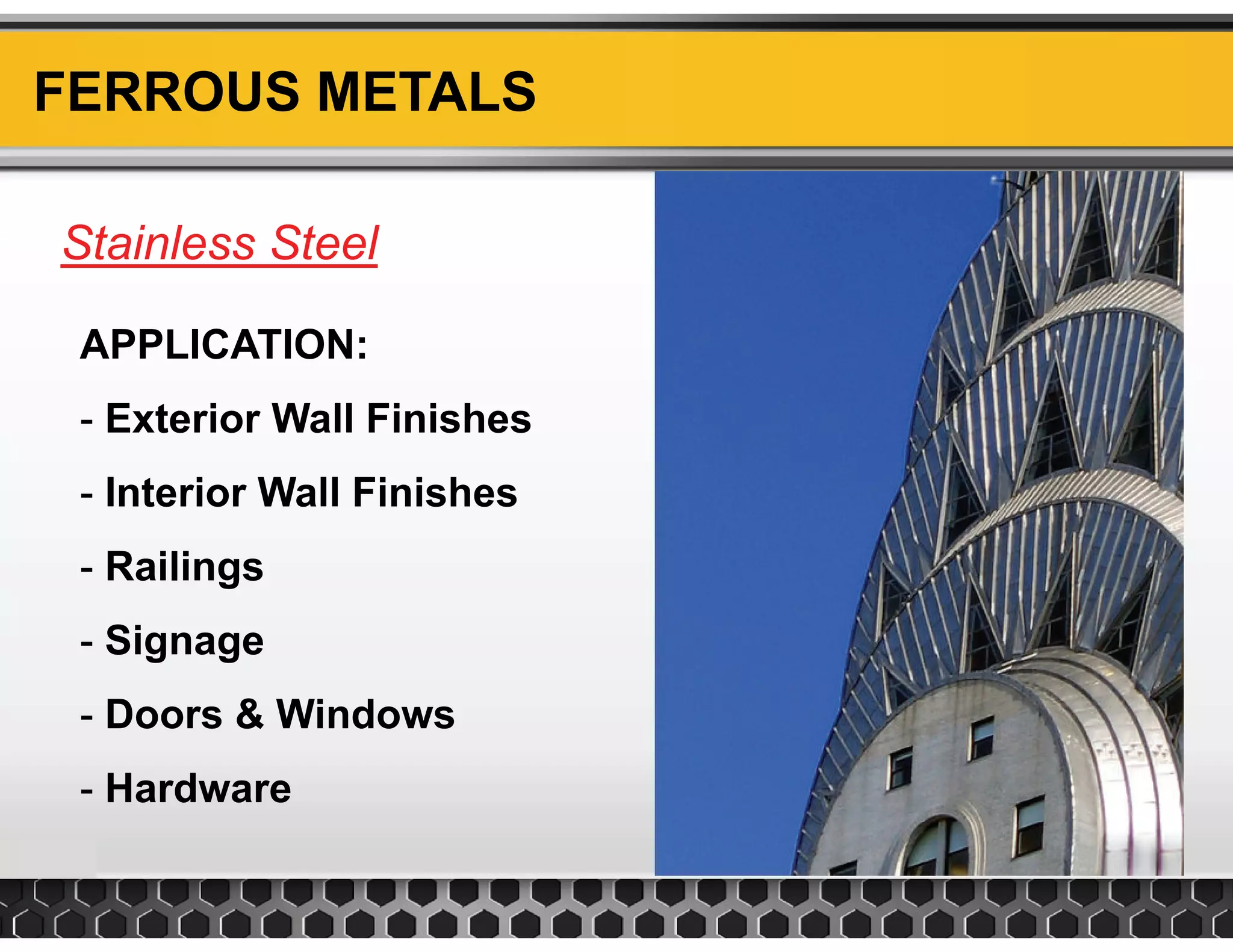
Stainless SteelStainless Steel
APPLICATION:
- Exterior Wall Finishes
- Interior Wall Finishes
- Railings
- Signage
Doors & Windo s- Doors & Windows
- Hardware
FERROUS METALS
HSLA (High Strength Low Alloy) Steel
A group of low carbon steels containing less
HSLA (High-Strength Low-Alloy) Steel
A group of low-carbon steels containing less
than 2% alloys in a chemical composition
specifically developed for increase strengthspecifically developed for increase strength,
ductility, & resistance to corrosion
Much stronger & tougher than ordinary carbon
steelsteel
FERROUS METALS
HSLA SteelHSLA Steel
APPLICATION:
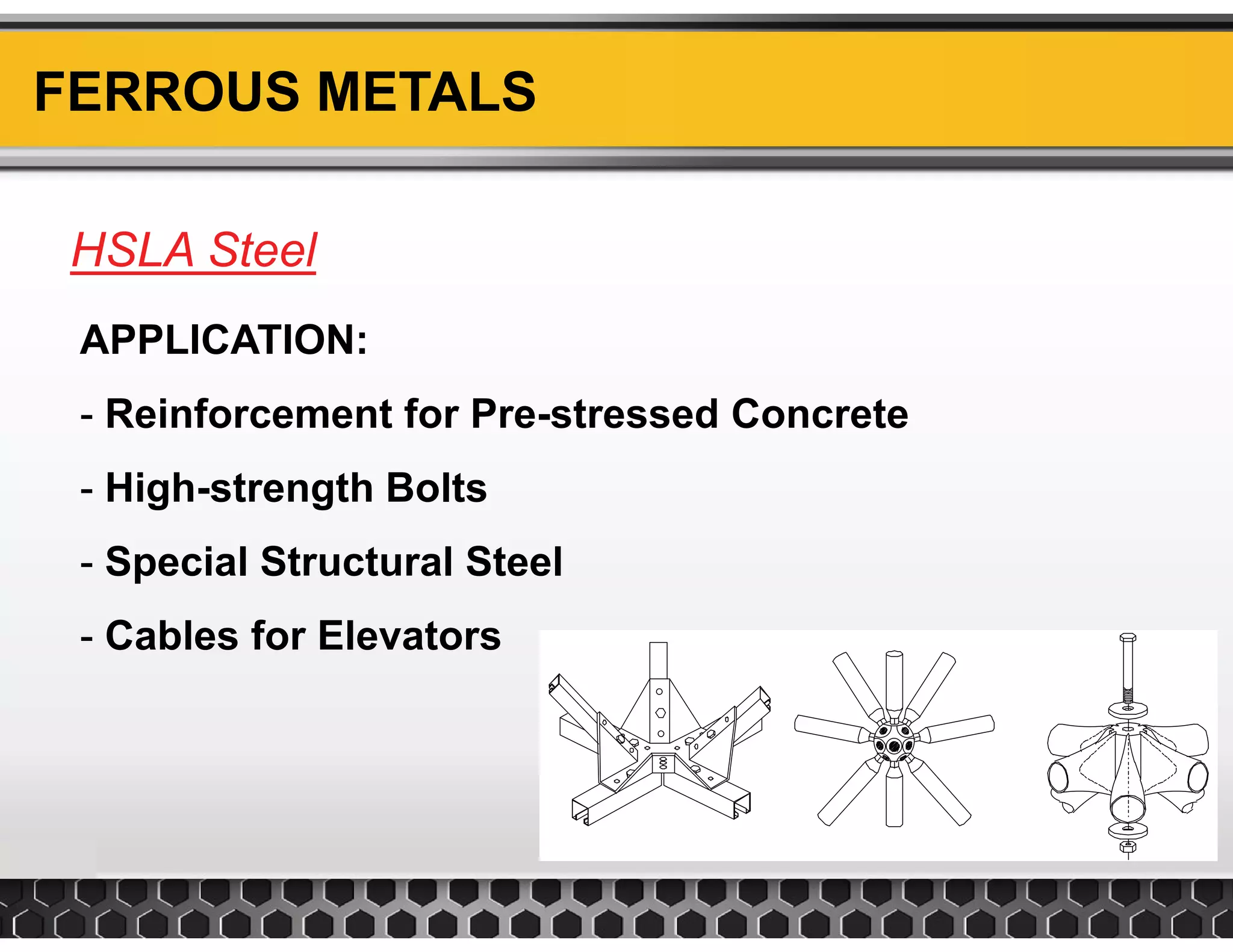
- Reinforcement for Pre-stressed Concrete
Hi h t th B lt- High-strength Bolts
- Special Structural Steel
- Cables for Elevators
FERROUS METALS
Tools Steel
refers to a variety of carbon and alloy steels
Tools Steel
refers to a variety of carbon and alloy steels
that are particularly suited to be made into
toolstools
Distinctively hard, resistance to abrasion andDistinctively hard, resistance to abrasion and
deformation, and has ability to hold a cutting
edgeedge
NNON-FERROUS METALS
Aluminum
• Soft, non magnetic, ductile and malleable silvery white
metal with thermal and electrical conductivity.
• Aluminum is the most abundant metal in the Earth's
crust, and the third most abundant element therein, after
oxygen and silicon.yg
Used as structural
framing like the highframing like the high
strength aluminum alloys
and secondary building
elements such aselements such as
windows, doors, roofing,
flashing, trim and hard
wares.
COPPER
Ductile malleable and bright reddish brown color withDuctile, malleable and bright reddish brown color with
high thermal and electrical conductivity.
Posses a “patina” weather reactive surface layer of
insoluble green salt which retards corrosion and used to
alloy bronze and brass to increase strength andalloy bronze and brass to increase strength and
corrosion resistance.
U d l t i l i i i i d fi t i lUsed as electrical wiring, piping and roofing material.
Care must be taken in fastening, attaching or supported
only by selected brass fittings.
BrassBrass
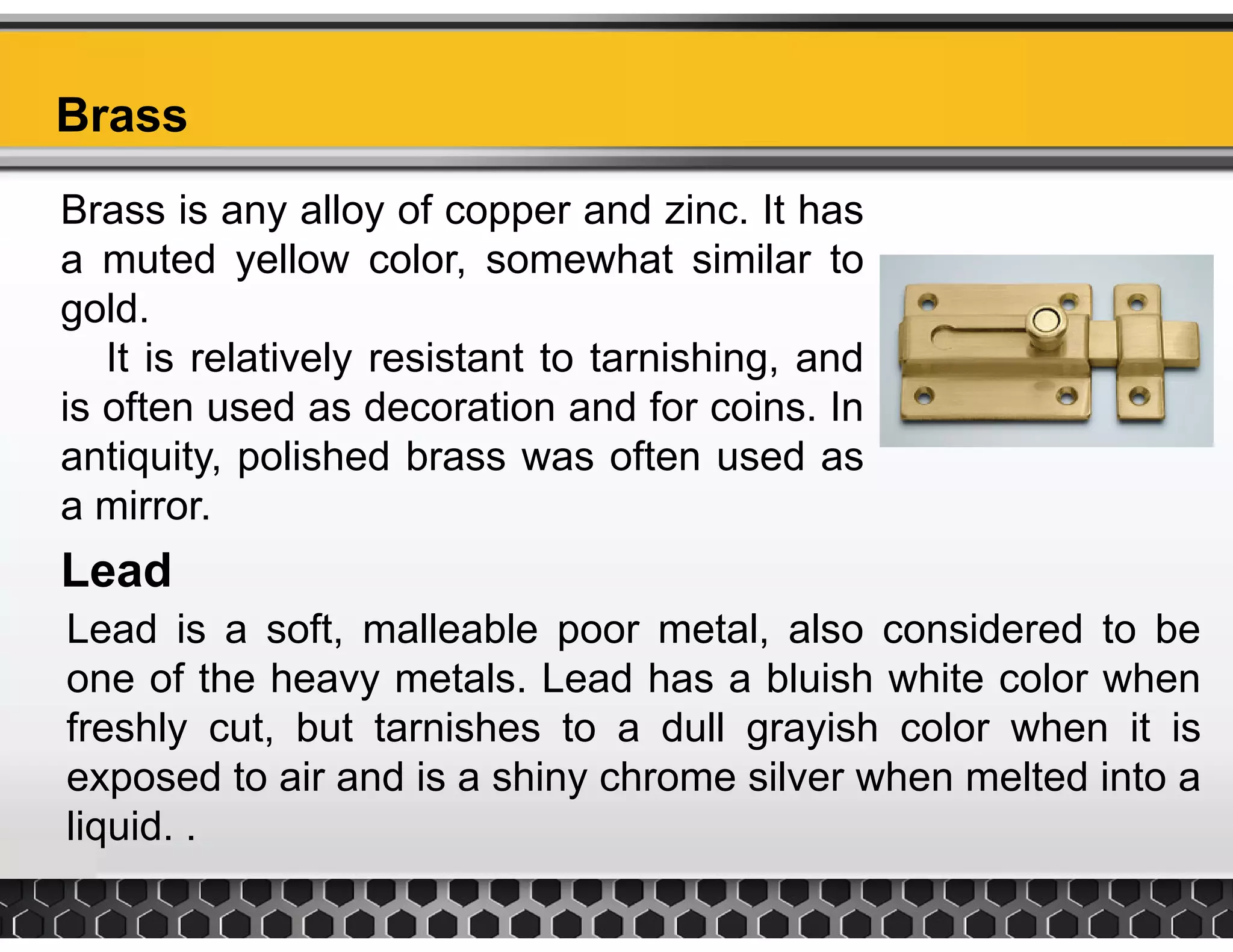
Brass is any alloy of copper and zinc. It has
t d ll l h t i il ta muted yellow color, somewhat similar to
gold.
It is relatively resistant to tarnishing andIt is relatively resistant to tarnishing, and
is often used as decoration and for coins. In
antiquity, polished brass was often used as
Lead
q y, p
a mirror.
Lead is a soft, malleable poor metal, also considered to be
one of the heavy metals. Lead has a bluish white color when
freshly cut, but tarnishes to a dull grayish color when it is
exposed to air and is a shiny chrome silver when melted into a
liquidliquid. .
Lead pipe in Roman baths
METAL JOINERY
Soldering is a process in which two or more metal items are
j i d t th b lti d fl i fill t l i t thjoined together by melting and flowing a filler metal into the
joint, the filler metal having a relatively low melting point.
AnnealingAnnealing
In the cases of copper, steel,
d b hi iand brass this process is
performed by substantially
heating the material (untilheating the material (until
glowing) for a while and
allowing it to cool slowly. Theg y
metal is softened and prepared
for further work such as
h i f ishaping, or forming.
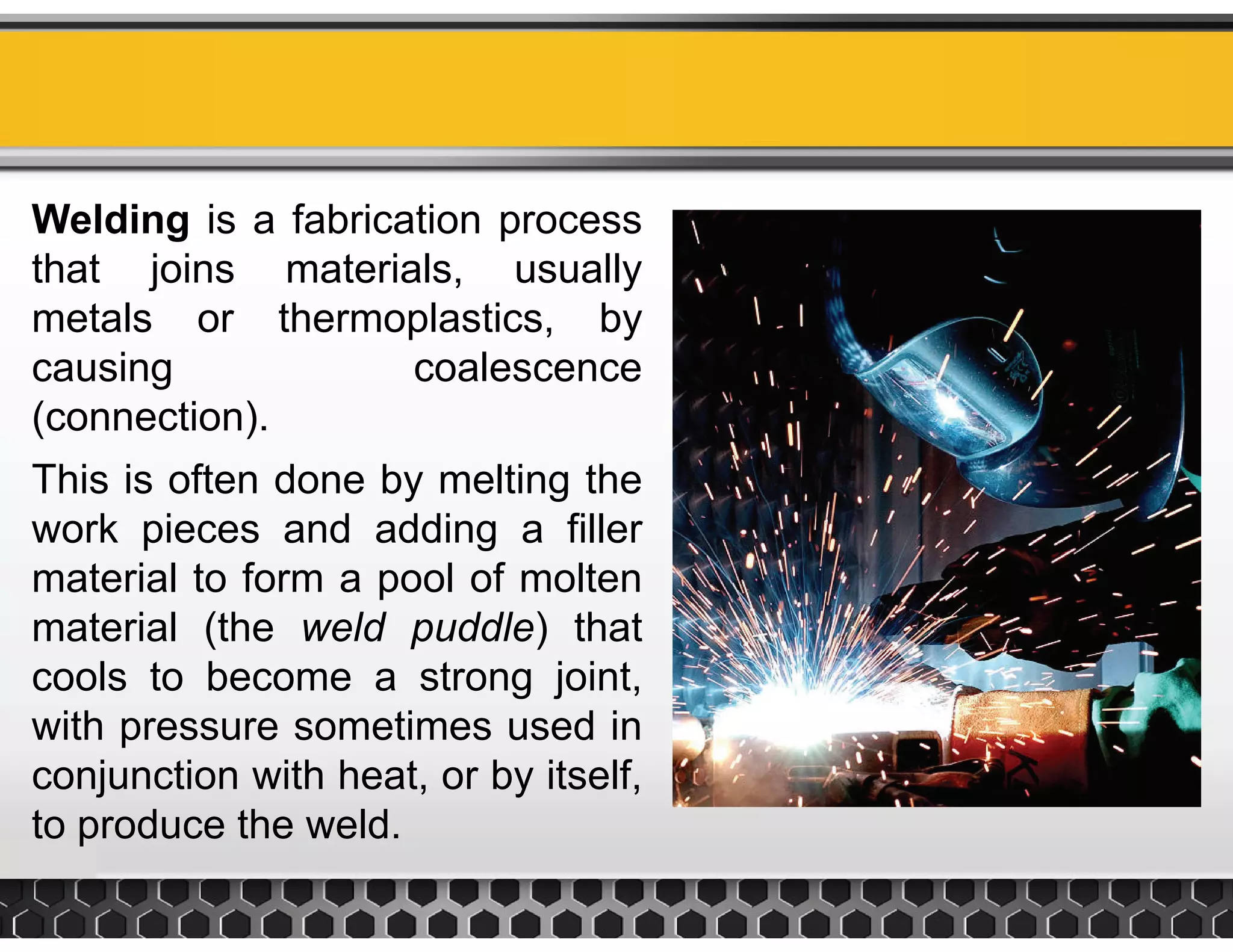
Welding is a fabrication process
that joins materials, usually
metals or thermoplastics, by
causing coalescencecausing coalescence
(connection).
This is often done by melting theThis is often done by melting the
work pieces and adding a filler
material to form a pool of moltenmaterial to form a pool of molten
material (the weld puddle) that
cools to become a strong joint,
with pressure sometimes used in
conjunction with heat, or by itself,
to produce the weldto produce the weld.
A rivet is a mechanical fastener. Before it is installed it
consists of a smooth cylindrical shaft with a head on one end.
The end opposite the head is called the buck-tail.
STEEL . . . 
• STEEL is a common building material used throughout the 
construction industry. y
• Its primary purpose is to form a skeleton for the building or 
t t ti ll th t f th t t th t h ldstructure  essentially the part of the structure that holds 
everything up and together.
• Steel has many advantages when compared to other 
structural building materials such as concrete , timber ,structural building materials such as concrete , timber , 
plastics  and newer composite materials.
STAINLESS  STEEL . . 
• ALLOY OF IRON AND CARBON , CHROMIUM, NICKEL &  , ,
MAGNESIUM
• STAINLESS STEEL IS RENOWNED ABOVE ALL FOR ITS RESISTANCESTAINLESS STEEL IS RENOWNED ABOVE ALL FOR ITS RESISTANCE 
TO CORROSION AND ITS ATTRACTIVE, STRIKING APPEARANCE. 
BOTH ARE DUE TO THE PRESENCE OF THE CHROMIUMAS ANBOTH ARE DUE TO THE PRESENCE OF THE CHROMIUM AS AN 
ALLOYING ELEMENT.
STAINLESS STEEL ALSO POSSESS PHYSICALS AND MECHANICAL• STAINLESS STEEL ALSO POSSESS PHYSICALS AND MECHANICAL 
PROPERTIES THAT MAKE IT AN EXCEPTIONALLY USEFUL AND 
DESIRABLE MATERIAL FOR THE WIDEST VARIETY OFDESIRABLE MATERIAL FOR THE WIDEST VARIETY OF 
APPLICATIONS.
PROPERTIES . . .
MALLEABILITY• MALLEABILITY
Can be hammered and pressed into shape
• DUCTILITY
C b d i t fi iCan be drawn into fine wire
ELASTICITY• ELASTICITY
Regains its shape after being deformed
PROPERTIES . . .
• HARDNESS
Resists being scratched or cut
• BRITTLENESS
Extremely hard and therefore , will not  break easily
• CONDUCTIVITY
Ability to conduct heat or electricity
INTERIORS USINGINTERIORS USING
STEELSTEEL . . . . . . . . . . . . . . .
• CEILING • FURNITURE
• WALLS • STAIR CASES
• INTERIORS OF KITCHEN
• FLOORING
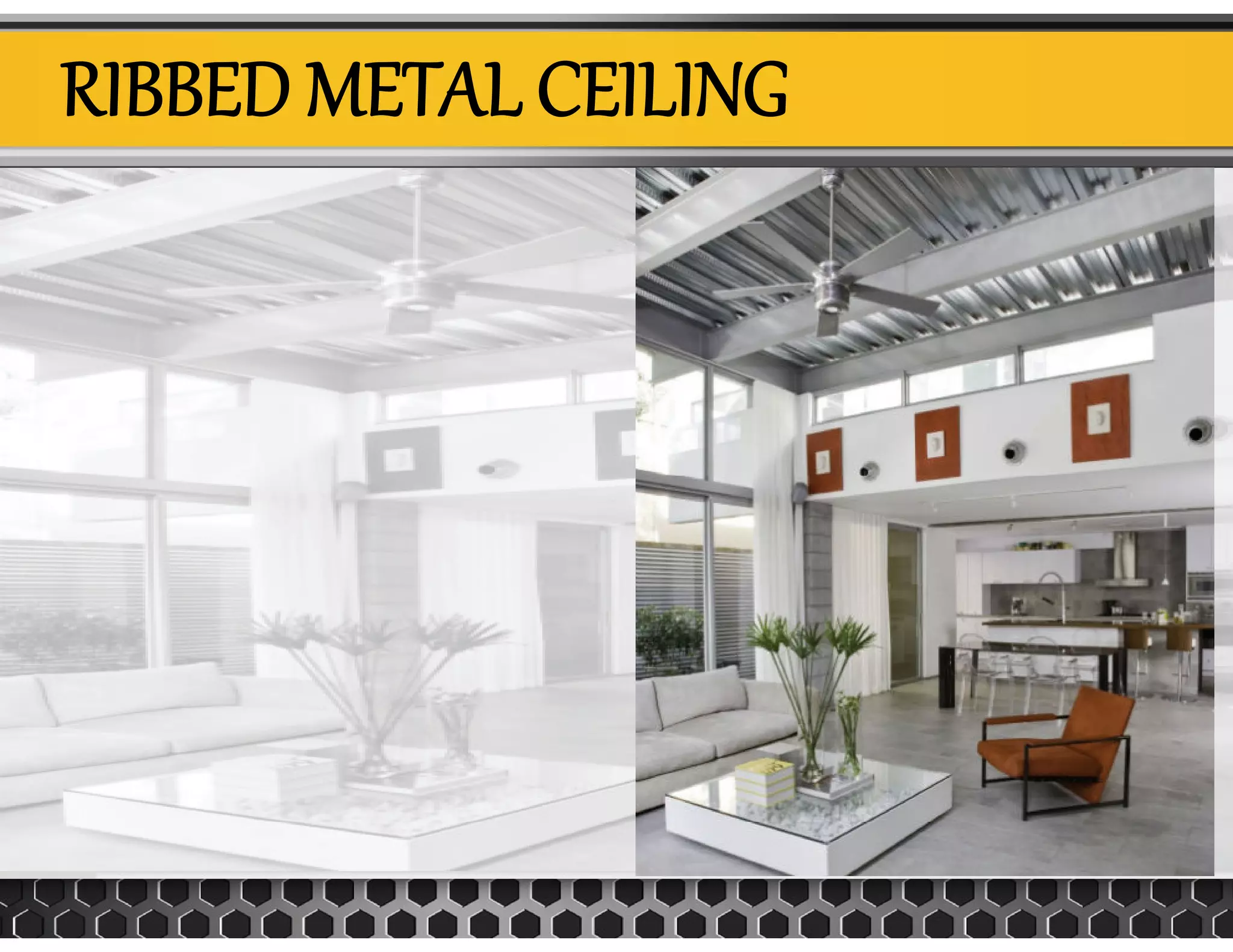
RIBBED METAL CEILING
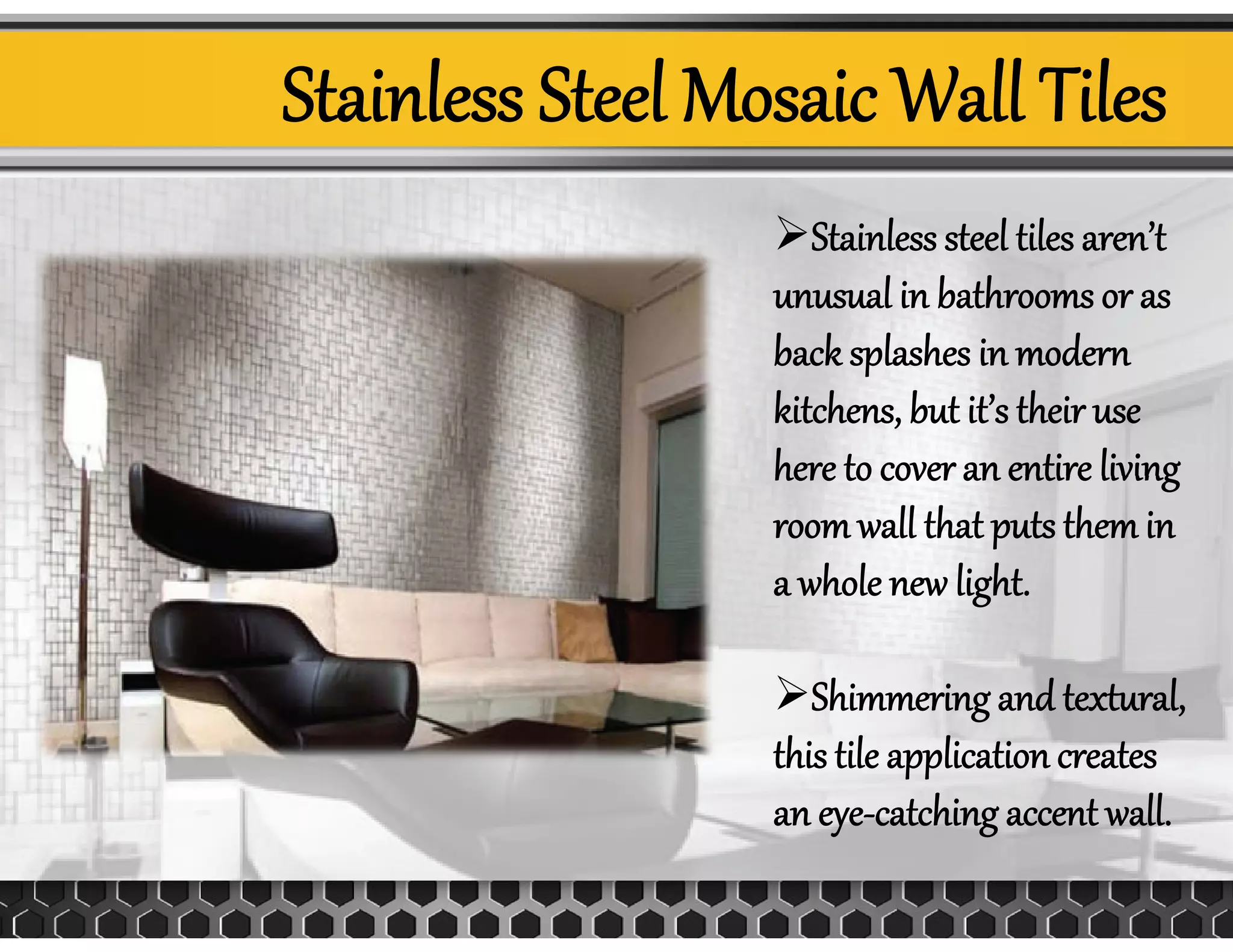
Stainless Steel Mosaic Wall Tiles
Stainless steel tiles aren’tStainless steel tiles arent 
unusual in bathrooms or as 
back splashes in modernback splashes in modern 
kitchens, but it’s their use 
here to cover an entire livinghere to cover an entire living 
room wall that puts them in 
a whole new light.a whole new light. 
Shimmering and textural,Shimmering and textural, 
this tile application creates 
an eye‐catching accent wall.an eye catching accent wall.
Aluminium & S.S. Modular KitchenAluminium & S.S. Modular Kitchen
Shiny metal is much more
than just an accent in this
modular kitchen. Calling to
mind commercial kitchens in
which every surface must be
easily sanitized, but on a
smaller scale, the minimalist
result is clutter‐free and
contrasts nicely with a natural
wood floor.
Ultramodern Steel SofaUltramodern Steel Sofa
Looking like it was carved from
one solid block of metal, this
curving sofa in a shape
reminiscent of a sea shell is
definitely a bold way to bring
metals into your living room.
Kitchen Platforms & wallsf
Steel Stairs
SINCE STAIRS ARE OFTEN
LOCATED IN THE HEART OFLOCATED IN THE HEART OF
A HOME, THEY PROVIDE
ANOTHER OPPORTUNITY TOANOTHER OPPORTUNITY TO
STUN WITH STEEL.
Aluminium Walls
Copper Cladded Wallpp
SURFACE FINISHES . .
THE MOST COMMON AVAILABLE FINISHES  INCLUDE : 
•COLD ROLLED FINISHES
•BRUSHED AND POLISHED FINISHES
•PATTERNED FINISHES•PATTERNED FINISHES
•SPECIAL DECORATIVE FINISHES

BUILDING MATERIALS AS A STEEL

  • 1.
  • 2.
    FERROUS METAL AND O OSNON-FERROUS METAL
  • 3.
    FERROUS METAL A metalcontaining iron as a primary material Iron- Iron - Cast Iron - Steel - Stainless Steel Wrought Iron- Wrought Iron
  • 4.
    NON-FERROUS METAL A metalcontaining little or no iron Aluminum- Aluminum - Bronze - Brass - Copper Lead- Lead
  • 5.
    IRON Iron is ametal extracted mainly from the iron ore hematite. It oxidizes readily in air and water to form Fe2O3 and is rarely found as a free element. Iron is believed to be the sixth most abundant element in the universe
  • 6.
    Pig iron isthe intermediate product of melting iron ore with coke and resin Cast into pigs in preparation for conversion into cast iron wrought iron or steelcast iron, wrought iron or steel Pig iron has a very high carbon content, typically 3.5 - 4.5%, which makes it very brittle and not useful directly as a material except for limited applications
  • 7.
    FERROUS METALS CAST IRON Ahard, brittle, nonmalleable iron-based alloy containing 2% 4 5% carbon and 0 5% 3% siliconcontaining 2%-4.5% carbon and 0.5%-3% silicon
  • 8.
    FERROUS METALS CAST IRON APPLICATIONAPPLICATION: -Piping & Fittings - Ornamental Ironwork Hardware- Hardware - Base Metal for Porcelain Enameled Plumbing Fixtures - Floor & Wall Brackets for Railings - Circular StairsCircular Stairs - Manhole Cover - Gratings
  • 9.
    FERROUS METALS WROUGHT IRON Atough, malleable, readily soft iron that is easily forged & welded Fatigue & corrosion resistant Commercially pure iron, containing only forged & welded. Fatigue & corrosion resistant approximately 0.2% carbon A fibrous material due to the slag inclusionsA fibrous material due to the slag inclusions, that gives it a "grain" resembling wood, which is visible when it is etched or bent to the point ofvisible when it is etched or bent to the point of failure
  • 10.
    FERROUS METALS WROUGHT IRON Literallymeans “worked iron” APPLICATION: - Piping & Fittings for Plumbing, Heating & Air conditioningHeating & Air-conditioning - Ornamental Ironwork Railing, Table, Chair, Door- Window Grill, etc…
  • 11.
    FERROUS METALS GALVANIZED IRON(G.I.)GALVANIZED IRON (G.I.) Iron coated with zinc to prevent rust. The process is achieved thru hot-dip galvanizing
  • 12.
    FERROUS METALS GALVANIZED IRON(G.I.) APPLICATION: GALVANIZED IRON (G.I.) - Metal Decking Roofing & Accessories- Roofing & Accessories - Ceiling Framing - Wall Framing - Piping- Piping
  • 13.
    FERROUS METALS STEEL Alloys ofiron and carbon Carbon content is no more than 2% Alloy elements is composed of phosphorousAlloy elements is composed of phosphorous, sulfur, oxygen, nitrogen, manganese, silicon, aluminum copper nickel etcaluminum, copper, nickel, etc. Can be wrought, rolled, cast, and welded, butCan be wrought, rolled, cast, and welded, but not extruded
  • 14.
    FERROUS METALS ALLOY ELEMENTS& IT’S PURPOSE/S: 1. Aluminum for surface hardening 2. Chromium for corrosion resistance 3 Copper for resistance to atmospheric corrosion3. Copper for resistance to atmospheric corrosion 4. Manganese in small amounts for hardening; in larger amounts for wear resistance 5. Molybdenum, combined with other alloying metals such asy , y g chromium & nickel, to increase corrosion resistance and to raise tensile strength without reducing ductility.
  • 15.
    6. Nickel toincrease tensile strength without reducing d tilit i hi h t ti t i iductility; in high concentrations, to improve corrosion resistance 7. Silicon to strengthen low alloy steels and improve oxidation resistance; in larger amounts to provide hard, b ittl ti i t t t i h i lbrittle castings resistant to corrosive chemicals 8. Sulfur for free machining, especially in mild steelsg y 9. Titanium to prevent inter-granular corrosion of stainless steelssteels 10. Tungsten, vanadium, and cobalt for hardness and b i i tabrasion resistance
  • 16.
    FERROUS METALS Types ofSteel: Carbon Steel Alloy Steel - Stainless Steel - HSLA Steel (high-strength low-alloy) Weathering Steel- Weathering Steel
  • 17.
    FERROUS METALS Carbon Steel Lowcarbon steel Medium/mild carbon steel (M S )Medium/mild carbon steel (M.S.) High-carbon steel Unalloyed steel in which the residual element as carbon Ultra-high-carbon steel Unalloyed steel in which the residual element as carbon, manganese, phosphorus, sulfur and silicon are controlled. Any increase in carbon content increase the strength and hardness but reduces its ductility and weldability.
  • 18.
    FERROUS METALS Carbon Steel APPLICATION: -Structural Steel - Concrete Reinforcement - Decking and Panels R fi & A i- Roofing & Accessories - Windows & Doors - Hardware
  • 19.
    FERROUS METALS Carbon Steel APPLICATIONAPPLICATION: StructuralSteel I-beam W shapeW-shape S-shape Channels AnglesAngles Plates Pipes & Tubing
  • 20.
    FERROUS METALS Stainless Steel Analloy steel containing a minimum of 12% Stainless Steel An alloy steel containing a minimum of 12% chromium & additional nickel, manganese, and molybdenum alloy elementsmolybdenum alloy elements Resistance to heat, oxidation & corrosionResistance to heat, oxidation & corrosion Does not stain, corrode or rust as ordinary steel, butDoes not stain, corrode or rust as ordinary steel, but not stain-proof
  • 21.
    FERROUS METALS Stainless SteelStainlessSteel APPLICATION: - Exterior Wall Finishes - Interior Wall Finishes - Railings - Signage Doors & Windo s- Doors & Windows - Hardware
  • 22.
    FERROUS METALS HSLA (HighStrength Low Alloy) Steel A group of low carbon steels containing less HSLA (High-Strength Low-Alloy) Steel A group of low-carbon steels containing less than 2% alloys in a chemical composition specifically developed for increase strengthspecifically developed for increase strength, ductility, & resistance to corrosion Much stronger & tougher than ordinary carbon steelsteel
  • 23.
    FERROUS METALS HSLA SteelHSLASteel APPLICATION: - Reinforcement for Pre-stressed Concrete Hi h t th B lt- High-strength Bolts - Special Structural Steel - Cables for Elevators
  • 24.
    FERROUS METALS Tools Steel refersto a variety of carbon and alloy steels Tools Steel refers to a variety of carbon and alloy steels that are particularly suited to be made into toolstools Distinctively hard, resistance to abrasion andDistinctively hard, resistance to abrasion and deformation, and has ability to hold a cutting edgeedge
  • 25.
    NNON-FERROUS METALS Aluminum • Soft,non magnetic, ductile and malleable silvery white metal with thermal and electrical conductivity. • Aluminum is the most abundant metal in the Earth's crust, and the third most abundant element therein, after oxygen and silicon.yg Used as structural framing like the highframing like the high strength aluminum alloys and secondary building elements such aselements such as windows, doors, roofing, flashing, trim and hard wares.
  • 26.
    COPPER Ductile malleable andbright reddish brown color withDuctile, malleable and bright reddish brown color with high thermal and electrical conductivity. Posses a “patina” weather reactive surface layer of insoluble green salt which retards corrosion and used to alloy bronze and brass to increase strength andalloy bronze and brass to increase strength and corrosion resistance. U d l t i l i i i i d fi t i lUsed as electrical wiring, piping and roofing material. Care must be taken in fastening, attaching or supported only by selected brass fittings.
  • 28.
    BrassBrass Brass is anyalloy of copper and zinc. It has t d ll l h t i il ta muted yellow color, somewhat similar to gold. It is relatively resistant to tarnishing andIt is relatively resistant to tarnishing, and is often used as decoration and for coins. In antiquity, polished brass was often used as Lead q y, p a mirror. Lead is a soft, malleable poor metal, also considered to be one of the heavy metals. Lead has a bluish white color when freshly cut, but tarnishes to a dull grayish color when it is exposed to air and is a shiny chrome silver when melted into a liquidliquid. .
  • 29.
    Lead pipe inRoman baths
  • 30.
    METAL JOINERY Soldering isa process in which two or more metal items are j i d t th b lti d fl i fill t l i t thjoined together by melting and flowing a filler metal into the joint, the filler metal having a relatively low melting point. AnnealingAnnealing In the cases of copper, steel, d b hi iand brass this process is performed by substantially heating the material (untilheating the material (until glowing) for a while and allowing it to cool slowly. Theg y metal is softened and prepared for further work such as h i f ishaping, or forming.
  • 31.
    Welding is afabrication process that joins materials, usually metals or thermoplastics, by causing coalescencecausing coalescence (connection). This is often done by melting theThis is often done by melting the work pieces and adding a filler material to form a pool of moltenmaterial to form a pool of molten material (the weld puddle) that cools to become a strong joint, with pressure sometimes used in conjunction with heat, or by itself, to produce the weldto produce the weld.
  • 32.
    A rivet isa mechanical fastener. Before it is installed it consists of a smooth cylindrical shaft with a head on one end. The end opposite the head is called the buck-tail.
  • 35.
    STEEL . . .  • STEEL is a common building material used throughout the  construction industry. y • Its primary purpose is to form a skeleton for the building or  tt ti ll th t f th t t th t h ldstructure  essentially the part of the structure that holds  everything up and together. • Steel has many advantages when compared to other  structural building materials such as concrete , timber ,structural building materials such as concrete , timber ,  plastics  and newer composite materials.
  • 36.
    STAINLESS  STEEL . .  • ALLOY OF IRON AND CARBON , CHROMIUM, NICKEL &  , , MAGNESIUM •STAINLESS STEEL IS RENOWNED ABOVE ALL FOR ITS RESISTANCESTAINLESS STEEL IS RENOWNED ABOVE ALL FOR ITS RESISTANCE  TO CORROSION AND ITS ATTRACTIVE, STRIKING APPEARANCE.  BOTH ARE DUE TO THE PRESENCE OF THE CHROMIUMAS ANBOTH ARE DUE TO THE PRESENCE OF THE CHROMIUM AS AN  ALLOYING ELEMENT. STAINLESS STEEL ALSO POSSESS PHYSICALS AND MECHANICAL• STAINLESS STEEL ALSO POSSESS PHYSICALS AND MECHANICAL  PROPERTIES THAT MAKE IT AN EXCEPTIONALLY USEFUL AND  DESIRABLE MATERIAL FOR THE WIDEST VARIETY OFDESIRABLE MATERIAL FOR THE WIDEST VARIETY OF  APPLICATIONS.
  • 37.
    PROPERTIES . . . MALLEABILITY• MALLEABILITY Can be hammered and pressed into shape • DUCTILITY Cb d i t fi iCan be drawn into fine wire ELASTICITY• ELASTICITY Regains its shape after being deformed
  • 38.
  • 39.
    INTERIORS USINGINTERIORS USING STEELSTEEL. . . . . . . . . . . . . . .
  • 40.
    • CEILING •FURNITURE • WALLS • STAIR CASES • INTERIORS OF KITCHEN • FLOORING
  • 41.
  • 42.
    Stainless Steel Mosaic Wall Tiles Stainless steel tilesaren’tStainless steel tiles arent  unusual in bathrooms or as  back splashes in modernback splashes in modern  kitchens, but it’s their use  here to cover an entire livinghere to cover an entire living  room wall that puts them in  a whole new light.a whole new light.  Shimmering and textural,Shimmering and textural,  this tile application creates  an eye‐catching accent wall.an eye catching accent wall.
  • 43.
    Aluminium & S.S.Modular KitchenAluminium & S.S. Modular Kitchen Shiny metal is much more than just an accent in this modular kitchen. Calling to mind commercial kitchens in which every surface must be easily sanitized, but on a smaller scale, the minimalist result is clutter‐free and contrasts nicely with a natural wood floor.
  • 44.
    Ultramodern Steel SofaUltramodern Steel Sofa Lookinglike it was carved from one solid block of metal, this curving sofa in a shape reminiscent of a sea shell is definitely a bold way to bring metals into your living room.
  • 45.
  • 46.
    Steel Stairs SINCE STAIRS AREOFTEN LOCATED IN THE HEART OFLOCATED IN THE HEART OF A HOME, THEY PROVIDE ANOTHER OPPORTUNITY TOANOTHER OPPORTUNITY TO STUN WITH STEEL.
  • 47.
  • 48.
  • 49.