METALS
Kardan University
Uploaded By: Engr.Ahmad Sameer
METALS
 Metals are the backbone of all
engineering projects and products.
Various metals are used in one form or
the other. Metals are found as
compounds like
oxides, sulphates, carbonates, phosphat
es etc. in nature.
 These compounds are known as ores.
Ores are treated to remove the
impurities and get the metal .
•Metals are… Solid at room temperature,
except mercury, which is liquid
•Metals have… very high melting point.
•Metals are… shiny when they cut.
•Metals are… good conductors of heat and
electricity.
•Metals are… usually strong & malleable so
they can be hammered into
shape.
METALS CHARACTERISTICS
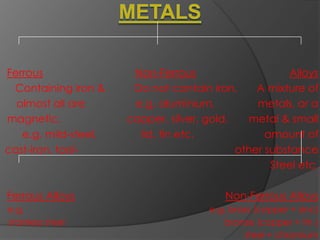
Ferrous Non-Ferrous Alloys
Containing iron & Do not contain iron. A mixture of
almost all are e.g. aluminium, metals, or a
magnetic. copper, silver, gold, metal & small
e.g. mild-steel, lid, tin etc. amount of
cast-iron, tool- other substance
Steel etc.
Ferrous Alloys Non-Ferrous Alloys
e.g. e.g. brass (copper + zinc)
stainless steel bronze (copper + tin )
steel + chromium
OCCURRENCE OF IRON
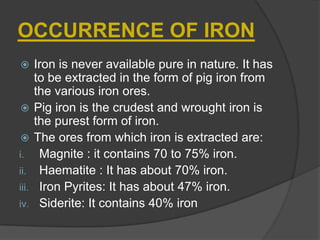
 Iron is never available pure in nature. It has
to be extracted in the form of pig iron from
the various iron ores.
 Pig iron is the crudest and wrought iron is
the purest form of iron.
 The ores from which iron is extracted are:
i. Magnite : it contains 70 to 75% iron.
ii. Haematite : It has about 70% iron.
iii. Iron Pyrites: It has about 47% iron.
iv. Siderite: It contains 40% iron
PIG IRON
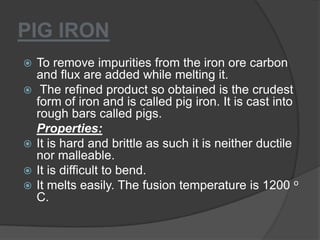
 To remove impurities from the iron ore carbon
and flux are added while melting it.
 The refined product so obtained is the crudest
form of iron and is called pig iron. It is cast into
rough bars called pigs.
Properties:
 It is hard and brittle as such it is neither ductile
nor malleable.
 It is difficult to bend.
 It melts easily. The fusion temperature is 1200 o
C.
PIG IRON
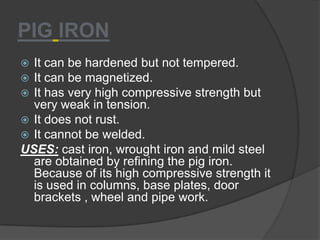
 It can be hardened but not tempered.
 It can be magnetized.
 It has very high compressive strength but
very weak in tension.
 It does not rust.
 It cannot be welded.
USES: cast iron, wrought iron and mild steel
are obtained by refining the pig iron.
Because of its high compressive strength it
is used in columns, base plates, door
brackets , wheel and pipe work.
CAST IRON
 Pig iron is remelted with limestone and
coke and poured into moulds of desired
shapes and sizes to get purer product
known as cast iron.
 Moulding remelted pig iron removes
impurity and gives a more uniform
product,
 Carbon contents in cast iron vary from 2
to 4.5%.
CAST IRON
PROPERTIES:
 Its structure is coarse crystalline and fibrous.
 Freshly fractured surface has grayish white
appearance.
 It is brittle.
 It cannot withstand shocks and impacts.
 It cannot be welded.
 It cannot be magnetized.
 It does not rust.
 It is fairly hard and cannot be worked with a
hand file.
CAST IRON
USES:
 It is used for casting, rain water
pipes, gratings, railings, balustrades(
staircase side railing).
 Because of high compressive strength it
is used in making columns, supports for
heavy machinery, carriage wheels etc.
 It is the basic material for the
manufacturing of Wrought iron and
steel.
WROUGHT IRON
 If all the carbon and other elements in pig
iron are oxidized and may be left with 0.25
percent of carbon then we obtain wrought
iron.
 It is by far the purest form of iron in which
the total impurities do not exceed 0.5%.
PROPERTIES:
 Its structure is fibrous and has silky luster.
 It is ductile and malleable.
 It is tough and can withstand shocks and
impact better than cast iron.
WROUGHT IRON
 It can be forged and welded.
 It rusts easily
 It is unaffected by saline water.
 It cannot be permanently magnetized.
USES :
It is used in making roofing
sheets, corrugated sheets, rods, gas and
water pipes, boiler tubes and ornamental
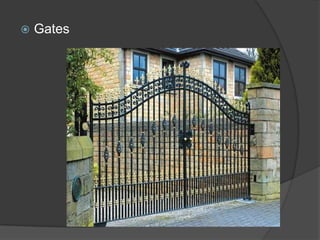
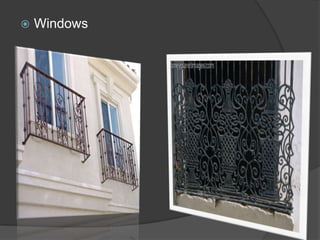
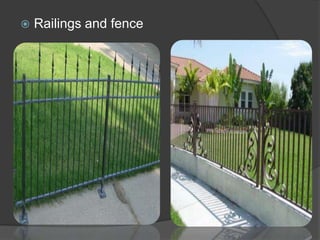
iron works such as grills gates and railing
and window guards.
 Gates
 Windows
 Railings and fence
STEEL
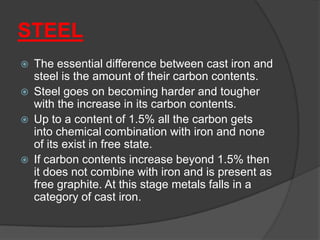
 The essential difference between cast iron and
steel is the amount of their carbon contents.
 Steel goes on becoming harder and tougher
with the increase in its carbon contents.
 Up to a content of 1.5% all the carbon gets
into chemical combination with iron and none
of its exist in free state.
 If carbon contents increase beyond 1.5% then
it does not combine with iron and is present as
free graphite. At this stage metals falls in a
category of cast iron.
STEEL
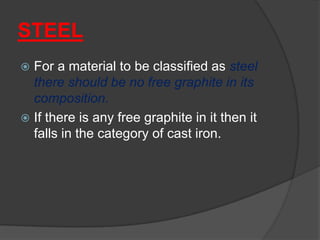
 For a material to be classified as steel
there should be no free graphite in its
composition.
 If there is any free graphite in it then it
falls in the category of cast iron.
CLASSIFICATION OF
STEEL
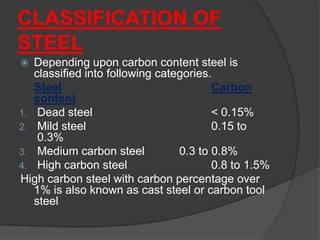
 Depending upon carbon content steel is
classified into following categories.
Steel Carbon
content
1. Dead steel < 0.15%
2. Mild steel 0.15 to
0.3%
3. Medium carbon steel 0.3 to 0.8%
4. High carbon steel 0.8 to 1.5%
High carbon steel with carbon percentage over
1% is also known as cast steel or carbon tool
steel
MILD STEEL
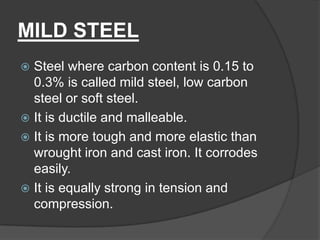
 Steel where carbon content is 0.15 to
0.3% is called mild steel, low carbon
steel or soft steel.
 It is ductile and malleable.
 It is more tough and more elastic than
wrought iron and cast iron. It corrodes
easily.
 It is equally strong in tension and
compression.
MILD STEEL(USES)
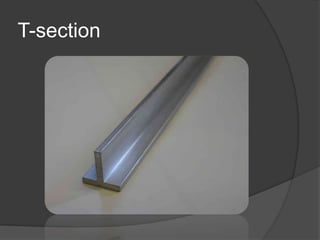
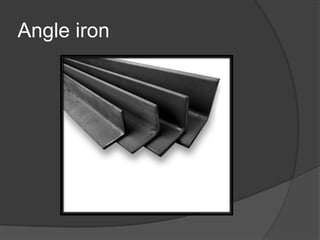
1. In construction work it is chiefly used as
rolled structural sections like I-section, T-
section, angle iron.
2. Mild steel round bars are extensively being
used as reinforcement in reinforced cement
concrete.
3. Plain and corrugated sheets of mild steel are
used as roof covering.
4. It is also used in the manufacturing of
various tools and equipments, for rail track,
transmission towers and industrial building.
T-section
I-section
Angle iron
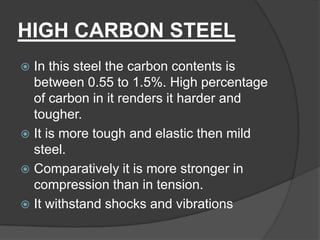
HIGH CARBON STEEL
 In this steel the carbon contents is
between 0.55 to 1.5%. High percentage
of carbon in it renders it harder and
tougher.
 It is more tough and elastic then mild
steel.
 Comparatively it is more stronger in
compression than in tension.
 It withstand shocks and vibrations
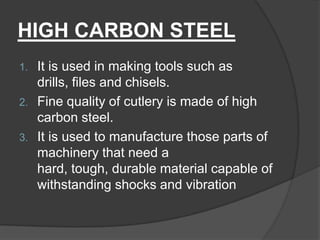
HIGH CARBON STEEL
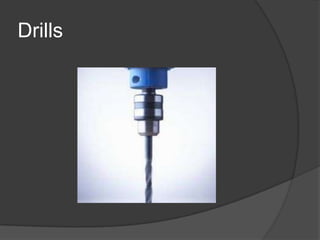
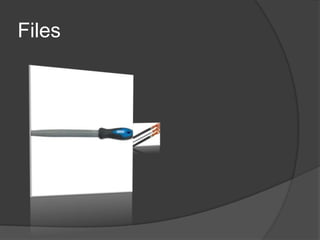
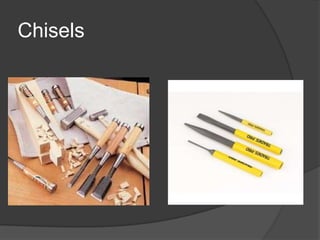
1. It is used in making tools such as
drills, files and chisels.
2. Fine quality of cutlery is made of high
carbon steel.
3. It is used to manufacture those parts of
machinery that need a
hard, tough, durable material capable of
withstanding shocks and vibration
Drills
Files
Chisels
HIGH TENSION STEEL
 It is essentially a low carbon steel and the
percentage of carbon is kept lesser than
0.15%. It is also termed as high tension steel.
 Because of increase tensile strength, lesser
weight of it used, as compared to mild steel at
the same job. The structure thus becomes
lighter.
 It withstand atmospheric corrosion better. It is
tougher and more elastic. It is more brittle and
less ductile then mild steel.
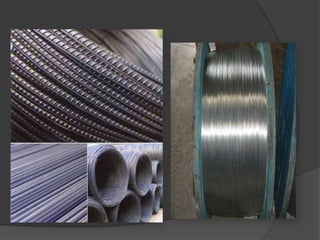
 High tension steel wires are extensively used
in reinforcing prestressed concrete structures.
REINFORCING STEEL
 Plain cement concrete being strong in
compression but weak in tension.
 Mild steel or high tension steel is
embedded as reinforcement in the
concrete to make it stronger in tension.
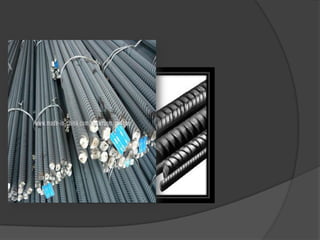
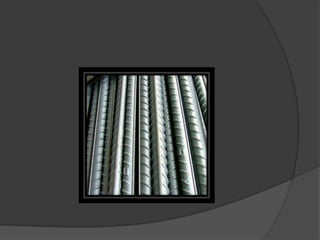
 Though flats and square bars can be
used as reinforcement yet the round
bars are extensively used for the
purpose
RUSTING & CORROSION
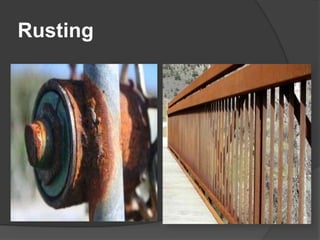
 Rusting is just oxidation of iron at the
surface. This process is activated by the
presence of moisture and carbon
dioxide.
 Atmospheric pollution also accelerates
rust formation.
 Corrosion is slow but steady eating
away of metal and is a consequence of
rusting
Rusting
Corrosion
PRESERVATION OF
STEEL
Following method could gainfully be
adopted to minimize rusting and corrosion.
TARRING:
 Iron is dipped in hot coal tar so that a film
of it sticks to the surface which protects the
surface from rusting and corrosion.
 Pipes or ends of poles to be embedded in
earth are usually given this protective
treatment.
PRESERVATION OF
STEEL
PAINTING:
 Paints usually the lead paints are applied on
the surface to be protected.
 Exposed metal surfaces as in case of roof
trusses and bridge structure are given this
treatment which have to be repeated after
regular interval of time.
PRESERVATION OF
STEEL
ENAMELLING:
Enamellings provides better and long life
protection as compared to painting. This
treatment is given only to smaller surface.
GALVANIZING:
depositing a thin film of zinc on the
iron/steel surface is termed as galvanizing.
The surface to be galvanized is first
cleared from all foreign materials by giving
it an acid wash to be followed by wash of
clean water.
PRESERVATION OF
STEEL
The surface is then dried and dipped in molten zinc.
The fine film of zinc that gets deposited protects the
surface from contact with atmosphere and
consequent oxidation.
SHERADISING:
Surface to be treated is cleaned of all foreign deposits
by acid wash and then with clean water. It is then
dried and covered with zinc dust and enclosed in
steel boxes to be heated in furnace under controlled
temperature. Molten zinc spreads over the whole
surface and on cooling forms a thin protective layer.
Sheradising gives better protection then galvanizing.
PRESERVATION OF
STEEL
TIN PLATING:
After cleaning the surface with acid wash followed
by clean water and drying in is dipped in a bath
of molten tin. A protective layer is left on the
surface.
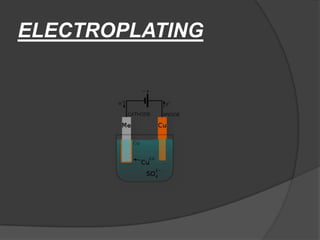
ELECTROPLATING:
By the process of electrolysis a thin film of
nickel, chromium, cadmium, copper, zinc is
deposited on the surface to be protected.
The surface to be protected is made the
cathode and the metal to be deposited is made
the anode.
ELECTROPLATING
JOINING METALS
 Metals are joined together by any one of the
following methods.
1. Soldering
2. Brazing
3. Welding
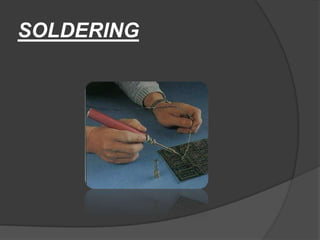
1.SOLDERING:
 It is the method of joining two metal surfaces
by means of low melting alloy of lead and tin
(usually mixed in the ratio of 1:2),
 This alloy known as solder melts and adheres
to the surfaces to be joined. It only serves to
fill up the joint.
SOLDERING
JOINING METALS
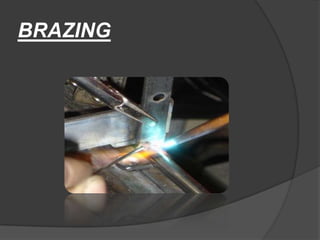
2. BRAZING:
 It is similar to the operation of soldering but
is done at much higher temperature ( from
650 to 1100 C).
 It consist of mixture of 1 part of tin, 3 parts
of zinc and four parts of copper. The
brazing solder is applied to the joint in the
presence of borax.
 It is used in joining together iron, copper,
brass and gun metal
BRAZING
JOINING METALS
3. WELDING:
Two methods of welding:
By Pressure Welding
It can be applied to mild steel and
wrought iron with low carbon and silicon
content may be used to join the metal. In
it the surfaces to be joined are heated to
such a temperature as to render them
plastic and then pressure is applied to
join the metals.
JOINING METALS
By Fusion Welding:
In this welding the surfaces to be weld are
brought near to each other and then
locally heated either by gas or by
electric spark until the surfaces are melt.

Metals

  • 1.
  • 2.
    METALS  Metals arethe backbone of all engineering projects and products. Various metals are used in one form or the other. Metals are found as compounds like oxides, sulphates, carbonates, phosphat es etc. in nature.  These compounds are known as ores. Ores are treated to remove the impurities and get the metal .
  • 3.
    •Metals are… Solidat room temperature, except mercury, which is liquid •Metals have… very high melting point. •Metals are… shiny when they cut. •Metals are… good conductors of heat and electricity. •Metals are… usually strong & malleable so they can be hammered into shape. METALS CHARACTERISTICS
  • 4.
    Ferrous Non-Ferrous Alloys Containingiron & Do not contain iron. A mixture of almost all are e.g. aluminium, metals, or a magnetic. copper, silver, gold, metal & small e.g. mild-steel, lid, tin etc. amount of cast-iron, tool- other substance Steel etc. Ferrous Alloys Non-Ferrous Alloys e.g. e.g. brass (copper + zinc) stainless steel bronze (copper + tin ) steel + chromium
  • 5.
    OCCURRENCE OF IRON Iron is never available pure in nature. It has to be extracted in the form of pig iron from the various iron ores.  Pig iron is the crudest and wrought iron is the purest form of iron.  The ores from which iron is extracted are: i. Magnite : it contains 70 to 75% iron. ii. Haematite : It has about 70% iron. iii. Iron Pyrites: It has about 47% iron. iv. Siderite: It contains 40% iron
  • 6.
    PIG IRON  Toremove impurities from the iron ore carbon and flux are added while melting it.  The refined product so obtained is the crudest form of iron and is called pig iron. It is cast into rough bars called pigs. Properties:  It is hard and brittle as such it is neither ductile nor malleable.  It is difficult to bend.  It melts easily. The fusion temperature is 1200 o C.
  • 7.
    PIG IRON  Itcan be hardened but not tempered.  It can be magnetized.  It has very high compressive strength but very weak in tension.  It does not rust.  It cannot be welded. USES: cast iron, wrought iron and mild steel are obtained by refining the pig iron. Because of its high compressive strength it is used in columns, base plates, door brackets , wheel and pipe work.
  • 8.
    CAST IRON  Pigiron is remelted with limestone and coke and poured into moulds of desired shapes and sizes to get purer product known as cast iron.  Moulding remelted pig iron removes impurity and gives a more uniform product,  Carbon contents in cast iron vary from 2 to 4.5%.
  • 9.
    CAST IRON PROPERTIES:  Itsstructure is coarse crystalline and fibrous.  Freshly fractured surface has grayish white appearance.  It is brittle.  It cannot withstand shocks and impacts.  It cannot be welded.  It cannot be magnetized.  It does not rust.  It is fairly hard and cannot be worked with a hand file.
  • 10.
    CAST IRON USES:  Itis used for casting, rain water pipes, gratings, railings, balustrades( staircase side railing).  Because of high compressive strength it is used in making columns, supports for heavy machinery, carriage wheels etc.  It is the basic material for the manufacturing of Wrought iron and steel.
  • 11.
    WROUGHT IRON  Ifall the carbon and other elements in pig iron are oxidized and may be left with 0.25 percent of carbon then we obtain wrought iron.  It is by far the purest form of iron in which the total impurities do not exceed 0.5%. PROPERTIES:  Its structure is fibrous and has silky luster.  It is ductile and malleable.  It is tough and can withstand shocks and impact better than cast iron.
  • 12.
    WROUGHT IRON  Itcan be forged and welded.  It rusts easily  It is unaffected by saline water.  It cannot be permanently magnetized. USES : It is used in making roofing sheets, corrugated sheets, rods, gas and water pipes, boiler tubes and ornamental iron works such as grills gates and railing and window guards.
  • 13.
  • 14.
  • 15.
  • 16.
    STEEL  The essentialdifference between cast iron and steel is the amount of their carbon contents.  Steel goes on becoming harder and tougher with the increase in its carbon contents.  Up to a content of 1.5% all the carbon gets into chemical combination with iron and none of its exist in free state.  If carbon contents increase beyond 1.5% then it does not combine with iron and is present as free graphite. At this stage metals falls in a category of cast iron.
  • 17.
    STEEL  For amaterial to be classified as steel there should be no free graphite in its composition.  If there is any free graphite in it then it falls in the category of cast iron.
  • 18.
    CLASSIFICATION OF STEEL  Dependingupon carbon content steel is classified into following categories. Steel Carbon content 1. Dead steel < 0.15% 2. Mild steel 0.15 to 0.3% 3. Medium carbon steel 0.3 to 0.8% 4. High carbon steel 0.8 to 1.5% High carbon steel with carbon percentage over 1% is also known as cast steel or carbon tool steel
  • 19.
    MILD STEEL  Steelwhere carbon content is 0.15 to 0.3% is called mild steel, low carbon steel or soft steel.  It is ductile and malleable.  It is more tough and more elastic than wrought iron and cast iron. It corrodes easily.  It is equally strong in tension and compression.
  • 20.
    MILD STEEL(USES) 1. Inconstruction work it is chiefly used as rolled structural sections like I-section, T- section, angle iron. 2. Mild steel round bars are extensively being used as reinforcement in reinforced cement concrete. 3. Plain and corrugated sheets of mild steel are used as roof covering. 4. It is also used in the manufacturing of various tools and equipments, for rail track, transmission towers and industrial building.
  • 21.
  • 22.
  • 23.
  • 24.
    HIGH CARBON STEEL In this steel the carbon contents is between 0.55 to 1.5%. High percentage of carbon in it renders it harder and tougher.  It is more tough and elastic then mild steel.  Comparatively it is more stronger in compression than in tension.  It withstand shocks and vibrations
  • 25.
    HIGH CARBON STEEL 1.It is used in making tools such as drills, files and chisels. 2. Fine quality of cutlery is made of high carbon steel. 3. It is used to manufacture those parts of machinery that need a hard, tough, durable material capable of withstanding shocks and vibration
  • 26.
  • 27.
  • 28.
  • 29.
    HIGH TENSION STEEL It is essentially a low carbon steel and the percentage of carbon is kept lesser than 0.15%. It is also termed as high tension steel.  Because of increase tensile strength, lesser weight of it used, as compared to mild steel at the same job. The structure thus becomes lighter.  It withstand atmospheric corrosion better. It is tougher and more elastic. It is more brittle and less ductile then mild steel.  High tension steel wires are extensively used in reinforcing prestressed concrete structures.
  • 31.
    REINFORCING STEEL  Plaincement concrete being strong in compression but weak in tension.  Mild steel or high tension steel is embedded as reinforcement in the concrete to make it stronger in tension.  Though flats and square bars can be used as reinforcement yet the round bars are extensively used for the purpose
  • 34.
    RUSTING & CORROSION Rusting is just oxidation of iron at the surface. This process is activated by the presence of moisture and carbon dioxide.  Atmospheric pollution also accelerates rust formation.  Corrosion is slow but steady eating away of metal and is a consequence of rusting
  • 35.
  • 36.
  • 37.
    PRESERVATION OF STEEL Following methodcould gainfully be adopted to minimize rusting and corrosion. TARRING:  Iron is dipped in hot coal tar so that a film of it sticks to the surface which protects the surface from rusting and corrosion.  Pipes or ends of poles to be embedded in earth are usually given this protective treatment.
  • 38.
    PRESERVATION OF STEEL PAINTING:  Paintsusually the lead paints are applied on the surface to be protected.  Exposed metal surfaces as in case of roof trusses and bridge structure are given this treatment which have to be repeated after regular interval of time.
  • 39.
    PRESERVATION OF STEEL ENAMELLING: Enamellings providesbetter and long life protection as compared to painting. This treatment is given only to smaller surface. GALVANIZING: depositing a thin film of zinc on the iron/steel surface is termed as galvanizing. The surface to be galvanized is first cleared from all foreign materials by giving it an acid wash to be followed by wash of clean water.
  • 40.
    PRESERVATION OF STEEL The surfaceis then dried and dipped in molten zinc. The fine film of zinc that gets deposited protects the surface from contact with atmosphere and consequent oxidation. SHERADISING: Surface to be treated is cleaned of all foreign deposits by acid wash and then with clean water. It is then dried and covered with zinc dust and enclosed in steel boxes to be heated in furnace under controlled temperature. Molten zinc spreads over the whole surface and on cooling forms a thin protective layer. Sheradising gives better protection then galvanizing.
  • 41.
    PRESERVATION OF STEEL TIN PLATING: Aftercleaning the surface with acid wash followed by clean water and drying in is dipped in a bath of molten tin. A protective layer is left on the surface. ELECTROPLATING: By the process of electrolysis a thin film of nickel, chromium, cadmium, copper, zinc is deposited on the surface to be protected. The surface to be protected is made the cathode and the metal to be deposited is made the anode.
  • 42.
  • 43.
    JOINING METALS  Metalsare joined together by any one of the following methods. 1. Soldering 2. Brazing 3. Welding 1.SOLDERING:  It is the method of joining two metal surfaces by means of low melting alloy of lead and tin (usually mixed in the ratio of 1:2),  This alloy known as solder melts and adheres to the surfaces to be joined. It only serves to fill up the joint.
  • 44.
  • 45.
    JOINING METALS 2. BRAZING: It is similar to the operation of soldering but is done at much higher temperature ( from 650 to 1100 C).  It consist of mixture of 1 part of tin, 3 parts of zinc and four parts of copper. The brazing solder is applied to the joint in the presence of borax.  It is used in joining together iron, copper, brass and gun metal
  • 46.
  • 47.
    JOINING METALS 3. WELDING: Twomethods of welding: By Pressure Welding It can be applied to mild steel and wrought iron with low carbon and silicon content may be used to join the metal. In it the surfaces to be joined are heated to such a temperature as to render them plastic and then pressure is applied to join the metals.
  • 48.
    JOINING METALS By FusionWelding: In this welding the surfaces to be weld are brought near to each other and then locally heated either by gas or by electric spark until the surfaces are melt.