What We LearnToday
Metal
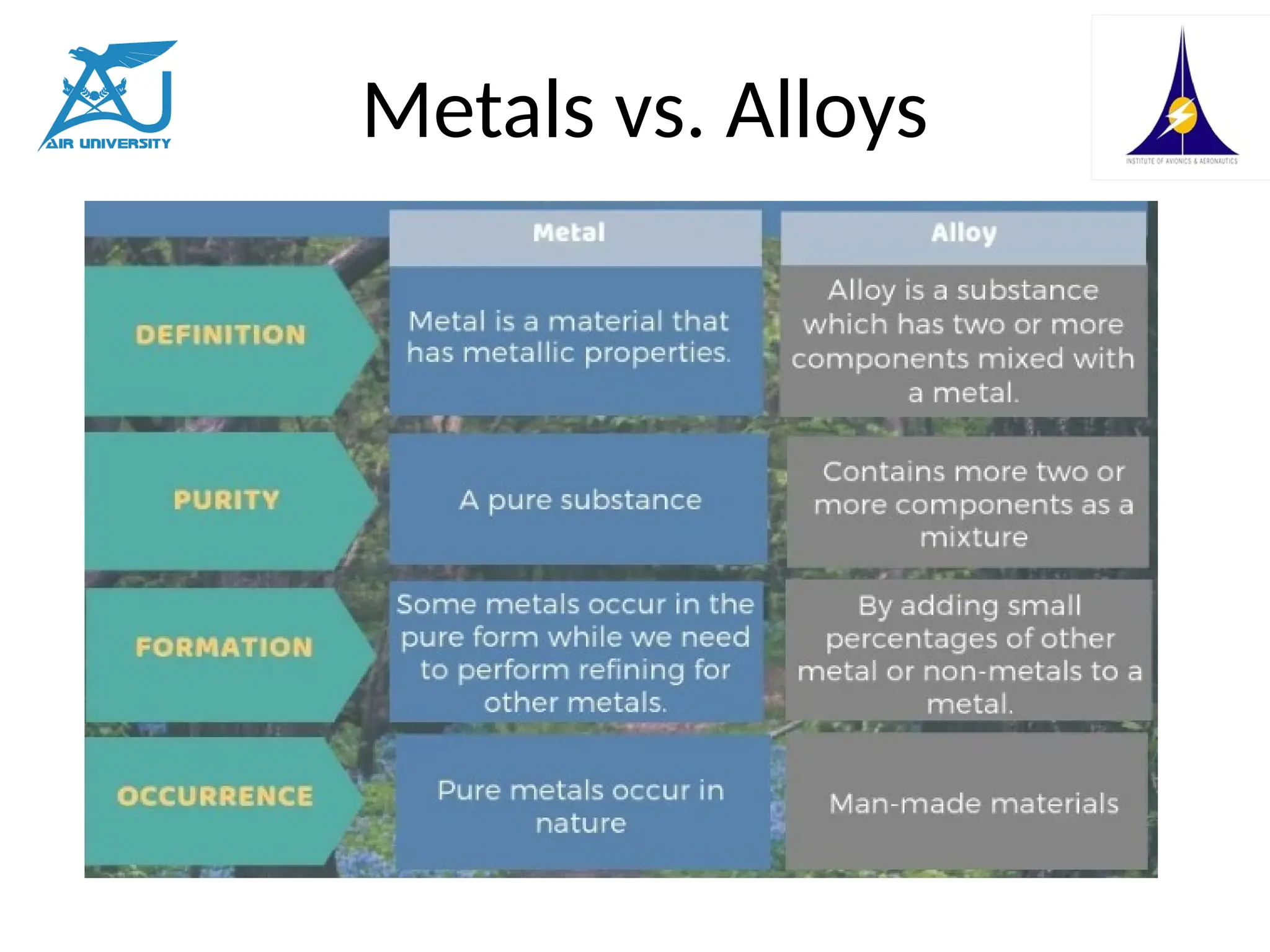
Metals vs. Alloys
Ferrous Metals
Steel
Steel Terminology
Steel Representation
High Temperature Metals
Department of Mechanical and Aerospace Engineering
Metals
Department of Mechanicaland Aerospace Engineering
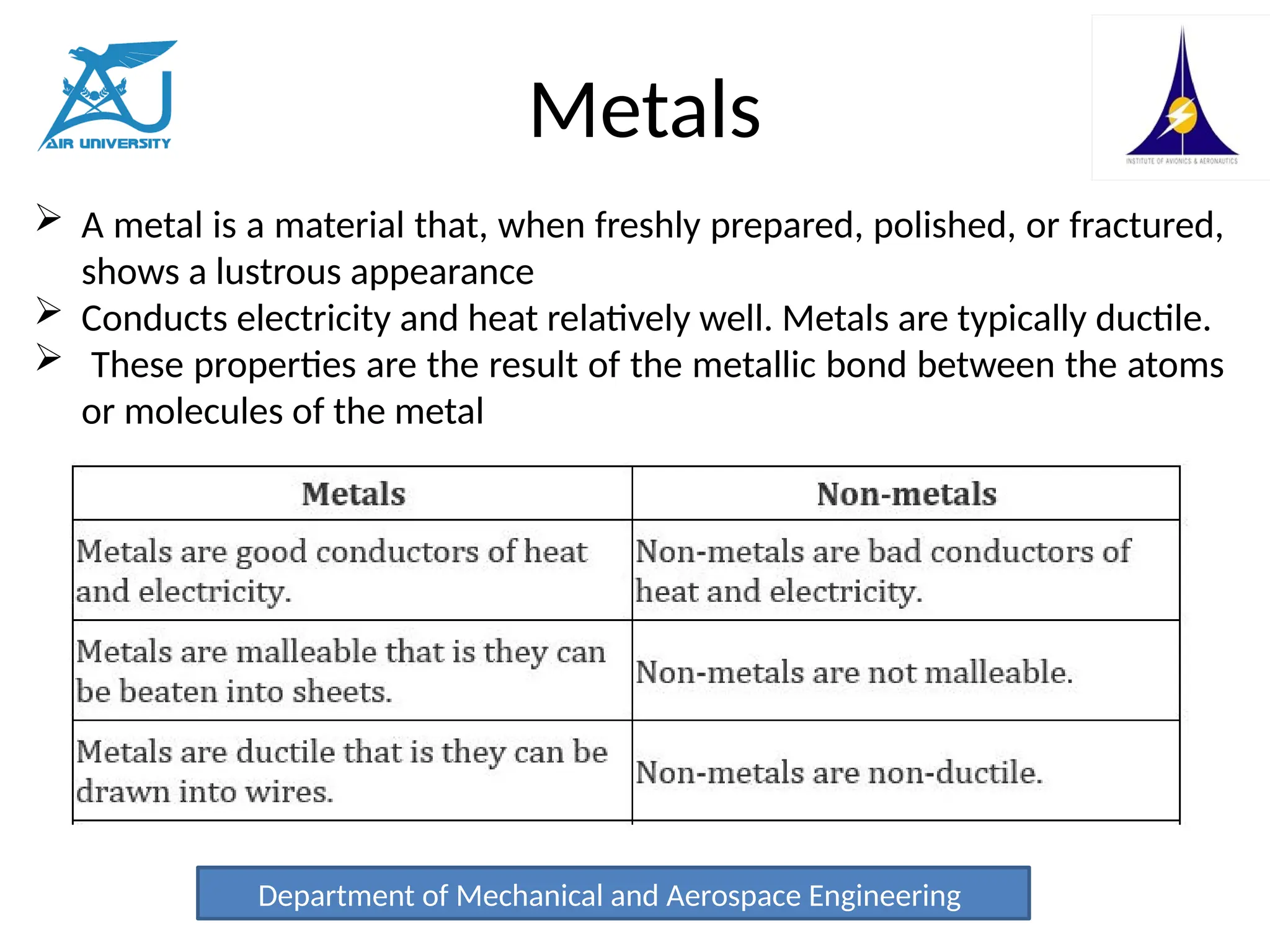
A metal is a material that, when freshly prepared, polished, or fractured,
shows a lustrous appearance
Conducts electricity and heat relatively well. Metals are typically ductile.
These properties are the result of the metallic bond between the atoms
or molecules of the metal
5.
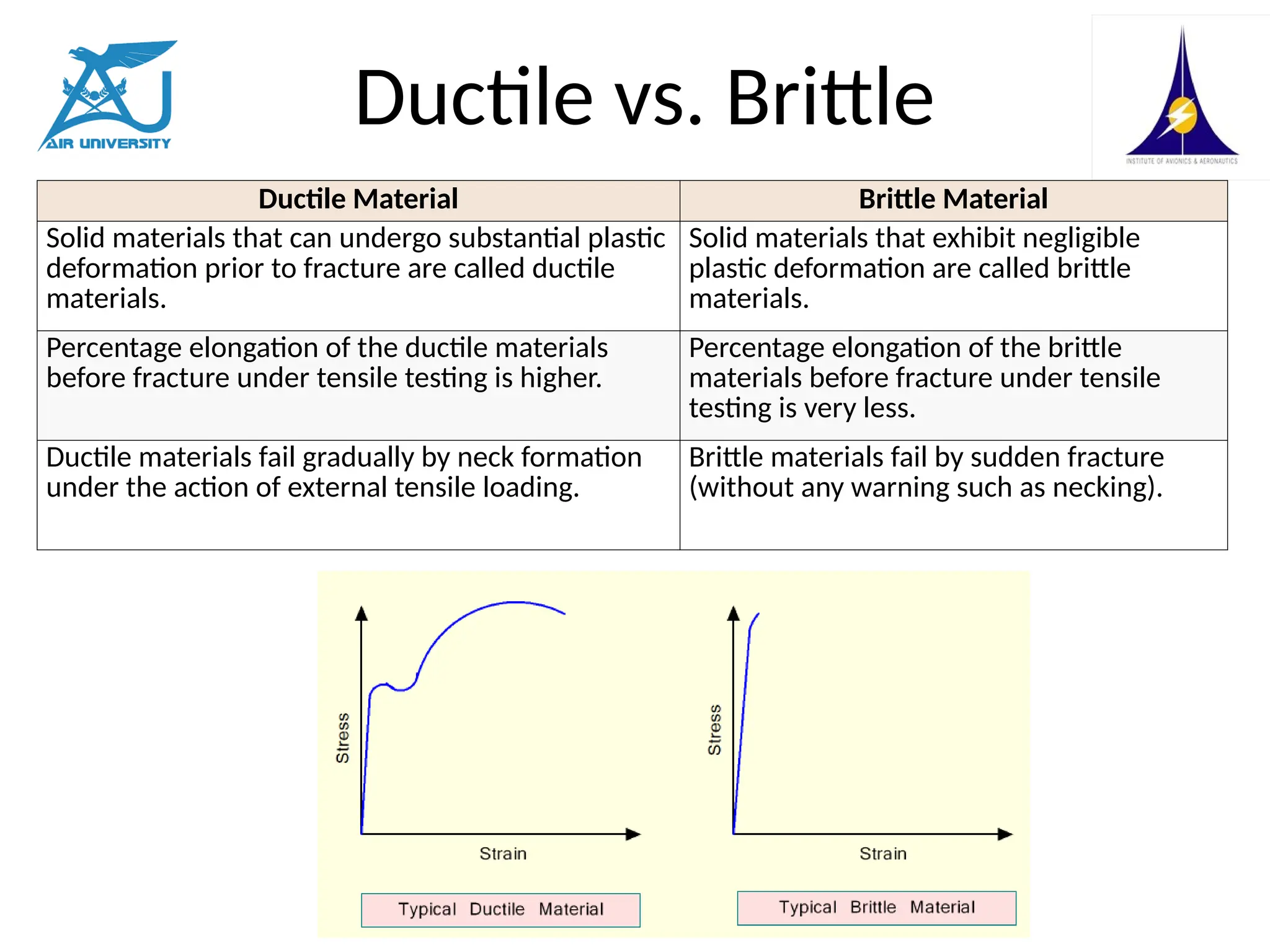
Ductile vs. Brittle
DuctileMaterial Brittle Material
Solid materials that can undergo substantial plastic
deformation prior to fracture are called ductile
materials.
Solid materials that exhibit negligible
plastic deformation are called brittle
materials.
Percentage elongation of the ductile materials
before fracture under tensile testing is higher.
Percentage elongation of the brittle
materials before fracture under tensile
testing is very less.
Ductile materials fail gradually by neck formation
under the action of external tensile loading.
Brittle materials fail by sudden fracture
(without any warning such as necking).
6.
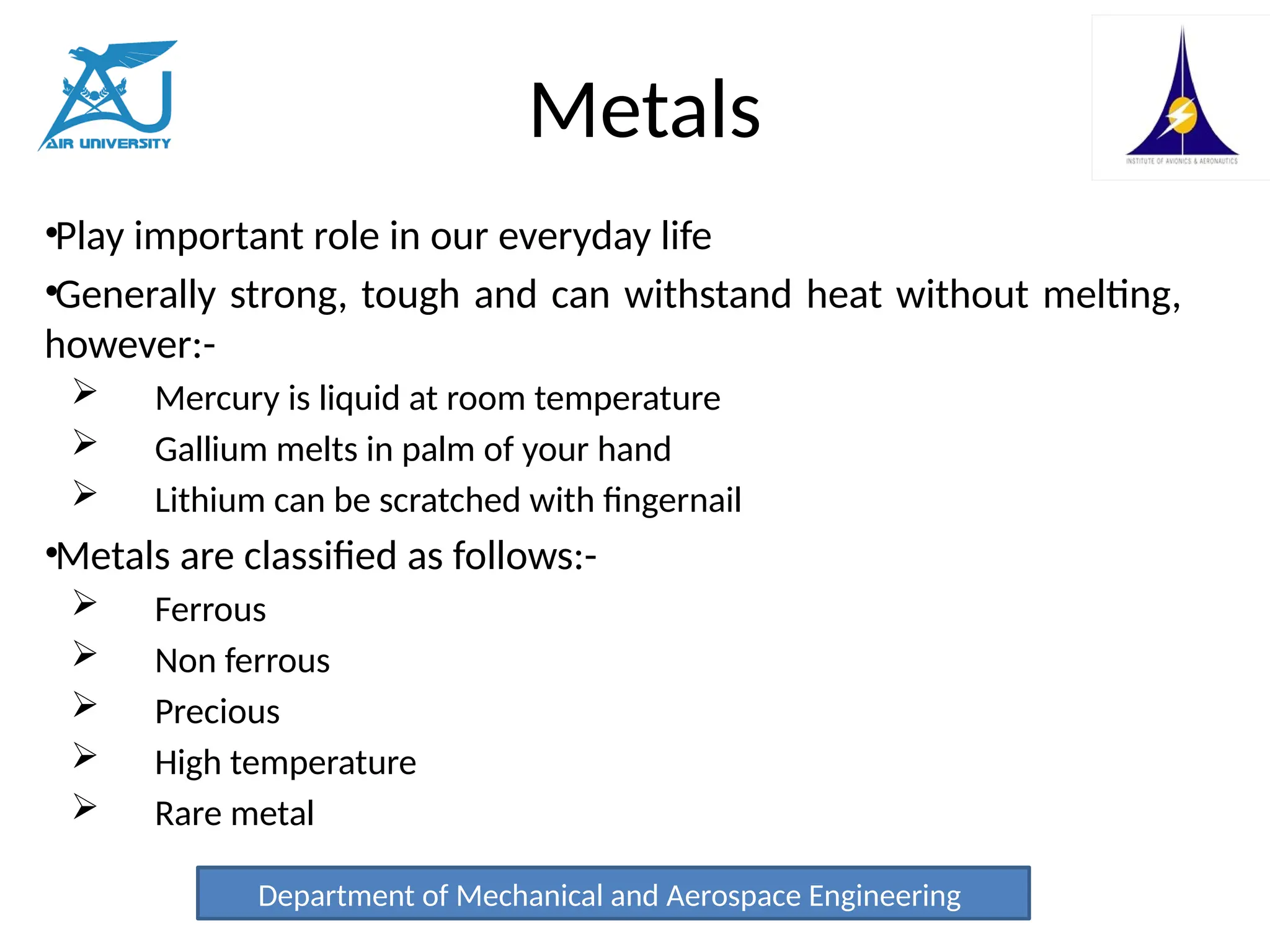
Metals
•Play important rolein our everyday life
•Generally strong, tough and can withstand heat without melting,
however:-
Mercury is liquid at room temperature
Gallium melts in palm of your hand
Lithium can be scratched with fingernail
•Metals are classified as follows:-
Ferrous
Non ferrous
Precious
High temperature
Rare metal
Department of Mechanical and Aerospace Engineering
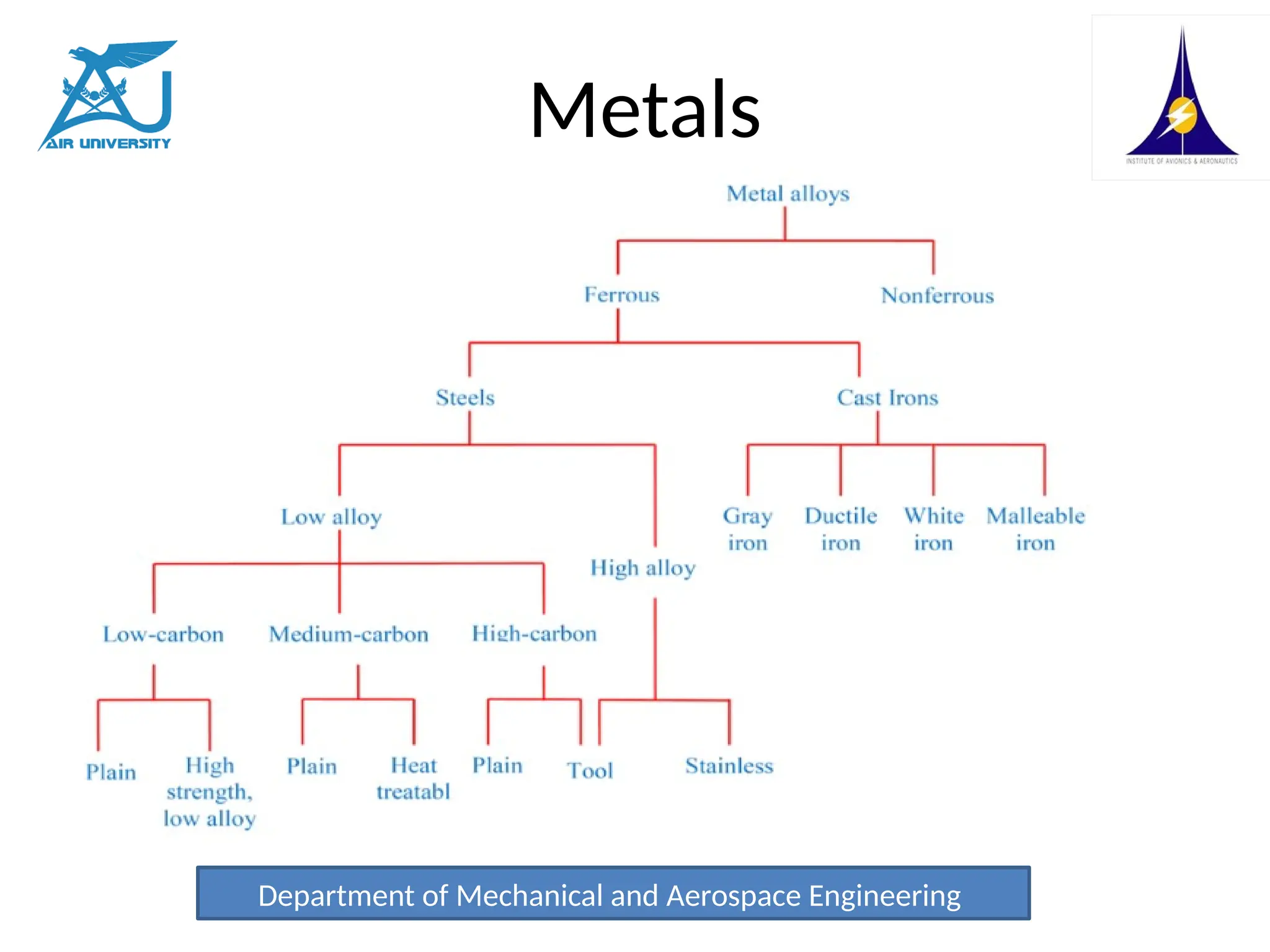
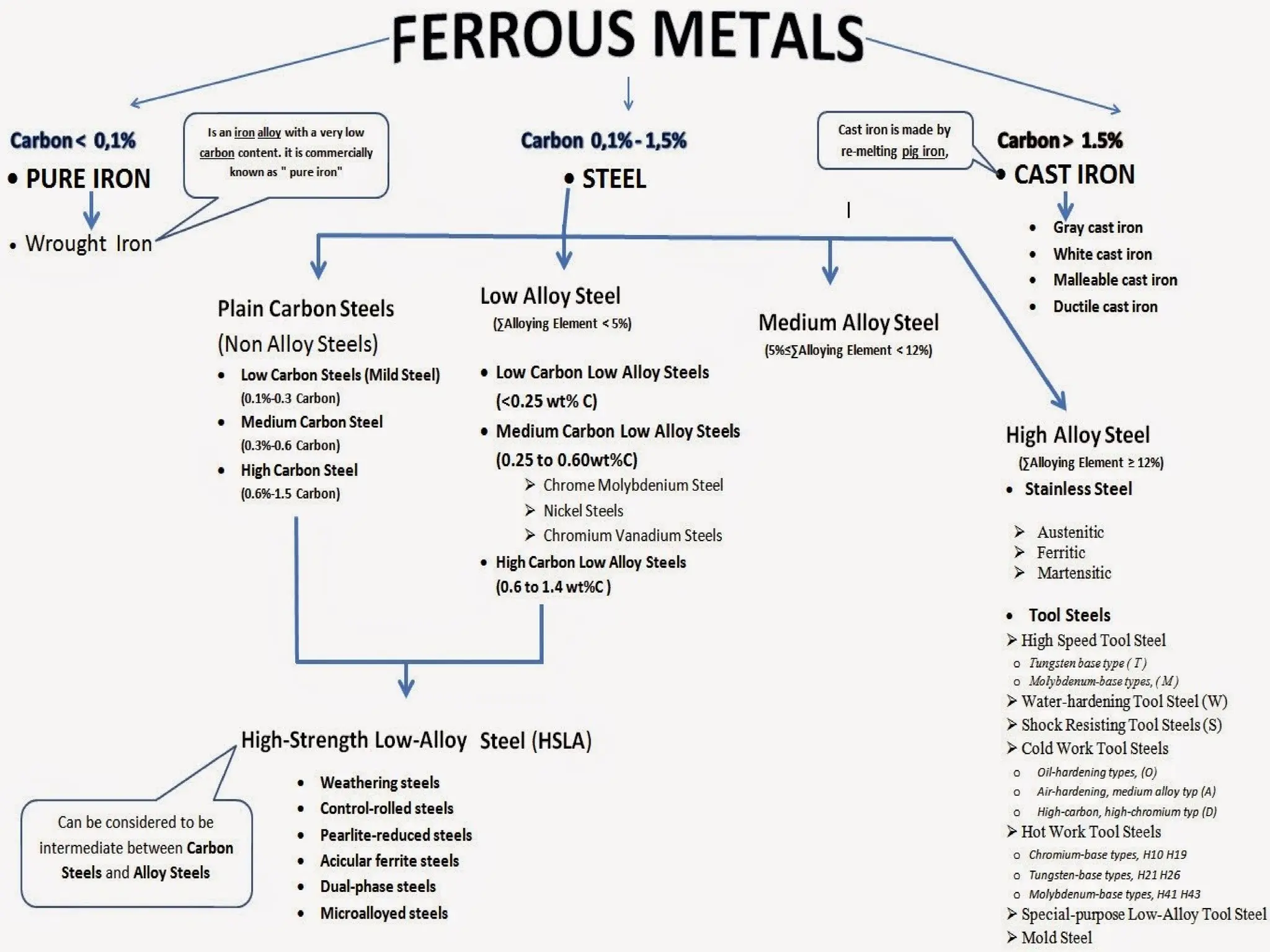
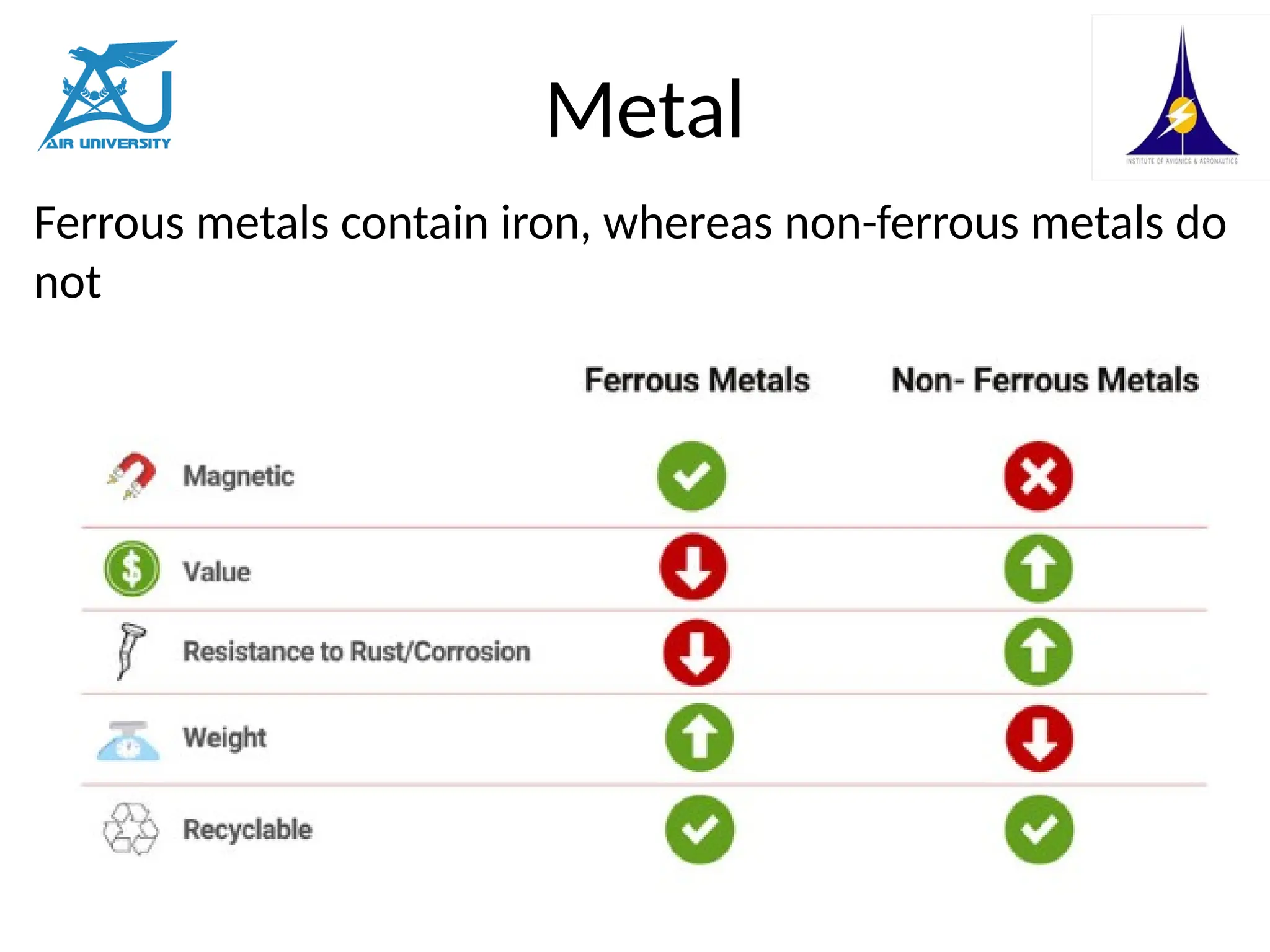
Ferrous Metals
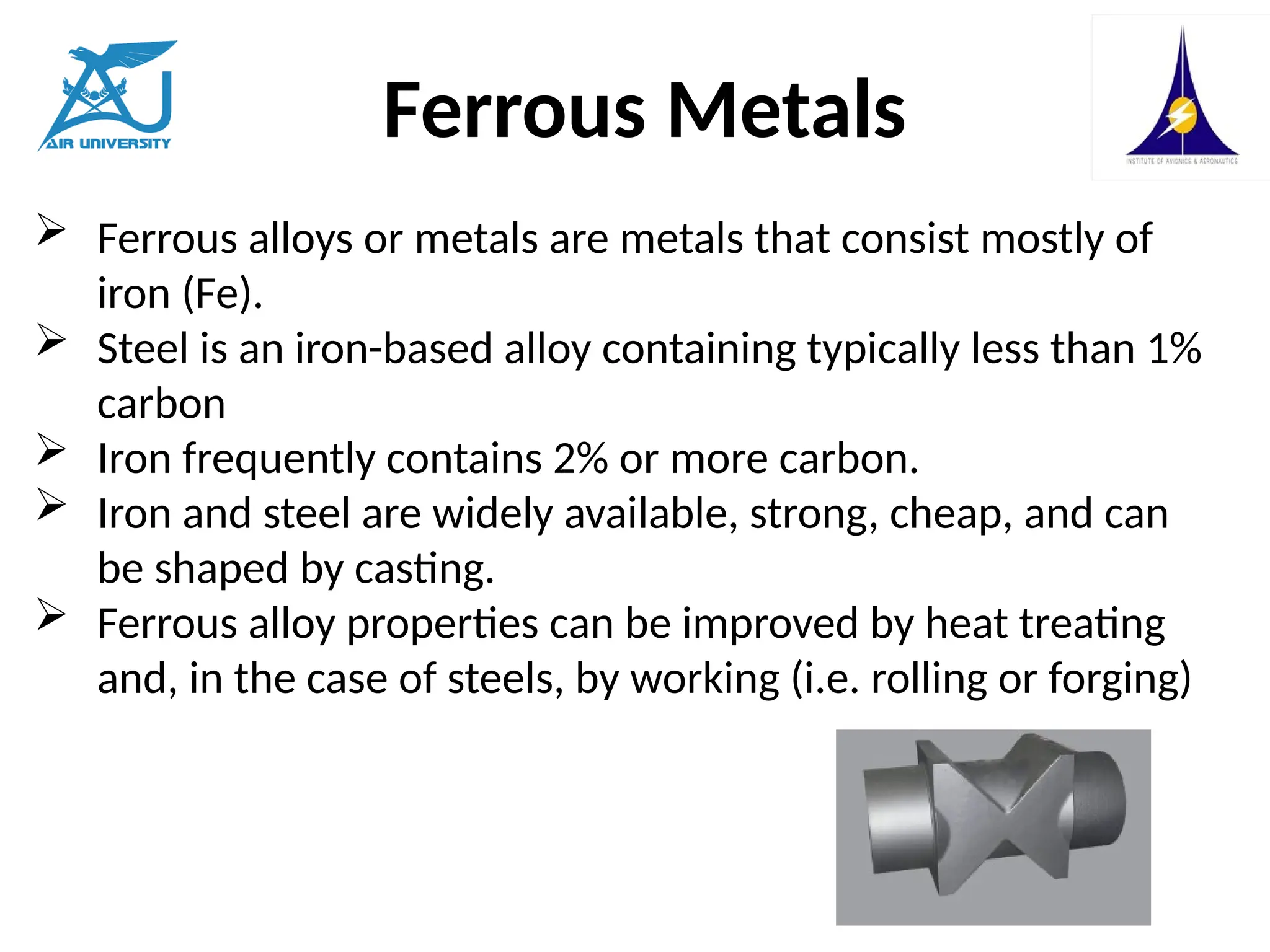
Ferrousalloys or metals are metals that consist mostly of
iron (Fe).
Steel is an iron-based alloy containing typically less than 1%
carbon
Iron frequently contains 2% or more carbon.
Iron and steel are widely available, strong, cheap, and can
be shaped by casting.
Ferrous alloy properties can be improved by heat treating
and, in the case of steels, by working (i.e. rolling or forging)
10.
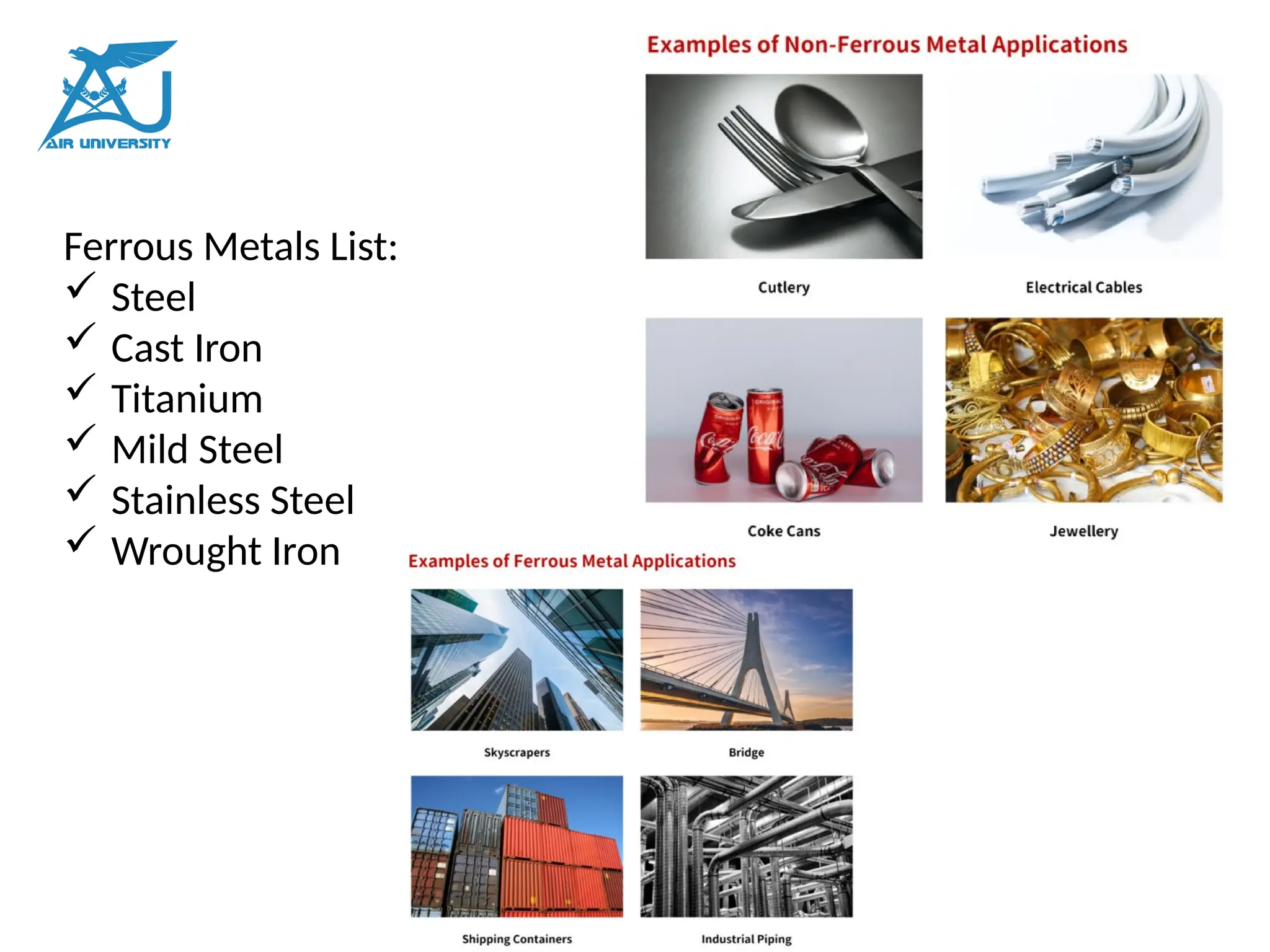
Ferrous Metals List:
Steel
Cast Iron
Titanium
Mild Steel
Stainless Steel
Wrought Iron
11.
Ferrous Metals
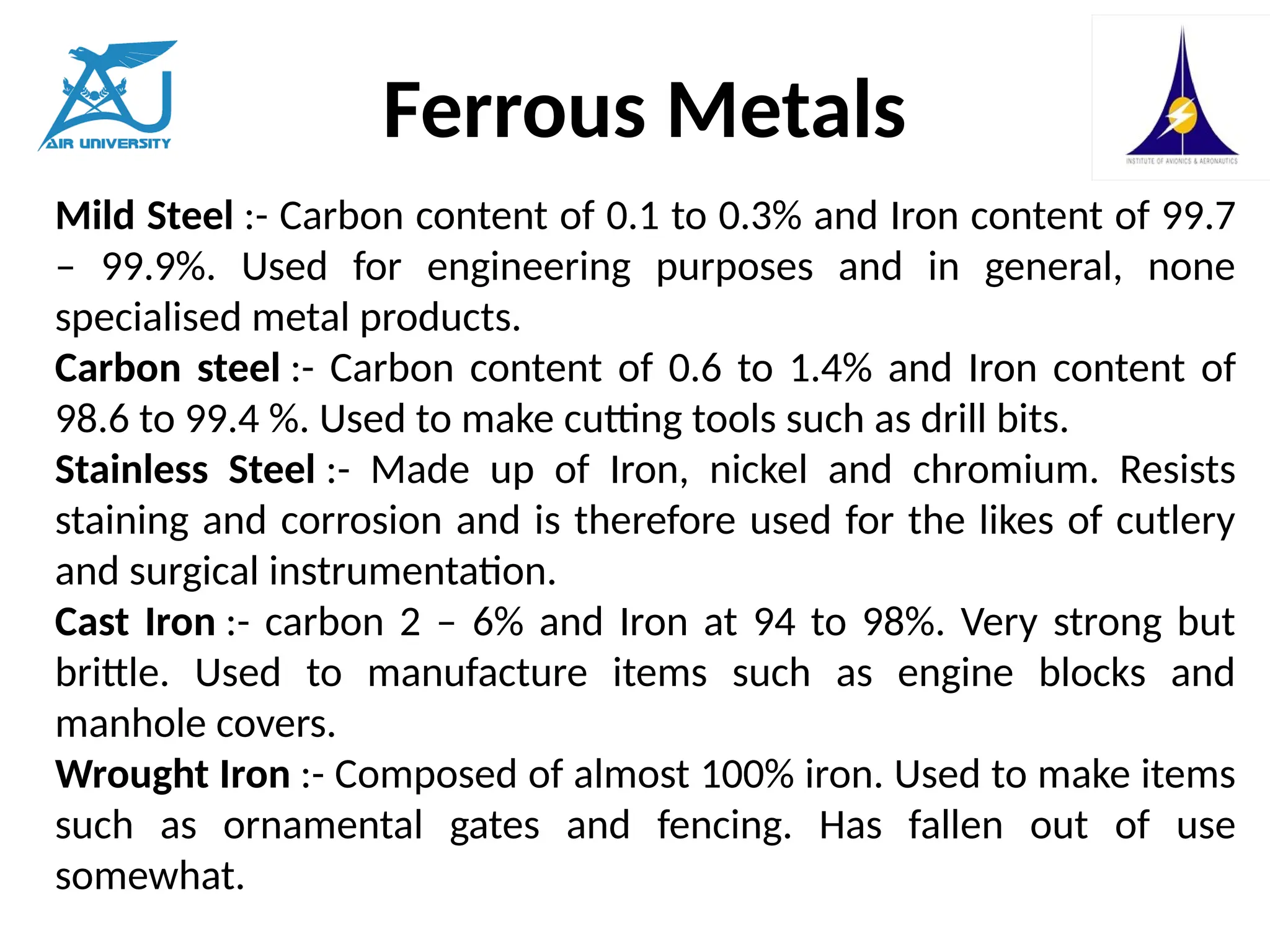
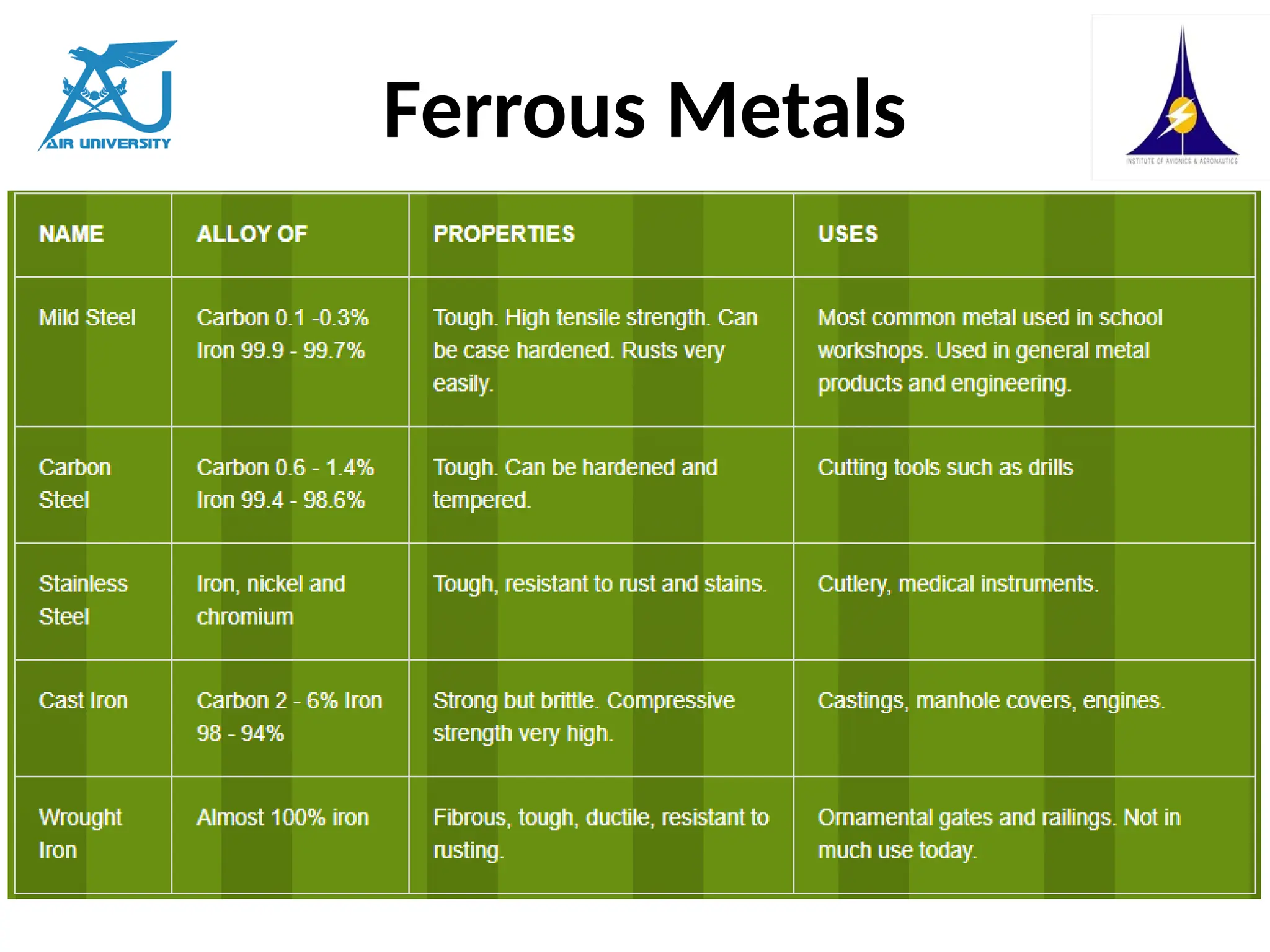
Mild Steel:- Carbon content of 0.1 to 0.3% and Iron content of 99.7
– 99.9%. Used for engineering purposes and in general, none
specialised metal products.
Carbon steel :- Carbon content of 0.6 to 1.4% and Iron content of
98.6 to 99.4 %. Used to make cutting tools such as drill bits.
Stainless Steel :- Made up of Iron, nickel and chromium. Resists
staining and corrosion and is therefore used for the likes of cutlery
and surgical instrumentation.
Cast Iron :- carbon 2 – 6% and Iron at 94 to 98%. Very strong but
brittle. Used to manufacture items such as engine blocks and
manhole covers.
Wrought Iron :- Composed of almost 100% iron. Used to make items
such as ornamental gates and fencing. Has fallen out of use
somewhat.
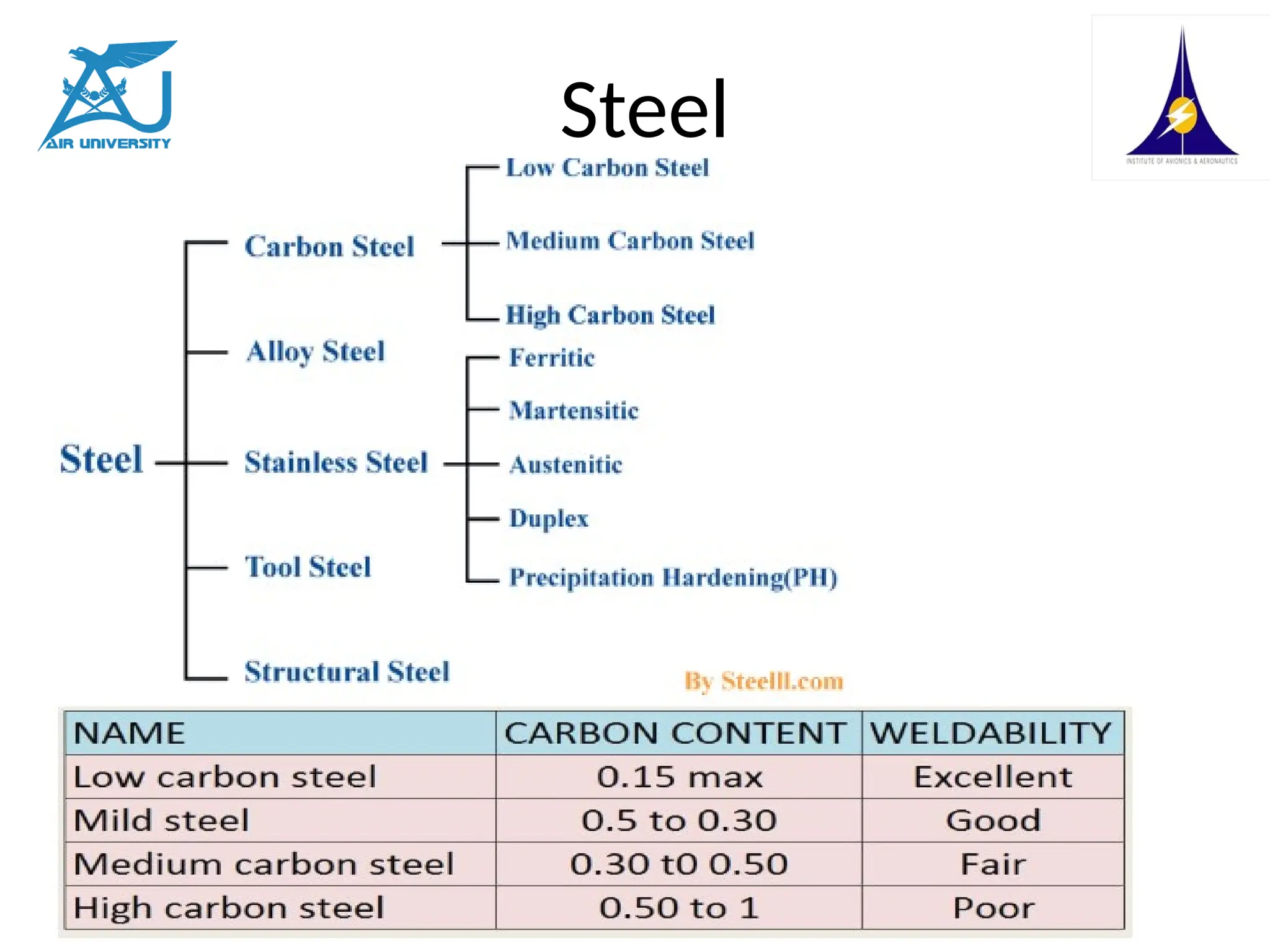
Steel
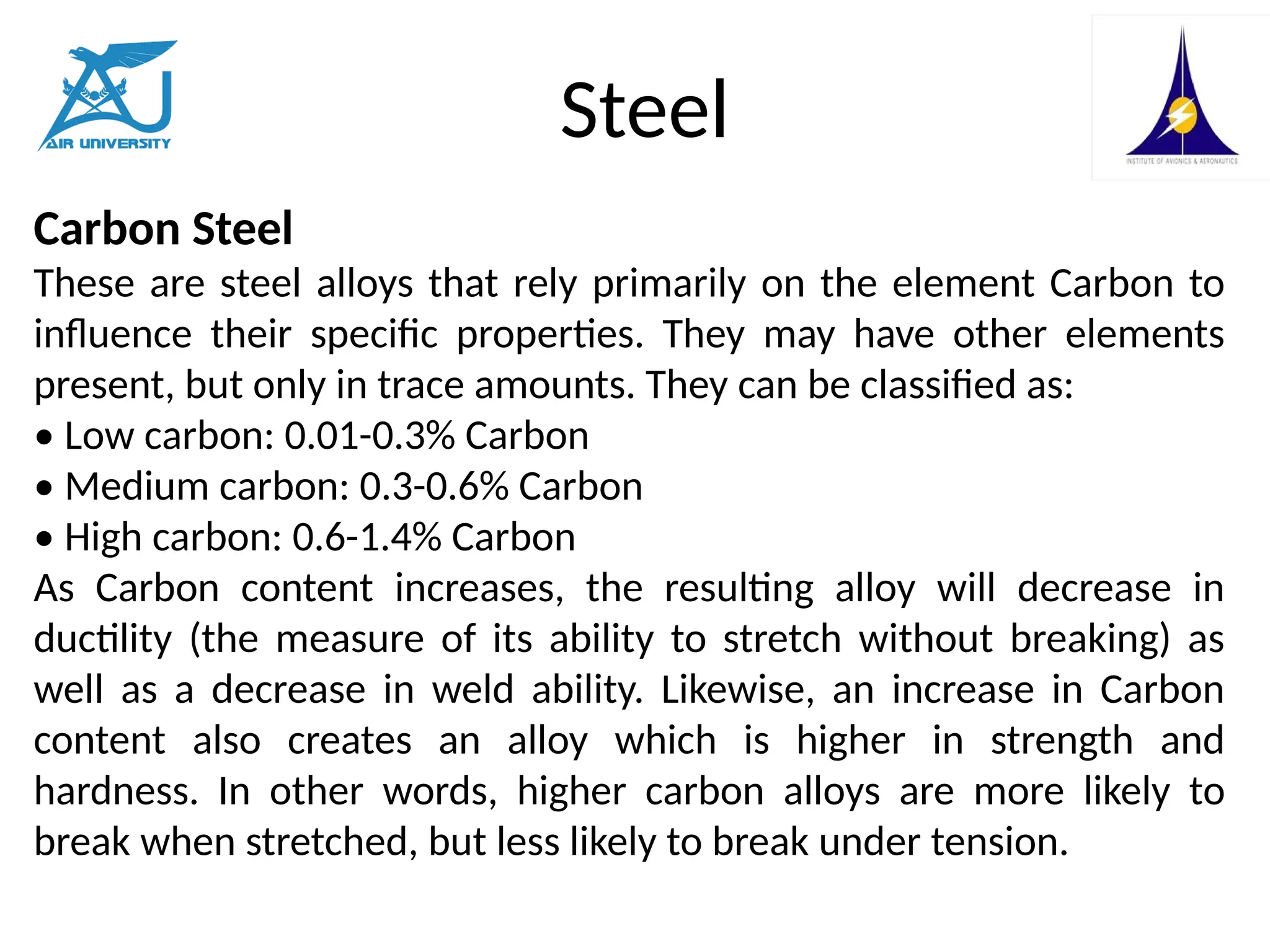
Carbon Steel
These aresteel alloys that rely primarily on the element Carbon to
influence their specific properties. They may have other elements
present, but only in trace amounts. They can be classified as:
• Low carbon: 0.01-0.3% Carbon
• Medium carbon: 0.3-0.6% Carbon
• High carbon: 0.6-1.4% Carbon
As Carbon content increases, the resulting alloy will decrease in
ductility (the measure of its ability to stretch without breaking) as
well as a decrease in weld ability. Likewise, an increase in Carbon
content also creates an alloy which is higher in strength and
hardness. In other words, higher carbon alloys are more likely to
break when stretched, but less likely to break under tension.
17.
Steel
Alloy Steel
Steelalloys that rely on any variety of other elements in
order to create a material with particular desired
properties are referred to as alloy steel.
They can contain elements like molybdenum, manganese,
nickel, chromium, vanadium, silicon, tungsten, copper and
boron.
Alloy steel with 1-5% alloying elements is considered low
alloy, while high alloy steel contains 5-50% alloying
elements by composition.
The benefits of alloy steel include increased strength, wear
resistance, toughness, and hardness.
18.
Steel
Stainless Steel
Steeltypes that contain at least 10.5% chromium in their
composition are called stainless steel. The primary purpose of
this addition is for maximum corrosion resistance while still
retaining its strength. So, stainless steel is much less likely to
oxidize or rust. Stainless steel can be classified as:
Austenitic - Not heat treatable (unable to be strengthened
through heat treatment) and non-magnetic and about 18%
chromium.
Ferritic - Not heat treatable and magnetic. Ferritic stainless steel
generally has lower carbon content, contains about 12-17%
chromium plus trace amounts of nickel.
Martensitic - Heat treatable and magnetic. This alloy has high
carbon content, about 11-17% and a small amount of nickel.
19.
Steel
Tool Steel
This groupcontains many different carbon and alloy
steel types which are grouped according to the
specific properties they display which make them
suitable for use in creating machine tools.
It may contain cobalt, vanadium, tungsten or
molybdenum in varying amounts.
These elements help to ensure they have high
strength, durability, and ability to hold sharpened
edges
20.
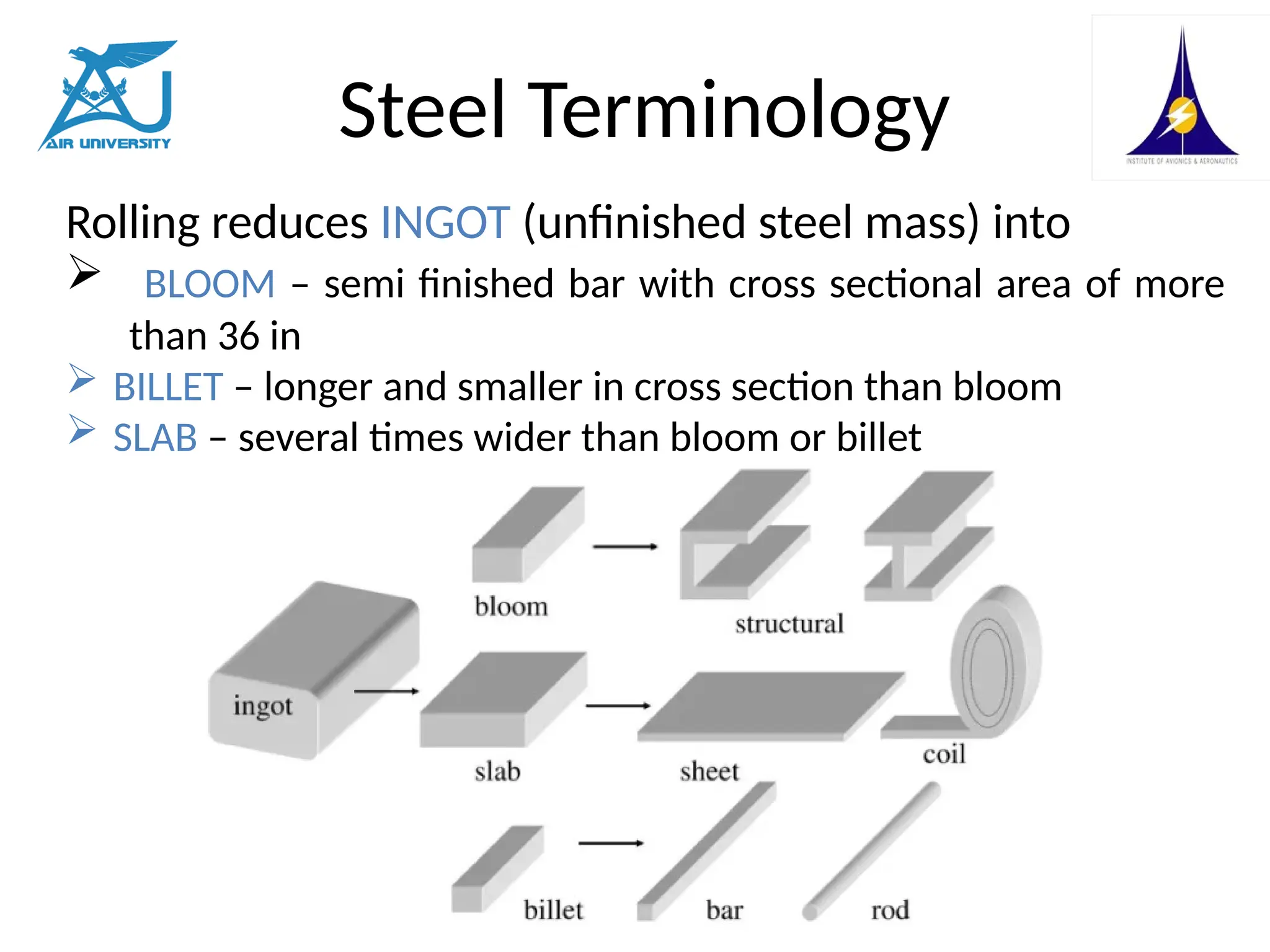
Steel Terminology
Rolling reducesINGOT (unfinished steel mass) into
BLOOM – semi finished bar with cross sectional area of more
than 36 in
BILLET – longer and smaller in cross section than bloom
SLAB – several times wider than bloom or billet
21.
Steel
The SAE-AISI systemthen classifies all other alloy steels using the
same four digit index as follows:
2 - Nickel steels;
3 - Nickel-chromium steels;
4 - Molybdenum steels;
5 - Chromium steels;
6 - Chromium-vanadium steels;
7 - Tungsten-chromium steels;
9 - Silicon-manganese steels.
The second digit of the series indicates the concentration of the
major element in percentiles (1 equals 1%). The last two digits of
the series indicate the carbon concentration to 0.01%.
Example:
SAE 5130 indicates a chromium steel alloy, containing 1% of
chromium and 0.30% of carbon.
22.
Non Ferrous Metals
The metals other than iron and alloys that do not contain an
appreciable amount of ferrous (iron) are known as non-ferrous
metals.
A distinguishing feature of non-ferrous metals is that they are
highly malleable (i.e., they can be pressed or hammered into thin
sheets without breaking).
Non-ferrous metals have one valuable advantage over ferrous
metals, which is that they are highly corrosion and rust resistant
because they do not have any iron content in them. Consequently,
these materials are suitable for highly corrosive environments such
as liquid, chemical and sewage pipelines.
Non-ferrous metals are also non-magnetic, which make them
suitable for many electrical and electronic applications.
23.
Non Ferrous Metals
•Aluminum
•Consists of a large family of aluminum alloys
• Soft and strong
• Strength can be increase by adding alloy elements, heat treating
or cold working
• Alloying elements also improve welding characteristics, corrosion
resistance and machinability
•Magnesium
• Lightest of structural metals
•High strength to weight and excellent machinability
•Titanium
• One of the space age metals
• As strong as steel but only half as heavy
• Most titanium alloys are capable of continuous operation at
temperatures of about 800o
F
24.
Non Ferrous Metals
•Copper
•Base metal and is oldest metal known
• Rich reddish brown color
• Good conductor of electricity, second to silver
• Can be shaped easily
•Brass
• Alloy of copper and zinc
• Commercial brass contains 90% copper and 10% zinc
•Bronze
• Composed of copper and tin
Harder than brass and more expensive
Zinc
Its alloys resist many forms of corrosion
Available in wire, sheet, foil and rods
Familiar as protective coating on steel and iron
25.
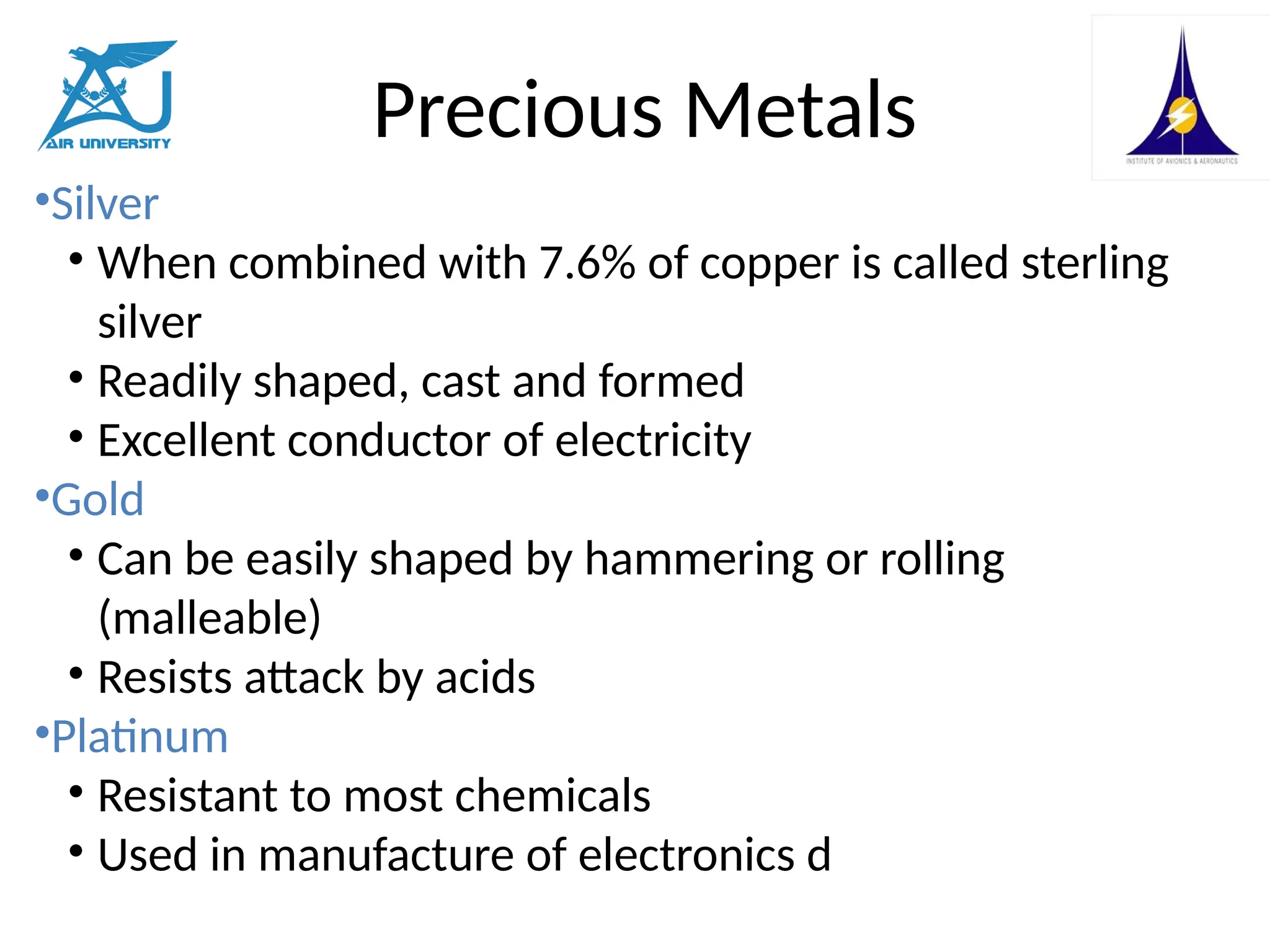
Precious Metals
•Silver
• Whencombined with 7.6% of copper is called sterling
silver
• Readily shaped, cast and formed
• Excellent conductor of electricity
•Gold
• Can be easily shaped by hammering or rolling
(malleable)
• Resists attack by acids
•Platinum
• Resistant to most chemicals
• Used in manufacture of electronics d
26.
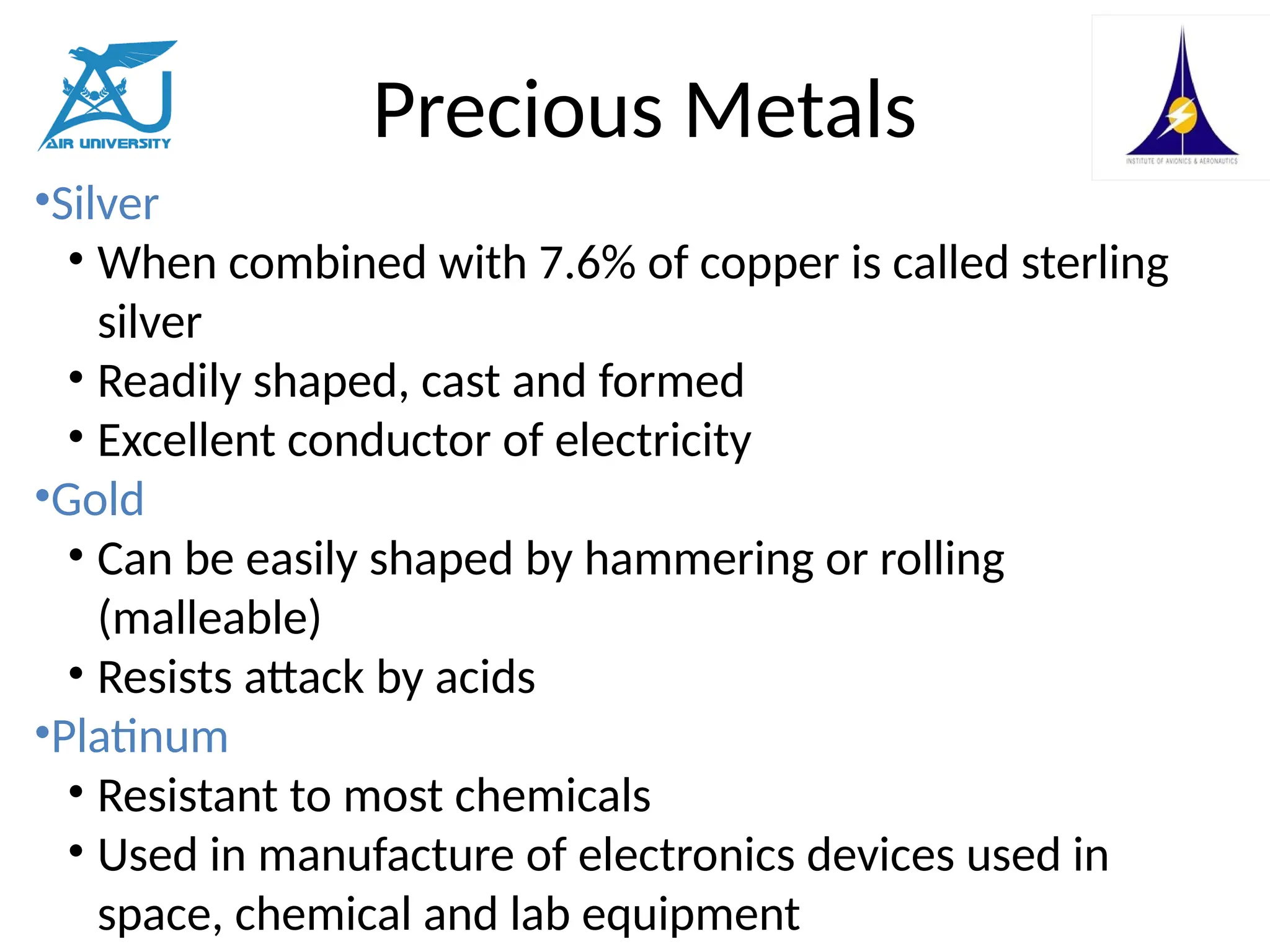
Precious Metals
•Silver
• Whencombined with 7.6% of copper is called sterling
silver
• Readily shaped, cast and formed
• Excellent conductor of electricity
•Gold
• Can be easily shaped by hammering or rolling
(malleable)
• Resists attack by acids
•Platinum
• Resistant to most chemicals
• Used in manufacture of electronics devices used in
space, chemical and lab equipment
27.
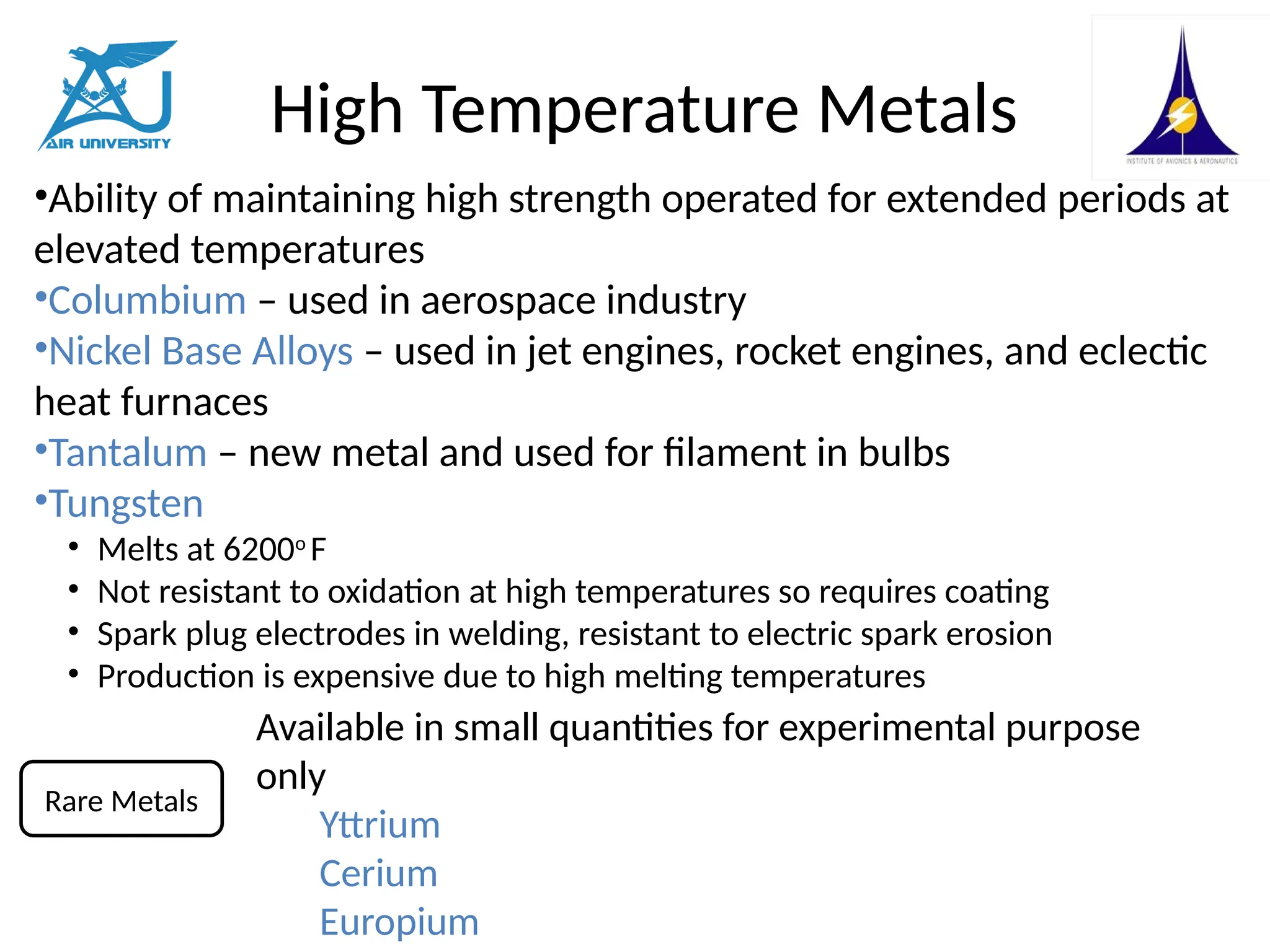
High Temperature Metals
•Abilityof maintaining high strength operated for extended periods at
elevated temperatures
•Columbium – used in aerospace industry
•Nickel Base Alloys – used in jet engines, rocket engines, and eclectic
heat furnaces
•Tantalum – new metal and used for filament in bulbs
•Tungsten
• Melts at 6200o
F
• Not resistant to oxidation at high temperatures so requires coating
• Spark plug electrodes in welding, resistant to electric spark erosion
• Production is expensive due to high melting temperatures
Available in small quantities for experimental purpose
only
Yttrium
Cerium
Europium
Rare Metals
28.
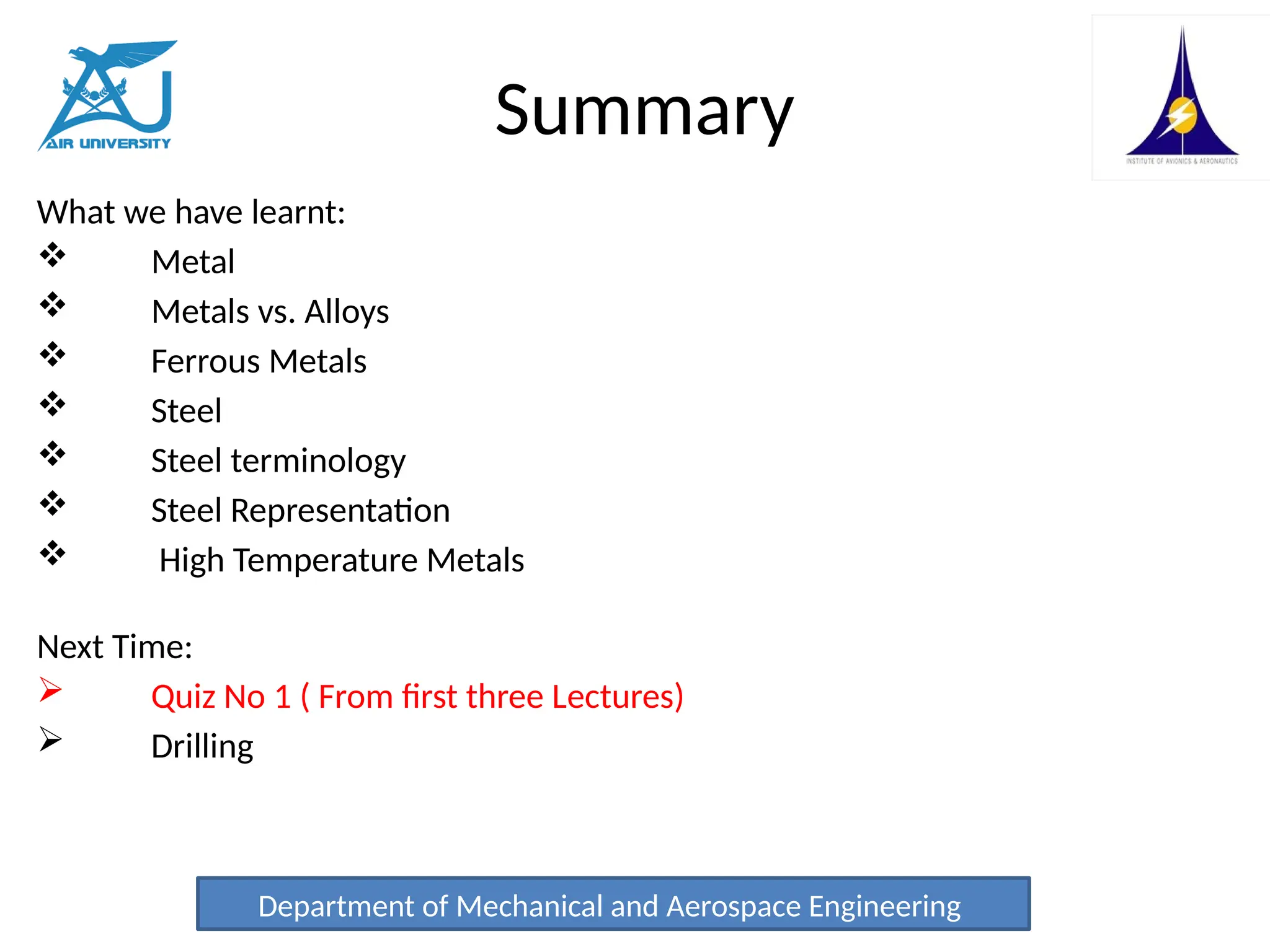
Summary
What we havelearnt:
Metal
Metals vs. Alloys
Ferrous Metals
Steel
Steel terminology
Steel Representation
High Temperature Metals
Next Time:
Quiz No 1 ( From first three Lectures)
Drilling
Department of Mechanical and Aerospace Engineering