Topic :
Guided By :
Branch : Batch :
Name ENROLLMENT NO.
Abhishek Chokshi 140120109005
Himal Desai
Harsh Dedakia
140120109008
140120109012
Orthographic
Projections
Basically, orthographic projection
means a 2-dimensional representation
of and 3-dimensional solid object. The
object is represented by projecting
lines from its edges such that the lines
are orthogonal to the projection plane.
Basically, there are 2 types of
orthographic projection. They are:
1) 1st angle projection
And
2)3rd angle projection
They are explained below.
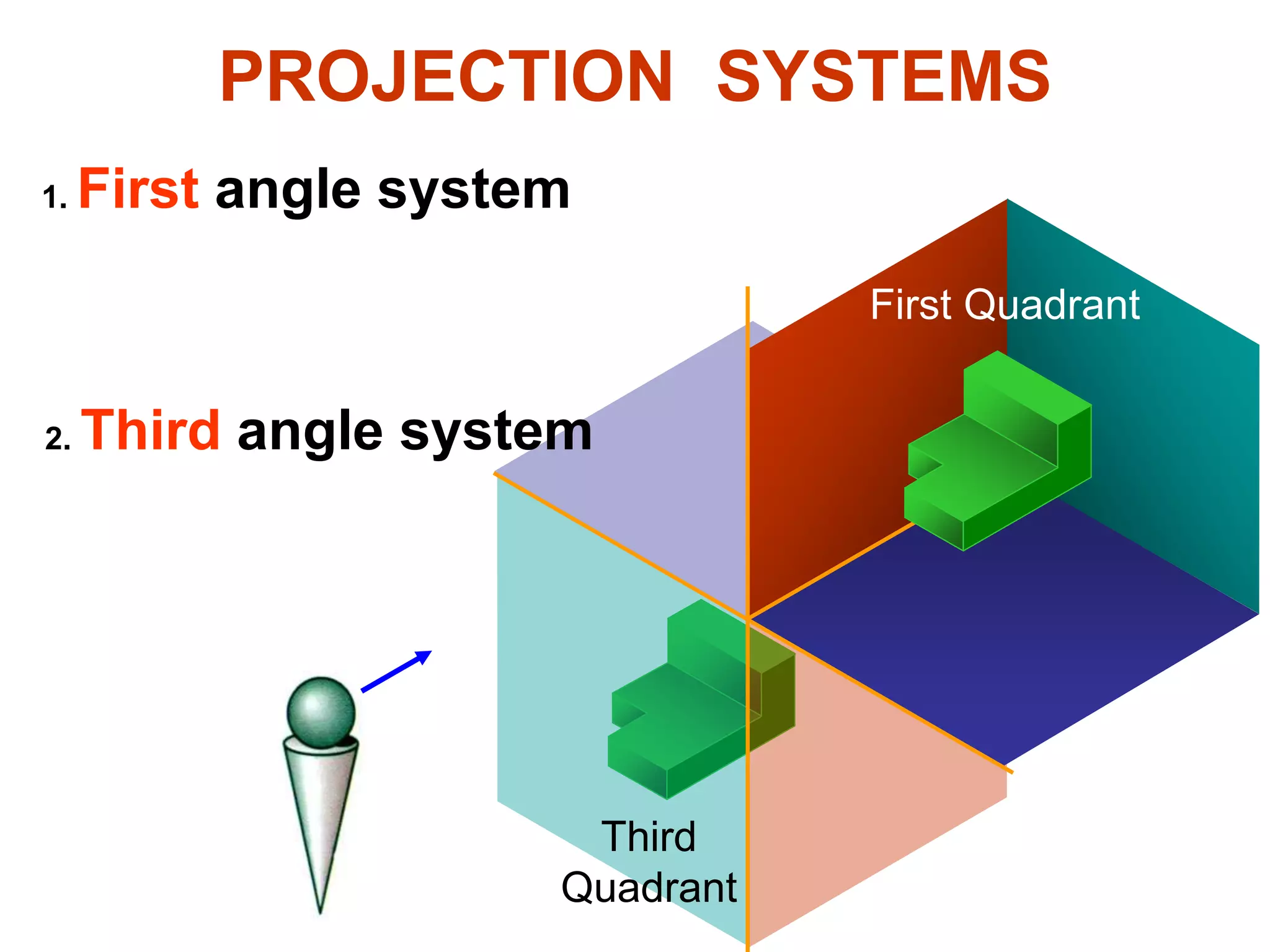
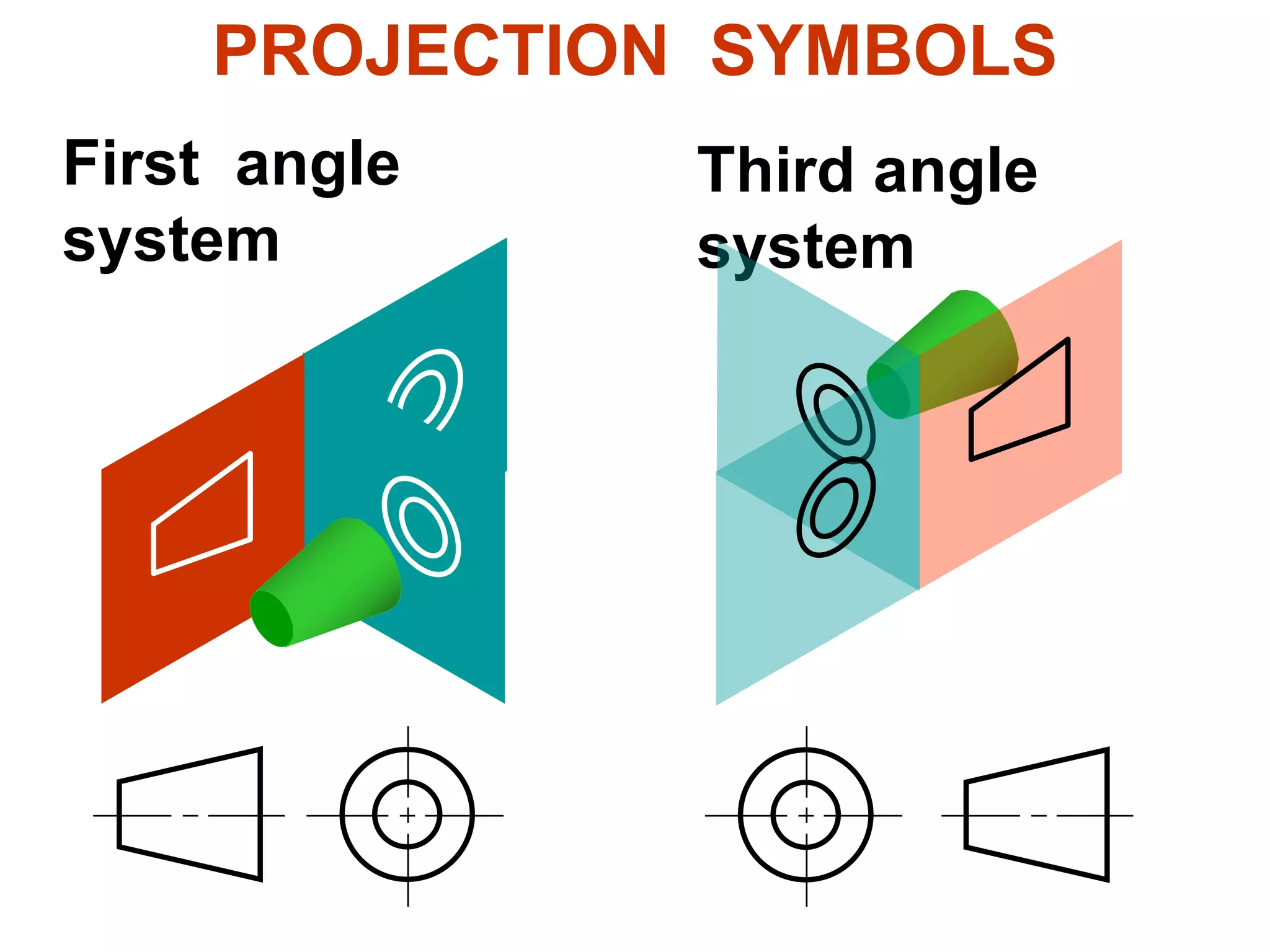
PROJECTION SYSTEMS
1. First angle system
2. Third angle system
First Quadrant
Third
Quadrant
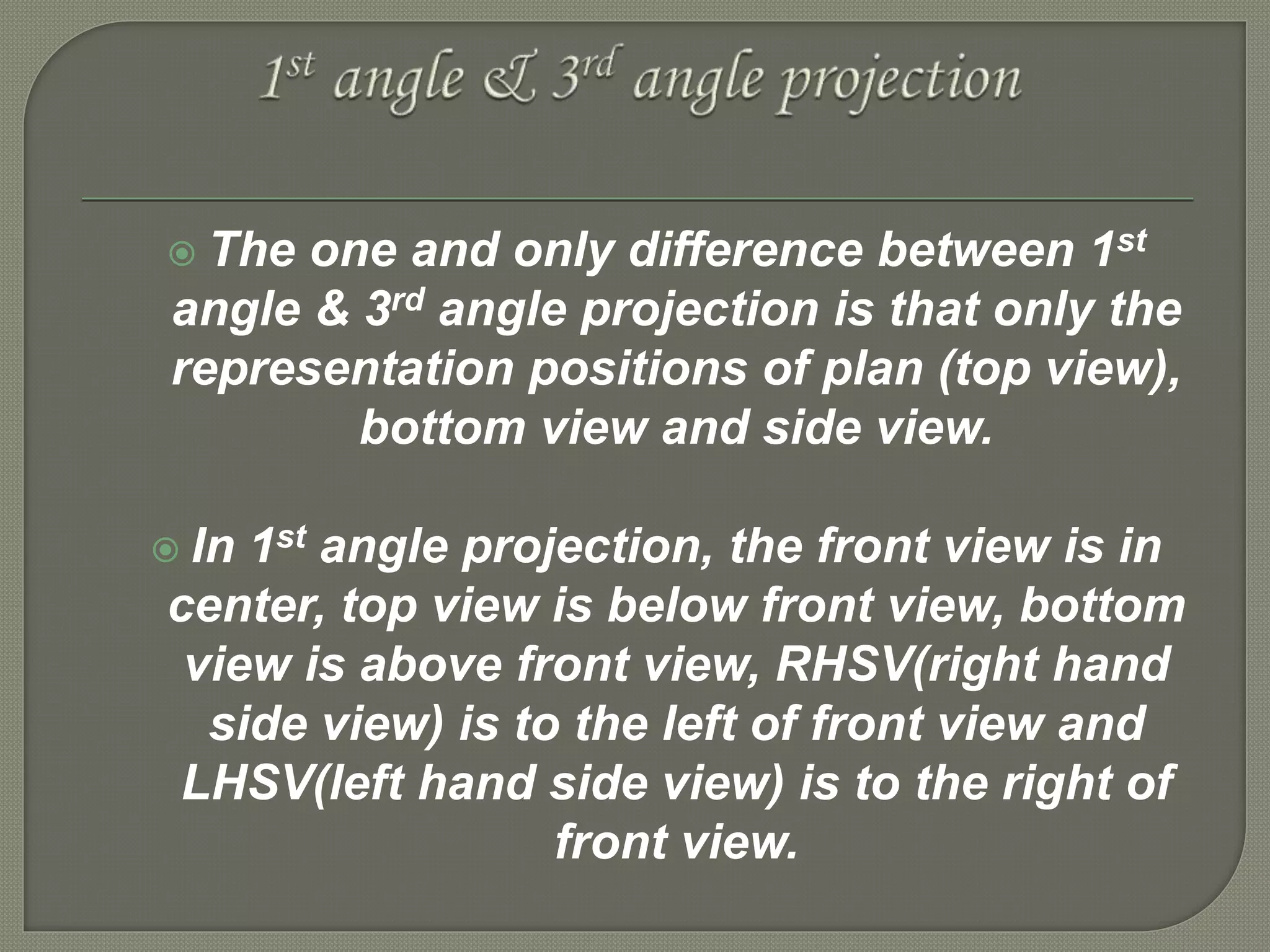
 The one and only difference between 1st
angle & 3rd angle projection is that only the
representation positions of plan (top view),
bottom view and side view.
 In 1st angle projection, the front view is in
center, top view is below front view, bottom
view is above front view, RHSV(right hand
side view) is to the left of front view and
LHSV(left hand side view) is to the right of
front view.
ORTHOGRAPHIC PROJECTION
1st angle system 3rd angle system
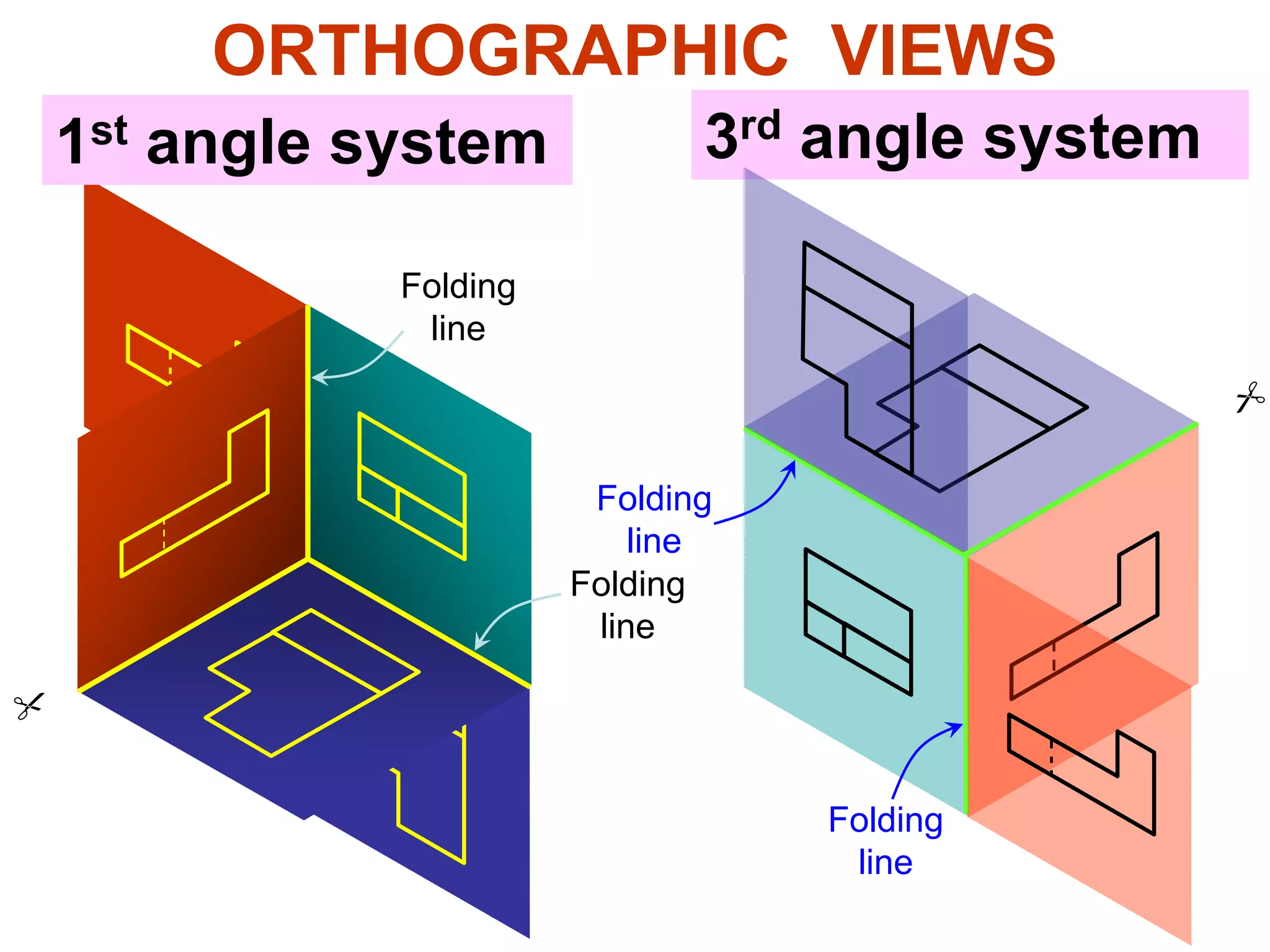
ORTHOGRAPHIC VIEWS
1st angle system 3rd angle system
Folding
line
Folding
line
Folding
line
Folding
line
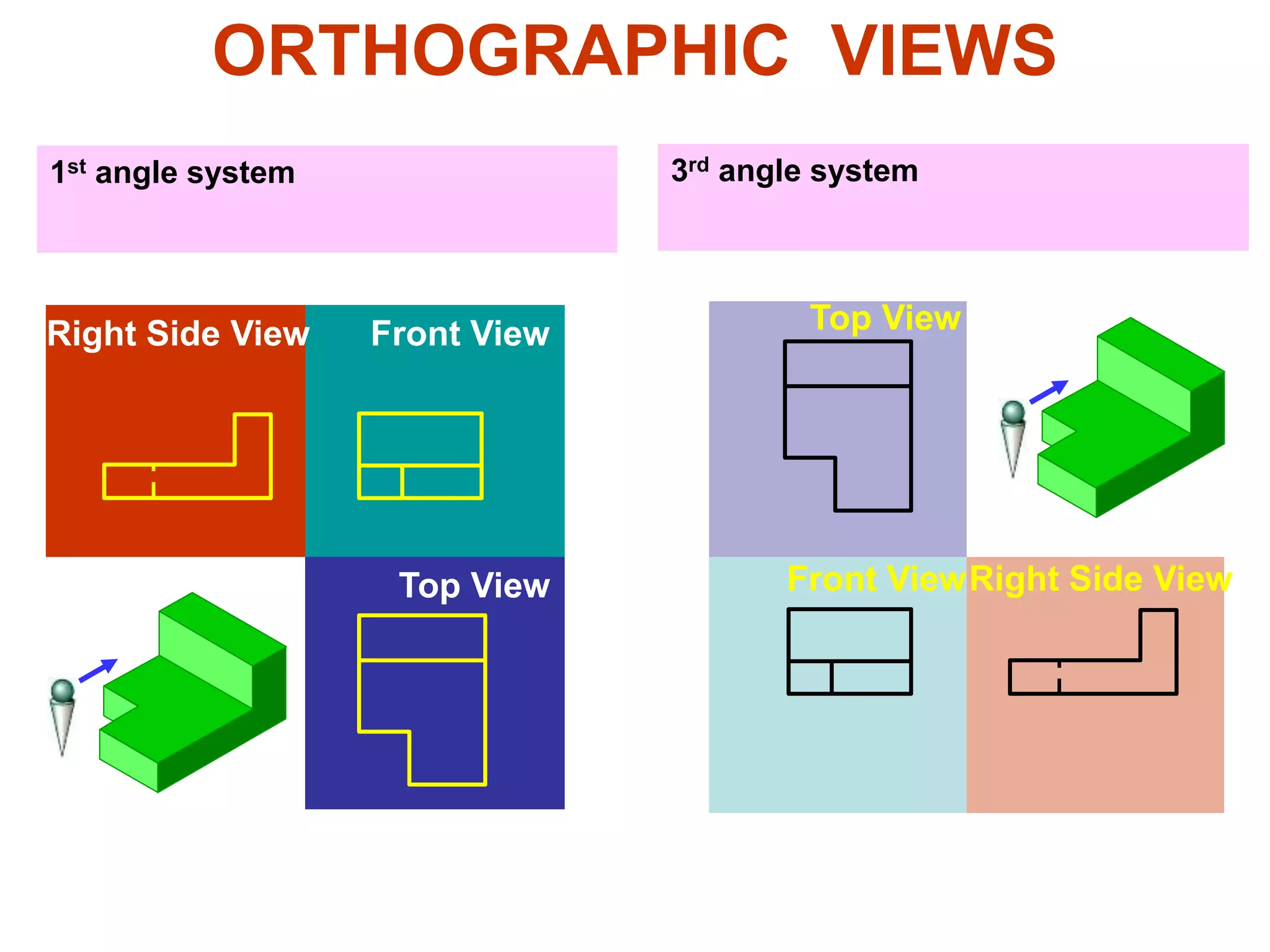
ORTHOGRAPHIC VIEWS
1st angle system 3rd angle system
Front View
Front View
Right Side View
Right Side View
Top View
Top View
First angle
system
Third angle
system
PROJECTION SYMBOLS
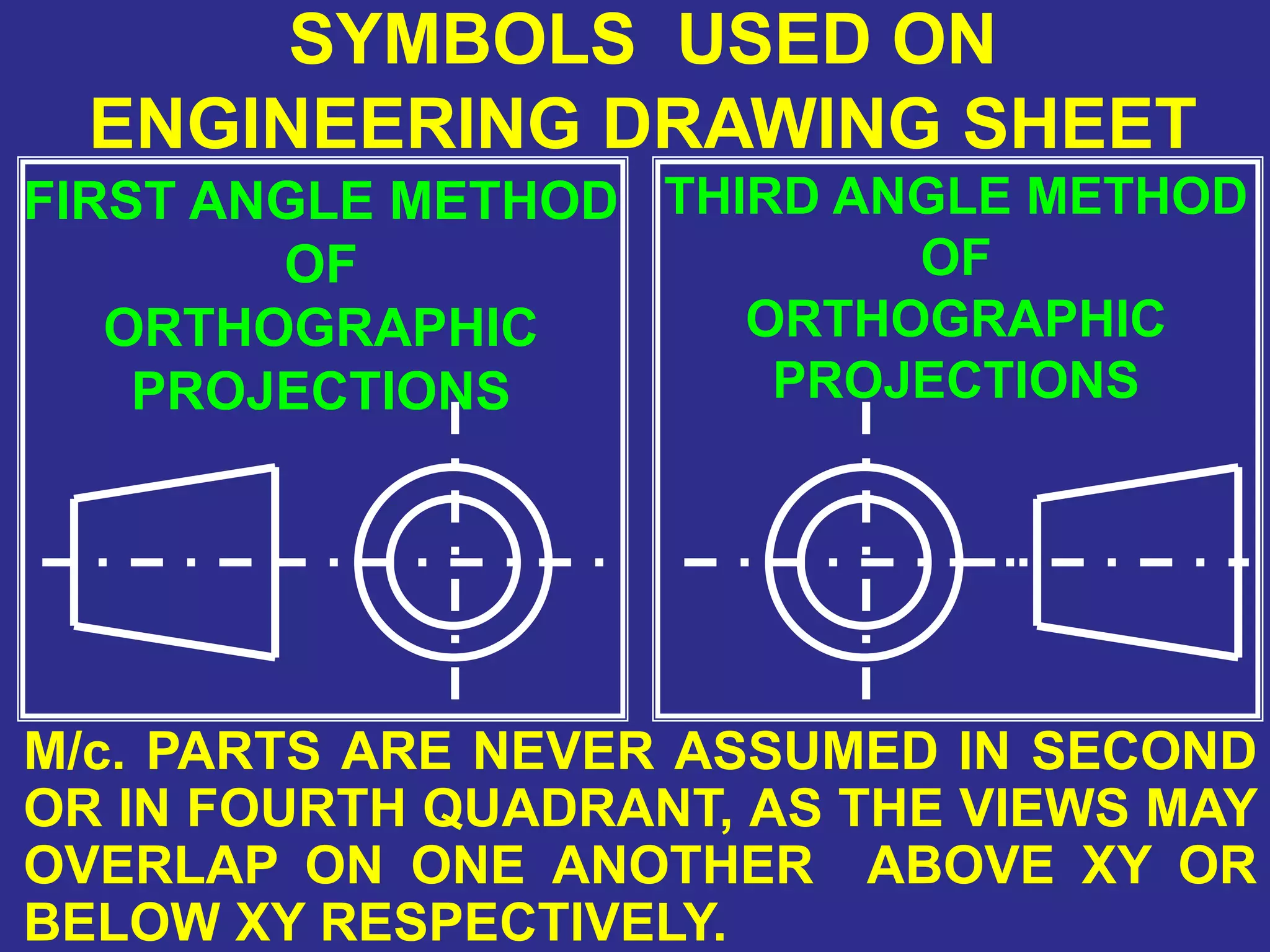
SYMBOLS USED ON
ENGINEERING DRAWING SHEET
FIRST ANGLE METHOD
OF
ORTHOGRAPHIC
PROJECTIONS
THIRD ANGLE METHOD
OF
ORTHOGRAPHIC
PROJECTIONS
M/c. PARTS ARE NEVER ASSUMED IN SECOND
OR IN FOURTH QUADRANT, AS THE VIEWS MAY
OVERLAP ON ONE ANOTHER ABOVE XY OR
BELOW XY RESPECTIVELY.
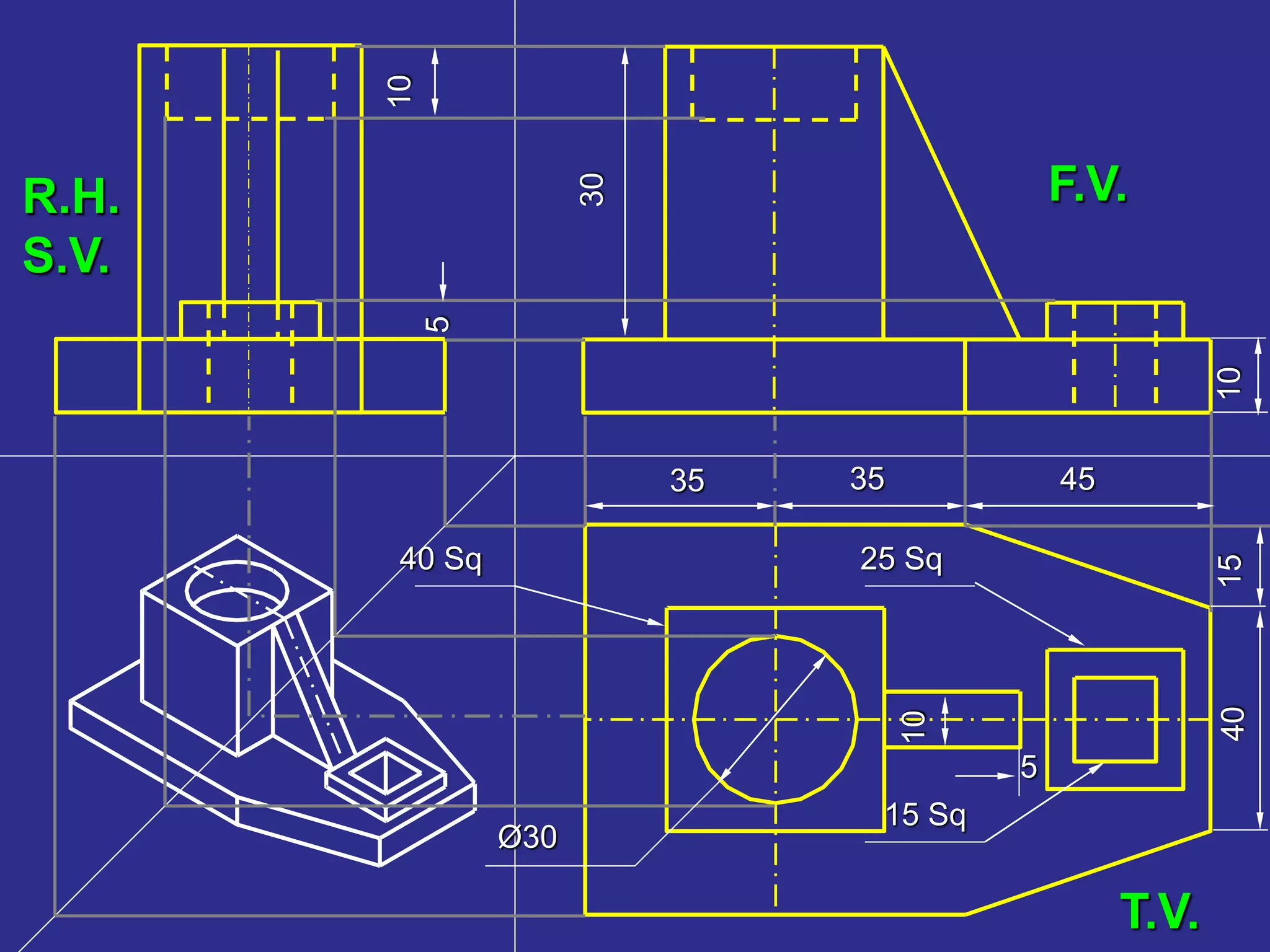
Step by step procedure Suggested
to prepare Orthographic views
(First angle method) for The simple
component Shown pictorially in
figure
30
10
25 SQ
15 SQ
Ø30,Depth 10
40 SQ
ISOMETRIC
ORTHO. VIEWS
25 Sq
4015
453535
15 Sq
40 Sq
Ø30
5
10
30
10
5
10
R.H.
S.V.
F.V.
T.V.
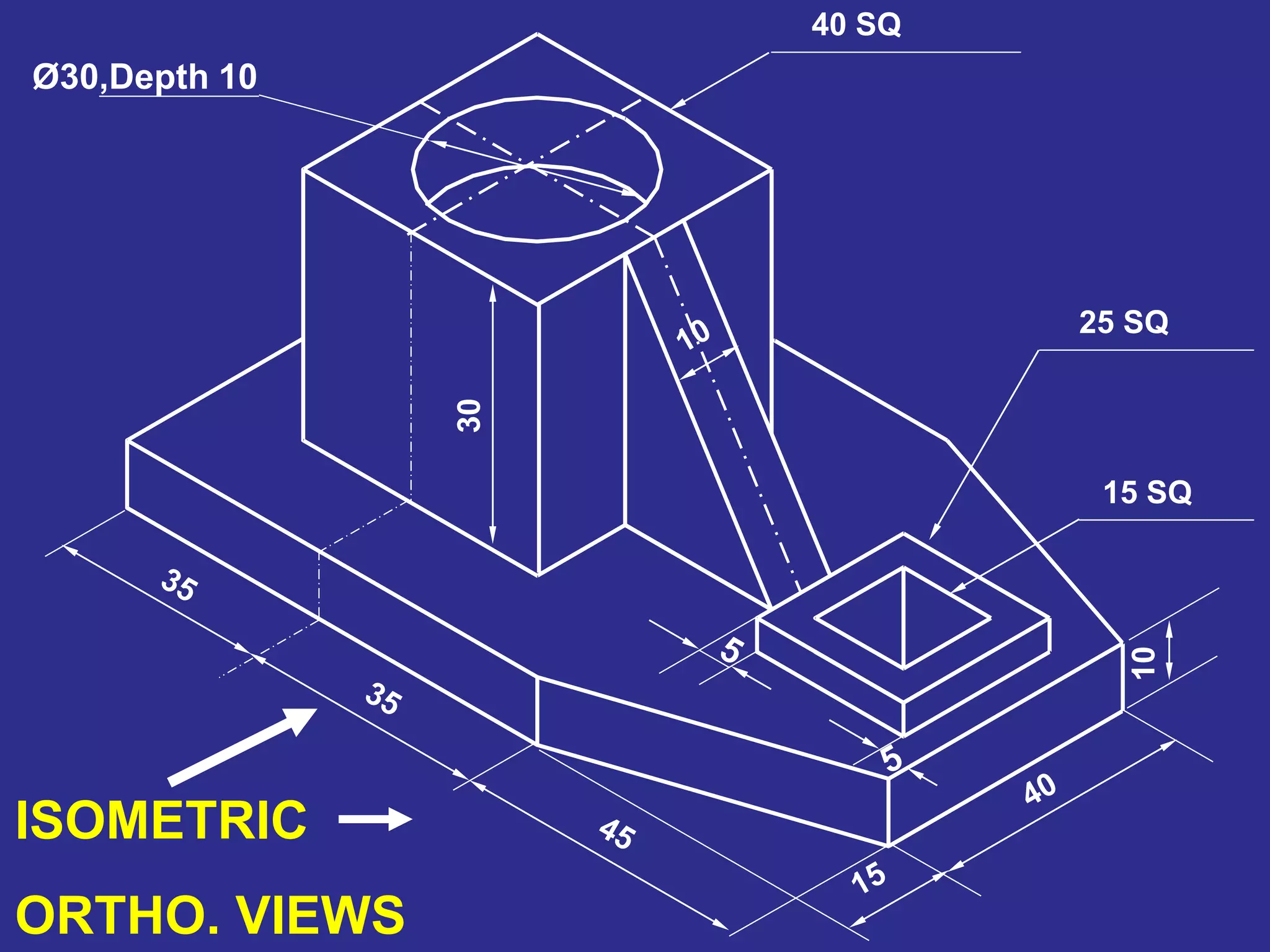
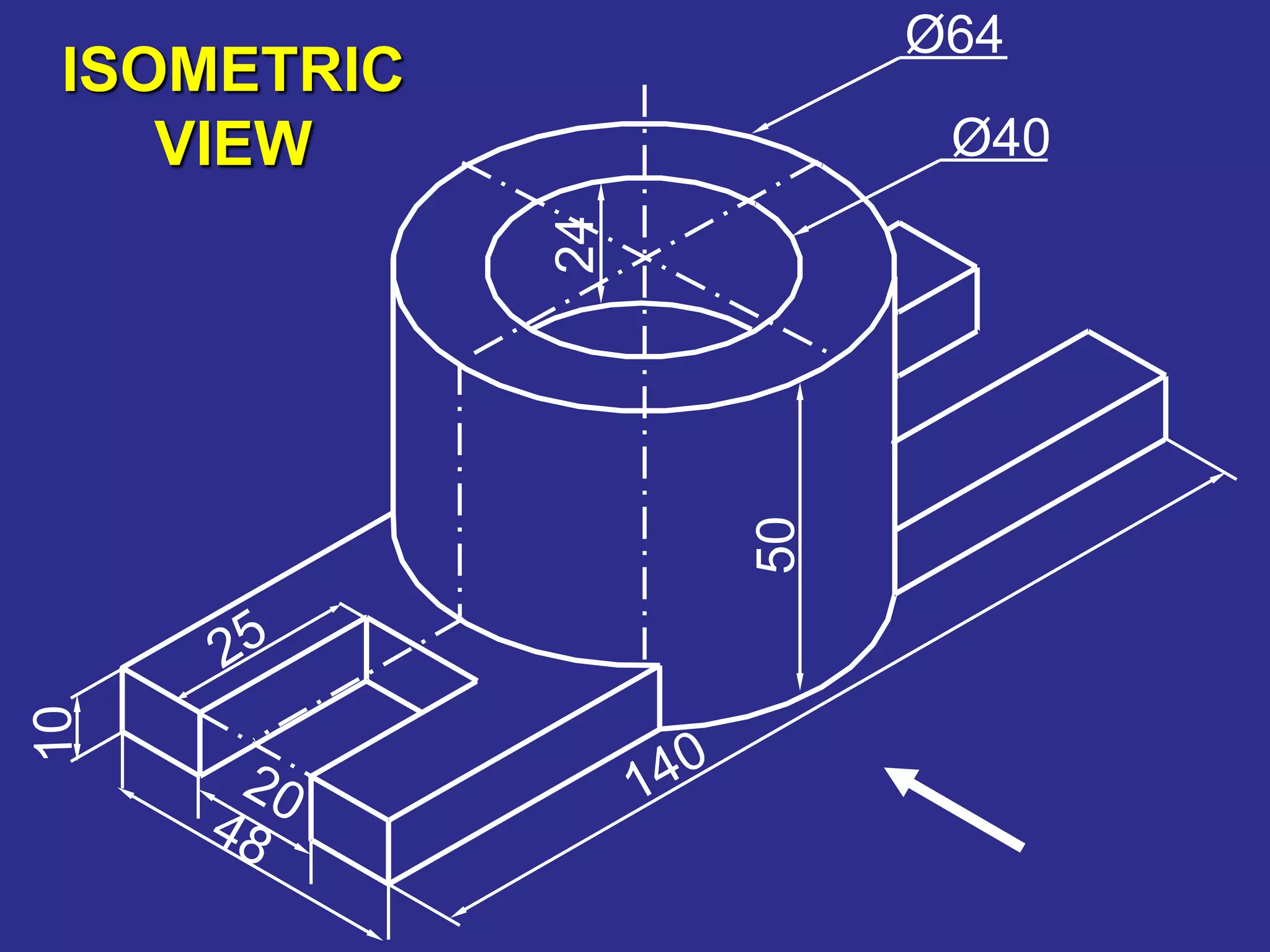
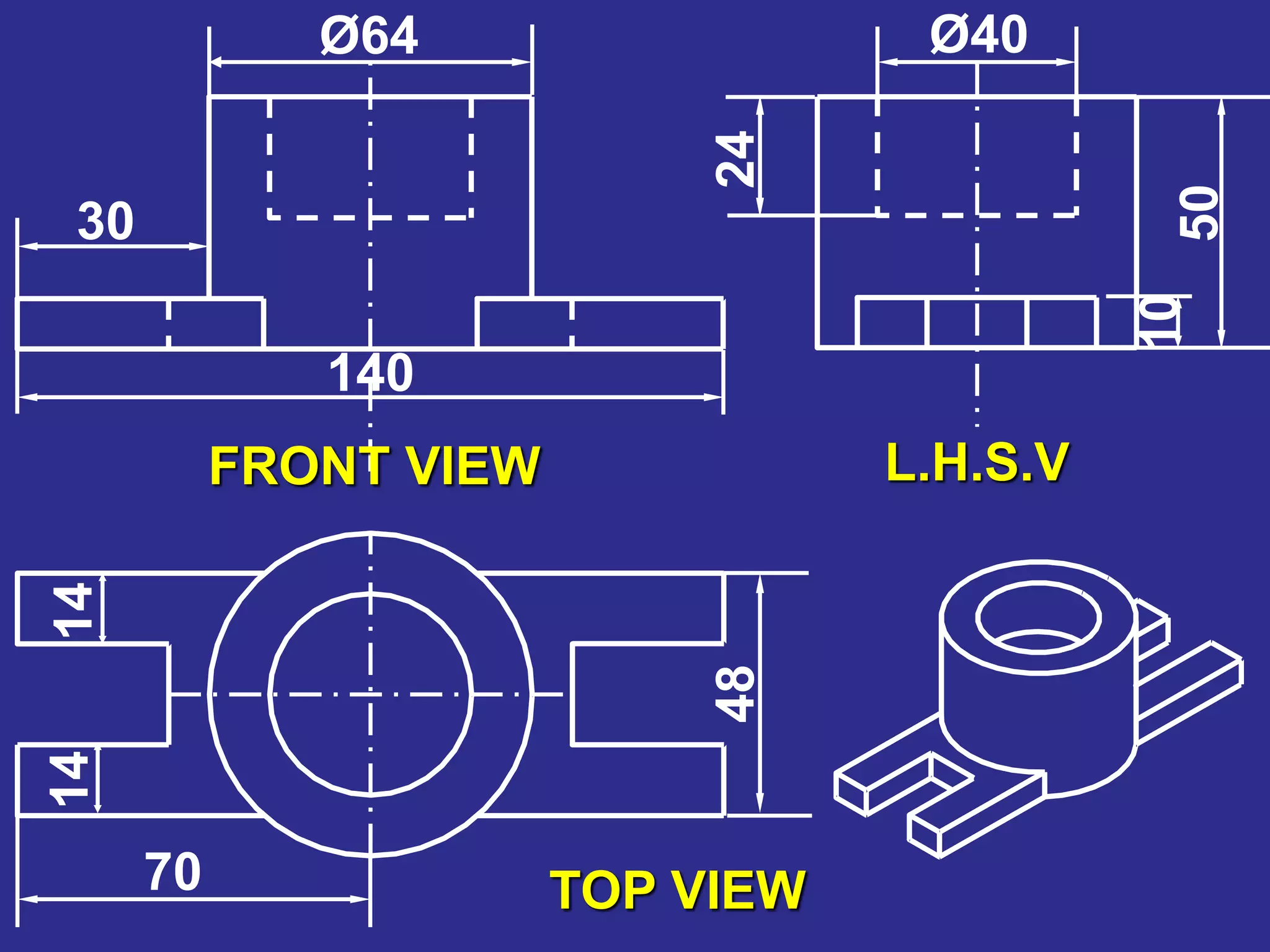
 Figure shows the isometric
view of a vertical shaft support.
 Draw its all the three views,
using first angle method of
projections.
 Give the necessary dimensions
as per aligned system.
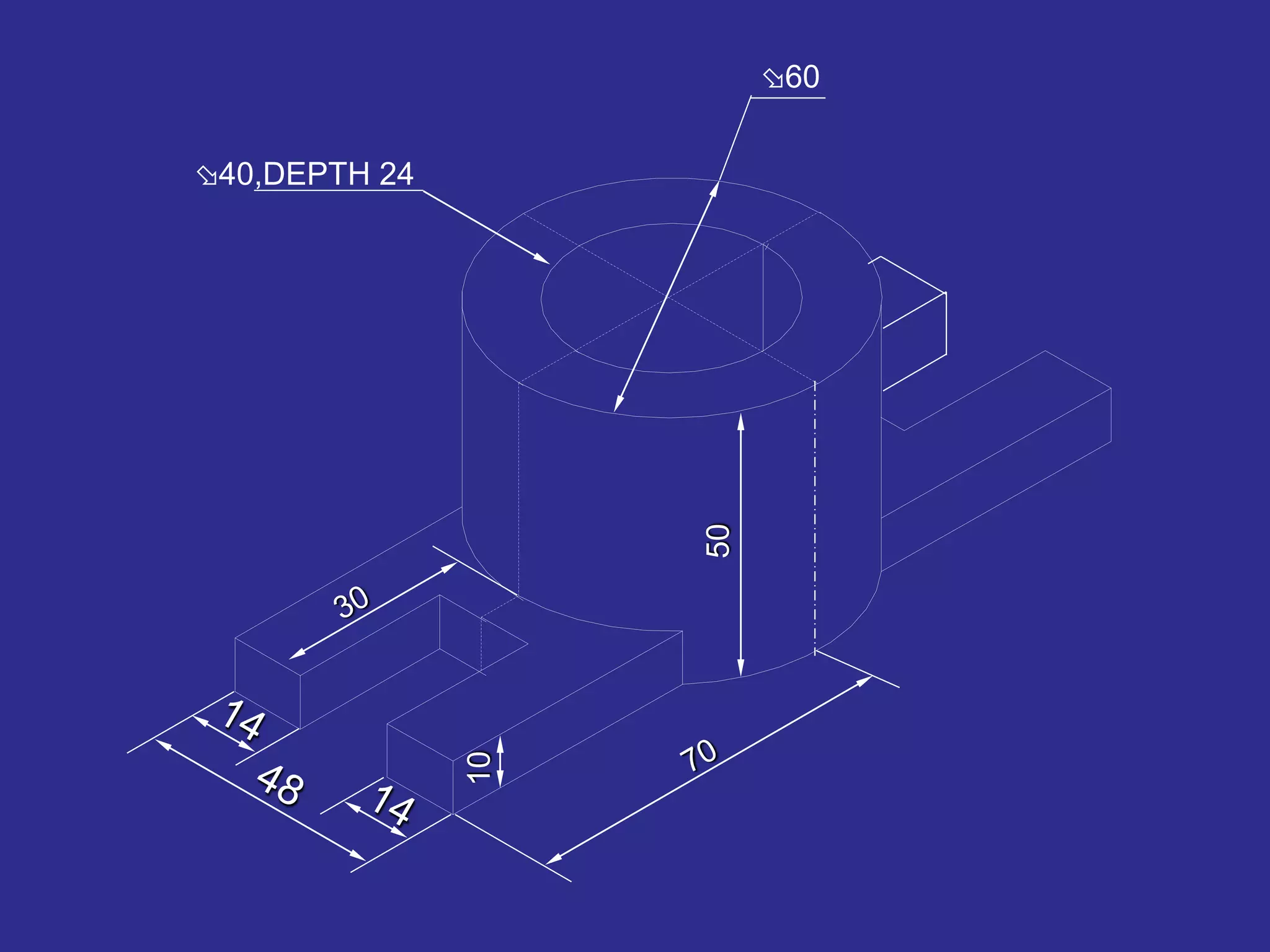
Exercise :-
ISOMETRIC
VIEW Ø40
Ø64
24
50
L.H.S.VFRONT VIEW
TOP VIEW
1414
48
70
24
10
Ø40
50
Ø64
30
140
Sectional
Orthographic
Projection
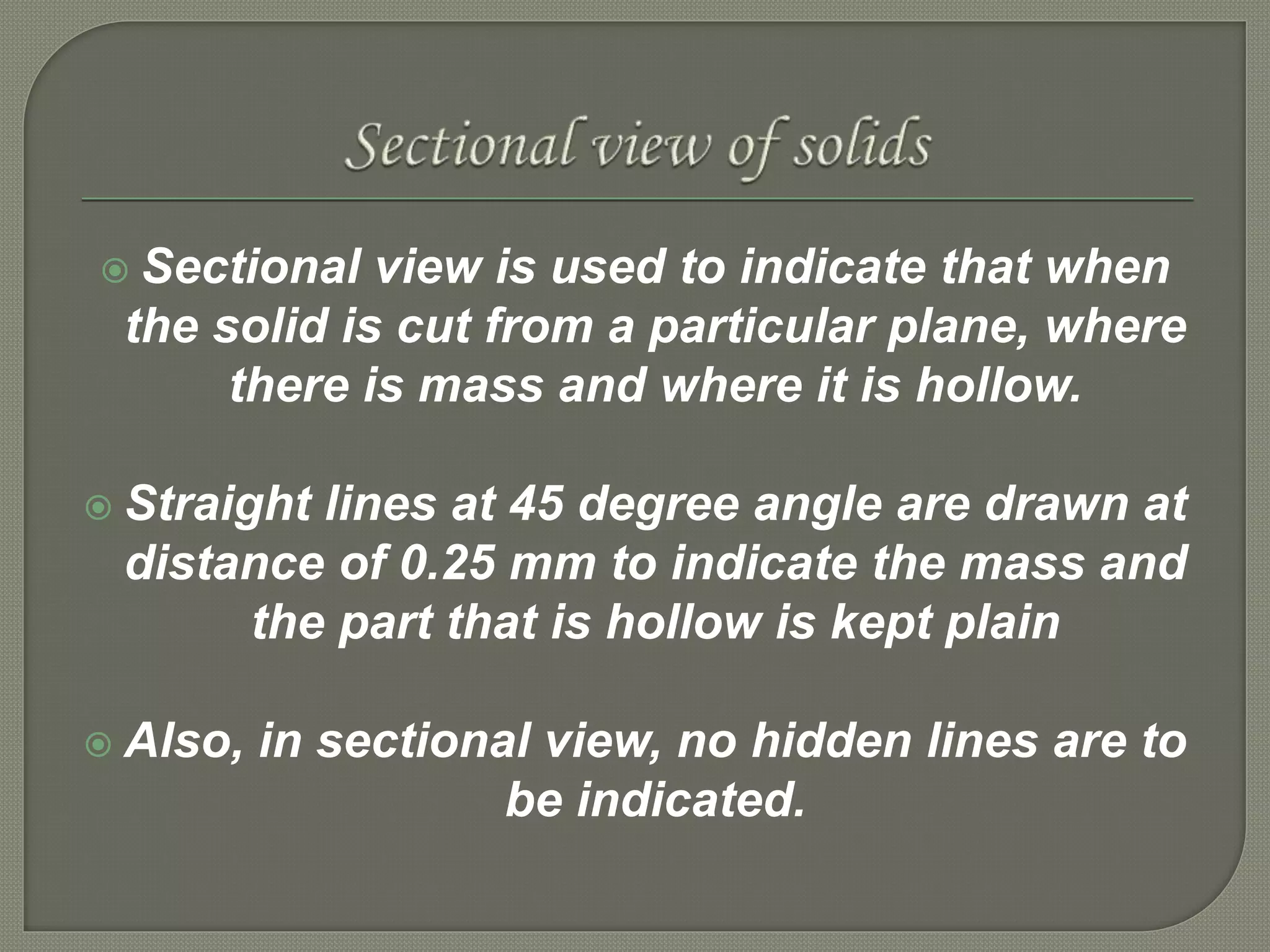
 Sectional view is used to indicate that when
the solid is cut from a particular plane, where
there is mass and where it is hollow.
 Straight lines at 45 degree angle are drawn at
distance of 0.25 mm to indicate the mass and
the part that is hollow is kept plain
 Also, in sectional view, no hidden lines are to
be indicated.
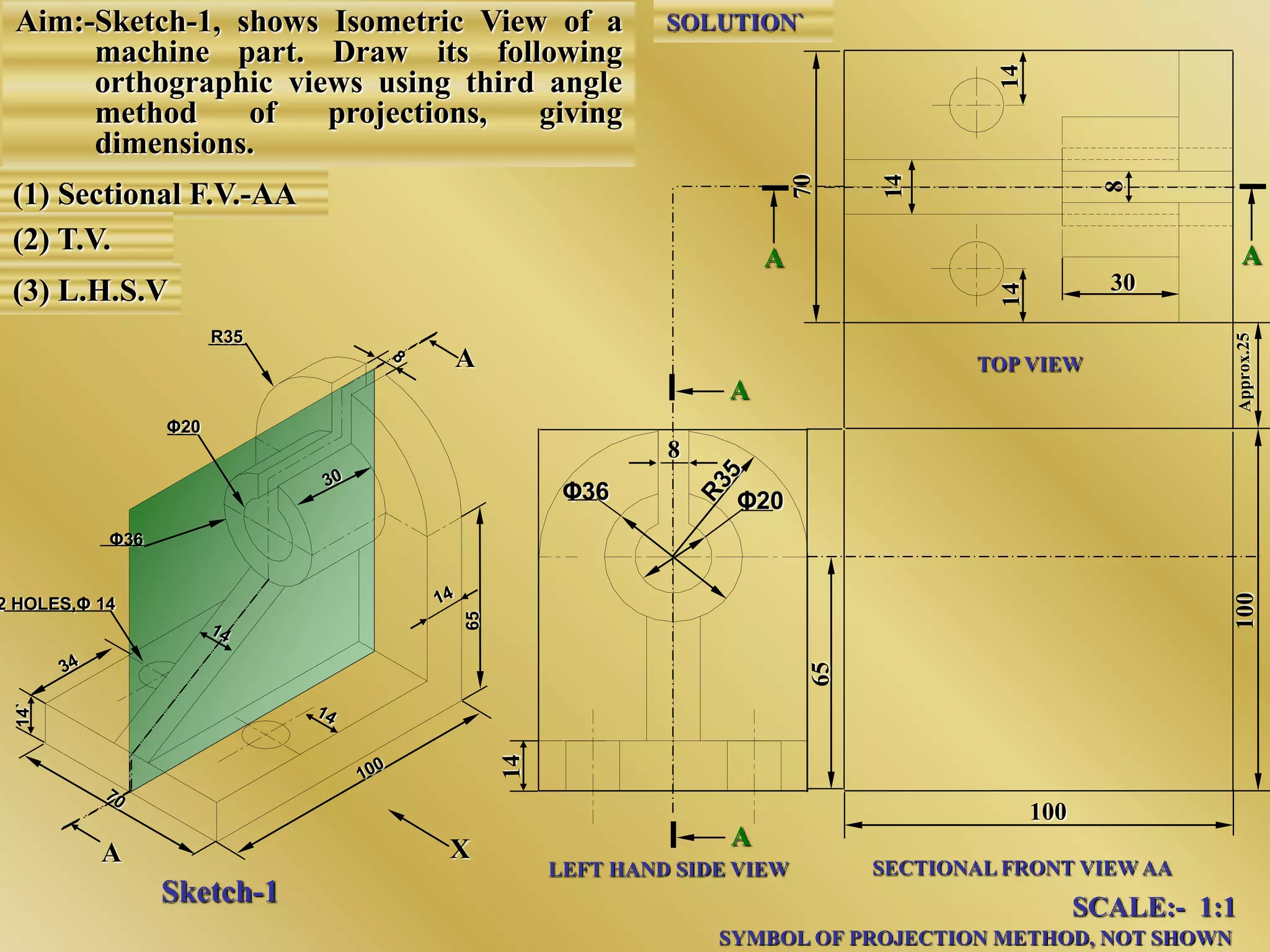
Aim:-Sketch-1, shows Isometric View of a
machine part. Draw its following
orthographic views using third angle
method of projections, giving
dimensions.
(1) Sectional F.V.-AA
(2) T.V.
(3) L.H.S.V
A
A
8
Φ20Φ36
A
A
LEFT HAND SIDE VIEW SECTIONAL FRONT VIEW AA
TOP VIEW
X
SCALE:- 1:1
SYMBOL OF PROJECTION METHOD, NOT SHOWN
Sketch-1
2 HOLES,Φ 14
Φ36
Φ20
R35
65
14`
100
AA
SOLUTION`
30
A
A
LEFT HAND SIDE VIEW SECTIONAL FRONT VIEW AA
TOP VIEW
SCALE:- 1:1
SYMBOL OF PROJECTION METHOD, NOT SHOWN
SOLUTION`
AA
100
8
Φ20Φ36
2 HOLES,Φ 14
X
Φ36
Φ20
R35
A
A
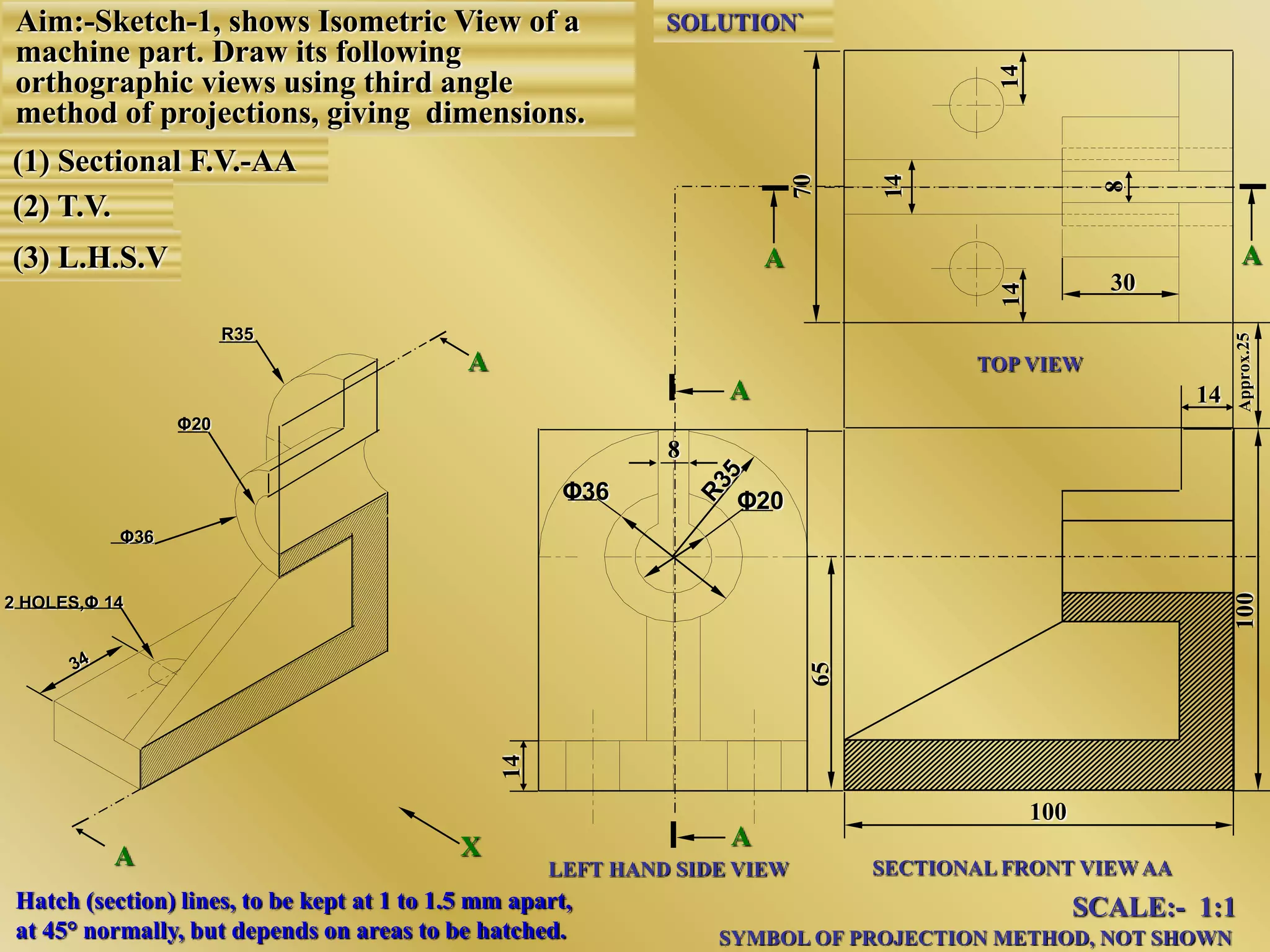
Aim:-Sketch-1, shows Isometric View of a
machine part. Draw its following
orthographic views using third angle
method of projections, giving dimensions.
(1) Sectional F.V.-AA
(2) T.V.
(3) L.H.S.V
14
30
Hatch (section) lines, to be kept at 1 to 1.5 mm apart,
at 45° normally, but depends on areas to be hatched.
50
10
40,DEPTH 24
60
Ø64
30
140
24
Ø40
50
10
L.H.S.VFRONT VIEW
1414
4870
TOP VIEW
Orthographic projection

Orthographic projection

  • 1.
    Topic : Guided By: Branch : Batch :
  • 2.
    Name ENROLLMENT NO. AbhishekChokshi 140120109005 Himal Desai Harsh Dedakia 140120109008 140120109012
  • 3.
  • 4.
    Basically, orthographic projection meansa 2-dimensional representation of and 3-dimensional solid object. The object is represented by projecting lines from its edges such that the lines are orthogonal to the projection plane.
  • 5.
    Basically, there are2 types of orthographic projection. They are: 1) 1st angle projection And 2)3rd angle projection They are explained below.
  • 6.
    PROJECTION SYSTEMS 1. Firstangle system 2. Third angle system First Quadrant Third Quadrant
  • 7.
     The oneand only difference between 1st angle & 3rd angle projection is that only the representation positions of plan (top view), bottom view and side view.  In 1st angle projection, the front view is in center, top view is below front view, bottom view is above front view, RHSV(right hand side view) is to the left of front view and LHSV(left hand side view) is to the right of front view.
  • 8.
    ORTHOGRAPHIC PROJECTION 1st anglesystem 3rd angle system
  • 9.
    ORTHOGRAPHIC VIEWS 1st anglesystem 3rd angle system Folding line Folding line Folding line Folding line
  • 10.
    ORTHOGRAPHIC VIEWS 1st anglesystem 3rd angle system Front View Front View Right Side View Right Side View Top View Top View
  • 11.
  • 12.
    SYMBOLS USED ON ENGINEERINGDRAWING SHEET FIRST ANGLE METHOD OF ORTHOGRAPHIC PROJECTIONS THIRD ANGLE METHOD OF ORTHOGRAPHIC PROJECTIONS M/c. PARTS ARE NEVER ASSUMED IN SECOND OR IN FOURTH QUADRANT, AS THE VIEWS MAY OVERLAP ON ONE ANOTHER ABOVE XY OR BELOW XY RESPECTIVELY.
  • 13.
    Step by stepprocedure Suggested to prepare Orthographic views (First angle method) for The simple component Shown pictorially in figure
  • 14.
    30 10 25 SQ 15 SQ Ø30,Depth10 40 SQ ISOMETRIC ORTHO. VIEWS
  • 15.
    25 Sq 4015 453535 15 Sq 40Sq Ø30 5 10 30 10 5 10 R.H. S.V. F.V. T.V.
  • 16.
     Figure showsthe isometric view of a vertical shaft support.  Draw its all the three views, using first angle method of projections.  Give the necessary dimensions as per aligned system. Exercise :-
  • 17.
  • 18.
  • 19.
  • 20.
     Sectional viewis used to indicate that when the solid is cut from a particular plane, where there is mass and where it is hollow.  Straight lines at 45 degree angle are drawn at distance of 0.25 mm to indicate the mass and the part that is hollow is kept plain  Also, in sectional view, no hidden lines are to be indicated.
  • 21.
    Aim:-Sketch-1, shows IsometricView of a machine part. Draw its following orthographic views using third angle method of projections, giving dimensions. (1) Sectional F.V.-AA (2) T.V. (3) L.H.S.V A A 8 Φ20Φ36 A A LEFT HAND SIDE VIEW SECTIONAL FRONT VIEW AA TOP VIEW X SCALE:- 1:1 SYMBOL OF PROJECTION METHOD, NOT SHOWN Sketch-1 2 HOLES,Φ 14 Φ36 Φ20 R35 65 14` 100 AA SOLUTION` 30
  • 22.
    A A LEFT HAND SIDEVIEW SECTIONAL FRONT VIEW AA TOP VIEW SCALE:- 1:1 SYMBOL OF PROJECTION METHOD, NOT SHOWN SOLUTION` AA 100 8 Φ20Φ36 2 HOLES,Φ 14 X Φ36 Φ20 R35 A A Aim:-Sketch-1, shows Isometric View of a machine part. Draw its following orthographic views using third angle method of projections, giving dimensions. (1) Sectional F.V.-AA (2) T.V. (3) L.H.S.V 14 30 Hatch (section) lines, to be kept at 1 to 1.5 mm apart, at 45° normally, but depends on areas to be hatched.
  • 23.
  • 25.