BPR & The Organization
What is BPR? Reengineering is the fundamental rethinking and redesign of business processes to achieve dramatic improvements in critical, contemporary measures of performance, such as cost, quality, service and speed. (Hammer & Champy, 1993)
BPR is Not? Automation Downsizing Outsourcing
What is a Process? A specific ordering of work activities across time and space, with a beginning, an end, and clearly identified inputs and outputs: a structure for action. (Davenport, 1993)
What is a Business Process? A group of logically related tasks that use the firm's resources  to provide customer-oriented results in support of the organization's objectives
Why Reengineer? Customers Demanding Sophistication Changing Needs Competition Local Global
Why Reengineer? Change Technology Customer Preferences
Why Organizations Don’t Reengineer? Complacency Political Resistance New Developments Fear of Unknown and Failure
Performance BPR seeks improvements of Cost Quality Service Speed
Key Characteristics Systems Philosophy  Global Perspective on Business Processes  Radical Improvement Integrated Change People Centred Focus on End-Customers Process-Based
Process Based Added Value BPR Initiatives must add-value over and above the existing process Customer-Led  BPR Initiatives must meet the needs of the customer
Radical Improvement Sustainable Process improvements need to become firmly rooted within the organization Stepped Approach Process improvements will not happen over night they need to be gradually introduced Also assists the acceptance by staff of the change
Integrated Change Viable Solutions Process improvements must be viable and practical Balanced Improvements Process improvements must be realistic
People-Centred Business Understanding Empowerment & Participation Organizational Culture
Focus on End-Customers Process improvements must relate to the needs of the organization and be relevant to the end-customers to which they are designed to serve
Implementing a BPR Strategy
Key Steps Select The Process & Appoint Process Team Understand The Current Process Develop & Communicate Vision Of Improved Process Identify Action Plan Execute Plan
Select the Process & Appoint Process Team Two Crucial Tasks Select The Process to be Reengineered Appoint the Process Team to Lead the Reengineering Initiative
Select the Process Review Business Strategy and Customer Requirements Select Core Processes Understand Customer Needs Don’t Assume Anything
Select the Process Select Correct Path for Change Remember Assumptions can Hide Failures Competition and Choice to Go Elsewhere Ask - Questionnaires, Meetings, Focus Groups
Appoint the Process Team Appoint BPR Champion Identify Process Owners Establish Executive Improvement Team Provide Training to Executive Team
Core Skills Required Capacity to view the organization as a whole Ability to focus on end-customers Ability to challenge fundamental assumptions Courage to deliver and venture into unknown areas
Core Skills Required Ability to assume individual and collective responsibility Employ ‘Bridge Builders’
Use of Consultants Used to generate internal capacity Appropriate when a implementation is needed quickly Ensure that adequate consultation is sought from staff so that the initiative is organization-led and  not  consultant-driven Control should  never  be handed over to the consultant
Understand the Current Process Develop a Process Overview Clearly define the process  Mission Scope Boundaries Set business and customer measurements  Understand customers expectations from the process (staff including process team)
Understand the Current Process Clearly Identify Improvement Opportunities Quality Rework Document the Process Cost Time  Value Data
Understand the Current Process Carefully resolve any inconsistencies Existing -- New Process Ideal -- Realistic Process
Develop & Communicate Vision of Improved Process Communicate with all employees so that they are aware of the vision of the future Always provide information on the progress of the BPR initiative - good and bad. Demonstrate assurance that the BPR initiative is both necessary and properly managed
Develop & Communicate Vision of Improved Process Promote individual development by indicating options that are available Indicate actions required and those responsible Tackle any actions that need resolution Direct communication to reinforce new patterns of desired behavior
Identify Action Plan Develop an Improvement Plan Appoint Process Owners Simplify the Process to Reduce Process Time Remove any Bureaucracy that may hinder implementation
Identify Action Plan Remove no-value-added activities Standardize Process and Automate Where Possible Up-grade Equipment Plan/schedule the changes
Identify Action Plan Construct in-house metrics and targets Introduce and firmly establish a feedback system Audit, Audit, Audit
Execute Plan Qualify/certify the process Perform periodic qualification reviews Define and eliminate process problems Evaluate the change impact on the business and on customers Benchmark the process Provide advanced team training
Information Technology & BPR
Benefits From IT Assists the Implementation of Business Processes Enables Product & Service Innovations Improve Operational Efficiency Coordinate Vendors & Customers in the Process Chain
Computer Aided BPR (CABPR) Focus Business Processes Process Redesign Process Implementation
BPR Challenges
Common Problems Desire to Change Not Strong Enough Start Point the Existing Process Not a Blank Slate Commitment to Existing Processes Too Strong REMEMBER - “If it ain’t broke …” Quick Fix Approach
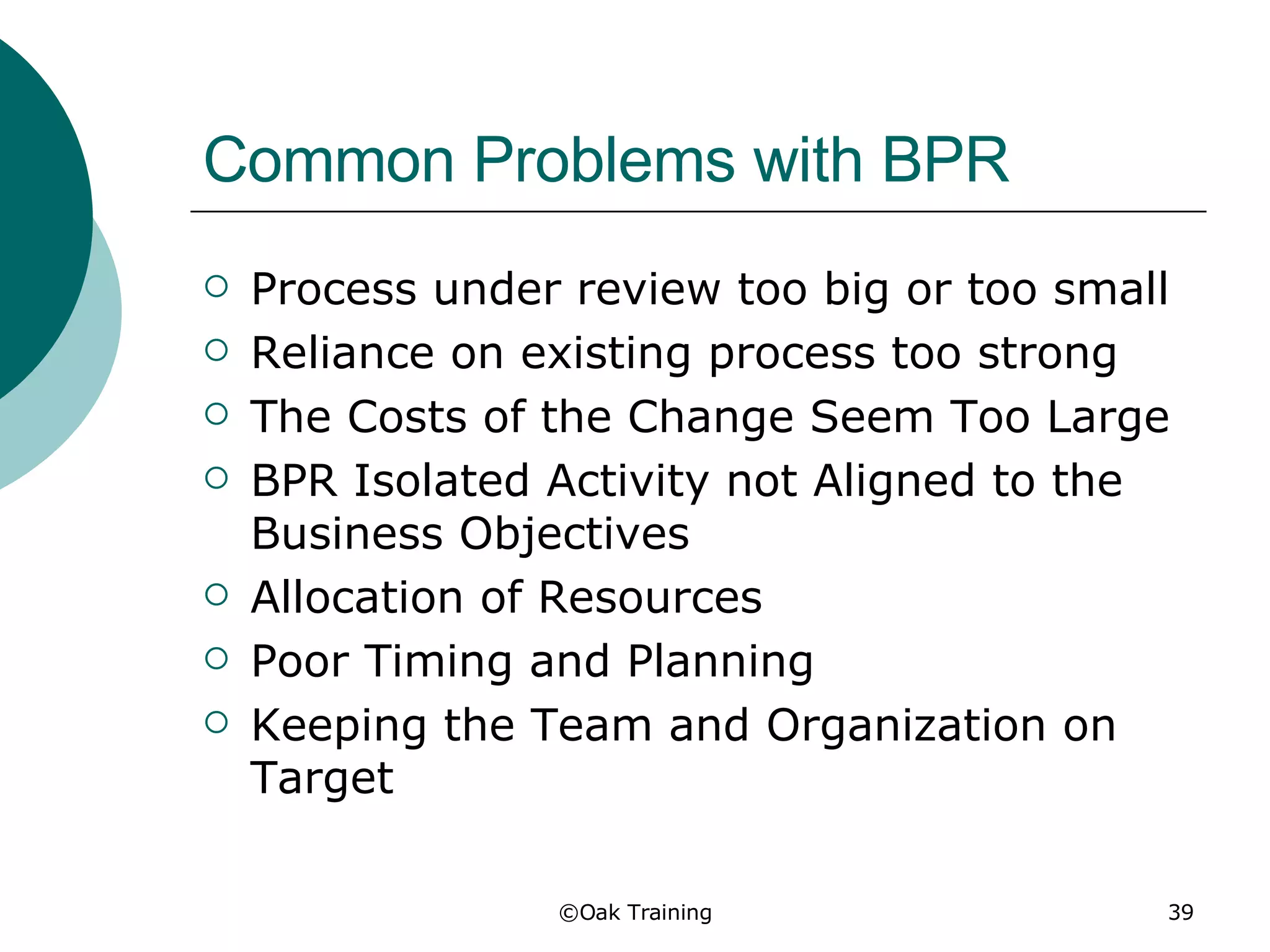
Common Problems with BPR Process under review too big or too small Reliance on existing process too strong The Costs of the Change Seem Too Large BPR Isolated Activity not Aligned to the Business Objectives Allocation of Resources Poor Timing and Planning Keeping the Team and Organization on Target
Summary Reengineering is a fundamental rethinking and redesign of business processes to achieve dramatic improvements BPR has emerged from key management traditions such as scientific management and systems thinking Rules and symbols play an integral part of all BPR initiatives
Summary Don’t assume anything - remember BPR is fundamental rethinking of business processes

Bpr

  • 1.
    BPR & TheOrganization
  • 2.
    What is BPR?Reengineering is the fundamental rethinking and redesign of business processes to achieve dramatic improvements in critical, contemporary measures of performance, such as cost, quality, service and speed. (Hammer & Champy, 1993)
  • 3.
    BPR is Not?Automation Downsizing Outsourcing
  • 4.
    What is aProcess? A specific ordering of work activities across time and space, with a beginning, an end, and clearly identified inputs and outputs: a structure for action. (Davenport, 1993)
  • 5.
    What is aBusiness Process? A group of logically related tasks that use the firm's resources to provide customer-oriented results in support of the organization's objectives
  • 6.
    Why Reengineer? CustomersDemanding Sophistication Changing Needs Competition Local Global
  • 7.
    Why Reengineer? ChangeTechnology Customer Preferences
  • 8.
    Why Organizations Don’tReengineer? Complacency Political Resistance New Developments Fear of Unknown and Failure
  • 9.
    Performance BPR seeksimprovements of Cost Quality Service Speed
  • 10.
    Key Characteristics SystemsPhilosophy Global Perspective on Business Processes Radical Improvement Integrated Change People Centred Focus on End-Customers Process-Based
  • 11.
    Process Based AddedValue BPR Initiatives must add-value over and above the existing process Customer-Led BPR Initiatives must meet the needs of the customer
  • 12.
    Radical Improvement SustainableProcess improvements need to become firmly rooted within the organization Stepped Approach Process improvements will not happen over night they need to be gradually introduced Also assists the acceptance by staff of the change
  • 13.
    Integrated Change ViableSolutions Process improvements must be viable and practical Balanced Improvements Process improvements must be realistic
  • 14.
    People-Centred Business UnderstandingEmpowerment & Participation Organizational Culture
  • 15.
    Focus on End-CustomersProcess improvements must relate to the needs of the organization and be relevant to the end-customers to which they are designed to serve
  • 16.
  • 17.
    Key Steps SelectThe Process & Appoint Process Team Understand The Current Process Develop & Communicate Vision Of Improved Process Identify Action Plan Execute Plan
  • 18.
    Select the Process& Appoint Process Team Two Crucial Tasks Select The Process to be Reengineered Appoint the Process Team to Lead the Reengineering Initiative
  • 19.
    Select the ProcessReview Business Strategy and Customer Requirements Select Core Processes Understand Customer Needs Don’t Assume Anything
  • 20.
    Select the ProcessSelect Correct Path for Change Remember Assumptions can Hide Failures Competition and Choice to Go Elsewhere Ask - Questionnaires, Meetings, Focus Groups
  • 21.
    Appoint the ProcessTeam Appoint BPR Champion Identify Process Owners Establish Executive Improvement Team Provide Training to Executive Team
  • 22.
    Core Skills RequiredCapacity to view the organization as a whole Ability to focus on end-customers Ability to challenge fundamental assumptions Courage to deliver and venture into unknown areas
  • 23.
    Core Skills RequiredAbility to assume individual and collective responsibility Employ ‘Bridge Builders’
  • 24.
    Use of ConsultantsUsed to generate internal capacity Appropriate when a implementation is needed quickly Ensure that adequate consultation is sought from staff so that the initiative is organization-led and not consultant-driven Control should never be handed over to the consultant
  • 25.
    Understand the CurrentProcess Develop a Process Overview Clearly define the process Mission Scope Boundaries Set business and customer measurements Understand customers expectations from the process (staff including process team)
  • 26.
    Understand the CurrentProcess Clearly Identify Improvement Opportunities Quality Rework Document the Process Cost Time Value Data
  • 27.
    Understand the CurrentProcess Carefully resolve any inconsistencies Existing -- New Process Ideal -- Realistic Process
  • 28.
    Develop & CommunicateVision of Improved Process Communicate with all employees so that they are aware of the vision of the future Always provide information on the progress of the BPR initiative - good and bad. Demonstrate assurance that the BPR initiative is both necessary and properly managed
  • 29.
    Develop & CommunicateVision of Improved Process Promote individual development by indicating options that are available Indicate actions required and those responsible Tackle any actions that need resolution Direct communication to reinforce new patterns of desired behavior
  • 30.
    Identify Action PlanDevelop an Improvement Plan Appoint Process Owners Simplify the Process to Reduce Process Time Remove any Bureaucracy that may hinder implementation
  • 31.
    Identify Action PlanRemove no-value-added activities Standardize Process and Automate Where Possible Up-grade Equipment Plan/schedule the changes
  • 32.
    Identify Action PlanConstruct in-house metrics and targets Introduce and firmly establish a feedback system Audit, Audit, Audit
  • 33.
    Execute Plan Qualify/certifythe process Perform periodic qualification reviews Define and eliminate process problems Evaluate the change impact on the business and on customers Benchmark the process Provide advanced team training
  • 34.
  • 35.
    Benefits From ITAssists the Implementation of Business Processes Enables Product & Service Innovations Improve Operational Efficiency Coordinate Vendors & Customers in the Process Chain
  • 36.
    Computer Aided BPR(CABPR) Focus Business Processes Process Redesign Process Implementation
  • 37.
  • 38.
    Common Problems Desireto Change Not Strong Enough Start Point the Existing Process Not a Blank Slate Commitment to Existing Processes Too Strong REMEMBER - “If it ain’t broke …” Quick Fix Approach
  • 39.
    Common Problems withBPR Process under review too big or too small Reliance on existing process too strong The Costs of the Change Seem Too Large BPR Isolated Activity not Aligned to the Business Objectives Allocation of Resources Poor Timing and Planning Keeping the Team and Organization on Target
  • 40.
    Summary Reengineering isa fundamental rethinking and redesign of business processes to achieve dramatic improvements BPR has emerged from key management traditions such as scientific management and systems thinking Rules and symbols play an integral part of all BPR initiatives
  • 41.
    Summary Don’t assumeanything - remember BPR is fundamental rethinking of business processes