Business
Strategy
CaseStudies
Overview
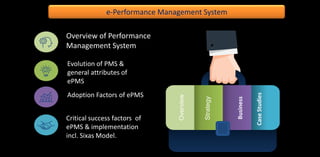
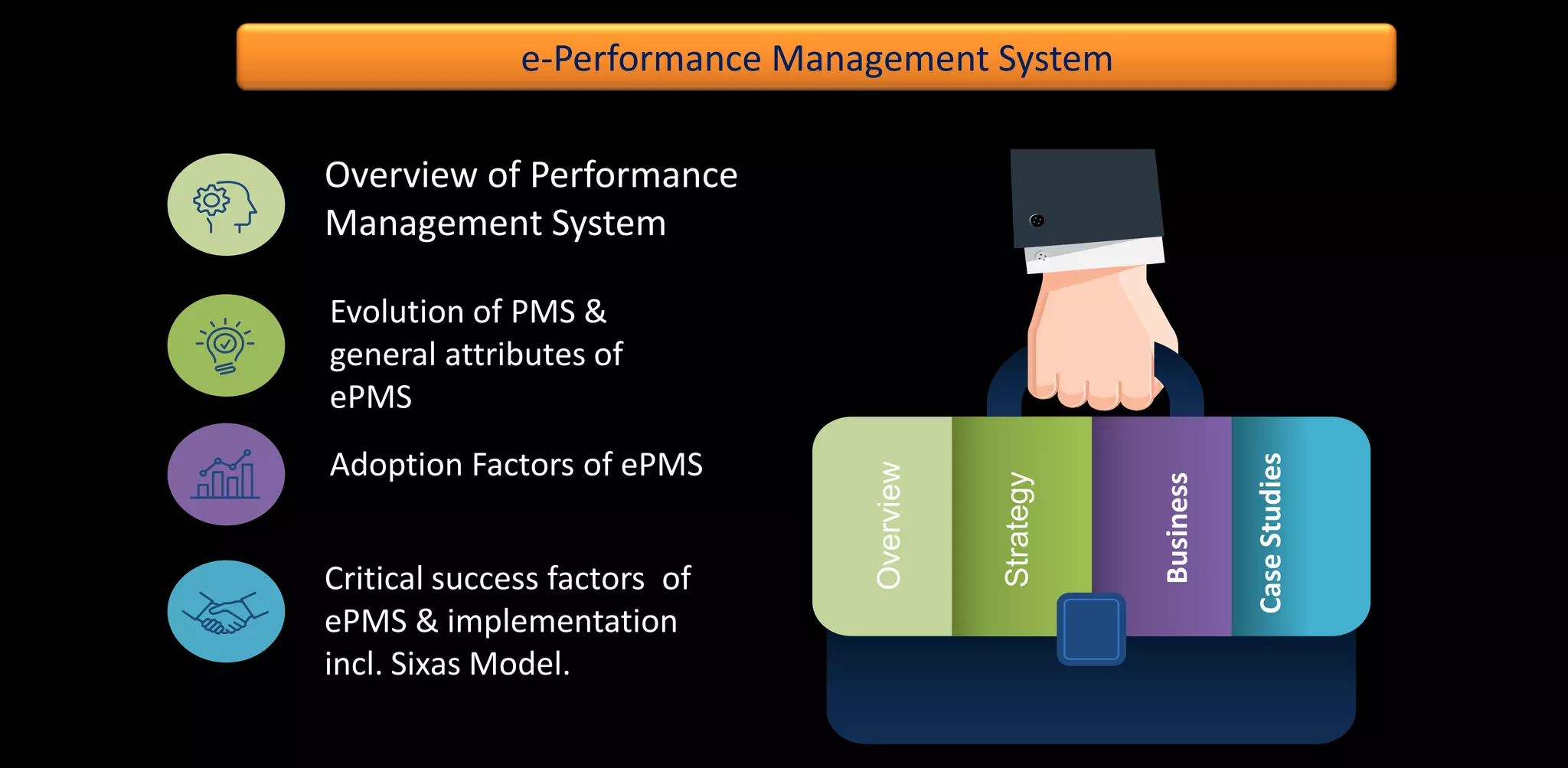
Overview of Performance
Management System
Evolution of PMS &
general attributes of
ePMS
Adoption Factors of ePMS
Critical success factors of
ePMS & implementation
incl. Sixas Model.
e-Performance Management System
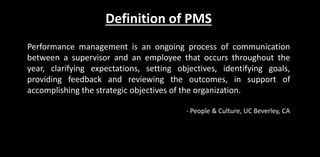
Definition of PMS
Performance management is an ongoing process of communication
between a supervisor and an employee that occurs throughout the
year, clarifying expectations, setting objectives, identifying goals,
providing feedback and reviewing the outcomes, in support of
accomplishing the strategic objectives of the organization.
- People & Culture, UC Beverley, CA
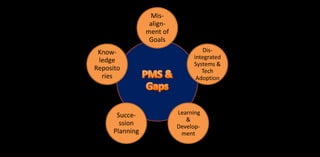
Mis-
align-
ment of
Goals
Dis-
integrated
Systems &
Tech
Adoption
Learning
&
Develop-
ment
Succe-
ssion
Planning
Know-
ledge
Reposito
ries
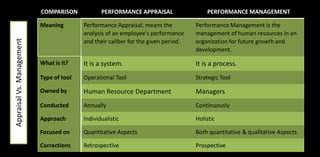
COMPARISON PERFORMANCE APPRAISAL PERFORMANCE MANAGEMENT
Meaning Performance Appraisal, means the
analysis of an employee's performance
and their caliber for the given period.
Performance Management is the
management of human resources in an
organization for future growth and
development.
What is it? It is a system. It is a process.
Type of tool Operational Tool Strategic Tool
Owned by Human Resource Department Managers
Conducted Annually Continuously
Approach Individualistic Holistic
Focused on Quantitative Aspects Both quantitative & qualitative Aspects
Corrections Retrospective Prospective
AppraisalVs.Management
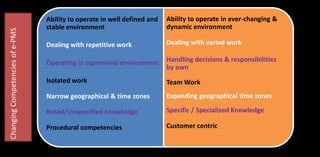
Ability to operate in well defined and
stable environment
Dealing with repetitive work
Operating in supervised environment
Isolated work
Narrow geographical & time zones
Broad/Unspecified knowledge
Procedural competencies
Ability to operate in ever-changing &
dynamic environment
Dealing with varied work
Handling decisions & responsibilities
by own
Team Work
Expanding geographical time zones
Specific / Specialized Knowledge
Customer centric
ChangingCompetenciesofe-PMS
People Factors
Tech Factors
Org. Factors
- Top management support,
- User acceptance,
- Effective communication
-Skills in HR and cultural factors.
- Extent of customization
- Modifying plug n play model
- Manageable complexity of ePMS
-Data Integrity | System usefulness
- Integration with 3rd party software
- Size of the organization
- Characteristics of organization
- Capacities & capabilities [training]
-Geographical distribution of
business & data integrity [ Sales &
Marketing ]
Adoption
Factors of
ePMS
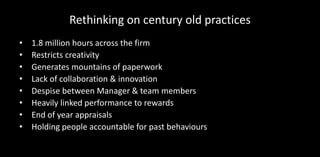
Rethinking on century old practices
• 1.8 million hours across the firm
• Restricts creativity
• Generates mountains of paperwork
• Lack of collaboration & innovation
• Despise between Manager & team members
• Heavily linked performance to rewards
• End of year appraisals
• Holding people accountable for past behaviours
System Process
Appraisal
Joint
Review
Output
Output &
Input
Reward
Oriented
Dev.
Oriented
Top-down
360’D
Feedback
Monolithic Flexible
Owned by
Managmt.
Owned
by Users
Cadre
Based
Service
Based
ConceptualEvolutionofPMS1999-2020
2020
2010
2000
1990
OKRs
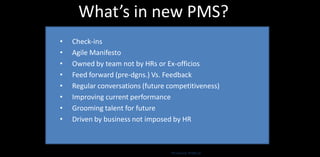
What’s in new PMS?
Pic Source: Profit.co
• Check-ins
• Agile Manifesto
• Owned by team not by HRs or Ex-officios
• Feed forward (pre-dgns.) Vs. Feedback
• Regular conversations (future competitiveness)
• Improving current performance
• Grooming talent for future
• Driven by business not imposed by HR
Early adopters of New Performance Management System
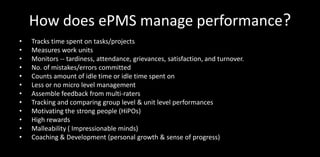
How does ePMS manage performance?
• Tracks time spent on tasks/projects
• Measures work units
• Monitors -- tardiness, attendance, grievances, satisfaction, and turnover.
• No. of mistakes/errors committed
• Counts amount of idle time or idle time spent on
• Less or no micro level management
• Assemble feedback from multi-raters
• Tracking and comparing group level & unit level performances
• Motivating the strong people (HiPOs)
• High rewards
• Malleability ( Impressionable minds)
• Coaching & Development (personal growth & sense of progress)
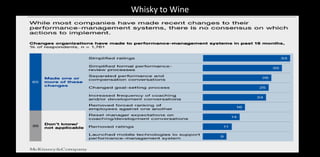
Whisky to Wine
Cloud based apps are
integrated with SNS;
automation;
administrative efficiency
Social Media Connect
Multiple evaluations;
helpful for developmental
purposes [not rewards];
anytime access to data
360-D Feedback
Favourable towards
electronic feedback ;
image management; less
time on processes & more
time on performance
management;
Feedback
Streamlines process
sometimes feedback is
harsh & negative and does
not give. addl Inuts; not
always captures relevant
aspects of performance;
Looks Good to Systems
rather displaying
performance related
behaviours;
Misunderstanding;
Distruct
Communication
Interpersonal distance
Tightly monitoring
behaviour; lower level
satisfaction; Systems
are not secure
Privacy violation
Merits
Demerits
Evaluation of
ePMS
Cuts costs; Decreases
time & effort; increases
efficiency; administrative
capablities; closely
replicates pen & paper;
Employee & Manager
relationships are strained;
Heavily rely on
comp.data than fact-
finding interactions;
biased, polit.,
Mechanical
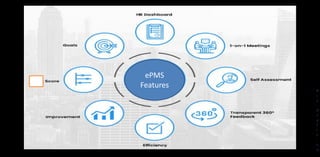
ePMS
Features
P
i
c
:
P
r
o
f
i
t
.
c
o
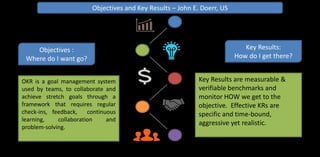
Objectives and Key Results – John E. Doerr, US
OKR is a goal management system
used by teams, to collaborate and
achieve stretch goals through a
framework that requires regular
check-ins, feedback, continuous
learning, collaboration and
problem-solving.
Key Results are measurable &
verifiable benchmarks and
monitor HOW we get to the
objective. Effective KRs are
specific and time-bound,
aggressive yet realistic.
Objectives :
Where do I want go?
Key Results:
How do I get there?
How to identify or design
Objectives and Key Results?
https://okrexamples.co/h
uman_resources-okr-
examples
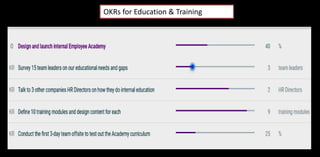
OKRs for Education & Training
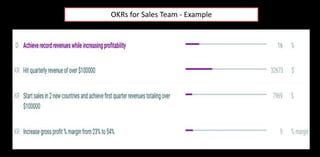
OKRs for Sales Team - Example
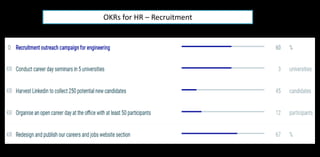
OKRs for HR – Recruitment
Weekly check-
ins for tracking
results
Quarterly
tactical
OKRs for the
teams
High Level strategic OKRs
for the company [low
prices, fast delivery, vast
selection – Amazon, Jeff
Bezos]
OKRs -Nested Cadences
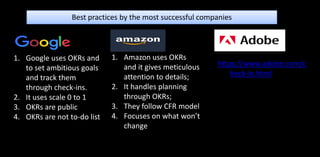
Best practices by the most successful companies
1. Google uses OKRs and
to set ambitious goals
and track them
through check-ins.
2. It uses scale 0 to 1
3. OKRs are public
4. OKRs are not to-do list
1. Amazon uses OKRs
and it gives meticulous
attention to details;
2. It handles planning
through OKRs;
3. They follow CFR model
4. Focuses on what won’t
change
https://www.adobe.com/c
heck-in.html
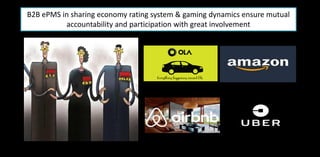
B2B ePMS in sharing economy rating system & gaming dynamics ensure mutual
accountability and participation with great involvement
How do you handle ePMS?
1. Make sure that each resource brings his/her best of who
he/she is.
2. Focus on a few areas
3. No rating or grading. It is all about performance achievement
rather comparing against each others.
4. Gamified learning
…Contd
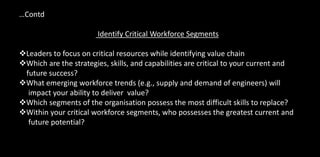
Identify Critical Workforce Segments
Leaders to focus on critical resources while identifying value chain
Which are the strategies, skills, and capabilities are critical to your current and
future success?
What emerging workforce trends (e.g., supply and demand of engineers) will
impact your ability to deliver value?
Which segments of the organisation possess the most difficult skills to replace?
Within your critical workforce segments, who possesses the greatest current and
future potential?
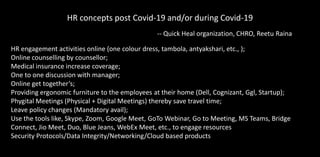
HR concepts post Covid-19 and/or during Covid-19
-- Quick Heal organization, CHRO, Reetu Raina
HR engagement activities online (one colour dress, tambola, antyakshari, etc., );
Online counselling by counsellor;
Medical insurance increase coverage;
One to one discussion with manager;
Online get together’s;
Providing ergonomic furniture to the employees at their home (Dell, Cognizant, Ggl, Startup);
Phygital Meetings (Physical + Digital Meetings) thereby save travel time;
Leave policy changes (Mandatory avail);
Use the tools like, Skype, Zoom, Google Meet, GoTo Webinar, Go to Meeting, MS Teams, Bridge
Connect, Jio Meet, Duo, Blue Jeans, WebEx Meet, etc., to engage resources
Security Protocols/Data Integrity/Networking/Cloud based products
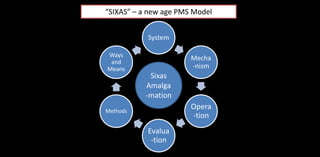
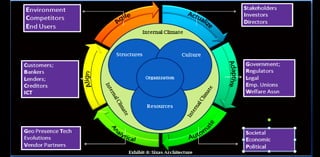
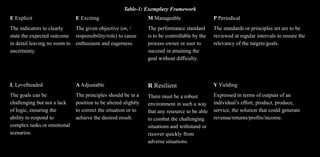
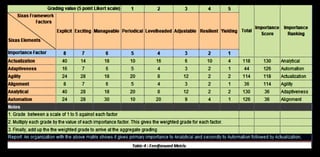
“SIXAS” – a new age PMS Model
System
Mecha
-nism
Opera
-tion
Evalua
-tion
Methods
Ways
and
Means
Sixas
Amalga
-mation
Table-1: Exemplary Framework
E Explicit
The indicators to clearly
state the expected outcome
in detail leaving no room to
uncertainty.
E Exciting
The given objective (or, /
responsibility/role) to cause
enthusiasm and eagerness.
M Manageable
The performance standard
is to be controllable by the
process owner or user to
succeed in attaining the
goal without difficulty.
P Periodical
The standards or principles set are to be
reviewed at regular intervals to ensure the
relevancy of the targets/goals.
L Levelheaded
The goals can be
challenging but not a lack
of logic, ensuring the
ability to respond to
complex tasks or emotional
scenarios.
A Adjustable
The principles should be in a
position to be altered slightly
to correct the situation or to
achieve the desired result.
R Resilient
There must be a robust
environment in such a way
that any resource to be able
to combat the challenging
situations and withstand or
recover quickly from
adverse situations.
Y Yielding
Expressed in terms of outputs of an
individual’s effort, product, produce,
service, the solution that could generate
revenue/returns/profits/income.
References | Resources (available online)
1. Objectives and Key Results: Driving Focus, Alignment, and
Engagement with OKRs - Paul R. Niven, Ben Lamorte
2. Radical Focus – Christina Wodtke (Available thru Anybook Mob.App)
3. The HR Scorecard : Linking People, Strategy, and Performance –
Brian E.Becker , Mark A.Huselid, and Dave Ulrich. (Anybook Mobile
App.)
4. Measure What Matters – John Doerr (Anybook Mobile App.)
5. Key Performance Indicators for Dummies – A Wiley Brand
6. Human Resources Kit for Dummmies – 2nd Edition – A Wiley Brand
e-Performance Management System
YOUR RESOURCE PERSON
Dr. Mruthyanjaya Rao Mangipudi
Research Scholar, Business Management &
Senior Manager (Corp. Support)
Karvy Stock Broking Limited, Financial District, Hyderabad
Tw: raomangipudi
LI : ememrao
Email: raomangipudi@gmail.com
Working summary
7 yrs in Judicial administrative subordinate services
13+ yrs in HR business partner, Admin, business
operations & certified ISO Lead Auditor (9001:2015)
Domains:
Legal, Telecom, IT (product Co.), ITES, Banking & Finance
Areas of interest:
Teaching | Organization Development | Inventing new
business models | PMS | L&D | Organization Design
yours sincerely,
Dr. Mruthyanjaya Rao Mangipudi
raomangipudi@gmail.com
Twitter : raomangipudi
LI: www.linkedin.com/ememrao

Enterprise Performance Management System or ePMS or e-PMS

  • 1.
    Business Strategy CaseStudies Overview Overview of Performance ManagementSystem Evolution of PMS & general attributes of ePMS Adoption Factors of ePMS Critical success factors of ePMS & implementation incl. Sixas Model. e-Performance Management System
  • 2.
    Definition of PMS Performancemanagement is an ongoing process of communication between a supervisor and an employee that occurs throughout the year, clarifying expectations, setting objectives, identifying goals, providing feedback and reviewing the outcomes, in support of accomplishing the strategic objectives of the organization. - People & Culture, UC Beverley, CA
  • 3.
  • 4.
    COMPARISON PERFORMANCE APPRAISALPERFORMANCE MANAGEMENT Meaning Performance Appraisal, means the analysis of an employee's performance and their caliber for the given period. Performance Management is the management of human resources in an organization for future growth and development. What is it? It is a system. It is a process. Type of tool Operational Tool Strategic Tool Owned by Human Resource Department Managers Conducted Annually Continuously Approach Individualistic Holistic Focused on Quantitative Aspects Both quantitative & qualitative Aspects Corrections Retrospective Prospective AppraisalVs.Management
  • 5.
    Ability to operatein well defined and stable environment Dealing with repetitive work Operating in supervised environment Isolated work Narrow geographical & time zones Broad/Unspecified knowledge Procedural competencies Ability to operate in ever-changing & dynamic environment Dealing with varied work Handling decisions & responsibilities by own Team Work Expanding geographical time zones Specific / Specialized Knowledge Customer centric ChangingCompetenciesofe-PMS
  • 6.
    People Factors Tech Factors Org.Factors - Top management support, - User acceptance, - Effective communication -Skills in HR and cultural factors. - Extent of customization - Modifying plug n play model - Manageable complexity of ePMS -Data Integrity | System usefulness - Integration with 3rd party software - Size of the organization - Characteristics of organization - Capacities & capabilities [training] -Geographical distribution of business & data integrity [ Sales & Marketing ] Adoption Factors of ePMS
  • 7.
    Rethinking on centuryold practices • 1.8 million hours across the firm • Restricts creativity • Generates mountains of paperwork • Lack of collaboration & innovation • Despise between Manager & team members • Heavily linked performance to rewards • End of year appraisals • Holding people accountable for past behaviours
  • 8.
    System Process Appraisal Joint Review Output Output & Input Reward Oriented Dev. Oriented Top-down 360’D Feedback MonolithicFlexible Owned by Managmt. Owned by Users Cadre Based Service Based ConceptualEvolutionofPMS1999-2020 2020 2010 2000 1990 OKRs
  • 9.
    What’s in newPMS? Pic Source: Profit.co • Check-ins • Agile Manifesto • Owned by team not by HRs or Ex-officios • Feed forward (pre-dgns.) Vs. Feedback • Regular conversations (future competitiveness) • Improving current performance • Grooming talent for future • Driven by business not imposed by HR
  • 10.
    Early adopters ofNew Performance Management System
  • 11.
    How does ePMSmanage performance? • Tracks time spent on tasks/projects • Measures work units • Monitors -- tardiness, attendance, grievances, satisfaction, and turnover. • No. of mistakes/errors committed • Counts amount of idle time or idle time spent on • Less or no micro level management • Assemble feedback from multi-raters • Tracking and comparing group level & unit level performances • Motivating the strong people (HiPOs) • High rewards • Malleability ( Impressionable minds) • Coaching & Development (personal growth & sense of progress)
  • 12.
  • 13.
    Cloud based appsare integrated with SNS; automation; administrative efficiency Social Media Connect Multiple evaluations; helpful for developmental purposes [not rewards]; anytime access to data 360-D Feedback Favourable towards electronic feedback ; image management; less time on processes & more time on performance management; Feedback Streamlines process sometimes feedback is harsh & negative and does not give. addl Inuts; not always captures relevant aspects of performance; Looks Good to Systems rather displaying performance related behaviours; Misunderstanding; Distruct Communication Interpersonal distance Tightly monitoring behaviour; lower level satisfaction; Systems are not secure Privacy violation Merits Demerits Evaluation of ePMS Cuts costs; Decreases time & effort; increases efficiency; administrative capablities; closely replicates pen & paper; Employee & Manager relationships are strained; Heavily rely on comp.data than fact- finding interactions; biased, polit., Mechanical
  • 14.
  • 15.
    Objectives and KeyResults – John E. Doerr, US OKR is a goal management system used by teams, to collaborate and achieve stretch goals through a framework that requires regular check-ins, feedback, continuous learning, collaboration and problem-solving. Key Results are measurable & verifiable benchmarks and monitor HOW we get to the objective. Effective KRs are specific and time-bound, aggressive yet realistic. Objectives : Where do I want go? Key Results: How do I get there?
  • 16.
    How to identifyor design Objectives and Key Results? https://okrexamples.co/h uman_resources-okr- examples
  • 17.
  • 18.
    OKRs for SalesTeam - Example
  • 19.
    OKRs for HR– Recruitment
  • 20.
    Weekly check- ins fortracking results Quarterly tactical OKRs for the teams High Level strategic OKRs for the company [low prices, fast delivery, vast selection – Amazon, Jeff Bezos] OKRs -Nested Cadences
  • 21.
    Best practices bythe most successful companies 1. Google uses OKRs and to set ambitious goals and track them through check-ins. 2. It uses scale 0 to 1 3. OKRs are public 4. OKRs are not to-do list 1. Amazon uses OKRs and it gives meticulous attention to details; 2. It handles planning through OKRs; 3. They follow CFR model 4. Focuses on what won’t change https://www.adobe.com/c heck-in.html
  • 22.
    B2B ePMS insharing economy rating system & gaming dynamics ensure mutual accountability and participation with great involvement
  • 23.
    How do youhandle ePMS? 1. Make sure that each resource brings his/her best of who he/she is. 2. Focus on a few areas 3. No rating or grading. It is all about performance achievement rather comparing against each others. 4. Gamified learning
  • 24.
    …Contd Identify Critical WorkforceSegments Leaders to focus on critical resources while identifying value chain Which are the strategies, skills, and capabilities are critical to your current and future success? What emerging workforce trends (e.g., supply and demand of engineers) will impact your ability to deliver value? Which segments of the organisation possess the most difficult skills to replace? Within your critical workforce segments, who possesses the greatest current and future potential?
  • 25.
    HR concepts postCovid-19 and/or during Covid-19 -- Quick Heal organization, CHRO, Reetu Raina HR engagement activities online (one colour dress, tambola, antyakshari, etc., ); Online counselling by counsellor; Medical insurance increase coverage; One to one discussion with manager; Online get together’s; Providing ergonomic furniture to the employees at their home (Dell, Cognizant, Ggl, Startup); Phygital Meetings (Physical + Digital Meetings) thereby save travel time; Leave policy changes (Mandatory avail); Use the tools like, Skype, Zoom, Google Meet, GoTo Webinar, Go to Meeting, MS Teams, Bridge Connect, Jio Meet, Duo, Blue Jeans, WebEx Meet, etc., to engage resources Security Protocols/Data Integrity/Networking/Cloud based products
  • 26.
    “SIXAS” – anew age PMS Model System Mecha -nism Opera -tion Evalua -tion Methods Ways and Means Sixas Amalga -mation
  • 28.
    Table-1: Exemplary Framework EExplicit The indicators to clearly state the expected outcome in detail leaving no room to uncertainty. E Exciting The given objective (or, / responsibility/role) to cause enthusiasm and eagerness. M Manageable The performance standard is to be controllable by the process owner or user to succeed in attaining the goal without difficulty. P Periodical The standards or principles set are to be reviewed at regular intervals to ensure the relevancy of the targets/goals. L Levelheaded The goals can be challenging but not a lack of logic, ensuring the ability to respond to complex tasks or emotional scenarios. A Adjustable The principles should be in a position to be altered slightly to correct the situation or to achieve the desired result. R Resilient There must be a robust environment in such a way that any resource to be able to combat the challenging situations and withstand or recover quickly from adverse situations. Y Yielding Expressed in terms of outputs of an individual’s effort, product, produce, service, the solution that could generate revenue/returns/profits/income.
  • 30.
    References | Resources(available online) 1. Objectives and Key Results: Driving Focus, Alignment, and Engagement with OKRs - Paul R. Niven, Ben Lamorte 2. Radical Focus – Christina Wodtke (Available thru Anybook Mob.App) 3. The HR Scorecard : Linking People, Strategy, and Performance – Brian E.Becker , Mark A.Huselid, and Dave Ulrich. (Anybook Mobile App.) 4. Measure What Matters – John Doerr (Anybook Mobile App.) 5. Key Performance Indicators for Dummies – A Wiley Brand 6. Human Resources Kit for Dummmies – 2nd Edition – A Wiley Brand
  • 31.
    e-Performance Management System YOURRESOURCE PERSON Dr. Mruthyanjaya Rao Mangipudi Research Scholar, Business Management & Senior Manager (Corp. Support) Karvy Stock Broking Limited, Financial District, Hyderabad Tw: raomangipudi LI : ememrao Email: raomangipudi@gmail.com Working summary 7 yrs in Judicial administrative subordinate services 13+ yrs in HR business partner, Admin, business operations & certified ISO Lead Auditor (9001:2015) Domains: Legal, Telecom, IT (product Co.), ITES, Banking & Finance Areas of interest: Teaching | Organization Development | Inventing new business models | PMS | L&D | Organization Design
  • 32.
    yours sincerely, Dr. MruthyanjayaRao Mangipudi raomangipudi@gmail.com Twitter : raomangipudi LI: www.linkedin.com/ememrao