Herman Aguinis, University of Colorado at Denver
PERFORMANCE MANAGEMENT
AND
STRATEGIC PLANNING
Prof. Preeti Bhaskar
Symbiosis Centre for Management Studies, NOIDA
Herman Aguinis, University of Colorado at Denver
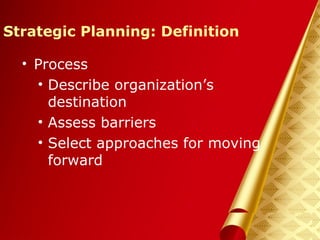
Strategic Planning: Definition
• Process
• Describe organization’s
destination
• Assess barriers
• Select approaches for moving
forward
Prentice Hall, Inc. © 2006
Herman Aguinis, University of Colorado at Denver
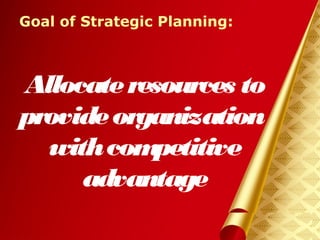
Goal of Strategic Planning:
Prentice Hall, Inc. © 2006
Allocateresources to
provideorganization
withcompetitive
advantage
Herman Aguinis, University of Colorado at Denver
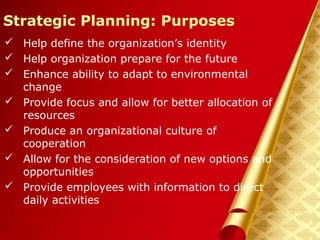
Strategic Planning: Purposes
 Help define the organization’s identity
 Help organization prepare for the future
 Enhance ability to adapt to environmental
change
 Provide focus and allow for better allocation of
resources
 Produce an organizational culture of
cooperation
 Allow for the consideration of new options and
opportunities
 Provide employees with information to direct
daily activities
Prentice Hall, Inc. © 2006
Herman Aguinis, University of Colorado at Denver
Therewas agoodstrategic
planninginmost of the
organization, but thereis no
clearrelationshipbetween
Organizational Level and
individual level goals.There is a need to link the strategic planning with
individual goals
Herman Aguinis, University of Colorado at Denver
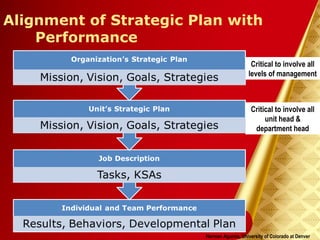
Alignment of Strategic Plan with
Performance
Critical to involve all
levels of management
Critical to involve all
unit head &
department head
Herman Aguinis, University of Colorado at Denver
Resent study including 338
organization in 42 countries
found performance
management is the 3rd
most
important factor affecting
success of a strategic plan.
Herman Aguinis, University of Colorado at Denver
Linking among organization ,
Unit strategic Plan , Job
Description and individual and
Team
BANK OF UTAH
Washington, United States
Herman Aguinis, University of Colorado at Denver
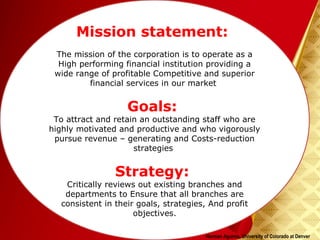
Mission statement:
The mission of the corporation is to operate as a
High performing financial institution providing a
wide range of profitable Competitive and superior
financial services in our market
Goals:
To attract and retain an outstanding staff who are
highly motivated and productive and who vigorously
pursue revenue – generating and Costs-reduction
strategies
Strategy:
Critically reviews out existing branches and
departments to Ensure that all branches are
consistent in their goals, strategies, And profit
objectives.
Herman Aguinis, University of Colorado at Denver
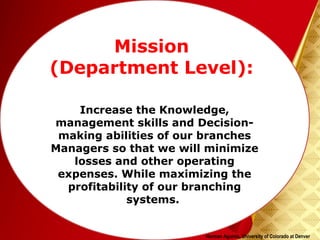
Mission
(Department Level):
Increase the Knowledge,
management skills and Decision-
making abilities of our branches
Managers so that we will minimize
losses and other operating
expenses. While maximizing the
profitability of our branching
systems.
Herman Aguinis, University of Colorado at Denver
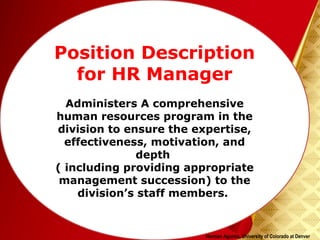
Position Description
for HR Manager
Administers A comprehensive
human resources program in the
division to ensure the expertise,
effectiveness, motivation, and
depth
( including providing appropriate
management succession) to the
division’s staff members.
Herman Aguinis, University of Colorado at Denver
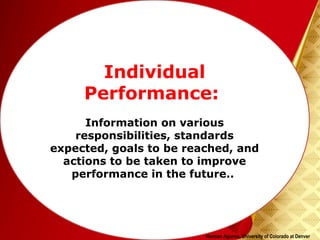
Individual
Performance:
Information on various
responsibilities, standards
expected, goals to be reached, and
actions to be taken to improve
performance in the future..
Herman Aguinis, University of Colorado at Denver
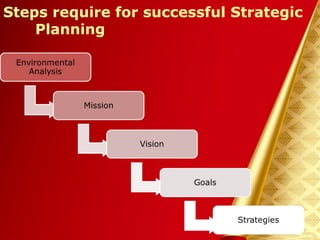
Steps require for successful Strategic
Planning
Herman Aguinis, University of Colorado at Denver
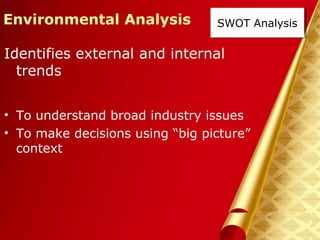
Environmental Analysis
Identifies external and internal
trends
• To understand broad industry issues
• To make decisions using “big picture”
context
Prentice Hall, Inc. © 2006
SWOT AnalysisSWOT Analysis
Herman Aguinis, University of Colorado at Denver
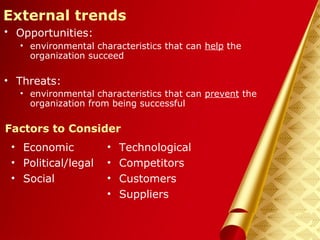
External trends
• Opportunities:
• environmental characteristics that can help the
organization succeed
• Threats:
• environmental characteristics that can prevent the
organization from being successful
Prentice Hall, Inc. © 2006
Factors to Consider
• Economic
• Political/legal
• Social
• Technological
• Competitors
• Customers
• Suppliers
Herman Aguinis, University of Colorado at Denver
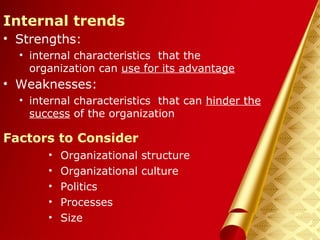
Internal trends
• Strengths:
• internal characteristics that the
organization can use for its advantage
• Weaknesses:
• internal characteristics that can hinder the
success of the organization
Prentice Hall, Inc. © 2006
Factors to Consider
• Organizational structure
• Organizational culture
• Politics
• Processes
• Size
Herman Aguinis, University of Colorado at Denver
Gap Analysis
Analyzes:
External environment
(opportunities and threats)
vis-à-vis
Internal environment
(strengths and weaknesses)
Prentice Hall, Inc. © 2006
Herman Aguinis, University of Colorado at Denver
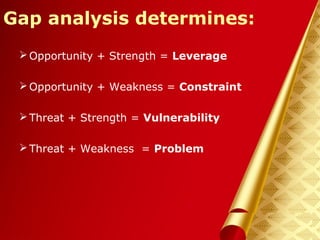
Gap analysis determines:
Opportunity + Strength = Leverage
Opportunity + Weakness = Constraint
Threat + Strength = Vulnerability
Threat + Weakness = Problem
Prentice Hall, Inc. © 2006
Herman Aguinis, University of Colorado at Denver
Strategic Planning for the Organization
Environmental and Gap Analyses
provide information for organizations
to decide:
Who they are
What they do
Prentice Hall, Inc. © 2006
Herman Aguinis, University of Colorado at Denver
Mission
A good mission statement answers:
Why does the organization exist?
What is the scope of the organization’s
activities?
Who are the customers served?
What are the products or services offered?
Prentice Hall, Inc. © 2006
Herman Aguinis, University of Colorado at Denver
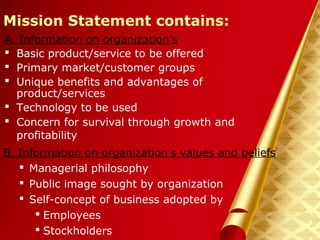
Mission Statement contains:
A. Information on organization’s
 Basic product/service to be offered
 Primary market/customer groups
 Unique benefits and advantages of
product/services
 Technology to be used
 Concern for survival through growth and
profitability
Prentice Hall, Inc. © 2006
B. Information on organization’s values and beliefs
 Managerial philosophy
 Public image sought by organization
 Self-concept of business adopted by
 Employees
 Stockholders
Herman Aguinis, University of Colorado at Denver
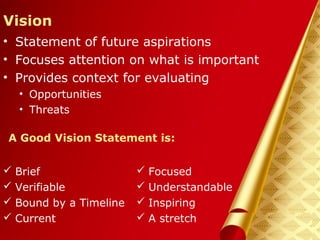
Vision
• Statement of future aspirations
• Focuses attention on what is important
• Provides context for evaluating
• Opportunities
• Threats
Prentice Hall, Inc. © 2006
A Good Vision Statement is:
 Brief
 Verifiable
 Bound by a Timeline
 Current
 Focused
 Understandable
 Inspiring
 A stretch
Herman Aguinis, University of Colorado at Denver
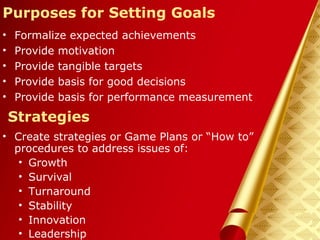
Purposes for Setting Goals
• Formalize expected achievements
• Provide motivation
• Provide tangible targets
• Provide basis for good decisions
• Provide basis for performance measurement
Prentice Hall, Inc. © 2006
Strategies
• Create strategies or Game Plans or “How to”
procedures to address issues of:
• Growth
• Survival
• Turnaround
• Stability
• Innovation
• Leadership
Herman Aguinis, University of Colorado at Denver
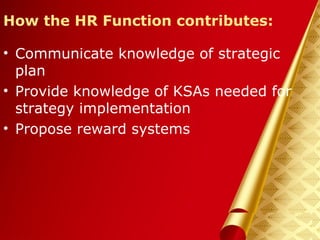
How the HR Function contributes:
• Communicate knowledge of strategic
plan
• Provide knowledge of KSAs needed for
strategy implementation
• Propose reward systems
Prentice Hall, Inc. © 2006
Herman Aguinis, University of Colorado at Denver
Strategic Plans at the Unit Level
• Organization Mission statement, Vision
statement, Goals, and Strategies
Must clearly align with………
And be congruent with……
• Every Unit Mission statement, Vision
statement, Goals, and Strategies
Prentice Hall, Inc. © 2006
Herman Aguinis, University of Colorado at Denver
Job Descriptions
• Tasks and KSAs are congruent
with Organization and Unit
strategic plans
• Activities described support
mission and vision of
Organization and Unit
Prentice Hall, Inc. © 2006
Herman Aguinis, University of Colorado at Denver
Individual and Team Performance
Organization and Unit mission, vision, goals lead
to
 Performance management system, which
Motivates employees
Aligns development plans with organization
priorities
Prentice Hall, Inc. © 2006
Herman Aguinis, University of Colorado at Denver
Strategic Plan  Choices in PM System
Design
• Criteria (Behavior vs. Results)
• Participation (Low vs. High)
• Temporal Dimension (Short Term vs. Long
Term)
• Level of Criteria (Individual vs.
Team/Group)
• System Orientation (Developmental vs.
Administrative)
• Rewards (Pay for Performance vs.
Tenure/Position)
Prentice Hall, Inc. © 2006
Herman Aguinis, University of Colorado at Denver
Building Support –
Answering “What’s In It for
Me?”
• Top Management:
• Help carry out vision
• All levels:
• Involvement
• Participation
• Understanding
Prentice Hall, Inc. © 2006

Unit- 3. Performance Management and strategic Planning

  • 1.
    Herman Aguinis, Universityof Colorado at Denver PERFORMANCE MANAGEMENT AND STRATEGIC PLANNING Prof. Preeti Bhaskar Symbiosis Centre for Management Studies, NOIDA
  • 2.
    Herman Aguinis, Universityof Colorado at Denver Strategic Planning: Definition • Process • Describe organization’s destination • Assess barriers • Select approaches for moving forward Prentice Hall, Inc. © 2006
  • 3.
    Herman Aguinis, Universityof Colorado at Denver Goal of Strategic Planning: Prentice Hall, Inc. © 2006 Allocateresources to provideorganization withcompetitive advantage
  • 4.
    Herman Aguinis, Universityof Colorado at Denver Strategic Planning: Purposes  Help define the organization’s identity  Help organization prepare for the future  Enhance ability to adapt to environmental change  Provide focus and allow for better allocation of resources  Produce an organizational culture of cooperation  Allow for the consideration of new options and opportunities  Provide employees with information to direct daily activities Prentice Hall, Inc. © 2006
  • 5.
    Herman Aguinis, Universityof Colorado at Denver Therewas agoodstrategic planninginmost of the organization, but thereis no clearrelationshipbetween Organizational Level and individual level goals.There is a need to link the strategic planning with individual goals
  • 6.
    Herman Aguinis, Universityof Colorado at Denver Alignment of Strategic Plan with Performance Critical to involve all levels of management Critical to involve all unit head & department head
  • 7.
    Herman Aguinis, Universityof Colorado at Denver Resent study including 338 organization in 42 countries found performance management is the 3rd most important factor affecting success of a strategic plan.
  • 8.
    Herman Aguinis, Universityof Colorado at Denver Linking among organization , Unit strategic Plan , Job Description and individual and Team BANK OF UTAH Washington, United States
  • 9.
    Herman Aguinis, Universityof Colorado at Denver Mission statement: The mission of the corporation is to operate as a High performing financial institution providing a wide range of profitable Competitive and superior financial services in our market Goals: To attract and retain an outstanding staff who are highly motivated and productive and who vigorously pursue revenue – generating and Costs-reduction strategies Strategy: Critically reviews out existing branches and departments to Ensure that all branches are consistent in their goals, strategies, And profit objectives.
  • 10.
    Herman Aguinis, Universityof Colorado at Denver Mission (Department Level): Increase the Knowledge, management skills and Decision- making abilities of our branches Managers so that we will minimize losses and other operating expenses. While maximizing the profitability of our branching systems.
  • 11.
    Herman Aguinis, Universityof Colorado at Denver Position Description for HR Manager Administers A comprehensive human resources program in the division to ensure the expertise, effectiveness, motivation, and depth ( including providing appropriate management succession) to the division’s staff members.
  • 12.
    Herman Aguinis, Universityof Colorado at Denver Individual Performance: Information on various responsibilities, standards expected, goals to be reached, and actions to be taken to improve performance in the future..
  • 13.
    Herman Aguinis, Universityof Colorado at Denver Steps require for successful Strategic Planning
  • 14.
    Herman Aguinis, Universityof Colorado at Denver Environmental Analysis Identifies external and internal trends • To understand broad industry issues • To make decisions using “big picture” context Prentice Hall, Inc. © 2006 SWOT AnalysisSWOT Analysis
  • 15.
    Herman Aguinis, Universityof Colorado at Denver External trends • Opportunities: • environmental characteristics that can help the organization succeed • Threats: • environmental characteristics that can prevent the organization from being successful Prentice Hall, Inc. © 2006 Factors to Consider • Economic • Political/legal • Social • Technological • Competitors • Customers • Suppliers
  • 16.
    Herman Aguinis, Universityof Colorado at Denver Internal trends • Strengths: • internal characteristics that the organization can use for its advantage • Weaknesses: • internal characteristics that can hinder the success of the organization Prentice Hall, Inc. © 2006 Factors to Consider • Organizational structure • Organizational culture • Politics • Processes • Size
  • 17.
    Herman Aguinis, Universityof Colorado at Denver Gap Analysis Analyzes: External environment (opportunities and threats) vis-à-vis Internal environment (strengths and weaknesses) Prentice Hall, Inc. © 2006
  • 18.
    Herman Aguinis, Universityof Colorado at Denver Gap analysis determines: Opportunity + Strength = Leverage Opportunity + Weakness = Constraint Threat + Strength = Vulnerability Threat + Weakness = Problem Prentice Hall, Inc. © 2006
  • 19.
    Herman Aguinis, Universityof Colorado at Denver Strategic Planning for the Organization Environmental and Gap Analyses provide information for organizations to decide: Who they are What they do Prentice Hall, Inc. © 2006
  • 20.
    Herman Aguinis, Universityof Colorado at Denver Mission A good mission statement answers: Why does the organization exist? What is the scope of the organization’s activities? Who are the customers served? What are the products or services offered? Prentice Hall, Inc. © 2006
  • 21.
    Herman Aguinis, Universityof Colorado at Denver Mission Statement contains: A. Information on organization’s  Basic product/service to be offered  Primary market/customer groups  Unique benefits and advantages of product/services  Technology to be used  Concern for survival through growth and profitability Prentice Hall, Inc. © 2006 B. Information on organization’s values and beliefs  Managerial philosophy  Public image sought by organization  Self-concept of business adopted by  Employees  Stockholders
  • 22.
    Herman Aguinis, Universityof Colorado at Denver Vision • Statement of future aspirations • Focuses attention on what is important • Provides context for evaluating • Opportunities • Threats Prentice Hall, Inc. © 2006 A Good Vision Statement is:  Brief  Verifiable  Bound by a Timeline  Current  Focused  Understandable  Inspiring  A stretch
  • 23.
    Herman Aguinis, Universityof Colorado at Denver Purposes for Setting Goals • Formalize expected achievements • Provide motivation • Provide tangible targets • Provide basis for good decisions • Provide basis for performance measurement Prentice Hall, Inc. © 2006 Strategies • Create strategies or Game Plans or “How to” procedures to address issues of: • Growth • Survival • Turnaround • Stability • Innovation • Leadership
  • 24.
    Herman Aguinis, Universityof Colorado at Denver How the HR Function contributes: • Communicate knowledge of strategic plan • Provide knowledge of KSAs needed for strategy implementation • Propose reward systems Prentice Hall, Inc. © 2006
  • 25.
    Herman Aguinis, Universityof Colorado at Denver Strategic Plans at the Unit Level • Organization Mission statement, Vision statement, Goals, and Strategies Must clearly align with……… And be congruent with…… • Every Unit Mission statement, Vision statement, Goals, and Strategies Prentice Hall, Inc. © 2006
  • 26.
    Herman Aguinis, Universityof Colorado at Denver Job Descriptions • Tasks and KSAs are congruent with Organization and Unit strategic plans • Activities described support mission and vision of Organization and Unit Prentice Hall, Inc. © 2006
  • 27.
    Herman Aguinis, Universityof Colorado at Denver Individual and Team Performance Organization and Unit mission, vision, goals lead to  Performance management system, which Motivates employees Aligns development plans with organization priorities Prentice Hall, Inc. © 2006
  • 28.
    Herman Aguinis, Universityof Colorado at Denver Strategic Plan  Choices in PM System Design • Criteria (Behavior vs. Results) • Participation (Low vs. High) • Temporal Dimension (Short Term vs. Long Term) • Level of Criteria (Individual vs. Team/Group) • System Orientation (Developmental vs. Administrative) • Rewards (Pay for Performance vs. Tenure/Position) Prentice Hall, Inc. © 2006
  • 29.
    Herman Aguinis, Universityof Colorado at Denver Building Support – Answering “What’s In It for Me?” • Top Management: • Help carry out vision • All levels: • Involvement • Participation • Understanding Prentice Hall, Inc. © 2006