INTEGRATING SDGs TO
DEVELOPMENT PLAN
Gellwynn Yusuf
Deputy Minister for Maritime and Natural Resources
Bangkok, Thailand, 24-25 Oktober 2016
Ministry of National Development Planning/Bappenas
Republic of Indonesia
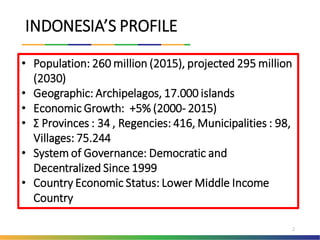
• Population: 260 million (2015), projected 295 million
(2030)
• Geographic: Archipelagos, 17.000 islands
• Economic Growth: +5% (2000- 2015)
• Ʃ Provinces : 34 , Regencies: 416, Municipalities : 98,
Villages: 75.244
• System of Governance: Democratic and
Decentralized Since 1999
• Country Economic Status: Lower Middle Income
Country
2
INDONESIA’S PROFILE
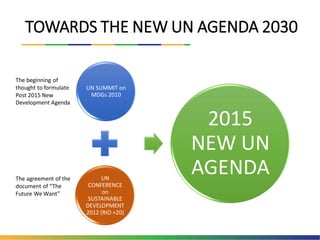
TOWARDS THE NEW UN AGENDA 2030
UN SUMMIT on
MDGs 2010
UN
CONFERENCE
on
SUSTAINABLE
DEVELOPMENT
2012 (RIO +20)
2015
NEW UN
AGENDA
The beginning of
thought to formulate
Post 2015 New
Development Agenda
The agreement of the
document of “The
Future We Want”
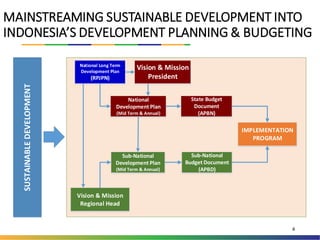
MAINSTREAMING SUSTAINABLE DEVELOPMENT INTO
INDONESIA’S DEVELOPMENT PLANNING & BUDGETING
4
SUSTAINABLEDEVELOPMENT
Vision & Mission
Regional Head
IMPLEMENTATION
PROGRAM
Sub-National
Development Plan
(Mid Term & Annual)
National Long Term
Development Plan
(RPJPN)
National
Development Plan
(Mid Term & Annual)
Vision & Mission
President
State Budget
Document
(APBN)
Sub-National
Budget Document
(APBD)
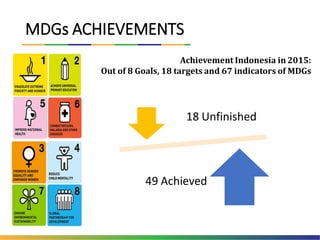
MDGs ACHIEVEMENTS
Achievement Indonesia in 2015:
Out of 8 Goals, 18 targets and 67 indicators of MDGs
18 Unfinished
49 Achieved
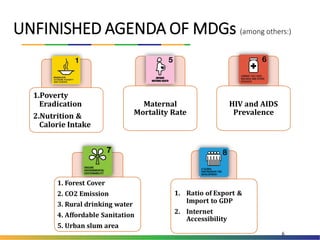
1. Forest Cover
2. CO2 Emission
3. Rural drinking water
4. Affordable Sanitation
5. Urban slum area
1. Ratio of Export &
Import to GDP
2. Internet
Accessibility
UNFINISHED AGENDA OF MDGs (among others:)
1.Poverty
Eradication
2.Nutrition &
Calorie Intake
Maternal
Mortality Rate
HIV and AIDS
Prevalence
6
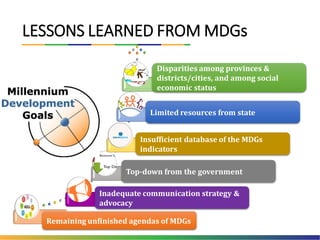
LESSONS LEARNED FROM MDGs
0
1
2
3
4
5
Disparities among provinces &
districts/cities, and among social
economic status
Limited resources from state
Insufficient database of the MDGs
indicators
Top-down from the government
Inadequate communication strategy &
advocacy
Remaining unfinished agendas of MDGs
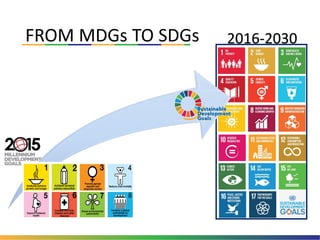
FROM MDGs TO SDGs 2016-2030
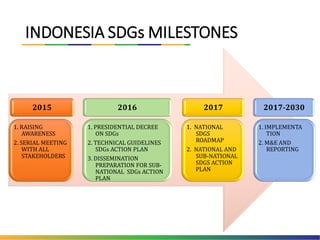
INDONESIA SDGs MILESTONES
1. RAISING
AWARENESS
2. SERIAL MEETING
WITH ALL
STAKEHOLDERS
1. PRESIDENTIAL DECREE
ON SDGs
2. TECHNICAL GUIDELINES
SDGs ACTION PLAN
3. DISSEMINATION
PREPARATION FOR SUB-
NATIONAL SDGs ACTION
PLAN
1. NATIONAL
SDGS
ROADMAP
2. NATIONAL AND
SUB-NATIONAL
SDGS ACTION
PLAN
1. IMPLEMENTA
TION
2. M&E AND
REPORTING
2015 2016 2017 2017-2030
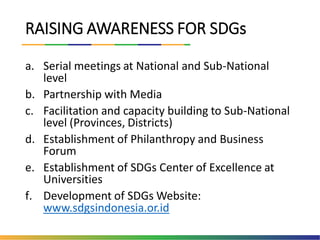
RAISING AWARENESS FOR SDGs
a. Serial meetings at National and Sub-National
level
b. Partnership with Media
c. Facilitation and capacity building to Sub-National
level (Provinces, Districts)
d. Establishment of Philanthropy and Business
Forum
e. Establishment of SDGs Center of Excellence at
Universities
f. Development of SDGs Website:
www.sdgsindonesia.or.id
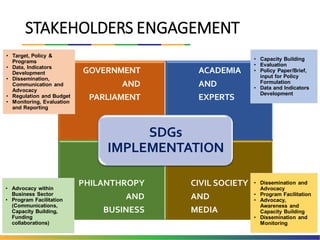
GOVERNMENT
AND
PARLIAMENT
ACADEMIA
AND
EXPERTS
PHILANTHROPY
AND
BUSINESS
CIVIL SOCIETY
AND
MEDIA
SDGs
IMPLEMENTATION
• Target, Policy &
Programs
• Data, Indicators
Development
• Dissemination,
Communication and
Advocacy
• Regulation and Budget
• Monitoring, Evaluation
and Reporting
• Advocacy within
Business Sector
• Program Facilitation
(Communications,
Capacity Building,
Funding
collaborations)
• Capacity Building
• Evaluation
• Policy Paper/Brief,
input for Policy
Formulation
• Data and Indicators
Development
• Dissemination and
Advocacy
• Program Facilitation
• Advocacy,
Awareness and
Capacity Building
• Dissemination and
Monitoring
STAKEHOLDERS ENGAGEMENT
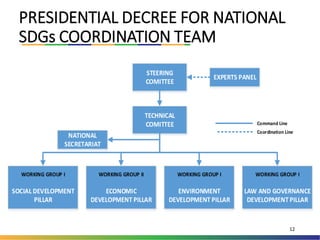
PRESIDENTIAL DECREE FOR NATIONAL
SDGs COORDINATION TEAM
12
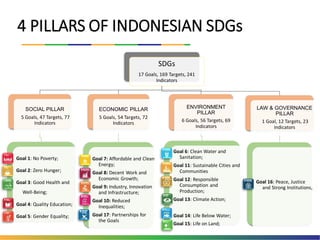
4 PILLARS OF INDONESIAN SDGs
SDGs
17 Goals, 169 Targets, 241
Indicators
SOCIAL PILLAR
5 Goals, 47 Targets, 77
Indicators
Goal 1: No Poverty;
Goal 2: Zero Hunger;
Goal 3: Good Health and
Well-Being;
Goal 4: Quality Education;
Goal 5: Gender Equality;
ECONOMIC PILLAR
5 Goals, 54 Targets, 72
Indicators
Goal 7: Affordable and Clean
Energy;
Goal 8: Decent Work and
Economic Growth;
Goal 9: Industry, Innovation
and Infrastructure;
Goal 10: Reduced
Inequalities;
Goal 17: Partnerships for
the Goals
ENVIRONMENT
PILLAR
6 Goals, 56 Targets, 69
Indicators
Goal 6: Clean Water and
Sanitation;
Goal 11: Sustainable Cities and
Communities
Goal 12: Responsible
Consumption and
Production;
Goal 13: Climate Action;
Goal 14: Life Below Water;
Goal 15: Life on Land;
LAW & GOVERNANCE
PILLAR
1 Goal, 12 Targets, 23
Indicators
Goal 16: Peace, Justice
and Strong Institutions,
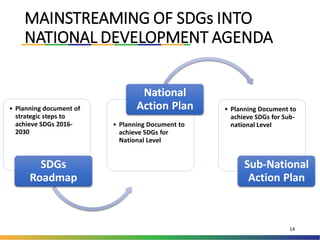
MAINSTREAMING OF SDGs INTO
NATIONAL DEVELOPMENT AGENDA
• Planning document of
strategic steps to
achieve SDGs 2016-
2030
SDGs
Roadmap
• Planning Document to
achieve SDGs for
National Level
National
Action Plan • Planning Document to
achieve SDGs for Sub-
national Level
Sub-National
Action Plan
14
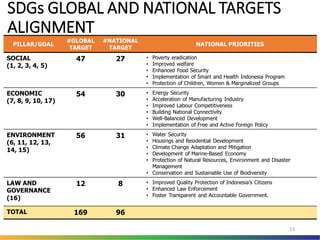
SDGs GLOBAL AND NATIONAL TARGETS
ALIGNMENT
15
PILLAR/GOAL
#GLOBAL
TARGET
#NATIONAL
TARGET
NATIONAL PRIORITIES
SOCIAL
(1, 2, 3, 4, 5)
47 27 • Poverty eradication
• Improved welfare
• Enhanced Food Security
• Implementation of Smart and Health Indonesia Program
• Protection of Children, Women & Marginalized Groups
ECONOMIC
(7, 8, 9, 10, 17)
54 30 • Energy Security
• Acceleration of Manufacturing Industry
• Improved Labour Competitiveness
• Building National Connectivity
• Well-Balanced Development
• Implementation of Free and Active Foreign Policy
ENVIRONMENT
(6, 11, 12, 13,
14, 15)
56 31 • Water Security
• Housings and Residential Development
• Climate Change Adaptation and Mitigation
• Development of Marine-Based Economy
• Protection of Natural Resources, Environment and Disaster
Management
• Conservation and Sustainable Use of Biodiversity
LAW AND
GOVERNANCE
(16)
12 8 • Improved Quality Protection of Indonesia’s Citizens
• Enhanced Law Enforcement
• Foster Transparent and Accountable Government.
TOTAL 169 96
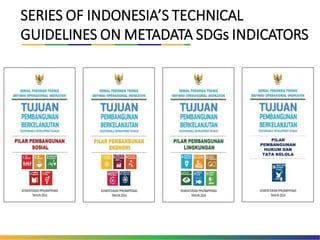
SERIES OF INDONESIA’S TECHNICAL
GUIDELINES ON METADATA SDGs INDICATORS
PILAR
PEMBANGUNAN
HUKUM DAN
TATA KELOLA
24
40
34
11
Social Pillar
Economic Pillar
Environment Pillar
Law & Governance
Pillar
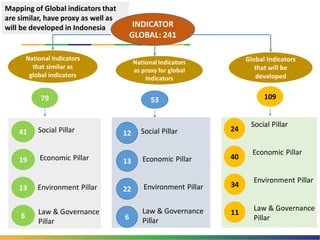
Mapping of Global indicators that
are similar, have proxy as well as
will be developed in Indonesia INDICATOR
GLOBAL: 241
National Indicators
that similar as
global indicators
79
13
6
41
19
Social Pillar
Economic Pillar
Environment Pillar
Law & Governance
Pillar
53
Global Indicators
that will be
developed
Pilar Hukum dan
Tata Kelola
22
6
12
13
Social Pillar
Economic Pillar
Environment Pillar
Law & Governance
Pillar
National Indicators
as proxy for global
Indicators
109
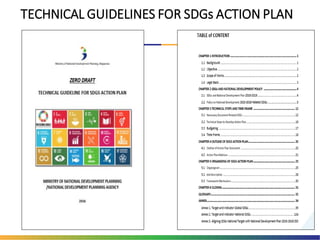
TECHNICAL GUIDELINES FOR SDGs ACTION PLAN
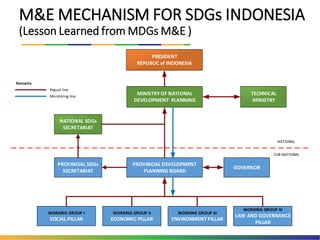
M&E MECHANISM FOR SDGs INDONESIA
(Lesson Learned from MDGs M&E )
MINISTRY OF NATIONAL
DEVELOPMENT PLANNING
WORKING GROUP I
SOCIAL PILLAR
WORKING GROUP II
ECONOMIC PILLAR
WORKING GROUP III
ENVIRONMENT PILLAR
WORKING GROUP IV
LAW AND GOVERNANCE
PILLAR
NATIONAL SDGs
SECRETARIAT
PROVINCIAL DEVELOPMENT
PLANNING BOARD
GOVERNOR
TECHNICAL
MINISTRY
PROVINCIAL SDGs
SECRETARIAT
PRESIDENT
REPUBLIC of INDONESIA
NATIONAL
SUB-NATIONAL
Report line
Monitoring line
Remarks:
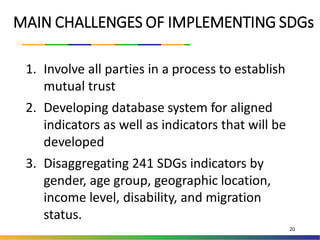
MAIN CHALLENGES OF IMPLEMENTING SDGs
1. Involve all parties in a process to establish
mutual trust
2. Developing database system for aligned
indicators as well as indicators that will be
developed
3. Disaggregating 241 SDGs indicators by
gender, age group, geographic location,
income level, disability, and migration
status.
20
THANK YOU
21

Integrating SDGs To Development Plan

  • 1.
    INTEGRATING SDGs TO DEVELOPMENTPLAN Gellwynn Yusuf Deputy Minister for Maritime and Natural Resources Bangkok, Thailand, 24-25 Oktober 2016 Ministry of National Development Planning/Bappenas Republic of Indonesia
  • 2.
    • Population: 260million (2015), projected 295 million (2030) • Geographic: Archipelagos, 17.000 islands • Economic Growth: +5% (2000- 2015) • Ʃ Provinces : 34 , Regencies: 416, Municipalities : 98, Villages: 75.244 • System of Governance: Democratic and Decentralized Since 1999 • Country Economic Status: Lower Middle Income Country 2 INDONESIA’S PROFILE
  • 3.
    TOWARDS THE NEWUN AGENDA 2030 UN SUMMIT on MDGs 2010 UN CONFERENCE on SUSTAINABLE DEVELOPMENT 2012 (RIO +20) 2015 NEW UN AGENDA The beginning of thought to formulate Post 2015 New Development Agenda The agreement of the document of “The Future We Want”
  • 4.
    MAINSTREAMING SUSTAINABLE DEVELOPMENTINTO INDONESIA’S DEVELOPMENT PLANNING & BUDGETING 4 SUSTAINABLEDEVELOPMENT Vision & Mission Regional Head IMPLEMENTATION PROGRAM Sub-National Development Plan (Mid Term & Annual) National Long Term Development Plan (RPJPN) National Development Plan (Mid Term & Annual) Vision & Mission President State Budget Document (APBN) Sub-National Budget Document (APBD)
  • 5.
    MDGs ACHIEVEMENTS Achievement Indonesiain 2015: Out of 8 Goals, 18 targets and 67 indicators of MDGs 18 Unfinished 49 Achieved
  • 6.
    1. Forest Cover 2.CO2 Emission 3. Rural drinking water 4. Affordable Sanitation 5. Urban slum area 1. Ratio of Export & Import to GDP 2. Internet Accessibility UNFINISHED AGENDA OF MDGs (among others:) 1.Poverty Eradication 2.Nutrition & Calorie Intake Maternal Mortality Rate HIV and AIDS Prevalence 6
  • 7.
    LESSONS LEARNED FROMMDGs 0 1 2 3 4 5 Disparities among provinces & districts/cities, and among social economic status Limited resources from state Insufficient database of the MDGs indicators Top-down from the government Inadequate communication strategy & advocacy Remaining unfinished agendas of MDGs
  • 8.
    FROM MDGs TOSDGs 2016-2030
  • 9.
    INDONESIA SDGs MILESTONES 1.RAISING AWARENESS 2. SERIAL MEETING WITH ALL STAKEHOLDERS 1. PRESIDENTIAL DECREE ON SDGs 2. TECHNICAL GUIDELINES SDGs ACTION PLAN 3. DISSEMINATION PREPARATION FOR SUB- NATIONAL SDGs ACTION PLAN 1. NATIONAL SDGS ROADMAP 2. NATIONAL AND SUB-NATIONAL SDGS ACTION PLAN 1. IMPLEMENTA TION 2. M&E AND REPORTING 2015 2016 2017 2017-2030
  • 10.
    RAISING AWARENESS FORSDGs a. Serial meetings at National and Sub-National level b. Partnership with Media c. Facilitation and capacity building to Sub-National level (Provinces, Districts) d. Establishment of Philanthropy and Business Forum e. Establishment of SDGs Center of Excellence at Universities f. Development of SDGs Website: www.sdgsindonesia.or.id
  • 11.
    GOVERNMENT AND PARLIAMENT ACADEMIA AND EXPERTS PHILANTHROPY AND BUSINESS CIVIL SOCIETY AND MEDIA SDGs IMPLEMENTATION • Target,Policy & Programs • Data, Indicators Development • Dissemination, Communication and Advocacy • Regulation and Budget • Monitoring, Evaluation and Reporting • Advocacy within Business Sector • Program Facilitation (Communications, Capacity Building, Funding collaborations) • Capacity Building • Evaluation • Policy Paper/Brief, input for Policy Formulation • Data and Indicators Development • Dissemination and Advocacy • Program Facilitation • Advocacy, Awareness and Capacity Building • Dissemination and Monitoring STAKEHOLDERS ENGAGEMENT
  • 12.
    PRESIDENTIAL DECREE FORNATIONAL SDGs COORDINATION TEAM 12
  • 13.
    4 PILLARS OFINDONESIAN SDGs SDGs 17 Goals, 169 Targets, 241 Indicators SOCIAL PILLAR 5 Goals, 47 Targets, 77 Indicators Goal 1: No Poverty; Goal 2: Zero Hunger; Goal 3: Good Health and Well-Being; Goal 4: Quality Education; Goal 5: Gender Equality; ECONOMIC PILLAR 5 Goals, 54 Targets, 72 Indicators Goal 7: Affordable and Clean Energy; Goal 8: Decent Work and Economic Growth; Goal 9: Industry, Innovation and Infrastructure; Goal 10: Reduced Inequalities; Goal 17: Partnerships for the Goals ENVIRONMENT PILLAR 6 Goals, 56 Targets, 69 Indicators Goal 6: Clean Water and Sanitation; Goal 11: Sustainable Cities and Communities Goal 12: Responsible Consumption and Production; Goal 13: Climate Action; Goal 14: Life Below Water; Goal 15: Life on Land; LAW & GOVERNANCE PILLAR 1 Goal, 12 Targets, 23 Indicators Goal 16: Peace, Justice and Strong Institutions,
  • 14.
    MAINSTREAMING OF SDGsINTO NATIONAL DEVELOPMENT AGENDA • Planning document of strategic steps to achieve SDGs 2016- 2030 SDGs Roadmap • Planning Document to achieve SDGs for National Level National Action Plan • Planning Document to achieve SDGs for Sub- national Level Sub-National Action Plan 14
  • 15.
    SDGs GLOBAL ANDNATIONAL TARGETS ALIGNMENT 15 PILLAR/GOAL #GLOBAL TARGET #NATIONAL TARGET NATIONAL PRIORITIES SOCIAL (1, 2, 3, 4, 5) 47 27 • Poverty eradication • Improved welfare • Enhanced Food Security • Implementation of Smart and Health Indonesia Program • Protection of Children, Women & Marginalized Groups ECONOMIC (7, 8, 9, 10, 17) 54 30 • Energy Security • Acceleration of Manufacturing Industry • Improved Labour Competitiveness • Building National Connectivity • Well-Balanced Development • Implementation of Free and Active Foreign Policy ENVIRONMENT (6, 11, 12, 13, 14, 15) 56 31 • Water Security • Housings and Residential Development • Climate Change Adaptation and Mitigation • Development of Marine-Based Economy • Protection of Natural Resources, Environment and Disaster Management • Conservation and Sustainable Use of Biodiversity LAW AND GOVERNANCE (16) 12 8 • Improved Quality Protection of Indonesia’s Citizens • Enhanced Law Enforcement • Foster Transparent and Accountable Government. TOTAL 169 96
  • 16.
    SERIES OF INDONESIA’STECHNICAL GUIDELINES ON METADATA SDGs INDICATORS PILAR PEMBANGUNAN HUKUM DAN TATA KELOLA
  • 17.
    24 40 34 11 Social Pillar Economic Pillar EnvironmentPillar Law & Governance Pillar Mapping of Global indicators that are similar, have proxy as well as will be developed in Indonesia INDICATOR GLOBAL: 241 National Indicators that similar as global indicators 79 13 6 41 19 Social Pillar Economic Pillar Environment Pillar Law & Governance Pillar 53 Global Indicators that will be developed Pilar Hukum dan Tata Kelola 22 6 12 13 Social Pillar Economic Pillar Environment Pillar Law & Governance Pillar National Indicators as proxy for global Indicators 109
  • 18.
    TECHNICAL GUIDELINES FORSDGs ACTION PLAN
  • 19.
    M&E MECHANISM FORSDGs INDONESIA (Lesson Learned from MDGs M&E ) MINISTRY OF NATIONAL DEVELOPMENT PLANNING WORKING GROUP I SOCIAL PILLAR WORKING GROUP II ECONOMIC PILLAR WORKING GROUP III ENVIRONMENT PILLAR WORKING GROUP IV LAW AND GOVERNANCE PILLAR NATIONAL SDGs SECRETARIAT PROVINCIAL DEVELOPMENT PLANNING BOARD GOVERNOR TECHNICAL MINISTRY PROVINCIAL SDGs SECRETARIAT PRESIDENT REPUBLIC of INDONESIA NATIONAL SUB-NATIONAL Report line Monitoring line Remarks:
  • 20.
    MAIN CHALLENGES OFIMPLEMENTING SDGs 1. Involve all parties in a process to establish mutual trust 2. Developing database system for aligned indicators as well as indicators that will be developed 3. Disaggregating 241 SDGs indicators by gender, age group, geographic location, income level, disability, and migration status. 20
  • 21.